Renewable energy growing at a fast pace, China and India leading the way.

Growth in renewable energy is set to hit an all-time record this year, but is still falling “well short” of what is necessary to slash planet-warming emissions, according to the International Energy Agency. The energy watchdog estimates that around 290 gigawatts (GW) of renewable energy capacity came online around the world in 2021 — enough electricity for approximately 200 million average US homes — according to a report published Wednesday.
By 2026, the agency predicts global renewable capacity will rise more than 60% from 2020 levels, an amount equivalent to the current total global power capacity of fossil fuels and nuclear combined, it said.
But to reach net-zero emissions by 2050, a goal many nations have set, renewables need a far bigger push. The current pace is being driven by China, which the agency says remains the global leader in renewable energy growth. The country is expected to reach 1200 GW of total wind and solar
capacity in 2026, four years sooner than its target date. Renewables are also being rapidly embraced in India, where they are projected to double new installations this year, in comparison to 2015-2020.
FT 1st Dec 2021
https://www.ft.com/content/317424af-a559-4598-a4df-5fe7c9fff947
Design flaw: the incident that shut down China’s EPR nuclear station could happen to other EPR reactors.

| The type of incident that caused a reactor shutdown at Taishan plant could happen to other plants. The incident in the Chinese reactor last June is believed to be due to a design flaw in the reactor vessel. The incident which led in July to the shutdown of a reactor at the EPR nuclear power plant in Taishan (China) is believed to be due to a fault in the design of the vessel, the Independent Research and Information Commission said on Saturday (November 27th) on radioactivity (CRIIRAD) which warns against the risk of an identical problem on other EPRs. An association created in the aftermath of the Chernobyl disaster, CRIIRAD wrote on Saturday to the management of the Nuclear Safety Authority (ASN) to share this information with it, which it says it has from a “whistleblower”. “This is a French person who works in the nuclear industry, having access to very precise technical information on the situation of the Taishan 1 reactor core,” said Bruno Chareyron, director of the CRIIRAD laboratory. Sud Ouest 28th Nov 2021 https://www.sudouest.fr/nucleaire-le-type-d-incident-qui-a-provoque-l-arret-de-l-epr-de-taishan-pourrait-arriver-a-d-autres-centrales-7148273.php |
Design flaw could explain problem at EDF’s Chinese nuclear plant
Design flaw could explain problem at EDF’s Chinese nuclear plant-NGO https://www.reuters.com/markets/commodities/design-flaw-could-explain-problem-edfs-chinese-nuclear-plant-ngo-2021-11-29/Reuters PARIS, Nov 29 (Reuters) – A design flaw in the reactor pressure vessel could be the cause of a problem that was made public in June at French company EDF’s jointly-owned nuclear power plant in China, a French non-governmental organisation said, quoting a whistleblower.
France’s Foreign Minister in Indonesia, raises concerns about AUKUS, nuclear submarines, and risks of weapons proliferation.
the theme of ‘betrayal’ in terms of both being ‘cheated’ out of a deal and being deceived by NATO allies and, in Australia’s case, a historical ally.

AUKUS was about ‘pressing a sense of confrontation with China’
if tomorrow Australia has some nuclear-powered submarines, why not, some other countries could ask for similar technology, it could be Indonesia, why not?’
Australia needs an entente cordiale with Indonesia over nuclear propulsion and non-proliferation, The Strategist, 29 Nov 2021, |David Engel However relaxed and comfortable Indonesian Defence Minister Prabowo Subianto might be about Australia’s plans to acquire nuclear-powered submarines (SSNs), the visit to Jakarta of French Foreign Minister Jean-Yves Le Drian has probably validated the very different view of Le Drian’s counterpart, Retno Marsudi.
……………………………………………. the most striking moment of the visit came during Le Drian’s address to Indonesia’s leading international affairs think tank, the Centre for Strategic and International Studies (CSIS). While his speech focused on issues such as multilateralism and the EU’s position on the Indo-Pacific, his response to a question on ‘minilateralism’—specifically, AUKUS and the Quad—took on a very different tone.
Ignoring the Quad, he levelled his remarks at AUKUS, stressing four points. The first two reiterated the theme of ‘betrayal’ in terms of both being ‘cheated’ out of a deal and being deceived by NATO allies and, in Australia’s case, a historical ally. He talked about American efforts to restore trust through various US commitments to France. He didn’t mention Australia in this context.
More significantly, his third point was that AUKUS was about ‘pressing a sense of confrontation with China’ (as the simultaneous translation put it). He said that, while France was not oblivious to China’s military threats and risks, he believed that the best way to respond to these threats was to ‘develop an alternative model rather than to first of all oppose’.
Perhaps his most significant point for Australian interests was his fourth, which went to the transfer of nuclear technology for submarine propulsion. He pointed out that until now no nuclear-weapon state had done this. But ‘if tomorrow Australia has some nuclear-powered submarines, why not, some other countries could ask for similar technology, it could be Indonesia, why not?’ He continued that, even though this technology was not covered by the Nuclear Non-Proliferation Treaty (NPT), the risk the arrangement posed of starting a trend was nonetheless of concern.
Irrespective of Le Drian’s intentions in answering the question in this manner—and it’s noteworthy that he didn’t cover AUKUS in his formal address—he would surely have known that his words would resonate powerfully with his audience, both at CSIS and more generally among Indonesia’s foreign policy establishment. While his depiction of Australia as duplicitous was evidently personal and heartfelt, it would also have struck a chord with those Indonesians who have characterised Canberra the same way over such issues as East Timor, Papua and spying allegations, irrespective of how justified that judgement might be.
Le Drian’s last point went directly to concerns about nuclear proliferation—issues that Indonesia highlighted in its official statement on AUKUS and the planned submarines. It corresponds closely ‘in spirit’ with subsequent official commentary to the effect that Indonesia was considering advocating a change to the NPT aimed at preventing non-nuclear-weapon states from acquiring SSNs………
whoever governs in Canberra now and into the future should at least make a priority of assuaging Jakarta’s worries on this subject, however overstated and unbalanced they are. While Indonesia’s prospects of changing the NPT and precluding Australia from having SSNs look remote at best—not least because several of its ASEAN colleagues do not share its views of Australia’s ambitions—the sooner the two countries can put this latest irritant to rest the better.
In the circumstances, the onus for doing so must primarily rest with Canberra………https://www.aspistrategist.org.au/australia-needs-an-entente-cordiale-with-indonesia-over-nuclear-propulsion-and-non-proliferation/
China puts forward proposals as Iran nuclear talks resume
China puts forward four proposals as Iran nuclear talks resumeCGTN China welcomes the resumption of talks about the Iran nuclear deal and has made four proposals in the hope of pushing forward the negotiation process, Chinese Foreign Ministry spokesperson Wang Wenbin told reporters on Monday…….
Reiterating China’s support for a diplomatic settlement, Wang put forward four proposals.
First, the U.S. is the initiator of the Iran nuclear crisis, Wang said, urging the U.S. to lift sanctions against Iran and third-party entities and individuals. On this basis, Iran should fully resume its nuclear commitments. Neither party should impose any other conditions for this, Wang said.
Second, all parties should respect each other’s legitimate rights and concerns, Wang said, calling on relevant parties to uphold the principle of mutual respect and win-win cooperation so as to promote regional peace and stability.
| The legitimate rights and interests of parties involved in economic and trade cooperation with Iran should be respected, added Wang.Third, the spokesperson called for a pragmatic and flexible negotiation strategy and encouraged all parties to use their political wisdom and settle the issue through equal consultation.China supports pushing forward the negotiation based on the previous consensuses, he noted.Fourth, Wang stressed that all parties should stay committed to a political settlement of the issue, and stay restrained and rational to maintain the negotiation process……. https://news.cgtn.com/news/2021-11-29/China-puts-forward-four-proposals-as-Iran-nuclear-talks-resume-15ADhfujpqE/index.html |
Tepco to repair Fukushima nuclear station’s partially melted protective ice wall.

Ice Wall to Halt Groundwater Flow at Japan’s Fukushima Nuclear Plant to Be Repaired https://thewire.in/world/ice-wall-to-halt-groundwater-flow-at-japans-fukushima-nuclear-plant-to-be-repaired
Tokyo Electric Power Co (Tepco) will launch remedial works at the stricken plant after ice wall tests indicated partial melting. Tokyo: Tokyo Electric Power Co (Tepco) will launch remedial works at the stricken Fukushima Daiichi nuclear plant to strengthen an ice wall intended to halt the flow of groundwater after testing indicated partial melting.
The work could begin as early as the start of December, according to a presentation from the plant operator dated Thursday, part of a costly and troubled effort to secure the site following the 2011 earthquake and tsunami.
The ice wall is intended to limit the seepage of groundwater into the plant, which has created large amounts of toxic water being stored by Tepco in tanks.
Japan plans to release more than 1 million tonnes of water into the sea after treating it. The water contains the radioactive isotope tritium, which cannot be removed.
China calls on the Association of Southeast Asian Nations (ASEAN) to make Southeast Asia a nuclear-weapons-free zone
China pushes for nuclear-weapon-free Southeast Asia, KhmerTimes, Aandolu Agency ISTANBUL 22 Nov 1 – China on Monday said it is ready to work with the members of the Association of Southeast Asian Nations (ASEAN) towards a nuclear-weapon-free region besides ensuring stability in the disputed South China Sea.
“China supports ASEAN’s efforts to build a nuclear-weapon-free zone, and is prepared to sign the Protocol to the Treaty on the Southeast Asia Nuclear-Weapon-Free Zone as early as possible,” President Xi Jinping told the China-Asia summit marking 30 years of the relations between two sides.
Beijing’s demand for a nuclear-free Southeast Asia comes as the US and UK empower their ally Australia with nuclear-armed submarines under a deal called AUKUS signed in September………..
The bilateral trade between China and ASEAN has skyrocketed by 85 times to $684.6 billion in 2020 from less than $8 billion in 1991, making the two sides each other’s largest trading partners. https://www.khmertimeskh.com/50975461/china-pushes-for-nuclear-weapon-free-southeast-asia/
Japan’s nuclear regulator inspecting seismic risks at Shika nuclear power station.
NRA looking into fault risks at nuclear plant https://www3.nhk.or.jp/nhkworld/en/news/20211118_26/ Japan’s nuclear regulator is inspecting the Shika nuclear power plant on the Sea of Japan coast to determine whether a fault beneath a reactor building is active.
The two-day inspection by the Nuclear Regulation Authority began at the plant in Ishikawa Prefecture on Thursday with 14 NRA experts taking part.
They went into a ditch dug for the survey, observed cross sections of geological strata and touched soil walls to confirm the layers’ conditions near faults.
Hokuriku Electric Power Company, which operates the plant, applied for screenings of the Number 2 reactor, which has been offline since 2011.
The NRA launched the screenings in 2014 with a focus on whether 10 faults at the plant, including one beneath the building that houses the Number 2 reactor, are active. In 2016, a panel of the authority said it could not deny that some of the faults could move.
In response, the firm insisted that the faults are not active, citing new data on constituents of mineral samples collected from the faults.
New guidelines for nuclear safety do not allow operators to build important facilities such as reactor buildings above active faults that could move.
If the fault beneath the Number 2 reactor is found to be active, operation of the facility cannot resume and it may eventually be dismantled.
The experts are expected to confirm on Friday the length of an active fault that runs near the complex.
Japanese municipalities are finding resistance to hosting nuclear waste dump, despite substantial government bribes.
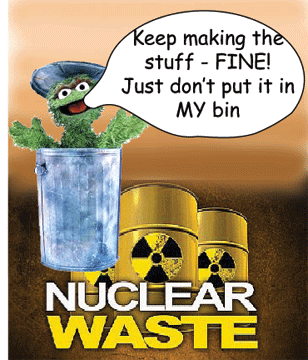
The two municipalities are meeting strong resistance from residents and nearby local governments.
Since Suttsu and Kamoenai expressed their willingness to accept the first-stage survey, the assemblies of some nearby municipalities have enacted ordinances declaring a rejection of nuclear waste and their governments have declined state grants related to the survey.
One year on, outlook for nuclear waste storage unclear Japan Times, 17 Nov 21, The outlook for the possible hosting of a final storage facility for nuclear waste in two Hokkaido municipalities remains uncertain, with Wednesday marking one year since a first-stage survey for the site’s selection started there, for the first time in Japan.
The town of Suttsu, along with the nearby village of Kamoenai, is undergoing the first-stage survey, known as literature investigation, to check whether it is suited to host a permanent underground storage site for high-level radioactive waste from nuclear power plants across the country.
The two municipalities are meeting strong resistance from residents and nearby local governments.
The government is seeking a location for the dump site, which will hold nuclear waste, or the remnants of spent nuclear fuel that has been treated, for a long period said to extend for 100,000 years.
The literature investigation, conducted by the Nuclear Waste Management Organization of Japan, or NUMO, will take about two years to confirm that there is no volcanic activity or active faults in the area by reviewing geological literature and data. The first-stage survey does not involve drilling.
Up to ¥2 billion in subsidies from the state will be paid to each location, as well as surrounding municipalities, for the first-stage investigation. The two municipalities plan to use the grants to set up regional revitalization funds.
Suttsu held a mayoral election last month in which the survey became a central topic of debate. Incumbent Mayor Haruo Kataoka, who decided to accept the first-stage research a year ago in line with what he felt was the will of the residents, won re-election.
However, his opponent, who called for a halt to the survey, gained about 80% of Kataoka’s vote count, suggesting that public opinion is still split.
The town government will decide whether to proceed to the second stage of the survey, called preliminary investigation, in a referendum.
Since Suttsu and Kamoenai expressed their willingness to accept the first-stage survey, the assemblies of some nearby municipalities have enacted ordinances declaring a rejection of nuclear waste and their governments have declined state grants related to the survey.
Suttsu and Kamoenai initially planned to have monthly opportunities for residents to exchange opinions on the issue, but the novel coronavirus crisis has limited such sessions to four each so far. The second-stage survey requires the consent of not only the municipal mayors, but also of Hokkaido Gov. Naomichi Suzuki, who is opposed to the investigation on the grounds that a prefectural ordinance rejects nuclear waste being brought to the prefecture.
No North Korea nuclear, ICBM tests for the time being
Unification minister predicts no North Korea nuclear, ICBM test ‘for time being’South Korea’s Lee In-young also frames end-of-war declaration as starting point for denuclearization, NK news Jeongmin Kim November 17, 2021 North Korea is unlikely to test any nuclear weapons or long-range missiles in the immediate future, South Korea’s Minister of Unification Lee In-young said on Wednesday, as the country’s March 2022 presidential election fast approaches.
Speaking at an international symposium in Busan, South Korea’s second-largest city, Lee also once again pitched the idea of formally ending the Korean War, an initiative that the Moon Jae-in administration continues to push in its last months in office.
“North Korea is testing short-range missiles [these days] but it appears that there is a high possibility that it won’t test nuclear weapons or long-range missiles — as known as ‘strategic provocation’ — for the time being,” Lee said, without providing further explanation.
North Korea last tested an intercontinental ballistic missile (ICBM) in Nov. 2017, and its sixth and last nuclear test was in September that year. Leader Kim Jong Un announced a self-imposed moratorium on weapons of mass destruction (WMD) tests the following year, but he has made ambiguous remarks about whether to continue the test ban over the past two years.
Lee on Wednesday remained hopeful that inter-Korean relations will improve, alluding to “possibilities of step-by-step, simultaneous corresponding measures” by Washington should North Korea make progress in denuclearization steps……..
“Denuclearization and the completion of a peace regime [on the Korean Peninsula] will need a lot of time … but the end-of-war declaration could become a formal starting point for such a process,” he said. https://www.nknews.org/2021/11/unification-minister-predicts-no-north-korea-nuclear-icbm-test-for-time-being/
N. Korea replaces, punishes 14 cadres and technicians working on nuclear-powered submarine programThe Central Committee criticized the technicians for failing to follow party policy to “localize” production
N. Korea replaces, punishes 14 cadres and technicians working on nuclear-powered submarine program
The Central Committee criticized the technicians for failing to follow party policy to “localize” production https://www.dailynk.com/english/north-korea-replaces-punishes-14-cadres-and-technicians-working-on-nuclear-powered-submarine-program/ By Jeong Tae Joo – 2021.11.15
North Korea recently replaced or punished 14 cadres and technicians tasked with designing small nuclear reactors for nuclear-powered submarines, apparently for failing to meet party criterion. The authorities will likely now face difficulties in their plan to acquire the capability of stealthily striking enemies.
According to multiple Daily NK sources in North Korea on Thursday, the Central Committee’s Military Industries Department began screening designs for nuclear-powered submarines on Nov. 5.
Work on the designs has been ongoing since October of last year.
North Korean leader Kim Jong Un said during the Eighth Party Congress in January that “new planning research for a nuclear-powered submarine has been completed and is to enter the final examination process.”
Nuclear-powered submarines are highly stealthy as they need not surface for long periods of time, making them the most likely weapon to survive an enemy’s preemptive strike.
Focusing on advancing the country’s arsenal of asymmetrical strategic weapons, North Korea has assigned its top researchers to the project.
In particular, the authorities reportedly put experts on the task of producing small nuclear reactors, the key to building the submarines, imploring them to “exercise their top abilities, given their rich experience built up over six nuclear tests.”
However, the Central Committee apparently criticized the screening report, which included analysis of design flaws.
Firstly, the Central Committee reportedly said it would “take 10 more years” to build nuclear-powered submarines according to current designs, even though the goal is to complete them by 2025.
The Central Committee also criticized the designs for failing to meet three criteria put forth by the party to achieve its goals.
Though party leadership had stressed 1) improving the capabilities of conventionally powered mini-submarines that are currently deployed, 2) building a new class of submarines capable of carrying North Korea’s existing SLBMs and 3) building nuclear-powered submarines capable of carrying several nuclear launch systems, the Central Committee reportedly judged that these criteria had not been met on the ground.
The Central Committee also criticized technicians for failing to follow party policy to “localize” production. That is to say, the committee took serious issue with designers handing over for final screening a complete comprehensive blueprint that called for large-scale imports of foreign technology and parts during the entire shipbuilding process.
Several basic errors were discovered as well, including a failure by designers to make the technical descriptions in the partial plans and assembly plans match when they drew the blueprints for the small nuclear reactors.
The Central Committee responded by excluding from the research team 14 cadres, researchers and technicians who took part in drawing up the plan. Six of them were kicked out of the party or disciplined.
One of the sources said the six who took responsibility for the failure were exiled with their families to remote areas. He added that the authorities now face snags in their plans, including the need to completely revise the designs for nuclear-powered submarines.
U. N. nuclear agency team to review plans for release of Fukushima water
U. N. nuclear agency team to review plans for release of Fukushima water, The Hindu, AP TOKYO:, NOVEMBER 15, 2021
The experts from IAEA are to meet with Japanese officials and visit the Fukushima Daiichi plant to discuss technical details of the planned release, Japanese officials said.
A team from the U.N. nuclear agency arrived in Japan on Monday to assess preparations for the release into the ocean of treated radioactive water from the wrecked Fukushima nuclear plant.
The experts on the team from the International Atomic Energy Agency (IAEA) are to meet with Japanese officials and visit the Fukushima Daiichi plant to discuss technical details of the planned release, Japanese officials said.
The government and the plant’s operator, Tokyo Electric Power Company (TEPCO) Holdings, announced plans in April to start gradually releasing the treated radioactive water in the spring of 2023 to allow the removal of hundreds of storage tanks to make room for facilities needed for the destroyed plant’s decommissioning.
The plan has been fiercely opposed by fishermen, local residents and Japan’s neighbours, including China and South Korea.
Japan has requested assistance from the IAEA to ensure the discharge meets international safety standards and to gain the understanding of the international community. A larger 11-member IAEA mission is expected next month.
Japanese Economy and Industry Minister Koichi Hagiuda pledged last week that Japan will explain the outcome of the IAEA reviews to the international community “in a courteous and transparent manner.” A separate IAEA taskforce on water testing earlier collected fish samples from the Fukushima coast as part of a routine review along with technical assistance for the plant’s decommissioning. The team included an expert from South Korea…………https://www.thehindu.com/news/international/u-n-nuclear-agency-team-to-review-plans-for-release-of-fukushima-water/article37498602.ece
Japan’s PM Kishida resolved to achieve nuclear-free world
Kishida resolved to achieve nuclear-free world, https://www.japantimes.co.jp/news/2021/11/15/national/kishida-un-disarmament-chief/ Prime Minister Fumio Kishida on Monday voiced his commitment to leading efforts to realize a world free of nuclear weapons in a meeting with the U.N. disarmament chief, ahead of next year’s U.N. conference on nuclear nonproliferation.
In a 15-minute meeting in Tokyo with Izumi Nakamitsu, U.N. undersecretary general and high representative for disarmament affairs, the two agreed on the importance of meaningful results at the review conference on the Nuclear Non-Proliferation Treaty, to be held in New York from Jan. 4 to 28, according to the Foreign Ministry.
As the leader of the only country to have suffered atomic bombings, in Hiroshima and Nagasaki in 1945, Kishida voiced his “determination to lead international efforts to realize a world without nuclear weapons” during the meeting, the ministry said. The prime minister’s family hails from Hiroshima Prefecture and he represents a constituency in the prefecture.
Nakamitsu expressed hope Japan will play a proactive role as a bridge between nations with differing stances.
Nakamitsu also met with Foreign Minister Yoshimasa Hayashi later in the day and invited him to attend the NPT review conference. Hayashi told her that “as the only country in the world to have suffered wartime atomic bombings, Japan has a very important responsibility” to push forward nuclear disarmament.
China and Saudi Arabia blocking progress towards a deal at COP26
China and Saudi Arabia are blocking progress towards a deal at Cop26 by
refusing to accept that they must be fully transparent about their
greenhouse gas emissions. Senior negotiators at the climate change
conference in Glasgow said that both countries had objected to proposed
reporting requirements aimed at resolving concerns that some nations
conceal the extent of their emissions.
The dispute is delaying progress on
other ingredients of a deal, including rules on establishing a global
market for carbon offsetting. China is understood to object because its
climate target is based on a reduction in emissions per unit of GDP,
meaning that full transparency would reveal data it wants to keep secret
about its economic growth.
Saudi Arabia’s emissions are strongly
influenced by its biggest company, the oil giant Saudi Aramco, and it is
thought to be concerned about revealing information about its performance.
China and Saudi Arabia are also objecting to proposed wording in the final
text that emphasises the need to limit warming to 1.5C, meaning the coal
and oil on which they depend would have to be phased out more quickly.
Times 9th Nov 2021
https://www.thetimes.co.uk/article/chinese-and-saudis-thwart-moves-towards-climate-deal-5pr86frjv
Taiwan’s referendum about unsealing nuclear power plant: but safety risks persist
Yes’ vote will unseal nuclear plant: premier, Taipei Times, 10 Nov 21, By Chien Hui-ju and Kayleigh Madjar / Staff reporter, with staff writer and CNA
- The Fourth Nuclear Power Plant would be unsealed if people vote in favor of its activation in a referendum next month, Premier Su Tseng-chang (蘇貞昌) said yesterday, although one of his ministers earlier said that nuclear power is not an answer to Taiwan’s energy challenges.
- Provisions of the Referendum Act (公民投票法) stipulate that the plant in New Taipei City’s Gongliao District (貢寮) — which has lain dormant since 2015, when it was mothballed by then-president Ma Ying-jeou (馬英九) — must be unsealed if enough people vote that way on Dec. 18.Launched by nuclear power advocate Huang Shih-hsiu (黃士修), referendum No. 17 — one of four referendums to be voted on — asks: “Do you agree that the Fourth Nuclear Power Plant should be unsealed and operated commercially to generate electricity?”
A possible start of the plant has worried people in the area, Su said at the legislature in Taipei, citing feedback from Yilan County.
The plant was sealed by Ma after public opposition rose due to perceived safety risks at the nearly completed facility.
However, Minister of Economic Affairs Wang Mei-hua (王美花) told reporters before the legislative session that anyone who understands the safety concerns and related problems at the plant would know that activation “is not an option.”
Responding to a comment by Huang that Japan’s Kyushu Electric Power restarted a reactor late last year, despite earthquake and volcano concerns, Wang said that every plant is different.
- Taiwan has its own set of circumstances that it must consider, for instance a geological survey after it was built found that the Fourth Nuclear Power Plant is in a fault zone, she said, adding that it has operational problems with its No. 1 generator, which has not passed inspections.
- Activation of the plant would take more than 10 years, she said, citing evaluations from the Atomic Energy Council.All professional decisions on the matter are in the hands of the council, she said.There would be many issues to work through before the facility could generate power were the vote to succeed, including new construction contracts, as well as fixing outdated equipment and interface integration issues, she said.The Democratic Progressive Party is intent on phasing out nuclear power by 2025, and Taiwan’s dependence on such energy has fallen significantly from more than 50 percent in 1985 to only 12.7 percent last year, Taiwan Power Co data showed……… https://www.taipeitimes.com/News/taiwan/archives/2021/11/10/2003767647
1 This Month



26 September – International Day for the Total Elimination of Nuclear Weapons


PLEASE OPPOSE HR 8255 AND S.3639 – bills would accelerate satellite deployment, with no environmental review or safeguards – https://ncstd5li.quorum.us/campaign/169331/
To see nuclear-related stories in greater depth and intensity – go to https://nuclearinformation.wordpress.com
-
Archives
- September 2026 (245)
- August 2026 (330)
- July 2026 (355)
- June 2026 (287)
- May 2026 (306)
- April 2026 (356)
- March 2026 (251)
- February 2026 (267)
- January 2026 (308)
- December 2025 (358)
- November 2025 (359)
- October 2025 (375)
-
Categories
- 1
- 1 NUCLEAR ISSUES
- business and costs
- climate change
- culture and arts
- ENERGY
- environment
- health
- history
- indigenous issues
- Legal
- marketing of nuclear
- media
- opposition to nuclear
- PERSONAL STORIES
- politics
- politics international
- Religion and ethics
- safety
- secrets,lies and civil liberties
- spinbuster
- technology
- Uranium
- wastes
- weapons and war
- Women
- 2 WORLD
- ACTION
- AFRICA
- Atrocities
- AUSTRALIA
- Christina's notes
- Christina's themes
- culture and arts
- Events
- Fuk 2022
- Fuk 2023
- Fukushima 2017
- Fukushima 2018
- fukushima 2019
- Fukushima 2020
- Fukushima 2021
- general
- global warming
- Humour (God we need it)
- Nuclear
- RARE EARTHS
- Reference
- resources – print
- Resources -audiovicual
- Weekly Newsletter
- World
- World Nuclear
- YouTube
-
RSS
Entries RSS
Comments RSS
 nuclear-news