Pakistan Reaffirms Pledge To Nuclear Non-Proliferation Goals
Eurasia Review , By Sher Bano
1540 Support Unit of Office for Disarmament Affairs (UNODA) hosted a side event entitled “Regional Approaches to Supporting UNSCR 1540 (2004)” on 1st June, 2022. UNSCR 1540 came in 2004 as a response to the threats of WMDs, non-proliferation and terrorism that emerged in 21st century. ……………………….
Pakistan conveyed its consistent view during the general debate that the international instruments and standards that are designed to address the threats to international security and peace posed by WMDs must be developed through multilateral and inclusive negotiations. Pakistan being a responsible nuclear state and member of the Security Council has being fulfilling its obligations under the resolution 1540 in order to strengthen the global framework for the non-proliferation of biological, nuclear and radiological weapons to the non-state actors. …………………….
Pakistan also seeks a non-discriminatory global regime on non-proliferation that is principle-based, inclusive and underpinned by the cardinal principle of equal and undiminished security for all states. Genuine progress on disarmament necessitates a conducive regional and global security environment as well as the resolution of long-standing disputes and conflicts. https://www.eurasiareview.com/01072022-pakistan-reaffirms-pledge-to-nuclear-non-proliferation-goals-oped/
 | |||
|
| |||
|
Japan has approved restarts of 10 nuclear reactors, but only 4 actually in operation
As of June 2022, 10 nuclear reactors at six power stations have been given
the go-ahead to restart in Japan but only 4 reactors are currently in
operation. Despite local governments agreeing to restart the reactors, some
have not yet become operational due to the time required to implement
safety measures and complete other construction work.
Nippon 29th June 2022
Britain to lift restrictions on food from Fukushima
Food from Fukushima will be freely available in the UK from Wednesday,
weeks after Boris Johnson snacked on popcorn from the Japanese prefecture
hit by a triple nuclear meltdown in March 2011. Britain restricted
Fukushima imports after the disaster, the world’s worst nuclear accident
since Chernobyl, but has gradually lifted them, even as other countries
limit or ban produce from the region. Johnson confirmed that the remaining
restrictions would end on Wednesday in a meeting the previous day with the
Japanese prime minister, Fumio Kishida, on the fringes of the G7 summit in
Germany. Johnson told Kishida that UK-Japan relations were going from
“strength to strength”.
Guardian 29th June 2022
Japan to Give Plutonium from Spent Fuel to France

June 21, 2022
Tokyo, June 21 (Jiji Press)–The Japan Atomic Energy Agency will give France plutonium extracted from spent nuclear fuel from its Fugen advanced converter reactor, officials have said.
The agency will conclude a contract with a French nuclear company this month at the earliest, according to the officials.
The French side is expected to reprocess the spent nuclear fuel from the reactor, which is in the decommissioning process, in the central Japan prefecture of Fukui.
On Wednesday, the Japanese and French governments exchanged notes on the transportation and reprocessing of spent nuclear fuel and the return of high-level radioactive waste to Japan.
The two sides agreed to start the removal of 731 spent nuclear fuel assemblies from Fugen in April 2023 and complete the work by the end of March 2027.
120 High School Students Connect Voices for Nuclear Abolition Video Produced by Masaharu Fukuyama Released

June 15, 2022
On March 15, a video of the “Peace Book Relay,” in which approximately 120 high school students from Japan and abroad send messages for the abolition of nuclear weapons to the music of Masaharu Fukuyama, 53, a singer from Nagasaki City, was released on the Internet. Mr. Fukuyama produced and directed the video. The video can be viewed on the website of the Nagasaki Camphor Tree Project (https://nagasaki.kusunoki-project.jp/page/), for which Mr. Fukuyama serves as general producer, and on the Nagasaki City official channel on the video-sharing website “You Tube.
The video is about 15 minutes long, and features “High School Peace Ambassadors” from 16 prefectures and high school students from Hawaii, Russia, and South Korea holding up their wishes for nuclear abolition in sketchbooks and other media in a relay format, with background music provided by Mr. Fukuyama’s songs “Camphor Tree,” “That’s All There is” and “Ammonite’s Dream.
https://mainichi.jp/articles/20220615/k00/00m/040/110000c?fbclid=IwAR3O6lOIU9ZFHdGss7fZkIRMtr2gb2hgiPRnNgjpEg0mSG-BPavTGSZFJzU
Japan to Give Plutonium from Spent Fuel to France, – (but the high level wastes must be returned to Japan)
https://www.nippon.com/en/news/yjj2022062000945/japan-to-give-plutonium-from-spent-fuel-to-france.html Tokyo, June 21 (Jiji Press)–The Japan Atomic Energy Agency will give France plutonium extracted from spent nuclear fuel from its Fugen advanced converter reactor, officials have said.
The agency will conclude a contract with a French nuclear company this month at the earliest, according to the officials.
The French side is expected to reprocess the spent nuclear fuel from the reactor, which is in the decommissioning process, in the central Japan prefecture of Fukui.
On Wednesday, the Japanese and French governments exchanged notes on the transportation and reprocessing of spent nuclear fuel and the return of high-level radioactive waste to Japan.
The two sides agreed to start the removal of 731 spent nuclear fuel assemblies from Fugen in April 2023 and complete the work by the end of March 2027.
Apprehension in Japan, about the idea of getting nuclear-powered submarines.
Kishida cautious about Japan acquiring nuclear-powered sub Nikkei Asia, June 19, 2022
Natsuo Yamaguchi, head of the LDP’s junior coalition partner Komeito, echoed Kishida’s view, calling the idea of a nuclear-powered submarine “unrealistic.”
Ichiro Matsui, leader of the Japan Innovation Party, and Yuichiro Tamaki, head of the Democratic Party for the People, called for acquisition of a nuclear-powered submarine to boost deterrence and reconnaissance capacity……….
The main opposition Constitutional Democratic Party of Japan’s leader Kenta Izumi was against acquiring a nuclear-powered submarine, saying the country’s defenses “won’t get stronger simply because some deluxe equipment is added.”………………. https://asia.nikkei.com/Politics/International-relations/Indo-Pacific/Kishida-cautious-about-Japan-acquiring-nuclear-powered-subs
Court rules Japanese government not responsible for Fukushima nuclear disaster damage
ABC News18 June 22
Key points:
- The nuclear disaster, caused by a tsunami striking the Fukushima Daiichi power plant, forced hundreds of thousands of people from their homes
- The ruling in the government’s favour may set a precedent for future cases
- The company Tepco were forced to pay damages to about 3,700 people in March K
Japan’s government is not liable for damages demanded by people whose lives were devastated by the Fukushima nuclear disaster, the country’s top court said on Friday, the first such ruling in a series of similar cases.
The ruling’s effect as a precedent will be closely watched, local media said……………… https://www.abc.net.au/news/2022-06-17/japan-government-not-responsible-for-nuclear-damage-court/101163670
Japan gov’t to skip 1st U.N. nuclear ban meeting next week
KYODO NEWS 15 June 22, – Japan will not join the first meeting of parties to a U.N. treaty banning nuclear weapons to be held in Vienna next week, Prime Minister Fumio Kishida said Wednesday, despite high expectations for its attendance as the only nation that has suffered atomic bombings.
Japan, which has not signed the Treaty on the Prohibition of Nuclear Weapons, did not complete the procedures for taking part in the three-day meeting, including as an observer, by the Tuesday deadline.
Survivors of the U.S. atomic bombings of Hiroshima and Nagasaki in August 1945, as well as member nations of the U.N. treaty, had hoped that the Japanese government would participate in the gathering that kicks off next Tuesday………………. https://english.kyodonews.net/news/2022/06/740ac3501176-japan-govt-to-skip-1st-un-nuclear-ban-meeting-next-week.html
Ukraine war – good chance for France to sell nuclear reactors to India, replacing deal with Russia.
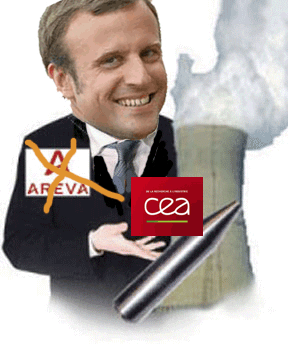
Supply of six nuclear reactors: Question mark on Russia inputs, India evaluates French push at Jaitapur https://indianexpress.com/article/india/supply-of-six-nuclear-reactors-question-mark-on-russia-inputs-india-evaluates-french-push-at-jaitapur-7966435/
The Department of Atomic Energy is actively examining a binding techno-commercial offer submitted by the French state-owned power company to help build six third-generation EPR reactors at Jaitapur in Maharashtra.
by Mihir Mishra , Anil Sasi June 13, 2022
Amid mounting uncertainties over the civil nuclear partnership with Russia in the wake of the Ukraine war, there are indications of fresh progress on the much-delayed deal with French power utility EDF for the supply of six EPR (European Pressurised Water Reactors) nuclear reactors.
The Department of Atomic Energy is actively examining a binding techno-commercial offer submitted by the French state-owned power company to help build six third-generation EPR reactors at Jaitapur in Maharashtra.
A high-level team from EDF was here late last month.
New Delhi had accorded an “in-principle” approval of the site at Jaitapur in Maharashtra for setting up of six reactors of 1650 MWe (megawatt electric) each as part of an umbrella nuclear deal signed with France in September 2008.
However, that proposal has been hanging fire on account of multiple factors, including the slowdown in nuclear projects globally post the Fukushima incident and internal reorganisation at French nuclear utility Areva (which was subsequently taken over by EDF).
If the Jaitapur deal takes off, it would be the largest nuclear power generating site in the country with a total capacity of 9,900 MWe and one of the biggest-ever export deals for the French side.
Sources said the issue of the techno-commercial offer came up during delegation level talks between Prime Minister Narendra Modi and French President Emmanuel Macron in May.
Japanese youths at Vienna Nuclear Ban Treaty meeting, call for abolition of nuclear weapons
Japanese youths to call for abolition of nuclear weapons at Vienna meeting, https://www3.nhk.or.jp/nhkworld/en/news/20220612_14/ Fourteen Japanese youths plan to call for the abolition of nuclear weapons at the first meeting of signatories to the UN Treaty on the Prohibition of Nuclear Weapons in Vienna later this month.
In an online meeting on Sunday, Takahashi Yuta, a university student from Hiroshima, said the younger generation must take over from the atomic-bomb survivors, or hibakusha.
He said many young people will travel to the meeting in Vienna, and he wants to convey the hibakushas’ voices to the world.
Okuno Kako, another university student from Hiroshima, is also working on environmental
Okuno said if nuclear weapons are used, they would cause temperatures to fall globally. She added that nuclear tests and the production of nuclear weapons also adversely affect the environment.
She said she wants to appeal for the abolition of nuclear weapons from the viewpoint of both environmental protection and peace, although they may appear to be unrelated.
The students plan to explain the hibakushas’ experiences at events organized by non-governmental organizations, and to give speeches calling for the abolition of nuclear weapons.
They also hope to convey the hibakushas’ views to representatives of the signatory countries in Vienna.
Aging Fukui nuclear unit to restart in Aug., 2 months early

June 10, 2022
An aging nuclear reactor in central Japan’s Fukui Prefecture will resume operating in August, about two months earlier than scheduled, with the unit expected to help ease tight electricity supply conditions during the busy summer season, its operator said Friday.
After being offline for about 10 years, Kansai Electric Power Co.’s Mihama No. 3 reactor initially restarted in June last year, becoming the first nuclear unit to operate beyond the government-mandated 40-year service period introduced under new rules set after the 2011 Fukushima disaster.
But the No. 3 unit was then suspended just four months after its restart after failing to meet the Oct. 25 deadline set by regulators to implement antiterrorism measures.
Kansai Electric said it will now start operation of a designated safety facility in late July and thus bring forward the schedule for the reactor’s restart from Aug. 12.
With the reactor back online, it is hoped the country’s power reserve rate, except for Hokkaido and Okinawa, in August will improve to 4.7 percent from 4.4 percent. The reactor was initially scheduled to operate from Oct. 20.
While the No. 3 unit was given the green light to operate, the Nos. 1 and 2 units of the plant in Mihama on the Sea of Japan coast were terminated in April 2015 in line with the 40-year limit.
Disaster-prone Japan has recently been struggling to provide stable power supply, with most of its nuclear power plants remaining offline under stricter safety regulations imposed since the Fukushima nuclear accident and an increasing number of aging thermal power plants being shut down.
“We will operate our nuclear plants in a safe manner while considering current challenges in the power supply and demand,” Kansai Electric said in a statement.
Even so, power supply still looks tight this summer as the government projects the reserve rate to drop to 3.1 percent in July, just 0.1 point above the required level for stable power supply.
Economy, Trade and Industry Minister Koichi Hagiuda on Friday urged the public again to save energy such as by setting air conditioning to 28 C, turning off unnecessary lights and avoiding stacking too much food in refrigerators.
Japan court: Nuclear plant’s tsunami safeguards inadequate.
TechXplore, 10 June 22, A Japanese court on Tuesday ordered a utility not to restart a nuclear power plant because of inadequate tsunami safeguards, backing the safety concerns of residents at a time the government is pushing for more reactors to resume power generation after pledging to ban imports of Russian fossil fuels.
The Sapporo District Court ruled that Hokkaido Electric Power Co. must not operate any of the three reactors at its coastal Tomari nuclear power plant in northern Japan because the inadequate tsunami protection could endanger people’s lives.
The utility said it will appeal the ruling, which it called “regrettable and absolutely unacceptable.”………………..
About 1,200 people from the area of the Tomari plant and elsewhere filed a lawsuit in late 2012 demanding that it be decommissioned because of inadequate earthquake and tsunami protections. In its ruling, the court dismissed that demand.
Chief Judge Tetsuya Taniguchi said Hokkaido Electric failed to take steps to address safety concerns and demonstrate the adequacy of the plant’s existing seawall, which was built after the Fukushima disaster but has since faced questions about its weak foundation.
………… The court also ruled that Hokkaido Electric had failed to adequately explain how it can ensure the safety of spent nuclear fuel inside the reactors. https://techxplore.com/news/2022-05-japan-court-nuclear-tsunami-safeguards.html
China Says It Does Not Want To See Another North Korean Nuclear Test
NDTV
China’s UN Ambassador Zhang Jun has urged Washington to ease unilateral sanctions on North Korea and end joint military exercises with South Korea in a bid to revive talks with Pyongyang.
WorldReuters: June 10, 2022 United Nations:
China’s U.N. envoy said on Thursday that Beijing does not want to see North Korea carry out a new nuclear test, which is partly why China vetoed a U.S.-led bid to impose new U.N. sanctions on Pyongyang over renewed ballistic missiles launches.
But Ambassador Zhang Jun warned against making presumptions on how Beijing might react at the United Nations if North Korea goes ahead with its first nuclear test since 2017. Washington has warned such a test could happen at “any time” and it would again push for more U.N. sanctions.
Let’s see what will happen, but I think we should not prejudge what will happen with a nuclear test,” Zhang told Reuters, two weeks after China and Russia vetoed imposing more U.N. Security Council sanctions on North Korea.
“The denuclearization is one of the key goals of China,” Zhang said. “We do not want to see another test.”
The double veto publicly split the 15-member Security Council for the first time since it started punishing Pyongyang in 2006. The body has steadily – and unanimously – ratcheted up sanctions over the years in a bid to cut off funding for North Korea’s nuclear weapons and ballistic missile programs.
However, in recent years China and Russia have been pushing for an easing of sanctions on humanitarian grounds – and in the hope that North Korea can be convinced to return to negotiations with the United States on giving up its nuclear weapons………………….. https://www.ndtv.com/world-news/china-says-it-does-not-want-to-see-another-north-korean-nuclear-test-3054324
EDITORIAL: Vienna meeting on the Treaty on the Prohibition of Nuclear Weapons -best chance for Japan to lead the way

Vienna meet best chance for Japan to make case for
nuclear abolition https://www.asahi.com/ajw/articles/14640066. June 8, 2022 Nuclear weapons must never be used. The international community must stand as one and make this plea. The urgency has never been greater than it is now.
As the only nation to have experienced atomic warfare, Japan’s mission is to lead the way.
The first meeting of the signatories to the Treaty on the Prohibition of Nuclear Weapons will be held in Vienna late this month against the backdrop of Russia’s war against Ukraine, which has escalated into a threat to use nuclear weapons.
The treaty categorically forbids all signatory nations to own, use or threaten to use nuclear weapons.
It went into force in January last year and has been ratified by more than 60 nations and regions.
The conference has been eagerly awaited as an opportunity to counter moves by the nuclear powers to expand their weapons arsenals and continue calls for a world without nuclear weapons.
All U.N. members are qualified to attend. Some have chosen to participate as observers, without having signed or ratified the nuclear ban treaty.
They include Germany and Norway, members of the North Atlantic Treaty Organization, as well as Sweden and Finland, which have announced they plan to join the military alliance.
Participating in discussions for the elimination of nuclear weapons does not conflict with remaining under the U.S. “nuclear umbrella.”
Observer nations intend to focus on long-term goals while dealing with the current Russian threat.
But the Japanese government has not changed its decision to sit out the conference, asserting there is no point in participating without engaging the nuclear powers in the process.
How will the international community regard the absence of Japan at this conference, given that it is the nation most familiar with the horrors that befell Hiroshima and Nagasaki?
We deplore the government’s stance.
Prime Minister Fumio Kishida, elected from Hiroshima, has stressed that background in projecting his political persona. He has appraised the nuclear ban treaty as “an important exit.”
We understand Kishida’s position of stressing the importance of Japan’s alliance with the United States.
But that stance must be all the more reason for him to seek Washington’s understanding and proudly attend the Vienna conference. That, we believe, is what “peace diplomacy” boils down to.
In the meantime, the government has appointed young anti-nuclear activists as “special youth envoys” and is sending them to the conference to convey the horrors of atomic bombing to the world.
Prime Minister Fumio Kishida, elected from Hiroshima, has stressed that background in projecting his political persona. He has appraised the nuclear ban treaty as “an important exit.”
We understand Kishida’s position of stressing the importance of Japan’s alliance with the United States.
But that stance must be all the more reason for him to seek Washington’s understanding and proudly attend the Vienna conference. That, we believe, is what “peace diplomacy” boils down to.
In the meantime, the government has appointed young anti-nuclear activists as “special youth envoys” and is sending them to the conference to convey the horrors of atomic bombing to the world.
We hope the delegation will remind the world firmly of the inhumanity of nuclear weapons.
During the Cold War, nuclear weapons were perceived as “the ultimate weapons that cannot be used.”
But since then, they have been reduced in size and become more readily available. Conspicuous moves have been made to lower the hurdle of their deployment. Fears of an accidental nuclear explosion have not evaporated.
How do we reconcile nuclear disarmament and arms control with initiatives for the abolition of nuclear weapons?
It will be a tough challenge, but we must keep striving to reach this goal.
–The Asahi Shimbun, June 8
1 This Month



26 September – International Day for the Total Elimination of Nuclear Weapons


PLEASE OPPOSE HR 8255 AND S.3639 – bills would accelerate satellite deployment, with no environmental review or safeguards – https://ncstd5li.quorum.us/campaign/169331/
To see nuclear-related stories in greater depth and intensity – go to https://nuclearinformation.wordpress.com
-
Archives
- September 2026 (245)
- August 2026 (330)
- July 2026 (355)
- June 2026 (287)
- May 2026 (306)
- April 2026 (356)
- March 2026 (251)
- February 2026 (267)
- January 2026 (308)
- December 2025 (358)
- November 2025 (359)
- October 2025 (375)
-
Categories
- 1
- 1 NUCLEAR ISSUES
- business and costs
- climate change
- culture and arts
- ENERGY
- environment
- health
- history
- indigenous issues
- Legal
- marketing of nuclear
- media
- opposition to nuclear
- PERSONAL STORIES
- politics
- politics international
- Religion and ethics
- safety
- secrets,lies and civil liberties
- spinbuster
- technology
- Uranium
- wastes
- weapons and war
- Women
- 2 WORLD
- ACTION
- AFRICA
- Atrocities
- AUSTRALIA
- Christina's notes
- Christina's themes
- culture and arts
- Events
- Fuk 2022
- Fuk 2023
- Fukushima 2017
- Fukushima 2018
- fukushima 2019
- Fukushima 2020
- Fukushima 2021
- general
- global warming
- Humour (God we need it)
- Nuclear
- RARE EARTHS
- Reference
- resources – print
- Resources -audiovicual
- Weekly Newsletter
- World
- World Nuclear
- YouTube
-
RSS
Entries RSS
Comments RSS
 nuclear-news