Fukushima’s unsolved nuclear radiation problem
Fukushima Radiation Readings at Their Highest, Japan Is Contaminated Financial Feed, by Chris Hartley on Apr 27, 2011 Robots sent to get Japan’s Fukushima Dai-Ichi reactor No. 1’s radiation readings reflected 1,120 millisierverts of radiation per hour, said the general manager of Tokyo Electric Power Co (Tepco) Junichi Matsumoto. The reading is 4 times higher than the yearly dose a nuclear worker is allowed to be exposed to……..Tepco said it is not possible to push through with the planned flooding of more water to reactor No. 1 to expedite its emergency cooling efforts. Kyoto University nuclear engineering professor Hironobu Unesaki said Tepco must figure out the high radiation’s source. If it’s from contaminated water leaking from inside the reactor, Tepco’s so-called water tomb may be jeopardized because flooding the containment vessel will result in more radiation in the building, added the professor. The explosion at the plant damaged reactors 1, 2, and 3’s cores and reactor 4’s fuel rods. Tepco has used several emergency measures to cool the units, such as pouring millions of liters of water.
Fukushima’s contract workers exposed to radiation
What is clear is that the contract laborers are routinely exposed to the highest level of radiation….the whole system is opaque, thus complicating the procedure for workers who need to apply for occupational hazards compensation.
Dying for TEPCO? Fukushima’s Nuclear Contract Workers, The Asia Pacific Journal , Paul Jobin, 28 April 11, Liquidators recruited by ads In the titanic struggle to bring to closure the dangerous situation at Fukushima Nuclear Plant No1, there are many signs that TEPCO is facing great difficulties in finding workers. At present, there are nearly 700 people at the site. As in ordinary times, workers rotate so as to limit the cumulative dose of radiation inherent in maintenance and cleanup work at the nuclear site. But this time, the risks are greater, and the method of recruitment unusual. Continue reading
Jaitapur nuclear project threatens rich agricultural region
is it fair to label the fears of the people of Jaitapur as anti-national because they do not want radioactive nuclear waste in their backyard?
Different rules for different people, Bahar Dutt, Hindustan Times, April 27, 2011 “……the problems for the people in Jaitapur are far more complex: a thriving vibrant economy, rich in natural resources, is being destabilised and only a handful of people have been offered employment……. Continue reading
Excess radiation exposure to woman at Fukushima
Woman at Fukushima Nuclear Plant Received Excess Level of Radiation, Forbes, Apr. 27 2011 – A woman working at the crippled Fukushima Daiichi nuclear plant (FDI) was exposed to radiation three times higher than the legal limit, according to a statement today by the plant operators.
The woman worked at FDI for 11 days in March, according to the Tokyo Electric Power Company (TEPCO), after the March 11th crisis began. TEPCO didn’t say why it waited a month to make the news public.
The woman was exposed to 17.55 millisieverts of radiation. The legal exposure limit for female nuclear plant workers in Japan is 5 millisieverts over 3 months…….TEPCO minimized the incident, saying that, “we have confirmed by a medical diagnosis that there is no impact on her health.”
Such a statement can be misleading. Only extremely high doses of radiation have an immediate impact on a person’s health. The primary threat to nuclear workers is the long-term prospect of developing cancer from lower levels of radiation…..http://blogs.forbes.com/oshadavidson/2011/04/27/woman-at-fukushima-nuclear-plant-received-excess-level-of-radiation/
How the nuclear establishment distorts radiation surveys
One problem is that the survey only calculates mortality ratios, ignoring people who might have cancer but are still alive at the time of the survey. Such obvious methodological bias is frequent in this sort of surveys. In France and other countries, another bias is the tendency to ignore contract workers, though they receive the highest cumulative radioactive doses. Therefore, it is difficult to resist the conclusion that the very goal of these epidemiological surveys is to minimize the risks of nuclear radiation and encourage the nuclear industry’s business as usual.
Dying for TEPCO?Fukushima’s Nuclear Contract Workers, TheAsiaPacific Journal , Paul Jobin 28 April 11, “…..What is the objective of epidemiological surveys?An epidemiological survey published in March, just before the catastrophe, was based on a huge cohort of 212,000 persons recorded between 1990 and 1999, out of the total of 277,000 who had worked in nuclear plants. The survey found a significant mortality ratio for only one type of leukemia and judged that other forms of cancer among this population could not be attributed to their exposure to radiation at nuclear plants. Continue reading
Government and nuclear industry intertwined in Japan
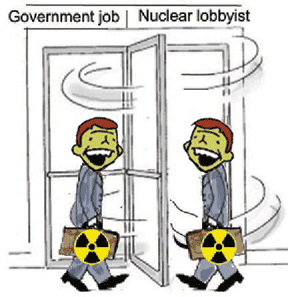 nuclear industry officials, bureaucrats, politicians and scientists — have prospered by rewarding one another with construction projects, lucrative positions, and political, financial and regulatory support. ……Japan would make the sale of nuclear reactors and technology the central component of a long-term export strategy to energy-hungry developing nations. A new company, the International Nuclear Energy Development of Japan, was created to do just that. Its shareholders were made up of the country’s nine main nuclear plant operators, three manufacturers of nuclear reactors and the government itself.
Safety Left Out in Japan’s ‘Nuclear  Power Village, Culture of Complicity Tied to Stricken Nuclear Plant, New York Times, By NORIMITSU ONISHI and KEN BELSON, April 26, 2011 “……..Revolving Door In Japan, the web of connections between the nuclear industry and government officials is now popularly referred to as the “nuclear power village.” The expression connotes the nontransparent, collusive interests that underlie the establishment’s push to increase nuclear power despite the discovery of active fault lines under plants, new projections about the size of tsunamis and a long history of cover-ups of safety problems. Continue reading
Fukushima will eventually be many times worse than Chernobyl
 Chernobyl is over. Fukushima hasn’t really begun. Chernobyl released a huge radioactive cloud when it blew up. Fukushima will exceed the Chernobyl release in a year no matter what else happens…..Fukushima will be many times worse than Chernobyl and will continue for, possibly, hundreds of years.
Fukushima Could Be Worse — And It Will Be, April 25,  2011, Hawaii News Daily, By Tom Burnett “.. F-Daiichi is releasing 154 teraBecquerels of radionuclide particulate matter a day. Almost all of the reports repeat the statement that Fukushima has (so-far) released only about 10% of the radiation Chernobyl released. No problem. Well, they say, “It COULD have been worse.” IT WILL BE! Continue reading
Jaitapur anti nuclear protestors continue, despite police crackdown
Fresh charges against Sena MLA Salvi for Jaitapur role, Times of India, Simit Bhagat, TNN | Apr 27, 2011, MUMBAI: The Ratnagiri police have slapped fresh charges on Shiv Sena MLA Rajan Salvi for his role in the protest against the Jaitapur nuclear power project in Sakhri Nate village on April 18. The violent protest led to police firing, which caused the death of a local fisherman. …..In Mumbai, around 300 activists from Left parties like the CPI and the CPI(M), and environmental activists demonstrated against the Jaitapur nuclear project.shouted slogans against the nuclear power plant and took out a rally from Dadar station till Lower Parel.
The idea of the rally was to protest against the repressive measures being used by the police to crush any peaceful protests against the nuclear power plant,” said Vivek Sundara, an activist from Azadi Bachao Andolan, who was a part of the rally.
Krishan Takhar, a student of Tata Institute of Social Sciences (TISS) said, “We will continue to protest against the nuclear power plant ….http://timesofindia.indiatimes.com/city/mumbai/Fresh-charges-against-Sena-MLA-Salvi-for-Jaitapur-role/articleshow/8094659.cms
No room for complacency about Japan’s nuclear reactors
Every functional nuclear plant is being pushed to the limit and beyond in order to maintain a semblance of normality – but they are ALL in bad repair and are sitting ducks for the next mega-quake….or for ONE overworked plant manager to make a bad decision. Or simply overuse…………There also seem to be problems at :
Onagawa reactor #3
Fukushima Daini reactor #3
Tokai Reactor #3
Kashiwazaki reactor #3……the core is generating deadly radiation
Fukushima Could Be Worse — And It Will Be, April 25, 2011, Hawaii News Daily, By Tom Burnett “……..I have information from Yoichi ‘boots on the ground’ that smoke was emitting from Kashiwazaki last week after the MAG 7,1 EQ. which occurred off Honshu on 7 APR 2011. Continue reading
How a Fukushima safety whistleblower was blackballed
Despite a new law shielding whistle-blowers, the regulator, the Nuclear and Industrial Safety Agency, divulged Mr. Sugaoka’s identity to Tokyo Electric, effectively blackballing him from the industry
Safety Left Out in Japan’s ‘Nuclear Power Village, Culture of Complicity Tied to Stricken Nuclear Plant, New York Times, By NORIMITSU ONISHI and KEN BELSON, April 26, 2011, TOKYO — Given the fierce insularity of Japan’s nuclear industry, it was perhaps fitting that an outsider exposed the most serious safety cover-up in the history of Japanese nuclear power. It took place at Fukushima Daiichi, the plant that Japan has been struggling to get under control since last month’s earthquake and tsunami. Continue reading
Nuclear Safety Commission – hourly Fukushima Radiation forecasts
Nuclear Body To Issue Hourly Radiation Forecasts, TOKYO (Nikkei) April 26–The Nuclear Safety Commission said Monday that it will start issuing forecasts of how airborne radioactive material may be spreading out by the hour from the Fukushima Daiichi power plant.
Starting Tuesday, the commission’s Web site will show hour-by-hour data from SPEEDI, a system that analyzes and predicts dispersal of radioactive material in the event of a nuclear emergency.
Run by the government-affiliated Nuclear Safety Technology Center, the system has taken flak for publishing results just twice since the Fukushima crisis began, despite 11.3 billion yen in development and operating costs……..http://e.nikkei.com/e/fr/tnks/Nni20110426D25JFA23.htm
Apparently, Pakistan’s nuclear program is “safe”
IAEA declares Pakistan nuclear program safe, Tehran Times, ISLAMABAD (APP) 25 April 11, — International Atomic Energy Agency (IAEA) on Monday declared the nuclear program of Pakistan as safe and secure and appreciated the obvious dedication to the safety and security of the regulators as well of operators.
Talking exclusively to APP on the sidelines of “International seminar on nuclear safety and security”, held here from 21-23 April, Deputy Director General IAEA Denis Flory said the IAEA emphasizes the importance of national responsibility for security, which Pakistan takes seriously. In fact, Pakistan has had an Action Plan in place to strengthen nuclear security since 2006, he added.
Giving details he said this plan covers such items as Management of Radioactive Sources; Nuclear Security Emergency Co-ordination Center (NuSECC); Locating and Securing Orphan Radioactive Sources.
Pakistan has worked with the agency to implement that plan and to provide resources for its implementation, he maintained. ….. http://www.tehrantimes.com/index_View.asp?code=239445
Japanese govt raises “acceptable”radiation standard for children
3.8 μSv/h is roughly 6 times the standard for “Radiation Controlled Areas” (0.6 μSv/h or more). The Labour Standards Act prohibits those under the age of 18 from working under these conditions. Forcing children to be exposed to such radiation doses is an exceedingly inhumane decision….”The cancer risk will visibly rise in the future. By setting these standards, the government will steer clear of any liability legally, however not morally.”
 Urgent Petition Against Imposing 20 milli-sievert Radiation Exposure Standard onto Children in Fukushima
http://blog.canpan.info/foejapan/daily/201104/24
On April 19th, the Ministry of Education, Culture, Sports, Science and Technology (MEXT) notified the Board of Education and related institutions in Fukushima Prefecture the level of 20 milli-sievert per year (mSv/y) as a Radiation Safety Standard for schools in Fukushima Prefecture. This is the standard to be used for school grounds and buildings. The Government has indicated that 20 mSv/y is equivalent to 3.8 micro-sievert per hour (μSv/h) measured outdoors. Continue reading
Fukushima debris too radioactive for workers to deal with
The legal limit on the amount of radiation a worker can be exposed to has been raised to 250 millisieverts for the crisis. It takes less than 17 minutes to hit that limit when working in an environment being exposed to 900 millisieverts per hour.
Hot debris hampers reactor repairs, Radiation map shows hazards lurking around every corner, Japan Times, Kyodo, 25 April 11, A contamination map revealing radiation levels at about 150 places in the Fukushima No. 1 power plant was released Saturday by troubled Tokyo Electric Power Co………One finding acquired from the map’s data as of Wednesday night is that a piece of concrete debris near the No. 3 reactor was emitting a nearly lethal 900 millisieverts per hour of radiation. Continue reading
Atmospheric radiation from Fukushima greater than they thought
.On April 17, plant operator Tokyo Electric Power Co. said in its plan for stabilization of the crippled reactors it would not start to get radiation leakage under control until the plan’s fourth month of implementation.
Atmospheric radiation leak underestimated, The Yomiuri Shimbun, 25 April 11, Data released by the government indicates radioactive material was leaking into the atmosphere from the Fukushima No. 1 nuclear power plant in early April in greater quantities than previously estimated. Continue reading
1 This Month



Shut down the radiation-damaged Heysham nuclear reactors now
To see nuclear-related stories in greater depth and intensity – go to https://nuclearinformation.wordpress.com

Say No to NASA’s Reckless Nuclear Reactor on the Moon
Say No to NASA’s Reckless Nuclear Reactor on the Moon
-
Archives
- October 2026 (256)
- September 2026 (339)
- August 2026 (330)
- July 2026 (355)
- June 2026 (287)
- May 2026 (306)
- April 2026 (356)
- March 2026 (251)
- February 2026 (267)
- January 2026 (308)
- December 2025 (358)
- November 2025 (359)
-
Categories
- 1
- 1 NUCLEAR ISSUES
- business and costs
- climate change
- culture and arts
- ENERGY
- environment
- health
- history
- indigenous issues
- Legal
- marketing of nuclear
- media
- opposition to nuclear
- PERSONAL STORIES
- politics
- politics international
- Religion and ethics
- safety
- secrets,lies and civil liberties
- spinbuster
- technology
- Uranium
- wastes
- weapons and war
- Women
- 2 WORLD
- ACTION
- AFRICA
- Atrocities
- AUSTRALIA
- Christina's notes
- Christina's themes
- culture and arts
- Events
- Fuk 2022
- Fuk 2023
- Fukushima 2017
- Fukushima 2018
- fukushima 2019
- Fukushima 2020
- Fukushima 2021
- general
- global warming
- Humour (God we need it)
- Nuclear
- RARE EARTHS
- Reference
- resources – print
- Resources -audiovicual
- Weekly Newsletter
- World
- World Nuclear
- YouTube
-
RSS
Entries RSS
Comments RSS

