Doubts on safety of Koodankulam nuclear project, and of others too
 “there should be a moratorium on all further nuclear activity, and revocation of recent clearances for nuclear projects”, given without regard to India’s ramshackle infrastructure and largely untested emergency procedures…
The issue is far larger than just Koodankulam. There are lingering doubts about the safety measures being reliable, workable and effective….
 Discordant voices on safety of nuclear power, THE HINDU, B.S.RAGHAVAN, 22 SEPT 11, Following the agitation, including mass fasting, by the people of Idinthakarai, the village adjacent to the Koodankulam atomic power project, who are in panic over the possibility of the occurrence of a disaster similar to the one at Fukushima and consequent dangers from radiation, there has been a cacophony of voices over the pros and cons of nuclear power. Continue reading
India’s new Nuclear Regulator will be a tame instrument of government
“This is an unprecedented directive which coerces and demands obedience from the Regulatory Authority.
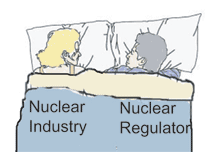 CPI-M flays nuclear safety authority bill, The Economic Times, 21 Sept 11, NEW DELHI: The CPI-M on Wednesday denounced the proposed Nuclear Safety Regulatory Authority Bill and asked the government to “set up a genuinely independent nuclear safety regulatory authority”. Continue reading
 Radioactive pollution from rare earths processing in China
China Re-Nationalizes Rare Earths – Part One, Metal Miner by STUART on SEPTEMBER 19, 2011 That China has suffered severe and widespread pollution from the mining and refining of rare earth elements (REE) is not in doubt —
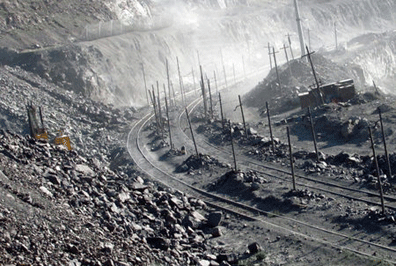
The New York Times reported this week that China had largely shut down its rare earth industry for three months to address pollution problems. Officials confirm evidence visible by satellite that large tracks around both legal and illegal mine sites have become wastelands…….
Apparently the government also plans to consolidate 80 percent of the production from southern China — which produces the rest of China’s rare earths — into three companies within the next year or two. All three of these companies are former ministries of the Chinese government that were spun out as corporations, and the central government still owns most of the shares. These actions will at least ensure Beijing achieves control of mining and refining; if pollution remains a problem, they only have themselves to blame.http://agmetalminer.com/2011/09/19/china-re-nationalizes-rare-earths-part-one/
Lynas’ rare earths processing plan for Malaysia fraught with dangers
Rare earths mining and processing is difficult, expensive and rarely ecologically friendly. It produces enormous quantities of wastewater, requires vast amounts of energy, uses toxic materials in the refining process and can produce radioactive materials with half-lives of hundreds of years.
Prime Minister Najib Tun Razak and other government officials have continued to insist the plant won’t open until all safety and environmental concerns are met. …
Typhoon and Fukushima’s leaking radioactive water
Typhoon Roke Hits Japan on Track for Leaking Nuclear Power Plant, SF Gate, Tsuyoshi Inajima and Yuriy Humber, September 20, 2011 (Bloomberg) — Typhoon Roke brought evacuation orders, downpours and fears of floods to southern Japan today as it began to traverse the country on a course towards the crippled Fukushima Dai-Ichi nuclear plant……….. Continue reading
State requests halt to Koodankulam nuclear project; protestors call off hunger strike
Koodankulam nuclear project: Protestors call off fast, Indian Express Sep 21 2011, Chennai: The 11-day-old fast by locals demanding scrapping of the Koodankulam nuclear power project was on Wednesday called off after Tamil Nadu Chief Minister J Jayalalithaa agreed for a cabinet resolution to request the Centre to halt the project. Continue reading
India aiming for global leadership in renewable eneergy
India will be global leader in solar energy: Minister of New And Renewable Energy Farooq Abdullah, THE ECONOMIC TIMES, 21 SEP, 2011, CHICAGO: Minister of New And Renewable EnergyFarooq Abdullah today discussed ways to reduce the cost of producing solar power and said the Jawaharlal Nehru National Solar Mission aims to establish India as a leader in the field. Continue reading
Nuclear power plant company a victim of cyber attacks
 Japanese defence contractor Mitsubishi Heavy Industries, which builds submarines, missiles and nuclear power plants, is the first publicly named victim….
Nuclear plant and missile maker Mitsubishi breached in latest cyber attacks, Security Watchdog, 21 Sept 11, Security experts at Trend Micro have uncovered another large-scale, co-ordinated campaign of targeted attacks, this time focused on compromising data at a series of defence industry companies including Mitsubishi Heavy Industries in Japan. Continue reading
Renewable energy prospects:Japan’s nuclear heirarchy failing to convince.
The nuclear village and its hired guns in the academic and administrative and political sectors have worked together to craft a mechanism through which compensation will almost inevitably be torn out of the public budget as well as the pockets of utility ratepayers.
 Creating a Solar Belt in East Japan: The Energy Future, Japan Focus , Son Masayoshi with an introduction by Andrew DeWit, 19 Sept 11 Introduction “……..In fact, the fight over Japan’s energy options is not at all ended. The nuclear village’s effort to portray Fukushima as merely a setback has failed in the face of the facts, of course. Continue reading
TEPCO hides information from Japan’s govt nuclear agancy
 Head of nuclear watchdog criticizes TEPCO over blacked-out documents, Paul Langley’s Nuclear History Blog, 19 Sept 11 The head of a government nuclear watchdog has criticized Tokyo Electric Power Co. (TEPCO) for not being transparent enough, after it submitted documents earlier this month that were mostly blacked out. Continue reading
… Are nuclear power plants actually cheap while natural energy is expensive?
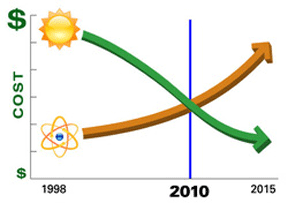 Creating a Solar Belt in East Japan: The Energy Future, Japan Focus , Son Masayoshi with an introduction by Andrew DeWit, 19 Sept 11 ”……… Are nuclear power plants actually cheap while natural energy is expensive? From the standpoint of practical, economical logic, solar power and natural energy are expensive. I had always believed that nuclear power was the most inexpensive way of producing power, at 5-6 yen per kilowatt-hour; therefore we have to use nuclear power and construct new plants. I am sure that many people thought the same.
But is this really true? According to figures listed on an application for approval of the nuclear power plant installation, its unit cost is 15-20 yen. This is the actual data; the pre-accident cost. Continue reading
People’s continued fight to shut down Japan’s nuclear industry
“The government and TEPCO need to admit to the crime they’ve committed. Then they need to work on making amends. This accident was not a natural disaster. It was caused by humans,” mayor, Tamotsu Baba, said……
even though Congressman Takano isn’t getting much support in the Japanese government for his campaign to shut down the country’s nuclear power plants, he is getting more attention from the public, and for now, that’s good enough, as he wants to mostly spread the word on a grassroots level, beyond his community and beyond the Tohoku region…..
 Fighting for a radiation- free Japan, Aj Jazeera, D. Parvaz 16 Sep 2011 Communities in the Tohoku region are struggling for information, decontamination and a say in future policies…. The radiation contamination has created a pristine post-apocalyptic postcard, a place where no one is allowed to live and farmers are forbidden from growing anything. It will be years before the full extent of damage to area residents and ecosystem alike will be known…..” Continue reading
Kudankulam anti nuclear protestors resolute against Chief Minister
 Anti-nuclear plant protesters in Tamil Nadu turn down Jayalalithaa appeal, THE ECONOMIC TIMES, 17 SEP, 2011, , JOE A SCARIA, CHENNAI: Protestors from three southern districts in Tamil Nadu have refused to give up their demand to shut down what is poised to be the nation’s newest nuclear power plant coming up in Kudankulam in Tirunelveli district.
Chief Minister Jayalalithaa Jayaram made a “kind appeal” to the protestors, including 127 people who are on a fast that entered the sixth day on Friday, to end their protest. She said the power plant had ensured all safety parameters, and that it was situated in the second zone of seismic activity where earthquakes were unlikely.
The protestors have turned down her plea. “The CM’s request was disappointing for all of those who are here demanding closure of the plant”, Amal Raj, a volunteer of the People’s Movement against Nuclear Energy which is spearheading the agitation against the nuke project told ET.
Among those who have thrown their weight behind the agitation to have the plant shut, is the local Radhapuram MLA, Michael Rayappan of DMDK, which was an ally of the ruling AIADMK in the assembly poll. … http://economictimes.indiatimes.com/news/politics/nation/anti-nuclear-plant-protesters-in-tamil-nadu-turn-down-jayalalithaa-appeal/articleshow/10012764.cms
Asking nuclear scientists about safety is like asking the Pope if he believes in God

Christina Macpherson's websites & blogs
Tamil Nadu’s Chief Minister discussed nuclear power safety with nuclear scientists and engineers – and surprise surprise – they said it was safe!
Koodankulam nuclear plant: Jayalalithaa slams protesters, says safety ensured, Sep 16, 2011, By Kumar Chellappan Chennai | Agency: DNA The agitators fasting for the closure of the 1000 MW Koodankulam Nuclear Power Plant were given a dressing down by Tamil Nadu chief minister Jayalalithaa who described the reactor quite safe.“My discussions with nuclear scientists and engineers have allayed all kinds of apprehensions….
Representations of various organisations including Peoples Movement Against Nuclear Energy, NGOs and some sections of the Church have been on indefinite fast asking for the closure of the Koodankulam plant which is expected to be commissioned by December 2011….
India: Central and State govts ignoring huge anti nuclear protest
 The non-violent struggle from people are not being responded to with seriousness by the state government and central government. There is a huge battalion of police personnel around Idinthakarai village.
Indefinite Fast Against Nuclear Plant in Koodankulam, By Peoples Movement Against Nuclear Energy (PMANE), 16 September, 2011,Countercurrents.org 5th day Update from Idinthakarai Indefinite Fast Koodankulam: The 25000 people who gathered in Idinthakari village for protesting against Koodankulam nuclear plant rejects Tamil Nadu Chief Minister freebies like mixy, grinder, laptop etc
1 This Month
23-25 October – on Zoom – World BEYOND War’s annual global conferenc


Shut down the radiation-damaged Heysham nuclear reactors now
To see nuclear-related stories in greater depth and intensity – go to https://nuclearinformation.wordpress.com

Say No to NASA’s Reckless Nuclear Reactor on the Moon
Say No to NASA’s Reckless Nuclear Reactor on the Moon

-
Archives
- October 2026 (231)
- September 2026 (339)
- August 2026 (330)
- July 2026 (355)
- June 2026 (287)
- May 2026 (306)
- April 2026 (356)
- March 2026 (251)
- February 2026 (267)
- January 2026 (308)
- December 2025 (358)
- November 2025 (359)
-
Categories
- 1
- 1 NUCLEAR ISSUES
- business and costs
- climate change
- culture and arts
- ENERGY
- environment
- health
- history
- indigenous issues
- Legal
- marketing of nuclear
- media
- opposition to nuclear
- PERSONAL STORIES
- politics
- politics international
- Religion and ethics
- safety
- secrets,lies and civil liberties
- spinbuster
- technology
- Uranium
- wastes
- weapons and war
- Women
- 2 WORLD
- ACTION
- AFRICA
- Atrocities
- AUSTRALIA
- Christina's notes
- Christina's themes
- culture and arts
- Events
- Fuk 2022
- Fuk 2023
- Fukushima 2017
- Fukushima 2018
- fukushima 2019
- Fukushima 2020
- Fukushima 2021
- general
- global warming
- Humour (God we need it)
- Nuclear
- RARE EARTHS
- Reference
- resources – print
- Resources -audiovicual
- Weekly Newsletter
- World
- World Nuclear
- YouTube
-
RSS
Entries RSS
Comments RSS

