USA desperate to sell NuScam’s small nuclear reactors – its latest targeted buyer is Thailand

Kamala Harris – nuclear saleswoman
BANGKOK: The United States will help Thailand develop nuclear power through a new class of small reactors, part of a programme aimed at [?] fighting climate change, Vice President Kamala Harris announced on a visit Saturday (Nov 19).
The White House said the assistance was part of its Net Zero World Initiative, a project launched at last year’s Glasgow climate summit in which the US partners with the private sector and philanthropists to promote [?]clean energy…………
Harris, who is visiting the US ally for an Asia-Pacific Economic Cooperation summit, will discuss the nuclear power initiative in a meeting later Saturday with Thai Prime Minister Prayut Chan-o-cha…………. more https://www.channelnewsasia.com/world/us-help-thailand-develop-small-nuclear-reactors-3085781
N Korea warns of ‘all-out’ nuclear response to US ‘aggression’
North Korea has promised to ‘resolutely react’ to US threat of nuclear weapons use with its own nuclear capabilities.
North Korean leader Kim Jong Un has promised to use nuclear weapons to counter threats from the United States hours after test-firing an intercontinental ballistic missile (ICMB), the latest escalation as the UN Security Council prepares to convene an emergency session on Pyongyang’s actions.
The United Nations Security Council, at the behest of Japan, South Korea and the US will gather on Monday to discuss North Korea’s latest missile launch…………………………………….. more https://www.aljazeera.com/news/2022/11/19/north-korea-warns-of-all-out-nuclear-response-to-us-provocation
Japan’s changing nuclear energy policy
No matter the policy, public trust for nuclear energy is unlikely to be restored

Nov 16, 2022
On Aug. 24, at the newly established GX (Green Transformation) Implementation Council chaired by Prime Minister Fumio Kishida, the Japanese government announced a new nuclear energy policy.
The framework for this new policy consists of three key points: maximize the use of existing nuclear power plants through an accelerated restart and extension of their operation period; develop and build advanced next-generation reactors; and develop conditions suitable for the use of nuclear energy, including back-end support.
The most contentious of these is the second point: the development and construction of advanced next-generation reactors. Since the Fukushima nuclear disaster, previous Japanese government policy has made no mention of building new power plants, so it is being seen as a major policy change. What explains this policy change and is it really feasible?
The most significant influence on the new policy is surely the 2050 Carbon Neutral policy. At present, Japan has only nine nuclear reactors in operation. In fiscal 2020, nuclear power generation accounted for only around 7% of the country’s total power generation. According to an estimate by Hajime Matsukubo, secretary-general of the Citizens’ Nuclear Information Center, achieving the government’s goal of raising this percentage to 20%-22% by fiscal 2030 will require around 26-33 operational nuclear reactors.
If the target ratio of nuclear power generation for fiscal 2050 is also set at around 20%, then around 37-50 operational reactors will be required. If new power plants are not constructed, by fiscal 2050 there will be three reactors with a 40-year service life and 23 reactors with a 60-year service life. If the Japanese government wants to keep the ratio of nuclear power generation at the stated level, then it will need around 20-40 new reactors.
Other factors cited as reasons for this shift in nuclear energy policy include soaring electric power prices due to the Ukrainian crisis and a desire to decrease dependency on fossil fuels. Whatever the reasons for the policy change may be, the government should explain them more clearly.
First, the policy mentions accelerating the restart and extending the operation period of existing nuclear power plants. However, the outlook for achieving this is unclear. Restarting nuclear power plants requires permission from the Nuclear Regulation Authority (NRA) and the agreement of local communities. Plants could also be forced to close due to legal actions such as injunctions, so there is still uncertainty.
With regard to operating period (service life), proposals — led primarily by the Ministry of Economy, Trade and Industry — have been made for the abolishment of the 40-year operating period regulation. But even with this regulation removed, the safety of all plants must ultimately be reviewed by the NAC. If the government is to observe its policy of placing top priority on safety, then it cannot influence NRA safety inspections.
In terms of constructing of new reactors, construction costs for advanced light water reactors — seen as the most practical — are already skyrocketing in the United States and Europe. In the case of small modular reactors, the second most anticipated type, almost all overseas projects are facing setbacks, delays and they have yet to be successfully constructed.
Above all, the biggest questions are these. Can nuclear power maintain competitiveness in a deregulated market? And are any power companies willing to place orders despite the investment risks? The answers are unknown.
The global situation also leaves little cause for optimism. According to the World Nuclear Industry Status Report 2022, the global ratio of nuclear power generation peaked in 1996 at 17.5% and has since gradually declined, falling to below 10% for the first time in 40 years, at 9.8% in 2021. At the same time, the ratio of renewable energy (wind and solar power) reached 10.2% in 2021, exceeding the ratio of nuclear power generation for the first time in history. In terms of future growth, it is quite likely that nuclear power generation’s contribution to combating climate change will decrease. In addition, the recent Ukrainian crisis has also highlighted the risks posed by nuclear power plants in the event of war. The future of nuclear energy at the global level hardly seems bright.
There are also numerous issues to be resolved before we can even begin speaking about a shift in policy. While the decision has already been made to allow contaminated water from the Fukushima No. 1 nuclear power plant to be released into the ocean, the agreement of local fishermen has yet to be obtained. There is also no prospect of removing the melted fuel debris from the reactor in the foreseeable future. Still today there are more than 30,000 refugees who are unable to return to their homes and many court cases for compensation are still ongoing. In short, the Fukushima nuclear disaster is not over yet.
Moreover, cleanup for the nuclear energy policy that the government has pursued over the past 50 years remains unresolved. Nuclear waste problems (including spent nuclear fuel) and the decommissioning of old reactors remain as issues, regardless of the future direction for nuclear power plants. A review of the nuclear fuel cycle policy that has left the country with massive amounts of plutonium is also necessary and inevitable.
Last but not least, there is the issue of public trust in nuclear energy — trust that was lost as a result of the Fukushima nuclear disaster and has not been regained. Looking at this policy change, there is no trace of sufficient validation or discussion. Until a process is established for developing polices with a solid factual basis and then making policy decisions through dialogue with the public, public trust in nuclear energy policy is unlikely to be restored any time soon.
Tatsujiro Suzuki is a professor and vice director at the Research Center for Nuclear Weapons Abolition, Nagasaki University. © 2022, The Diplomat
https://www.japantimes.co.jp/opinion/2022/11/16/commentary/japan-commentary/japan-nuclear-power/
Machinery manufacturer Nippon Steel Works subsidiary confirms 449 cases of fraud, including falsification of inspection resultsNippon Steel Works subsidiary confirms 449 cases of fraud, including falsification of inspection results
Machinery manufacturer Japan Steel Works announced that its subsidiary in Muroran, Hokkaido, Japan, repeatedly falsified or fabricated the inspection results of its products, and that a total of 449 irregularities were identified. These included products for nuclear power plants.

November 14, 2022
Machinery manufacturer Nippon Steel Works, Ltd. announced that its subsidiary in Muroran City, Hokkaido, Japan, has repeatedly falsified or fabricated inspection results for its products, and that a total of 449 cases of fraud have been confirmed. The company apologizes and says it will consider disciplinary action against those involved.
After an internal report uncovered irregularities in the rewriting of inspection data for parts at Muroran-based subsidiary Nippon Steel M&E, Nippon Steel established a special investigation committee made up of outside lawyers in May of this year, and has been conducting an investigation.
The company released a report summarizing the results of the investigation on April 14, stating that 449 cases of falsification and fabrication were confirmed.
The subsidiary is a major manufacturer of products used in nuclear power plants, and 20 of the fraudulent products were related to nuclear power plants.
In addition, the company has stated that none of the products involved are used in Japan for nuclear power plants.
The report also pointed out the causes of the irregularities, including a dysfunctional management system and a lack of awareness of compliance.
President Matsuo said, “We are deeply sorry for the inappropriate behavior in nuclear power products.
In response to the investigation report, Toshio Matsuo, president of Nippon Steel Corporation, issued a comment saying, “I would like to express my deepest apologies again for the inconvenience and concern we have caused you.
The report also stated, “We take the fact of the failure of the self-cleansing function and the recommendations of the special investigation committee very seriously and sincerely, and we will work to reform our systems and culture to prevent recurrence and restore confidence in our company. We are committed to reforming our systems and culture to prevent recurrence and restore trust in our company.
https://www3.nhk.or.jp/news/html/20221114/k10013891391000.html?fbclid=IwAR1jlq0dwOU2zoAmESiIxWfCogc1FQ2ikxgf0mxhLXi852vZYNKcQyF_b4o
Japan’s new nuclear energy policy- is it really feasible?
On August 24, 2022, at the newly established GX (Green Transformation)
Implementation Council chaired by Prime Minister Kishida Fumio, the
Japanese government announced a new nuclear energy policy.
The framework
for this new policy consists of three key points: maximize the use of
existing nuclear power plants through an accelerated restart and extension
of their operation period; develop and build advanced next-generation
reactors; and develop conditions suitable for the use of nuclear energy,
including back-end support.
The most contentious of these is the second
point: the development and construction of advanced next-generation
reactors. Since the Fukushima nuclear disaster, previous Japanese
government policy has made no mention of building new power plants, so it
is being seen as a major policy change. What explains this policy change,
and is it really feasible?
The Diplomat 14th Nov 2022
https://thediplomat.com/2022/11/japans-changing-nuclear-energy-policy/
Japan looks to finalize nuclear reactor service extension by year-end

This Feb. 13, 2021 photo taken from a Mainichi Shimbun helicopter shows the Fukushima Daiichi nuclear power plant in Fukushima Prefectur
November 8, 2022
TOKYO (Kyodo) — Japan’s industry ministry is considering extending the lifespan of nuclear reactors to beyond the current 60 years with ambitions to finalize the plan by the end of the year, in a bid to cut carbon emissions and ensure stable energy supplies threatened by Russia’s war in Ukraine, sources familiar with the matter said Tuesday.
The Ministry of Economy, Trade and Industry is looking to extend the number of years nuclear power stations can remain open by considering screening periods, necessary for stricter plant safety operations, as separate from the total service life, which could allow nuclear reactors to operate for longer. During safety checks, the nuclear plants are not operational.
A ministry panel is set to discuss extending the service life of the nuclear power stations in such a way as a main scenario among other options, with plans to finalize their decision by the end of the year, the sources said.
Under the current safety rules, the Nuclear Regulation Authority limits nuclear reactors’ service period to 40 years in principle. If approved by the regulatory body however, the period can be extended by up to 20 years.
The panel will also look at scrapping the 60-year lifespan, as well as maintaining the current rules as two alternative options, in case the proposal is found not to be viable.
Prime Minister Fumio Kishida said in August that Japan will push ahead with the use of nuclear power, citing the plan as an option to achieve net-zero emissions and secure a stable electricity supply.
Japan relies heavily on fossil fuel imports for power generation, with its energy self-sufficiency rate standing at 12.1 percent as of fiscal 2019, lower than many other developed countries.
Nuclear power plant operators must pass the tougher regulations to restart their reactors after a nationwide halt which occurred after the Fukushima nuclear disaster of March 11, 2011, which was caused by a massive earthquake and tsunami. Only a handful of reactors in Japan have since resumed operations, while the public remains concerned over their safety.
Some utilities face prolonged screening processes by the NRA. More than nine years have passed since the safety examinations of Hokkaido Electric Power Co.’s Tomari nuclear power plant began, for example.
The electric power industry has urged more than 60 years of service will be safe provided appropriate maintenance operations are guaranteed.
The safety watchdog proposed earlier this month that the safety of nuclear plants aged 30 years or older, regardless of whether a reactor lifespan is extended, be checked at least once a decade to obtain approval for their continued operation.
https://mainichi.jp/english/articles/20221108/p2g/00m/0bu/042000c
In Suttsu, Japan, residents don’t want nuclear waste
At a time when Japan announces the restart of seventeen nuclear reactors by 2023, the question
of the management of radioactive waste arises. In Suttsu, a landfill project is under study, to the great despair of the inhabitants. “We don’t want our village to become a village of garbage cans”, protest Kazuyuki
Tsuchiya and his wife, Kyoko.
This couple in their seventies runs an inn in Suttsu, located on the island of Hokkaido, in northern Japan. Composed of 78% forest, this village of 2,800 souls, landlocked between mountains and the seaside, is picturesque.
It is here that a nuclear waste storage project has been taking shape since 2020 . The only ones to have applied to the Radioactive Waste Management Company (Numo), created by the Ministry of Economy, Trade and Industry.
Ouest France 3rd Nov 2022
NRA risks losing its reputation as neutral nuclear watchdog body

Members of the Nuclear Regulation Authority hold a meeting Nov. 2 in Tokyo’s Minato Ward.
November 5, 2022
The Nuclear Regulation Authority (NRA) has started working on legal revisions to effectively eliminate the limit on the operational life span of nuclear reactors.
The NRA appears to be responding to growing calls for the “revival” of nuclear power generation within the government and the business community. The NRA was set up as a highly independent nuclear safety watchdog in line with lessons gleaned from the 2011 Fukushima nuclear disaster. It should not forget its original mission.
The legal life span of a nuclear reactor is 40 years in principle but can be extended to 60 years at a maximum.
But the Ministry of Economy, Trade and Industry (METI), acting at Prime Minister Fumio Kishida’s behest, has proposed increasing the life span of reactors. Acting in tandem with the government’s move, the NRA instructed its Secretariat, a government agency, to review the current rules.
In a recent meeting on this issue, the NRA Secretariat presented a proposal which would require reactors that have been in service for 30 years to undergo inspections for signs of degradation at intervals of 10 years or less to win permission for continued operation. As long as they keep passing these periodical inspections, they can run beyond the 60-year limit.
The NRA is expected to work out, possibly by the end of the year, an outline of a draft revision of the Nuclear Reactor Regulation Law for the extended operations of nuclear plants.
The 40-year cap was a rule established under a bipartisan agreement reached through Diet debate that focused on the bitter lessons from the triple meltdown at the Fukushima No. 1 nuclear power plant in 2011. This rule, along with the suspension of new construction and expansion of nuclear power plants, played an important role in reducing the nation’s dependence on atomic energy, a policy goal adopted by the government. The rule must not be changed without national debate after only 10 years.
The NRA argues that whether to extend the legal life of reactors is a policy decision concerning the use of nuclear power that is outside its mandate. That means the NRA’s mandate is to ensure proper regulations of nuclear power generation according to the government’s policy.
At a glance, this position appears to be based on the principle of the separation of nuclear safety regulation from the government’s policy to promote nuclear power generation. But it is, in effect, regulation in line with promotion.
Nuclear power plants inevitably wear down over time. There are many plant parts that were not designed to be replaced. As the initial design philosophy for reactors has become outdated, the risk of unexpected problems and malfunctions increases. The 40-year rule was partly aimed at avoiding such unclear and unpredictable risks.
Extended life spans will inevitably increase the burden of inspections and raise the cost of electricity generated by aging reactors due to costs incurred by taking the necessary measures to pass inspections. This also raises questions about whether extended operations of reactors will make economic sense.
The NRA claims the regulations for reactors that have run for 30 years or longer would become “far more rigorous than now” under the proposed change. Some NRA experts have said the new system should make it harder for older reactors to pass inspections. Others have pointed out the importance of responding to the risks posed by natural disasters like earthquakes, tsunami and volcanic eruptions.
But the specifics of the new regulations and operational rules remain unclear. The ongoing policy debate on the issue, clearly driven by arguments for promoting nuclear power, raises doubts about whether the government could develop a new regulatory system that can win the support of the residents and administrations of host communities and the public as a whole.
To prevent another nuclear tragedy, it is vital for the NRA to remain solidly committed to maintaining its independence. Serious doubt about its independence would deliver a huge blow to its credibility with society.
If its independence is undermined, the NRA might be unable to resist future political pressure for relaxing the safety regulations or safety inspections of aged and risky reactors.
The NRA must realize that the situation poses a critical test of its commitment to its core mission as the nuclear safety watchdog.
Nuclear waste: from Bure in the Meuse, France to Japan, opponents of the burial unite
In Bure, in the Meuse, the Cigéo project for the burial of long-lived nuclear waste has been recognized as being of public utility. Opponents are calling on the Japanese to mobilize against a similar project on the island of Hokkaido.

Opponents of the Bure nuclear waste burial project have lent their support to the inhabitants of Suttsu, Japan, where a similar project is under study.
Ouest-France Alan LE BLOA. Published on 03/11/2022
On the borders of the Meuse and Haute-Marne regions, the Cigéo project for a nuclear waste burial center in Bure has been declared to be in the public interest. The decree, published on Friday, July 8, authorizes the National Agency for Radioactive Waste Management (Andra) to acquire the land needed for the surface installations, as well as the land located above the galleries. This means about 3,500 hectares, which can be expropriated if necessary.
85,000 m3 of radioactive waste
The aim of the project is to bury 85,000 cubic meters of long-lived high-level and intermediate-level radioactive waste from France’s nuclear power plants 500 meters underground by at least 2080. This decisive step, since the launch of research on site twenty years ago, has rekindled tensions. Some thirty associations and residents have filed an appeal with the Council of State to challenge the decision. A message relayed to Japan
On September 16, EELV and LFI parliamentarians gave their political support to the opponents’ action… which is becoming international. In a message relayed to Japan, they have, in fact, sent their support to the inhabitants of the village of Suttsu, opposed to the project of burying radioactive waste in the subsoil of the island of Hokkaido, in the north of the archipelago. The burial projects “are devastating for our territories and represent economic brakes for their future. No one wants to live next to a radioactive repository. The promises of development are lies intended to make the projects acceptable”, they write, condemning “the lack of transparency of the authorities”.
In the meantime, in Bure, an observatory for the health of local residents is being set up. Its objective? To monitor the physical and psychological health of residents within a 25 km (6,000 people in 180 municipalities) and 50 km (340,000 people in 679 municipalities) perimeter. Some 900 people, selected at random, are to be interviewed to assess their health.
Nuclear waste: in Japan, a sensitive project in an earthquake-prone region
On the island of Hokkaido, a contested project plans to bury 19,000 tons of radioactive waste 300 m underground. In a region subject to the risk of earthquakes.

Yugo Ono, geologist and professor emeritus at the University of Hokkaido, considers that it is risky to bury radioactive waste in an area subject to seismic movements.
Ouest-France Johann FLEURI. Published on 03/11/2022 at 06h30
On the island of Hokkaido, Numo is carrying out stage 1 of the investigation, which began in 2020. The radioactive waste management company is studying the location, soils, seismic history of the area and calculating budgets. Residents and the city council will be asked to vote on whether to proceed with the project and move to Phase 2. The vote, scheduled for November, has been postponed.
Stored for over a thousand years
The 19,000 tons of nuclear waste that could eventually be buried on site, between 300 m and 3 km below the surface of the ground, are extracts of liquid waste, which after several treatments, remain highly radioactive and must be stored for more than a thousand years, to no longer present a danger to humans. The burial project, the first of its kind in the archipelago, consists of placing them in stainless steel tubes, so that they can be stored as vitrified waste. Numo plans to store 40,000 of these containers underground.
Soil and water table
An underground project that seems risky in a country subject to earthquakes. At Numo, we believe that “the degree of danger is under control”. In the event of a major earthquake, “the containers will follow the movement of the earth”. But Yugo Ono, a geologist and professor emeritus at Hokkaido University, does not share this opinion. “Buried, the waste could pollute the soil and groundwater in the event of a strong earthquake,” he says.
Risks
“The geology of the region, composed of volcanic rocks, is unsuitable for such a project, says the scientist. The soil is very affected by seismic activity. In the case of a major earthquake in Suttsu, “the radioactivity will spread into the water table,” he says. The waste would be stored at a depth of 300 meters, while “seismic activity can be felt up to 10 kilometers down.” Under pressure, the expert is certain: “The tanks will break.”
Another method
Rather than burial, “the only method of storing radioactive waste for Japan today is in steel containers, covered with 2 meters of concrete, within the walls of nuclear power plants. According to Yugo Uno, “this is the safest method, which we master best and it is not so expensive”. But this system requires that the containers be changed every fifty years at the most because the steel will be attacked by radioactivity. “Every twenty years would be better for maximum safety.”
REPORT. In Suttsu, Japan, the inhabitants do not want nuclear waste
At a time when Japan is announcing the restart of seventeen nuclear reactors by 2023, the question of radioactive waste management arises. In Suttsu, a landfill project is under study, to the great despair of the inhabitants.

Miki Nobuka, 50 years old, says she learned that the project of nuclear waste burial was validated while she was buying her bread.
Ouest-France Johann FLEURI. Published on 03/11/2022
“We don’t want our village to become a garbage dump,” say Kazuyuki Tsuchiya and his wife Kyoko. This couple of septuagenarians runs an inn in Suttsu, located on the island of Hokkaido, in northern Japan. This village of 2,800 souls, 78% of which is made up of forests, is picturesque and is located between mountains and the sea.
It is here that a nuclear waste storage project has been taking shape since 2020. Suttsu and the neighboring village of Kamoenai (800 inhabitants) were the only ones to apply to the Radioactive Waste Management Corporation (Numo), created by the Ministry of Economy, Trade and Industry and the electricity companies, and were selected to receive, within 20 years, the 19,000 tons of radioactive waste piling up in the country’s power plants, particularly in Fukushima Dai-chi and Rokassho in Aomori, where storage capacity is saturated.
In Japan, between the villages of Suttsu and Kamoenai, which have applied for the radioactive waste burial project, is the Tomari nuclear power plant. In Japan, between the villages of Suttsu and Kamoenai, which have applied for the radioactive waste disposal project, is the Tomari nuclear power plant.
Although Suttsu officially submitted its application, the inhabitants feel that they were not consulted and accuse the municipal council of having made the decision alone. Miki Nobuka, 50 years old, says she learned that the project was approved while she was buying her bread. This mother has been campaigning ever since to “stop it for our children”.
More than 50% of the inhabitants against
According to Kazuyuki Tsuchiya’s calculations, “more than 50% of the inhabitants of Suttsu are against”. Not having had access to the details of the project, “the council makes heavy decisions in plenary sessions”. The residents feel betrayed and angry. “The mayor wants to take advantage of the subsidies to develop the city, but we don’t want it,” he says.
According to Kazuyuki Tsuchiya’s calculations, “more than 50 percent of the residents of Suttsu are against” the radioactive waste disposal project.
In the first phase of the project, which consists mainly of soil investigation, 15 million euros are paid to each of the two municipalities. Fifty-three million in the second phase, which is to be voted on by referendum. The city council can say stop at any time,” says a Numo spokesperson. A vote will validate the continuation of each phase.”
Lack of transparency
But “we want to have access to all the documents: it’s unacceptable,” says Kazuyuki Tsuchiya, who won his case in the Hakodate administrative court last March for lack of transparency on the part of local authorities. The court ruled that the city of Suttsu should publicly share all the minutes of the city council meeting during which the vote for the final storage project was held. The vote for the second phase, originally scheduled for November, has therefore been postponed to a later date.
When contacted, the mayor of Suttsu refused to answer our questions. The Kishida government has announced the restart of 17 of its reactors by 2023 and the probable construction of new ones in the future. The Prime Minister also declared that before each restart, the local population, who live near the said plants, would be consulted. A promise that makes the inhabitants of Suttsu smile bitterly.
Japanese government seeks to allow nuclear reactors to operate for 80 years
Japanese authorities on Wednesday proposed that the safety of nuclear
plants aged 30 years or older be checked at least once a decade to obtain
approval for continued operation.
The proposal from the Nuclear Regulation
Authority came as the government seeks to scrap a rule that limits the
operating life of reactors to a maximum of 60 years. The regulator said the
proposed mandatory safety checks should also be applied to nuclear reactors
in use for more than 60 years.
It means that if the safety is confirmed,
Japan may be able to authorize nuclear plants to run for 80 years, as in
the United States. “The (proposed) regulations will be much stricter than
the current system,” Shinsuke Yamanaka, chairman of the nuclear watchdog,
said at a press conference. “It is our responsibility to regulate
properly.”
Japan Today 3rd Nov 2022
North Korea fired intercontinental ballistic missile – Seoul
https://www.rt.com/news/565844-north-korea-icbm-launch/ 4 Nov 22, The launch failed during the second-stage separation, a South Korean military official told Yonhap
North Korea has launched an intercontinental ballistic missile (ICBM) as part of a large-scale show of force against the ongoing war games between the US and South Korea, according to Seoul’s armed forces.
The South Korean Joint Chiefs of Staff said the military detected “what is presumed to be a long-range ballistic missile launch from the Sunan area in Pyongyang” early on Thursday morning, noting that two additional short-range missiles followed about one hour later.
After analyzing details of the launch, the military added that the weapon traveled a distance of around 760km (472 miles) and reached a top speed of Mach 15. However, a defense source later told Yonhap that “the missile seems to have failed in normal flight” after its second-stage separation.
In a statement later on Thursday, the Joint Chiefs said “Our military has beefed up surveillance and vigilance” and would maintain a “readiness posture in close cooperation with the US.”
Thursday’s launch marks the first time Pyongyang has fired an ICBM since May, though it comes amid a record number of missile tests overall this year. The DPRK has also unleashed hundreds of rockets, missiles, and artillery shells into the sea in recent days as a demonstration to Washington and Seoul, which are in the middle of some of their largest air drills ever.
With tensions soaring on the peninsula, the North has repeatedly condemned the exercises as a rehearsal for a full-scale invasion, even suggesting earlier this week that Washington could be preparing a nuclear attack. The US and South Korea, meanwhile, have denounced each missile launch by Pyongyang as a dangerous provocation and have vowed to continue strengthening military ties.
Studies on nuclear radiation’s impact on people necessary: BRIN
https://en.antaranews.com/news/258613/studies-on-nuclear-radiations-impact-on-people-necessary-brin 4 Nov 22, Jakarta (ANTARA) – Environmental and health studies on the impact of radiation exposure on people living in areas of high natural radiation, such as Mamuju, West Sulawesi, are necessary, the National Research and Innovation Agency (BRIN) has said.
A researcher from BRIN’s Research Center for Metrology Safety Technology and Nuclear Quality, Eka Djatnika Nugraha, said that in some places in Indonesia, such as Mamuju, people have been exposed to natural radiation that is several times higher than the global average at around 2.4 millisieverts per year.
“This situation may pose a health risk to the public due to chronic external and internal exposure,” Nugraha said in a statement received on Friday.
Mamuju is an area of high natural background radiation due to the high concentration of uranium and thorium in the rocks and soil, he observed.
Thus, studies on the health of people living in such areas could serve as a potential source of information about the effects of chronic low-dose exposure, he added.
In order to obtain scientific evidence on the effects of chronic low-dose radiation exposure on health, it is necessary to conduct a comprehensive environmental assessment of the exposure situation in areas of high natural radiation, he elaborated.
Meanwhile, head of BRIN’s Nuclear Energy Research Organization, Rohadi Awaludin, said that it is important to know and understand the safety and protection measures against nuclear radiation technology, especially for everyone involved or in contact with it.
“Nuclear radiation technology, including ionization, has been used and applied to various aspects, including industry and health, food, and others. This technology is the answer to the problems we have, but there are also risks that (one) must be (aware of) from this technology,” he added.
Poland, South Korea sign outline accords on nuclear power project
Aljazeera 31 Oct 22
South Korea and Poland to assess the viability of building four 1,400-megawatt nuclear reactors in Patnow.
Seoul and Warsaw have signed outline agreements to develop nuclear power in Poland, according to ministries from both countries, as Poland strives to phase out coal and lower its carbon emissions and South Korea seeks to revive its nuclear industry.
Poland’s ZE PAK and PGE and Korea Hydro & Nuclear Power (KHNP) will assess the viability of building four 1,400-megawatt nuclear reactors in Patnow, central Poland, using South Korean technology, the South Korean Ministry of Trade, Industry and Energy said on Monday in a joint statement with the Polish Ministry of State Assets.
The companies, with government backing, intend to prepare a preliminary development plan for the plant by the end of this year, they said in a statement.
Since the election this year of President Yoon Suk-yeol, who pledged to revive the country’s nuclear power industry, South Korea has stepped up efforts to win nuclear power plant export orders……………………
Monday’s agreements follow an announcement on Friday when Warsaw said US firm Westinghouse Electric Co will build the country’s first nuclear power plant in northern Poland. https://www.aljazeera.com/news/2022/10/31/poland-south-korea-sign-outline-accords-on-nuclear-power-project
1 This Month

of the week – Nuclear Information and Resource Service
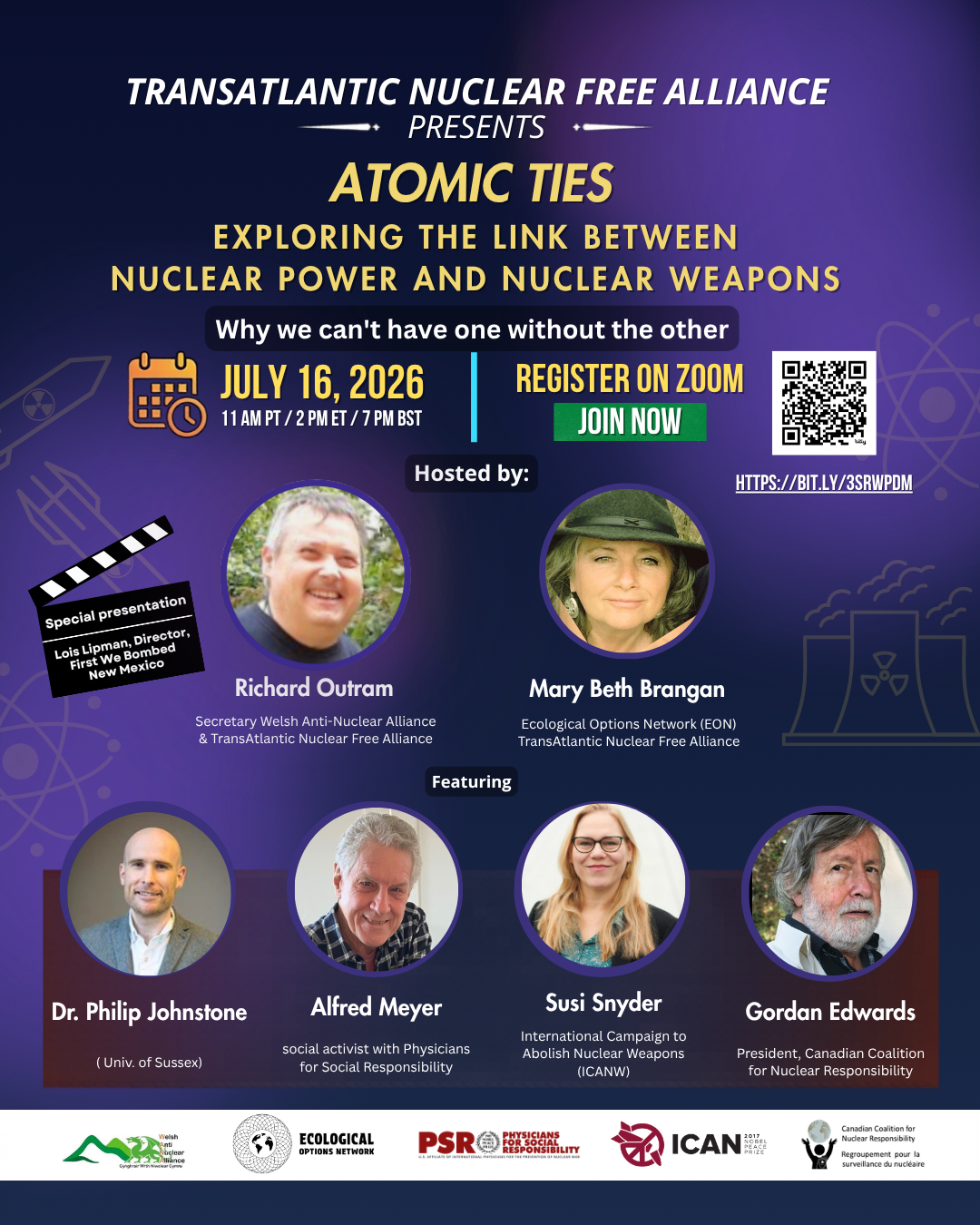
July 16 – 19H BST ATOMIC TIES Webinar!!


22,000+ miles voyaging for nuclear disarmament
and a radiation-free environment https://vfpgoldenruleproject.org/
To see nuclear-related stories in greater depth and intensity – go to https://nuclearinformation.wordpress.com
-
Archives
- July 2026 (135)
- June 2026 (287)
- May 2026 (306)
- April 2026 (356)
- March 2026 (251)
- February 2026 (267)
- January 2026 (308)
- December 2025 (358)
- November 2025 (359)
- October 2025 (375)
- September 2025 (257)
- August 2025 (319)
-
Categories
- 1
- 1 NUCLEAR ISSUES
- business and costs
- climate change
- culture and arts
- ENERGY
- environment
- health
- history
- indigenous issues
- Legal
- marketing of nuclear
- media
- opposition to nuclear
- PERSONAL STORIES
- politics
- politics international
- Religion and ethics
- safety
- secrets,lies and civil liberties
- spinbuster
- technology
- Uranium
- wastes
- weapons and war
- Women
- 2 WORLD
- ACTION
- AFRICA
- Atrocities
- AUSTRALIA
- Christina's notes
- Christina's themes
- culture and arts
- Events
- Fuk 2022
- Fuk 2023
- Fukushima 2017
- Fukushima 2018
- fukushima 2019
- Fukushima 2020
- Fukushima 2021
- general
- global warming
- Humour (God we need it)
- Nuclear
- RARE EARTHS
- Reference
- resources – print
- Resources -audiovicual
- Weekly Newsletter
- World
- World Nuclear
- YouTube
-
RSS
Entries RSS
Comments RSS
 nuclear-news