Release peaceful protestors of Koodankulam nuclear plant – Sandeep Pandey
 Mr. Pandey said, “That there has been no violence so far is a unique feature of this movement and the credit goes to the fisherfolk of Tirunelveli. The government must withdraw all false cases and release two of the activists still in jail, Satish Kumar and Muhilan.”
 Magsaysay awardee opposes KKNPP http://www.thehindu.com/news/states/tamil-nadu/article3433480.ece 19 May 12 Sandeep Pandey, Magsaysay award winner and a convener of the National Alliance of People’s Movements, said on Friday that Indian nuclear scientists were dealing with an unknown technology in the Kudankulam Nuclear Power Project (KKNPP) and that it should not be commissioned hastily as it was against the people’s interest. Continue reading
Kudankulam nuclear plant unsafe say protestors in London
 The fact is that the Indian nuclear programme itself is backed up heavily by the US and foreign corporates (like Atomsroyexport) and US companies are salivating over deals with the Nuclear Power Corporation of India.”
Protest in Britain over Kudankulam nuclear plant http://ibnlive.in.com/news/protest-in-britain-over-kudankulam-nuclear-plant/259242-62-128.html IBN Tamil Nadu 19, 2012 London: Anti-nuclear and rights group on Friday held a noisy demonstration in  front of the Indian High Commission here in protest against the Kudankulam Nuclear Power Plant being built in a tsunami-prone area of Tamil Nadu. Continue reading
Bomb threat to Kudankulam Nuclear plant
One held in connection with Kudankulam Nuclear plant bomb threat letters DNA, May 20, 2012 One person has been arrested on charges of sending letters stating that bombs would explode inside the controversial Kudankulam Nuclear plant on May 21, police said on Sunday….. Leaders of People’s Movement Against Nuclear Energy, spearheading the stir
against KNPP, had said it has no role in the threat letters. http://www.dnaindia.com/india/report_one-held-in-connection-with-kudankulam-nuclear-plant-bomb-threat-letters_1691454
Japanese industry plans to cope well with a nuclear free summer
 Many big companies in the region have said they can manage with power saving steps, and some experts said voluntary steps would probably suffice to shrink the supply-demand gap given growing awareness of energy saving measures.
Japan seeks 15 pct summer power savings in west, May 18, 2012
 * Japan avoids mandatory power use limits for summer
* Critics doubt utilities’ shortage forecasts
By Yoko Kubota TOKYO, May 18 (Reuters) – Japan urged at least 15 percent power cuts in its urban-industrial west this summer from 2010 levels to cope with shortages after all nuclear reactors shut down, but stopped short of the mandatory cuts seen in the east last year. The government said on Friday that it aimed to avoid rolling blackouts in the region – home to many manufacturers including struggling electronics giants Panasonic Corp and Sharp Corp – although it needed to prepare just in case. Last summer, the government imposed mandatory usage cuts of 15 percent on customers of Fukushima plant operator Tokyo Electric Power and Tohoku Electric in the east of the country. Neither will face numerical targets this summer as they are expected to meet demand by firing up thermal plants. Continue reading
Nuclear industry downturn in China
 Chinese nuclear manufacturers are now dealing with overcapacity as the world nuclear industry enters a trough,
China can manufacture 12 nuclear reactors sets annually whereas the industry needs only 40 sets before 2020
 Japan leak sent nuclear industry reeling, 2012-05-19, By Liu Yiyu (China Daily) Japan’s nuclear emergency of last year has left a mark on Chinese nuclear manufacturers, which have since seen billions of yuan worth of orders postponed, a senior industry official said. Continue reading
Political, economic, pressure on Japan to restart nuclear reactors, despite community opposition
How Close Is Japan to Pushing the “On” Button on Reactors? WSJ, By Mitsuru Obe and Phred Dvorak, May 18, 2012, Prime Minister Yoshihiko Noda said Thursday the government’s “close” to a decision on whether to restart two nuclear reactors in western Japan — the first pair in line to switch back on after last year’s terrible accident in Fukushima.
So what’s the controversial decision going to be and where does it stand? JRT expects it’ll be a “yes,” but the pressures against restarting are so great that the order to bring
them back online could be delayed for months — possibly after peak electricity demand in the summer. Here’s our attempt to cut through the obscure, politically charged process….. Continue reading
Research report – low level radiation IS a cancer causer

 Studies of the Mortality of Atomic Bomb Survivors, Report 14, 1950–2003: http://www rrjournal.org/doi/pdf/10.1667/RR2629.1 An Overview of Cancer and Noncancer Diseases
The long struggle against nuclear power in Japan
Environmentalists, meanwhile, say they remain undaunted by the Oi decision, which has become a watershed moment in their activism.
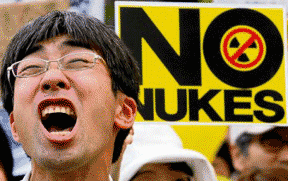 Activists Brace for Long War Against Nuclear Power, By Suvendrini Kakuchi TOKYO, May 17, 2012 (IPS) – For the past two decades Masao Ishiji (59), has been fighting tooth and nail to ban the operation of four nuclear reactors that dot the western coastline of Oi in the Fukui prefecture facing the Japan Sea.
Earlier this week, that desperate battle reached a critical front. When the Oi municipal assembly passed a new resolution Monday to restart Unit 3 and 4 reactors that had been closed for a year for stress tests, anti-nuclear activists knew they had reached a crucial juncture in their fight to eradicate nuclear power from the country. Continue reading
Increased radiation in Tokyo Bay
Radiation increasing in Tokyo Bay May 18, 2012 “If the contamination were to spread to fish, it is possible that radioactive isotopes could accumulate when bigger fish feed on smaller ones.” — Hideo Yamazaki
Radioactive contamination from Japan’s Fukushima nuclear disaster has risen sharply in Tokyo Bay over the past several months rather than decline, according to a new study.
Researcher Hideo Yamazaki from Osaka’s Kinki University found that contaminated sludge has accumulated due to runoff into the bay from rivers flowing from highly contaminated regions. This has caused radioactive cesium levels to rise by 1.5 to 13 times since August, Yamazaki says.
New devices to detect ionising radiation
Firms say new gear visually detects radiation hot spots, Japan Times, 18 May 12, A number of companies have started marketing equipment and devices that enable inspectors to visually detect radiation hot spots.
The devices are expected to be a great help to municipalities and construction companies engaged in decontamination work in areas affected by the nuclear crisis at Tokyo Electric Power Co.’s Fukushima No. 1 power plant.
Hitachi Consumer Electronics Co. has developed a camera that can detect gamma rays emitted by radioactive substances 10 or more meters away. The box-shaped device, which weighs 16.8 kg and measures 34 cm in all dimensions, is highly portable, the company says.
It detects three kinds of radioactive material — cesium-134, cesium-137 and iodine-131…..
http://www.japantimes.co.jp/text/nn20120518b1.html
Indian Member of Parliament demands scrapping of nuclear power programme
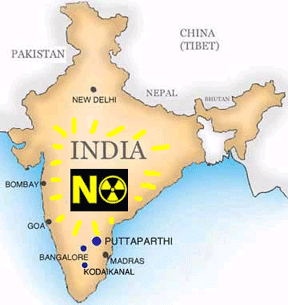 Scrap nuclear power programme, demands Lok Sabha MP Business Standard, Press Trust of India / New Delhi May 17, 2012, An Independent MP today demanded scrapping of the country’s nuclear power programme saying it would have adverse effect on farm production, environment and people.
“I demand that the government should stop the nuclear power programme because it can affect our farm productivity, environment and people,” Tarun Mandal said during Zero Hour. He pointed out that radiation can be spread through water used in the atomic power plants which can badly hit crops, environment and people of the country. Mandal suggested that the government should harness other sources of
energy like hydro-power to meet power demand….. http://www.business-standard.com/generalnews/news/scrap-nuclear-power-programme-demands-lok-sabha-mp/9901/
In 2006 TEPCO knew of the tsunami danger to Fukushima
TEPCO knew 6 years ago about tsunami risk to Fukushima, Japan Daily Press, By Adam Westlake / May 16, 2012 Officials from the Nuclear and Industrial Safety Agency (NISA) said on Tuesday that they, and Tokyo Electric Power Co. (TEPCO), were notified in 2006 of the risks a tsunami posed to the utility’s Fukushima Daiichi nuclear plant.
After the 2004 tsunami that devastated Indonesia, a session was held by NISA and several of Japan’s utility companies to look at the state of the country’s nuclear reactors and
how prepared they were for earthquakes or tsunamis…
.. In August of 2006, their research culminated in a report that showed the utility companies in attendance, which included TEPCO, that the Fukushima facility had a high risk of losing power, and taking on sea water, in the event of a 14 meter (45.9 feet) tsunami. …. http://japandailypress.com/tepco-knew-6-years-ago-about-tsunami-risk-to-fukushima-162237
Japanese govt’s nuclear push with Kazakhstan, and the global nuclear industry web
A complex web of agreements across national borders links many of the biggest players in the nuclear industry.
“Japan hasn’t used the Fukushima disaster as an opportunity to push for renewable energy or energy efficiency,” “Instead, it has used the time since the disaster to push for the restart of nuclear reactors.”
How Long Will Japan’s Nuclear Recess Be? Enter KazakhstanTruth Out , 15 May 2012 By Steve Horn, “……Japan Announces Big Nuclear Deal with Kazakhstan Unmentioned by all but two news outlets was the fact that a day before the announcement, the Japanese government signed a deal with Kazakhstan’s state-owned nuclear giant, KazAtomProm, to begin supplying Japan with more nuclear fuel starting in 2013. Continue reading
Radiation to be measured in monkeys in Fukushima forests
The group plans to target monkeys in southern Minami-Soma in the prefecture, an area that was inside the no-entry zone around the crippled nuclear plant until mid-April. Relatively high radiation levels have been recorded in the area.
“It’s difficult to accurately gauge how much radioactive cesium has
contaminated mountain forests because the substance is easily moved by
rainwater and by other natural conditions,”
 Wild monkeys to help gauge Fukushima radiation http://www.yomiuri.co.jp/dy/national/T120511004760.htm The Yomiuri Shimbun, 11 May 12, FUKUSHIMA–Wild Japanese monkeys wearing special collars fitted with dosimeters and Global Positioning System devices will be used to measure radiation levels in the mountain forests of Fukushima Prefecture in an experiment due to start this month.
A group of researchers at Fukushima University plans to start the experiment to determine the dispersal of radiation due to the crisis at the Fukushima No. 1 nuclear power plant and support decontamination work. Continue reading
Lawsuit against TEPCO, over suicide in Fukushima
 Japan grapples with post-tsunami suicides Daily Mail, By Arata Yamamoto, NBC News , 12 May 12 TOKYO, Japan – More than 60 people have committed suicides related to last year’s 9.0 quake and tsunami, which triggered meltdowns at a nuclear plant in Fukushima, the Japanese government says.
The data comes as a family prepares to file the first lawsuit against the Tokyo Electric Power Co. over the suicide of Hamako Watanabe, a 58-year-old woman who set herself on fire in wake of the disaster.
In 2011, 55 people committed suicide, with another six cases reported since the beginning of 2012. Suicides linked to the Fukushima nuclear accident are included in the numbers, but attribution to the nuclear crisis has been omitted due to privacy concerns. The data was collected using local police reports since last June…..
Watanabe’s family will seek $910,000 in damages in the death of Hamako Watanabe from TEPCO, the operator of the Fukushima nuclear plant, according to The Japan Times and The Mainichi . They plan to file the lawsuit – which would be the first over a suicide linked to the nuclear crisis – on May 18 in Fukushima District Court….
Hamako Watanabe had been a poultry worker until her workplace was shuttered after the tsunami, and she began to show signs of insomnia and had a poor appetite. A group of lawyers representing victims of the nuclear crisis said her depression and suicide were due to the nuclear disaster, The Mainichi reported. http://www.dailymail.co.uk/news/article-2142849/Haunting-shots-Chernobyl-nuclear-disaster-revealed-true-scale-catastrophe–cost-photographers-lives.html?ito=feeds-newsxml
1 This Month
23-25 October – on Zoom – World BEYOND War’s annual global conferenc


Shut down the radiation-damaged Heysham nuclear reactors now
To see nuclear-related stories in greater depth and intensity – go to https://nuclearinformation.wordpress.com

Say No to NASA’s Reckless Nuclear Reactor on the Moon
Say No to NASA’s Reckless Nuclear Reactor on the Moon

-
Archives
- October 2026 (199)
- September 2026 (339)
- August 2026 (330)
- July 2026 (355)
- June 2026 (287)
- May 2026 (306)
- April 2026 (356)
- March 2026 (251)
- February 2026 (267)
- January 2026 (308)
- December 2025 (358)
- November 2025 (359)
-
Categories
- 1
- 1 NUCLEAR ISSUES
- business and costs
- climate change
- culture and arts
- ENERGY
- environment
- health
- history
- indigenous issues
- Legal
- marketing of nuclear
- media
- opposition to nuclear
- PERSONAL STORIES
- politics
- politics international
- Religion and ethics
- safety
- secrets,lies and civil liberties
- spinbuster
- technology
- Uranium
- wastes
- weapons and war
- Women
- 2 WORLD
- ACTION
- AFRICA
- Atrocities
- AUSTRALIA
- Christina's notes
- Christina's themes
- culture and arts
- Events
- Fuk 2022
- Fuk 2023
- Fukushima 2017
- Fukushima 2018
- fukushima 2019
- Fukushima 2020
- Fukushima 2021
- general
- global warming
- Humour (God we need it)
- Nuclear
- RARE EARTHS
- Reference
- resources – print
- Resources -audiovicual
- Weekly Newsletter
- World
- World Nuclear
- YouTube
-
RSS
Entries RSS
Comments RSS

