Solar panels for IKEA’s buildings in China
 IKEA To Use Solar Power on Buildings in China, Market Watch, June 12, 2012, IKEA Group partners with Hanergy to install solar panels on IKEA buildings BEIJING, Jun 12, 2012 (BUSINESS WIRE) — IKEA Group today announced that, as part of its goal to only use renewable energy to power its buildings, it will partner with Hanergy, one of China’s leading clean energy companies, to install solar photovoltaic panels on IKEA owned buildings in China. Continue reading
Charge nuclear officials under criminal law, say Fukushima residents
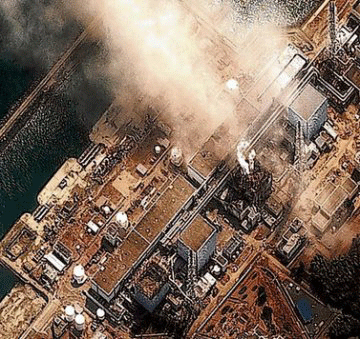 Fukushima residents call for criminal charges against nuclear officials http://articles.cnn.com/2012-06-11/asia/world_asia_japan-nuclear-complaint_1_fukushima-daiichi-nuclear-plant-fukushima-residents-tepco?_s=PM:ASIA June 11, 2012|By Kyung Lah, CNN The executives of the Japanese utility that owns the stricken Fukushima Daiichi nuclear plant and a number of the country’s government officials should go to jail, according to a complaint filed by more than 1,000 local residents on Monday.
A total of 1,324 people lodged the unusual criminal complaint with the Fukushima prosecutor’s office, naming Tsunehisa Katsumata, the chairman of Tokyo Electric Power Co. (TEPCO) and 32 others.
The complaint argues that the 33 TEPCO executives and government officials are responsible for causing the nuclear disaster that followed the March 11 earthquake and tsunami and exposing the people of Fukushima to radiation.
Disinformation to Japanese public on the relative costs of nuclear and renewable energy
Weapons of Disinformation The most common item in this process of manipulating the public discussion in favor of a vested interest has been the publishing of studies and reports by private “scientific” institutes. These papers by so-called “energy experts” are disguised as objective scientific assessments of the current situation and future developments…. their sole purpose is to convince the public and industrial and political leaders who might not have enough subject knowledge to notice the bias.
Japan: Ignorance and/or Dishonesty of “Energy Experts”, Clean Technica, JUNE 11, 2012 BY THOMAS Currently, the main focus is on the struggle about whether or not to restart two nuclear reactors at the Ōi Nuclear Power Plant, which has a combined capacity of 2.2 GW of electric power.
Those forces in favor of a nuclear comeback proclaim that there would be no alternative to a restart. According to them, reactivating two nuclear reactors is the only way to ensure the stability of the power grid in the Kansai region, Japan’s second-largest industrial area.
In order to convince the public, industry leaders and the government of this so-called existential necessity, the so-called “nuclear village” bombards the discussion with doomsday scenarios about how dangerous blackouts are – how they risk lives and the economy — as well as trying to reestablish the perception that nuclear power would be the cheapest form of electricity generation.
Considering that the so-called “nuclear village” of Japan finds itself in the unfamiliar situation of an uphill battle to regain trust and favorable public opinion, it is trying everything it can to change the odds in its favor once again. Continue reading
Japan’s secrecy over the true extent of Fukushima radiation
Japan Used Claims of Inaccuracy To Divert Release of Critical Radioactive Material at Fukushima Nuclear Plant, Spy Ghana 12 June 12, Japanese officials have failed to justify why it took them over a month to disclose large-scale releases of radioactive material in mid-March at the crippled Fukushima Daiichi nuclear power plant. Continue reading
Proposed nuclear reactor restarts in Japan – ‘woefully unprepared for accidents’
critics say the offsite center in Oi is woefully unprepared for a severe accident on the scale of Fukushima.
Fukushima Watch: Japan Gets ‘Feudal’ on Reactor Restarts By Chester Dawson and Mitsuru Obe, WSJ, June 12, 2012 As the Japanese government moves full steam ahead with plans to bring back online the first nuclear reactors since last year’s crisis in Fukushima, the town of Oi is preparing to roll out the futons for a pair of long-term visiting V.I.P.s from Tokyo. The two high-ranking government officials are being sent to the rural seaside town as part of a promise made last month by nuclear disaster minister Goshi Hosono, in order to pave the way for restarts of Oi’s No. 3 and No. 4 reactors—a controversial decision amid widespread public anxiety about nuclear safety. Continue reading
Solar energy brings clean drinking water to 10,000 Indian villages
A solar energy based drinking water supply system has already changed lives of villagers in naxal affected Gadchiroli district of Maharashtra where solar energy based dual pump piped water supply system has been installed.

 10,000 Naxal villages to get 24 into 7 water supply, courtesy solar http://www.hindustantimes.com/India-news/NewDelhi/10-000-Naxal-villages-to-get-24-into-7-water-supply-courtesy-solar/Article1-868921.aspx Chetan Chauhan, Hindustan Times New Delhi, June 10, 2012 You in India’s top cities may envy around one-fifth of total villages in 78 naxal affected districts set to get around the clock tap water supply, courtsey solar energy. Three Central government ministries — New and Renewable Energy, Drinking
Water and Sanitation and Finance — have come together to provide 24 into 7 clean drinking water to 10,000 villages in the Naxal affected districts under the Integrated Action Plan of the Central government. Continue reading
World Health Organisation dancing to nuclear lobby’s tune on Fukushima radiation?
 Dr. Caldicott says the WHO only focuses on
  thyroid cancer and ignores all other cancers and other radiation related diseases.
“There is a substantially increased incidence of thyroid tumors among exposed children, up to 50 percent of those tested by ultrasound. But instead of biopsying these tumors, they are ‘following’ them, i.e. doing nothing, which means they are
not being diagnosed and many of these children are therefore destined to die, because almost certainly
many of the tumors will be malignant,” …. She is far from alone in her views.
The Fukushima Battleground Over Science, By Aron Lamm, Epoch Times, 8 June 12, More than a year after the Fukushima nuclear incident, there is still much disagreement about many aspects of its actual consequences. A recent example is a report by the World Health Organization, which estimates radiation doses and cancer risks in the wake of the disaster.
Its findings are being criticized by other medical professionals who use different assumptions and different science, and accuse the WHO of downplaying the gravity of the health risks for people living in the affected area…… Continue reading
Decommissioning is far cheaper than radioactive fallout cleanup!
1. The TEPCO Gang controlled Labor Middlemen are also making a killing off this Trillion Dollar Eco-Disaster, by providing disposable labors like the original 50 responders whose records seem to have vanished, while making BIG money for TEPCO… See: http://is.gd/Ljj4Ff
2. Regarding the highly radioactive material itself:
I wonder if any of the Japanese Leaders are asking (on or off the record), what happened to all the highly radioactive materials that are now missing from Fukushima and what they are doing to recover them ASAP. Since it is true that that TEPCO is using GANG supplied labor then it must be worrisome that much of this highly radioactive material may have been stolen to be later sold to terrorist organizations because of it’s dirty weapon potential for BIG money! I hope some future terrorist dirty explosion does not contain Fukushima radioactive debris, as it will give the phrase “Made in Japan” a new meaning!
A comment from Capt D on http://www.washingtonpost.com/blogs/ezra-klein/post/how-hard-is-it-to-dismantle-150-nuclear-reactors-europes-about-to-find-out/2012/06/09/gJQA2EH0PV_blog.html
Fukushima radiation worse than we’ve been told
The meltdown at Fukushima is releasing far more radiation into the atmosphere [than the Nagasaki A bomb] and if unit 4 were to tumble, it would have the same effect as 1,100 A-bombs….. much more radiation than we’ve been led to believe has made its way to the American shores.
Fukushima forum: Dr. John Apsley says U.S. is feeling the effects of radiation, Donna Anderson Coast to Coast Radio Examiner 10 June 12, Dr. John Apsley appeared on the Fukushima forum on Coast to Coast AM on Saturday, June 9, 2012 .
For more than 30 years Dr. Apsley , author of “Fukushima Meltdown & Modern Radiation: Protecting Ourselves and Our Future Generations ” has specialized in cell regeneration and accelerated wound repair. He appeared on the show to deliver his findings on the effects of
Fukushima radioactive fall-out on the Japanese people, as well as Americans. Continue reading
Japanese government ‘in the pocket of the nuclear industry’ will restart reactors
“By ignoring them and continuing his reckless push to restart Ohi, prime minister Noda is compromising the health and safety of millions, and showing just how deep his government is in the pocket of the nuclear industry,”

U-turn on nuclear as Japan PM decides: ‘We can’t do without it’ Scotsman.com 9 June 2012 Japan’s prime minister has ruled that two mothballed nuclear reactors in the west of the country must be restarted to protect jobs and ensure the “survival of society”, risking a backlash amid safety fears more than a year after the Fukushima disaster. Continue reading
India’s solar-powered buses
Apoorva Renewable Energy to make solar-electric buses for transport body Business Line, BANGALORE, JUNE 8: Buses in Bangalore may soon be powered by solar energy. The Bangalore Metropolitan Transport Corporation (BMTC) has placed orders with Apoorva Renewable Energy Products to design solar-electric hybrid buses, the company CEO, Mr Suresh Babu, said on the sidelines of the Global Investors Meet 2012.
“The BMTC has asked us to provide a sample hybrid vehicle and we have accepted the order and will start working on it,” Mr Babu said. Several other government bodies such as the Bruhat Bengaluru Mahanagara Palike (BBMP) are in talks with the company too, he said.
The company makes three-wheeled vehicles powered by electric and solar power, and customises products for Indian conditions. “Using a common technology, we design products as per customer requirements and outsource the manufacturing,” Mr Babu said.
EXPORTS Currently, the company’s vehicles are used in Delhi and parts of Karnataka and it will start exporting in two months from now….. http://www.thehindubusinessline.com/companies/article3505672.ece
Japan’s re-opened nuclear plants will not be safe until after 2015
Filtered vents that could substantially reduce radiation leaks in case of an accident ; a radiation-free crisis management building; and fences to block debris washed up by a tsunami won’t be ready until 2015. This means the plant, as well as plant workers and residents, won’t be fully protected from radiation leaks in case of a Fukushima-class crisis…
Japan readies for reopening of nuclear reactors amid safety concerns, guardian.co.uk, 8 June 2012 Prime minister Yoshihiko Noda assures citizens’ safety and says reactors must be restarted to boost economy… Prime minister Yoshihiko Noda said the government has taken ample safety measures to ensure the two reactors in western Japan would not leak radiation ifan earthquake or tsunami as severe as last year’s should strike them. Continue reading
Japan mulling over energy options for the future
A key element in the national dialogue will be the future energy mix for Japan to 2030. Three advisory committees – to METI, Environment and Cabinet – have been consulted and the government is ready to put out three options for public consultation
The government appears to have got the message that the public want more choice in their energy supply.
It will be interesting to see what happens when they let the public have their say.
 Japan’s energy dilemma: a renewables embrace?, Climate Spectator, 8 Jun 2012. Gwen Andrews “……..modeling by the Institute of Energy Economics of Japan demonstrates the immensely difficult choices the country is facing……
The announcement of the restarts may be twinned with another announcement, of a ‘national dialogue’ on future energy policy. Japan reviews its energy policy plan every three years, with the last review completed in June 2010. The events of ‘3/11’, as the Japanese call the tsunami disaster, has brought forward a fierce debate on where the
country goes from here.
The debate is notable in that it is front page news, Continue reading
Indian government treats anti nuclear citizens as mentally ill
If anything, then, the really delusion-prone people are on the other side, in the Department of Atomic Energy (DAE) and Nuclear Power Corporation of India Limited (NPCIL). The day the Fukushima crisis took a turn for the worse last year, with hydrogen explosions ripping through three reactors, DAE secretary Sreekumar Banerjee said the blasts were “purely a chemical reaction and not a nuclear emergency …”. NPCIL chairman SK Jain went one better: “There is no nuclear accident….It is a well-planned emergency preparedness programme …“
 No margin for error Hindustan Times Praful Bidwai June 04, 2012 When it comes to thrusting nuclear power down the throats of unwilling people, official India sets a record of violations of dignity and rights that is embarrassing. Which other government but India’s maligns all anti-nuclear protesters as foreign-inspired and lacking any agency? Where else would the police file 107 FIRs against 55,795 peaceful anti-nuclear protesters, but at Koodankulam, charging 6,800 with “sedition” and ”waging war against the State”?
And which other government has asked a psychiatric institution, in this case, the National Institute of Mental Health and Neuro-Sciences (Nimhans), to “counsel” people and convince them that the project, despite the hazards, is good for them?
To its discredit, Nimhans despatched psychiatrists to Koodankulam to ”get a peek into the protesters’ minds” and help these insane people to “understand the importance” of the plant. According to reports quoting its director, Nimhans has “commenced the collection of primary data” and is now seeking “field reactions” to write “multiple strategies” to address “the problem” (the opposition to nuclear power).
Such opposition is thus equated with schizophrenia, fear of sexual intimacy, paranoia or craving for victimhood, to be cured by drastic means. By this criterion, more than 80% of the people of Japan, Germany, France and Russia – who oppose new nuclear plants – must be considered abnormal. Continue reading
Fukushima nuclear disaster remains a problem for the whole world
324 Civic organizations from all over the world have submitted a petition called “An Urgent Request for UN Intervention to Stabilize the Fukushima Unit 4 Spent Nuclear Fuel”, Mr. Murata said noting that those organizations are also demanding a moratorium on Japan’s nuclear reactors.
”the nuclear village and nuclear dictatorship is exposed, and public opinion and their movements are strong.”Nuclear village is a term for the Japanese distorted social structure in which the pronuclear politicians, scholars and companies have more power than those who are skeptical of nuclear energy. Anti-nuclear protests have been ignored for more than 40 years.
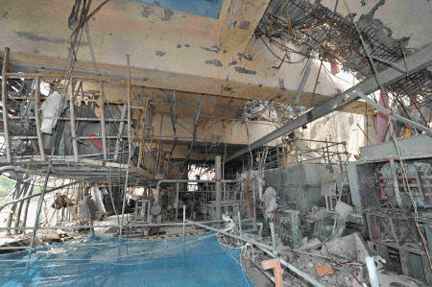 Fukushima Reactor Global Security Issue: Japanese Former Diplomat http://www.panorientnews.com/en/news.php?k=1784, June 7, 2012 Tokyo- (PanOrient News)The Fukushima Daiichi Nuclear Plant Number 4 reactor presents a security problem for the entire world, Mitsuhei Murata, Japan’s former ambassador to Switzerland said.
Fukushima Daiichi plants are “not under control at all… and the situation with nuclear reactors in Japan is like vehicles being driven without a license,” Mr. Murata told a news conference at the foreign correspondents’ club of Japan on June 5. Continue reading
1 This Month
23-25 October – on Zoom – World BEYOND War’s annual global conferenc


Shut down the radiation-damaged Heysham nuclear reactors now
To see nuclear-related stories in greater depth and intensity – go to https://nuclearinformation.wordpress.com

Say No to NASA’s Reckless Nuclear Reactor on the Moon
Say No to NASA’s Reckless Nuclear Reactor on the Moon

-
Archives
- October 2026 (199)
- September 2026 (339)
- August 2026 (330)
- July 2026 (355)
- June 2026 (287)
- May 2026 (306)
- April 2026 (356)
- March 2026 (251)
- February 2026 (267)
- January 2026 (308)
- December 2025 (358)
- November 2025 (359)
-
Categories
- 1
- 1 NUCLEAR ISSUES
- business and costs
- climate change
- culture and arts
- ENERGY
- environment
- health
- history
- indigenous issues
- Legal
- marketing of nuclear
- media
- opposition to nuclear
- PERSONAL STORIES
- politics
- politics international
- Religion and ethics
- safety
- secrets,lies and civil liberties
- spinbuster
- technology
- Uranium
- wastes
- weapons and war
- Women
- 2 WORLD
- ACTION
- AFRICA
- Atrocities
- AUSTRALIA
- Christina's notes
- Christina's themes
- culture and arts
- Events
- Fuk 2022
- Fuk 2023
- Fukushima 2017
- Fukushima 2018
- fukushima 2019
- Fukushima 2020
- Fukushima 2021
- general
- global warming
- Humour (God we need it)
- Nuclear
- RARE EARTHS
- Reference
- resources – print
- Resources -audiovicual
- Weekly Newsletter
- World
- World Nuclear
- YouTube
-
RSS
Entries RSS
Comments RSS

