Japan’s government to nationalise Tepco nuclear company, to save it from bankruptcy
 Japan to nationalise nuclear plant operator http://www.abc.net.au/news/2012-05-10/japan-nuclear-plan-to-save-tepco/4002972 By North Asia correspondent Mark Willacy May 10, 2012 Japan’s government will effectively nationalise TEPCO, the operator of the crippled Fukushima nuclear plant, as part of a $12 billion restructuring plan.
TEPCO is facing massive clean-up bills and compensation claims. By injecting the funds into TEPCO to save it from bankruptcy, the Japanese government will also take a controlling stake in the operator of the Fukushima plant.
Announcing the plan, Japan’s industry minister, Yukio Edano, demanded that TEPCO rid itself of its secretive and complacent corporate culture.
The deal will also see TEPCO’s creditor banks extend fresh loans to the company and, effectively, the nationalisation one of the world’s largest utilities companies.
India’s atomic energy chief says fears about nuclear radiation are “irrational”
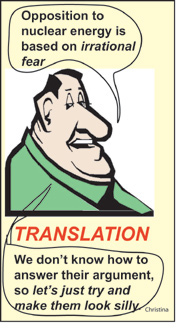
 Priority is to remove irrational fears about radiation: Ratan Kumar Sinha Interview with Chairman, Atomic Energy Commission Business Standard, Sanjay Jog / Mumbai May 10, 2012, Ratan Kumar Sinha, who was director of Bhabha Atomic Research Centre, took over as chairman of Atomic Energy Commission and secretary of Department of Atomic Energy (DAE) last week.
His appointment comes at a time when India’s nuclear sector is facing challenges. Sinha, in an interview with Sanjay Jog, speaks on a number of issues. Edited excerpts:
What are your priorities?
The first is to remove an irrational fear of radiation in the public mind….. We would educate the public and try to remove the unwarranted fear of radiation associated with nuclear plants.
Offline nuclear reactors still dangerous, need constant cooling
 News Navigator: What danger is still posed by offline nuclear reactors? Answers by Taku Nishikawa, Science & Environment News Department The Mainichi, 8 May 12, As of May 5, all nuclear reactors in Japan were offline. The Mainichi answers common questions readers may have about the safety and dangers of offline nuclear plants.
Question: With the reactors offline, has the danger of nuclear accidents disappeared?
Answer: The danger is likely less than while the reactors are running, but it still exists. Nuclear plants make power by turning turbines with the heat from the chained fission of Uranium-235 in nuclear fuel.
This chained fission is stopped in an offline reactor, but fuel rods continue to release “decay heat” as various unstable nuclei created during the reactors’ operation until now naturally break down. This decay heat has to continually be removed.
Q: What will happen if it is not removed? Continue reading
Damaged South Korean nuclear reactor to shut down for 2 years
 Uljin Nuclear Reactor Faces 2-Year Shutdown The Chosunilbo, 10 May 12, Additional faults have been detected in the No. 4 reactor at the Uljin Nuclear Power Plant, which has been undergoing repairs, and a complete shutdown now seems inevitable……..
Korea Hydro and Nuclear Power Corporation has found that damage in the No. 4 reactor, where operations were halted due to defects in the machine that condensates steam from the turbine, is more serious than expected and tentatively decided to replace the steam generator.
Replacing it will take one or two years, so the reactor will not operate until at least next summer. It generates 1 million kW, or the capacity of two thermal power stations. …
http://english.chosun.com/site/data/html_dir/2012/05/10/2012051001397.html
Japan’s idle nuclear reactors still need huge electricity to keep them safe
The end of nuclear, CLIMATE SPECTATOR, Matthew Wright , 8 May 2012 “………When they get too old to operate safely or get shut early due to disaster they still need to be propped up on life support, to manage the site cleanup, to manage their waste and to cool that waste.
In fact right now, Japan’s 54 idled reactors are using the electricity equivalent to the output of three entire reactors, just to provide cooling and other critical services. These will need to go on being delivered to the sites for years even if the reactors are to be completely decommissioned.
That means that nuclear reactors are competing with hospitals, schools and factories for scarce electricity supplies. Due to inherent safety risks, the reactors get power ahead of everyone else in the country. It doesn’t matter if you’re in an emergency ward needing urgent medical attention to save your life, the reactors’ safety comes first……
http://www.businessspectator.com.au/bs.nsf/Article/nuclear-power-and-Japan-end-of-nuclear-Fukushima-d-pd20120508-U3UUW?opendocument&src=rss
Japan’s nuclear shutdown and political uncertainty
Japan plays nuclear power politics, Star Tribune, by: THE ECONOMIST May 7, 2012
“…….So powerful is the symbolism of having no nuclear plants in operation that Prime Minister Yoshihiko Noda has tried to get at least two reactors back up and running. He has failed, and now his political opponents may try to make capital out of this
…….What both main parties fear is that the nuclear debate could become an electoral issue in what promises to be a stormy summer……
The government’s attempt to restart the reactors comes even before a new regulatory body has been established with the transparency, independence and technical ability that its predecessors lacked. It comes before any attempt has been made to clarify the chain of command for handling such accidents Continue reading
Majority of Japanese would choose energy restrictions rather than restart nuclear power
the survey shows 61 percent of people in the Kinki region, which is expected to face the most serious power shortage, say they “can endure” such restrictions. Seventy-ninepercent of people in the Kanto region, which took sweeping energy-saving measures last summer, also say they can put up with restricted use of power. Meanwhile, more than 70 percent of peoplepolled elsewhere in the country say they can live with such restrictions…..
63% of Japanese citizens say ‘no’ to restarting of Oi nuclear reactors: Mainichi poll. 8 May 12, Sixty-three percent of Japanese people stand against reactivating two idled reactors at the Oi Nuclear Power Plant in Fukui Prefecture, and 74 percent say they “can endure” restricted use of electricity in the summer, a nationwide survey conducted by the Mainichi shows, suggesting that the general public is becoming increasingly in favor of breaking away from nuclear power generation. Continue reading
Public opposition holds up Lynas’ rare earths processing plans for Malaysia
the expanding protest movement …… has already delayed the project by eight months and cast a shadow over its future.
The resistance – fed by social networks and Malaysia’s increasingly lively independent online media – also raises broader questions over the global expansion of an industry that has created huge environmental problems in China
Opponents say the Lynas plant doesn’t meet with best practice standards for the industry as it is too close to heavily populated areas and in a place where the ground water level is high. Molycorp’s plant in California, by comparison, is situated far from residential areas in an arid climate.
Citizen backlash keeps Malaysia rare earth plant on hold, The West, Siva Sithraputhran, Reuters May 9, 2012 GEBENG, Malaysia – The expensive machinery lies silent, idling as Malaysia’s government weighs a delicate decision to allow shipments of raw material to arrive from Australia and finally start operations at the world’s largest rare earths plant outside China. Continue reading
500 courageous Indian women join Koodankulam anti nuclear fast
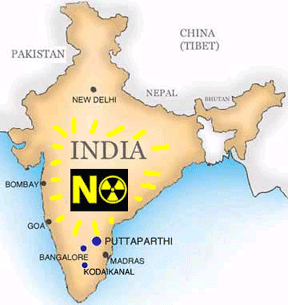 Indefinite hunger strike against KKNPP gains momentum Chennai Online Tirunelveli, Tamil Nadu, May 4 : The ongoing fourth round of indefinite hunger strike against controversial Koodankulam Nuclear Power Project (KKNPP) by the activists of People’s Movement Against Nuclear Energy (PMANE), a civil group spearheading the struggle against the nuclear project, gained momentum, with more number of women activists joining the fasting agitation today.
Nearly 500 women from the coastal hamlets around KKNPP joined the fast with 24 activists who were observing the fast-unto-death stir since May 1 last. The anti-nuclear protesters, including women and children, were assembling in large numbers in the protest venue. Talking to newsmen, M Pushparayan, a key activist of PMANE, claimed though morenumber of women activists were willing to join the fast, they were being prevented and intimidated by the police.
 The women from different villages had enrolled their names to participate in the indefinite fast but did not visit the venue due to possible police harassment, he said. “Police have blocked the entrance of the villages and threaten the hired vehicle drivers not to transport people to Idinthakarai village. Even if they dared, police threaten them to cancel their vehicle licenses. So, the drivers are not willing to come to Idinthakarai.
The police have deployed anti-riot vehicles Vajra and Varun at the entrances of the villages,” he said. Meanwhile, health condition of the 25 activists who were on fast since May 1, had started deteriorating and their pulse rates were going down. One of the activists, Vinoth was admitted to the hospital today, he added.
http://news.chennaionline.com/chennai/Indefinite-hunger-strike-against-KKNPP-gains-momentum/ff5dcb87-d243-4704-8109-783bb9458db3.col
Cheering Japanese in their thousands greet nuclear power shutdown
Electricity shortages are expected only at peak periods, such as the middle of the day in hot weather, and critics of nuclear power say proponents are exaggerating the consequences to win public approval to restart reactors.

Japanese cheer as nuclear reactor shut for checkup SF Gate, Associated Press, May 6, 2012 Thousands of Japanese celebrated the switching off of the last of their nation’s 50 nuclear reactors Saturday, waving banners shaped like giant fish that have become a potent antinuclear symbol. Continue reading
Japan’s nuclear corruption
All 50 reactors have been suspended, but the nation still has power to heat toilet seats, light garish neon signs and run the ubiquitous vending machines despite the government’s repeated warnings of a possible power crunch.
the nation’s long-standing problem – excessively cozy ties between government officials and private enterprise.
the tip of the iceberg in Japan’s corrupt power structure. Behind collusive ties between bureaucrats and power companies, “the public has been little short of becoming the guinea pig of radiation contamination,”
The media also have collusive ties with the power company as is often the case with Japanese newspapers and broadcasters.

Japan’s nuclear reactors run on corrupt structure, critics say http://www.brecorder.com/articles-a-letters/187/1186708/ MAY 07, 2012 TAKEHIKO KAMBAYASHI None of Japan’s 50 nuclear reactors is in operation after the last running unit was shut down Saturday.
With no power outages reported, some wonder why so much atomic power was needed in the earthquake-prone country to begin with. Continue reading
Japan moves toward renewable energy, as nuclear lobby’s influence wanes
“We have the technological know-how. Japan can do anything that Germany can.”
the heavy political influence once exerted by the country’s “nuclear village” of power companies and regulators is waning, experts say.
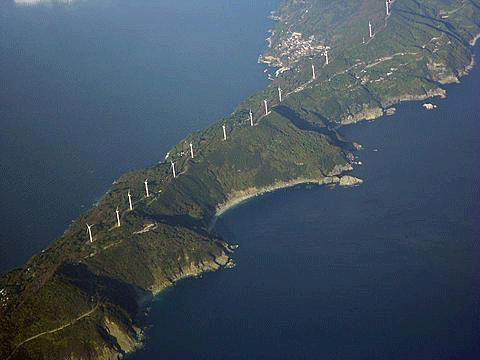
above – wind turbines, Japan
Crisis-hit Japan mulls shift to renewable energy, Knox News, By Elaine Kurtenbach and Mari Yamaguchi Associated Press May 6, 2012 “……..To offset the energy shortfall, utilities have ramped up oil- and gas-based generation, giving resource-poor Japan, the world’s third-largest economy, its biggest annual trade deficit ever last fiscal year. That $100 million-plus a day extra cost, worries over the risks of nuclear power and concern over carbon emissions are leading many decision-makers to view renewable energy sources such as solar, hydro and wind more positively. Continue reading
North Korea’s complicated manouverings on nuclear testing
it is possible that from before its inception, the HEU program was made to be sold. The North is likely to freeze and even dismantle it, on the condition of a big pay off and if they are allowed to maintain their existing stock piles of weapons-grade plutonium
 Uranium or plutonium? The Korea Times, By Andrei Lankov 7 May 12, It seems likely that the third North Korean nuclear test will take place soon ― perhaps, in a matter of days or weeks. There are signs of preparation at the test site, and it would fit into a well-established pattern: a test of a long-range rocket is usually followed by a nuclear test. …. Continue reading
Japan is no further on in getting new nuclear regulator
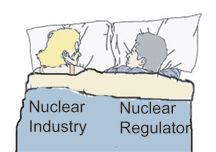 it would lead to problems in the future if the government rushes to restart Japan’s nuclear reactors without changing the current framework, in which the nuclear regulator is under the auspices of its promoter, the industry ministry.
New nuclear regulatory agency still up in air, Mainichi, 7 May 12 TOKYO (Kyodo) — Japan entered a rare period on Sunday of having no nuclear power supply following last year’s
Fukushima No. 1 Nuclear Power Plant disaster, without seeing much progress on shaping a new nuclear regulatory agency that could play a key role in addressing public concerns over the safety of atomic power.
The government plans to establish a new agency under the Environment Ministry amid criticism that the existing Nuclear and Industrial Safety Agency lacks teeth because it is under the umbrella of the Economy, Trade and Industry Ministry, a promoter of nuclear power.
But parliamentary deliberations on a bill submitted by the government to launch the new agency on April 1 have not yet started and the main opposition Liberal Democratic Party has complained that the organization’s independence would not be sufficiently secure under the government plan. Continue reading
Shutdown could mean the end of nuclear power in Japan
a ministry panel believes that Japan can still reduce its greenhouse-gas emissions by 25 percent by 2030 from 1990 levels without nuclear, provided it makes energy savings and speeds up the adoption of renewables, which currently account for just 10 percent of the energy mix.
Japan shuts down last nuclear reactor for tests. End of nuclear power? Christian Science Monitor, If Japan survives the summer without power blackouts, citizens may pressure the government to make the temporary nuclear shutdown permanent. By Justin McCurry, Correspondent / May 4, 2012 TOKYO
This weekend’s nuclear shutdown in Japan is being greeted with a mixture of anxiety and optimism, just over a year since the Fukushima Daiichi nuclear power plant accident signaled the beginning of the end of the country’s dependence on atomic energy. By May 6, the last of Japan’s 50 working reactors – another four were crippled in the disaster – will be offline when the Hokkaido Electric Power Companycloses the No. 3 unit at its Tomari plant in the far north, in the industry’s first enforced closure in Japan since 1965.
Debate is now swirling around the prospects for the economy and environment post-Fukushima, as Japan braces itself for a long, hot summer and the possibility of power cuts that could prove the most severe test of public resolve yet……… Continue reading
1 This Month

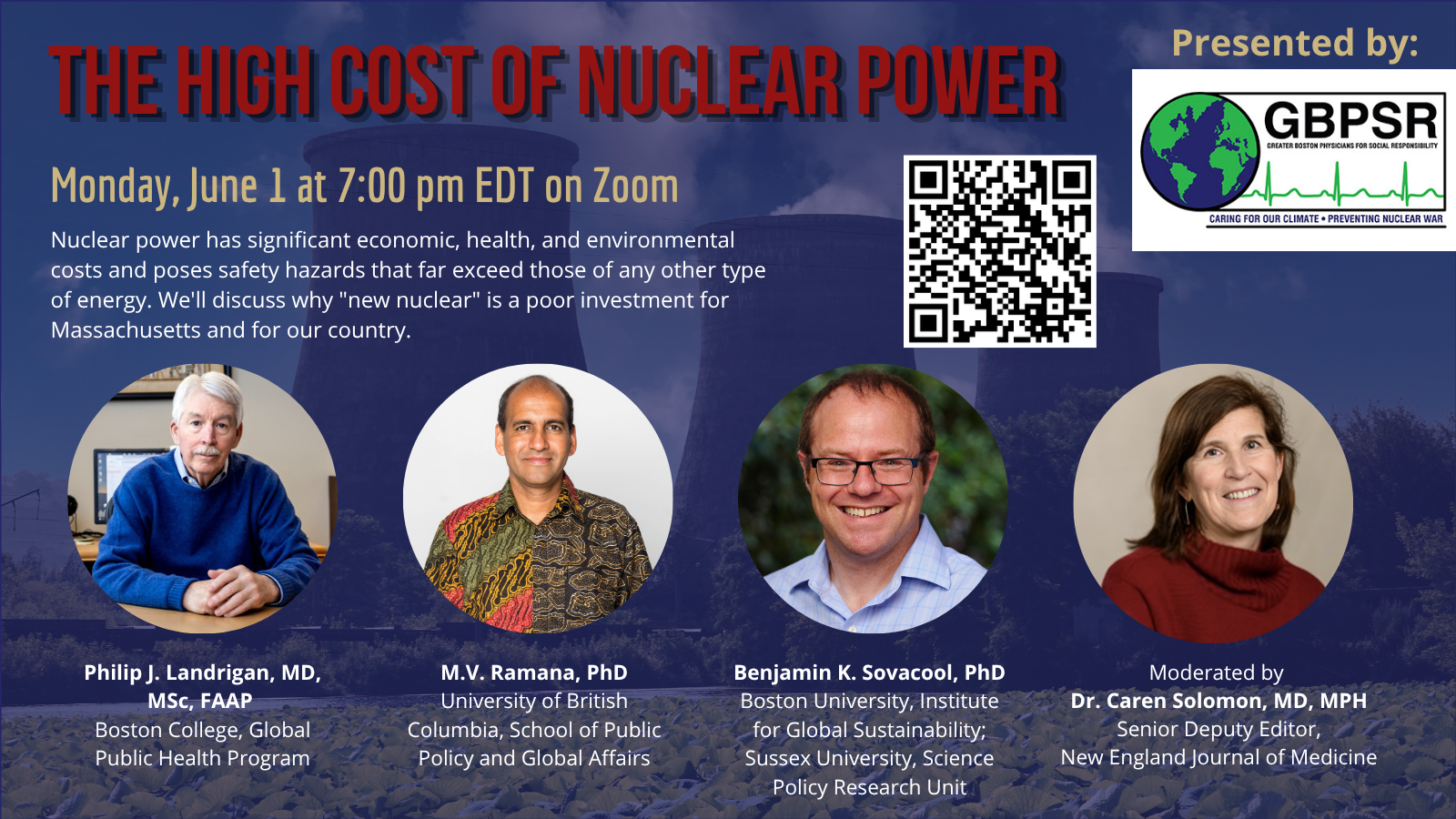
1 June Webinar – The High Cost of Nuclear Power – Register


of the week– Nuclear Reactor Information Task Force
To see nuclear-related stories in greater depth and intensity – go to https://nuclearinformation.wordpress.com
-
Archives
- May 2026 (243)
- April 2026 (356)
- March 2026 (251)
- February 2026 (268)
- January 2026 (308)
- December 2025 (358)
- November 2025 (359)
- October 2025 (376)
- September 2025 (257)
- August 2025 (319)
- July 2025 (230)
- June 2025 (348)
-
Categories
- 1
- 1 NUCLEAR ISSUES
- business and costs
- climate change
- culture and arts
- ENERGY
- environment
- health
- history
- indigenous issues
- Legal
- marketing of nuclear
- media
- opposition to nuclear
- PERSONAL STORIES
- politics
- politics international
- Religion and ethics
- safety
- secrets,lies and civil liberties
- spinbuster
- technology
- Uranium
- wastes
- weapons and war
- Women
- 2 WORLD
- ACTION
- AFRICA
- Atrocities
- AUSTRALIA
- Christina's notes
- Christina's themes
- culture and arts
- Events
- Fuk 2022
- Fuk 2023
- Fukushima 2017
- Fukushima 2018
- fukushima 2019
- Fukushima 2020
- Fukushima 2021
- general
- global warming
- Humour (God we need it)
- Nuclear
- RARE EARTHS
- Reference
- resources – print
- Resources -audiovicual
- Weekly Newsletter
- World
- World Nuclear
- YouTube
-
RSS
Entries RSS
Comments RSS
 nuclear-news