Restart of nuclear reactors in Oi, Japan, killing the tourism industry
the distinction of being selected as the first town with reactors designated for restart has put a damper on the town’s ambitions to diversify its economy by becoming more of a tourism resort.
A survey released May 31 by national broadcaster NHK found 81% of people in the towns bordering Oi think the nuclear plant there may suffer a Fukushima-type disaster.
 Japan’s Nuclear Restarts Worry Tourism Industry WSJ, By CHESTER, DAWSON, 22 June 12 OI, Japan—The Sodegahama public beach draws thousands of swimmers and sunbathers who flock each summer to the sheltered cove at the tip of a rural peninsula in Fukui prefecture. At one end of the arc of sand is a popular campground with a pair of historic bronze cannons dating from 1854. At the other lies a tree-covered hill shielding the view of four nuclear reactor domes 1,000 feet (several hundred meters) away.
As the Japanese government has moved to restart nuclear reactors for the first time since last year’s disaster in Fukushima, this seaside town, which depends on the plant for jobs and subsidies, is wary about of the impact on another major source of revenue: tourism….. Continue reading
Nuclear reprocessing is not the answer to Japan’s mounting radioactive wastes
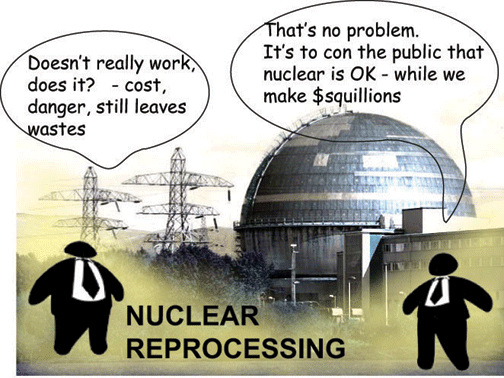 The amount of spent fuel stored at power stations has continued to surge, standing at around 14,200 tons across 17 facilities as of last September, including the wrecked Fukushima No. 1 nuclear plant.
Japan Nuclear Fuel Ltd.’s storage facilities are already almost full and contained a total of 2,800 tons as of February, while several power stations are expected to reach maximum capacity over the next three years if their currently idled reactors are restarted, industry
sources said.
 Policy of recycling all spent nuclear fuel may be axed, Japan Times, 22 June 12, Kyodo, Jiji The Japan Atomic Energy Commission has proposed both reprocessing and directly disposing of spent nuclear fuel if Japan’s atomic energy reliance is cut to 15 percent, a departure from the current policy of total reprocessing…
.. The changed tack comes as massive amounts of spent fuel are accumulating at nuclear plants nationwide and as decades-long efforts to activate reprocessing facilities remain mired
in technical difficulties, sources said. Continue reading
20,000 anti-nuclear protestors rally outside Japanese PM’s home
Japan protest over nuclear restart (Google News, 23 June 12, AFP) TOKYO — About 20,000 people gathered in front of Japanese Prime Minister Yoshihiko Noda’s residence in Tokyo late Friday to protest his decision to restart two nuclear reactors.
“No to the restart!” shouted the protestors, who were led by investigative journalist Satoshi Kamata and Nobel Prize-winning author Kenzaburo Oe, who started an anti-nuclear petition that has so far gathered more than 7.5 million signatures… Japan protest over nuclear restart
Japanese government’s snide move towards nuclear weapons
Japan’s nuclear ambition, Tokyo has only to strike out controversial phrase Korea Times, 23 June 12, The world has long regarded Japan as a virtual nuclear power. On Wednesday, Tokyo took its first step toward becoming a “real” one.
The upper house of Japan’s Diet passed an amendment to the country’s Atomic Energy Basic Law to allow the use of nuclear power for “national security,” according to the Tokyo Shimbun. The addition of these controversial words was made so furtively that not only the
Japanese public but even many Lower House lawmakers didn’t know about
it, other reports say.
Despite denials from the Japanese government, there should be little doubt about Tokyo’s intention — nuclear armament. The stealthy way the Japanese parliament handled the matter proves it. Continue reading
Referendums in Japan about nuclear power?
Fukushima Watch: Japan Mulls Referendum on Nuclear Power, WSJ, By Mitsuru Obe, June 22, 2012, Do Japanese want nuclear power? Why not find out in a referendum? That’s what proponents of putting the nuclear question to the people are saying, pointing out that similar polls have been held in the United States, Germany, Italy, Switzerland and Sweden. Trade and industry minister Yukio Edano is one prominent proponent. Even before
his ruling Democratic Party of Japan came to power, ……As industry minister, Mr. Edano
oversees Japan’s power industry…
.. Unlike public opinion polls, referendums are supposed to be preceded by a period of intense public discussion. In Japan, a national referendum is required only for constitutional amendments. Such ballots can be called on other issues, but their verdicts have no binding power. Continue reading
Fukushima nuclear power to be replaced by big solar energy plant
 Mixed Greens: Big solar to replace Fukushima nuclear, REneweconomy, By Sophie Vorrath 21 June 2012, Toshiba Corp has announced that it will begin building solar plants with a total generating capacity of 100MW on its northeastern coastline – the region that last year was devastated by an earthquake and tsunami, which then triggered a nuclear disaster – making it the biggest solar project in Japan.
Reuters reports that the Japanese electronics conglomerate will spend around ¥30 billion ($379.6 million) to build several large-scale solar plants in Minami Soma – located around 25km from the crippled Fukushima nuclear plant. Continue reading
Malaysia sets special radiation standards for rare earths plant to get Lynas off the hook
 the Atomic Energy Licensing Board (AELB) has arbitrarily set its own safety standards for radiation exposure, which is not in accordance with international standards.
The AELB standards would be used to exempt and clear Lynas’ radioactive wastes for reuse and recycle. The exposure to radioactive waste was one of the causes that led to high levels of lead poisoning and other severe health complications of the people in Bukit Merah.
 TOL sell-out by PSC: The final smirk from Lynas , Malaysia Chronicle, by Charles Santiago, 19 June 2012 “…….Health over investment? The PSC has outlined a guideline to look into health measures for the people, wording it to say that this was undertaken to arrest the fears of the public. Severe birth defects, eight leukemia cases over five years in a community of 11,000, tears and anguish of the poor people from a largely shoe-making community – these are not news headlines. Neither is it the plot of a movie.
These are the consequences of carelessly allowing the Asian Rare Earth factory to be built in Bukit Merah, Perak in 1982. When Mitsubishi Chemical started operating its rare earth factory, the villagers complained of choking sensation, pungent smell, coughs and colds.
The community also saw a sharp rise in the cases of infant deaths, congenital disease, leukemia and lead poisoning. Thirty years later, it has not wiped out the memories and heartache of the villagers who lost their children and loved ones. Only the government is feigning ignorance. Continue reading
Japan’s new “national security” amendment could pave way for nuclear weapons development
“Is this intended to pave the way for (Japan’s) nuclear armament?”..
‘National security’ amendment to nuclear law raises fears of military use June 21, 2012 THE ASAHI SHIMBUN Supporters of an amendment quietly slipped into Japan’s nuclear power law saying it should contribute to “national security” are denying it could provide cover for military use of nuclear technology.
The provision, which says nuclear safety should be guaranteed not only to defend lives, people’s health and the environment but also to “contribute to Japan’s national security,” became part of the Atomic Energy Basic Law on June 20.
Critics say the change to the 1955 basic law, known as the “constitution” of nuclear energy use in Japan, was made without proper debate on the sidelines of political maneuvering in the Diet.
However, it could have far-reaching consequences for Japan’s nuclear stance and heighten international concern about the nation’s nuclear recycling program of extracting plutonium from spent nuclear fuel. Continue reading
Japan’s new nuclear regulator to be back in bed with the nuclear industry?
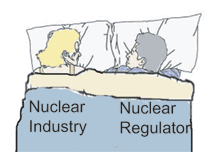 the regulator could have a nuclear-industry friendly stance if the pro-business opposition party, the Liberal Democratic Party, comes into power in the next general elections, which could take place as early as autumn, or by September 2013 at the latest.
Fukushima Watch: Back-Pedaling on Reactor Age Limits? By Mitsuru Obe http://blogs.wsj.com/japanrealtime/2012/06/20/fukushima-watch-back-pedaling-on-reactor-age-limits/ While Japan was transfixed by the drama of restarting nuclear
reactors, another potentially big shift on the atomic-energy front was taking place quietly in the wings.
Japan’s ruling Democratic Party of Japan last week acceded to opposition party requests to retract a plan that would set an age limit of 40 years on nuclear reactors. The DPJ now says that the age limit, which had previously been included in the new nuclear safety bill under deliberation in parliament, will be decided instead by the country’s new regulator, which is to be established as early as this autumn.
The rule, which would limit the length of time a reactor could stay in operation to 40 years, was proposed in December, following concern that aged equipment contributed to the March 2011 meltdowns at the Fukushima Daiichi plant. The three reactors that spun out of control
were all built during the 1970s. Nuclear crisis minister Goshi Hosono said at the time the rule was proposed that “reactors will basically have to be decommissioned after 40 years of operation.” Extending the life beyond 40 years would be allowed in exceptional circumstances
only, he said.
The bill, with the 40-year age limit excised, swiftly cleared Japan’s lower house last Friday, and is expected to pass the opposition-dominated upper house on Wednesday. Industry minister Yukio Edano Friday bemoaned the change, saying “We wanted to have the bill
passed as was originally proposed by the government.” Continue reading
Japan’s new nuclear regulatory body – an uncertain quantity
Japan Adopts New Law For Nuclear Regulatory Body 6/20/2012 (RTTNews) – Japan’s Diet (Parliament) on Wednesday enacted a law to set up an independent nuclear regulatory body by September.
The new law was adopted following widespread criticism after last year’s accident at the Fukushima Daiichi nuclear power plant. Lawmakers have complained that the existing Nuclear and Industrial Safety Agency is controlled by the Ministry of Economy, Trade and
Industry, which promotes nuclear power.
The proposed nuclear regulatory commission is to be largely independent of the government and will have control over a nuclear regulatory agency. Appointees to the five-member commission will not to be allowed to return to work at their former Ministries or agencies. The legislation also provides for the setting up of a new Cabinet Office council to study nuclear disaster preparedness, Japanese media reported.
The new law limits the Prime Minister’s powers to give orders during emergencies, and tasks the commission with making decisions involving knowledge of reactor technology. It allows the Prime Minister to give instructions only when the commission is too slow in deciding. The commission is to review the current 40-year limit for operating nuclear plants….. http://www.rttnews.com/1909544/japan-adopts-new-law-for-nuclear-regulatory-body.aspx?type=gn&Node=B1
Boost for solar power in Japan
Odawara, a city of 200,000 south of Tokyo, is setting up its own power company that will install solar panels at public facilities and sell electricity to Tokyo Electric Power Co
Residents who want to install panels on their homes will also get subsidies..
Japan approves renewable subsidies in shift from nuclear power, Malaysian Insider, TOKYO, June 18 — Japan approved today incentives for renewable energy that  could unleash billions of dollars in clean-energy investment and help the world’s third-biggest economy shift away from a reliance on nuclear power after the Fukushima disaster.
Industry Minister Yukio Edano approved the introduction of feed-in tariffs (FIT), which means higher rates will be paid for renewable energy. The move could expand revenue from renewable generation and related equipment to more than $30 billion (RM90 billion) by 2016, brokerage CLSA estimates. Continue reading
Japan’s nuclear authority did not pass on information on Fukushima radiation
The information was passed to the Nuclear and Industrial Safety Agency (NISA) and the science and technology ministry by Japan’s Foreign Ministry but neither agency passed it to the prime minister’s office, which was overseeing the evacuations.
 thousands fled in the same direction as the radioactive material was drifting.
People fled towards Fukushima radiation Stuff.co.nz, 20 June 12 Japanese authorities failed to disclose US data about the spread of radiation spewing from a crippled nuclear plant last year, leaving some evacuees fleeing in the same direction as the radioactive emissions.
News that Japan’s nuclear watchdog and the science and technology ministry sat on the information collected by US military aircraft – another sign of the chaos at the time – is likely to add to mistrust of nuclear power just days after the government approved the restart
of two idled reactors…
.. US military aircraft gathered radiation data from March 17-19 over a 45km radius and found that people in an area about 25km northwest of the plant – where some people were moving – were exposed to the annual permissible level of radiation within eight hours, Japanese media said.
The information was passed to the Nuclear and Industrial Safety Agency (NISA) and the science and technology ministry by Japan’s Foreign Ministry but neither agency passed it to the prime minister’s office, which was overseeing the evacuations. Continue reading
Uncertainty about the restart of Japan’s other nuclear reactors,
 Uncertain prospects loom for post-Oi reactors, Masayuki Takata / Yomiuri Shimbun 17 June 12, Now that the government has decided to reactivate the Nos. 3 and 4 reactors at the Oi nuclear power plant in Fukui Prefecture, attention has turned to which will be next among the nation’s other 48 idle reactors….
Which reactor will be reactivated next is expected to be left up to a new nuclear regulatory commission to be established in August at the earliest. However, there are no clear prospects for restarting more reactors because it has not been decided how the new organization will
confirm their safety.
At a press conference held Saturday after the four-minister meeting, Economy, Trade and Industry Minister Yukio Edano said the Cabinet would not decide on reactivating the 48 reactors.
“The new regulatory organization will make its own decisions [regarding the safety of the reactors] independently” from the government, Edano said. It is unclear, however, to what extent the nuclear regulatory commission will take the current safety standards into consideration when making its assessments. Continue reading
Majority of Japanese oppose restart of 2 Oi nuclear reactors
Opinion polls consistently show more than half of Japanese are opposed to nuclear power,
In the communities surrounding Oi, only 38% of residents support the restart of the reactors, the NHK survey found…..
Nuclear-Restart Plans Divide Japan Tokyo Aims to Get Economy Back on Track, but Local Leaders, Some Residents Oppose Atomic Power, WSJ. By MITSURU OBE And CHESTER DAWSON, June 17, 2012, TOKYO—Japan ordered a pair of reactors back online for the first time since last year’s nuclear accident, but the chaos and confusion surrounding the decision highlight how unready the country may still be to restart its atomic-energy engine….
.. the restart decision comes a month ahead of deliberations over a new energy plan, which could call for scrapping nuclear power for good. And the restarts would come a few months before the setup of a new Japanese nuclear regulator, which will craft new safety guidelines and is expected to take a harder line on vetting reactors. Continue reading
6.5 million petition against restarting Japan’s nuclear reactors
On Friday, Japan’s Nobel literature prize laureate Kenzaburo Oe visited the prime minister’s office and handed the signatures of 6.5 million opposed to the continued use of nuclear reactors.
Japan orders nuclear restart amid protests, Business Recorder, 16 JUNE 2012 TOKYO: Japan ordered nuclear reactors back online on Saturday, defying public sentiment against atomic power following last year’s meltdowns at Fukushima sparked by a huge quake-tsunami disaster. Continue reading
1 This Month
23-25 October – on Zoom – World BEYOND War’s annual global conferenc


Shut down the radiation-damaged Heysham nuclear reactors now
To see nuclear-related stories in greater depth and intensity – go to https://nuclearinformation.wordpress.com

Say No to NASA’s Reckless Nuclear Reactor on the Moon
Say No to NASA’s Reckless Nuclear Reactor on the Moon

-
Archives
- October 2026 (199)
- September 2026 (339)
- August 2026 (330)
- July 2026 (355)
- June 2026 (287)
- May 2026 (306)
- April 2026 (356)
- March 2026 (251)
- February 2026 (267)
- January 2026 (308)
- December 2025 (358)
- November 2025 (359)
-
Categories
- 1
- 1 NUCLEAR ISSUES
- business and costs
- climate change
- culture and arts
- ENERGY
- environment
- health
- history
- indigenous issues
- Legal
- marketing of nuclear
- media
- opposition to nuclear
- PERSONAL STORIES
- politics
- politics international
- Religion and ethics
- safety
- secrets,lies and civil liberties
- spinbuster
- technology
- Uranium
- wastes
- weapons and war
- Women
- 2 WORLD
- ACTION
- AFRICA
- Atrocities
- AUSTRALIA
- Christina's notes
- Christina's themes
- culture and arts
- Events
- Fuk 2022
- Fuk 2023
- Fukushima 2017
- Fukushima 2018
- fukushima 2019
- Fukushima 2020
- Fukushima 2021
- general
- global warming
- Humour (God we need it)
- Nuclear
- RARE EARTHS
- Reference
- resources – print
- Resources -audiovicual
- Weekly Newsletter
- World
- World Nuclear
- YouTube
-
RSS
Entries RSS
Comments RSS

