Japan’s Fukushima Daini nuclear plant might never restart
 Doubts linger over Japan’s nuclear future, FT.com, By Mure Dickie, Tokyo, 4 July 12, When the world’s appalled gaze turned to Japan’s tsunami-crippled Fukushima Daiichi nuclear power station in March last year, few paid much attention to its sister atomic plant, , Fukushima Daini, , just 10 km south……
for all the seeming normality of the scene, Daini’s future is shrouded in doubt.
Work to fully restore safety systems damaged by the tsunami is expected to be completed by March. But even the new bosses of operator Tokyo Electric Power shy away from the question of whether Daini’s reactors will ever be turned back on. Continue reading
Radiation at Fukushima Daini nuclear plant, from Fukushima Daiichi nuclear plant
 Fukushima Watch: At Fukushima Daini, It’s Safer Inside Than Outside WSJ, July 4, 2012, That’s because Daini is just 10 kilometers south of Fukushima Daiichi, the site of Japan’s biggest nuclear accident. And since the area still receives lots of radioactive fallout from Fukushima Daiichi, radiation exposure is less inside the thick-walled reactor buildings than it is out in the compound.
JRT, which went on a media tour of Daini on Wednesday, found that background radiation levels in the plant compound were around 0.5 to 1.0 microsieverts per hour — some 16 to 33 times higher than prior to the March 2011 accident.
In Tokyo, radiation levels are about 0.05 microsieverts per hour, in most places….
http://blogs.wsj.com/japanrealtime/2012/07/04/fukushima-watch-at-fukushima-daini-its-safer-inside-than-outside/
Earthquake risks under nuclear reactors at Tsuruga , Japan
 Reactor restarts, but Japan’s energy policy in flux, NISA calls for reviews of fault lines near Fukui nuclear reactors July 04, 2012, THE ASAHI SHIMBUN The Nuclear and Industrial Safety Agency said it will order reassessments of the seismic risk of geological fault lines that run near two nuclear facilities in Fukui Prefecture.
During a hearing session with expert seismologists on July 3, NISA said the potential damage from the fault lines should be studied further at the Mihama nuclear power plant, operated by Kansai Electric Power Co. (KEPCO), and the Monju prototype fast breeder reactor in Tsuruga, run by the Japan Atomic Energy Agency (JAEA).
The Shiraki-Nyu fault, which is recognized as active, runs north-south about 1 kilometer east of the Mihama nuclear plant and 500 meters west of the Monju reactor. In addition, the premises of the Mihama nuclear plant contain nine fault lines, while nine others run under the Monju reactor…. Japan Atomic Power Co., operator of the Tsuruga nuclear power plant in Tsuruga, Fukui Prefecture, is conducting re-investigations after NISA pointed out that sliding along the Urazoko active fault, which cuts through the plant’s premises, could lead to movements of a fault line directly beneath the No. 2 reactor….
Anti nuclear protests grow as Japan restarts 2 nuclear reactors
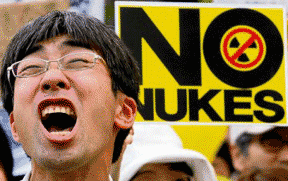 “We are against the restart,” protestors chanted to the beat of
  drums as they faced a line of riot police.
On Friday, tens of thousands of people gathered on streets outside the premier’s residence in central Tokyo with organisers estimating the turnout at up to 180,000.
Protesters try to block Japan nuclear switch-on, Radio Australia 1 July 2012, Engineers in Japan have begun refiring an atomic reactor, despite growing public protests in the aftermath of meltdowns at Fukushima.
Local media reported that the process to restart Unit No. 3 at Oi in western Japan began around 9:00 pm (1200 GMT).
It had earlier been reported that control rods that have prevented an atomic reaction would be removed and fission would begin. The reactor was expected to reach criticality early Monday morning.
A noisy demonstration near the power station that had begun earlier in the day was continuing, live streamed footage showed. Continue reading
Pro nuclear advocates stack Japan’s committee to plan retreat from nukes!
 The subcommittee consists of 25 members, of whom only about eight favor abandoning nuclear energy.
Is this not odd for a group that is supposed to be discussing ways to steer Japan from nuclear power generation?
The Prometheus Trap/ Tug of war over future of nuclear energy, The Asahi Shimbun. KIYOSHI OKONOGI 29 June 12, “…..The Fundamental Issues Subcommittee of the Advisory Committee for Natural Resources and Energy, which advises the minister of economy, trade and industry, was in session on April 11 at the ministry building in Tokyo’s Kasumigaseki district. The task of this subcommittee was to discuss the policy of the administration of Prime Minister Yoshihiko Noda to wean the nation off nuclear power generation. Continue reading
Solar Centre opens in western Japan, many more to come
JAPAN OPENS SOLAR ENERGY PARKS 7 News, July 2, 2012 TOKYO (AFP) – Japan opened several solar energy
parks on Sunday as a new law came into force requiring companies to purchase renewable energy at a fixed price in a push for alternatives to nuclear power…. A new solar centre opened in Kyoto in western Japan, while various municipalities also started up installations able to provide energy for hundreds of thousands of households.
Japanese telecommunications Softbank chief Masayoshi Son, opposed to nuclear energy since a powerful earthquake and tsunami last year that crippled reactor cooling systems, said it had plans for 11 solar or windpower centres in Japan.
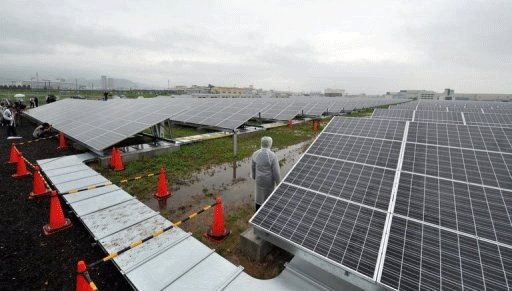
The push to invest in renewable energy resources is a mark of Japan’s search for alternatives to nuclear power, as 49 reactors out of 50 in the country have been shut down for safety checks and amid growing public protests. The new law that took effect on Sunday requiring power companies to purchase all renewable energy at a fixed tariff is aimed at encouraging firms to pursue sustainable initiatives. The government estimates the power provided by renewable energy this
year in Japan will attain 2,500 megawatts, the equivalent of two medium-sized nuclear reactors.
http://au.news.yahoo.com/world/a/-/world/14100878/japan-opens-solar-energy-parks/
North Korea’s former leader wanted mass production of nuclear bombs

 Kim Jong-il ordered mass production of uranium bombs: papers http://english.yonhapnews.co.kr/northkorea/2012/07/02/16/0401000000AEN20120702003200315F.HTML TOKYO, July 2 (Yonhap) — North Korea’s late leader Kim Jong-il had ordered his officials to mass-produce nuclear bombs by using highly enriched uranium, Japanese news reports said Monday, citing an internal document obtained from Pyongyang. Continue reading
Japan’s nuclear reprocessing reactor’s astronomic costs
Fast breeder reactor far costlier than regular nuclear power generation http://english.kyodonews.jp/news/2012/06/166571.html TOKYO, June 29, Kyodo If the development of the controversial Monju prototype fast breeder reactor is continued, its costs will swell to over 1.4 trillion yen and its power generation costs will be 10,000 yen per kilowatt hour, roughly 1,000 times greater than a regular reactor, according to data compiled by Kyodo News.
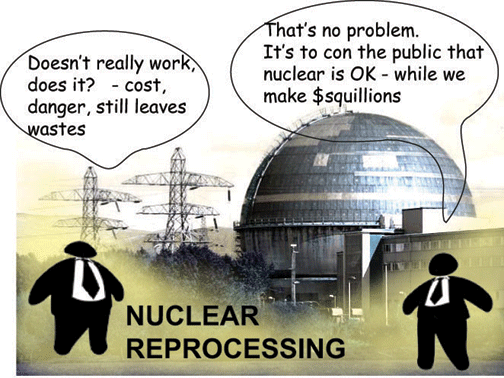
Construction of the Monju reactor started in Tsuruga, Fukui Prefecture, in 1985 as part of the government’s policy of establishing a nuclear fuel cycle to make use of spent nuclear fuel at conventional atomic plants that run on uranium. Monju uses a uranium and plutonium mix as fuel.
The facility of the government-affiliated Power Reactor and Nuclear Fuel Development Corp. first reached criticality, a situation where a chain reaction of nuclear fission is sustained, in 1994. http://english.kyodonews.jp/news/2012/06/166571.html
100,000 Japanese rally against restart of nuclear power
Huge Tokyo Rally Protests Nuclear Restart By MITSURU OBE And ELEANOR WARNOCK, WSJ, June 29, 2012, TOKYO—Tens of thousands of people protested against the nation’s first nuclear reactor restarts at the Japanese prime minister’s residence Friday, in one of the largest demonstrations since the accident at the Fukushima Daiichi plant last year set off wide opposition to nuclear power.
The massive demonstration was called to protest a government decision to restart Sunday two reactors at the Oi plant in western Japan. It was the 14th demonstration organized by a coalition of anti-nuclear groups outside the premier’s residence since March 29. Organizers estimated the number of participants to be more than 100,000. The National Police Agency, which also releases estimates, was unavailable for comment. The looming restart of the two Oi reactors, a decision
made by Prime Minister Yoshihiko Noda’s administration amid power-shortage concerns, seems to have galvanized support for Friday’s demonstration.
The sidewalks in front of the prime minister’s office and near the Parliament were overflowing with protesters. Some participants carried handwritten signs, while others held aloft elaborate placards reading ”No Restarts.” For more than two hours the crowd kept up a rhythmic cheer of “Against the restarts, against the restarts, against the restarts.”….
http://online.wsj.com/article/SB10001424052702303649504577496802810864704.html?mod=googlenews_wsj
USA joining with China to develop thorium nuclear reactors
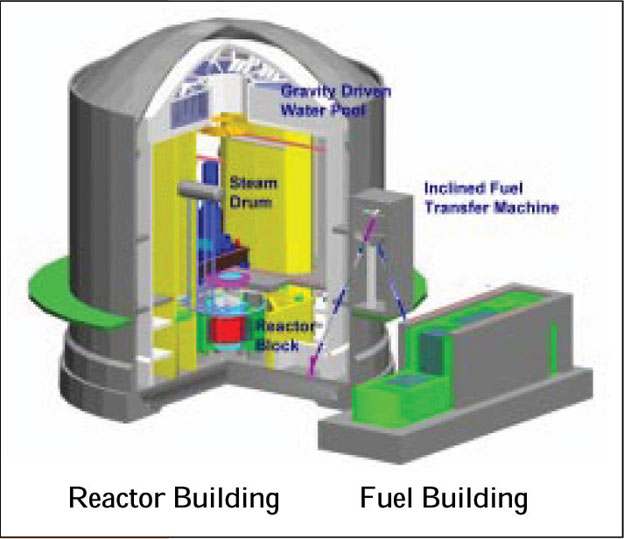 What’s not clear is what, exactly, the U.S. will get from the collaboration….
U.S. partners with China on new nuclear, By Mark Halper Smart Planet June 26, 2012 E Pluribus Thorium? U.S. Assistant Energy Secretary Peter Lyons and Chinese Academy of Sciences’ Jiang Mianheng have joined forces for thorium development. What’s in it for the U.S.?
The U.S. Department of Energy is quietly collaborating with China on an alternative nuclear power design known as a molten salt reactor that could run on thorium fuel Continue reading
Radiation incident at Rawatbhata atomic power station in Rajasthan
 Two suffer radioactive exposure at Rawatbhata atomic power station, The Hindu, 29 June 12, Two workers of the Rawatbhata atomic power station in Rajasthan are under observation after they were found to have been exposed to radioactive tritium vapour beyond the permissible limit.
The incident took place on June 23 at Unit 5 when a modification work was on during a routine biennial shutdown…. A report on the NPCIL website said the incident occurred due to an “inadvertent” rise in tritium levels in a localised area of the containment building of
reactor-5. “The localised increase in the tritium [in turn] occurred due to the opening of the moderator cover gas line, where welding jobs were to be performed.”
http://www.thehindu.com/news/national/article3585956.ece
Group for Zero Nuclear Power – a new force in Japan’s Parliament
(Group for Zero Nuclear Power), made up of nine politicians from seven political parties
 The lawmakers’ group plans to campaign for a phased scrapping of nuclear reactors, similar to the policy adopted by Germany.
Experts warn against restarting nuclear reactors in Japan, Times of India, Subodh Varma, TNN | Jun 28, 2012, NEW DELHI: Japan is in ferment as the date for restarting two of its nuclear reactors draws close after over an year’s shutdown. Hundreds have participated in protests at several places. Local councils are confused and divided. Two seismic experts publicly warned that the government is under-estimating the threat to these reactors which are located very near a seismic fault.
And a group of lawmakers cutting across political parties released a danger ranking of 50 nuclear reactors in Japan calling for their phased decommissioning. …. Continue reading
Malaysian govt insists that Lynas might have to take its radioactive wastes back to Australia
The Temporary Operating License will only be issued after Lynas fulfils two new conditions imposed

 AELB: Lynas committed to returning radioactive waste to AustraliaThe Malaysian Insider By Lisa J. Ariffin June 28, DENGKIL, June 28 — Lynas is committed to return all potentially harmful waste from its rare earths plant here to Australia despite its government’s firm refusal to take it in, Malaysia’s radiation regulator said today.
The Atomic Energy Licensing Board (AELB) told reporters today the Australian miner would have to send home all residue that could not be turned into commercial products or if a location for a permanent disposal facility (PDF) here could not be determined or approved.
“Lynas will have 10 months to come up with a permanent disposal facility plan for its radioactive residue upon receiving its temporary operating license (TOL),” said Dr Noor Hasnah Mohamed Khairullah who is special adviser to the AELB director-general.
“If they fail to find a location for the PDF, or if the plan is not approved, then Lynas has to return the residues back to Australia. Continue reading
To save TEPCO Corporation, Japan’s govt plans a big restart of nuclear energy
Tepco’s Plans Restart of World’s Biggest Nuclear Plant, Bloomberg News By Tsuyoshi Inajima and Yuji Okada June 28, 2012 Tokyo Electric Power Co. (9501), owner of the crippled Fukushima reactors, is committed to restarting another nuclear plant next year that is the world’s largest and itself was damaged in a 2007 earthquake.
Bringing the Kashiwazaki Kariwa power station online, even though it sets up the state-controlled utility for further conflicts with a nuclear-weary public, is part of “Plan A,” President Naomi Hirose, 59, said in an interview. The plan refers to a 10-year business reconstruction that handed control of the power company known as Tepco to Japan’s government. “We have no choice right now but to do our bestto carry out Plan A,” Hirose said on June 18. “We don’t have a Plan B.”

Tepco’s decision runs counter to polls showing the majority of Japanese want less reliance on atomic power after meltdowns at its Fukushima Dai-Ichi reactors last year. The radiation release and cost to the public of as much as $138 billion sparked anti-nuclear sentiment across the world. In Japan, all 50 reactors, including the seven at Kashiwazaki Kariwa, have been required to pass so-called stress tests introduced to improve safety after the Fukushima
disaster. Only two near the western city of Osaka have won permission
to resume operations, leaving 48 offline.
“Tepco’s plan is only wishful thinking” because no more reactors are likely to be approved this year, said Tomoko Murakami, a Tokyo-based nuclear analyst at the Institute of Energy Economics, Japan. “Without the restart, there is not much hope to revive the company.”…… http://www.businessweek.com/news/2012-06-27/tepco-s-new-chief-sees-no-plan-b-to-revive-profitability
Fukushima nuclear reactor No.1 cleanup stalled by lethal levels of radiation

 Fukushima radiation at record high RECORD amounts of radiation have been detected at the Fukushima nuclear reactor, further hampering clean-up operations. http://www.heraldsun.com.au/ipad/fukushima-radiation-at-record-high/story-fn6s850w-1226410635366 28 June 12 TEPCO, the operator of Japan’s crippled nuclear plant, took samples from the basement of reactor number 1 after lowering a camera and surveying instruments through a drain hole in the basement ceiling.
Radiation levels above radioactive water in the basement reached up to 10,300 millisievert an hour, a dose that would kill humans within a short time after making them sick within minutes. The annual allowed dose for workers at the stricken site would be reached in only 20 seconds.
“Workers cannot enter the site and we must use robots for the demolition,” said TEPCO.
The Fukushima operator said that radiation levels were 10 times higher than those recorded at the plant’s two other crippled reactors, number two and three. This was due to the poor state of the nuclear fuel in the reactor compared to that in the two others.
The meltdown at the core of three of Fukushima’s six reactors occurred after the March 11, 2011 earthquake and ensuing massive tsunami shut off the power supply and cooling system.
Demolition of the three reactors as well as the plant’s number 4 unit is expected to take 40 years and will need the use of new technologies.
1 This Month
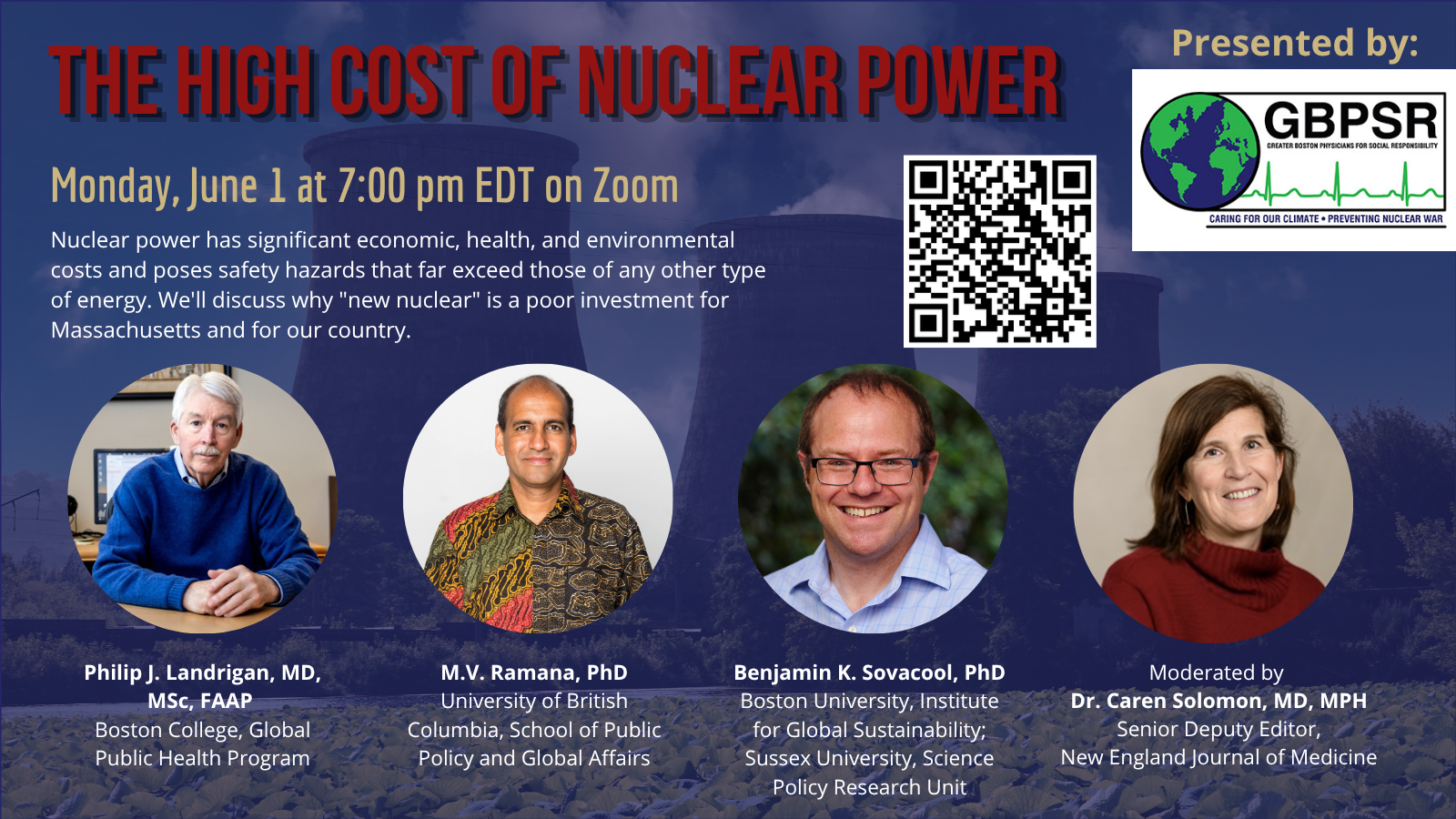
1 June Webinar – The High Cost of Nuclear Power – Register


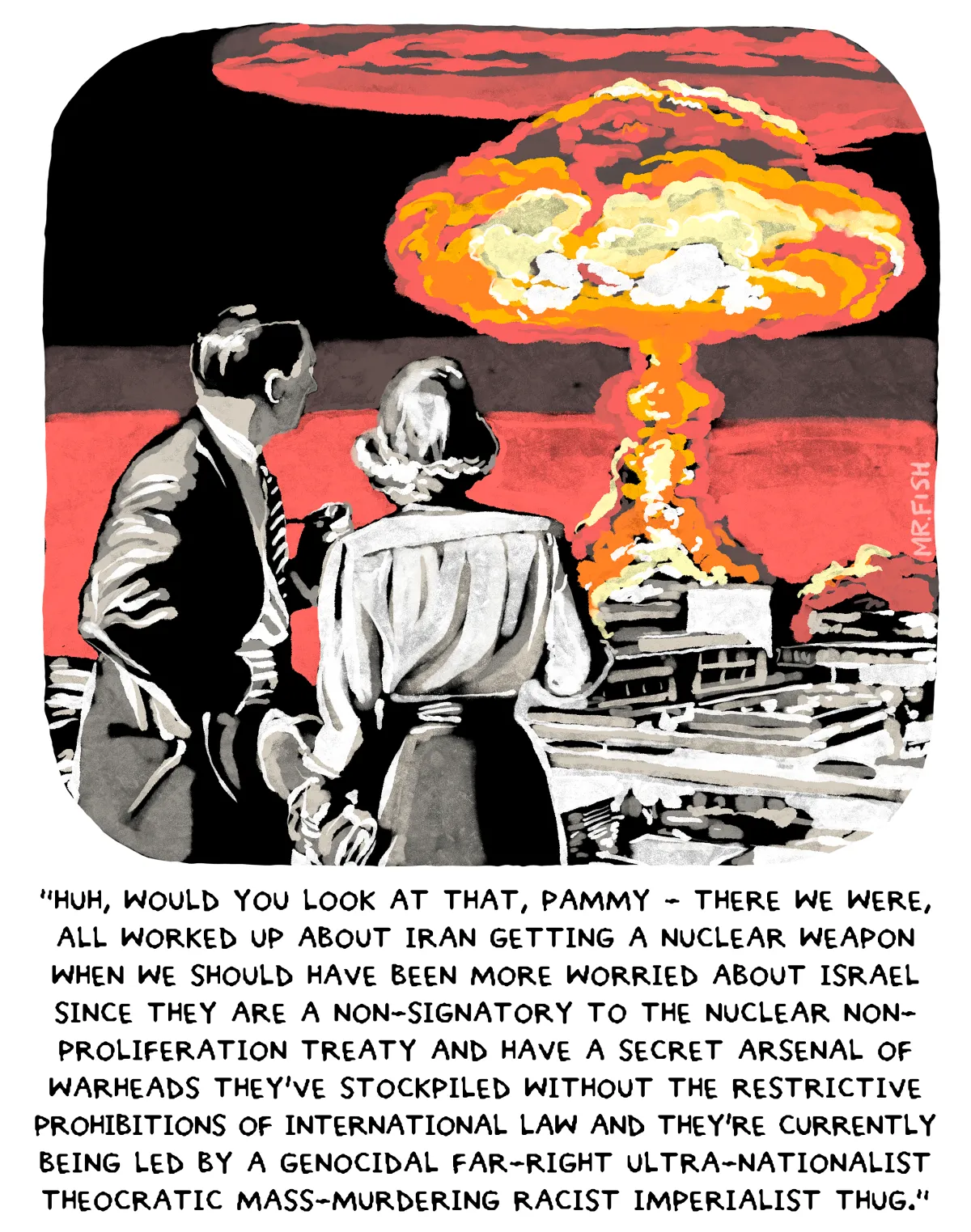
of the week– Nuclear Reactor Information Task Force
To see nuclear-related stories in greater depth and intensity – go to https://nuclearinformation.wordpress.com
-
Archives
- May 2026 (243)
- April 2026 (356)
- March 2026 (251)
- February 2026 (268)
- January 2026 (308)
- December 2025 (358)
- November 2025 (359)
- October 2025 (376)
- September 2025 (257)
- August 2025 (319)
- July 2025 (230)
- June 2025 (348)
-
Categories
- 1
- 1 NUCLEAR ISSUES
- business and costs
- climate change
- culture and arts
- ENERGY
- environment
- health
- history
- indigenous issues
- Legal
- marketing of nuclear
- media
- opposition to nuclear
- PERSONAL STORIES
- politics
- politics international
- Religion and ethics
- safety
- secrets,lies and civil liberties
- spinbuster
- technology
- Uranium
- wastes
- weapons and war
- Women
- 2 WORLD
- ACTION
- AFRICA
- Atrocities
- AUSTRALIA
- Christina's notes
- Christina's themes
- culture and arts
- Events
- Fuk 2022
- Fuk 2023
- Fukushima 2017
- Fukushima 2018
- fukushima 2019
- Fukushima 2020
- Fukushima 2021
- general
- global warming
- Humour (God we need it)
- Nuclear
- RARE EARTHS
- Reference
- resources – print
- Resources -audiovicual
- Weekly Newsletter
- World
- World Nuclear
- YouTube
-
RSS
Entries RSS
Comments RSS
 nuclear-news