Bangladesh goes solar
Bangladesh sees surge in use of solar energy , 31 Jul 2012 Alertnet By Syful Islam DHAKA, Bangladesh As costs fall and incomes rise, power-hungry Bangladesh is seeing a surge in the adaptation home solar energy systems.
Last year, close to 40,000 units a month were installed on average across the country; this year installations have surged to 55,000 a month, according to Ruhul Quddus, head of the Rural Services Foundation, a Bangladeshi charity. His charity is installing 11,000 solar power systems a month, up from 8,000 a month last year, he said.
Altogether, 30 percent more homes are using solar power in Bangladesh than a year ago – a change driven by a rise in purchasing capacity and falling prices.
“Rural people now want to improve their quality of life,” including by trading kerosene lamps for solar and using the latest electrical appliances, said Abser Kamal, chief executive office of Grameen Shakti, a pioneering organisation in renewable energy in Bangladesh.
Per capita income has been rising in Bangladesh in recent years as the country’s growth rate has improved. During the last fiscal year, per capita hit income hit $848 a year, up from $676 three years ago, according to government figures. The country’s growth rate during the last fiscal year was 6.32 percent, and this year the government is targeting growth of 7.2 percent.
Installing solar power in their homes helps families with a variety of tasks, Kamal said.
A RANGE OF BENEFITS….. http://www.trust.org/alertnet/news/bangladesh-sees-surge-in-use-of-solar-energy
Green Party formed in Japanese politics
Japanese Green Party forms with an eye on national politics, Asahi Shimbun, July 30, 2012 By KOJI SONODA Sensing the timing is right, a Japanese version of the environmentalist Green Party has been formed to nudge Japan to abandoning nuclear power by fielding candidates in upcoming national elections. subscription only
A medical view on what is really going on in Fukushima
 What Really Happened in Fukushima : A Report From a Medical Care Provider http://fukushimavoice-eng.blogspot.com.au/2012/07/what-really-happened-in-fukushima.html?spref=tw Part 1, December 21, 2011

I am a medical care provider. At my workplace we began taking care of patients from the evacuation zone from Fukushima Daiichi nuclear power plant in the evening of March 11, 2011.
The president of the hospital where I am employed says people live longer when irradiated and Fukushima people now will be healthier because of radiation hormesis. There is no argument allowed. Since this statement comes from a physician, many people believe this in Fukushima.
Those who were contemplating on evacuating from Fukushima are now in a mental state that is not even conducive to thinking about it any longer. This was becoming obvious beginning in April or May, 2011, and it might have been a coping mechanism for mass psychology and dangers. However, it is entirely different now. I feel they are no longer capable of avoiding dangers.
This is what I heard from a clinical laboratory technician at work. Thyroid ultrasound examinations for children, which have already been done in my town and which will be held in other cities from now on, are being performed by Fukushima University Medical School Hospital laboratory technicians who have only done blood tests before. In other words, they are being done by people who have never used ultrasound equipment before.
Technicians are being dispatched from Fukushima University Medical School. For instance, there is a whole body counter car stationed in Kawamata-machi, Date district, where a part of the town is a deliberate evacuation area. There are physicians and clinical laboratory technicians stationed there, and they are all young.
Currently there is ”that” Yamashita stationed at Fukushima University Medical School. After being dismissed as the radiation advisor for Fukushima prefecture, he became a vice president for Fukushima University Medical School. The reason not a single Fukushima physician even mentions medical care for radiation exposure is because of the power of Fukushima University Medical School. Physicians in Fukushima who are not self-sufficient are not allowed to provide medical care for radiation exposure, and those who are self-sufficient left Fukushima.
Yamashita and Fukushima University Medical School are planning on creating a cancer center (already publicized). Minami Tohoku General Hospital in Koriyama-city, which has been introducing Gamma Knife and PET for cancer treatments on a large scale, has not had any say. It is obvious this is because of Fukushima University Medical School.
I have also learned the following from a radiology technician in mid-March, 2011. Test anomalies began to show in Kanto summer of 2011 also. But in mid-March, X-rays for a particular patient began to show white spots. They didn’t show up if the patient was undressed. They didn’t show up in X-rays of other patients who were examined at the hospital. This particular patient was actually not even an evacuee but a resident who lived 45 kilometers from the Fukushima Daiichi nuclear power plant.
The technician initially thought they were dust specks, but they were clearly bright spots. It was determined that clothes hung up to dry outside must have radioactive materials attached to them. This “finding” was reported as such to the hospital president as well as the prefectural office. At the time we had no idea what was going on at Fukushima Daiichi, and it was reported as a proof that “the radioactive materials have reached as far as here,” but it was never publicized.
Inadequate medical screening of Fukushima evacuees, especially children
 Red Cross Team said “We were told by headquarters not to provide medical care for those exposed to radiation” after 3/11 –Hospital Worker July 28th, 2012 By ENENews
Title: What Really Happened in Fukushima A Report From a Medical Care Provider Source: FukushimaVoice
What Really Happened in Fukushima A Report From a Medical Care Provider Part 2, December 22, 2011
Please let me explain about what happened immediately after the earthquake.
On March 11, 2011, we began to have more and more evacuees from Futaba-machi.
 We accepted both inpatients and outpatients without any manual or instruction for medical care for radiation exposure. However, Fukushima University Medical School Hospital only accepted the seriously injured (essentially refusing to accept evacuees) and the Red Cross medical team said “we were told by the headquarters not to provide medical care for those exposed to radiation.”
They stayed for three days, but the Red Cross medical team went to another prefecture without seeing any patients.
More and more evacuees were coming in. There was a talk of making this hospital a screening center in order to provide adequate screening examinations, but it was stopped by Fukushima University Medical School.
By the way, what was called screening examination was contamination examination of body surface by gamma survey meters.
Incidentally there is something important I would like to add. There was a “thyroid examination” of children from Iitate-mura and Kawamata-machi at the end of March, 2011, but it was just like this screening examination. Of course there was nothing abnormal found. The children had taken a shower and changed their clothes beforehand.
Extreme rise in heart attack deaths in Fukushima
 Japanese Writer, Professor: “Extreme increase of mortality caused by cardiac disease” in Fukushima — Death rate “might give the creeps to some people” July 28th, 2012 By ENENews post from Ryuichi Akiba translated by Dissensus Japan:
It’s a report of the investigation on population shift and causes of death of the year before and January and February of this year.
It can provide valuable figure how much the extremely large amount of fallout released from Fukushima Daiichi damaged public health and life.
The “cause specific death rate” deserves careful attention.
The figure might give the creeps to some people.
In fact, the data shows that the number of death increased by 12.5% and the number of death caused by cardiac disease increased by 14.6% after the Fukushima nuclear accident.
What does the extreme increase of mortality caused by cardiac disease mean?
Dr.Yury Bandazhevsky of Belarus examined the people exposed to radiation and the people who had died of Chernobyl and clinically identified the association between Cesium radiation and cardiac disease.
We can’t either determine or deny the morbidity and mortality increased only because of radiation released from Fukushima Daiichi.
We need to pay attention to the next months’ vital statistics to figure this out.
What is needed most is clinical or epidemiologic study; statistic or report by independent doctors and researchers. We need many Bandazhevskys to save the children of Japan and all over the world.
The Health, Labor and Welfare Ministry yesterday released its monthly vital statistics of February 2012: http://www.mhlw.go.jp/toukei/saikin/hw/jinkou/geppo/m2012/02.html
- The number of death was up 12.5 percent (=12695 people) compared to the same month of the year before
- The number of death caused by Malignant Neoplasm was up 7.7%(=2066 people) from the same month of the year before
- The number caused by cardiac disease was up 14.6% (=2585 people)
Busting the pro nuclear positive spin by TEPCO
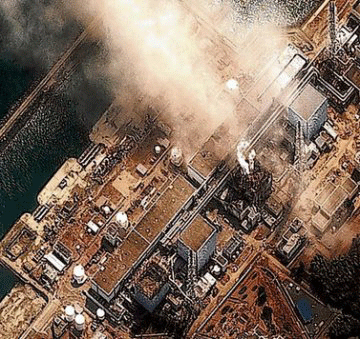 Ex-Fukushima Daiichi Worker: “There are leaks everywhere” — Tepco portraying situation in best possible light http://enenews.com/ex-fukushima-daiichi-worker-there-are-leaks-everywhere-tepco-portraying-situation-in-best-possible-light July 26th, 2012 By ENENews Takahashi Kei, a former cooling system worker at the plant now working as a radiation survey volunteer, said [Tepco’s] executives are portraying the situation in the best possible light.
“There are leaks everywhere, wreckage too. It’s not as simple as they portray,” he said.
TEPCO acknowledges that three reactors at the plant remain full of melted and re-solidified fuel that must be removed and that spent fuel pools elsewhere on the grounds must be kept cool to prevent them from releasing radiation again. It estimates it will take about 40 years to
completely decommission the site.
The children of Fukushima.
Fukushima Daiichi has been like a suppurating wound, leaching radionuclides into the environment since March 2011,
 According to the American Thyroid Association (ATA), thyroid problems from nuclear events occur when radioactive iodine is leaked into the atmosphere and thyroid cells that absorb too much of this radioactive iodine may become cancerous, with children being particularly susceptible.
Fukushima – Local Children Unwitting Guinea Pigs, Scoop, By. John C.K. Daly of Oilprice.com, 27 July 2012, “…….The issue of nuclear radiation on human health cites besides Fukushima the August 1945 U.S nuclear bombings of Hiroshima and Nagasaki and the April 1986 explosion of the Chernobyl reactor complex in Ukraine, but in reality, there are no comparisons to evaluate Fukushima. Continue reading
Shoddy way that India’s government overrides anti nuclear villagrers
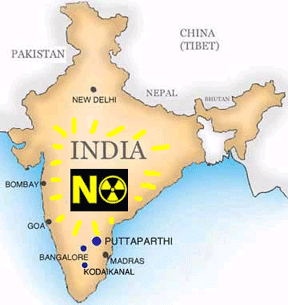
 Nuclear showdown in Delhi’s neighbourhood Rediff, 26 July 12, 2012 Gopal Krishna Plans to build India’s biggest indigenous nuclear power plant have failed to impress villagers in Haryana’s Fatehabad district, who fear a Fukushima-type disaster. The shoddy way in which the government agencies have handled the issue has not helped matters either. Gopal Krishna reports.
The angry protest by Haryana villagers against the proposed nuclear plant 210 km from Delhi on July 17 — a day after biggest rally in
Tokyo demanded an end to nuclear power — signifies the unity of the
struggle against nuclear power.
In Fatehabad, a big dharna and conference is planned on August 17, 2012 against the Gorakhpur nuclear power project. Continue reading
Changing nature of Japan’s anti nuclear movement
Political Clout of Japan’s Anti-Nuke Movement Tested By YUKA HAYASHI And TOKO SEKIGUCHI, 28 July 12, TOKYO—Two events Sunday will test the political influence of Japan’s growing movement against nuclear power: a regional election featuring one of the country’s most prominent industry critics, and a 1960s-style surround-the-parliament protest aimed at evoking memories of past mass demonstrations. Continue reading
Mihama reactor 2 turns 40 years; future uncertain, Japan Times, Kyodo TSURUGA, Fukui Pref. 27 July 12 — Reactor 2 at the Mihama nuclear power plant in Fukui Prefecture marked its 40th year in operation Wednesday, while the government weighs allowing the now-idled unit to keep running longer than originally planned.
The Nuclear and Industrial Safety Agency last week approved changes in safety regulations to permit reactors to keep running for more than 40 years.
All but two of Japan’s 50 commercial nuclear reactors are now shut down due to safety concerns in the wake of the meltdowns at the Fukushima No. 1 plant in March 2011. Before they can be restarted, the reactors must pass “stress tests” to check their ability to withstand
earthquakes and tsunami.
The 500,000-kw reactor 2 at the Mihama plant, operated by Kansai Electric Power Co., is the third-oldest commercially run reactor in Japan. The two older are reactor 1 at Japan Atomic Power Co.’s Tsuruga plant, also in Fukui, and reactor 1 at the Mihama plant….. http://www.japantimes.co.jp/text/nn20120726a9.html
Corrosion at Hamaoka nuclear power station
 Corrosion confirmed at Japan nuke plant — Seawater flowed into reactor pressure vessel — Years before prospects will be known http://enenews.com/corrosion-confirmed-at-japan-nuke-plant-seawater-flowed-into-reactor-years-before-prospects-for-reactor-will-be-known
July 26th, 2012 By ENENews In a fresh development adding to local worries, Chubu
Electric Power Co. said Wednesday that many parts of reactor 5 at its Hamaoka nuclear power station in Shizuoka Prefecture have been confirmed corroded. Continue reading
NHK: International nuclear experts turning attention to Onagawa nuke plant — Intensity of 3/11 quake exceeded maximum limit (VIDEO) http://enenews.com/nhk-nuclear-experts-turning-attention-to-onagawa-nuclear-plant-intensity-of-311-quake-exceeded-maximum-limit-video July 26th, 2012
By ENENews Title: IAEA to assess quake resistance at Onagawa plant Source: NHK World
Data at some nuclear plants in northern and eastern Japan show that the intensity of the quake exceeded the maximum level assumed by the plants’ designers.
Officials from the IAEA and foreign experts will visit the Onagawa nuclear plant in Miyagi Prefecture on Monday for an on-site assessment.
Japan’s Nuclear and Industrial Safety Agency says the team will enter the plant’s No.1 through No.3 reactors to examine piping and the cooling system. They will also check the condition of the nuclear fuel pools.
But this is the first time since last year’s disaster that it will assess quake resistance at a nuclear plant in Japan.
Fukushima casual workers got 4 times as much radiation as employees
Radiation doses 4 times larger for ‘outside workers’ at nuclear plants , Asahi Shimbun, July 26, 2012 By TOSHIHIRO OKUYAMA/ Staff Writer Nuclear plant workers not employed by the operating utilities were exposed to nearly four times the radiation doses received by utility employees, indicating that “outside workers” are often assigned the dangerous tasks, statistics showed....subscription only .
http://ajw.asahi.com/article/0311disaster/fukushima/AJ201207260071
Suspicious geological faults http://www.japantimes.co.jp/text/ed20120727a1.html 27 July 12, The trade and industry ministry’s Nuclear and Industrial Safety Agency (NISA) on July 18 ordered Kansai Electric Power Co. (Kepco) and Hokuriku Electric Power Co. to carry out geological surveys, including boring, at the Oi nuclear power plant in Fukui Prefecture and the
Shika nuclear power plant in Ishikawa Prefecture, respectively.
This is because of suspicions having been raised that fault crushing belts running through the Oi plant site and a fault running through the Shika plant site are active faults. Continue reading
Nuclear showdown in Delhi’s neighbourhood Rediff, 26 July 12, July 26, 2012 Gopal Krishna “………. The three levels of conflict of interest that have been identified in
the EIA process for nuclear facilities are relevant for the EIA report of the proposed atomic power plant in Fatehabad.
First, the EIA is prepared by consultants who are retained to work on behalf of, and by implication act in the interests of, their client — the nuclear organization proposing the project.
Second, the organization that has been tasked with preparing the EIA to support its proposal for a project is the same which will benefit from the project.
The third conflict of interest is that the regulatory agency Atomic Energy Regulatory Authority is itself regulated by the nuclear power promoters, the Atomic Energy Commission, which is under the direct charge of Prime Minister Manmohan Singh.
The EIA report reveals that the water requirement for the project will be met from Fatehabad branch of the Bhakra canal. Unlike sea as a source of water in the case of Fukushima, in Fatehabad, canal water is the only source for water….” http://www.rediff.com/news/slide-show/slide-show-1-nuclear-showdown-in-delhi-s-neighbourhood-fatehabad/20120726.htm
1 This Month
23-25 October – on Zoom – World BEYOND War’s annual global conferenc


Shut down the radiation-damaged Heysham nuclear reactors now
To see nuclear-related stories in greater depth and intensity – go to https://nuclearinformation.wordpress.com

Say No to NASA’s Reckless Nuclear Reactor on the Moon
Say No to NASA’s Reckless Nuclear Reactor on the Moon

-
Archives
- October 2026 (190)
- September 2026 (339)
- August 2026 (330)
- July 2026 (355)
- June 2026 (287)
- May 2026 (306)
- April 2026 (356)
- March 2026 (251)
- February 2026 (267)
- January 2026 (308)
- December 2025 (358)
- November 2025 (359)
-
Categories
- 1
- 1 NUCLEAR ISSUES
- business and costs
- climate change
- culture and arts
- ENERGY
- environment
- health
- history
- indigenous issues
- Legal
- marketing of nuclear
- media
- opposition to nuclear
- PERSONAL STORIES
- politics
- politics international
- Religion and ethics
- safety
- secrets,lies and civil liberties
- spinbuster
- technology
- Uranium
- wastes
- weapons and war
- Women
- 2 WORLD
- ACTION
- AFRICA
- Atrocities
- AUSTRALIA
- Christina's notes
- Christina's themes
- culture and arts
- Events
- Fuk 2022
- Fuk 2023
- Fukushima 2017
- Fukushima 2018
- fukushima 2019
- Fukushima 2020
- Fukushima 2021
- general
- global warming
- Humour (God we need it)
- Nuclear
- RARE EARTHS
- Reference
- resources – print
- Resources -audiovicual
- Weekly Newsletter
- World
- World Nuclear
- YouTube
-
RSS
Entries RSS
Comments RSS

