Fukushima workers faked radiation doses, to keep their jobs
 Without faking the exposure level, the executive told the workers they would quickly reach the legally permissible annual exposure limit of 50 millisieverts,
Japan firm ‘told workers to lie about radiation dose’ News.com.au July 21, 2012 Workers at the crippled Fukushima nuclear plant in Japan were apparently told to lie about radiation.
A SUBCONTRACTOR at Japan’s crippled Fukushima nuclear plant reportedly told workers to lie about possible high radiation exposure. Continue reading
Falsified radiation doses for Fukushima workers
the executive instructed about four workers to make the [lead shield] covers…
Radiation dosages ‘falsified’ The Yomiuri Shimbun/Asia News Network Asia One News, Jul 23, 2012 The health ministry is investigating allegations that a construction company ordered its workers at the crippled Fukushima No. 1 nuclear power plant to cover their dosimeters with lead to indicate lower exposure levels, according to sources. Continue reading
New government inquiry finds that Japan’s nuclear reactors are still unsafe
 Japan nuclear plants ‘still not safe’ Report from independent panel delivers damning assessment of country’s nuclear regulator and Fukushima plant operator. Aljazeera 23 Jul 2012 A government-appointed inquiry has delivered a damning assessment of Japanese nuclear regulators and the operator of the Fukushima nuclear power plant, raising further fears that despite new rules, the country’s nuclear sector still does not meet safety requirements.
The 450-page report by a 10-member panel of independent experts was released on Monday, and comes as anti-nuclear activists continue a vociferous campaign against the restarting of two nuclear reactors in the country.
The government is currently readying a new energy policy, due next month. Continue reading
Fukushima’s children: more than a third at risk of developing cancer
doctors are outraged that the results are not being sufficiently publicized.
The World Health Organization warns that young people are particularly prone to radiation poisoning in the thyroid gland. Infants face the direst consequences, as their cells divide at a higher rate.
Children who were under 18 when the nuclear disaster struck last year will be subject to continuous thyroid examinations every two years until they reach 20 years of age, and after that, every five years for the rest of their lives.
 Over a third of Fukushima children at risk of developing cancer http://www.rt.com/news/fukushima-children-radiation-exposure-abnormalities-632/ 20 July, 2012,Over a third of children in Japan’s Fukushima region could be prone to cancer if medics don’t apply more effort in treating their unusually overgrown thyroid glands and commit to international health aid and consultations, according to a new report.
The shocking new report shows that nearly 36 per cent of children in the nuclear disaster-affected Fukushima Prefecture have abnormal thyroid growths. This is an extremely large number of abnormalities – some of which, experts say, pose a risk of becoming cancerous.
After examining more than 38,000 children from the area, medics found that more than 13,000 have cysts or nodules as large as 5 millimeters on their thyroids, the Sixth Report of Fukushima Prefecture Health Management Survey states.
In comparison, a 2001 analysis by the Japan Thyroid Association found that fully zero per cent of children in the city of Nagasaki, which suffered a nuclear attack in August of 1945, had nodules, and only 0.8 per cent had cysts on their thyroids, reports the Telegraph.
Radiation enters the body and is distributed through soft tissue, especially in muscle, and then accumulates in the thyroid. It is this accumulation that can potentially lead to cancer. Continue reading
Japan’s ruling party ‘fracturing’ over nuclear power
Newspapers reported on Friday that the government had picked Shunichi Tanaka, 67, an expert in radiation physics and a former deputy head of the Cabinet Office’s Atomic Energy Commission, to head the new safety regulator.
some saying he represented Japan’s “nuclear village” — a nexus of politicians, utilities and regulators that experts say was a major factor in the failure to avert the Fukushima disaster. …..
 Ex-Japan PM joins anti-nuclear demo outside PM’s office
* Ex-PM Hatoyama at anti-nuclear rally bad news for PM Noda
* Efforts to pick new atomic safety commission members snags after media leak
* Nuclear energy becoming bigger part of political debate (Recasts with ex-PM Hatoyama joining anti-nuclear demo near)
By Mari Saito and Tetsushi Kajimoto TOKYO, July 20 (Reuters) – In a rare move by a former Japanese prime minister, Yukio Hatoyama joined a boisterous anti-nuclear demonstration outside his old office on Friday, a fresh sign that the ruling party he once led is fracturing over energy and other policies. Continue reading
20,000 cleanup workers not counted, in estimating Fukushima cancer risks

 Thousands More Radiation-Related Deaths Expected From Fukushima, Asian Scientist, Study By Rebecca Lim July 20, 2012 Thousands of deaths could still be expected from the Fukushima nuclear fallout in the years to come, according to the first estimate of the disaster’s worldwide impact AsianScientist (Jul. 20, 2012) –
The research, published in the latest edition of the journal Energy & Environmental Science, found that inhalation exposure, external exposure, and ingestion exposure of the public to radioactivity may result in up to 1,300 cancer mortalities and up to 2,500 cancer morbidities worldwide, mostly in Japan.
Stanford University researchers John Ten Hoeve and Mark Jacobson feel that the risk of a meltdown is not small, given that “modest to major radionuclide releases (occurred) in almost 1.5 percent of all reactors ever built.”….
Estimates in the paper do not account for the increased radiation risk to the roughly 20,000 workers at the plant in the months following the accident.
Psychological effects such as depression, anxiety, fear, and unexplained physical symptoms which were seen post-Chernobyl, are likely to be repeated in evacuees after Fukushima, they say….
India’s farmers opposing nuclear power, and politicians taking up their fight
Nuclear power or not? Leaders fight it out (Haryana Newsletter) India Daily News, Chandigarh, July 20 — Leaders of all political hues in Haryana are fighting a nuclear war these days. The leaders have gone ballistic with their positioning over the issue of setting up a nuclear power plant in southwest Haryana. Continue reading
Media’s strange silence on thyroid abnormalities in Fukushima children
We also spoke with Dr. Bryan Haugen, president-elect of the American Thyroid Association and head of endocrinology at the University of Colorado School of Medicine, who hadn’t heard of the report before we contacted him.
Haugen agreed with the Caldicott’s assessment that it is surprising for kids to “have this many nodules and cysts seen, especially this soon after the accident,” and the fact that “this something that is not more widely known.”
The New York Academy of Sciences estimates that nearly one million people around the world have died from exposure to radiation released by the 1986 nuclear disaster at the Chernobyl reactor.
 CONFIRMED: 36 Percent Of Fukushima Kids Have Abnormal Thyroid Growths And Doctors Have Been Left In The Dark : http://www.businessinsider.com/fukushima-children-have-abnormal-thyroid-growths-2012-7#ixzz21CwegRH8 Michael Kelley | Jul. 19, 2012 A few days ago we reported that 36 percent of Fukushima children have abnormal thyroid growths likely from radiation exposure, based on the “Fukushima Prefecture Health Management Survey.”
We got in touch with Australian pediatrician Dr. Helen Caldicott, who has spoken about the growths, to ask her about the implications of the study.
After confirming the validity of the report, Caldicott reinforced the alarming nature of the findings:
1. “It is extremely rare to find cysts and thyroid nodules in children.”
2. “This is an extremely large number of abnormalities to find in children.”
3. “You would not expect abnormalities to appear so early — within the first year or so — therefore one can assume that they must have received a high dose of [radiation].”
4. “It is impossible to know, from what [officials in Japan] are saying, what these lesions are.”
Doctors worry about these abnormal growths because even though thyroid nodules are relatively common, they are not common in children and some of them could become cancerous. When asked why these results haven’t been widely reported, Calidcott noted that Japanese officials are not sharing ultrasound results with foremost experts of thyroid nodules in children and accused the media of “practicing psychic numbing,” saying that she doesn’t understand why media outlets are choosing to ignore the nuclear fallout. Continue reading
Japan now has to take its anti nuclear movement seriously
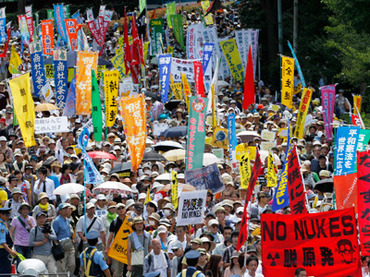
Hemmed in by police in the sweltering heat, the demonstrators are mostly
good-natured. But for how long?
Japan’s anti-nuclear protests The heat rises The restart of two nuclear reactors has belatedly lit a fuse under the Japanese, The Economist Jul 21st 2012 | TOKYO | PEOPLE power is not a phrase usually associated with Tokyo. A famously buttoned-up city, epitomised by its obedient ranks of identikit commuter salarymen, Tokyo rarely hosts serious protests…Suddenly, what had looked like the waning cause of a core of diehard liberals has become a protest movement. . … on July 16th tens of thousands braved 30-degree heat in a central Tokyo park to attend a “Sayonara Nukes” rally.
The generous sprinkling of ordinary families, as well as the 7.5m signatures that Mr Oe and company claim to have gathered, gave the protest more than nostalgic value. Its fuel was anger. Recent reports into last year’s triple Fukushima meltdown 210km (130 miles) away have shown that the world’s most crowded metropolis narrowly avoided
catastrophe.
Though many worry about the economic cost of scrapping nuclear power, others belatedly question the logic of having 54 commercial reactors in a country with one-fifth of the world’s strong earthquakes.
Even worse, people said, was that the government had restarted at least one nuclear reactor (a second was switched on again on July 18th) while questions still remain about the safety of nuclear power, and about a regulatory structure that took the threat of natural
disaster too lightly. Continue reading
Abnormal thyroid growths in 36% of Fukushima children
 36 Percent Of Fukushima Children Have Abnormal Growths From Radiation Exposure http://www.businessinsider.com/a-stunning-36-percent-of-fukushima-children-have-abnormal-growths-from-radiation-exposure-2012-7#ixzz21Cetabn4 Michael Kelley | Jul. 16, 2012, Of more than 38,000 children tested from the Fukushima Prefecture in Japan, 36 percent have abnormal growths – cysts or nodules – on their thyroids a year after the Fukushima nuclear disaster, as reported by ENENews.
The shocking numbers come from the thyroid examination section of the “Sixth Report of Fukushima Prefecture Health Management Survey,” published by Fukushima Radioactive Contamination Symptoms Research (FRCSR) and translated by the blog Fukushima Voice. Shunichi Yamashita, M.D., president of the Japan Thyroid Association, sent a letter to members in January with guidelines for treating thyroid abnormalities. In 2001 Yamashita co-authored a study that found normal children in Nagasaki to have 0 percent nodules and 0.8 percent cysts. Continue reading
Japan’s politicians starting to worry about (their jobs) and anti nuclear protests
as numbers swell there are indications the country’s usually inflexible politicians are getting worried and just might start paying attention.
they [protestors] are very ordered: protesters stick to the anti-nuclear message and go home in an orderly fashion at the appointed time.
But the demonstrations’ regularity and sheer size – – is giving the government pause for thought in a country where for decades the political elite has largely ignored popular opinion…..

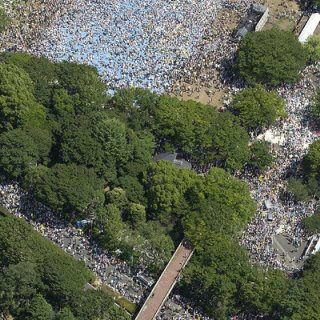 Nuclear fears galvanise Japan’s sedate society Channel News Asia: 20 July 2012 TOKYO: Japan’s usually sedate societyis angry and getting organised against nuclear power, with the kind of snowballing protest movement not seen for decades. Weekly demonstrations outside the prime minister’s residence attract tens of thousands of people and a rally in west Tokyo this week drew a crowd organisers claimed at 170,000, demanding an end to atomic power in post-Fukushima Japan.
And as numbers swell there are indications the country’s usually inflexible politicians are getting worried and just might start paying attention….. “No one used to care before (the disaster),” said
Masaki Yoshida, a mother-of-three who was forced from her Fukushima
home by the radiation-spewing plant. Continue reading
Lengthy and dangerous process to remove nuclear fuel rods
The pool at No. 4 was behind the secret worst-scenario mapped out by the government, which warned millions of people might have to flee from spewing radiation, including parts of the Tokyo area, which has a population of 35 million people. U.S. authorities have also repeatedly expressed worries about the spent-fuel pool at reactor No. 4.
“If we are asked whether things are completely safe, we cannot say that,” “If there is another major earthquake, we don’t know what may happen,
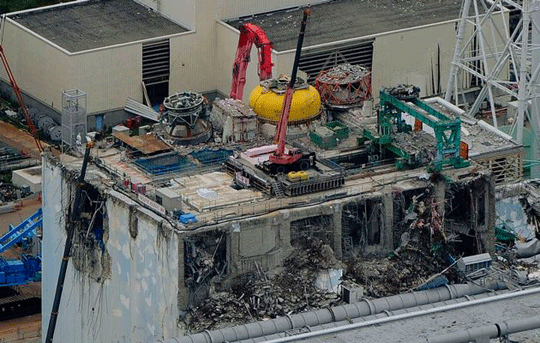
Japan removes two nuclear fuel rods from Fukushima plant Times Live Sapa | 18 July, 2012 A giant crane removed two rods packed with nuclear fuel from the Fukushima nuclear plant. This is the beginning of a delicate and long process to deal with a remaining risk of more radiation escaping from the disaster-struck plant.
All of the 1,535 rods next to reactor No. 4 at the crippled Fukushima Dai-ichi plant in northeastern Japan must eventually be removed from a spent-fuel pool to safer storage – an effort expected to take through the end of next year, according to the government. Continue reading
In last 24 hours – 3 earthquakes hit Fukushima
M4.5 quake hits Fukushima — Third M4 in last 24 hours July 19th, 2012 By ENENews Title: : Earthquake Information
Source: Japan Meteorological Agency Date: July 20, 2012 http://enenews.com/m4-5-quake-hits-fukushima-third-m4-in-last-24-hours
Earthquake fault line under Japan’s only operating nuclear reactor?
 Japan nuclear watchdog probes claims that country’s only working reactor sits on active fault line Warning comes just 18 months after tsunami wiped out Fukushima plant DAILY MAIL, 19 July 2012 Japan’s nuclear safety watchdog has ordered an investigation into claims the country’s only active nuclear power station is positioned above a tectonic fault line.
Geologists believe the Oi plant in Fukui Prefecture is at real risk of earthquake if the tectonic plates it sits on suddenly shift.
The news comes at a sensitive time for the Japanese nuclear industry – less than 18 months after a tsunami struck the nuclear power station at Fukushima, causing a meltdown…
The first reactor was fired up a few weeks ago and a second is planned to restart later in July. The power company insists it won’t alter its schedule, despite the order to examine the earth under the huge plant…. Experts reporting to the safety watchdog have also recommended tests are carried out at the nearby Shika plant, claiming both sites could be sitting on active fault lines. http://www.dailymail.co.uk/news/article-2176062/Japan-nuclear-watchdog-probes-claims-countrys-working-reactor-sits-active-fault-line.html#ixzz21C4tdqr4
High cesium levels in migratory fish in Pacific: Is Fukushima still leaking radiation?
 the persistently high cesium numbers may be a sign that the Fukushima plant is still leaking radiation into the ocean.
Lead scientist surprised by Japan data: Fukushima plant still leaking radiation into ocean? By ENENews Title: Post-Fukushima, Japan’s irradiated fish worry B.C. experts Source: Vancouver Free Press Author: Alex Roslin Date: July 19, 2012
The numbers show that far from dissipating with time, as government officials and scientists in Canada and elsewhere claimed they would, levels of radiation from Fukushima have stayed stubbornly high in fish. Continue reading
1 This Month
23-25 October – on Zoom – World BEYOND War’s annual global conferenc


Shut down the radiation-damaged Heysham nuclear reactors now
To see nuclear-related stories in greater depth and intensity – go to https://nuclearinformation.wordpress.com

Say No to NASA’s Reckless Nuclear Reactor on the Moon
Say No to NASA’s Reckless Nuclear Reactor on the Moon

-
Archives
- October 2026 (190)
- September 2026 (339)
- August 2026 (330)
- July 2026 (355)
- June 2026 (287)
- May 2026 (306)
- April 2026 (356)
- March 2026 (251)
- February 2026 (267)
- January 2026 (308)
- December 2025 (358)
- November 2025 (359)
-
Categories
- 1
- 1 NUCLEAR ISSUES
- business and costs
- climate change
- culture and arts
- ENERGY
- environment
- health
- history
- indigenous issues
- Legal
- marketing of nuclear
- media
- opposition to nuclear
- PERSONAL STORIES
- politics
- politics international
- Religion and ethics
- safety
- secrets,lies and civil liberties
- spinbuster
- technology
- Uranium
- wastes
- weapons and war
- Women
- 2 WORLD
- ACTION
- AFRICA
- Atrocities
- AUSTRALIA
- Christina's notes
- Christina's themes
- culture and arts
- Events
- Fuk 2022
- Fuk 2023
- Fukushima 2017
- Fukushima 2018
- fukushima 2019
- Fukushima 2020
- Fukushima 2021
- general
- global warming
- Humour (God we need it)
- Nuclear
- RARE EARTHS
- Reference
- resources – print
- Resources -audiovicual
- Weekly Newsletter
- World
- World Nuclear
- YouTube
-
RSS
Entries RSS
Comments RSS

