Decentralised solar energy for a billion Indian villagers

 Solar energy offers a ray of hope http://www.thehindu.com/news/cities/Visakhapatnam/article3806664.ece RAVI P BENJAMIN TERI is engaged in setting up solar charging stations in rural and Agency areas
With a view to easing the power situation, The Energy and Resources Institute (TERI), a global NGO, is engaged in setting up Solar Charging Stations in the rural and Agency areas in collaboration with the Union Ministry of New and Renewable Energy.
As part of the MNRE mandate to popularise the tapping of solar power, TERI has been introducing solar appliances, including home lighting systems, individual lanterns, and task lights, etc, in the villages which are experiencing long hours of power-cut. TERI State coordinator V. Murthy told The Hindu that nearly 100 SCSs were being set up in rural areas in the State. Solar lights and other appliances were being supplied to every home so that villages can overcome total darkness at the time of power interruption.
The objective of SCSs is mainly to recharge batteries which can be used for four to six hours every day. TERI is engaged in supply of solar lights as well as in opening charging stations manned by a single person. The stations can charge up to 50 lights at a time. Every village will have a local entrepreneur who will supply and maintain the solar lamps.
Every nine villages will have a technical resource person who will ensure smooth functioning of the SCSs. As many as 11 stations are operating in the district and 46 more are in the process of being set up. Thirty stations are operating in Srikakulam district, four in East Godavari district, and 40 are being established. Nine stations are running in Guntur, 12 in Karimnagar, and two in Adilabad. The local people in every village take care of the entrepreneur’s salary by paying for battery recharge.
Also, the nine villages contribute Rs.300 each to take care of the technician’s salary. Local NGOs engaged in Maa Thota and coffee plantations are working with TERI. TERI, Nabard, Vikasa, Kovel Foundation, and a host of NGOs are engaged
in the solar mission of lighting a billion lives.
Zero nuclear energy the favoured choice for Japanese
Japan Citizens Favor Zero Nuclear In Debate Over Energy Options Bloomberg, By Tsuyoshi Inajima and Yuji Okada – Aug 21, 2012 Japan ’s public wants the government to phase out nuclear power according to the results of town hall-like forums to give the public a say in the debate on the nation’s energy supply post-Fukushima.
The forums brought together 286 citizens for two days in early August in Tokyo from thousands surveyed by phone. They were broken into smaller groups to discuss and vote on three energy supply options the government proposed: Zero nuclear, 15 percent nuclear, and 20 percent to 25 percent nuclear.
A total 47 percent opted for zero nuclear, 16 percent favored the nuclear ratio at 15 percent, while 13 percent endorsed 20-25 percent, according to a report by Yasunori Sone , a professor of political science at Keio University and the head of the group that organized the survey for the government. The remainder chose more than one option, said Sone’s report.
The poll results “indicate Japanese citizens are prepared for a policy shift to green energy from nuclear power and consequent lifestyle changes and cost burdens,” according to the report….. http://www.bloomberg.com/news/2012-08-22/japan-finds-47-of-citizens-support-zero-nuclear-power-option.html
Sources of plutonium found around Fukushima

 Gundersen: I think plutonium being reported around Fukushima is raw, unoxidized pieces of nuclear rods that were blown out from Unit 3′s spent fuel pool August 22nd, 2012 Regarding the recent test results that detected plutonium at 10 locations in Fukushima, Fairewinds’ Arnie Gundersen writes to ENENews:
Pu came from the damaged fuel rods, obviously. The question is whether it was the damaged rods inside U1/2/3 reactors or whether it was the U3 spent fuel pool. Given U1/2/3 had a containment around the cores (even if damaged), this data leads me to continue to believe that the U3 SFP detonation is the most likely location for the release.
When asked if the plutonium could have been transported by smoke from the burning fuel rods inside the reactors, Gundersen replies:
Burning is oxidation, so U or Pu combines with oxygen to create U oxide… just like Carbon combines with oxygen to make CO2…. small micron size particles….. I think the Pu at Fuku is raw, unoxidized, blown out, not burned
Increasing citizen distrust of Japan’s corrupt “nuclear village”
“The government is appointing experts from the so-called nuclear-power village to a new nuclear-power regulation committee. They are corrupt,”
 Citizens’ groups propel rising wave of antinuclear activism Japan Times, 19 Aug By ERIKO ARITA “……Mirei Akagi, a 33-year-old mother of two from Saitama Prefecture, was at the Yoyogi Park protest. She said she had participated in several protests and that each time she had learned about them via the social-networking website Facebook….. Continue reading
Fukushima radiation effects – grassroots reports
Fukushima Radioactive Contamination Symptoms Research By No War Now / http://nowarnow.wordpress.com/2012/08/19/fukushima-radioactive-contamination-symptoms-research/19 August, 2012 / Mirror of Newsletter at http://frcsrnewsletter.blogspot.com/
In the last ten days, there were multiple reports of changes in white blood cell counts. In Fukushima-city, 60 kilometers from ground zero, a five-year-old child is already hospitalized with leukemia. At a Tokyo private medical clinic 250 kilometers from ground zero, it is reported that 700 children have had leukopenia since last April. This constitutes 80% of children who were seen at this clinic. There is no end to occurrences of infectious diseases, especially rubella, and reported cases are triple what was reported last year and previous years, according to a summary by Japan’s National Institute of Infectious Diseases.
Reports from members of the general public Continue reading
Docs get together to say no to nuclear war Times of India, Payal Gwalani, TNN | Aug 19, 2012, NAGPUR: If there is a nuclear war in the future, its harms would far outstretch those seen in Japan after the Second World War. It may have the potential to wipe out entire populations of the affected areas with the possibility of affecting the environment and the food supply among many other things, say medical practitioners.
Indian Institute for Peace, Disarmament and Environmental Protection along with radiotherapy unit of Government Medical College and Hospital and International Physicians for Prevention of Nuclear War (IPPN) had together organized an awareness programme about the harms of nuclear warfare for medical students and doctors. A documentary film called ‘A Mother’s Prayer’ that has footage captured immediately after theHiroshima blasts was also screened…… http://timesofindia.indiatimes.com/city/nagpur/Docs-get-together-to-say-no-to-nuclear-war/articleshow/15557843.cms
How Safe Is Pakistan’s Nuclear Arsenal? Radio free Europe By Abubakar Siddique August 19, 2012 Militants’ storming of a Pakistani Air Force base where some nuclear warheads are reportedly stored has once again sounded the alarms about the security of the country’s atomic weapons. Continue reading
Thousands rally again in anti nuclear protest in Tokyo
Tokyo’s anti-nuclear protesters remember WWII http://www.brecorder.com/general-news/172/1229068/ August 18, 2012 BUSINESS RECORDER Japanese anti-nuclear demonstrators on Friday recounted the horror of World War II, days after the region marked Tokyo’s surrender nearly seven decades earlier. Thousands of marchers took to streets in the
capital for a weekly rally in front of the prime minister’s office and parliament to pressure the government to drop its policy of using nuclear power. Continue reading
Japan showing how it manages well WITHOUT nuclear power
With summer soon ending, fears that Japan couldn’t function without nuclear power during summer periods of heaviest electricity demand are being proven unfounded.
Dire predictions of what would happen to the Japanese economy without restarting reactors haven’t held up.
As More About Fukushima Contamination and Casualties Is Known, Japan Proceeding Without Nuclear Reactors, Samuel S. Epstein Cancer prevention expert, Prof. emeritus at U. of IL School of Public Health, Chicago HUFFINGTON POST, 16 Aug 12, “….the impact of Fukushima continues…..
………..Aside from the changes in health, Fukushima has also had a major impact on public policy. . Within days of the meltdowns, Germany shut some reactors, four of them permanently; the Merkel government then announced a plan to phase out all remaining reactors by 2022. Belgium and Switzerland soon followed with similar phase-out plans.
Italy, which has no operating reactors, placed a moratorium on plans to build new ones. Newly-elected French president Hollande campaigned on a pledge to drop the percent of French electricity from nuclear power from 75% to 50% by 2030.
But the biggest development has taken place in Japan,….. Continue reading
Japan’s media controlled – not reporting deaths of nuclear evacuees
 “Complete Information Control”: Japan newspapers
  receive much frightening info that’s covered up — Some evacuees died from acute symptoms yet not reported — Journalists scared http://enenews.com/complete-information-control-newspapers-receive-tons-frightening-information-covered-fukushima-journalist-frightened-govt-died-acute-symptoms-never-reported August 16th, 2012 By ENENews According to the news received yesterday, 6 evacuees out of 10 from a certain area of Namiecho who relocated themselves in Yonezawa died of acute symptoms (it was said leukemia), and that horrified the remaining evacuees. They presented this fact to the administration and medias, however, the media didn’t report it at all. They said they are scared of the government…
.. Local newspaper companies receive tons of frightening information, however, all are covered up. After the protest that took place in front of the PM’s residence, Tokyo Simbun expressed its regret to be not able to report it. Tokyo Simbun is a conscientious company. What are the other companies doing?..
.. Extracted from Mailing List of Fukushima Nuclear Disaster complainant. This document represents the actual situation of Fukushima. Majority are aware of the ongoing crisis. Complete information control is being carried out. My little brother is a local journalist of Fukushima, and he told me the government keeps a tight lid on information and it frightens him. Google Translation
Early plan was for USA to drop concrete on Fukushima nuclear reactors
Former Japan Official: US army planned to entomb Fukushima reactors days after 3/11 — Given permission to use Yamagata airport http://enenews.com/former-japan-official-us-army-planned-to-entomb-fukushima-reactors-days-after-311-given-permission-to-use-yamagata-airport June 21st, 2012 a
By ENENews 1. There is elephant’s foot coming from reactor 4, which is produced from nuclear explosion.ormer NHK news broadcaster Hori Jun interviewed Mr. Matsuda, policy secretary of former Prime Minister Naoto Kan, with summary translation by Fukushima Diary:
2. In the night of 3/14/2011, Japanese government and US army were planning to drop coolant onto Fukushima plants by airplane and cover the plants with sarcophagus.
At 10:00AM of 3/15/2011, when Kan, former Japanese prime minister was in the headquarters of Tepco, Kitazawa, Minister of Defense gave US army the permission to use Yamagata airport.
[…]
US army was planning to fly to Fukushima plants. To complete this mission, Japanese government needed to evacuate all the Tepco workers from Fukushima plants but they ended up not removing Tepco from the plant area, the plan was not realized after all.
[…]
Madras High Court highly critical of India’s Atomic Energy Regulatory Board

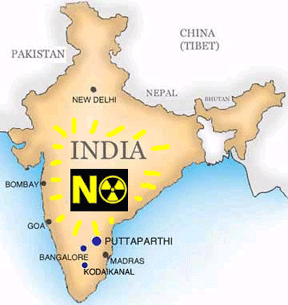 Court frowns on ministers over Kudankulam launch date Court says ministers respects only Supreme Court IANS August 16, 2012 Chennai: With the protest against Kudankulam nuclear power plant entering its second year, the Madras High Court hearing two petitions against the project Thursday came down on union ministers, the Atomic Energy Regulatory Board (AERB) and the Tamil Nadu Pollution Control Board (TNPCB). Continue reading
“No way that banks would provide financing” for nuclear power , says bank chairman
 Bank chairman stands defiant with blunt anti-nuclear message, The Mainichi, 15 Aug 12, I was hardly getting anywhere trying to write about “hope” and the general election that’s supposed to come sooner or later when Tsuyoshi Yoshiwara, chairman of Johnan Shinkin Bank, appeared on television.
“Can the member corporations of the Keidanren (the Japan Business Federation) buy out nuclear reactors themselves and operate them?” he asked, point blank.
“There’s no way banks would provide financing,” he continued. “Corporations propose something (the continuation of nuclear reactors) that they can’t even do on their own, knowing full well that the burden will ultimately fall on the public. And yet they say that what they propose is ‘realistic.’ That makes no sense, and is most irresponsible.” Continue reading
Disease and death toll from Fukushima radiation needs careful, patient, tracking
[in the 12 months after Fukushima] an excess of 38,700 Japanese deaths, with no obvious cause.
Nobody should yet race to conclusions that 38,700 Japanese died from Fukushima exposure in the first year after the disaster.
The final element needed before conclusions are made is patience; vital statistics must continue to be tracked, and compared with radiation exposures to the Japanese people.
[In 2009] A team of Russian researchers, led by Dr. Alexey Yablokov, published results of 5,000 reports and articles on Chernobyl – many in Russian languages never before made public. Yahlokov’s team concluded that near Chernobyl, increases in disease sand deaths were observed for nearly every human organ system.
 Let the Counting Begin Fukushima’s Nuclear Casualties http://www.counterpunch.org/2012/08/15/fukushimas-nuclear-casualties/ by JOSEPH MANGANO, 15 Aug 12 It’s been nearly 18 months since the disastrous nuclear meltdown at Fukushima. There have been many reports on the huge amounts of radioactivity escaping into the air and water, unusually high levels in air, water, and soil – along with atypically high levels of toxic chemicals in food – that actually “passed” government inspection and wasn’t banned like some other food.
Conspicuously absent are reports on effects of radiation exposure on the health of the Japanese people. Have any health officials publicly announced post-March 2011 numbers on fetal deaths, infant deaths, premature births, birth defects, cancer, or other health conditions? The answer so far is an emphatic “no.”
The prolonged silence doesn’t mean data doesn’t exist. Japanese health officials have been busy with their usual duties of collecting and posting statistics on the Internet for public inspection. It’s just that they aren’t calling the public’s attention to these numbers.
Thus, it is the public who must find the information and figure out what it means. After locating web sites, translating from Japanese, adding data for each of 12 months, and making some calculations, mortality trends in Japan after Fukushima are emerging. Continue reading
The psychological toll on nuclear workers in Japan
Nuclear Workers Stressed After Japanese Quake Med Page Today, By Michael Smith, August 14, 2012 Reviewed by Dori F. Zaleznik, MD; Associate Clinical Professor of Medicine, Harvard Medical School, Boston and Dorothy Caputo, MA, BSN, RN, Nurse Planner
Action Points
This study of psychological distress and post-traumatic stress response among workers at two nuclear power plants involved in the Fukushima earthquake/tsunami found high levels of self-reported distress especially among workers at the plant that suffered the meltdown…
Psychological distress and post-traumatic stress response (PTSR) were common among workers at two Japanese nuclear plants in the wake of the March 11, 2011 earthquake, researchers reported. But rates were significantly higher among workers at the Daiichi
plant, which suffered a meltdown, than they were at the Daini plant, which was damaged but remained intact, according to Takeshi Tanigawa, MD, PhD, of Ehime University Graduate School of Medicine in Ehime, Japan, and colleagues.
Both groups of workers were exposed — at much the same rate — to slurs and discrimination because the Tokyo Electric Power Company, which operates the plants, was widely criticized for its response to the disaster, Continue reading
1 This Month
23-25 October – on Zoom – World BEYOND War’s annual global conferenc


Shut down the radiation-damaged Heysham nuclear reactors now
To see nuclear-related stories in greater depth and intensity – go to https://nuclearinformation.wordpress.com

Say No to NASA’s Reckless Nuclear Reactor on the Moon
Say No to NASA’s Reckless Nuclear Reactor on the Moon
-
Archives
- October 2026 (190)
- September 2026 (339)
- August 2026 (330)
- July 2026 (355)
- June 2026 (287)
- May 2026 (306)
- April 2026 (356)
- March 2026 (251)
- February 2026 (267)
- January 2026 (308)
- December 2025 (358)
- November 2025 (359)
-
Categories
- 1
- 1 NUCLEAR ISSUES
- business and costs
- climate change
- culture and arts
- ENERGY
- environment
- health
- history
- indigenous issues
- Legal
- marketing of nuclear
- media
- opposition to nuclear
- PERSONAL STORIES
- politics
- politics international
- Religion and ethics
- safety
- secrets,lies and civil liberties
- spinbuster
- technology
- Uranium
- wastes
- weapons and war
- Women
- 2 WORLD
- ACTION
- AFRICA
- Atrocities
- AUSTRALIA
- Christina's notes
- Christina's themes
- culture and arts
- Events
- Fuk 2022
- Fuk 2023
- Fukushima 2017
- Fukushima 2018
- fukushima 2019
- Fukushima 2020
- Fukushima 2021
- general
- global warming
- Humour (God we need it)
- Nuclear
- RARE EARTHS
- Reference
- resources – print
- Resources -audiovicual
- Weekly Newsletter
- World
- World Nuclear
- YouTube
-
RSS
Entries RSS
Comments RSS

