Seabed off Fukushima radioactive for decades to come
Radiation settles on seabed off Japan Radio Australia 26 October 2012, New research suggests radiation from the crippled Fukushima nuclear plant has settled on the ocean floor off Japan, and could contaminate sea life for decades.
Contamination may be due to low-level leaks from the Fukushima nuclear plant. (Credit: AFP) Marine chemist Ken Buesseler of the Woods Hole Oceanographic Institution reviewed official Japanese data on radiation levels in fish, shellfish and seaweed collected near the crippled nuclear plant. He concluded the lingering contamination may be due to low-level leaks from the facility, or contaminated sediment on the ocean floor.
His research, published on Thursday in the US magazine Science, estimated that about 40 per cent of fish caught near Fukushima are considered unfit for consumption under Japanese
regulations…..http://www.radioaustralia.net.au/international/2012-10-26/radiation-settles-on-seabed-off-japan/1036750
Nuclear lobby overrides democracy in India – ban on Australian filmmaker David Bradbury
 Australia’s best-known documentary film-maker, David Bradbury, was prevented by the Tamil Nadu Police from entering Idinthakarai.
The detention is likely to have international ramifications given the stature of Bradbury as a film-maker
Australian Film-Maker Stopped by Police in Koodankulam, Tamil Nadu By Sri Lanka Guardian October 26, 2012 Chennai, Amid conflicting reports about detention of Australian Film-maker David Bradbury in Koodankulam, we are posting below the updates as we receive them. After deportation of a German tourist and 3 Japanese activists, this is yet another move of stifling democracy by the Government which must be condemned in strongest terms. Continue reading
Fukushima radioactive water could fill 50 Olympic sized swimming pools
To deal with the excess tainted water, the utility has channeled it to more than 300 huge storage tanks placed around the plant.
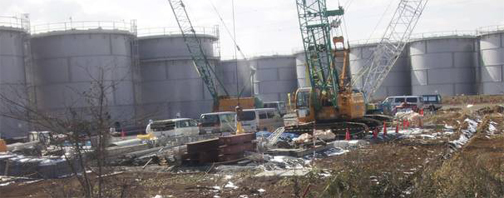
 Fukushima Nuclear Disaster: Plant’s Contaminated Water Storage Running Out Of Space HUFFINGTON POST, By MARI YAMAGUCHI 10/25/12 TOKYO — Japan’s crippled nuclear power plant is struggling to find space to store tens of thousands of tons of highly contaminated water used to cool the broken reactors, the manager of the water treatment team said.
About 200,000 tons of radioactive water – enough to fill more than 50 Olympic-sized swimming pools – are being stored in hundreds of gigantic tanks built around the Fukushima Dai-ichi plant. Operator Tokyo Electric Power Co. has already chopped down trees to make room for more tanks and predicts the volume of water will more than triple within three years. Continue reading
India stops Australian film maker entering Kudankulam anti nuclear protest area
Australian filmmaker prevented from entering Kudankulam 25 Oct  12http://www.dnaindia.com/india/report_australian-filmmaker-prevented-from-entering-kudankulam_1756187 , Oct 25, 2012, Three persons from Australia were today prevented from entering Idinthakarai, the epicentre of protests by People’s Movement Against Nuclear Energy leading the stir against Kudankulam Nuclear Power Plant in Tirunelveli district, police said.
Filmmaker David Bradbury along with his wife and son arrived in India on tourist visas and were about to enter Idinthankarai from Kanyakumari district this morning when police stopped them near Radhapuram police station, they said.
“After interrogations, the three were made to go back, since prohibitory orders were in place,” an officer said.
The PMANE has been leading protests against the plant for over a year citing safety concerns.
Commissioning of the first unit of the Indo-Russian project was originally scheduled for December last year, but has been delayed due to the protest.
Nuclear power obstacle in Japan: new evacuation plans
under the new radiation forecast, many more local governments will have to compile disaster management plans for areas that could require evacuation.
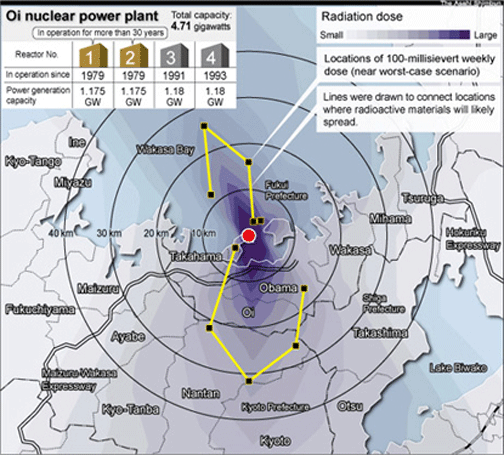
Radiation forecast creates hurdle in resuming nuclear plant operations UPDATE: Forecast predicts wider evacuations needed if nuclear disaster repeated October 25, 2012 THE ASAHI SHIMBUN Municipalities are demanding a greater say in whether utilities can restart their reactors after the new industry watchdog placed more communities in the danger zone of possible nuclear accidents. Continue reading
Inedible for years to come – fish near Fukushima coast

 Fukushima fish ‘may be inedible for a decade’ Fiona Harvey, environment correspondent guardian.co.uk 25 October 2012 Marine scientist finds levels of radioactivity in fish near stricken Fukushima nuclear plant are higher than expected
Fish from the waters around the Fukushima nuclear plant in Japan could be too radioactive to eat for a decade to come, as samples show that radioactivity levels remain elevated and show little sign of coming down, a marine scientist has warned.
According to a paper published in the journal Science on Thursday, large and bottom-dwelling species carry most risk, which means cod, flounder, halibut, pollock, skate and sole from the waters in question could be off limits for years, .
Sample fish caught in waters near the stricken reactors suggest there is still a source of caesium either on the seafloor or still being discharged into the sea, perhaps from what is left of the cooling waters. As the levels of radioactive isotopes in the fish are not declining as fast as they should have, the outlook for fishing in the area is likely to be poor for the next 10 years, the paper’s author told the Guardian.
“These fish could have to be banned for a long time. The most surprising thing for me was that the levels [of radioactivity] in the fish were not going down. There should have been much lower numbers,” said Ken Buesseler, senior scientist at the Woods Hole Oceanographic Institution in the US, who wrote the paper titled Fishing For Answers Off Fukushima.
He said his findings – taken in part from Japanese research and sampling of fish in the area – showed how difficult it was to predict the outcome of a nuclear incident such as that at Fukushima. ….. http://apps.facebook.com/theguardian/environment/2012/oct/25/fukushima-fish-inedible-decade-radioactivity
China puts the brakes on nuclear power
 China Slows Development of Nuclear Power Plants, NYT By KEITH BRADSHER, October 24, 2012 HONG KONG — Still responding to the partial meltdowns last year at nuclear reactors in Fukushima, Japan, the Chinese government has lowered its target for the construction of nuclear power plants by 2015, notably by not building more nuclear reactors at inland locations.
A white paper on energy policy released after a cabinet meeting on Wednesday said that the government planned to have 40 gigawatts of nuclear power capacity installed by 2015, and pledged strict safety standards. While the white paper and state-controlled media did not
describe this as a reduction in the target, the country’s current Five-Year Plan sets a target of 50 gigawatts….. Nuclear power generates only 1.8 percent of China’s electricity, far below the global average of 14 percent. http://www.nytimes.com/2012/10/25/business/global/china-reduces-target-for-construction-nuclear-power-plants.html?_r=2&
Fish caught off Japan’s coast becoming MORE radioactive
the most contaminated fish found yet off Fukushima were caught in August, some 17 months after the disaster. The two greenlings, which are bottom-feeders, had cesium levels of more than 25,000 becquerels per kilogram, 250 times the level the government considers safe.
Radiation levels in fish off Japan not declining since nuclear disaster Anchorage Daily News, October 25, 2012 By MALCOLM FOSTER — Associated Press TOKYO — Radioactive cesium levels in most kinds of fish caught off the coast of Fukushima haven’t declined in the year following Japan’s nuclear disaster, a signal that the seafloor or leakage from the damaged reactors must be continuing to contaminate the waters – possibly threatening fisheries for decades, a researcher says. Continue reading
Outside Fukushima’s evacuation zone, but kindergarten still not safe
NHK: Kindergarten outside evacuation zone closed because of Fukushima radiation threat — “No one can deny the reality” (VIDEO) http://enenews.com/nhk-fukushima-kindergarten-evacuation-zone-closed-because-radiation-threat-one-deny-reality-contamination-away-video October 24th, 2012 at
 Watch the NHK report here http://www.youtube.com/watch?feature=player_detailpage&v=6scs7iE02Vg#t=145s
Source: NHK NewsWatch 9
Published by: Missingsky101
Date Aired: February 2012
Date Published: Oct 23, 2012
[The head of a kindergarten in Minamisoma city, Fukushima Prefecture] decided to close the kindergarten indefinitely […] a history of 60 years […]
[He] says, “No one can deny the reality that the community is exposed to radiation” […]
The director was forthright about lingering concerns of radiation that never went away no matter how hard the school tried to decontaminate the premises […]
Wider evacuation area plans needed, says Japan’s nuclear regulator
the wide area of forecasted contamination means local governments will face a greater burden in compiling effective disaster management plans.
Shunichi Tanaka, chairman of the Nuclear Regulation Authority, has called such plans a minimum requirement before nuclear plants can be cleared for a restart.
If local governments cannot compile effective disaster management plans, it means the security of local residents is not assured. In such circumstances, not only would it be difficult to resume operations at such plants, but the very existence of those plants could be called into question.
Forecast predicts wider evacuations needed if nuclear disaster repeated Nuclear watchdog may broaden definition of active fault lines October 24, 2012 THE ASAHI SHIMBUN A forecast of the radiation released in another nuclear accident shows that at four plants, a 30-kilometer evacuation zone would be insufficient for public safety, and that more distant residents would need to flee their homes too. Continue reading
While India’s nuclear dream languishes, solar energy up and running quickly
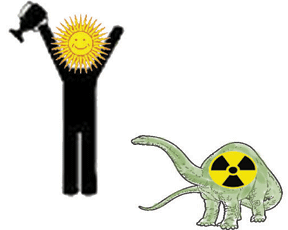 The latest news is that Reliance is building Asia’s largest solar power plant in Jaisalmer district of Rajasthan. “The 250 MW plant being built with Areva of France would be ready by late 2014. The entire project would be ready by 2014”
Cheap nuclear energy is an illusion The Pioneer: Kumar Chellappan, 25 Oct 12 Nuclear energy is expensive and unsustainable, and takes more than a decade to be fully operational. It is also high on risks. Moreover, the 20 nuclear reactors spread across the country generate hardly 60 per cent of the total installed nuclear power
Hidden subsidies have helped the Nuclear Power Corporation of India Continue reading
Amid political and cost uncertainties, Japan to continue building some nuclear reactors
 uncertainties about the future cost of operating nuclear plants in Japan weaken the economic case for more atomic power. “There will be more costs for safety upgrades, and no one knows what kind of insurance system is going to be put in place. These things will make a big difference to generating costs.”….
Japanese plan to complete reactors raises doubts about nuclear phase-out WP, By Jonathan Soble | Financial Times, October 23 TOKYO — It has been only a month since Japan declared that it would close down its nuclear industry by the end of the 2030s, but already a contentious plan to complete several partially built reactors is sowing doubts about the government’s commitment to the radical policy shift…..
In the weeks since the nuclear phase-out was announced, Yukio Edano, industry minister, has said three approved but unfinished reactors are exempt from a central provision of the phase-out policy, under which no new plants will be built. Continue reading
China slowing down its nuclear power program
China to approve only a few new reactors by 2015 By David Stanway BEIJING  Oct 24, 2012 (Reuters) – China will approve a small number of new nuclear reactors before 2015 to be built only in coastal regions, the government said on Wednesday, as it unveiled a raft of measures to spur private investments in energy. Continue reading
Japan’s nuclear regulator warns that Fukushima’s situation is still precarious
Fukushima situation stable but still precarious: regulator (Reuters) Fredrik Dahl. 24 Oct, – The situation at Japan’s stricken Fukushima nuclear power plant has been stabilized but is still precarious, more than a year and a half after disaster struck, a senior Japanese regulatory official said on Wednesday.. Continue reading
Radiation hotspots in schools, playgrounds near Fukushima
 AFP: Some school facilities in Fukushima city exceeding radiation limit by 1,000% — Many hot spots around playground equipment are especially disturbing – http://enenews.com/afp-school-facilities-fukushima-city-exceed-radiation-limit-1000-many-hot-spots-around-playground-equipment-especially-disturbing-greenpeaceGreenpeace
Title: Japan’s radiation monitoring unreliable: Greenpeace
Source: AFP
Author: Kyoko Hasegawa
Date: Oct 23, 2012
Government radiation monitoring in areas near Japan’s crippled Fukushima nuclear plant is unreliable, Greenpeace charged on Tuesday, w, with heavily populated areas exposed to 13 times the legal limit.
The environmental group said authorities were wasting time cleaning up evacuated areas and should prioritise decontamination efforts in places where people live, work and play.
Greenpeace found that in some parks and school facilities in Fukushima city, home to 285,000 people, radiation levels were above three microsieverts per hour. Japan’s recommended radiation limit is 0.23 microsieverts per hour. […]
Rianne Teule, Greenpeace’s radiation expert
“We also found that official monitoring posts placed by the government systematically underestimate the radiation levels”
Some machines are shielded from radiation by surrounding metal and concrete structures
“Official monitoring stations are placed in areas the authorities have decontaminated. However, our monitoring shows that just a few steps away the radiation levels rise significantly”
“Decontamination efforts are seriously delayed and many hot spots that were repeatedly identified by Greenpeace are still there”
“It is especially disturbing to see that there are many hot spots around playground equipment, exposing children who are most vulnerable to radiation risks”
1 This Month
23-25 October – on Zoom – World BEYOND War’s annual global conferenc


Shut down the radiation-damaged Heysham nuclear reactors now
To see nuclear-related stories in greater depth and intensity – go to https://nuclearinformation.wordpress.com

Say No to NASA’s Reckless Nuclear Reactor on the Moon
Say No to NASA’s Reckless Nuclear Reactor on the Moon
-
Archives
- October 2026 (180)
- September 2026 (339)
- August 2026 (330)
- July 2026 (355)
- June 2026 (287)
- May 2026 (306)
- April 2026 (356)
- March 2026 (251)
- February 2026 (267)
- January 2026 (308)
- December 2025 (358)
- November 2025 (359)
-
Categories
- 1
- 1 NUCLEAR ISSUES
- business and costs
- climate change
- culture and arts
- ENERGY
- environment
- health
- history
- indigenous issues
- Legal
- marketing of nuclear
- media
- opposition to nuclear
- PERSONAL STORIES
- politics
- politics international
- Religion and ethics
- safety
- secrets,lies and civil liberties
- spinbuster
- technology
- Uranium
- wastes
- weapons and war
- Women
- 2 WORLD
- ACTION
- AFRICA
- Atrocities
- AUSTRALIA
- Christina's notes
- Christina's themes
- culture and arts
- Events
- Fuk 2022
- Fuk 2023
- Fukushima 2017
- Fukushima 2018
- fukushima 2019
- Fukushima 2020
- Fukushima 2021
- general
- global warming
- Humour (God we need it)
- Nuclear
- RARE EARTHS
- Reference
- resources – print
- Resources -audiovicual
- Weekly Newsletter
- World
- World Nuclear
- YouTube
-
RSS
Entries RSS
Comments RSS

