South Korea to sell 40 trilion won ($32.55 billion) nuclear power plant to Turkey.
South Korea has conveyed its preliminary proposal to Turkiye for
constructing a major nuclear power plant in Turkiye, local Turkish media
reports. According to the report, Korea Electric Power Corp. (KEPCO)
presented the proposal regarding the construction of four reactors capable
of providing 1,400 megawatts (MW) of electricity in the northern province
of Sinop. The project is forecast to be worth about 40 trillion won ($32.55
billion).
Middle East Monitor 2nd Feb 2023
Confusion to the public” and “embarrassing expressions”…Nuclear Regulation Commission blacked out documents provided by METI, which were not made public

Three internal review documents of the Nuclear Regulation Authority (NRA), which are conspicuously blacked out, in Minato Ward, Tokyo, on March 3.
February 3, 2023
On February 3, the Nuclear Regulation Authority (NRA), the secretariat of the Nuclear Regulation Authority (NRA), released documents on its review process in response to the issue of undisclosed information exchange between the NRA and officials of the Agency for Natural Resources and Energy of the Ministry of Economy, Trade and Industry (METI) over the review of nuclear power plant operation periods. The Agency did not disclose any of the materials it had provided to the Regulation Authority, and most of the internal review materials were “blacked out” with only three pages. The Agency’s backward-looking attitude toward information disclosure was conspicuous, and it was not clear whether the views of the Agency, which promotes nuclear power generation, had any influence on the regulatory system.
◆The Regulatory Agency reiterated that it had “exhausted all necessary explanations.
What was made public was the status of internal studies at the Regulatory Agency for reviewing the operating period, which was stipulated to be “40 years in principle, with a maximum of 60 years. Although the Regulatory Agency received from the Ene Agency an imaginary diagram of the revision of the law and other materials, it did not disclose any of the materials prepared by the Ene Agency, saying that the Ene Agency, the preparer, should decide whether or not to disclose the information.
Although the Regulatory Agency’s internal study materials were believed to envision multiple patterns of legal revision related to the operation period and describe the advantages and challenges of each, the majority of the materials were not disclosed. At the press conference, Yoichiro Kurokawa, director of the Regulatory Agency’s General Affairs Division, explained, “The documents contain the views of the person who prepared them and are far removed from the views of the organization, so disclosing them would cause confusion among the public.
When asked by the media about the content of the blacked-out section, Mr. Kurokawa stated that in the section on the advantages of the proposed amendment of the articles to the minimum necessary, it was stated that “on the surface of the text, it looks almost unchanged,” and added, “In the first place, since we are changing the regulations for the operation period, it is inappropriate to say that ‘almost unchanged’ is the case. There were expressions that seemed embarrassing, and we determined that it was not appropriate to disclose them.”
At the press conference, a number of people pointed out that the disclosure was insufficient, but Section Chief Kurokawa reiterated that “we have done all the necessary explanations.
Before the Regulatory Commission ordered a review of the regulatory system regarding the operation period in October of last year, the Regulatory Agency had met with EneAgency officials at least seven times between July and September to exchange information. (Nozomi Masui)
https://www.tokyo-np.co.jp/article/229204
Government to Revise Basic Policy on Final Disposal of Nuclear Waste for First Time in Eight Years

February 2, 2023
The Japanese government has decided to revise its basic policy for the first time in eight years toward the final disposal of high-level radioactive waste (so-called “nuclear waste”) generated by nuclear power generation.
The government has decided to implement “geological disposal,” in which a final disposal site will be established and buried deeper than 300 meters below the ground. However, the number of target areas has not increased since then, and there are calls from local residents to expand their interest nationwide.
Against this backdrop, the government has decided to revise for the first time in eight years its basic policy outlining the details of its efforts to realize final disposal, and has compiled a new draft basic policy.
The draft clearly states that “the government will work together and under its own responsibility toward the final disposal of the waste,” and it also states that the government will take a front-loaded approach to the issue.
The proposal also includes a new initiative to hold discussions with the heads of local governments where nuclear power plants are located, among other things.
Through these efforts, the government hopes to increase the number of regions that will accept surveys and move forward with the selection of a final disposal site.
https://www3.nhk.or.jp/news/html/20230202/k10013968751000.html?fbclid=IwAR1N8fy-DN4FoPsdEzJjArdrYv5VO5EQiw85zrb7D3Y_xT3P2ONvtnl- PCc
Takahama nuclear reactor in Fukui halted after alert goes off

The No. 4 reactor at Kansai Electric Power Co.’s Takahama nuclear power plant in Takahama, Fukui Prefecture
Jan 30, 2023
Fukui – A reactor at Kansai Electric Power Co.’s Takahama nuclear power station in Fukui Prefecture was automatically halted Monday after an alert went off warning of a rapid decrease in the number of neutrons within the unit, the complex’s regulator and operator said.
The No. 4 reactor was halted at 3:21 p.m., the Osaka-based utility said, adding that there has been no indication of the incident causing environmental contamination. The reactor’s cooling function is normal, according to the Nuclear Regulation Authority.
The No. 4 reactor restarted in November after being shut down for routine inspections.
The seaside plant has four reactors and faces the Sea of Japan.
https://www.japantimes.co.jp/news/2023/01/30/national/takahama-nuclear-plant-halt/
Judge to be Changed Just Before Tokai Daini Nuclear Power Plant Appeals Court; Plaintiffs See Problems with His Past Representation of the State
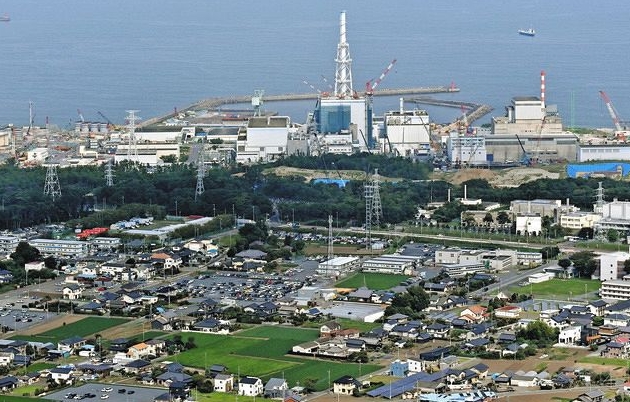
Tokai Daini Nuclear Power Plant is under construction for restart, from the Oozuru helicopter in Tokai-mura, Ibaraki Prefecture, in August 2021.
January 25, 2023
The Tokyo High Court, which is in charge of the lawsuit against Japan Atomic Power Company’s Tokai No. 2 Nuclear Power Plant (Tokai-mura, Ibaraki Prefecture), is expected to move to a different division in the appeal trial of the injunction lawsuit against the plant’s operation. The plaintiffs’ lawyers had asked the presiding judge to voluntarily withdraw from the case, citing problems with the fact that he had represented the national government in past administrative lawsuits related to nuclear power plants. The first date of the appeal hearing, which was scheduled for March 31, has been canceled. (Mayumi Kojima)
Defense team “appreciates the decision.
According to the defense team, the chief judge in charge of the case, Norio Nagatani, worked for many years in the Litigation Division of the Ministry of Justice, which is in charge of proving the government’s case in administrative lawsuits. In addition to representing the government in several nuclear power plant-related lawsuits, he was also a councilor in charge of litigation and in a position to direct the administrative lawsuit (later withdrawn) that sought an injunction against the operation of Tokai No. 2 from the government.
Last September, Nagatani was transferred from the head of the Hiroshima District Court to the Tokyo High Court, where he became the presiding judge for the appeal of the injunction lawsuit. In December, the defense lawyers asked Nagatani to voluntarily withdraw from the case on the grounds that a fair trial would not be conducted.
According to attorney Yuichi Kaito of the defense team, on the 25th of this month, Mr. Nagatani explained to them that “in view of various circumstances, the case will be reassigned. A new department is expected to take over the proceedings.
At a press conference held in Tokyo on March 25, attorney Hiroyuki Kawai said, “Mr. Nagatani said he would be fair and neutral regardless of his background, but objectively speaking, there is an inference that he is siding with the administration. (I commend him for making the decision to change the case. Mr. Kaito said, “You should not be both the representative of the government and the presiding judge in administrative lawsuits. (The exchange of judges (between judges and prosecutors) was banned by the DPJ administration, and the exchange of judges with representatives of the state in administrative lawsuits should also have been banned,” he noted.
◆Although the motion was filed… “It is highly unusual for a judge to actually be replaced.”
The appeal of the injunction lawsuit against the Tokai No. 2 nuclear power plant by Japan Atomic Power Company (JAPC), which resulted in the unusual prospect of a change in the trial division in charge of the case, was heard by the court. It is rare for judges to be replaced under the same circumstances, and an expert pointed out that “the very fact that he tried to preside over the case in the first place shows a lack of common sense.
According to the plaintiffs’ lawyers in the Tokai No. 2 lawsuit, a Supreme Court judge avoided participating in the hearing of the Hyakuri Air Base (Ibaraki Prefecture) lawsuit, in which the constitutionality of the Self Defense Forces was disputed and the Supreme Court rejected the appeal in 1989, because he had been involved in the government’s substantiation activities in the past. In 1991, a judge at the Odawara Branch of the Yokohama District Court was replaced after the plaintiffs alleged that he had conducted the case in a way that favored the defendants.
In 2018, the Kanazawa Branch of the Nagoya High Court rejected a motion by the plaintiffs to replace a judge at the first instance court that had vacated an injunction on KEPCO’s Nos. 3 and 4 reactors at the Ooi Nuclear Power Plant in Fukui Prefecture. The Kanazawa District Court also rejected the plaintiffs’ motion for an injunction against Hokuriku Electric Power Co.’s Shiga Nuclear Power Plant (Ishikawa Prefecture), which is currently under litigation.
Former judge Hajime Tada, attorney-at-law, commented on the replacement motion, “It is often a kind of a warning shot to the court. It is extremely unusual for a judge to actually be replaced. In the case of Tokai Daini, he pointed out, “It cannot be said that the court can make a neutral decision, and it is quite natural for the court to change the trial division. He criticized the change, saying, “It shows that the court is leaning toward the administration and disrespects the independence of the judiciary. (Kenta Onozawa)
Plaintiffs’ Residents Welcome the Decision
The plaintiff residents living near the Tokai Daini Nuclear Power Plant voiced their surprise and welcome. Hiroko Kawano, 80, whose home is 1.7 km from the plant, said, “It was too badly done, so I am glad. I think the plaintiffs’ petition was approved,” she said happily.
She learned of Judge Norio Nagatani’s background at a rally held by the plaintiffs’ group in Tokyo on April 22. I thought the government was doing an amazing job,” he said. Although there is supposed to be separation of powers, it looks as if the government has intervened in the appointment of the court.
Kiyoko Aizawa, 81, of Tokai-mura, said, “I thought the government would continue to forcefully proceed. The news reports have been covering the situation, so perhaps they couldn’t just ignore it. Tokai No. 2 is decrepit, and there are many people living around it. I don’t know who the next presiding judge will be, but I definitely want to win.
A 74-year-old man living in Hitachi City, a neighbor to the north of Tokai Village, said, “The court effectively accepted our side of the story, and I think they really meant to hit us where it hurts. I don’t think the government’s major policy of wanting to overturn the first trial at any cost has changed. I don’t think the government has changed its major policy of wanting to overturn the first trial at any cost, and I think they may try some more tricks.
On the other hand, Japan Atomic Power Company (JAPC) responded to an interview with this newspaper, saying, “We do not know the details of the case, so we will refrain from commenting. (Nagasaki High School and University)
https://www.tokyo-np.co.jp/article/227401?fbclid=IwAR2M8pe0zQeUjHI6qABHn-U-W6rBcrAcd5A5jElo-qNPkMf9RmUGhNtz5w4
China objects to more nuclear sub talks among UK, U.S, Australia
BEIJING, Feb 3 (Reuters) – China “firmly objects” to further cooperation between Britain, U.S. and Australia on nuclear submarines, its foreign ministry said in a regular briefing on Friday.
Chinese foreign ministry spokesperson Mao Ning said, “China is gravely concerned about this and firmly objects to it,” in response to a question that cited a media report saying British Prime Minister Rishi Sunak’s visit to the United States in March may yield announcements on more nuclear submarine cooperation…………. Reporting by Yew Lun Tian and Joe Cash ; Writing by Liz Lee; Editing by Christian Schmollinger https://www.reuters.com/world/china-objects-more-nuclear-sub-talks-among-uk-us-australia-2023-02-03/
Many errors in TEPCO’s nuclear power plant examination documents at Kashiwazaki Kariwa Unit 3

January 19, 2023
On January 19, TEPCO Holdings revealed that 149 errors were found in the examination documents for the Kashiwazaki Kariwa Unit 3 nuclear power plant in Niigata Prefecture, which is under review by the Nuclear Regulation Authority before its 30th year of operation. 131 of the errors were made using information from Unit 2, which has already been examined.
TEPCO apologized at the review meeting on the same day, saying, “We should reflect on this. The Regulatory Commission said, “This is a matter that concerns the reliability of the documents, and we hope you will take it seriously,” and demanded that a recurrence of the problem be prevented.
According to TEPCO, because they did not know the names of the materials required for the documents, they used those of the Unit 2 reactor of the same type. The same document contained an error due to a programming error, which was discovered when the company checked for similar errors.
Kashiwazaki Kariwa Unit 3, which began operation in August 1993, is currently shut down and has not yet applied for an inspection to restart operations. Nuclear power plants are required to undergo an examination to check the management of their facilities before they reach 30 years of operation. Kyodo News
https://www.nikkei.com/article/DGXZQOUA19CCU0Z10C23A1000000/?fbclid=IwAR339KW18B9GAITAh2AdBAorc1cA-7vkU_OoWvyCT7G1ECB-RI8xeldvadc
Takahama nuclear reactor in Fukui halted after alert goes off
https://www.japantimes.co.jp/news/2023/01/30/national/takahama-nuclear-plant-halt/ 30 Jan 23, FUKUI – A reactor at Kansai Electric Power Co.’s Takahama nuclear power station in Fukui Prefecture was automatically halted Monday after an alert went off warning of a rapid decrease in the number of neutrons within the unit, the complex’s regulator and operator said.
The No. 4 reactor was halted at 3:21 p.m., the Osaka-based utility said, adding that there has been no indication of the incident causing environmental contamination. The reactor’s cooling function is normal, according to the Nuclear Regulation Authority.
The No. 4 reactor restarted in November after being shut down for routine inspections.
The seaside plant has four reactors and faces the Sea of Japan.
Can Talks with China about Nuclear Weapons Be Constructive?
January 26, 2023 Gregory Kulacki https://blog.ucsusa.org/gregory-kulacki/can-talks-with-china-about-nuclear-weapons-be-constructive/
Politico reported US Secretary of State Antony Blinken is “under pressure” to “raise administration concerns” about the size of China’s nuclear arsenal when he travels to Beijing in early February.
Constructive conversations on nuclear weapons policy are urgently needed. Both governments are upgrading their nuclear capabilities. Chinese military planners worry about US preparations to use nuclear weapons first to forestall defeat in a conventional war, as well as US efforts to undermine China’s ability to retaliate. US military planners are concerned about the construction of new Chinese missile silos, which will significantly increase the probability and magnitude of Chinese nuclear retaliation if the United States uses nuclear weapons first.
The nuclear aspect of what some US observers describe as a new Cold War with China is different than the US nuclear contest with the Soviet Union. It’s not about numbers. Chinese leaders don’t express interest in numerical parity. President Biden’s remarks on China’s nuclear weapons policy suggest he thinks they do. That’s unfortunate. If a desired outcome of Blinken’s visit is to start a dialogue on nuclear weapons, he will need to focus less on the numbers and more on why Chinese leaders built the silos.
What Chinese leaders want – what they have wanted since they decided to develop nuclear weapons in 1955 – is to be able to use conventional military force without undue concern the United States will use nuclear weapons to stop them. Being able to credibly threaten to use nuclear weapons to prevent or defeat Chinese conventional military initiatives has been a cornerstone of US defense policy in East Asia since the Korean War.
Chinese efforts to negate US first use threats are an important part of Chinese nuclear strategy. Chinese leaders believe if they can convince US decision-makers they will retaliate, then they can safely ignore US threats to use nuclear weapons first.
Chinese military planners have always been concerned their comparatively small nuclear force could tempt US decision makers to try to wipe it out at the beginning of a war. Continued US investment in ballistic missile defense creates additional doubt about US respect for China’s ability to retaliate.
The bulk of China’s current nuclear force consists of missiles launched from trucks. Recent technological advances increase the possibility the United States could destroy or disable those missiles with conventional munitions. Switching to silos makes that far less likely.
Current US projections of a large increase in the size of China’s nuclear force assume the new silos are an addition, not a replacement. They also assume everyone of those silos will contain a new missile and every one of those missiles will carry multiple warheads. But China does not need that many warheads to achieve its strategic objective. Even if the silos sit empty, US military planners must assume they’re not, and US decision-makers must assume China can retaliate if the United States uses nuclear weapons first.
If Secretary Blinken’s only objective is to talk about numbers, his Chinese interlocutor can tell China’s leaders their decision to build the silos was a strategic success. It is hard to see how that makes the United States or its Asian allies safer.
It would be wiser if Blinken said the United States no longer needs to threaten to use nuclear weapons first to keep the peace. Instead of handing Chinese leaders a strategic victory, he would convey a surprising US confidence in its conventional forces. That’s more likely to restrain Chinese leaders than what they continue to see as empty US threats to start a nuclear war; threats revolutionary leader Mao Zedong famously described as a “paper tiger.”
As paradoxical as it may seem to a US strategic culture obsessed with size, forgoing the option to use nuclear weapons first may be the best way to get Chinese leaders to respect the ability of the United States to defend its allies, and to begin a constructive conversation about nuclear weapons.
Japan’s Plan To Discharge Water From Fukushima Nuclear Plant Faces Pacific Opposition
By BenarNews, By Stephen Wright
Officials from Pacific island nations will meet Japan’s prime minister in March in an effort to halt the planned release of water from the tsunami-damaged Fukushima Daiichi nuclear plant into the Pacific Ocean, a regional leader said.
Plans to dispose of Fukushima water over four decades are a source of tension between Japan and Pacific island nations and a possible complication for the efforts of the United States and its allies to show a renewed commitment to the Pacific region as China’s influence grows.
The planned discharges “are a very serious issue that our leaders have accepted must be stopped at all costs,” Henry Puna, secretary-general of the 18-nation Pacific Islands Forum, said Thursday at a press conference in the Solomon Islands capital Honiara.
The Japanese government’s timetable for disposal of Fukushima water indicates that releases could begin as soon as April this year – part of an effort to decommission the stricken power station over several decades. Water contaminated by the nuclear reactors damaged in a 2011 tsunami is stored in dozens of large tanks at the coastal Fukushima plant.
Japan’s method involves putting the contaminated water through a purification process known as the Advanced Liquid Processing System, which it says will reduce all radioactive elements except tritium to below regulatory levels. The treated water would then be diluted by more than 100 times to reduce the level of tritium – radioactive hydrogen used to create glow-in-the-dark lighting and signs……………………………
Data doubts
Five scientists working with the Pacific Islands Forum last week criticized the quality of data they had received from Tokyo Electric on the treated water in the tanks and expressed doubts about how well the purification process works.
Over more than four years, only a quarter of tanks had been tested for radiation, and testing rarely covered more than nine types of radiation out of 64 types that should be tested for, said the five scientists, who include Woods Hole Oceanographic Institution’s senior scientist Ken Buesseler.
“The accident is not over; this is not normal operations for a reactor. Therefore, extraordinary efforts should be made to prove operations are safe and will not cause harm to the environment,” the scientists’ presentation said.
The Pacific Islands Forum has described the scientists as independent nuclear experts. The forum’s secretariat didn’t respond to a question about whether the scientists are compensated for their work with the forum.
Nigel Marks, a materials scientist at Australia’s Curtin University and former nuclear reactor engineer, who is not advising the forum, said he is sympathetic to concerns that Tokyo Electric’s data could be more complete.
“But at the same time some recognition for Japan’s unique situation must be acknowledged,” he said. “The authorities have done their very best that technology allows. Eventually they reach a point where there is too much water to store.”
Puna said the Pacific islands delegation would meet with Japanese Prime Minister Fumio Kishida around March 7. They want a delay in water releases, at the very least, while more research is carried out, he said.
“There are serious gaps in the scientific evidence on the safety or otherwise of the proposed release,” Puna said. “I am pleased that the Japanese prime minister has finally agreed to meet with a high-level delegation from our region.”
Decades of Fukushima water discharges, Puna said, could “damage our livelihoods, our fisheries livelihoods, our livelihood as people who are dependent very much and connected to the ocean in our culture and identity.”
Mihai Sora, a Pacific analyst at Australia’s Lowy Institute, said it’s hard to imagine a more alarming proposition for Pacific island nations given the “toxic legacy” of nuclear weapons testing and waste dumping in the Pacific.
The timing, amidst regional geopolitical competition that has traditional powers falling over themselves to demonstrate who’s a better partner to the Pacific, could scarcely be worse,” Sora said.
The United States, United Kingdom and France carried out more than 300 nuclear detonations in the Pacific from 1946 to 1966, according to the International Disarmament Institute at Pace University in New York, which exposed thousands of military personnel and civilians to radiation and made some atolls uninhabitable.
“Decades of hard-won regional goodwill towards Japanese Pacific engagement are at risk with this single policy initiative,” Sora said……………….
Japan’s embassy in Suva, Fiji didn’t respond to a request for comment. https://www.eurasiareview.com/28012023-japans-plan-to-discharge-water-from-fukushima-nuclear-plant-faces-pacific-opposition/
Former US Secretary of State says Pakistan’s 2019 conflict with India almost sparked nuclear war
A former high-ranking US official has revealed he will “never forget the night” when the world witnessed what almost became a nuclear catastrophe.
Alex Blair news.com.au 25 Jan 23
Former US Secretary of State Mike Pompeo has detailed just how close the world came to nuclear war in 2019.
In February 2019, the relationship between rival nuclear powers India and Pakistan came dangerously close to escalating into a full-blown conflict, Pompeo writes in his memoir.
It all kicked off when India launched a military operation against militants within Pakistani territory, in response to an attack on its own troops in the disputed region of Kashmir that left 40 Indian soldiers dead.
Pakistan retaliated by shooting down two Indian aircraft and capturing a fighter pilot.
Both nations lay claim to Kashmir, but currently control only portions of the region. India has long accused Pakistan of supporting separatist militants in the Kashmir Valley, a claim that Pakistan denies.
The two nations, both nuclear powers, have engaged in multiple conflicts throughout their history, with the majority of these conflicts centred around the disputed region.
In his memoir, Never Give An Inch: Fighting for the America I Love, Pompeo emphasises that the world was unaware of the sheer gravity of the situation……………………………………………………….. more https://www.news.com.au/technology/innovation/military/former-us-secretary-of-state-says-pakistans-2019-conflict-with-india-almost-sparked-nuclear-war/news-story/75da26ebea96f1064d024205c6108bc2
The Disastrous Downsides of South Korea Building Nuclear Weapons
38 North BY: SIEGFRIED S. HECKER, JANUARY 20, 2023
Is South Korea Willing to Lose Its World-leading Nuclear Power Program to Build the Bomb?
In a wide-ranging interview on January 11, South Korean President Yoon Suk-yeol warned Pyongyang that if North Korea’s nuclear threat continues to advance, South Korea would consider building nuclear weapons of its own or ask the United States to redeploy them on the Korean Peninsula. Although President Yoon walked back these comments at the World Economic Forum in Davos, they were published in the South Korean press and reinforced by some Republic of Korea (ROK) defense analysts. Cheon Seong-whun said, “President Yoon’s comment could turn out to be a watershed moment in the history of South Korea’s national security.”
A South Korean decision to build its own bomb could, indeed, be a watershed. Threatening Pyongyang does little besides give it a stronger justification to enhance its own nuclear arsenal. I believe that such a move would trigger a tsunami that would wipe out Seoul’s remarkable economic miracle and destroy the soft power it has established around the world……………………….
The National Burden of a Nuclear Arsenal
Whereas President Yoon’s comment, “…we can have our own nuclear weapons pretty quickly, given our scientific and technological capabilities” is true, it doesn’t come close to capturing the national redirection, expense, and immense burden that Seoul would have to shoulder to field not just one bomb, but a nuclear arsenal to counter Pyongyang’s.
It is true that with its advanced technological capabilities, South Korea could probably build the bomb quickly. But a few bombs don’t make a nuclear deterrent, particularly if Seoul will have to go it alone. And let’s be clear, if Seoul were to go down this path, Washington could, and likely would, withdraw its nuclear umbrella. Building a nuclear arsenal to counter Pyongyang’s would require a major national redirection of its economy and diplomacy that would negatively affect nearly all facets of South Korean life for decades.
For nearly fifty years, South Korea has pursued a civilian nuclear energy program. It wisely focused on the middle of the fuel cycle—that is, reactor fuel fabrication, reactor construction and operation, and electricity production. It has built neither enrichment nor reprocessing facilities. Consequently, South Korea has no inventory of bomb-grade plutonium or uranium currently stockpiled. To build nuclear weapons, it would have to repurpose some of its civilian reactors to produce the plutonium bomb fuel (combined with using its laboratory-scale pyroprocessing facilities to extract plutonium) or construct a centrifuge facility to make highly enriched uranium. Either path would take at least two years to produce enough bomb fuel for even a few bombs. In the longer term, an effective nuclear deterrent would require new, dedicated nuclear weapons facilities, requiring substantial time and financial commitments.
The next step in building a bomb is weaponization—that is, designing, building and testing the nuclear devices. South Korea could surely master all scientific and engineering challenges of building a bomb—as it has demonstrated so convincingly in mastering civilian nuclear power generation. Some of the purely military aspects could be accomplished in concert with its conventional military technical complex. But to prove the design and fabrication, there would need to be nuclear testing, but where? Neighboring countries—China and Japan—would certainly object strongly, and there would undoubtedly be strong domestic opposition to tests from every South Korean province.
The nuclear warheads will also have to be integrated into delivery vehicles—such as ballistic missiles, cruise missiles, submarine-launched missiles or bombers. South Korea has all the basic building blocks, but it would still have substantial work to do to integrate the nuclear warheads into the delivery systems. Moreover, these requirements will continue to evolve as North Korea upgrades its offensive and defensive capabilities. The assembly, disassembly and fielding of nuclear devices pose serious safety and security risks and would have to be learned without help or advice from current nuclear powers. Seoul will also have to develop a command-and-control structure that is more stringent than anything it has done so far for its conventional military.
Another consequence of building a nuclear arsenal is that it will compete for resources—financial, personnel, and technical—with the South’s conventional military…………………………………………………………………………
Seoul Would Deal a Serious Blow to the Nonproliferation Regime
South Korea would be the first democratic country to withdraw from the NPT, dealing a blow to decades of US leadership in preventing nuclear proliferation. As serious as the North Korean nuclear threat is, I believe Washington would have no choice but to condemn and counter the South’s decision to build the bomb. The nonproliferation regime is a complex fabric of treaties, agreements, assurances, practices, and international organizations. North Korea’s bomb and Iran’s pursuit of the bomb have already stressed the regime. The negative impacts of Russia’s invasion of Ukraine are playing out now. South Korea should not join these countries in undermining the regime……………………………………………………………
Shooting Itself in the Foot
South Korea’s decision to build the bomb will be widely condemned…………………………..
The irony is that an indigenous nuclear arsenal will make South Korea less secure. It is likely to draw an escalatory response from the North, and Seoul may then have to face that threat on its own. ………………………………. more https://www.38north.org/2023/01/the-disastrous-downsides-of-south-korea-building-nuclear-weapons/
The US has a new nuclear proliferation problem: South Korea
The US has a new nuclear proliferation problem: South Korea. Last week,
Seoul officially put its nuclear option on the table, for the first time
since 1991. South Korean President Yoon Suk-yeol declared the country would
consider building its own arsenal of nuclear weapons if the threat it faces
from nuclear-armed North Korea continues to grow. It will.
Bulletin of Atomic Scientists 19th Jan 2023
Righting shoddy nuclear waste storage site to cost Japan 36 bil. yen (280 million US$)

File photo taken in October 2021 shows the Japan Atomic Energy Agency’s Tokai Reprocessing Plant in Tokai, Ibaraki Prefecture, eastern Japan
Jan 15, 2023
The Japan Atomic Energy Agency estimates that it will cost taxpayers 36.1 billion yen ($280 million) to rectify the shoddy storage of radioactive waste in a storage pool at the Tokai Reprocessing Plant, the nation’s first facility for reprocessing spent nuclear fuel, an official said Sunday.
Around 800 containers of transuranic radioactive waste, or “TRU waste,” were dropped into the pool from 1977 to 1991 using a wire in the now-disused plant in Tokai, a village in Ibaraki Prefecture northeast of Tokyo. They emit high levels of radiation.
The waste includes pieces of metal cladding tubes that contained spent nuclear fuel, generated during the reprocessing process. The containers are ultimately supposed to be buried more than 300 meters below surface.
The agency has estimated that 19.1 billion yen will be needed to build a new storage facility for the containers, and 17 billion yen for a building that will cover the storage pool and the crane equipment to grab containers.
The 794 containers each are about 80 centimeters in diameter, 90 cm tall and weigh about 1 ton, with many lying on their sides or overturned in the pool. Some have had their shape altered by the impact of being dropped.
The containers were found stored in the improper manner in the 1990s. While the agency said the storage is secure from earthquakes and tsunamis, it has nonetheless decided to improve the situation.
The extractions have been delayed by about 10 years from the original plan and are expected to begin in the mid-2030s.
The Tokai Reprocessing Plant was the nation’s first plant that reprocessed spent fuel from nuclear reactors to recover uranium and plutonium. Between 1977 and 2007, about 1,140 tons of fuel were reprocessed. The plant’s dismantlement was decided in 2014 and is expected to take about 70 years at a cost of 1 trillion yen.
Japan, US to team up on next-generation nuclear reactors

Jan. 10, 2023
Japan and the United States have agreed to start work on developing next-generation nuclear reactors as part of joint efforts to strengthen energy security and promote decarbonization.
Japan’s Industry Minister Nishimura Yasutoshi met US Energy Secretary Jennifer Granholm in Washington on Monday.
Nishimura said, “With this agreement, the two countries will explore opportunities for cooperation in the development and construction of next-generation reactors, making the most of existing reactors, and building strong supply chains.”
The two sides said in a joint statement their efforts will include building advanced light water reactors.
They also agreed to try to maximize the use of existing reactors, and establish robust supply chains for uranium fuel and nuclear components.
Japan approved a new policy on nuclear power in December. It includes the development of next-generation reactors to replace decommissioned ones.
1 This Month

of the week – Shut Down Drone Warfare!


Tell the Ukrainian Government to Drop Prosecution of Peace Activist Yurii Sheliazhenko

Petition to revoke the licensing of the Near Surface Nuclear Disposal Facility (NSDF) at Chalk River. https://www.ourcommons.ca/petitions/en/Petition/Details?Petition=e-7247
To see nuclear-related stories in greater depth and intensity – go to https://nuclearinformation.wordpress.com
-
Archives
- April 2026 (103)
- March 2026 (251)
- February 2026 (268)
- January 2026 (308)
- December 2025 (358)
- November 2025 (359)
- October 2025 (376)
- September 2025 (257)
- August 2025 (319)
- July 2025 (230)
- June 2025 (348)
- May 2025 (261)
-
Categories
- 1
- 1 NUCLEAR ISSUES
- business and costs
- climate change
- culture and arts
- ENERGY
- environment
- health
- history
- indigenous issues
- Legal
- marketing of nuclear
- media
- opposition to nuclear
- PERSONAL STORIES
- politics
- politics international
- Religion and ethics
- safety
- secrets,lies and civil liberties
- spinbuster
- technology
- Uranium
- wastes
- weapons and war
- Women
- 2 WORLD
- ACTION
- AFRICA
- Atrocities
- AUSTRALIA
- Christina's notes
- Christina's themes
- culture and arts
- Events
- Fuk 2022
- Fuk 2023
- Fukushima 2017
- Fukushima 2018
- fukushima 2019
- Fukushima 2020
- Fukushima 2021
- general
- global warming
- Humour (God we need it)
- Nuclear
- RARE EARTHS
- Reference
- resources – print
- Resources -audiovicual
- Weekly Newsletter
- World
- World Nuclear
- YouTube
-
RSS
Entries RSS
Comments RSS
 nuclear-news