VIDEO: Taiwanese protest against unfair nuclear referendum

 VIDEO: Hundreds rally against Taiwan nuclear referendum http://au.news.yahoo.com/thewest/a/-/world/17337705/hundreds-rally-against-taiwan-nuclear-referendum/May 27, 2013, TAIPEI (AFP) – Hundreds of Taiwanese protested in the capital Taipei on Sunday over government plans to hold what they call an unfair referendum on the fate of a nearly-completed nuclear power plant.
Chanting slogans like “Stop dangerous nuclear power”, the protestors stood together in front of parliament to spell out the word “STOP” and held up black and yellow signs.
The demonstration came a few days before the ruling Kuomintang party plans to push through a bill to host a nationwide referendum that will decide whether the the island’s fourth nuclear plant should be completed.
A “No” vote would only be accepted if turnout reaches 50 percent of the island’s 18 million people, rather than a poll based on a simple majority.
“Such a design is unfair,” Liu Hui-min, a spokeswoman for the protest, told AFP.
“Since so many people have voiced against the risky power plant, the government should scrap the project instead,” referring to several public surveys which indicated around 70 percent of respondents opposed the plant.
Concerns about the island’s nuclear power plants have been mounting since the March 2011 Fukushima crisis in Japan……
Hitachi, Toshiba and Mitsubishi General Electric, Westinghouse, Areva will make Japan keep nuclear power
 Is it safe? Ruling party pushes nuclear village agenda BY JEFF KINGSTON JAPAN TIMES, 26 May 13, “…..The election of the pro-nuclear Liberal Democratic Party to power in December 2012 was not about energy policy, but has revived prospects for the nuclear village; citizens may favor phasing out nuclear energy, but they will not get to decide. Hitachi, Toshiba and Mitsubishi tie-ups with General Electric, Westinghouse and Areva mean that Japan stands at the nexus of the global nuclear-energy industry. The recent award of a $22 billion contract by Turkey to a Japanese-led consortium indicates how high the stakes are, explaining why domestic firms’ nuclear-policy preferences are fully reflected in government policy.
 If Japan terminated nuclear power, the pain would extend beyond the utilities and vendors; lenders and investors, including Japan’s major banks and insurance firms, would also face huge losses. Pulling the plug on nuclear power could also drive some of Japan’s 10 utilities into insolvency. In addition, there have been strident voices from the political right calling for the retention of nuclear energy because it leaves available the nuclear-weapons option. Washington, too, has warned Tokyo that phasing out nuclear energy would harm bilateral relations because it would raise concerns about Japan’s large stockpiles of plutonium and uncomfortable questions about the consistency of U.S. nuclear non-proliferation efforts targeting Iran and North Korea…….http://www.japantimes.co.jp/opinion/2013/05/26/commentary/is-it-safe-ruling-party-pushes-nuclear-village-agenda/#.UaPpE9JwpLs
UN calls on Japan to help Fukushima victims more
UN asks Japan, operator to help nuclear power plant victims Times Live, Sapa-AP | 26 May, 2013 A United Nations expert who investigated the aftermath of Japan’s 2011 nuclear power plant disaster says the government and the operator of the facility should do more to help those affected by the catastrophe.
A report by special rapporteur Anand Grover, posted on the UN Human Rights Council’s website, says the government’s takeover of Tokyo Electric Power Co. allowed the utility to evade full responsibility for the nuclear disaster, the worst since Chernobyl. The report points to problems with the handling of the crisis, including a difficult process for seeking compensation for radiation exposure, a lack of openness about health risks from radiation and inadequate protection for nuclear plant workers.
It urges Japan to improve its emergency preparedness and its handling of compensation claims.
The Geneva-based council is due to discuss the report, compiled after a visit to Japan by Grover late last year, at its general meeting starting Monday.
Japan’s atomic energy industry remains in crisis more than two years after a powerful earthquake and tsunami triggered meltdowns in three reactors at the Fukushima Dai-Ichi nuclear plant…… http://www.timeslive.co.za/scitech/2013/05/26/un-asks-japan-operator-to-help-nuclear-power-plant-victims
Strict safety measures would mean Japan’s nukes are uneconomic
 Is it safe? Ruling party pushes nuclear village agenda BY JEFF KINGSTON JAPAN TIMES, 26 May 13, “………the NRA has signaled its intention to not approve restarting a reactor at the Tsuruga plant in Fukui, and there are several other candidates for closure; Tepco’s Kashiwazaki plant with six reactors is sited near an active fault line as proven in the 2007 earthquake there, but the utility’s business plan depends on restarting this facility. There are some tough calls ahead.
There has also been no conclusion declared as to whether or not seismic damage compromised cooling-system pipes at the Fukushima plant in the interval before the tsunami hit. This is an important issue because if the earthquake caused the meltdowns, all Japan’s reactors would require extensive safety upgrades that would further undermine their financial viability. In any event, The Economist magazine has concluded that nuclear power is simply not economically feasible.
The NRA is set to adopt stricter safety regulations in July, but the key will be the implementation and monitoring of compliance. Problematically, there are only nine inspectors overseeing the 3,000 workers engaged in decontamination and decommissioning efforts at Fukushima, a bungled operation that has been left to the discretion of Tepco.
The utility decided against bringing in outside experts and failed to anticipate the problem of what to do with massive volumes of radioactive waste water that are accumulating at the plant. The improvised responses have proved inadequate, while the touted “solution” involves dumping the toxic water into the ocean. The Tokyo-based New York Times reporter Martin Fackler concludes that Tepco is “lurching from one problem to the next without a coherent strategy … a cautionary tale about the continued dangers of leaving decisions about nuclear safety to industry insiders” (NYT 4/29/2013).
Despite this and other red flags on nuclear safety, the political pressures on the NRA to resume business as usual are intensifying……. .http://www.japantimes.co.jp/opinion/2013/05/26/commentary/is-it-safe-ruling-party-pushes-nuclear-village-agenda/#.UaPpE9JwpLs
Over 4000 villagers at hearing on Chutka nuclear power project: but hearing cancelled!
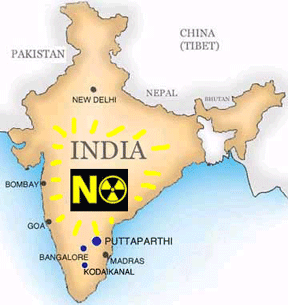 Public hearing on MP’s Chukta nuclear power project cancelled
http://www.business-standard.com/article/current-affairs/public-hearing-on-mp-s-chukta-nuclear-power-project-cancelled-113052401095_1.html Led by Ramon Magsaysay award winner Dr Sandeep Pandey and others prominent activists of the state, locals of as many as 38 villages restricted Mandla district administration to organise a public hearing on controversial Chutka nuclear power project.
According to activists, more than 4,000 villagers reached the hearing site at Chutka and stalled the process before it could take place. “The public hearing meeting has been cancelled today,” said a government spokesperson but refused to give details on next schedule.
According to the protesters, agitation against the 1,400 MW Chutka nuclear power project (450 km east from Bhopal) was boiling up. They are likely to intensify agitation against land acquisition process launched by state government. Continue reading
Radiation incident at Japanese Atomic Energy Lab
Radiation leak reported day after incident at Ibaraki laboratory, Global Post, 24 May 13Radioactive substances were released into the atmosphere Thursday outside the controlled area at one of the Japan Atomic Energy Agency’s nuclear physics laboratories in Ibaraki Prefecture, the Nuclear Regulation Authority’s secretariat said early Saturday morning.
Fifty-five researchers and others who were engaged in experiments and other work at the laboratory may have been exposed to radiation as a result of inhaling the substances, but none were taken to hospital, the government body said. Four have so far undergone checkups and the highest radiation dose detected was 1.7 millisievert.
No impact from the radiation is expected beyond the premises of the accelerator laboratory in Tokaimura….. http://www.globalpost.com/dispatch/news/kyodo-news-international/130524/radiation-leak-reported-day-after-incident-at-ibaraki-
Japan’s Tsuruga nuclear reactor ruled unsafe, for permanent closure
 JAPAN NUCLEAR REACTOR ATOP ACTIVE FAULT: REGULATOR, Yahoo 7 News, May 23, 2013TOKYO (AFP) – Japan’s nuclear watchdog said Wednesday that one reactor was sitting directly above an active tectonic fault, effectively ruling out a restart forever.
The Nuclear Regulation Authority (NRA) said it had approved a report from experts which found a crack in the Earth’s crust lying underneath the reactor at a plant in Tsuruga, western Japan, was active. ”There is a need for us to take the report seriously,” NRA chairman
Shunichi Tanaka said.
It is the first time the newly-minted NRA has made such a ruling. It is still investigating possibly-active faults under five other
reactors. A second reactor at Tsuruga, which sits 300 metres (328 yards) away, is not one of this number.
The final decision on a restart rests with the government, who are expected to be asked by plant operator Japan Atomic Power to overrule
the watchdog.
Observers say despite its pro-nuclear stance, Prime Minister Shinzo Abe’s administration is unlikely to risk public ire by backing the
operator, meaning the reactor would become the first to be permanently shuttered since the Fukushima disaster……
http://au.news.yahoo.com/latest/a/-/latest/17290072/japan-nuclear-reactor-atop-active-fault-regulator/
Latest earthquake caused leak from Fukushima Daiichi Units 5-6
Tepco: M6 quake caused leak at Fukushima Daiichi — Water coming from pipe of Units 5, 6 http://enenews.com/m6-quake-caused-leak-at-fukushima-daiichi-water-coming-from-pipe-of-units-5-6
Title: Earthquake Occurred on May 18, 2013 (Fukushima Daiichi and Daini Nuclear Power Stations) (Follow-up Information No.2)
Source: Tepco Press Release
Date: May 20, 2013
h/t Anonymous tip
This is a follow-up report on the statuses of Fukushima Daiichi and Daini Nuclear Power Stations after the earthquake occurred in the offshore of Fukushima Prefecture (M5.9) at around 2:48 PM on May 18.
At around 4:10 PM in Fukushima Daiichi Nuclear Power Station, a TEPCO employee found water dropping from an overflow pipe of Units 5-6 RO treated water tank (D7 tank) where the leakage was found yesterday on the site patrol after the earthquake. […]
Regarding the treated water dropping from an overflow pipe of Units 5-6 RO treated water tank, the leakage area is estimated to be about 2 m x about 2 m and the leakage amount is estimated to be about 4 liters. […]
The water dropping is assumed to be caused by the earthquake occurred at around 2:48 PM today since the treated water tank was at full capacity from yesterday. […]
See also: Strong M6 quake hits near Fukushima nuclear plant — Intensity 5+ on JMA scale — Officials: “No reports of damage so far”
Chna’s nuclear weapons secrets
China’s nuclear program still shrouded in secrecy JAPAN TIMES, BY MICHAEL RICHARDSON MAY 23, 2013 SINGAPORE – China’s program to expand and modernize its conventional armed forces is well-documented and closely watched by nearby Asia-Pacific states, as well as the United States and other more distant countries with interests in the region. However, China’s arsenal of nuclear weapons and delivery systems (missiles and aircraft) is shrouded in secrecy — and controversy……
Most U.S. arms control officials and analysts continue to say that China has between 240 to 400 nuclear warheads, nearly all of them on ballistic missiles in underground silos or on mobile launchers that are hard to find and destroy. These include long-range missiles capable of reaching the U.S. mainland.
Such a force is less than a third of the arsenals kept by the U.S. and Russia, which between them still have far more long-range nuclear weapons than any other states with nuclear arms, despite big negotiated cuts in their inventories.
Still, the Chinese force would be enough to ensure strategic deterrence, meaning that if China was attacked by a nuclear power, it could still retaliate and inflict unacceptable damage…..
China has not publicly declared how many nuclear weapons it has and there is no way for outsiders to verify their estimates. China officially proclaims a “no first use” policy, stating that it would use nuclear forces only in response to a nuclear strike against China.
The pledge has two parts: first, that Beijing will never use nuclear weapons first against any nuclear-weapon state; and second, that it will never use or threaten to use nuclear weapons against any nonnuclear-weapons state or nuclear-weapon-free zone of the kind that exists in Southeast Asia and the South Pacific……
Unraveling China’s nuclear secrets without its cooperation will be nearly impossible. The best hope may be for the U.S. and Russia to make any future nuclear arms reduction negotiations contingent on participation by China, India and Pakistan. http://www.japantimes.co.jp/opinion/2013/05/23/commentary/chinas-nuclear-program-still-shrouded-in-secrecy/#.UZ58j6JwpLs
Safecast’s revolution in radiation data collection
Safecast’s software and devices are all open source, and anyone can use the data. Franken says it’s being used by researchers around the world and even by the government in some Japanese cities.
you can tie specific medical symptoms to radiation levels.”
In Japan, Citizen Radiation-Tracking Project Goes Big Time, PRI’s The World, BY CATHERINE WINTER ⋅ MAY 21, 2013 ⋅ON A SUNNY SPRING MORNING JUST OUTSIDE TOKYO, JOE MOROSS HOOKS A RADIATION DETECTOR OUTSIDE THE BACK WINDOW OF A LITTLE RED CAR. HE LOOKS AT A MAP OF THE AREA ON HIS LAPTOP COMPUTER, TRYING TO FIND A ROUTE HE HASN’T DRIVEN BEFORE, SO HE CAN TAKE NEW RADIATION READINGS.
“We want to cover every street so people who look at our maps can drill down and zoom in and find out what the measurement is right in front of their house,” Moross says.
Moross is taking measurements for Safecast. Since the nuclear accident at Fukushima Daichi two years ago, volunteers like him have been driving around Japan, testing radiation and adding their readings to online maps.
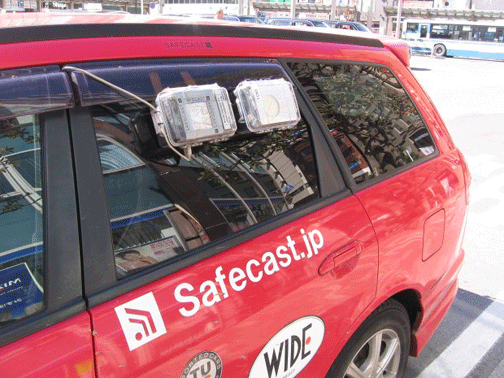
When The World last checked in on Safecast, in May of 2011, the group had just formed and had posted a handful of radiation measurements.
Now, Safecast volunteers have taken close to 10 million separate readings……. Continue reading
Japan learning radioactive cleanup from Hanford – does not inspire confidence

it’s time everyone stopped making the stuff
Japanese officials visit Hanford to learn nuclear cleanup strategies KPIU 885 By Anna King, 21 May 13 The people overseeing the cleanup of the Fukushima nuclear power plant disaster are learning some valuable lessons from the long-running cleanup at the Hanford Nuclear Reservation. A Japanese government delegation recently toured some of the southeast Washington site this week….. Japanese may need to build a facility two to four times larger to handle all their contaminated trees, topsoil and debris…http://www.kplu.org/post/japanese-officials-visit-hanford-learn-nuclear-cleanup-strategies

“Japan Atomic’s survival is now in doubt,”
 Japan emerges as solar beacon, SMH, 22 May 13, “…..Nuclear doubts Meanwhile Japan’s new nuclear regulator looks set to shut down at least one plant and maybe more, after a report published 16 May found that an earthquake fault under the country’s oldest reactor at Japan Atomic’s Tsuruga plant was active. National law bans building reactors on active faults.
“Japan Atomic’s survival is now in doubt,” Takashi Aoki at Mizuho Asset Management told Bloomberg News. This also raises the risk for the five other power stations under investigation for active faults. Japan Atomic has repeatedly said that the fault is not active, according to a company statement.
The new Nuclear Regulation Authority (NRA) also said last week it would issue an order to keep a separate unit, the Monju experimental fast breeder reactor, closed until its operator overhauled safety measures.
The verdict might be a blow for Abe’s efforts to get the nuclear capacity back online but it could be reassuring news for the Japanese public that the new watchdog does not seem to shy away from making unwelcome decisions to prioritise safety. The NRA’s predecessor reportedly ignored warnings before March 2011 when the earthquake and tsunami caused the meltdown of three reactors in Fukushima……..
Members of Abe’s party gathered on 14 May to demand restart of the nuclear reactors for the sake of the economic recovery. However, their demands may not be in line with public sentiment: in March, thousands of protesters marched through Tokyo, calling on the government to reject nuclear power.
The NRA is not expected to compile new safety standards until after July 2013, meaning that any decision on resuming operations could likely only be made after the upper house elections this summer…….http://www.smh.com.au/business/carbon-economy/japan-emerges-as-solar-beacon-20130522-2jzpt.html#ixzz2U3UWoJXE
Radiation affected people outside Fukushima seek compensation
 Hundreds seek compensation in Japan nuclear crisis http://timesofindia.indiatimes.com/world/rest-of-world/Hundreds-seek-compensation-in-Japan-nuclear-crisis/articleshow/20177997.cms
AP | May 21, 2013 TOKYO: Hundreds of people living just outside Japan’s Fukushima prefecture say they have been denied adequate compensation after the country’s 2011 nuclear disaster despite suffering elevated radiation levels.
Nearly 700 residents from Hippo district in Miyagi prefecture, just northeast of Fukushima, filed a claim Tuesday with a government arbitration office demanding that they be given the same compensation as residents of Fukushima. Continue reading
A top market for solar energy – Japan
Japan emerges as solar beacon, SMH May 22, 2013 – ”……The country’s generous solar feed-in tariff continues to bolster demand: Japan Asia Group’s plans are moving ahead to develop 500 megawatts of solar projects over the next three years, Tetsuo Yamashita, chairman of the company, said at a meeting with analysts on 16 May. It has 24 solar plants already developed in Europe, but may trim its business in that region, Yamashita said. Japan Asia received a 1.6 billion yen loan for five solar projects in its home country from Shinsei Bank and Mitsubishi UFJ Lease & Finance Company, it said in a statement in March.
The preceding day, Eurus Energy Holdings announced plans to build a 115MW solar power station in northern Japan. The aim is to start construction of the 49 billion yen ($US480 billion) project this July and to begin running the station in November 2015. Eurus is a venture between Toyota Tsusho Corporation and Tokyo Electric Power Company (Tepco).
And on 14 May, Nippon Paper Industries said that its joint venture with Mitsubishi will begin construction on a 21MW solar power station in western Japan this autumn. The plant is expected to start selling electricity to Shikoku Electric Power in H2 2014.
Demand for solar power is increasing for non-residential projects, according to data released by the Ministry of Economy, Trade and Industry on 17 May. Approved applications for non-residential solar projects jumped to 11GW by the end of February from just under 6GW at the end of January.
The start of the feed-in tariff last year helped Sharp to reduce losses at its solar unit in the Asian country: global solar sales climbed 16 per cent to 260 billion yen ($US2.54 billion) last fiscal year, mainly driven by an increase in residential demand in Japan, the company said. Sharp’s operating losses fell to 4.4 billion yen ($US43 billion) for the 12 months ended 31 March compared with 21.9 billion yen ($US210 billion) the previous year….. Japan is forecast to install 6-9.4GW of solar capacity this year under its feed-in tariff, according to Bloomberg New Energy Finance. This could make it the second-largest – or even the top – solar market in theworld
TEPCO’s share price up on projected restarting of Japan’s nuclear reactors
Thanks To Abenomics, The Company At The centre Of The Fukushima Nuclear Crisis, Has Surged Nearly 400% This Year BUSINESS INSIDER MATTHEW BOESLER 22 May 13 ‘… a pretty shocking chart: it’s the share price of TEPCO, the beleaguered Japanese power company at the centre of the Fukushima nuclear disaster that followed from the Japanese earthquake in April 2011.
Year-to-date, the stock is up 396%. In recent days, it’s gone absolutely vertical in the past few days on speculation that the company will at last power up its nuclear reactors again, which have been shut down since the disaster.Bloomberg’s Tsuyoshi Inajima has the details:
Tepco shares yesterday rose 16 per cent to 726 yen after the Yomiuri newspaper reported the utility will apply to the Nuclear Regulation Authority for a restart of No. 1 and No. 7 units at the Kashiwazaki Kariwa plant in northern Japan in July.
Tepco denied the Yomiuri report and said the utility is still designing a filtered vent system, part of the new safety requirements to be set by the nuclear safety watchdog. The company can’t say when it can complete the installation.
Of course, the announcement and beginning of the implementation of the Japanese government’s “Abenomics” economic stimulus strategy has caused the broader Japanese stock market to surge this year, making it one of the best performing global stock markets so far in 2013. (The surge in stocks is also a byproduct of the weakening Japanese yen, which has been the primary conduit of Abenomics so far.)……. http://au.businessinsider.com/abenomics-sends-tepco-shares-surging-2013-5
1 This Month
23-25 October – on Zoom – World BEYOND War’s annual global conferenc


Shut down the radiation-damaged Heysham nuclear reactors now
To see nuclear-related stories in greater depth and intensity – go to https://nuclearinformation.wordpress.com

Say No to NASA’s Reckless Nuclear Reactor on the Moon
Say No to NASA’s Reckless Nuclear Reactor on the Moon
-
Archives
- October 2026 (170)
- September 2026 (339)
- August 2026 (330)
- July 2026 (355)
- June 2026 (287)
- May 2026 (306)
- April 2026 (356)
- March 2026 (251)
- February 2026 (267)
- January 2026 (308)
- December 2025 (358)
- November 2025 (359)
-
Categories
- 1
- 1 NUCLEAR ISSUES
- business and costs
- climate change
- culture and arts
- ENERGY
- environment
- health
- history
- indigenous issues
- Legal
- marketing of nuclear
- media
- opposition to nuclear
- PERSONAL STORIES
- politics
- politics international
- Religion and ethics
- safety
- secrets,lies and civil liberties
- spinbuster
- technology
- Uranium
- wastes
- weapons and war
- Women
- 2 WORLD
- ACTION
- AFRICA
- Atrocities
- AUSTRALIA
- Christina's notes
- Christina's themes
- culture and arts
- Events
- Fuk 2022
- Fuk 2023
- Fukushima 2017
- Fukushima 2018
- fukushima 2019
- Fukushima 2020
- Fukushima 2021
- general
- global warming
- Humour (God we need it)
- Nuclear
- RARE EARTHS
- Reference
- resources – print
- Resources -audiovicual
- Weekly Newsletter
- World
- World Nuclear
- YouTube
-
RSS
Entries RSS
Comments RSS

