Compensation for Fukushima evacuees’ radiation anxiety
 Fukushima Evacuees To Get Radiation Uncertainty Compensation http://www.rttnews.com/2128844/fukushima-evacuees-to-get-radiation-uncertainty-compensation.aspx?type=gn&utm_source=google&utm_campaign=sitemap 6/3/2013 A government-backed arbitration body in Japan directed the operator of the tsunami-wrecked Fukushima nuclear power plant to pay compensation to former residents of a district for radiation exposure and future healthuncertainties.
As per a directive issued by the Nuclear Damage Claim Dispute Resolution Center, the Tokyo Electric Power Company (TEPCO) has to pay about $10,000 each to pregnant women and those aged below 18 years. The other residents of Nagadoro district would get $5,000 each, Japanese media reported on Sunday.
Nagadoro is near the Fukushima plant where radiation levels remain high and it is the only district that the government declared uninhabitable for a long period.
An evacuation order for the area was issued more than a month after the nuclear accident on March 11, 2011. The arbitrators accepted the residents’ claim of fear and anxiety as they had lived without any protection against high radiation doses because of their delayed evacuation. The residents had already received compensation for having to evacuate, but the amount did not cover health anxieties. Lawyers representing the residents said it was for the first time that compensation for health anxietywas granted.
The massive tsunami severely damaged four reactors at the Fukushima plant north of Tokyo, knocking out its cooling systems and triggering meltdowns and radiation leaks. Tens of thousands of people fled their homes in the worst atomic disaster since the 1986 Chernobyl nuclear accident.
Another try to fix Fukushima reactor – inject cement-like grout
Cement-like grout to be injected into Fukushima reactor? (PHOTO) http://enenews.com/cement-like-grout-to-be-injected-into-fukushima-reactor-photo Tepco Handout, May 30, 2013 (Summary translation of page 26 by Fukushima Diary): […] the […] the committee of experts suggested Tepco to fill the torus room with grout. […] Tepco plans to conduct the feasibility study with United States Department of Energy this year. […] They assume it takes 1.5 years to make planning, and 2 years to inject the grout material. […] The committee points out the benefit of using grout is it doesn’t directly touch the molten fuel. However, it hasn’t been confirmed that the fractured molten fuel is not really in the torus rooms.
Department of Energy: Grouting—Grout is a promising option to stop water leakage that’s occurring between reactor and turbine buildings at Fukushima Daiichi’s reactor units, and could be a key step toward facilitating decommissioning of units 1-4. SRNL has extensive experience in grout development and also has operating experience with grouting components reactors and other facilities.
Reuters: The company may resort to pouring a cement-like material into the rectors’ suppression chambers to plug leaks it has not been able to locate, Suzuki said. “One approach we are considering is putting grout, like cement,” he said. “In other words, filling it in. That would block all the holes.”
See also: “Too many holes” in Fukushima reactors? May have to fill up suppression chambers with cement -Tepco
The Asian nuclear arms race
Asian countries pile up nuclear arms DW, 3 June 13 The arms race in
Asia has increased since 2008 mainly due to growing tensions between
China and Japan, the two Koreas, and India and Pakistan, says the
Stockholm International Peace Research Institute in its report.
The Stockholm International Peace Research Institute (SIPRI) says in
its latest report that China, India and Pakistan have added more
nuclear weapons to their stock in the last few years.
The annual report claims that while China appears to be expanding its
nuclear arsenal, India and Pakistan are increasing both their nuclear
as well as their conventional weapons.
Pakistan is also enhancing its plutonium production at the central
Khushab city, which is home to the Heavy Water and Natural Uranium
Research Reactor – an important component of the Islamic state’s
special weapons program.
SIPRI further says that in 2012 China, India and Pakistan added 10
warheads each to their nuclear storage. China, it says, now has 250
nuclear warheads, whereas Pakistan possesses 100 to 120, and India 90
to 110.
The three Asian countries are home to over 2.7 billion people, which
is nearly 40 percent of the global population…..
http://www.dw.de/asian-countries-pile-up-nuclear-arms/a-16856178
China pledges no pre-emptive nuclear strike
Shangri-La Dialogue: China reiterates ‘no-first-use’ nuclear pledge Straits Times News Jun 02, 2013 CHINA is maintaining its pledge not to be the first to use nuclear weapons in a conflict, a top Chinese general said on Sunday.
Omission of the “no-first-use” pledge in a recently released defence
white paper had created ripples in military circles and sparked
speculation that China may have dropped the policy.
“I want to make a solemn statement that the Chinese government will
never discard our pledge of no first-use of nuclear arms,”
Lieutenant-General Qi Jianguo told the Shangri-La Dialogue security
forum in Singapore.
“We have been sticking to this policy for half a century, and its
facts have proven that it is not only in the interest of the Chinese
people but also of the people of all the world.” ….. subscribers
only http://www.straitstimes.com/breaking-news/asia/story/shangri-la-dialogue-china-reiterates-no-first-use-nuclear-pledge-20130602
As Fukushima radioactive water grows, situation hopeless for fishermen
 Fukushima fishermen forced to test fish for radiation REUTERS, 31 May 13“….The fishermen of Hisanohama, forced out of work by the disaster, have had no choice but to take the only job available – checking contamination levels in fish just offshore from the destroyed nuclear reactor buildings. ”We used to be so proud of our fish. They were famous across Japan and we made a decent living out of them,” said 80-year-old Yaoita, who survived the tsunami by taking on the waves and sailing the six-person True Prosperity out to sea.”Now the only thing for us is sampling.”…..
The fishermen and Tepco are in dispute over the utility’s plans to dump 100 tons of groundwater a day from the devastated plant into the sea. The complicated clean-up plan for Fukushima could take 30 years or more. Tepco’s challenge is what to do with the contaminated water that has been pooling at the plant at a rate of 400 tons a day – enough to fill an Olympic-size swimming pool in a week.
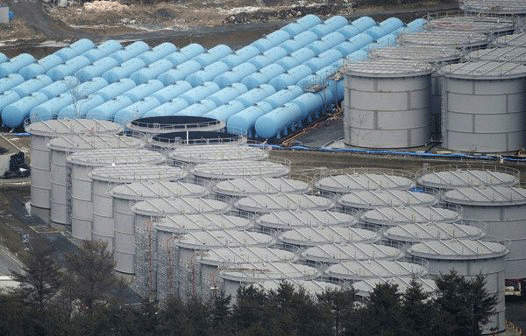
So far it has been racing to build tanks to store the contaminated water on the grounds of the plant, in which all the water is kept at the moment.It has also asked fishermen to support a plan to build a “by-pass” that would dump groundwater into the sea before it becomes contaminated by flowing under the reactor’s wreckage.
“We are staunchly against it,” said Tatsuo Niitsuma, 71, who fishes with Yaoita.
MORE CONTAMINATION, LESS HOPE Representatives from fishing cooperatives met Tepco officials on Thursday to discuss the proposal, with Trade Minister Toshimitsu Motegi to instruct Tepco on what to do, although no final plans were announced. In addition to the “by-pass” Motegi, who also holds the energy portfolio, told Tepco to create “protective walls” in the ground by freezing the soil around the reactors to create an underground barrier to stop groundwater from flowing in and mixing with contaminated water inside the reactor building.
The fishermen, however, worry the “by-pass” plan risks more contamination and delays, possibly ending any hope for the only job they know.
Tepco officials have said it may take as long as four years to fix the problem, but have said they do not need outside help.
The uncertainty and stress have become problems. Many former fishermen live in temporary homes next to people they barely know after losing not only their jobs, but also family members…….. http://www.reuters.com/article/2013/05/31/us-fukushima-fishermen-idUSBRE94U0D620130531
Transferring nuclear wastes – it’s like a game of “Pass The Parcel”
 Australia-Euratom Nuclear Safeguards: Plutonium Retransfers …..The Agreement will enter into force when Australia notifies the Delegation to the European Commission that all domestic requirements necessary to give effect to the Agreement have been satisfied…. Department of Foreign Affairs and Trade – Australian Government 01/06/2013 | Press release
  distributed by noodls http://www.noodls.com/view/2FBAFE516E5E78B9F15B62CBEB136F9A32994CC7
 Australia and the European Atomic Energy Community (Euratom) exchanged diplomatic notes in Canberra on 28 May 1998 as the first step towards bringing into force an Agreement under which Australia will – subject to certain conditions – broaden its consent for the return from the European
  Union to Japan of Australian obligated plutonium following the reprocessing of Japanese spent fuel in Europe. The European Union is an important provider of nuclear fuel cycle services for countries purchasing Australian uranium and Japan is a major market for Australian uranium exports. Continue reading
Desperate radioactive water problem at Fukushima – attempt to freeze surrounding soil
 Soil around Fukushima to be frozen to stop groundwater leaking in http://www.abc.net.au/news/2013-05-31/operator-ordered-to-freeze-soil-around-crippled-nuclear-plant/4724554 By North Asia correspondent Mark Willacy, The Japanese government has ordered the operator of the Fukushima nuclear plant to freeze the soil around its crippled reactor buildings to stop groundwater seeping in and becoming contaminated.
Every day another 400 tonnes of groundwater forces its way into the plant, becomes contaminated with radioactivity and needs to be stored onsite. Plant operator Tokyo Electric Power Company (TEPCO) already has a quarter of a million tonnes of radioactive water stored in tanks at Fukushima. (below Fukushinma Daichi reactor No 6)

Fearing the nuclear plant is running out of space to store contaminated water, the Japanese government has ordered TEPCO to take the drastic step. The government hopes these frozen walls of soil will stop huge amounts of groundwater leaking into the buildings and it wants the system to be in place within two years.
According to a report compiled by a government panel on Thursday, there are no previous examples of using walls created from frozen soil to isolate groundwater being used for longer than a few years.
This means the project at the Fukushima plant poses “an unprecedented challenge in the world”.
Japan’s PM Abe pushing for nuclear reactor sales to India – and fast!
 Japan, India seek prompt nuclear accord Asia One, 31 May 13 TOKYO – Prime Minister Shinzo Abe and visiting Indian Prime Minister Manmohan Singh agreed to conclude a nuclear cooperation agreement as soon as possible……Although the negotiations on the nuclear cooperation pact began in June 2010, they have been suspended due partly to the nuclear crisis at the Fukushima No. 1 nuclear power plant following the Great East Japan Earthquake in 2011.
The two leaders instructed related authorities to accelerate the negotiations……
The Abe administration considers the export of infrastructure to be a pillar of its growth strategy. The Indian government, for its part, plans to increase its nuclear energy generation by constructing 18 new nuclear reactors by 2020.
The Japanese side hopes to reach an agreement with India by the end of this year, leading to exports of nuclear power plants and related equipment……
Meanwhile, Singh expressed his support for Japan’s bid to host the 2020 Summer Olympics.
They also confirmed the plan to arrange an official visit by the Emperor and Empress to India from late November to early December. http://news.asiaone.com/News/AsiaOne%2BNews/Asia/Story/A1Story20130531-426340.html
Never ending delay in plans for India’s Jaitapur nuclear power plant
Moushumi Das Gupta, Hindustan Times
Areva had in 2010 signed a framework agreement with the Nuclear Power Corporation of India (NPCIL) to build two of the new generation European Pressurised Reactors (EPR) of 1650 MW each as part of Phase I with an option to build four more.
But amidst protests by locals — concerned over safety issues following the Fukushima accident — and confusion over some clauses of civil nuclear liability law that puts the onus on suppliers in case of accidents, the commercial pact has not been signed as yet resulting in the project failing to take off the ground.
The delay has not only resulted in Areva rescheduling the original 2017 date for commissioning the reactors but company officials said it will also lead to an escalation in the cost of power to be generated. Currently the per unit cost of power has been fixed at Rs. 4.
“No way that the EPR would start by 2017. More the delay, the unit cost would get affected. The Rs. 4 per unit tariff is meant for plants starting in 2017,” said Arthur De Montalembert, executive vice-president, business development, international commercial organization at Areva…… http://www.hindustantimes.com/world-news/Europe/Jaitapur-nuclear-plant-headed-for-delay-Areva/Article1-1067427.aspx
India’s rural communities angry over uranium and weapons projects
Grasslands bristle over uranium plant, test range http://timesofindia.indiatimes.com/city/bangalore/Grasslands-bristle-over-uranium-plant-test-range/articleshow/20357979.cms Deepika Burli, TNN | May 31, 2013 BANGALORE: Green activists and local villagers have taken serious exception to proposals from defence and research institutions to build sensitive projects on the 10,000 acres of Amrit Mahal Kaval land allotted to them in Challakere taluk of Chitradurga district.
“The Barc plan envisages conducting experiments with uranium, which will not only ruin the fertility of the land but put the lives of so many villagers at risk. Continue reading
India’s long range missile to have Multiple Nuclear Warheads
India’s Agni-V ICBM to Carry Multiple Nuclear Warheads The Diplomat, By Zachary Keck May 31, 2013 India is reconfiguring its longest-range missile to enable it to carry multiple nuclear warheads, Chennai-based The Hindu reported on Wednesday, citing a senior Indian official.
V.K. Saraswat, Director-General of the Defence Research and Development Organisation, told the newspaper that a team is modifying the Agni-V to give it the ability to carry Multiple Independently Targetable Re-entry Vehicles (MIRVs).
“Work on that is going on and it is at design stage,” Saraswat told The Hindu.
The Agni-V is a nuclear-capable three-stage, solid-fuel missile with an initial range of 5,000 kilometers that will likely be extended to over 5,5000 kms, making it an Inter-Continental Ballistic Missile (ICBM). India first tested the Agni-V last April, and the launch was a success…… http://thediplomat.com/flashpoints-blog/2013/05/31/indias-agni-v-icbm-to-carry-multiple-nuclear-warheads/
South Korea seeking uranium enrichment, despite its previous pledges
Two-Decade-Old Pledge Complicates South Korean Nuclear Goals National Journal, By Elaine M. Grossman May 30, 2013 | South Korea’s designs on producing atomic fuel recently scotched a 2014 trade deal with the United States, but could yet have new ramifications: Potentially shattering a twenty-one-year-old pledge Seoul made to never process sensitive nuclear materials, according to issue experts.
“By dint of the Joint Declaration of 1992, South Korea has said it will not possess enrichment or reprocessing facilities on its peninsula,” Thomas Moore, deputy director of the Proliferation Prevention Program at the Center for Strategic and International Studies, said at a recent panel discussion. …………http://www.nationaljournal.com/nationalsecurity/two-decade-old-pledge-complicates-south-korean-nuclear-goals-20130530

 South Korea Shuts 2 Reactors Over Faked Certificates http://www.nytimes.com/2013/05/29/world/asia/south-korea-turns-off-nuclear-reactors.html?_r=0 By CHOE SANG-HUN May 28, 2013 SEOUL, South Korea — South Korea said on Tuesday that it was turning off two nuclear power reactors and delaying the scheduled start of operations at another two after its inspectors discovered that the reactors used components whose safety certificates had been fabricated.
South Korea’s nuclear power industry has been plagued by a series of forced shutdowns, corruption scandals and mechanical failures in recent years, undermining public confidence in atomic energy even as the country’s dependence on it for electricity is expected to grow. Continue reading
Japan’s corrupt ‘nuclear village’ still ruling policy?
The Fukushima plant looks to be a bottomless pit, with the tab set to grow as decontamination and decommissioning will take decades. And, how much will it cost to deal with all the radioactive waste accumulated at Japan’s 50 other reactors and where will that be stored?
Is it safe? Ruling party pushes nuclear village agenda BY JEFF KINGSTON JAPAN TIMES, 26 May 13, “……This April, the Nuclear Regulation Authority (NRA) began assessing whether the two Oi reactors meet new safety standards slated to go into effect in July. There are three active fault lines near the Oi plant on the Sea of Japan coast, but it will not have a remote command center ready until 2015 and its raised sea wall will not be completed until March 2014. The new safety guidelines also require that utilities equip reactors with filtered venting systems to reduce radioactive releases in the event of an emergency, but they are granted a five-year grace period before these must be in place.
Consequently, the reactors are now operating based on the hope that these countermeasures will prove unnecessary; Fukushima demonstrates the folly of wishing risk away. The findings of three major investigations into the Fukushima accident were released in 2012, detailing the absence of a culture of safety in the nuclear industry in Japan and cozy, collusive relations between regulators and the utilities that compromised safety……
In fact, tsunami risks should have come as no surprise to Tepco, as the Tohoku coastline has been battered by major ones in 1611, 1677, 1793, 1896 and 1933. Indeed, there are tsunami stones dotting the Tohoku coastline warning future generations to heed the perils. Tepco’s own researchers warned about the tsunami risk in Fukushima, and clearly the one triggered by the Great East Japan Earthquake on March 11, 2011, was no black swan, once in a 1,000-year event. But the utilities and the government ignored the risks and sited reactors in tsunami-risk zones.

The Diet investigation concludes that what’s termed “regulatory capture” — regulators regulating in favor of the regulated — was at the heart of the nuclear accident, and it blasts the absence of a culture of safety. Moreover, it outlines an institutionalized culture of collusion, complacency and deceit involving regulators and utilities that explains why Fukushima in particular, and the nuclear industry in general, settled for inadequate safeguards…….. Continue reading
Japan’s Prime Minister Abe willing to take a chance on nuclear safety
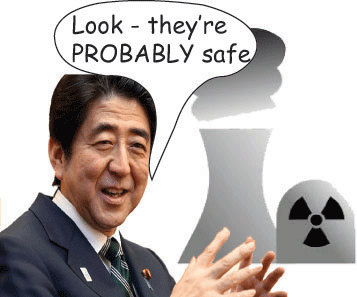 Abe to pledge resumption of Japan nuclear plants By MarketWatch, May 26, 2013, TOKYO—Prime Minister Shinzo Abe will clarify his government’s plan to resume operation of idled nuclear power plants in a growth strategy to be compiled in mid-June, Kyodo News quoted sources familiar with the matter as saying Saturday.
The draft energy policy to be included in the growth strategy states that steps will be taken to restart reactors judged safe for operation by the nuclear regulatory authorities, they said.
The government will pledge that it will make utmost efforts to ensure plant safety to gain support from municipalities hosting nuclear plants, the sources said.
The energy policy laid out in the growth strategy will be the government’s official endorsement of Abe’s plan to rely on nuclear power until the nation’s final policy is made on nuclear energy use…. http://www.marketwatch.com/story/abe-to-pledge-resumption-of-japan-nuclear-plants-2013-05-26
1 This Month
23-25 October – on Zoom – World BEYOND War’s annual global conferenc


Shut down the radiation-damaged Heysham nuclear reactors now
To see nuclear-related stories in greater depth and intensity – go to https://nuclearinformation.wordpress.com

Say No to NASA’s Reckless Nuclear Reactor on the Moon
Say No to NASA’s Reckless Nuclear Reactor on the Moon
-
Archives
- October 2026 (170)
- September 2026 (339)
- August 2026 (330)
- July 2026 (355)
- June 2026 (287)
- May 2026 (306)
- April 2026 (356)
- March 2026 (251)
- February 2026 (267)
- January 2026 (308)
- December 2025 (358)
- November 2025 (359)
-
Categories
- 1
- 1 NUCLEAR ISSUES
- business and costs
- climate change
- culture and arts
- ENERGY
- environment
- health
- history
- indigenous issues
- Legal
- marketing of nuclear
- media
- opposition to nuclear
- PERSONAL STORIES
- politics
- politics international
- Religion and ethics
- safety
- secrets,lies and civil liberties
- spinbuster
- technology
- Uranium
- wastes
- weapons and war
- Women
- 2 WORLD
- ACTION
- AFRICA
- Atrocities
- AUSTRALIA
- Christina's notes
- Christina's themes
- culture and arts
- Events
- Fuk 2022
- Fuk 2023
- Fukushima 2017
- Fukushima 2018
- fukushima 2019
- Fukushima 2020
- Fukushima 2021
- general
- global warming
- Humour (God we need it)
- Nuclear
- RARE EARTHS
- Reference
- resources – print
- Resources -audiovicual
- Weekly Newsletter
- World
- World Nuclear
- YouTube
-
RSS
Entries RSS
Comments RSS

