Human Rights Forum urges stop to new uranium mining in Kadapa, India
Excessive mining in AP uranium plant opposed http://www.deccanherald.com/content/333841/excessive-mining-ap-uranium-plant.html Hyderabad, May 21, 2013, DHNS:
The HRF has been opposing the proposed 4,500 TPD (tonnes per day) in comparison with the current 3,000 TPD.
The HRF, in a press release, stated that the excessive mining of uranium will make the land futile and deplete the groundwater. The scars left by increased uranium mining will be permanent. HRF’s claims are backed by the Environmental Impact Assessment (EIA) reports.
The uranium mining can eventually harm individuals. To evaluate the aftereffects of uranium mining, one has just to visit Jaduguda in Jharkhand where uranium mining takes place.
Greenhouse gas emissions to be capped by China
China emissions cap proposal hailed as climate breakthrough REneweconomy, By Giles Parkinson on 22 May 2013 China, the world’s biggest polluter, is proposing to set a cap on greenhouse gas emissions as early as 2016 in a move that is being hailed as a potentially transformative step in the fight against climate change.
According to news reports from China, the powerful National Development and Reform Commission (NDRC) has proposed setting absolute caps that would divorce the growth on emissions from growth in the economy, and will also set a peak in its overall emissions in 2025, five years earlier than planned.
China has already pledged to cut its emissions intensity – the amount of Co2 it emits per economic unit – by up to 45 per cent by 2020. The significance of an absolute cap is that it promises to reign in emissions even if the economy grows faster than expected.
Furthermore, Point Carbon reports, at a recent NDRC meeting, its vice director Xie Zhenhua said China should set long-term emission targets for 2030 and 2050 in a bid to decarbonise its economy. China, like Australia is heavily dependent on carbon-intensive coal to generate electricity – just over 82 per cent. But it has also proposed a cap on coal consumption of 4 billion tonnes.
Lord Nicholas Stern, the chair of the Grantham Research Institute on Climate Change at the London School of Economics, described it as “exciting news”, and said it should encourage all countries, the US in particular, to take stronger action.
“And it improves the prospects for a strong international treaty being agreed at the United Nations climate change summit in 2015,” he told The Independent in the UK…….. http://reneweconomy.com.au/2013/china-emissions-cap-proposal-seen-as-climate-breakthrough-40529

South Korea hopes to become a major exporter of nuclear plants….. It won a US$20.4-billion contract with the United Arab Emirates (UAE) to build four nuclear power plants there. Potential future export markets for South Korea include Saudi Arabia, India, Vietnam, Poland, and South Africa, as well as the U.S. and China…… http://english.yonhapnews.co.kr/national/2013/05/22/26/0301000000AEN20130522000200315F.HTML
Perpetual water needed to nuclear reactors – will end up in Pacific Ocean
 Japan Times: Discharges of Fukushima nuclear material into Pacific “have effectively contaminated the sea” — Melted reactor cores will burn again if water not perpetually poured in — “Tepco proposing some of it be dumped into ocean” http://enenews.com/japan-times-discharges-of-nuclear-material-into-the-pacific-from-fukushima-have-effectively-contaminated-the-sea-melted-reactor-cores-will-burn-again-if-water-not-perpetually-poured-in-t
Title: Fukushima No. 1 can’t keep its head above tainted water
Source: The Japan Times
Author: Reiji Yoshida
Date: May 21, 2013
[…] Tepco must perpetually pour water over the melted cores of reactors 1, 2, and 3 via makeshift systems to prevent the fuel from melting and burning again. […]
Tepco is proposing some of the water be dumped into the sea after processing it to remove most, but not all, radioactive isotopes. […]
Previous discharges into the Pacific have effectively contaminated the sea. Failure to store it means it will probably flood the whole compound and end up in the ocean anyway. […]
Will the processed water pose health or environmental risks?
According to Tepco, the processed water could theoretically be safe […]
Tritium is the exception, however. Tepco says the tritium level in the contaminated water is between 1 million and 5 million becquerels per liter. The legal limit is 60,000. […]
See also: Gundersen: “Liquid releases” of nuclear material into ocean will continue for years and years at Fukushima Daiichi — Already 10 times Chernobyl (VIDEO)
Japan set to become a top solar energy market in 2013
 Goldman Sachs eyes Japan renewable energy investments http://www.eco-business.com/news/goldman-sachs-eyes-japan-renewable-energy-investments/ 20 May 13,
Goldman Sachs Group Inc. (GS) plans to invest as much as 50 billion yen ($487 million) in renewable energy projects in Japan in the next five years, tapping demand for electricity produced from solar and wind-power generators.
The Wall Street firm also plans to take as much as 250 billion yen of bank loans and project-financing over the same period to move ahead with projects that would cost a total of 300 billion yen, Hiroko Matsumoto, a Tokyo-based spokeswoman for Goldman, said by telephone. The Nikkei newspaper reported the plan earlier today.
Japan began offering incentives in July through feed-in tariffs to encourage renewables after the Fukushima nuclear-plant crisis stemming from the March 11, 2011 earthquake and tsunami. Japan has been forced to slash its reliance on atomic power generation since Fukushima.
“We believe that we can leverage our global expertise in investing in renewable energy in places such as the US and India, to help expand Japan’s renewable power capabilities,” Ankur Sahu, co-head of the merchant banking division in the Asia-Pacific, said by e-mail.
Goldman Sachs formed the Japan Renewable Energy Co. unit in August to plan, design and operate power plants run on sun, wind, fuel cells and biomass fuels, it said on its website.
Investor attraction
Renewable energy has attracted interest from investors ranging from billionaire Masayoshi Son’s Softbank Corp. and financial-services company Orix Corp. to the country’s biggest banks led by Mizuho Financial Group Inc.
Japan will probably become the largest solar market in the world after China this year, according to data compiled by Bloomberg.
Commercial and utility-scale projects will boost solar installations to a range of 6.1 gigawatts to 9.4 gigawatts in 2013, exceeding an earlier forecast of 3.2 gigawatts to 4 gigawatts, Bloomberg New Energy Finance said in April.
Companies that stand to benefit include Kyocera Corp., Sharp Corp. and Suntech Power Japan Corp., all of which make and sell solar panels for residential and industrial use.
Rice being planted within 20 km of Fukushima No 1 nuclear power plant
Rice planted 10 miles from Fukushima Daiichi — Residents can’t stay in town overnight — “Intended for sale” http://enenews.com/jiji-rice-being-planted-about-10-miles-from-fukushima-daiichi-intended-for-sale
Title: Rice planted in former no-go zone
Source: JIJI
Date: May 20, 2013
Farmers in the city of Tamura, Fukushima Prefecture, have begun planting rice in a district once designated a no-go zone because of radioactive fallout ejected by the disaster-hit Fukushima No. 1 power plant.
It is the first time since the March 2011 core meltdowns that rice intended for sale has been planted in any former hot zone within 20 km of the power plant.
Saturday’s rice planting was carried out in Tamura’s Miyakojimachi district, about 15 km [9.4 miles] from the plant […]
Residents can enter without permission during the daytime but aren’t allowed to stay overnight […]
See also: Japan Times: Radiation level in Fukushima town 400 times higher than in Tokyo — 10 kilometers from Daiichi
Fishermen testing fish for radiation, in South Fukushima waters
Fishermen net fish in Fukushima waters to measure radiation levels
http://ajw.asahi.com/article/0311disaster/recovery/AJ201305210005 May 21, 2013 By HIROSHI KAWAI/ Staff Writer
A fishing vessel from Fukushima Prefecture caught fish in waters south
of the crippled Fukushima No. 1 nuclear power plant on May 20 to test
them for levels of radiation contamination, as local fishing
cooperatives hope to soon resume fishing in the area.
The No. 12 Akira Maru belonging to the Iwaki fishermen’s cooperative
trawled plenty of flatfish and other species.
Due to ocean currents, the concentration of radioactive materials has
been found to be higher in waters to the south of the plant, than to
the north.
Of the Akira Maru’s catch, nine species of fish were kept as samples
to measure radiation levels in them. The fishermen tested about 10
kilograms of each type and threw the rest back into the sea.
“It feels hollow to have to throw fish back into the sea, considering
that they could fetch high prices,” Captain Akiyoshi Abe said.
Before the nuclear accident triggered by the Great East Japan
Earthquake and tsunami in March 2011, waters off the prefecture were
known as a good fishing area where more than 100 species could be
caught.
Many local fisheries cooperatives have had to suspend operations since
the nuclear accident.
10 Km from Fukushima nuclear plant radiation levels 400 times higher than in Tokyo
 Japan Times: Radiation level in Fukushima town 400 times higher than in Tokyo — 10 kilometers from Daiichi http://enenews.com/japan-times-radiation-level-fukushima-town-400-times-higher-tokyo
Title: Fukushima photos focus on what can’t be seen
Source: Japan Times
Author: Ken Kawashima
Date: May 19, 2013
[…] Returning to the base of [Mount Higakure] overlooking the manmade lake behind the [Sakashita] dam, we find a public radiation-monitoring post indicating a reading of 0.44μSv/hour — roughly 40 times the level in Tokyo on the same day.
Moving on from there, before heading back to Tokyo we decide to drop by the abandoned tsunami-ravaged town of Tomioka, which had been off-limits until just recently. There, a mere 10 km from the nuclear plant, we were chastened to find the radiation readings were almost 10 times those by the dam — some 400 times Tokyo levels at the same time on the same day. […]
Full report here
Japanese authorities ignore radiation levels in Tokyo river eels
 Local governments ignore cesium detection in Tokyo river eels, Asahi Shimbun May 17, 2013 By YUSUKE FUKUI/ Staff Writer Tokyo and Chiba local governments took no action for nearly two months after being informed that radioactive cesium had been detected in eels caught in a boundary river between the two prefectures.
Officials of both governments said no independent study was conducted because the eels were not caught by professional fishermen intending to sell the catch.
The detection of the cesium was also not publicized. On March 9, a 47-year-old self-employed woman caught an eel from the Edogawa river in Tokyo’s Katsushika Ward. Concerned about reports that cesium had accumulated downstream in the river, she sent the eel to Hideo Yamazaki, a professor of environmental analysis at Kinki University in Osaka Prefecture. Using a germanium semiconductor detector, Yamazaki found that the eel had 147.5 becquerels of radioactive cesium per kilogram, higher than the central government standard of 100 becquerels.
Yamazaki reported his finding to the Fisheries Agency in late March because he felt there was a need for an official investigation to back up his finding as well as further studies to look into the effects on other fish.
Although the Fisheries Agency informed both the Tokyo metropolitan and Chiba prefectural governments about the finding, neither had conducted an official study as of May 16.
An official with the Tokyo metropolitan government’s fisheries division said, “Basically, only fish that enter the distribution network is subject to studies. The eel fishing season also does not start until summer.”….. Yamazaki conducted further studies on four eels caught by the same woman in April and May in the Edogawa river. The eels had cesium levels between 97.4 becquerels and 129.6 becquerels per kilogram, with three of the eels having cesium levels exceeding the central government standard….. http://ajw.asahi.com/article/behind_news/social_affairs/AJ201305170079
Fukushima to California – the path of nuclear radiation along Latitude 40
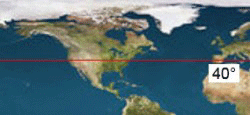 Study: Concentrated Fukushima radioactive plume staying on narrow path toward U.S. — Moving with surface water along 40 N — Same latitude as Northern California(MAP) http://enenews.com/study-concentrated-fukushima-radioactive-plume-staying-along-narrow-path-moving-surface-water-along-40-same-latitude-northern-california-map
Title: Surface pathway of radioactive plume of TEPCO Fukushima NPP1 released 134Cs and 137Cs
Source: Biogeosciences
Authors: M. Aoyama, M. Uematsu, D. Tsumune, and Y. Hamajima
Date: May 7, 2013
[…] The main body of radioactive surface plume of which activity exceeded 10 Bq m−3 travelled along 40° N and reached the International Date Line on March 2012, one year after the accident. A distinct feature of the radioactive plume was that it stayed confined along 40° N when the plume reached the International Date Line. […]
A distinct feature of the radioactive plume was that it stayed confined along 40 N when the plume reached the International Date Line, as stated in Sect. 3.2. The radioactive plume travelled 1800 km (from 160 E to 178 E) for 270 days (9 months) (Fig. 5); therefore, an average zonal speed (u) of the surface radioactive plume was calculated to be about 8 cm s−1 which was consistent with the speed of the reported surface current of 4–16 cm s−1 in the region (Maximenko et al., 2009). […]
We can also assume that the Fukushima radioactive plume moved with surface water […]
Full study here
Anti nuclear protests draws thousands of marchers in Taipei, Taiwan
 THOUSANDS IN TAIWAN RALLY AGAINST NUCLEAR POWER Yahoo 7 News, May 20, 2013, TAIPEI (AFP) – Thousands of Taiwanese marched through the capital Taipei on Sunday urging the government to halt construction of a nearly completed nuclear power plant, citing the Japanese atomic crisis.
The demonstrators chanted slogans like “No Nuke for Our Children” during the march which extended for miles as they evoked memories of the March 2011 Fukushima crisis sparked by an earthquake and tsunami. Continue reading
Japan’s Monju nuclear reprocessing plant not safe to restart
 AUDIO Japan’s nuclear safety record criticised by regulator http://www.radioaustralia.net.au/international/radio/program/connect-asia/japans-nuclear-safety-record-criticised-by-regulator/1132464 17 May 2013, Japan’s nuclear watchdog has refused to give the go-ahead to commission an experimental fast-breeder reactor due to safety concerns. The Monju reactor in the Fukui prefecture has been closed for almost two decades after a leak and a fire in 1995.
The head of the Nuclear Regulation Authority has blasted Monju’s operator for its lack of a safety culture, saying it deserved severe action.
The decision comes as dealing with Japan’s stockpile of nuclear waste becomes more urgent. Reporter: Karon Snowdon Speakers: Professor Andrew O’Neil, Director of the Griffith University Asia Institute; Hajime Matsukubo, International relations director of Tokyo’s Citizens Nuclear Information Centre
Saving the irradiated animals of Fukushima
 PROMETHEUS TRAP/ The disaster and animals (8): Woman repeatedly rescued pets in the Fukushima off-limits zoneAsahi Shimbun May 08, 2013 By MISUZU TSUKUE/ Staff Writer
Editor’s note: This is the eighth part of a new series that has run in the past under the title of The Prometheus Trap. This series deals with how pets and livestock fared in the evacuation zone around the Fukushima No. 1 nuclear power plant. The series will appear on Mondays, Wednesdays and Fridays.
After the government on April 22, 2011, banned entry into a 20-kilometer radius from the disaster-stricken Fukushima No. 1 nuclear power plant, declaring it to be an evacuation zone, many people still began to enter the area illegally to rescue pets left behind.
One of them was Mieko Yoshida, a 63-year-old cram school teacher who lived in Odaka Ward in the city of Minami-soma…….
Yoshida started a one-woman campaign for the rescue and protection of pets left behind in the no-go zone. When she stood in front of the city office, carrying a placard reading, “Give me back my family,” many pet owners approached her, saying, “The same here.”
Yoshida compiled a list of some 80 houses in the off-limits zone where pets had been left behind. She secretly went to these houses to feed and rescue the animals. Her concern for the lives of these vulnerable animals outweighed her fear of radiation.
Police kept bolstering the barricades erected to keep people from entering the zone, but that didn’t deter Yoshida from her stealth animal rescue mission…… http://ajw.asahi.com/article/0311disaster/life_and_death/AJ201305080006
Concerted propaganda campaign to hide the severity of Fukushima radioactivity
 WHAT ABOUT THE ONGOING THREAT OF FUKUSHIMA FALLOUT ?,Veterans Today, 14 May 13“…….So what has the American government done to protect us? (According to the Washington Post)” It has pressured the Japanese government to re-start its nuclear program, and is allowing Fukushima seafood to be sold in the U.S. And U.S. nuclear regulators actually weakened safety standards for U.S. nuclear reactors after the Fukushima disaster. And as we noted 6 months after Fukushima melted down: Americanand Canadian authorities have virtually stopped monitoring airborne radiation, and are not testing fish for radiation. (Indeed, the EPA reacted to Fukushima by raising “acceptable” radiation levels.)” See report ~
In other words, there is currently a concerted worldwide propaganda campaign to cover up the severity of the major nuclear fallout of Fukushima by raising acceptable levels of radiation and, in essence, saying that a little more radiation in your system is nothing to be concerned about.
The cover up regarding exposure to radiation especially applies to Japan itself. On December 20, 2012, a multi-professional symposium was held in Tokyo, and organized by Free Press Association of Japan, a non-profit organization. The symposium clearly illustrates that the issues of radioactive exposure are consideredtaboo on the Japanese media ~ as they most certainly are on the American main stream media. 7 minute video
In yet another example of growing corporate totalitarianism, we now have a worldwide conspiracy to suppress the radiation exposure of the ongoing Fukushima nuclear fallout. Led by Japan itself and reinforced by America’s plutocracy ~ much like the financial crisis, the gulf oil Spill, and all other major crises ~ we continue to cover up instead of address the real human problem, human cost and human consequences of these events, and that is the very definition of corporate totalitarianism.
In that regard, what did the leader of the free world, President Obama actually have to say regarding this disaster in 2011? Short true Video (with appropriate Photoshop allowance for hypocrisy)
Clearly, the situation regarding the Fukushima fallout is out of control ~ now that the fog of calculated deception is slowly lifting. As such, the US needs to be forced to lead the way in rallying international support for the crippled plant for it’s obviously more than Japan can handle itself. A Senate investigation would be a first step in facing the reality of Fukushima fallout as well as its ongoing threat. Please continue to circulate thispetition ~
Only the united will of the people in action can block the gears of an out of control plutocracy along with the abuse of corporate totalitarianism but now, in regards to Fukushima, our very lives are at stake….. http://www.veteranstoday.com/2013/05/14/fukushima-fallout-threat-and-cover-up-continues/
THE ONGOING THREAT OF FUKUSHIMA FALLOUT

 WHAT ABOUT THE ONGOING THREAT OF FUKUSHIMA FALLOUT ?, Veterans Today, 14 May 13 The Washington Blog posed that same question on April 13, 2013 ~ Is Fukushima Leaking … Or Are the Reactors Wholly Uncontained?
“You may have heard that Tepco ~ the operator of the stricken Fukushima nuclear power plants ~ announced alarge leak of radioactive water….. You may have heard that the cooling system in the spent fuel pools at Fukushima has failed for a second time in a month.
This is newsworthy stuff … but completely misses the big picture. Associated Press notes: ” Experts suspect a continuous leak into the ocean through an underground water system, citing high levels of contamination in fish caught in waters just off the plant. (Tepco graphics of the Fukushima plants even appear to show water directly flowing from the plant to the ocean. And see this.) In fact, Japanese experts say that Fukushima is currently releasing up to 93 billion becquerels of radioactive cesium into the ocean each day. ”
How much radiation is that? Continue reading
1 This Month
23-25 October – on Zoom – World BEYOND War’s annual global conferenc


Shut down the radiation-damaged Heysham nuclear reactors now
To see nuclear-related stories in greater depth and intensity – go to https://nuclearinformation.wordpress.com

Say No to NASA’s Reckless Nuclear Reactor on the Moon
Say No to NASA’s Reckless Nuclear Reactor on the Moon
-
Archives
- October 2026 (170)
- September 2026 (339)
- August 2026 (330)
- July 2026 (355)
- June 2026 (287)
- May 2026 (306)
- April 2026 (356)
- March 2026 (251)
- February 2026 (267)
- January 2026 (308)
- December 2025 (358)
- November 2025 (359)
-
Categories
- 1
- 1 NUCLEAR ISSUES
- business and costs
- climate change
- culture and arts
- ENERGY
- environment
- health
- history
- indigenous issues
- Legal
- marketing of nuclear
- media
- opposition to nuclear
- PERSONAL STORIES
- politics
- politics international
- Religion and ethics
- safety
- secrets,lies and civil liberties
- spinbuster
- technology
- Uranium
- wastes
- weapons and war
- Women
- 2 WORLD
- ACTION
- AFRICA
- Atrocities
- AUSTRALIA
- Christina's notes
- Christina's themes
- culture and arts
- Events
- Fuk 2022
- Fuk 2023
- Fukushima 2017
- Fukushima 2018
- fukushima 2019
- Fukushima 2020
- Fukushima 2021
- general
- global warming
- Humour (God we need it)
- Nuclear
- RARE EARTHS
- Reference
- resources – print
- Resources -audiovicual
- Weekly Newsletter
- World
- World Nuclear
- YouTube
-
RSS
Entries RSS
Comments RSS

