Cabinet adopts policy of using nuclear reactors beyond 60-year limit

The No. 3 reactor at Kansai Electric Power’s Mihama nuclear power plant in Mihama, Fukui Prefecture, the first nuclear reactor in Japan to operate beyond 40 years.
Feb 10, 2023
The Cabinet formally adopted a policy on Friday that will allow for the operation of nuclear reactors beyond their current 60-year limit alongside the building of new units to replace aging ones as part of efforts to cut carbon emissions while ensuring adequate national energy supply.
The government’s “green transformation” policy features extensive use of nuclear power along with renewable energy and marks a major policy shift for the country, which suffered a devastating nuclear disaster in 2011. The Cabinet decision follows a meeting in late December at which the policy was agreed upon.
The government also plans to raise about ¥20 trillion ($152 billion) through the issuance of green transformation bonds to boost investment in decarbonization projects, as it estimates public and private investment of over ¥150 trillion will be necessary over the next 10 years.
Bills necessary to implement the new policy were submitted to parliament Friday.
The new policy will effectively extend the amount of time reactors can remain operational beyond 60 years by excluding time spent on inspections and other periods they are offline from consideration when calculating their total service life.
The policy also calls for developing advanced reactors, regarded as safer than conventional ones, and only allowing them to be built within the premises of reactors destined for decommissioning. The government aims to begin operating next-generation reactors in the 2030s.
It also states the central government is responsible for the final disposal of high-level radioactive waste created through nuclear power generation. The issue has been a source of concern among the public and a challenge in advancing nuclear policy.
Economy, Trade and Industry Minister Yasutoshi Nishimura said at a news conference after the Cabinet meeting that the government hopes to expand the areas in which it will conduct first-stage surveys as part of the selection process for the final disposal site.
The new policy stipulates government support for local governments which accept the survey.
Public sentiment turned sour over the use of nuclear power as a national source of energy following the Fukushima No. 1 nuclear disaster in March 2011 that was triggered by a massive earthquake and tsunami. The government had repeatedly said it was not considering building new reactors or replacing existing ones.
But since Russia launched a major invasion of Ukraine in late February last year, a sharp rise in global energy prices has threatened the stable supply of energy for Japan, a resource-scarce country that heavily relies on fossil fuel imports, prompting officials to look into greater use of nuclear power.
Prime Minister Fumio Kishida instructed the government last summer to look into how the country can maximize the use of its nuclear energy facilities most effectively.
Cabinet decides on a policy of “maximum utilization” of nuclear power plants, a major shift from “reducing dependence on nuclear power plants,” enabling nuclear power plants to operate for more than 60 years and promoting rebuilding

Prime Minister’s Office
February 10, 2023
On February 10, the cabinet approved the government’s basic policy for decarbonization, which includes rebuilding next-generation nuclear power plants and extending their operational life beyond 60 years. In addition to renewable energy, the policy also specifies “maximum utilization” of nuclear power plants. After the accident at TEPCO’s Fukushima No.1 nuclear power plant, the government has been advocating a reduction in dependence on nuclear power, but the worsening environment for procuring energy resources due to the crisis in Ukraine and other factors have led to a major shift in energy policy.
The decision was made in the form of the “Basic Policy for the Realization of GX (Green Transformation). Minister of Economy, Trade, and Industry Yasutoshi Nishimura stated, “The public and private sectors will work together to accelerate efforts toward the realization of GX.
After the compilation of the policy in December of last year, a public comment period was held, and approximately 3,300 opinions were received.
The period of operation of nuclear power plants, which after the Fukushima accident was set at “40 years in principle, with a maximum of 60 years,” will be extended to allow operation for more than 60 years, excluding from the calculation the period during which the plants are shut down to respond to the screening process for restarting. The company will also work on the development and construction of next-generation nuclear power plants on the grounds that this will increase safety. (Kyodo)
https://www.tokyo-np.co.jp/article/230468
NRA delays easing reactor rules after one expert objects

Akira Ishiwatari, a commissioner of the Nuclear Regulation Authority, raises opposition to the government’s plan to ease safety regulations for reactors at a meeting on Feb. 8.
February 9, 2023
A Nuclear Regulation Authority panel member objected to the government’s draft policy to lift the 40-year cap on the lifespan of nuclear reactors, forcing official approval to be delayed.
Akira Ishiwatari, one of the five members of the NRA, said at a Feb. 8 meeting that dropping the restriction on reactors’ operation periods at 40 years, in principle, and a maximum 60 years from the nuclear reactor regulation law, is not a “change to make them safer.”
Ishiwatari, a former professor of geology at Tohoku University and head of the Geological Society of Japan, is tasked with studying plant operators’ measures to safeguard reactors from earthquakes and tsunami. He has been on the NRA since 2014.
Under the more stringent reactor regulations introduced in 2013 following the 2011 Fukushima nuclear disaster, the life of a reactor was limited to 40 years, in principle, to enhance the safety of nuclear facilities. But it can operate 20 more years, including the period when they were shut down for safety checks or court injunctions, if found safe to do so by the NRA.
The Kishida administration compiled a plan to ease the rules last month that would allow reactors to serve beyond the maximum 60-year limit by excluding the time when they were offline.
For example, the lifespan of a reactor that remained idle for 10 years would be extended to 70 years in total.
Ishiwatari noted that some reactors have been shut down for many years due to the NRA’s prolonged safety examinations for their restart.
But he expressed concern that excluding the shutdown period from the maximum 60-year rule would lead to the activation of more aged units.
With his objection, NRA Chairman Shinsuke Yamanaka decided to postpone the panel’s approval of the government policy for more discussion on the issue.
A majority of the public opposes the easing of the reactor restrictions.
At the NRA meeting, it was reported that most of the 2,016 opinions received from the public over the government plan were critical.
Still, the NRA initially planned to back the government policy to remove the cap and install a system that would require a reactor to undergo safety checks in under every decade once it reaches 30 years in service.
Cabinet approves a major change in nuclear power plant policy, including new construction and operation beyond 60 years.

Unit 3 of Kansai Electric Power Co.’s Mihama Nuclear Power Plant in Mihama Town, Fukui Prefecture, September 16, 2022; photo by Satoru Iizuka from an Asahi Broadcasting Corporation TV helicopter.
February 10, 2023
On February 10, the Kishida administration approved the “Basic Policy for Realization of GX (Green Transformation),” which includes allowing new construction and operation of nuclear power plants for more than 60 years, at a cabinet meeting. The change in nuclear power policy since the accident at TEPCO’s Fukushima Daiichi Nuclear Power Plant became an official government policy. Related bills will be submitted to the ordinary Diet session.

Prime Minister Fumio Kishida speaks at the GX Executive Conference. Second from the front is Yasutoshi Nishimura, Minister of Economy, Trade, and Industry. In the back is Akihiro Nishimura, Minister of the Environment = 2:59 p.m., December 22, 2022, Prime Minister’s Official Residence, photo by Koichi Ueda.
Public comments on the draft of the basic policy presented in December of last year included many objections to the nuclear power policy, but no major revisions were made.
The basic policy mainly lists policies that should be taken over the next 10 years toward the realization of a decarbonized society in 2050. It clearly states the “maximum use” of nuclear power plants as well as renewable energy. After the accident, the government had stated that it did not envision the construction of new nuclear power plants at this time, but it has now shifted to a policy of working toward this goal.
Specifically, the government will “work on the development and construction” of improved nuclear power plants, which it calls “next-generation innovative reactors,” and will rebuild them on the sites of nuclear power plants that have been decided to be decommissioned. The government will also “consider” building nuclear power plants in areas where there are currently no nuclear power plants.
https://www.asahi.com/articles/ASR2B0BKBR29UTFK015.html?fbclid=IwAR37nbrqQvZ8dCIO0ks8hkt6LpoP7GEh1Irdxc7LpFQf9Blvh-RB7C_qJcc
Regulatory Commissioners object to proposed new rules for nuclear power plant regulation
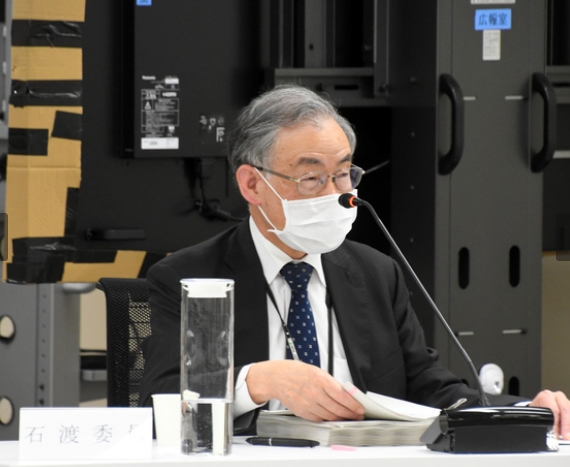
Akira Ishiwata, a member of the Nuclear Regulation Authority of Japan (NRAJ), expresses his opposition to the draft of new safety regulation rules for nuclear power plants.
February 9, 2023
At the February 8 meeting of the Nuclear Regulation Authority (NRA), committee members voiced their opposition to the draft framework for new safety regulation rules, which would require safety inspections at intervals of no more than 10 years starting from 30 years of operation. The committee members decided not to make a formal decision on that day, and will discuss the issue again next week or later.
Since the end of last year, the Regulatory Commission has been conducting “public comments” to gather opinions from the public on the draft framework. At the meeting, it was reported that 2016 comments had been received, many of which were opposed to the 40-year operation period stipulated in the Nuclear Reactor Regulation Law, but the committee decided that no revisions to the draft were necessary and decided to proceed with the decision as originally proposed.
Regulatory Commission is in the forefront of extending the operation of nuclear power plants.
In response, Akira Ishiwata, a member of the committee in charge of the earthquake and tsunami review, stated, “I am opposed to this proposal,” citing two main reasons.
The first is that the stipulation of an operating period will be removed from the Reactor Regulation Law, which is under the jurisdiction of the Regulatory Commission.
Mr. Ishiwata said, “The mission of the Nuclear Regulation Commission is to protect people and the environment based on scientific and technical findings. This change is not about changing the law based on some new findings. Dropping the operation period from the law (Reactor Regulation Law) is not an alteration to the safety side,” he said.
https://www.asahi.com/articles/ASR286GKRR28ULBH00F.html?iref=pc_photo_gallery_bottom
Proposal to operate nuclear power plants for more than 60 years “cannot be considered a change to the safe side”; Regulatory Commission postpones formal decision due to unusual opposition
February 9, 2023
At its regular meeting on February 8, the Nuclear Regulatory Commission discussed whether to make a formal decision on a new regulatory system for nuclear power plants to operate beyond 60 years, but it decided not to do so due to opposition from Akira Ishiwata, who stated that the proposal “cannot be considered an alteration to the safe side. The matter will be discussed again at the regular meeting next week. It is extremely unusual for the regulatory commission to be divided on such an important matter. (Kenta Onozawa)
◆Public comments: Most oppose the review

The new draft regulation will review the deterioration status of nuclear power plants every 10 years or less, starting 30 years after the start of operation, and if the plant complies with the regulatory standards, the extension of operation will be approved. The proposal was unanimously approved at the regular meeting held last December. On the day of the meeting, the final draft was discussed based on the results of public comments received from the public.
The majority of the 2016 comments received from the public were against the review of the system, but the secretariat of the Regulatory Commission consulted with the regular meeting on whether to make a formal decision on the draft without changing the content of the draft regulation. Of the five committee members, four, including Chairman Shinsuke Yamanaka, voted in favor of the draft, while Commissioner Ishiwata expressed his opposition. Chairman Yamanaka stated that he would not make a decision by majority vote, but would discuss the matter again together with the proposed amendment to the article of the Nuclear Reactor Regulation Law (Reactor Regulation Law) that stipulates the operation period.
At a press conference following the regular meeting, Chairman Yamanaka said, “I think there is a misunderstanding (among Commissioner Ishiwata). I don’t think it is a problem that there are opposing opinions. I would like to deepen the discussion among the committee members.
Last December, the government decided to allow nuclear power plants to operate for more than 60 years by excluding from the number of years of operation the period during which the plants were shut down for restart examinations and judicial decisions. It aims to submit a draft amendment to related laws to the current Diet session. The current provisions in the Reactor Regulation Law regarding the period of operation, which is “40 years in principle, with a maximum of 60 years,” are expected to be deleted and redefined in the Electricity Business Law under the jurisdiction of the Ministry of Economy, Trade and Industry (METI).
◆”Aging nuclear power plants will be operated in the future,” said Akira Ishiwata, a member of the committee.

I am against this proposal. Akira Ishiwatari, a member of the committee, stated his opposition in a firm tone toward the end of the meeting.
This change is not based on new scientific findings. It is not a change for the sake of safety, because the law will drop the period of operation. There is no need for us to amend the law voluntarily.
A geological expert, he has served as a professor at Tohoku University and as a member of the committee since 2014. When it was discovered that geological data had been rewritten during the review of the Tsuruga No. 2 reactor at the Japan Atomic Power Company’s Tsuruga Nuclear Power Plant in Fukui Prefecture, he proposed that the review be suspended. When the secretariat of the Regulatory Commission proposed last November that the Commission hear opinions from electric power companies on the proposed new regulations, he opposed the proposal, saying that it was too early to make a decision. Discussions were postponed.
Under the new government policy, the period of shutdown due to the review will be excluded from the number of years of operation. In most cases, the 10 units currently under review have been delayed due to inadequate explanations from the power companies. Commissioner Ishiwata, who is in charge of the examination of earthquake and tsunami countermeasures, said, “We are not unnecessarily prolonging the examination, but unfortunately it is taking a long time. The longer the review takes, the longer the operation period will be, and the older (aged) nuclear power plants will be in operation in the future.
He expressed strong concern that the more difficult the review process becomes, the more likely it is to encourage the operation of aging nuclear power plants. At the meeting, Chairman Yamanaka explained that “this is a mechanism to ensure that regulations can be implemented no matter what the operating period is like,” but Commissioner Ishiwata did not back down, saying, “My thoughts are as I have stated.
https://www.tokyo-np.co.jp/article/230093
Japan: Cabinet adopts policy of using nuclear reactors beyond 60-year limit
Japan Times 10 Feb 23
The Cabinet formally adopted a policy on Friday that will allow for the operation of nuclear reactors beyond their current 60-year limit alongside the building of new units to replace aging ones as part of efforts to cut carbon emissions while ensuring adequate national energy supply.
The government’s “green transformation” [whaaa..aat?] policy features extensive use of nuclear power along with renewable energy and marks a major policy shift for the country, which suffered a devastating nuclear disaster in 2011. The Cabinet decision follows a meeting in late December at which the policy was agreed upon.
The government also plans to raise about ¥20 trillion ($152 billion) through the issuance of green transformation bonds to boost investment in decarbonization projects, as it estimates public and private investment of over ¥150 trillion will be necessary over the next 10 years……… (Subscribers only] https://www.japantimes.co.jp/news/2023/02/10/national/reactor-limit-extended//
Fears of ‘catastrophic’ nuclear horror as Turkey’s reactor rocked by horror earthquake
Turkey’s Akkuyu Nuclear Power Plant is facing a major risk, an expert has
warned, as the death toll of the disastrous earthquake racks up. The
disaster in Turkey and Syria has so far left 11,224 confirmed dead, with
the World Health Organisation warning that the final death toll could be as
high as 20,000.
Rescue teams in Turkey and Syria worked through the night
to recover more bodies from the rubble of thousands of buildings destroyed.
Following the disaster, an expert told Express.co.uk that Turkey’s nuclear
power plant, which lies just 16 miles away from an earthquake fault and is
currently under construction, could be at risk.
Express 8th Feb 2023
North Korea shows off largest-ever number of nuclear missiles at anniversary parade
ABC News 9 Feb 23,
Nuclear-armed North Korea showcased its missile production muscle during a night-time parade, state media reported on Thursday, displaying more intercontinental ballistic missiles (ICBMs) than ever before and hinting at a new solid-fuel weapon.
Key points:
- As many as 11 Hwasong-17s, North Korea’s largest ICBM, were shown during the parade
- Analysts say that 11 ICBMs would be enough to overwhelm US missile defences
- A prototype of a new solid-fuel ICBM also appeared to be displayed
The country has forged ahead with its ballistic missile program, test-launching dozens of advanced missiles last year despite United Nations Security Council resolutions and sanctions.
“This time, Kim Jong Un let North Korea’s expanding tactical and long-range missile forces speak for themselves,” said Leif-Eric Easley, a professor at Ewha University in Seoul.
…………………………………………. more https://www.abc.net.au/news/2023-02-09/north-korea-shows-off-largest-ever-number-of-nuclear-missiles/101954372
China’s spy balloon can help deflate US nuclear tensions with Beijing
Defense News, By David Gompert and Hans Binnendijk 8 Feb 23
The row over China’s surveillance balloon could, once the dust settles, present a chance to begin lessening the risk of nuclear war between the two superpowers.
While the United States is right to charge China with violating its airspace in an apparent attempt to spy on America’s strategic missile systems in Montana, this episode reminds us that the two nations have no mechanism to exchange views and clear up misconceptions on the purpose of their respective nuclear arsenal.
Consequently, suspicions abound.
It is understandable that this infamous spy balloon has riled up the American body politic. Yet, it is important to keep the strategic situation in mind. The United States and China are in a stable state of mutual deterrence, meaning that neither power could launch a nuclear first strike on the other without inviting devastating retaliation. That said, the greater the mutual suspicions about intent, the greater the danger that this stability could fail.
The absence of a way to build mutual confidence between the United States and China regarding nuclear weapons and nuclear war is potentially dangerous. The United States is unsure what to make of China’s build-up of its nuclear arsenal, and China is fearful that the United States seeks the capability to deny China a credible deterrent. What makes this situation increasingly perilous are the rising tensions in Sino-U.S. relations in the Pacific and the growing risks of escalating crises and even war there.
In an article in the journal Survival to be published soon, we spell out the case and agenda for a process whereby the superpowers could clarify why they have nuclear weapons and the doctrines governing their use.
Specifically, we recommend direct and candid bilateral strategic stability talks on nuclear doctrines, forces, intentions, and worries. This would be coupled with confidence-building measures such as providing prior notifications of missile testing, clarifying the purpose of new weapons, and managing disconcerting intelligence.
This could reduce suspicions, such as Chinese fears that the United States aspires to have a first-strike capability and American fears that China will relentlessly expand its capability to target U.S. deterrent forces. Each nation would of course continue independent intelligence-gathering. But “worst-case” interpretation of intelligence could be mitigated by dialogue.
These strategic stability talks might include implementing a bold concept: a bilateral US-Chinese pledge not to use nuclear weapons first against each other or against the other nation’s treaty allies……………………………. more https://www.defensenews.com/opinion/commentary/2023/02/07/chinas-spy-balloon-can-help-deflate-us-nuclear-tensions-with-beijing/
Japan Plans to Dump Fukushima Wastewater Into a Pacific With a Toxic Nuclear History
In December, the U.S.-based National Association of Marine Laboratories also announced its opposition to TEPCO’s plans, publishing a position paper that says “there is a lack of adequate and accurate scientific data supporting Japan’s assertion of safety” while “there is an abundance of data demonstrating serious concerns about releasing radioactively contaminated water.”
BY AMY GUNIA , FEBRUARY 6, 2023,
Pacific Island nations have for decades been grappling with the environmental and health consequences of Cold War-era nuclear testing in the region by the likes of the U.S. and France. Now, they worry about another kind of nuclear danger from neighbors much closer to home.
As concerns over energy security and the desire to transition away from fossil fuels pushes several Asian nations to reconsider once-scrapped nuclear power programs, there is increasing anxiety over how the waste from those facilities—depending on the methods of disposal—might impact the lives of Pacific Islanders.
Notably, in the region, Philippines President Ferdinand “Bongbong” Marcos said in his first address to Congress in mid-2022 that he was open to adding nuclear energy to the country’s energy mix, the Indonesian government said in December it plans to build a nuclear power plant by 2039, and weeks later Japan announced that it plans to ramp up the use of nuclear energy.
Nuclear plants have long been touted as a reliable source of carbon-free energy, though many plants across the world had been shuttered in past decades over worries about the safety of nuclear waste disposal. In this new era of nuclear revival, similar uncertainties abound.
In Japan, one plant that isn’t even operational has become the frontline for the fight between activists seeking safety assurances for waste disposal and operators who are running out of space in on-site tanks to store the wastewater accumulating from keeping damaged reactors cool. Currently, Japan plans to release wastewater from the Fukushima Daiichi nuclear power plant into the Pacific Ocean later this year.
“It’s just horrendous to think what it might mean,” says Henry Puna, the secretary general of the Pacific Islands Forum (PIF), a regional intergovernmental organization that has more than a dozen member countries, including, for example, the Cook Islands, Fiji, Tonga, and Vanuatu. “The people of the Pacific are people of the ocean. The ocean is very much central to our lives, to our culture, to our livelihoods. Anything that prejudices the health of the ocean is a matter of serious concern.”
When a magnitude 9.1 earthquake and tsunami hit off the coast of Japan in 2011, it caused a meltdown at the Fukushima nuclear power plant. Since then, water is being used to cool the damaged reactors and prevent further catastrophe. Now, more than 1.3 million metric tons of radionuclide-contaminated water has been collected on site, and it continues to accumulate, as rain and groundwater seep in. Tokyo Electric Power Company (TEPCO), the operator of the plant, says that the storage tanks take up too much space and hinder decommissioning the plant. Japan initially said that it would begin releasing the water into the ocean in the spring of 2023. Chief Cabinet Secretary Hirokazu Matsuno told the media in January that the release target date is now around spring or summer, which appears to be a postponement, according to the Associated Press, due to construction delays on a pipeline and the apparent need to gain greater public support.
The plan has faced widespread opposition. Japanese fishermen, international environmentalists, and other governments in the region, including China, South Korea, and Taiwan, have all expressed concern. Some of the strongest pushback has come from Pacific Island countries, including from lawmakers, former leaders, regional fisheries management groups, and other organizations. Among those voices is the PIF, which is advocating for more time to deal with questions and concerns. Earlier this year, the PIF appointed a panel of independent global nuclear experts to help inform its members in their consultations with Japan and TEPCO. The experts have stressed that more data are needed to determine the safety of the water for disposal.
“We think that there is not enough scientific evidence to prove that the release is safe, environmentally, healthwise, and also for our economy in the Pacific,” says Puna, who is also the former Prime Minister of the Cook Islands. Until more information is shared and evaluated, he asks that Japan “please defer the discharge of the water.”
……………………………. there appears to be a major disconnect between TEPCO and others, including the PIF panel of experts—who say that they’re concerned with the adequacy, accuracy, and reliability of the data backing up the decision to release the water.
Robert H. Richmond, a research professor and the director of the Kewalo Marine Laboratory at the University of Hawaii at Manoa, who is one of the panel experts, tells TIME that “the critical, foundational data upon which a sound decision could be made was either absent or, when we started getting more data,” he says, “extremely concerning.” He also casts doubt on if the IAEA is in the best position to assess the risks. “They’re an agency that has a mandate to promote the use of nuclear energy,” says Richmond, “and our mandate is to look after the people, the ocean, and the people who depend on the ocean. And our unanimous conclusion … is that this is a bad idea that is not defended properly at this point, and that there are alternatives that Japan should really be looking at.”
“One of the biggest surprises to me was the fact that the data was so sparse,” says Ferenc Dalnoki-Veress, scientist-in-residence and adjunct professor at the James Martin Center for Nonproliferation Studies at the Middlebury Institute of International Studies at Monterey, who is also on the PIF panel of experts. “There were prolonged gaps in data collection, which suggests that the matter may not have been given the level of attention and importance it deserved.” He adds that only a fraction of the tanks had been sampled, and only a handful of some 60 isotopes were typically measured in the samples—fewer than he would expect for this kind of assessment. (TEPCO says that the analysis done on a sample of tanks so far is just to assess the water’s condition in storage but that, after the purification process, further measurements will be taken on all the treated water before discharge to ensure that only that which meets sufficient standards of safety is released into the ocean).
Some still fear the safety of the treated water, and the far-reaching implications if it’s dumped into the ocean. Puna points out, for example, that the waters of the Western and Central Pacific Ocean produce much of the world’s tuna. If the tuna were to be impacted, it would cause major problems for Pacific nations, for which fisheries are a significant source of income, as well as for consumers globally.
In December, the U.S.-based National Association of Marine Laboratories also announced its opposition to TEPCO’s plans, publishing a position paper that says “there is a lack of adequate and accurate scientific data supporting Japan’s assertion of safety” while “there is an abundance of data demonstrating serious concerns about releasing radioactively contaminated water.”
……………………………………. A scarring past and a new path forward
Other nuclear plants across the globe have released treated wastewater containing tritium. Rafael Mariano Grossi, the IAEA’s director general, said in 2021 that Japan’s plan is “in line with practice globally, even though the large amount of water at the Fukushima plant makes it a unique and complex case.”
But Pacific Island nations have particular reason to be anxious. There is a noxious legacy of nuclear testing in the region, and other countries have historically treated the Pacific as a dumping ground for their waste. The U.S. conducted 67 nuclear tests in the Marshall Islands between 1946 and 1957—and disposed of atomic waste in Runit Dome, where it’s still stored. That testing led not only to forced relocations, but also to increased rates of cancers. Today there is concern that the dome is leaking and that rising sea levels might impact its structural integrity. France also conducted 193 nuclear tests from 1966 to 1996 at Moruroa and Fangataufa atolls in French Polynesia.
…………………….. Rather than let dumping wastewater into the ocean become the norm, at this juncture for nuclear energy, some say it’s an opportunity to explore different ways of doing things. The panel of PIF experts has proposed several alternative solutions, including treating the water and storing it in more secure tanks to allow the tritium time to decay, or using the treated water to make concrete for use in projects that won’t have high contact with humans.
“This is not the first nuclear disaster and by no means is it going to be the last,” says Richmond. “This is an opportunity for Japan,” he says, “to do the right thing and to invest time, effort, and money into determining and coming up with new ways of handling radioactive waste and setting a new trajectory.”
Renewables In China Trend Upward While Nuclear Trends Flat.

The blue line at the bottom is nuclear, and not particularly sharp eyes will note that it’s trending to flat. The red line at the top is wind, water, and solar cumulative additions to annual TWh of electricity flowing into China’s grid, and not particularly sharp eyes will note it’s curving upwards.
The natural experiment of renewables vs nuclear continues in China, and it continues to unfold in renewables’ favor.
Clean Technica, ByMichael Barnard, 7 Feb 23,
I’ve been publishing assessments of the poor performance of nuclear compared to wind and solar in China for years (2014, 2019, 2021, 2022). My premise nine years ago was a first principles assertion with limited empirical results that wind and solar would radically outstrip nuclear in China. Why? Modularity reducing long-tailed risks, as Professor Bent Flyvbjerg, global expert and go to person for megaprojects, puts it in his new book How Big Things Get Done, where he includes my assessment of the natural experiment.
Subsequent assessments found that was true. Every year, the combination of wind and solar, and usually both individually, outstripped new nuclear generation, both in raw nameplate capacity and in additional TWh of annual generation. But as Professor Mark Z. Jacobson likes to remind us, it’s not WS, it’s WWS, that is wind, water, and solar. And so, today I spent a bit of time looking at hydroelectric generation capacity additions around the world since 2000, which turned out to be almost entirely in China. Of the 132.5 GW of new big hydroelectric projects connected to the grid in the world since 2000, 113 GW were in China. Unsurprising to anyone paying the slightest attention, but still, big numbers.
But what does that mean when added to wind and solar and compared to nuclear, leveraging the 2010 to 2022 data set I already had?…………………………………….
there is an interesting question about all forms of electrical generation, which is what capacity factors they are operating at. China’s wind and solar were historically curtailed by transmission connection challenges, which have been being resolved every year. Last year’s bumper crop of offshore wind, of course, were connected with HVDC to the grid without challenges.
What about hydro? It has different challenges for capacity factors, typically having a spring spate with often far too much water to use for generation, and a fall lull where generation is low. In the case of China, the best data I have at present is from the International Hydropower Association (IHA) which lists 1,355 TWh of electrical generation from 370,160 MW of capacity in 2020. That’s a 42% capacity factor, which I used for the generation.
I was somewhat surprised by this, and would be interested in better data, should anyone have some at hand. What it does mean is that while nuclear added a total of about 243 TWh of net new electrical generation from 2010 through 2022, hydro only added about 229 TWh of new generation. It was an interesting result which I’ll spend a little time assessing in a bit. Of course, wind energy added about 711 TWh of new generation annually over that period and solar added about 474 TWh. Both outstripped nuclear and hydro.
For purposes of wind, solar, and nuclear, I’d been simply presenting the new TWh of generation added each year. But in adding water to the data set, it seemed reasonable to make it cumulative.
In the graph above , the blue line at the bottom is nuclear, and not particularly sharp eyes will note that it’s trending to flat. The red line at the top is wind, water, and solar cumulative additions to annual TWh of electricity flowing into China’s grid, and not particularly sharp eyes will note it’s curving upwards.
Poking at the disparity between additions of actual TWh by renewable generation source a bit more, there are a few things to note.
The first, of course, is that wind and solar siting is much simpler than major hydroelectric siting. They just need flattish areas with good wind and sun, and wind likes ridge lines where flat bits can be made. Big hydro needs a big river with a reasonably significant drop along its length and at least one place where it’s carved a big valley. Meandering rivers like the Mississippi need not apply, although they are much better for inland shipping. The combination means that it’s typically easier to get materials and workers for wind and solar farms to the sites, easier to move construction vehicles around them and the like.
And hydroelectric reservoirs have another reality: you can’t live or work where they are. Unlike solar farms which can simply be built around existing buildings or roads, or wind farms where turbines can be built in the non-productive corners of farm fields, hydroelectric reservoirs displace everybody and everything where they exist. …………………………………
Still, China has managed to construct and attach 16 of them [hydro-electric dams] to the grid since 2000. I was aware of the Three Gorges Dam, of course, but was unaware that it was a small portion of the hydroelectric China had constructed. And while each project’s cost and schedule results vs plans are unavailable, China did succeed in building them.
The natural experiment of renewables vs nuclear continues in China, and it continues to unfold in renewables’ favor. https://cleantechnica.com/2023/02/06/renewables-in-china-trend-upward-while-nuclear-trends-flat/
Death and Japan’s nuclear shelter salesman

Khrushchev once speculated that the survivors of the apocalypse would envy the dead. I agree.
LEO LEWIS, https://www.ft.com/content/5dbd0e08-5eec-4486-a1ba-fe1948d11159— 5 Feb 23
The “doomsday clock” maintained since 1947 by the Bulletin of Atomic Scientists is many things. An index of our gossamer proximity to annihilation; a metaphor for the human paradox of progress and regression; a near-drained reservoir of hope that the gods will spare us from ourselves. And, of course, a superb marketing tool for any half-decent nuclear shelter salesman.
The Bulletin’s January 24 decision to move the hands of its doomsday clock closer to midnight (signifying global catastrophe) than they have ever been before should, logically, give the bunker business a recession-defying sales spike. The collective shrug it will actually get is more profoundly alarming.
For Hiroki Nakajima, the marketing director of shelter-maker World Net International (WNI), these are comparatively good times. North Korean ballistic missile tests and China’s rising military power, he says, have driven Japanese shelter sales significantly higher than in the past. The fear factor soared after Vladimir Putin invaded Ukraine and started issuing explicit nuclear threats. WNI historically used to sell only a couple of $80,000 premium shelters a year; in 2022 that shot up to a still modest 25 — hardly a nation gripped with fear.
Nakajima, whose best customers are the very wealthy and very nervous, says he will consider listing the company on the Tokyo Stock Exchange “as society’s needs require”. He delivers his nuclear shelter sales pitch from a medium-sized warehouse with models arranged by size, blast resilience and interior decor. I am shown into one with eggshell blue padded walls and, optimistically given the post-Armageddon broadcasting constraints, a wall-mounted TV.
We are in the smallish seaside town of Yaizu, a pretty fishing port that looks back on to a snow-capped Mount Fuji and whose placidness contrasts effectively with the mental picture of the horrors that would make a shelter purchase value for money. Nakajima’s marketing strategy includes judicious repetition of the phrase “your whole family will die” wherever appropriate; mostly as the certain outcome of any attempt at self-preservation other than buying a WNI shelter.
As efforts to induce apocalyptic terror go, it is valiant stuff. But he is talking to someone who grew up in Britain in the 1980s: someone who has had his wits scared out of him by far, far more proficient fearmongers. Set against (among others) Threads, The War Game, When the Wind Blows and the Protect and Survive public information films, Japanese shelter marketing feels almost upbeat. As Cold War children we hummed pop songs that were more chillingly referential to nuclear obliteration than the WNI website. And that was when the Doomsday clock was set further from midnight than it is now.
But Nakajima is not without support in his bid to set out the risks. Last month, the Japanese government began considering for the first time what a shelter subsidy scheme might look like, suggesting that its assessment of the nuclear threat has advanced from the general to the specific. Should such a subsidy emerge, says Nakajima, sales could be 100 times what they are now.
I sit for some time in WNI’s cramped showcase shelter, imagining the circumstances that might bring me to this bunker if I ever owned one: the mass extinction beyond its sturdily engineered walls, the irradiated cinders of civilisation blown against its air filter intake, the endless weeks cocooned with whichever loved ones made it in time, mourning those who did not. Nikita Khrushchev once speculated that the survivors of such a war would envy the dead. I agreed, and Nakajima quietly lost a customer.
The faint feeling of absurdity in WNI’s showroom points, obliquely, to a problem with the doomsday clock. Arguably the most potent symbol of humanity’s collective need to change tack, the clock is now set at just 90 seconds to midnight but seems to have lost its capacity to terrify at a time when we should be more terrified than ever before.
For while the clock is most closely associated in the public mind with the threat of nuclear war, it has long been a broader metric of imperilment from all human-made global disaster — a spectrum of risk ranging from climate change, and the denial of it, to microscopic autonomous robots.
The trouble with the clock is that, where once it was a paramount siren, it is now merely one of many alarms telling us that we are doomed. Under cover of that surfeit of fear, the clock has now gone pretty much as far as it can without being right. That is something none of us — even those with the best shelter $80,000 will buy — can afford to see proved.
China expresses dissatisfaction and protest over US shooting down civilian airship; US sets bad precedent
The Pentagon earlier said on Friday that the balloon did not pose a “military or physical” threat.
It’s widely known that US aircraft, appearing in civilian or military purposes, operate around China much more frequent than Chinese aircraft do around the US
Global Times, By Chen Qingqing and Liu Xuanzun, Feb 05, 2023
China expressed strong dissatisfaction and protest on Sunday against the US’ move to shoot down a non-threatening Chinese airship for civilian use, calling the US’ move an overreaction and vowing to reserve the right to take necessary actions. By turning an unintentional accident into an incident that has been hyped by the US officials and media, Washington is adding new uncertainties into the already-intense relations with China, creating a bad precedent for blurring the line between civilian and military uses, experts said.
The Chinese Foreign Ministry expressed strong dissatisfaction and protested against the US’ use of force to shoot down a Chinese civilian unmanned airship, urging the US to properly handle the incident.
The Chinese side has verified the situation and communicated with the US side multiple times, saying the unintended entry of the airship into US airspace was due to force majeure and the incident was totally an accident, the ministry said.
The US military on Saturday local time shot down a “suspected Chinese spy balloon” off the Carolina coast following an authorization of the Biden administration after the airship has been flying over the US for days. The action was hailed by the US President Joe Biden as “a success,” according to US media reports.
The “balloon episode” went viral on the US social media. A number of US hawks on China-related matters have been hyping the use of balloon for spying purpose and deliberately distorted it as “a direct assault on the US national sovereignty.”
“The US attack on Chinese civilian unmanned airship by force is an obvious overreaction,” Senior Colonel Tan Kefei, a spokesperson at China’s Ministry of National Defense, said in a statement on Sunday.
China will reserve the right to take necessary measures in dealing with similar situations, Tan said.
Tan’s remarks mean that if a foreign airship accidentally enters the Chinese airspace, the Chinese forces could also shoot it down in a similar manner, observers said.
Biden was first briefed on the balloon Tuesday and has been receiving updates from his national security team, CNN said. The Pentagon earlier said on Friday that the balloon did not pose a “military or physical” threat………………………………………….
Overreaction, bad precedent
The US shooting down the Chinese civilian balloon is also considered an overreaction from a technical point of view, said military aviation experts.
Despite admitting that the balloon did not pose a military or physical threat, an F-22 fighter of the US Air Force fired an AIM-9X air-to-air missile and shot down the balloon, supported by F-15 fighters, tankers and warships, the Pentagon said on the day on its website.
The missile was fired from the F-22 from an altitude of 58,000 feet (17,678 meters) when the balloon was 60,000 and 65,000 feet, the Pentagon said.
This is like shooting a mosquito with a cannon, which is not only overreacting but also impractical, a Chinese military expert who requested anonymity told the Global Times on Sunday.
Compared with an unmanned balloon that flies with the wind, the US interception method that featured an advanced stealth fighter jet and fired a missile is too costly………………………………….
It’s widely known that US aircraft, appearing in civilian or military purposes, operate around China much more frequent than Chinese aircraft do around the US, Lü noted. …………
more https://www.globaltimes.cn/page/202302/1284857.shtml
China marketing nuclear reactors to Pakistan
Pakistani Prime Minister Shehbaz Sharif has inaugurated the third unit of
the Karachi Nuclear Power Plant (KANUPP), which has 1.1GW of power
generating capacity. Built with an investment of $2.7bn, the K-3 nuclear
unit is expected to ease Pakistan’s ongoing energy crisis, according to
Bloomberg.
It is the second Chinese-designed Hualong One reactor to be
deployed at KANUPP, having been built with the Chinese Government’s
assistance under the China-Pakistan Economic Corridor (CPEC) initiative. At
the inauguration ceremony, Prime Minister Sharif said Pakistan ‘badly
needs’ clean and cheap sources of energy, be they nuclear, hydropower or
other renewables.
Power Technology 3rd Feb 2023
https://www.power-technology.com/news/pakistan-karachi-nuclear-power-plant/
1 This Month

of the week – Shut Down Drone Warfare!


Tell the Ukrainian Government to Drop Prosecution of Peace Activist Yurii Sheliazhenko

Petition to revoke the licensing of the Near Surface Nuclear Disposal Facility (NSDF) at Chalk River. https://www.ourcommons.ca/petitions/en/Petition/Details?Petition=e-7247
To see nuclear-related stories in greater depth and intensity – go to https://nuclearinformation.wordpress.com
-
Archives
- April 2026 (103)
- March 2026 (251)
- February 2026 (268)
- January 2026 (308)
- December 2025 (358)
- November 2025 (359)
- October 2025 (376)
- September 2025 (257)
- August 2025 (319)
- July 2025 (230)
- June 2025 (348)
- May 2025 (261)
-
Categories
- 1
- 1 NUCLEAR ISSUES
- business and costs
- climate change
- culture and arts
- ENERGY
- environment
- health
- history
- indigenous issues
- Legal
- marketing of nuclear
- media
- opposition to nuclear
- PERSONAL STORIES
- politics
- politics international
- Religion and ethics
- safety
- secrets,lies and civil liberties
- spinbuster
- technology
- Uranium
- wastes
- weapons and war
- Women
- 2 WORLD
- ACTION
- AFRICA
- Atrocities
- AUSTRALIA
- Christina's notes
- Christina's themes
- culture and arts
- Events
- Fuk 2022
- Fuk 2023
- Fukushima 2017
- Fukushima 2018
- fukushima 2019
- Fukushima 2020
- Fukushima 2021
- general
- global warming
- Humour (God we need it)
- Nuclear
- RARE EARTHS
- Reference
- resources – print
- Resources -audiovicual
- Weekly Newsletter
- World
- World Nuclear
- YouTube
-
RSS
Entries RSS
Comments RSS
 nuclear-news