Macau worried about proposed uranium processing plant
 Macau asks questions about proposed uranium processing plant, South China Morning Post, Thursday, 11 July, 2013 Phila Siu Macau has made an official inquiry to the Guangdong government about a proposal to build a uranium processing plant near Jiangmen , but the Hong Kong government would not say yesterday whether it had also done so.
The approach by Macau follows an announcement that the 230-hectare plant was planned for an industrial zone in an area governed by Jiangmen, which is about 100 kilometres from Hong Kong.
Macau’s chief executive, Fernando Chui Sai-on, said in a statement yesterday: “The SAR government has officially enquired about this through the communication mechanism between Guangdong and Macau.”….. Worries have been expressed that contamination from the plant could find its way into Hong Kong’s food supply…..http://www.scmp.com/news/china/article/1279838/macau-asks-questions-about-proposed-uranium-processing-plant
Fukushima groundwater has radioactive contamination
 Toxic radiation detected in groundwater at Fukushima nuclear plant Raw Story France-Presse July 7, 2013 Toxic radioactive substances have once again been detected in groundwater at the crippled Fukushima nuclear plant, its Japanese operator said on Sunday, the latest in a series of incidents at the tsunami-battered complex.
Tokyo Electric Power Co (TEPCO) said tests showed that tritium, a radioactive isotope of hydrogen used in glow-in-the-dark watches, was present at levels 10 times the permitted rate. “From test samples on July 5… we detected a record high 600,000 becquerels per litre” of tritium, 10 times higher than the government guideline of 60,000 becquerels per litre, TEPCO  said in a statement….
The new readings came after TEPCO said in late June that it had detected the highly toxic strontium-90, a by-product of nuclear fission that can cause bone cancer if ingested, at levels 30 times the permitted rate. At the time it had detected tritium at around eight times the allowed level, or 500,000 becquerels per litre.
The substances, which were released by the meltdowns of reactors at the plant in the aftermath of the huge tsunami of March 2011, were not absorbed by soil and have made their way into underground water.
Subsoil water usually flows out to sea, meaning these two substances could normally make their way into the ocean, possibly affecting marine life and ultimately impacting humans who eat sea creatures…. http://www.rawstory.com/rs/2013/07/07/toxic-radiation-detected-in-groundwater-at-fukushima-nuclear-plant/
China moves fast towards renewable energy, slows down nuclear program

 Solar, wind power gain over nuclear power in China, says German official South China Morning Post, Joyce Man in Berlin 8 July 13, German official says solar and wind generation is reaching the market faster than nuclear power under Beijing’s latest five-year plan China’s thinking has shifted increasingly towards renewable energy, which is reaching the market faster than nuclear power, a German environment official has said.
“If you analyse the last 10 years, the thinking in China has shifted more and more towards renewables. I see that renewables are getting to the markets quicker than expected and nuclear energy is getting to the markets slower than expected,” said Karsten Sach, deputy director general for European and international environment policy at the German Ministry for the Environment, Nature Conservation and Nuclear Safety. He was speaking to the South China Morning Post in Berlin.
Sach emphasised the importance of wind and solar energy: “If you read Chinese projections a decade ago on how nuclear and renewables would develop over the next decade, you would have seen nuclear far ahead of renewables. If you look at what happened and the projections of what will happen in the most recent five-year plan, you see renewables in front of nuclear.
“That’s just the facts and those are sometimes ignored. I don’t comment on Chinese policy. I just see [China is] doing much more on renewables than on nuclear. It’s a very welcome decision, but China has to make its own decision,” the German official said.
Sach said China recognised renewables would form a world market in the future. He said the country understood it could deliver energy in a socially beneficial way, without air pollution, and create jobs in remote areas………. http://www.scmp.com/news/china/article/1277560/solar-wind-power-gain-over-nuclear-power-china-says-german-official
India’s nuclear radiation leaks – a national secret
 Dr Subbarao said that BARC, in response to a PIL filed in the Bombay High Court by an NGO in 2005, filed affidavit confirming the presence of radioactivity in the Thane Creek from Dhurva reactor. But they so far have refused to release the any test reports citing it to be a threat to national security.
Even RTI applications filed by activists have borne little fruit. “After so many complaints, we got access to a few paragraphs of the Chaturvedi report on Jaitapur. People have a right to know how these projects will affect them. Why should it be a national secret?”
 Radiation leak a national secret? DNA, Dilnaz Boga , Jul 7, 2013 Union minister hints at radiation leak, scientists and fishermen confirm ecological damage; but no PIL or RTI query has managed to get BARC to release reports on radiation levels around Thane creek. In the third week of June, while tackling the issue of oil spills along Mumbai’s coast, Union Minister for Environment and Forests Jayanti Natarajan told dna that steps had to be taken to curtail the radioactive waste leaking into Thane Creek from the Bhabha Atomic Research Centre (BARC).
“Yes, at times radioactive material escapes and ports have to ensure that radiation doesn’t spread to the people and the environment,” Natarajan said.
Going by the past trends, the rare admission from the Union Ministry is possibly the closest the public may get to knowing the truth behind the radiation leak.
Citing national security as the reason, BARC for decades has vehemently refused to make public the weekly test reports on radiation levels around nuclear plants where people reside. The plea of environmentalists and scientists demanding independent investigations by third parties and transparency in testing have also been rejected. Continue reading
Once again, a rat causes equipment failure at Fukushima nuclear reactor
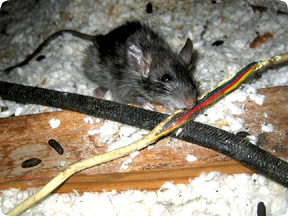 Rat causes equipment breakdown at Fukushima No. 2 nuclear plant http://enenews.com/rat-equipment-breakdown-fukushima-2-nuclear-plant
Title: TEPCO reports another rat problem, this time at Fukushima No. 2 plant
Source: THE ASAHI SHIMBUN
Date: July 04, 2013
A rat caused a battery charger to break down in an emergency gas turbine generator vehicle at the Fukushima No. 2 nuclear plant, the latest rodent-related problem to hit Tokyo Electric Power Co.
The rat is believed to have entered the vehicle through a 3- to 4-centimeter opening for cables and then shorted a switchboard, a TEPCO official said July 3. […]
The gas turbine generator vehicle was deployed for emergency use at the No. 2 plant after the Great East Japan Earthquake […]
See also: NYT: Rat Chase Again Bedevils Fukushima Nuclear Plant — Power lost to spent fuel pool for hours
Tepco rushes effort to restart two nuclear reactors, ignores local councils
TEPCO gets harsh response from Niigata gov. over restarting reactors Global Post 5 July 13 Tokyo Electric Power Co. faced a harsh response on Friday from Niigata Gov. Hirohiko Izumida in its attempt to swiftly apply for a state safety assessment of two reactors there as a step toward resuming their operations.
After meeting with Izumida and the mayors of two municipalities that the Kashiwazaki-Kariwa plant straddles, TEPCO President Naomi Hirose admitted it is “difficult” to join other utilities’ moves to apply for safety assessment of reactors next Monday, when a set of new regulations for atomic power plants take effect.
Izumida said TEPCO did not offer any explanation to local people before announcing the company’s plan to file for the assessment of the plant’s Nos. 6 and 7 reactors.
“Why did you rush (to make a decision to file for application)?” the governor said in the meeting, while also refusing to accept a paper in which TEPCO sought approval on a plan to install a safety system which is essential to restart the two units under the new safety standards…… http://www.globalpost.com/dispatch/news/kyodo-news-international/130705/tepco-gets-harsh-response-niigata-gov-over-restarting-
Fukushima Prefecture voters stress the reality of the nuclear crisis
Fukushima voters urge politicians to face reality of nuclear crisis Global Post 5 July 13 Voters in Fukushima Prefecture, where about 150,000 people are still living as evacuees from their homes due to the nuclear disaster triggered by the 2011 earthquake and tsunami, urged politicians to face the reality of the crisis as official campaigning for the July 21 House of Councillors election got under way Thursday…….
Yasuo Yoshida, a 46-year-old fisherman in Iwaki, a coastal city in the prefecture, said politicians should visit the areas affected by the nuclear disaster more often and listen to the local people.
“Now we face a moment of truth in trying to rebuild Fukushima’s fishing industry and I want politicians to ensure that the central government will take responsibility” for the revival of fishing, he said. Continue reading
Highest radiation levels for 12 months found at Fukushima
 Fukushima records highest radiation level in a year http://www.straight.com/blogra/398066/fukushima-records-highest-radiation-level-year by CHARLIE SMITH on JUL 4, 2013 You might think that radiation levels would be falling more than two years after Japan’s most serious nuclear disaster since the bombing of Nagasaki in the Second World War.
But on a rooftop in Fukushima, radioactive cesium levels were at the highest levels observed in the past year, according to the Asahi Shumbun newspaper. The publication reported that University of Tokyo associate professor Ryoji Enomoto found moss with 1.7 million becquerels just over 50 kilometres from a crippled nuclear-power plant.
This was confirmed by a nonprofit group, the newspaper noted. According to an article by David Chandler of the Massachusetts Institute of Technology, a dose of 500 millisieverts can cause symptoms of radiation poisoning. It’s not easy converting becquerels, which measures radiation emitted, to millisieverts, which measure biological damage.
But you would likely want to move if levels of 1.7 million becquerels were ever detected in your neighbourhood.
Scientists detect highest cesium levels in a year in Fukushima http://ajw.asahi.com/article/0311disaster/fukushima/AJ201307040081 July 04, 2013 FUKUSHIMA–Radioactive cesium levels found in moss on a rooftop in downtown Fukushima exceeded 1.7 million becquerels, the highest levels detected in a year, researchers said. Continue reading
Japan’s nuclear industry has poor safety culture
 Japan: Building Nuclear Safety Culture Will Take ‘Long Time’ VOA, Reuters July 04, 2013 TOKYO — Japan’s nuclear regulator said on Thursday that elevating safety culture to international standards will “take a long time.” That assessment came days before new rules take effect that aim to avoid a repeat of the Fukushima nuclear disaster that occurred in March 2011………..
 “The new regulations include extremely stringent requirements that the operators would not be able to endure if they don’t change their culture,” authority chairman Shunichi Tanaka told reporters. “We will need a long time to change this culture, but day-to-day efforts to meet those tough standards will in the end lead to the improvement in the safety culture.”
Trying to restart
Tokyo Electric Power Co., operator of the Fukushima plant that had three meltdowns, Kansai Electric Power Co., and three other listed nuclear operators have said they will apply for restarts after the rules go into effect.
Tanaka declined to comment on whether he considered Tokyo Electric – still struggling to contain leaks and power cuts at its ravaged plant – fit to operate nuclear facilities. He added that whether the company will be given a green light would depend on the contents of its application…….
Tanaka stressed that the new regulator had what it took to impose the new regulations. “We have large authority and powers. If the operator does not comply with our regulations, they won’t be able to operate, let alone restart their reactors,” he said.http://www.voanews.com/content/japan-says-building-nuclear-safety-culture-will-take-long-time/1695038.html
Shutdown in September for Japan’s only two operating nuclear power units
Japan’s only two operating nuclear units to shut in September: regulator Tokyo (Platts)–4 Jul 2013 Kansai Electric Power Co can continue operating Ohi-3 and -4, the only nuclear units running in Japan, until they will have to be shut for maintenance in September, Nuclear Regulation Authority commissioners agreed unanimously Wednesday.
Ohi-3 and -4 can run until September 2 and 15, respectively. Japanese law allows reactors 13 months of continuous operation before they must shut for maintenance.
The units, each with gross capacity of 1,180 MW, are sometimes referred to as Ooi and are the largest of Kansai EPC’s 11 power reactors.
Ohi-3 and -4 were assessed against NRA’s safety requirements, which will come into force Monday. The assessment of the units, including an inspection of the site June 15, found they “will not cause serious safety problems immediately,” a 46-page NRA staff document said.
Japan’s other 48 operational nuclear units have remained down after completing maintenance and refueling outages following the March 11, 2011 earthquake and tsunami that resulted in permanent shutdowns of units 1 through 4 at Tokyo Electric Power Co.’s Fukushima I……….http://www.platts.com/latest-news/electric-power/Tokyo/Japans-only-two-operating-nuclear-units-to-shut-26076364
Secret promises to USA, by Japan, to burn plutonium
 Mainichi: Japan’s secret promise with U.S. to burn plutonium — “It is abnormal for sure” — “Expected to stir up controversy” http://enenews.com/mainichi-japan-secretly-promised-to-burn-plutonium-it-is-abnormal-for-sure-expected-to-stir-up-controversy
Title: Japan made secret promise with U.S. to restart pluthermal nuclear program
 Source: Mainichi
Date: June 25, 2013
A Japanese prime ministerial envoy secretly promised to the United States that Japan would resume its controversial “pluthermal” program, using light-water reactors to burn plutonium, according to documents obtained by the Mainichi.
The secret promise was made by Hiroshi Ogushi, then parliamentary secretary of the Cabinet Office, to Daniel Poneman, deputy secretary of the U.S. Department of Energy, during Ogushi’s visit to the United States on behalf of then Prime Minister Yoshihiko Noda in September last year.
[…] The fact that a Japanese official promised to the U.S. to implement such a controversial project without a prior explanation to the Japanese public is expected to stir up controversy. […]
“It is abnormal for sure,” said one official with the Agency for Natural Resources and Energy. […]
See also: Plutonium-burning reactors to restart in Japan? — Gov’t forcing companies to use MOX fuel — Official: “We have no other choice”
Radioactive water being pumped into Fukushima nuclear building
Report: Contaminated water purposely being pumped into basement of Fukushima reactor’s turbine building http://enenews.com/report-contaminated-water-purposely-being-pumped-into-basement-of-fukushima-reactors-turbine-building
Title: Water in all leaky trenches at No. 1 routed to other storage, Tepco says
Source: Kyodo, JIJI
Date: July 3, 2013
Water in all leaky trenches at No. 1 routed to other storage, Tepco says
Tokyo Electric Power Co. has finished pumping out radioactive water from all seven of its huge covered trenches at the crippled Fukushima No. 1 nuclear plant […]
[…] It was found that the highly radioactive water that had been pumped into the trenches, which are triple-lined, was seeping into the ground. […]
The less-contaminated water was pumped into the basement of the reactor 6 turbine building and will eventually be transferred to above-ground containers, Tepco said late Monday. […]
See also: Japan Engineer: Fukushima contaminated water to go in giant pit — “It can easily be discharged underground” (VIDEO)
Japanese political party to campaign for abolishing nuclear power
Your Party stands against tax hike, nuclear plants Japan Times, 3 July 13 BY REIJI YOSHIDA Your Party will stress its call to freeze the upcoming consumption tax hike and promise to abolish all nuclear power plants by 2030 when the campaign for the Upper House officially starts Thursday, party leader Yoshimi Watanabe
said. Continue reading
Japan’s wind energy systems to increase, with off shore turbines
What is not well known is that Japan has considerable wind power, and that its string of wind turbines continued to function throughout the 2011 tsunami disaster.
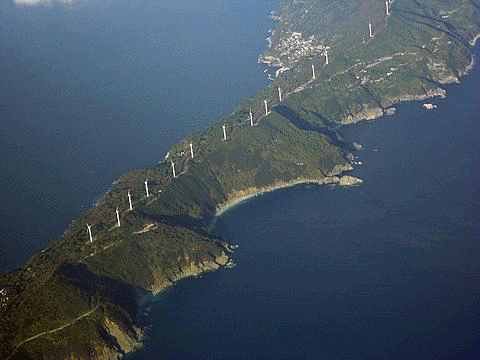
Work starts on Fukushima floating project Wind Power Monthly 25 June 2013 by Martin Foster, JAPAN: Installation of wind turbines in the testing phase of the biggest offshore floating project to date will finally get under way this week, 20 kilometres off the coast of Fukushima. Two 2MW downwind floating turbines are scheduled to be towed from shipyards belonging to Mitsui Engineering and Shipbuilding in Chiba prefecture to Onahama port on 28 June, according to a new schedule released by Takeshi Ishihara a civil engineering professor at the University of Tokyo and technical adviser to the project…….
The cable is scheduled to be loaded on ship, laid and sunk in the seabed from the end of July until the end of August. It is planned to connect the cable some time in the month of August, with the project due to start generating power in mid-September.
The massive floating wind farm project, which is being developed by an 11-entity consortium lead by Marubeni Corporation, may eventually see 132 floating turbines come on line. It has been named Fukushima Mirai, literally the future of Fukushima, and has been planned as part of post-nuclear disaster recovery efforts in the area.
The project fulfils a ten-year dream for Ishihara.
“I feel that we have taken the first real step towards finally realising the dream I have embraced for the past ten years. I am really pleased,” he told Windpower Monthly. http://www.windpowermonthly.com/article/1187536/work-starts-fukushima-floating-project
Japan’s nuclear industry hope to restart, but delay safety upgrades
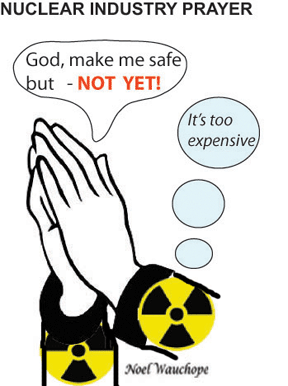
I couldn’t help being reminded of Saint Augustine’s famous prayer – “God make me pure – but not yet!”
The cost of upgrading all of the nuclear power plants is expected to exceed ¥1 trillion.
Nuclear safety rules put onus on utilities Japan Times, BY KAZUAKI NAGATA , 1 July 13, The Nuclear Regulation Authority on July 8 will begin enforcing new safety standards at atomic power stations, more than two years after Tokyo Electric Power Co.’s Fukushima No. 1 plant experienced three reactor core meltdowns…………
Utilities are meanwhile hoping that the regulators will be lenient with reactor restarts as long as they agree
to upgrade their plants to the new safety regime over time……
A major difference is that it will now be mandatory for utilities to install defenses that can prevent meltdowns from being caused by natural disasters — such as earthquakes, tsunami and tornadoes — as well as defenses against terrorist attacks…… Continue reading
1 This Month
23-25 October – on Zoom – World BEYOND War’s annual global conferenc


Shut down the radiation-damaged Heysham nuclear reactors now
To see nuclear-related stories in greater depth and intensity – go to https://nuclearinformation.wordpress.com

Say No to NASA’s Reckless Nuclear Reactor on the Moon
Say No to NASA’s Reckless Nuclear Reactor on the Moon
-
Archives
- October 2026 (170)
- September 2026 (339)
- August 2026 (330)
- July 2026 (355)
- June 2026 (287)
- May 2026 (306)
- April 2026 (356)
- March 2026 (251)
- February 2026 (267)
- January 2026 (308)
- December 2025 (358)
- November 2025 (359)
-
Categories
- 1
- 1 NUCLEAR ISSUES
- business and costs
- climate change
- culture and arts
- ENERGY
- environment
- health
- history
- indigenous issues
- Legal
- marketing of nuclear
- media
- opposition to nuclear
- PERSONAL STORIES
- politics
- politics international
- Religion and ethics
- safety
- secrets,lies and civil liberties
- spinbuster
- technology
- Uranium
- wastes
- weapons and war
- Women
- 2 WORLD
- ACTION
- AFRICA
- Atrocities
- AUSTRALIA
- Christina's notes
- Christina's themes
- culture and arts
- Events
- Fuk 2022
- Fuk 2023
- Fukushima 2017
- Fukushima 2018
- fukushima 2019
- Fukushima 2020
- Fukushima 2021
- general
- global warming
- Humour (God we need it)
- Nuclear
- RARE EARTHS
- Reference
- resources – print
- Resources -audiovicual
- Weekly Newsletter
- World
- World Nuclear
- YouTube
-
RSS
Entries RSS
Comments RSS

