India: wind energy production is beating nuclear
 “Since 2007, with almost 100% investment from the private sector, wind energy production is more than that of nuclear energy,”
 Why nuclear when wind energy is better? http://www.dnaindia.
 com/bangalore/1861294/report-why-nuclear-when-wind-energy-is-better , Jul 15, 2013, : Bangalore | Agency: DNA Malavika Velayanikal Members of Parliament interact with renewable energy experts at the Climate Parliament meet in the city. What happens when a bunch of intelligent and well-informed Members of Parliament get thrown into a room full of renewable energy experts?
This, in nutshell, is what happened at the first day on Climate Parliament meet in Bangalore on Saturday.
“When both nuclear energy and wind energy each contribute 3% of the total energy production in the country, why is the government promoting and investing in nuclear energy, and not wind energy, which is almost entirely funded by the private sector?” This was one of the hard questions that came up during the meet. Continue reading
Time for a more realistic diplomacy with North Korea

 U.S. Policy Toward a Nuclear North Korea Should Reflect Reality US News, By MICHAEL SHANK, RACHEL KENT July 15, 2013 “……..what politicos have forgotten, or conveniently overlooked, is that in the past few
  weeks, North Korea has twice made offers to talk with the United States about its nuclear program. Clearly, something happened – possibly China condoning sanctions or Dennis Rodman saying he was going to visit North Korea again – that made the reclusive country want to begin discussing its nuclear program. This is a good trend and something we should support.
.. the United States has been neutral, even chilly, in its response to North Korea’s recent overtures. Continue reading
People power winning against the nuclear industry – even in China!

 China Protest Forcing Nuclear Retreat Shows People Power By Bloomberg News – Jul 14, 2013 Protests in a southern Chinese city last week that forced local authorities to abandon plans for a uranium-processing facility highlight the growing willingness of ordinary people to challenge the state on environmental issues.
The proposed Longwan Industrial Park project won’t be approved “in order to fully respect the opinion of the masses,” the government of Heshan, Guangdong province, said in a statement on its website on July 13. A “social-stability risk assessment” of the proposal that was released for public awareness generated “much opposition,” it said.
Heshan is the latest local authority to back down in the face of pressure from a public increasingly empowered by its ability to sway officials who fear social unrest. Governments in cities across the country have canceled or delayed plans for industrial projects over the past year after confrontations with residents concerned about safety and pollution.
“Chinese civil society is getting stronger,” said Willy Wo-Lap Lam, an adjunct professor of history at the Chinese Universityof Hong Kong. “People now realize if their numbers are big enough, if they are united and stand their ground, the government will back down,” he said.
Opposition to the uranium facility underscores growing concern among China’s expanding middle class that industrial plants damage the environment and people’s health. Pollution has replaced land grabs as the primary cause of social unrest with many of the protests erupting in more prosperous coastal cities such as Shanghai and Ningbo where residents have deployed smartphones and used social media to organize their campaigns…….
“In future, especially in coastal developed regions, these kinds of public demonstrations may be the norm as we’ve seen in the West, where such projects face growing ‘not in my backyard’ sort of opposition,” said Ma. “In the future, large projects in China will need a longer and longer time to get approved like they do in the West.” http://www.bloomberg.com/news/2013-07-14/china-protest-forcing-nuclear-retreat-shows-people-power.html
Taiwan nuclear reactor shut down by typhoon
 Typhoon Soulik causes nuclear reactor shutdown By John Liu, The China Post July 15, 2013, TAIPEI, Taiwan — Typhoon Soulik’s strong winds caused one of the reactors at Taiwan’s First Nuclear Power Plant to automatically shut down as part of precautionary measures twice on Saturday. At 2:50 a.m. on July 13, strong winds knocked out systems designed to reduce the likelihood of direct lighting strikes on the facility at the plant’s number two reactor unit, resulting in an automatic shutdown. While repairs were carried out on the system, the reading for the number of neutrons became exceedingly high, once again leading to an emergency shutdown as part of protection measures.
Taiwan Power Co. (台電) nuclear energy spokesman Tsai Fu-feng (蔡豐富) said both shutdowns are part of protection measures and “there are no safety concerns.” Tsai said however that there is room for improvement in the handling of the power plant………
The typhoon also led to a significant amount of detritus blocking the water inlet. The company will not only need to acquire approval from the AEC but also fix the blockage before the power plant resumes normal function……
The AEC said similar incidents have happened at the country’s nuclear power plants, and is still waiting on Taipower’s report for a detailed explanation of the cause and description of the accompanying procedures for handling the accident……http://www.chinapost.com.tw/taiwan/national/national-news/2013/07/15/383773/Typhoon-Soulik.htm
Success for Chinese anti nuclear protestors, as government scraps plans for uranium processing plant
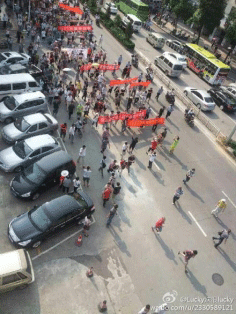 China cancels $6 billion uranium plant after protest SATURDAY JUL 13, 2013 | CHEN AIZHU, QI DING FOR REUTERS BEIJING (Reuters) – China has abruptly canceled plans to build its largest uranium processing plant in a southern Chinese city, a day after hundreds of protesters took to the streets demanding the project be scrapped, a local government website said on Saturday.
The proposed 230-hectare complex in the heart of China’s Pearl River delta industrial heartland in Guangdong province had also sparked unease in neighboring Hong Kong and Macau.
Authorities in the gambling enclave had formally raised the issue with their Guangdong counterparts, the South China Morning Post reported.
A one-line statement published on the Heshan city government’s website said that “to respect people’s desire, the Heshan government will not propose the CNNC project”.
State-run China National Nuclear Corporation and China Guangdong Nuclear Power Corp (CGNPC) had planned to build the 37 billion yuan ($6 billion) project.
Officials from both companies could not be reached for comment……..
The surprisingly swift decision to cancel the project came after hundreds marched to city offices on Friday that forced officials to pledge an extension of public consultation by 10 days. Locals had planned more protests on Sunday.
Chinese authorities are becoming increasingly sensitive to local protests over environmental issues, having canceled, postponed or relocated several major petrochemical and metals plants…….http://www.newsdaily.com/article/dea9628fb2b26f48d30394204db3e45a/china-cancels-6-billion-uranium-plant-after-protest
Anti nuclear march in Jiangmen – a rare protest movement in China
Jiangmen rises against uranium plant http://www.thestandard.com.hk/breaking_news_detail.asp?id=38672&icid=2&d_str= (07-12 12:57) More than 1,000 people have marched to the municipal government office in Jiangmen to protest against a plan to build a uranium processing plant in Guangdong City.
The protesters say they’re concerned about radiation and possible nuclear pollution. They’re also unhappy with the government’s 10-day consultation process, which ends tomorrow, RTHK reports.
Jiangmen authorities have already signed an agreement with the China National Nuclear Corporation to house the 40-billion-yuan project. Construction is expected to begin at the end of this year.
Japan’s strange and menacing radioactive black substance
I would say they’re much more an ingestion hazard. And that usually tends to target children and agricultural workers. […] A child on average consumes between 100 and 200 milligrams of soil a day because of hand-to-mouth activity. So that’s something to really think about.
Japan’s Black Dust, with Marco Kaltofen http://fairewinds.org/podcast/japans-black-dust-with-marco-kaltofen 12 July 13, This week Fairewinds Energy Education interviewed Marco Kaltofen, a leading scientist who studies radiation as well as specific radioactive isotopes. Marco and Arnie discuss a recent sample that contained highly concentrated radioactive material from Japan’s Fukushima Daiichi nuclear power plant accident. As the sound quality of this recording varies, we have transcribed the podcast so you can read along. Read Marco’s Report: Radiological Analysis of Namie Street Dust http://fairewinds.org/podcast/japans-black-dust-with-marco-kaltofen
Japan’s Radioactive Black Dust – Audio interview with transcript
Japan kids ingesting pieces of Fukushima fuel rods? Expert: Mystery black substance “very likely contains concentrated unburned nuclear fuel” (VIDEO) http://enenews.com/japan-kids-swallowing-pieces-of-fukushima-fuel-rods-expert-mystery-black-substance-very-likely-contains-concentrated-unburned-nuclear-fuel-video
Title: Japan’s Black Dust, with Marco Kaltofen
Source: Fairewinds Energy Education
Date: July 10, 2013
Marco Kaltofen, President at Boston Chemical Data Corp. & Doctoral student researcher at Worcester Polytechnic Institute: […] We kept hearing reports about something unusual, a black dust […] we finally got a very small sample of that […]
What’s different about this material is unlike a lot of the soil and dust samples we’ve gotten, there’s a real uniformity to this stuff. It’s a single substance. Continue reading
Wind farm development going ahead in Fukushima
Wind farm takes shape off Fukushima as Japan seeks non-nuclear energy http://www.euronews.com/2013/07/12/wind-farm-takes-shape-off-fukushima-as-japan-seeks-non-nuclear-energy/ The first phase is complete of a plan to build the world’s largest offshore wind farm near the Fukushima nuclear plant that was crippled by an earthquake and tsunami in March 2011.
The first turbine has been delivered to the area and the facility is due to become operational in October.
It is part of plans by Fukushima Prefecture to ditch nuclear energy and move towards total reliance on renewable sources over the next 25 years.
By 2020 scores of giant turbines 200 metres high should produce twice as much power as the world’s current biggest offshore windfarm at Greater Gabbard off the UK’s Suffolk coast.
“First and foremost, we want to make this a symbol of Fukushima’s recovery. Secondly, this floating wind farm concept is the ace up our sleeves for the next stage of renewable energy development,” said Keisuke Murakami, Head of New and Renewable Energy at the Economy, Trade and Industry Ministry. There have been concerns about radioactive water leaking into the sea from Fukushima, and official accounts have given conflicting evidence over whether fish are safe to eat.
The disaster all but shut down Japan’s nuclear industry, forcing the country to rely heavily on imported gas.
It is hoped that wind turbines will be more resistant to earthquakes, typhoons and tsunamis.
Guangdong protests against uranium processing plant
 Jiangmen residents protest against uranium processing plant http://www.scmp.com/news/china/article/1280894/jiangmen-residents-protest-against-uranium-processing-plant Several hundred people gathered in Jiangmen’s city centre on Friday morning to protest against a planned uranium processing plant in the Guangdong city.
“Jiangmen doesn’t want radiation”, one banner carried by demonstrators said. “We want children, not atoms,” said another. Police appear to have been anticipating the protest with Jiangmen city government building being cordoned-off.
One group of protesters gathered in front of the building, another group meet at the Donghu Lake park.
Two protesters, who declined to be identified, said that the protest had been organized via QQ and WeChat, two social messaging services, at least two days ahead of the protest.
One local said that the local government had held an emergency meeting last night to prepare for the protest. According to one demonstrator, the public protest lasted from 8am to 11:30am and is planned resume in the afternoon.
Some protesters were holding banners calling for another protest on Sunday.
Thee 30-hectare plant would carry out uranium conversion, enrichment and fuel fabrication, the Jiangmen City Development and Reform Bureau said in an earlier statement.
The plant’s construction some 100km from Hong Kong and Macau has sparked health concerns in both cities as well. The Heshan government under the administration of Jiangmen held a press conference earlier on Friday morning defending the project. Heshan mayor Wu Yuxiong said that the local government has decided to extend the period in which the risk assessment report is publicly accessible by a further ten days.
Microblogs about the protests have been quickly censored, indicating increased sensitivity about a backlash. Earlier this year, two demonstrations against a gas refinery in Kunming have caused a public backlash. A similar protest in Chengdu had been repressed.
Fukushima’s leaking water 90,000 times more radioactive than the “safe level”
 Fukushima Radiation Leaks Rise Sharply By William Boardman, Reader Supported News 11 July 13 Bad as the situation is at Fukushima, it’s gotten worse.
  erhaps you’ve heard that radiation levels of the water leaving the Fukushima Daiichi nuclear power plant in Japan and flowing into the Pacific Ocean have risen by roughly 9,000 per cent. Turns out, that’s probably putting a good face on it.
By official measurement, the water coming out of Fukushima is currently 90,000 times more radioactive than officially “safe” drinking water.
These are the highest radiation levels measured at Fukusmima since March 2011, when an earthquake-triggered tsunami destroyed the plant’s four nuclear reactors, three of which melted down.
As with all nuclear reporting, precise and reliable details are hard to come by, but the current picture as of July 10 seems to be something like this:
On July 5, radiation levels at Fukushima were what passes for “normal,” which means elevated and dangerous, but stable, according to measurements by the owner, the Tokyo Electric Power Company (TEPCO).
- On July 8, radiation levels had jumped about 90 times higher, as typically reported. TEPCO had no explanation for the increase.
- On July 9, radiation levels were up again from the previous day, but at a slower rate, about 22 per cent. TEPCO still had no explanation.
- On July 10, Japan’s Nuclear Regulation Authority (NRA) issued a statement saying that the NRA strongly suspects the radioactive water is coming from Fukushima’s Reactor #1 and is going into the Pacific.
Rising radioactivity in Fukushima’s leaking water
- 11,000 becquerels per liter – TEPCO’s measurement of Cesium-134 on July 9.
- 18,000 becquerels per liter — TEPCO’s measurement of Cesium-137 on July 8.
- 22,000 becquerels per liter – TEPCO’s measurement of Cesium-137 on July 9.
Fukushima Radiation Leaks Rise Sharply By William Boardman, Reader Supported News 11 July 13 “………Here’s another perspective on the same situation:
- 10 becquerels per liter – The officially “safe” level for radioactivity in drinking water, as set by the NRA.
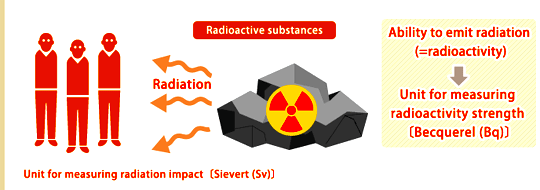
A becquerel is a standard scientific measure of radioactivity, similar in some ways to a rad or a rem or a roentgen or a sievert or a curie, but not equivalent to any of them. But you don’t have to understand the nuances of nuclear physics to get a reasonable idea of what’s going on in Fukushima. Just keep the measure of that safe drinking water in mind, that liter of water, less than a quart, with 10 becquerels of radioactivity.
- 60 becquerels per liter – For nuclear power plants, the safety limit for drinking water is 60 becquerels, as set by the NRA, with less concern for nuclear plant workers than ordinary civilians.
- 60-90 becquerels per liter – For waste water at nuclear power plants, the NRA sets a maximum standard of 90 becquerels per liter for Cesium-137 and 60 becquerels per liter of Cesium-134.
At some of Fukushima’s monitoring wells, radiation levels were in fractions of a becquerel on July 8 and 9. At the well (or wells) that are proving problematical, TEPCO has provided no baseline readings. Continue reading
Fukushima’s radioactive water storage space nearly full, and leaking
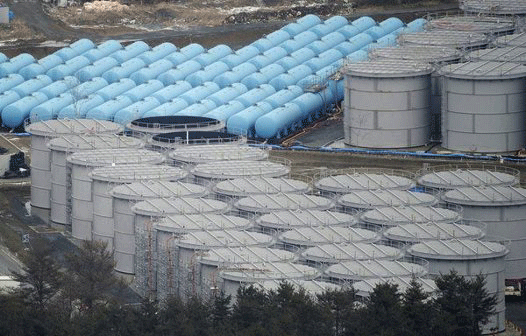 No thanks to Tepco’s ongoing failures, the Fukushima disaster is nowhere near over
The most pressing problem aside from stopping the leaks is that storage space for the irradiated water is running out—the Wall Street Journal reports(paywall) that 310,000 of the 350,000 tons of storage space at the site are now occupied, and at least one tank has been leaking. Neither Tepco nor the Japanese government have a long-term solution to the problem.
Two years after the tsunami, Fukushima is still leaking radiation and Tepco is still clueless http://qz.com/102992/two-years-after-the-tsunami-fukushima-is-still-leaking-radiation-and-tepco-is-still-clueless/ By Jake Maxwell Watts @jmwatts_ July 11, 2013 Radioactive water has been steadily leaking into the sea around the damaged Fukushima Daiichi nuclear power plant ever since it was hit by an earthquake and tsunami in March 2011, Japan’s nuclear watchdog announced on Wednesday. Plant operator Tokyo Electric Power Co, widely reviled for its inept response to the disaster, had long insisted that no leakage was taking place; in recent days it has backtracked to saying that it is “not sure” if there’s a leak.
The levels of cesium detected by the nuclear regulator are high enough to cause significantly increased rates of cancer, but are not an immediate threat to public health because they are in a remote location.
Tepco has been pumping water into three reactors for the past two years in an attempt to cool them, creating enough radioactive water to fill an Olympic-sized swimming pool every week. Now it seems that at least some of that contaminated water has also been flowing into the sea. Continue reading
Fukushima radiation seeps into the ocean
The threat of radioactive substances spreading into the Pacific Ocean has prompted concerns from Japan’s neighbors
Toxic water at Fukushima likely contaminating sea – Japan’s nuclear watchdog RT.com July 10, 2013 Japan’s nuclear watchdog says that highly contaminated radioactive water is likely seeping into the ground from the crippled Fukushima Daiichi nuclear reactors and contaminating the Pacific Ocean.
Shunichi Tanaka, chairman of the Nuclear Regulation Authority (NRA), said the contamination is “strongly suspected” and has been occurring since March 2011, when a massive earthquake and tsunami triggered three meltdowns in the Fukushima plant.
“I think contamination of the sea is continuing to a greater or lesser extent,” Tanaka said. “It was contaminated at the time of the accident, but I think it has been continuing for the last two years. Coming up with countermeasures against all possible scenarios is a top priority.”
The plant operator, Tokyo Electric Power Co. (Tepco), claims that the source of contamination is the pit from which radioactive water is leaking into the sea. However, Tanaka believes that this may be not the only source of contamination. Continue reading
Radioactive cesium levels 90% higher in Fukushima groundwater
 Fukushima Groundwater Shows Record Radiation Levels HUFFINGTON POST, Reuters 07/09/2013 “……SITUATION WORSENS Tokyo Electric Power Co, the operator of the Fukushima station, hit by the March 2011 earthquake and tsunami, said that an observation well between the damaged reactor No. 2 and the sea showed levels of radioactive caesium-134 were 90 times higher on Monday than they had been the previous Friday.
Tokyo Electric, also known as Tepco, said it detected caesium-134 at 9,000 becquerels per litre, 150 times above Japan’s safety standard. A becquerel is a measure of the release of radioactive energy. The reading for caesium-137, with a half life of 30 years, was some 85 times higher than it had been three days earlier.
The latest findings, 25 metres from the sea, come a month after Tepco detected radioactive caesium in groundwater flowing into its wrecked plant far from the sea on elevated ground. The level of caesium found in June was much lower than the amount announced on Tuesday.
The spike, combined with recent discoveries of high levels of radioactive elements like tritium and strontium, suggest that contaminated water is spreading toward the sea side of the plant from the reactors sitting on higher ground…..
Confusion and secrecy surround China’s proposed uranium processing plant in Jiangmen,
 Experts call for more details on Guangdong uranium plant, South China Morning Post, Olga Wong and Minnie Chan Concern over sketchy nature of details and possible radiation risks from proposed nuclear development in Guangdong.
Nuclear experts and green activists have called for more information from the Guangdong government after limited details were released about its proposal for a uranium processing plant in Jiangmen, about 100 kilometres from Hong Kong.
An announcement by the Jiangmen City Development and Reform Bureau said the 230-hectare plant would carry out uranium conversion, enrichment and fuel fabrication.
But the three-page statement, issued last Thursday, did not make it clear whether the plant, in the Longwan industrial district of Zhishanzhen, would perform spent fuel reprocessing – recycling of old fuel rods that could emit high doses of radiation – or what measures would be used to avoid radiation leaks…… Continue reading
1 This Month
23-25 October – on Zoom – World BEYOND War’s annual global conferenc


Shut down the radiation-damaged Heysham nuclear reactors now
To see nuclear-related stories in greater depth and intensity – go to https://nuclearinformation.wordpress.com

Say No to NASA’s Reckless Nuclear Reactor on the Moon
Say No to NASA’s Reckless Nuclear Reactor on the Moon
-
Archives
- October 2026 (170)
- September 2026 (339)
- August 2026 (330)
- July 2026 (355)
- June 2026 (287)
- May 2026 (306)
- April 2026 (356)
- March 2026 (251)
- February 2026 (267)
- January 2026 (308)
- December 2025 (358)
- November 2025 (359)
-
Categories
- 1
- 1 NUCLEAR ISSUES
- business and costs
- climate change
- culture and arts
- ENERGY
- environment
- health
- history
- indigenous issues
- Legal
- marketing of nuclear
- media
- opposition to nuclear
- PERSONAL STORIES
- politics
- politics international
- Religion and ethics
- safety
- secrets,lies and civil liberties
- spinbuster
- technology
- Uranium
- wastes
- weapons and war
- Women
- 2 WORLD
- ACTION
- AFRICA
- Atrocities
- AUSTRALIA
- Christina's notes
- Christina's themes
- culture and arts
- Events
- Fuk 2022
- Fuk 2023
- Fukushima 2017
- Fukushima 2018
- fukushima 2019
- Fukushima 2020
- Fukushima 2021
- general
- global warming
- Humour (God we need it)
- Nuclear
- RARE EARTHS
- Reference
- resources – print
- Resources -audiovicual
- Weekly Newsletter
- World
- World Nuclear
- YouTube
-
RSS
Entries RSS
Comments RSS

