Radiation contaminated food – over 6 million pounds found in South Korea
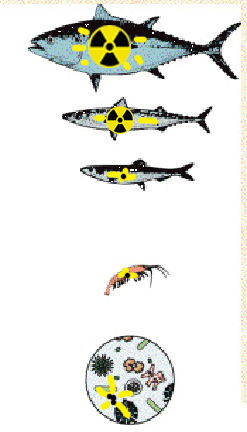 TV: Public concern over Japan fish imports “looks to be justified” — Contaminated seafood recently on sale in Korea adding to fears — Over 6 million pounds found since 3/11 — Strong backlash against gov’t http://enenews.com/tv-publics-concerns-over-japan-fish-imports-look-to-be-justified-contaminated-seafood-recently-on-sale-in-korea-over-6-million-pounds-found-since-311
Arirang News,, Aug 19, 2013: Consumer concerns about the safety of Japanese fish imports into Korea since the Fukushima nuclear disaster look to be justified as authorities here say over 3-thousand tonnes of fish from Japan have been found to contain levels of radioactive cesium since 2011. Korea’s Ministry of Food and Drug Safety on Sunday said there were 131 different cases in which fish containing traces of cesium were detected since March 2011. […] Cases peaked in 2012, but the amount has dropped sharply this year.
The Korea Herald, Aug 18, 2013: Government slammed over monitoring of Japanese seafood […] Seafood contaminated by radiation leaks from the Fukushima nuclear plant has been found in the local market recently, adding to public fears […] However, the food ministry was found not to have carried out additional inspections nor tightened return procedures […] While most products had below 10 becquerels of radiocesium (134Cs and 137Cs) per kilogram, some products showed up to 98 becquerels ― just two becquerels less than the level considered unsafe. […] The government’s stance has sparked strong public backlash. [Tepco] has recently confirmed long-held suspicions that the sea had been contaminated […]
Japan buying lots of solar panels

 REC Supplies 15,000+ Panels To Japanese Solar Farms, by Energy Matters. 20 Aug 13, REC is continuing to make its presence felt in Japan, with 2 new solar farms using REC Peak Energy Series solar panels.
The 2.5 MW Toyobo Mie (Kusu) C-Energy plant; located in Yokkaichi, Mie Prefecture, started operation last month and is expected to generate 2.5 million kWh of electricity annually.
The second REC-based installation is a ground-mounted 1.3 MW array situated at the Research Institute in Ohtsu City, Shiga Prefecture. Construction of that facility began last month and will be completed in December.
Japan is becoming a lucrative market for REC, with 29 percent of REC’s solar panel shipments heading to the nation in the second quarter of 2013….. http://www.energymatters.com.au/index.php?main_page=news_article&article_id=3897
After 2 years, Fukushima groundwater cesium levels now 8 times higher!
 Cesium levels in Fukushima water 8 times higher than after disaster Asahi Shimbun By SHUNSUKE KIMURA/ Staff Writer 16 Aug 13 Tokyo Electric Power Co. has reported finding radioactive cesium levels in underground water at the crippled Fukushima No. 1 nuclear power plant that is eight times greater than what it recorded right after the accident.
TEPCO, which operates the facility, said Aug. 15 that it detected 11,600 becquerels of radioactive cesium per liter of contaminated water in a tunnel near the No. 1 reactor building on the side facing the ocean.
That compares with 1,490 becquerels per liter it recorded at the site shortly after the accident in March 2011.
TEPCO said it believes the readings have soared due to rainwater containing cesium flowing into the tunnel. But the amount detected is roughly one-100,000th of that found in radioactive water in a tunnel near the No. 2 reactor building……http://ajw.asahi.com/article/0311disaster/fukushima/AJ201308160041
Tokyo nuclear company withdraws libel suit against freelance writer
 NUCLEAR INDUSTRY BUSINESSMAN WITHDRAWS LIBEL SUIT AGAINST FREELANCER http://en.rsf.org/japan-nuclear-industry-businessman-16-08-2013,45056.html REPORTERS WITHOUT BORDERS WELCOMES THE DECISION BY SHIRO SHIRAKAWA, THE HEAD OF THE NUCLEAR security systems company New Tech, to withdraw a libel suit against freelance journalist Minoru Tanaka. A Tokyo court has accepted the withdrawal, announced on 12 August.
“This libel suit was an attempt by an influential member of Japan’s nuclear industrial complex, known as the ‘nuclear village,’ to harass and intimidate Tanaka into silence and self-censorship,” Reporters Without Borders said.
“We are pleased that it did not work but we continue to be concerned for other journalists who try to cover the sensitive issue of Japan’s nuclear industry. There are still too many cases of reporters being pressured or censored when they try to provide information about the Fukushima disaster and its aftermath.
“The damages award Tanaka was facing if found guilty of libelling Shirakawa was clearly out of all proportion. We urge the courts to reject such ‘gag suits’ or ‘SLAPPs’ if they continue to be filed, and to propose proportionate alternatives such as the publication of a response.”
Shirakawa sued Tanaka, 52, over a December 2011 article for the weekly Shukan Kinyobiheadlined “The last big fixer, Shiro Shirakawa, gets his share of the TEPCO nuclear cake” – TEPCO being the owner of the Fukushima-Daiichi nuclear plant that suffered meltdowns after a tsunami in March 2011.
Using information in the public domain, the article accused Shirakawa of making a lot of money by acting as an intermediary between TEPCO, construction companies, politicians such as the leading parliamentarian Kamei Shizuka, and even clandestine organizations.
Ever since the Fukushima-Daiichi disaster, freelance journalists who cover the nuclear industry have had their access to information restricted and have, for example, been prevented from covering anti-nuclear demonstrations.
Reporters Without Borders issued several press releases condemning the judicial harassment of Tanaka, who was sued for 67 million yen (600,000 euros) in damages.
New plan for Fukushima nuclear reactors – a concrete tomb?
 Bloomberg: Tepco now in talks to cover Fukushima reactors with concrete for next 75 years — Officials reviewing plan in U.S.http://enenews.com/just-in-tepco-now-in-talks-to-cover-fukushima-reactors-with-concrete-for-next-75-years-officials-reviewing-plan-with-u-s-experts
(at left – Chernobyl’s concrete tomb building in progress)
Title: Nagasaki Bomb Maker Offers Lessons for Japan’s Fukushima Cleanup
Source: Bloomberg
Author: Shigeru Sato & Yuji Okada
Date: Aug. 15, 2013
[… Tepco] has sent engineers on visits to the Hanford site in Washington state this year to learn from decades of work treating millions of gallons of radioactive waste. Hanford also has a method to seal off reactors known as concrete cocooning that could reduce the 11 trillion yen ($112 billion) estimated cost for cleaning up Fukushima. […]
At Hanford, the energy department finished a $65 million cocooning project in June last year, the DOE said in a statement. That involved demolishing the last one of the nine reactor buildings down to the four-foot- (1.2 meter) thick concrete shield around the reactor core.
More concrete was added to the shield, along with a new concrete roof to put the reactor into so-called safe storage for 75 years. This allows radiation levels to decay to safer levels in the core and gives the operator time to determine the final disposal method, according to the statement.
There are three ways to decommission nuclear reactors, said Ishikawa. One is immediate dismantling. Another, used at the wrecked Chernobyl plant in Ukraine, entombed the whole building in concrete. The third is cocooning used at Hanford. Entombing and cocooning cost less than immediate dismantling as it reduces the expense for handling and moving highly radiated material, Ishikawa said.
Tepco is talking with the DOE on whether cocooning could work for the crippled reactors in Fukushima. Sealing them off in concrete for 75 years would allow more focus on cleaning up surrounding areas so that residents could return, said Ishikawa. […]
Published on ENENews ten hours earlier: Nuclear Experts: One century before Japan tries to deal with Fukushima’s melted cores? — “More likely what’s left of reactors will be left in situ for 100 years or more” (VIDEO)
Japan’s costly nuclear radiation cleanup may not work
The mushrooms that used to provide a livelihood for foragers are now steeped in dangerous levels of caesium
Nothing on the same scale had ever been attempted before. After the Chernobyl accident in 1986, highly contaminated houses were entombed in concrete and the surrounding area was abandoned.
By contrast, Japan’s government is attempting to bring background radiation levels [down]
“Decontamination in the true sense of the word is not being carried out,” ”I think the government recognises that Fukushima cannot be returned to how it was.”
 INSIGHT – JAPAN’S NUCLEAR CLEAN-UP: COSTLY, COMPLEX AND AT RISK OF FAILING YAHOO 7 NEWS, 15 AUG 13 BY SOPHIE KNIGHT KAWAUCHI, Japan (Reuters) – The most ambitious radiation clean-up ever attempted has proved costly, complex and time-consuming since the Japanese government began it more than two years in the wake of the Fukushima nuclear meltdown. It may also fail.
Doubts are mounting that the effort to decontaminate hotspots in an area the size of Connecticut will succeed in its ultimate aim – luring more than 100,000 nuclear evacuees back home.
If thousands of former residents cannot or will not return, parts of the farming and fishing region could remain an abandoned wilderness for decades. Continue reading
Taiwan government subverts Internet Search Results to favour nuclear energy

 Taiwanese Government Alters Search Results to Favor Nuclear Energy Policy Global Voices Advocacy, by Oiwan Lam 14 August 2013 For several months, activists in Taiwan fighting to prevent the launch of operations at a nuclear plant they argue would be hazardous for public health and the natural environment. Alongside mobilizing public support and lobbying government officials, they are now facing a new challenge: search engine censorship. Over the last few days, searches run on Yahoo! Kimo for the names of various anti-nuclear activists have yielded links to Nuclear Safety, Taiwan Energy [zh], a website run by the Bureau of Energy and Ministry of Economic Affairs, as their top result.
 Yesterday, the Ministry of Economic Affairs admitted to Taiwan Apple Daily [zh] that the government had spent 100,000 Taiwanese Yuan (equivalent to USD3500) to alter the search results for 92 keywords on Google and Yahoo! Kimo, the country’s most popular search engine. Among the 92 keywords, 63 are related to nuclear energy and 29 are the names of individuals, many of whom are anti-nuclear activists.
The website Nuclear Safety, Taiwan Energy presents scientific evidence aimed at convincing the public that nuclear energy is safe and the island’s fourth nuclear plant meets international safety standards………… Continue reading
US West Coast seafoods should be tested for radiation
Calls for US seafood testing after revelations of Fukushima radiation leaks http://japandailypress.com/calls-for-us-seafood-testing-after-revelations-of-fukushima-radiation-leaks-1633993/ AUGUST 16, 2013 by IDA TORRES NUCLEAR EXPERTS IN THE UNITED STATES ARE CALLING FOR TESTING OF SEAFOOD CAUGHT IN THE WEST COAST WATERS AS NEWS CAME OUT THAT THE FUKUSHIMA DAIICHI PLANT HAS BEEN LEAKING CONTAMINATED WATER INTO THE PACIFIC OCEAN FOR SOME TIME NOW. THE PLANT OPERATOR TOKYO ELECTRIC POWER ADMITTED LAST WEEK THAT EVERYDAY, 300 TONS OF WATER CONTAINING RADIOACTIVE MATERIALS HAVE BEEN SEEPING INTO THE OCEAN.
Dr. Arjun Makhijani, president of the Institute for Energy and Environmental Research, said that because the Pacific Oceanis such a large body of water, the contaminated water would have already been diluted by the time it reached the West Coast. But he acknowledges that no one knows up until now how contaminated the ocean has become and so a sampling of the US West Coast waters would be helpful, as well as a random sampling of seafood caught from that area.
The immediate concern though is for the people in Fukushima, particularly the fishermen, residents and cleanup crews, who are possibly directly affected by the leaks. There is fear that the spike in levels of strontium 90 which bio-concentrates in the bones of fish and algae. He said the accumulation effect of the radioactive strontium 90 could be extremely dangerous for a pregnant woman who has eaten or drank contaminated materials because the baby will be born with a weak immune system. Joseph Mangano, executive director of the nonprofit Radiation and Public Health Project, said that “a cocktail of more than 100 radioactive chemicals” from Fukushima can bring certain dangers when ingested through food or just breathing contaminated air. Health risks include birth defects and thyroid cancer.
Japan’s ghost towns , and the plight of the nuclear refugees
INSIGHT – JAPAN’S NUCLEAR CLEAN-UP: COSTLY, COMPLEX AND AT RISK OF FAILING YAHOO 7 NEWS, 15 AUG 13 BY SOPHIE KNIGHT “……Many have given up hope of ever returning to live in the shadow of the Fukushima nuclear plant. A survey in June showed that a third of the former residents of Iitate, a lush village famed for its fresh produce before the disaster, never want to move back. Half of those said they would prefer to be compensated enough to move elsewhere in Japan to farm.
Nuclear evacuees currently receive a living allowance from plant operator Tokyo Electric Power Co. (Tepco), which is cut off when the government decides they are able to move home again.
“I feel like some people don’t want to go back because they’re happy living off the compensation money from Tepco and they don’t want that to end,” said Hiroaki Inoue, an official from the Ministry of Economy, Trade and Industry spending a year working at the Kawauchi village office to monitor the spending of the reconstruction budget.
But some evacuees say it is unfair to cut off financial support when their previous homes and villages remain unliveable.
“There’s no jobs, no shops open, nothing. It’s become an incredibly difficult place to live and yet they’re saying ‘You can go home now’,” said a single mother evacuated from near Kawauchi, who declined to be named for fear of retribution from the authorities.
“It’s so unfair to say that. It’s not that simple.”
In Tomioka, a coastal ghost town north of the Fukushima plant, ambient radiation remains at 10 times the government’s target. Wild boar wander the streets.
“This could be fixed,” said Yokota on a recent visit. “They could get these levels right down. But the thing is, people didn’t come back quickly enough. That’s fatal.”
(Additional reporting by Antoni Slodkowski; Editing by Kevin Krolicki and Alex Richardson) http://au.news.yahoo.com/world/a/-/world/18506729/insight-japans-nuclear-clean-up-costly-complex-and-at-risk-of-failing/
US navy man attributes his sickness to Fukushima radiation
Paper: Navy sailor’s health melted down after exposure to Fukushima fallout — Now a shaking, withering patient unable to walk by himself — Lives of younger service members “at stake as well” — Doctors won’t give a diagnosis (PHOTOS) http://enenews.com/paper-navy-sailors-health-melted-down-after-exposure-to-fukushima-fallout-now-a-shaking-withering-patient-unable-to-walk-by-himself-lives-of-younger-service-members-at-stake-as-well-d
Title: Without medical diagnosis, Utah sailor lives in limbo
Source: Deseret News (Utah)
Author: Jed Boal,
Published: Aug. 14 2013 [...] Over the last 21 months, [Lt. j.g. Steve Simmons, who served on board the USS Ronald Reagan with the U.S. Navy during Fukushima crisis] said his health has melted down, too, and he’s not alone. […]
He believes he’s suffering from radioactive contamination […]
Since November of 2011 Lt. j.g. Steve Simmons has been sick. He believes he’s suffering from radioactive contamination, but doctors won’t give him a diagnosis. (Simmons Family via Deseret News)
After November 2011, Simmons said he went from being a fitness buff always up for a challenging hike to a shaking and withering patient who cannot walk on his own. He’s lost 25 pounds, down to 128 pounds, and lost 25 percent to 30 percent of his muscle mass.
“The muscle weakness has progressed to the point where he needs 24-hour care,” his wife said.
[…] doctors won’t provide a diagnosis, he said. […]
Simmons is not part of the lawsuit [150 former sailors and Marines suing Tepco].
He’s especially concerned about the younger sailors and Marines. “Their lives are at stake as well,” he said. […]
View photos of Lt. j.g. Simmons here
UPDATE: TV: Many U.S. sailors are suffering serious symptoms of radiation sickness after being contaminated during Fukushima nuclear disaster — USS Ronald Reagan was as close as a mile away
Critically dangerous – removing radioactive rods from Fukushima’s elevated cooling pool
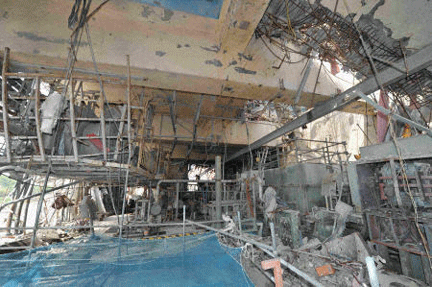
The deadliest part of Japan’s nuclear clean-up Stuff.co.NZ AARON SHELDRICK AND ANTONI SLODKOWSKI 14 Aug 13, The operator of Japan’s crippled Fukushima nuclear plant is preparing to remove 400 tonnes of highly irradiated spent fuel from a damaged reactor building, a dangerous operation that has never been attempted before on this scale.
INADVERTENT CRITICALITY “There is a risk of an inadvertent criticality if the bundles are distorted and get too close to each other,” Gundersen said. He was referring to an atomic chain reaction that left unchecked could result in a large release of radiation and heat that the fuel pool cooling system isn’t designed to absorb.
“The problem with a fuel pool criticality is that you can’t stop it. There are no control rods to control it,” Gundersen said. “The spent fuel pool cooling system is designed only to remove decay heat, not heat from an ongoing nuclear reaction.”
The rods are also vulnerable to fire should they be exposed to air, Gundersen said.
The fuel assemblies are situated in a 10 metre by 12 metre concrete pool, the base of which is 18 metres above ground level. The fuel rods are covered by 7 metres of water, Nagai said.
The pool was exposed to the air after an explosion a few days after the quake and tsunami blew off the roof. The cranes and equipment normally used to extract used fuel from the reactor’s core were also destroyed. Tepco has shored up the building, which may have tilted and was bulging after the explosion, a source of global concern that has been raised in the US Congress……….
Under normal circumstances, the operation to remove all the fuel would take about 100 days. Tepco initially planned to take two years before reducing the schedule to one year in recognition of the urgency. But that may be an optimistic estimate.
“I think it’ll probably be longer than they think and they’re probably going to run into some issues,” said Murray Jennex, an associate professor at San Diego State University who is an expert on nuclear containment and worked at the San Onofre nuclear plant in California.
“I don’t know if anyone has looked into the experience of Chernobyl, building a concrete sarcophagus, but they don’t seem to last well with all that contamination.” Corrosion from the salt water will have also weakened the building and equipment, he said….. http://www.stuff.co.nz/world/asia/9041215/The-deadliest-part-of-Japans-nuclear-clean-up
Fukushima’s ice wall fraught with problems, but what else can they do?
At Fukushima, those problems will be even more extreme, but the cost of doing nothing is even higher
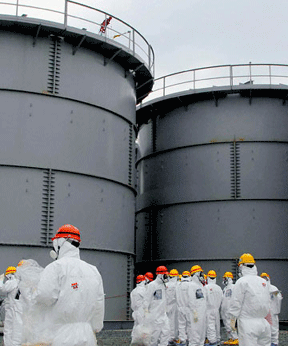 How to Build an Ice Wall Around a Leaking Nuclear Reactor Yahoo News, Alexis C. Madrigal, The Atlantic 14 Aug 13 Building cryogenic barriers sounds like the specialty of an obscure supervillain, but it’s a well-established technique in civil engineering, used regularly for tunnel boring and mining. Ground freezing was even tested as a way of containing radioactive waste in the 1990s at Oak Ridge National Laboratory and performed admirably.
at left, workers near Fukushima radioactive water storage tanks
Joe Sopko, the civil engineering firm Moretrench’s director of ground freezing, has spoken with several consultants about the details of the project, and he’s convinced it’s certainly possible. “This is not a complicated freeze job. It really isn’t,” he told me. “However, the installation, because of the radiation, is.”…….
Here’s how it works. Freeze pipes, made from normal steel, are sunk into the ground at regular intervals. The spacing is normally about one meter. Then, some type of coolant is fed into the pipes. Sopko uses a brine — salty liquid which can be cooled far below the freezing point of fresh water without turning into a solid. On the surface, a big refrigerator chills the liquid, which is pumped into the pipes. The liquid extracts heat from the ground, and returns to the chiller, where it is recooled and sent back down. It’s not a fast process and can take many months. (Sometimes, for speed’s sake an expendable refrigerant like liquid nitrogen is used, but it requires trucking in tanks full of the stuff.) Continue reading
Japan’s only 2 operating nuclear reactors to shut indefinitely
 Japan to go nuclear-free during safety checks Fox News, August 14, 2013 OKYO (AFP) – Japan will go without nuclear power for a period starting September when its only two operating reactors are shut down for mandatory safety checks, a utility company said Wednesday.
Kansai Electric Power, which runs both reactors at the Oi nuclear plant in western Japan, said the units will go offline on September 2 and 15 respectively for an indefinite duration…… The two Oi reactors resumed operation in July last year while two other units at the same plant have remained offline for safety checks…… A vocal anti-atomic campaign, whose leading lights say the industry had an overly cosy relationship with its regulators in the decades leading up to the disaster, nudged the government into establishing a new industry watchdog.
It has set stricter standards that operators must show they can meet before they will be granted permission to re-start idle reactors. http://www.foxnews.com/world/2013/08/14/japan-to-go-nuclear-free-during-safety-checks/#ixzz2c5cMEa00
Corruption, Prime Minister Abe, and the “Nuclear Village”
My own worry is that the web of scientists, bureaucrats, corporate media. universities, local and central governments in japan – Japan’s “Nuclear Village” will quietly spread around the world. Like the financial crisis – with banks “too big to fail” – so the tangled web of so much money involved could bring about a global Nuclear Village. – C.M

But it takes a village to breed such a corrupt and dangerous system. Tepco got away with its negligence for years because of the cozy ties between power companies and the regulators, bureaucrats and researchers that champion the industry — the “nuclear village.” Backed by its connections, money and control of the media, Tepco has brazenly continued to cook its radiation data for the last two and a half years. It matters little that the government is finally commandeering Tepco’s cleanup: The government is Tepco.
Dollar Signs Abe’s Liberal Democratic Party is blinded by dollar signs. In May, Abe visited Turkey to help close a $22 billion deal for Japan to build nuclear power plants in that seismically active nation. That kind of cash makes power companies virtually untouchable.
Abe’s Japan Is Blind to Scary Nuclear Reality http://www.bloomberg.com/news/2013-08-12/abe-s-japan-is-blind-to-scary-nuclear-reality.html By William Pesek Aug 12, 2013
Forget Abenomics. Ignore Shinzo Abe’s efforts to rejuvenate Japan’s diplomatic and military clout. Look past the quest to rewrite the constitution. History will judge this prime minister by one thing alone: what he did, or didn’t do, to end the worst nuclear crisis since Chernobyl.
It’s mind-boggling how disengaged Japan’s leaders have been since their “BP moment” — the March 2011 near-meltdown at the Fukushima Dai-Ichi nuclear plant. Abe’s predecessorsNaoto Kan and Yoshihiko Noda virtually ignored the radiation leaks and spent fuel rods sitting 135 miles (217 kilometers) from Tokyo. In December, Abe became the third prime minister to pretend all was well at Fukushima after a devastating earthquake and tsunami that flooded the plant.
The official line on Fukushima is depressingly familiar: The folks at Greenpeace International are trouble makers bent on scaring Japanese; the alarmists at theWorld Health Organization should mind their own business; the international news media needs to discover decaffeinated coffee. Nuclear power is clean, safe and — most important, now that a weakened yen has driven up energy bills — cheap.
 Reality made an inconvenient reappearance last week. Mounting evidence that radioactive groundwater is gushing into the Pacific Ocean forced Abe to admit that plant owner Tokyo Electric Power Co. Inc. isn’t up to the task of containing the disaster. Under international pressure, he pledged the government would “make sure there is a swift and multifaceted approach in place” to stop the leak.
Abe’s Seriousness
Pardon me for doubting Abe’s seriousness. It’s not just the sketchiness of the suggested remedy: freezing the ground around Fukushima, a tactic scientists fear will prove inadequate. It’s not the fact that nuclear regulators remain more focused on restarting reactors than on neutralizing the one that’s polluting North Asia. Continue reading
A political advantage: the reason why USA bombed Japanese cities
.it wasn’t necessary to use the bomb against the cities of Japan in order to win the war but our possession and demonstration of the bomb would make the Russians more manageable in Europe.
The real purpose in incinerating two high-density civilian population centers, says Stimson, was “to persuade Russia to play ball.”
that’s the very definition of terrorism: using violence or the threat of violence as the means to achieve political ends. It’s terrorism with a vengeance. Americans just don’t do that kind of thing. Americans would never behave in such a horribly depraved and cruel manner. But, in fact, we did. And, as Part II of this article will make devastatingly clear, we still do. And it won’t stop until America awakens to the truth about itself, and, openly acknowledging that truth with a show of genuine heartfelt remorse, proceeds to make amends where amends are due.
America’s Nuclear Madness: Terrorism With A Vengeance (Part I) By Robert Quinn” OpEdNews 8/11/2013 “………The inhumanity of it all couldn’t be more telling. The dropping of the second bomb on Nagasaki was especially brutal and cruel. Knowing of the horrendous horrors that had already been unleashed in Hiroshima, three days later the U.S. did the same thing to the civilian population of Nagasaki. Why? Japan’s surrender was already assured without the bombs. Surely surrender would soon be following on the heels of Hiroshima’s decimation. So, again, why the second bomb?
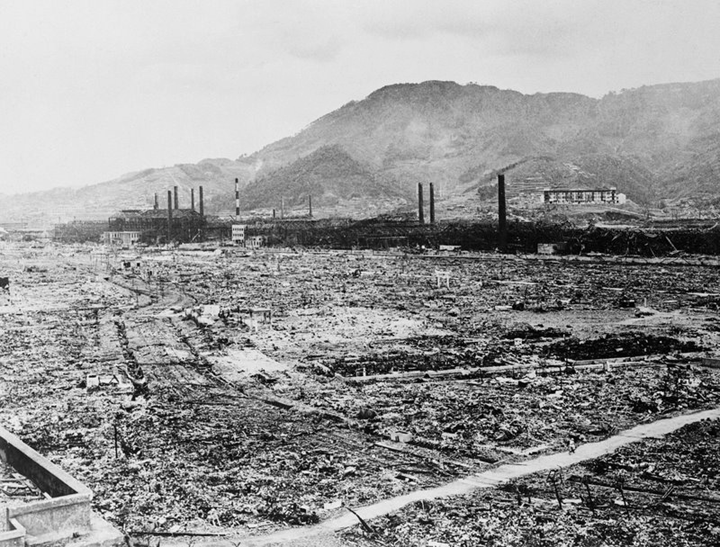
The answer is as simple as it is grotesque. The second bomb was dropped on Nagasaki because Japan’s surrender was never the issue. Getting Japan to surrender was the pretext. The bombs were dropped to make a point. There were political reasons for nuking those two high-density civilian populations, and the United States was not going to let Japan interfere with its political agenda by way of an untimely surrender. The dropping of the second bomb on Nagasaki was part of a political maneuver that had already been decided upon — a one-two punch stratagem designed to strike fear into post-war Russia (our ally in the war against Germany) and convince them to accept their subordinate position on the postwar world stage.
Atomic Bombs Were Dropped On High-Density Civilian Populations In Japan To Make A Political Statement Continue reading
1 This Month
23-25 October – on Zoom – World BEYOND War’s annual global conferenc


Shut down the radiation-damaged Heysham nuclear reactors now
To see nuclear-related stories in greater depth and intensity – go to https://nuclearinformation.wordpress.com

Say No to NASA’s Reckless Nuclear Reactor on the Moon
Say No to NASA’s Reckless Nuclear Reactor on the Moon
-
Archives
- October 2026 (160)
- September 2026 (339)
- August 2026 (330)
- July 2026 (355)
- June 2026 (287)
- May 2026 (306)
- April 2026 (356)
- March 2026 (251)
- February 2026 (267)
- January 2026 (308)
- December 2025 (358)
- November 2025 (359)
-
Categories
- 1
- 1 NUCLEAR ISSUES
- business and costs
- climate change
- culture and arts
- ENERGY
- environment
- health
- history
- indigenous issues
- Legal
- marketing of nuclear
- media
- opposition to nuclear
- PERSONAL STORIES
- politics
- politics international
- Religion and ethics
- safety
- secrets,lies and civil liberties
- spinbuster
- technology
- Uranium
- wastes
- weapons and war
- Women
- 2 WORLD
- ACTION
- AFRICA
- Atrocities
- AUSTRALIA
- Christina's notes
- Christina's themes
- culture and arts
- Events
- Fuk 2022
- Fuk 2023
- Fukushima 2017
- Fukushima 2018
- fukushima 2019
- Fukushima 2020
- Fukushima 2021
- general
- global warming
- Humour (God we need it)
- Nuclear
- RARE EARTHS
- Reference
- resources – print
- Resources -audiovicual
- Weekly Newsletter
- World
- World Nuclear
- YouTube
-
RSS
Entries RSS
Comments RSS

