New well near Fukushima has radioactive tritium
 Toxic water detected in newly built well at Fukushima nuclear plant, Japan Times, 11 Aug 13 KYODO Tokyo Electric Power Co. said Sunday it has detected radioactive tritium in groundwater collected from a newly built observation well by the sea at the crippled Fukushima No. 1 nuclear power plant.
The groundwater sample collected Saturday from the well contained 34,000 becquerels of tritium per liter, up from 23,000 becquerels detected in a sample collected Thursday, a day after the well was installed some 4 meters away from the sea, the plant operator said.
The observation well was set up Wednesday about 4 meters north of the water intake for the No. 1 reactor.
Radioactive water is increasing at the Fukushima complex daily because groundwater is contaminated as it passes through the plant’s premises, where three reactors experienced meltdowns following the March 2011 earthquake and tsunami disaster.
The utility suspects that groundwater has been contaminated at an underground trench by the sea that is connected to the No. 2 reactor building. The newly built well is located some 160 meters north of the trench…… http://www.japantimes.co.jp/news/2013/08/11/national/toxic-water-detected-in-newly-built-well-at-fukushima-nuclear-plant/#.UgkymNJwo6I
Fukushima radiation leaks out of control
Nuclear Official: Growing alarm at Fukushima’s out of control radioactive leaks… Emergency is accelerating due to “faster-than-expected swelling” underground — TV: Tepco now paving over surface with asphalt (VIDEO) http://enenews.com/nuclear-official-radioactive-leaks-getting-out-of-control-and-creating-a-state-of-emergency-at-fukushima-emergency-is-accelerating-due-to-faster-than-expected-swelling-underground
Has the Fukushima “China Syndrome” begun?
Associated Press,, Aug. 8, 2013: Shinji Kinjo, an official at the Nuclear Regulation Authority, said faster-than-expected swelling of the underground water following the installation of the chemical barriers accelerated the emergency
Bloomberg Aug. 7, 2013 at 8:41p ET: The regulator has also indicated growing alarm about the water leaks. Radioactive water leaks are getting out of control and “creating a state of emergency,” said Shinji Kinjo
NHK, Aug. 7, 2013: [Tepco’s] paving the ground surface with asphalt to keep out rainwater
NHK, , Aug. 8, 2013: Industry, Economy and Trade Minister Toshimitsu Motegi told the panel of experts on Thursday to come up with concrete proposals by the end of September. […] Among the approaches he suggested was the possibility of releasing into the sea groundwater that is below the legal limits of contamination.
Watch NHK’s broadcast hereWatch NHK’s broadcast here
VIDEO: Strontium 90 at high levels in Fukushima’s uncontrolled water leak
the unfortunate thing about strontium especially is that it bioaccumulates in algae, it bioaccumulates in fish. It targets the bone, because it’s like calcium.
the government is trying to shore up its decision to support restarting nuclear reactors by showing some kind of commitment to preventing this disaster from
getting too much worse………
 VIDEO: Fukushima Reinforces Worst Fears for Japanese Who Are Anti-Nuclear Power
http://www.pbs.org/newshour/bb/world/july-dec13/japan2_08-08.html
How are the Japanese people reacting to the news of the continuing contamination leak and what does it mean for Japan’s energy policy? Jeffrey Brown talks with Arjun Makhijani of the Institute for Energy
and Environmental Research and Kenji Kushida of Stanford University
about what the government may do to stop the flow.
“……..ARJUN MAKHIJANI, Institute for Energy and Environmental Research: So there are a couple of different problems. One of the problems is what they have found in the groundwater and what actually
is there.
So, so far, we have been concerned about an element called cesium, cesium 137 and 134, which is radioactive. But now they have found strontium-90, which is much more dangerous, at levels that are 30
times more than cesium. So to give you an idea of the level of contamination, if somebody drank that water for a year, they would almost certainly get cancer. So it’s very contaminated.
So that’s one problem. The other is the defenses to hold back this water from the sea seem to be overcome. So now the contaminated waters, 70,000, 80,000 gallons is flowing into the sea every day.
JEFFREY BROWN: And do we know how far out to sea this contaminated water is going and what happens to it when it goes into the sea? Continue reading
A giant wall of ice – will it stop Fukushima radiation leak?
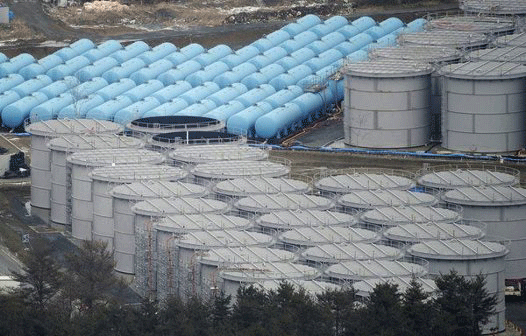 Can a giant ice wall stop Fukushima radiation from leaking into the sea? Grist, By Lisa Hymas Aug 9, 2013 “……..So now Tokyo Electric Power Company, or TEPCO, which owns the plant, has a plan to build an underground wall of frozen earth to stop the radioactive water leakage. NPR explains:
[T]o understand, you need to know the geography of Fukushima. There are three melted down reactors, and they’re all right on the coast. To the west, you have mountains. To the east, you have ocean. And so what’s happening is groundwater flows downhill. It flows down through the ruins of the plant and then flows out to the sea. …
So now, TEPCO has proposed literally creating a wall of ice around the plant. And what they’re talking about is not a wall above ground, but freezing the ground around the plant to stop water from flowing in. …
So the basic idea is that they run piping into the ground and they put coolant in the piping and that freezes the earth around the pipes, and it all sort of gradually forms together into a wall. This is something that civil engineers see sometimes, but it’s not that common. And certainly, the way they’re talking about using it in Fukushima is unprecedented. This wall will be nearly a mile around according to TEPCO. It would require more than 2 million cubic feet of soil to be frozen. But if it worked, then it may be the only way to keep water from flowing into the plant and contaminated water from flowing out.
The New York Times points out another challenge: “the wall will need to be consistently cooled using electricity at a plant vulnerable to power failures. The original disaster was brought on by an earthquake and tsunami that knocked out electricity.”…..
[The wall is] expected to cost between $300 million and $400 million. http://grist.org/news/can-an-ice-wall-stop-fukushima-radiation-from-leaking-into-the-sea/?utm_source=syndication&utm_medium=rss&utm_campaign=feed
Proposal for an island of nuclear waste off Fukushima coast
 Asahi: Huge island made of “contaminated soil and rubble” proposed off Fukushima coast — Place for disposal of radioactive debris — “Measures will be taken to prevent adverse impact on ocean” http://enenews.com/asahi-huge-island-made-contaminated-soil-rubble-proposed-fukushima-coast-could-be-disposal-radioactive-debris
Title: INTERVIEW: Former member of ‘nuclear village’ calls for local initiative to rebuild Fukushima
Source: AJW by The Asahi Shimbun
Author: TAKAFUMI YOSHIDA
Date: August 8, 2013
Yukiteru Naka, former General Electric engineer who spent 40 years at nuclear plants in Fukushima Prefecture
[…] In May, I presented a Futaba County Island Construction Plan to heads of municipal governments in Futaba county.
It calls for creating a huge island off the Fukushima No. 1 plant from contaminated soil and rubble and building facilities for decommissioning as well as for disposal of and research on debris.
(A high level of) radiation is not expected on the island because it will be covered with a large amount of soil. All possible measures will be taken to prevent an adverse impact on the ocean. […]
I came up with the proposal for the purpose of reconstructing all of Fukushima Prefecture. In return, I expect government assistance in building the man-made island and other projects. […]
Will companies set up in a place full of abandoned homes? Can agriculture be revived when there are no successors? The government’s approach is not realistic. […]
[The island could] change the image of Futaba county drastically and develop an area where young people want to gather.
The Futaba County Island Construction Plan should contribute to decommissioning the reactors at the Fukushima No. 1 plant and reconstructing local communities. I expect experts to study the feasibility of the project. […] See also: Like a Pyramid: Mountain of debris 20 meters tall in Miyagi — Hot white vapor rising up from trash — 100km north of Fukushima (PHOTO)
Japan getting ready to officially discharge radioactive water to Pacific Ocean?
The government’s expanded role will likely be led by the Ministry of Economics, Trade and Industry, or METI, which has been criticized for its close ties to TEPCO and the rest of the nuclear industry
Other aspects of the Fukushima plant’s decommissioning have also been dominated by other members of Japan’s collusive “nuclear village,” as the close-knit industry is called, including reactor makers and politically connected large construction companies.

 Japanese government intervenes to shore up crippled Fukushima Daiichi nuclear plant, The Globe and Mail, MARTIN FACKLER TOKYO — The New York Times News Service , Aug. 08 2013,“……….As the scope of the latest crisis became clearer Wednesday, Japan’s popular prime minister, Shinzo Abe, ordered his government to intervene in the cleanup of the plant – taking a more direct role than any government since the triple meltdowns in 2011 qualified Fukushima as the world’s second worst nuclear disaster after Chernobyl.
Abe, a staunch defender of the country’s nuclear program, appears to have calculated that he needed to intervene to rebuild public trust and salvage a pillar of his economic revival plan: the restarting of Japan’s many idled nuclear plants………Some experts suggested Wednesday that the government’s intervention may be the first step in attempts to win public acceptance for what they say is an increasing inevitability: the dumping into the ocean of some of the less contaminated of the huge amount of water being stored in hulking tanks that are overwhelming the plant.
At a news conference last week, Shunichi Tanaka, chairman of Japan’s Nuclear Regulation Authority, seemed to lay the groundwork, saying eventually “it will be necessary to discharge water,” a possible solution likely to raise concerns not only in Japan but in other Pacific Rim countries. Continue reading
Mayor of Nagasaki’s Peace Declaration
Full text of Nagasaki Peace Declaration http://mainichi.jp/english/english/newsselect/news/20130809p2a00m0na002000c.html By Tomihisa Taue,Mayor of Nagasaki The following is the full text of the Peace Declaration presented Aug. 9, 2013 by Nagasaki Mayor Tomihisa Taue, at a ceremony to mark the 68th anniversary of the World War II atomic bombing of the city.
Sixty-eight years ago today, a United States bomber dropped a single atomic bomb directly over Nagasaki. The bomb’s heat rays, blast winds, and radiation were immense, and the fire that followed engulfed the city in flames into the night. The city was instantly reduced to ruins. Of the 240,000 residents in the city, around 150,000 were afflicted and 74,000 of them died within the year. Those who survived have continued to suffer from a higher incidence of contracting leukemia, cancer, and other serious radiation-induced diseases. Even after 68 years, they still live in fear and suffer deep psychological scars.
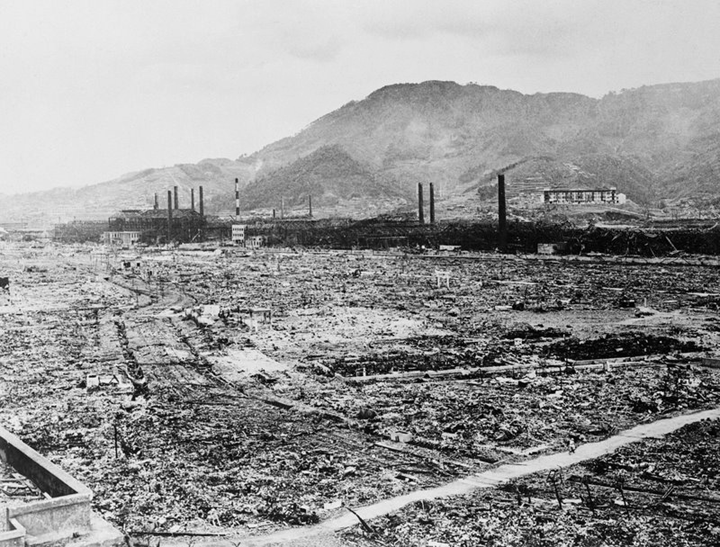
Humankind invented and produced this cruel weapon. Humankind has even gone so far as using nuclear weapons on both Hiroshima and Nagasaki. Humankind has repeatedly conducted nuclear tests, contaminating the earth. Humankind has committed a great many mistakes. This is why we must on occasion reaffirm the pledges we have made in the past that must not be forgotten and start anew. Continue reading
Fukushima nuclear plant water has very high cesium levels
 Nuclear Expert: Water now at Fukushima plant has 3 times more cesium than Chernobyl’s total release — “That underscores the scale of this never-ending threat” http://enenews.com/nuclear-expert-water-now-at-fukushima-plant-has-3-times-more-cesium-than-chernobyl-released-that-underscores-the-scale-of-this-never-ending-threat
Title: A Fukushima fisherman’s tale: Radioactive water from the Daiichi plant is flowing into the ocean at a rate of 300 tons a day
Source: The Independent
Author: David McNeill
Date: August 7, 2013
Experts say the government’s admission shows that the crisis at the Daiichi complex is being managed, not solved.
“It is an emergency – has been since 11 March 2011 and will continue to be long into the future,” said Shaun Burnie, an independent nuclear consultant.
He says onsite contaminated water contains three times the caesium released from the 1986 Chernobyl accident – the world’s worst nuclear disaster.
“That underscores the scale of this never-ending threat.”
See also: Senior Scientist: 100 times more strontium than cesium in water at Fukushima plant — “Strontium gets into your bones… it changes the equation for Japanese fisheries” — Not “too” concerned U.S. fish will be affected
Yoshito Matsushige, photographer of iconic Hiroshima bombing pictures
the American military confiscated all of the post-bomb prints, just as they seized the Japanese newsreel footage,
 Journalist Took Five Historic Pictures—That Must Never Be Repeated The Nation, Greg Mitchell on August 8, 2013 Yoshito Matsushige, a photographer for the Chugoku Shimbun, took the only pictures in Hiroshima on August 6, 1945, that have surfaced since. It was these five photos Life magazine published on September 29, 1952, hailing them as the “First Pictures—Atom Blasts Through Eyes of Victims,” breaking the long media blackout on graphic images from Hiroshima and Nagasaki.
On August 6, 1945, Matsushige wandered around Hiroshima for ten hours, carrying one of the few cameras that survived the atomic bombing and two rolls of film with twenty-four possible exposures. This was no ordinary photo opportunity. He lined up one gripping shot after another, but he could only push the shutter seven times. Continue reading
Japanese man advocates for Korean hibakusha
 Japanese man stands up for Korean A-bomb victims jdp. AUGUST 8, 2013 by FAITH AQUINO Second-generation A-bomb victim Nobuto Hirano has been helping Korean atomic bomb survivors for almost three decades now. Although the Little Boy and the Fat Man were dropped in Hiroshima and Nagasaki, respectively, there were also thousands of Korean victims of the atomic explosions. Despite criticism from fellow Japanese, Hirano has continued to carry out his advocacy for the hibakusha who also deserve compensation but were neglected….http://japandailypress.com/japanese-man-stands-up-for-korean-a-bomb-victims-0833537/
Each week, OLympic swimming pool sized highy radioactive leak from Fukushima
An official from the newly created nuclear watchdog told Reuters on Monday that the highly radioactive water seeping into the ocean from Fukushima was creating an “emergency” that Tepco was not containing on its own.
Highly radioactive water pouring out of Japan’s Fukushima nuclear plant http://www.ndtv.com/article/world/highly-radioactive-water-pouring-out-of-japan-s-fukushima-nuclear-plant-402630 Reuters August 07, 2013 Tokyo: Highly radioactive water from Japan’s crippled Fukushima nuclear plant is pouring out at a rate of 300 tonnes a day, officials said today, as Prime Minister Shinzo Abe ordered the government to step in and help in the clean-up.
The revelation amounted to an acknowledgement that plant operator Tokyo Electric Power Corporation (Tepco) has yet to come to grips with the scale of the catastrophe, 2 1/2 years after the plant was hit by a huge earthquake and tsunami. Tepco only recently admitted water had leaked at all.
Calling water containment at the Fukushima Daiichi station an “urgent issue,” Abe ordered the government for the first time to get involved to help struggling Tepco handle the crisis.
The leak from the plant 220 km northeast of Tokyo is enough to fill an Olympic swimming pool in a week. Continue reading
Fukushima reactor buildings risk collapse as water accumulates underground
The Fukushima plant sits smack in the middle of an underground aquifer. Deep beneath the ground, the site is rapidly being overwhelmed by water.
What happens when you pour hundreds of thousands of tons of water (400 metric tons each day times 2.5 years times 365 days in a year equals 365,000 metric tons of water) onto soil which sits above a massive aquifer?
The spent fuel pool at Fukushima Unit 4 is the top short-term threat to humanity, and is a national security issue for America.
As such, it is disturbing news that the ground beneath unit 4 is sinking.
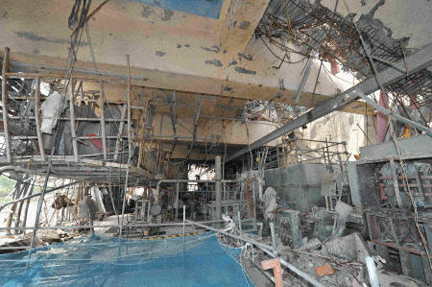
Fukushima: Japan’s Nuclear Accident Response Director Warns that Tepco’s Actions Might Cause Reactor BuIldings to Collapse http://www.globalresearch.ca/fukushima-japans-nuclear-accident-response-director-warns-that-tepcos-actions-might-cause-reactor-buildings-to-collapse/5345279?utm_source=rss&utm_medium=rss&utm_campaign=fukushima-japans-nuclear-accident-response-director-warns-that-tepcos-actions-might-cause-reactor-buildings-to-collapse By Washington’s Blog Global Research, August 07, 2013 Tepco’s ill-considered efforts to change soil permeability and water flow have caused severe problems at the site … including highly radioactive groundwater bubbling up to the surface.
NHK notes:
The vice governor of Fukushima Prefecture has asked the government to take the lead in handling the matter and stop the leakage. Masao Uchibori told an official from the Nuclear Regulation Authority that some of Tepco’s measures have increased the risk of further leaks. Continue reading
Abe better focus on Fukushima radiation crisis, not on nuclear power restart
The first thing Abe must do is shift the Nuclear Regulation Authority’s focus away from evaluating the safety of atomic plants for restart, back to the fast-growing crisis of toxic sludge flowing into the sea around Fukushima. Really folks, first things first. Let’s first make sure children living within a 100 mile radius won’t develop cancer 10 years from now.
Japan’s Nuclear Nightmare Bloomberg By William Pesek Aug 7, 2013 “………It also would have been great if Abe himself had cared more about nuclear safety than dollars when he assumed the premiership in December. His focus was on restarting the 52 reactors taken offline out of an abundance of caution after the earthquake. Never mind that most Japanese want them to remain mothballed. Japan’s potent “nuclear village,” the nexus of power companies and pro-nuclear regulators, bureaucrats and researchers, packs way too much political firepower.

This nuclear-industrial complex is one of the nation’s biggest advertisers, which keeps the Japanese media in line. That’s partly why international campaigners like Greenpeace received so few column inches as they presented report after report showing radiation levels far above what Tepco would admit. (Tepco was eventually forced to come clean.)
So, is Abe’s sudden interest in Fukushima’s radiation mess for real? Well, it has to be at this point. Aside from the risk to his approval ratings, Tokyo is actively vying for the 2020 Summer Olympics. International Olympic Committee officials might find the threat of protests in Istanbul preferable to jokes about Tokyo hosting the Chernobyl Games. Continue reading
Tepco General Manager – “this radioactive discharge is beyond our control”
Tepco Press Conference: The situation at Fukushima is bleak — “This discharge is beyond our control” (VIDEO) http://enenews.com/tepco-situation-fukushima-bleak-discharge-beyond-control-video
Title: Japan’s nuclear body says radioactive groundwater at Fukushima an ‘emergency’
Source: Arirang News
Date: Aug. 6, 2013
Transcript Excerpts
Two and a half years may have passed since the Fukushima nuclear disaster, but problems there are as serious now as they’ve ever been […]
The head of the country’s Nuclear Regulatory Authority task force Shinji Kinjo told Reuters on Monday that the leak was an emergency, but he was worried the plant’s operator, TEPCO, had no sense of how to deal with it. […]
In a recent news conference, TEPCO General manager Masayuki Ono said the situation was bleak.
“We understand that this discharge is beyond our control and we do not think the current situation is good.” […]
Japan’s desperate battle to contain Fukushima’s radioactive water
Japan Nuclear Plant’s Battle to Contain Radioactive Water Tepco Builds Sunken Barrier to Ring-Fence Site, but Water May Have Already Overtopped Wall WSJ, 6 Aug 13, by MARI IWATA and PHRED DVORAK
To stem the advance of radioactive water to the sea, the operator of the stricken Fukushima Daiichi nuclear power plant has tried plugs, walls, pumps and chemicals that harden the ground into a solid barrier.
But as Tokyo Electric Power Co. 9501.TO +3.26% prepares this week to start work on a new set of measures that would ring off and cap the area where the most highly contaminated water has been found, some experts and regulators are saying that the battle to completely contain radioactivity to the site of one of the world’s worst nuclear accidents may be a losing one.
In the most recent example of Tepco’s Sisyphean struggle, the company said late last week that rising levels of contaminated groundwater may have already overtopped a sunken barrier that the utility started only a month ago, and wasn’t even expecting to complete until late this week. Tepco’s water-control measures, such as pumping out contaminated water and putting it in storage, are “merely a temporary solution,” said Shunichi Tanaka, chairman of Japan’s Nuclear Regulation Authority, at a news conference last week. Eventually, “it will be necessary to discharge water” that’s still contaminated into the sea, he said…..
Controlling contaminated water has been a struggle at Fukushima Daiichi ever since the March 2011 earthquake and tsunami knocked out the power at the plant and sent its three active reactors spiraling out of control. Some 400 metric tons of water a day is still being used to cool the melted fuel cores—though much of that water is now recycled. More troubling is another 400 tons a day of groundwater that flows down from hills and mountains into the compound, and toward the sea.
For the past two years, Tepco has been trying to keep the contamination contained by pumping accumulated water out of the highly radioactive reactor buildings, and storing it in tanks on the plant grounds. But the company’s efforts went into overdrive a few months ago, when it found that groundwater sampled near the crippled reactors was showing spiking levels of radioactive elements. It was unclear why. What’s more, Tepco said that the water was likely leaking into the sea.
The continuing problems at the reactor site, including the company’s lack of transparency over the radioactive leaks, have drawn criticism from Japanese regulators….http://online.wsj.com/article/SB10001424127887323420604578651713545887032.html
1 This Month
23-25 October – on Zoom – World BEYOND War’s annual global conferenc


Shut down the radiation-damaged Heysham nuclear reactors now
To see nuclear-related stories in greater depth and intensity – go to https://nuclearinformation.wordpress.com

Say No to NASA’s Reckless Nuclear Reactor on the Moon
Say No to NASA’s Reckless Nuclear Reactor on the Moon
-
Archives
- October 2026 (160)
- September 2026 (339)
- August 2026 (330)
- July 2026 (355)
- June 2026 (287)
- May 2026 (306)
- April 2026 (356)
- March 2026 (251)
- February 2026 (267)
- January 2026 (308)
- December 2025 (358)
- November 2025 (359)
-
Categories
- 1
- 1 NUCLEAR ISSUES
- business and costs
- climate change
- culture and arts
- ENERGY
- environment
- health
- history
- indigenous issues
- Legal
- marketing of nuclear
- media
- opposition to nuclear
- PERSONAL STORIES
- politics
- politics international
- Religion and ethics
- safety
- secrets,lies and civil liberties
- spinbuster
- technology
- Uranium
- wastes
- weapons and war
- Women
- 2 WORLD
- ACTION
- AFRICA
- Atrocities
- AUSTRALIA
- Christina's notes
- Christina's themes
- culture and arts
- Events
- Fuk 2022
- Fuk 2023
- Fukushima 2017
- Fukushima 2018
- fukushima 2019
- Fukushima 2020
- Fukushima 2021
- general
- global warming
- Humour (God we need it)
- Nuclear
- RARE EARTHS
- Reference
- resources – print
- Resources -audiovicual
- Weekly Newsletter
- World
- World Nuclear
- YouTube
-
RSS
Entries RSS
Comments RSS

