“Tactical” nuclear weapons useless and dangerous
Nothing tactical about nuclear weapons Express Tribune, By Zahir Kazmi May 17, 2014 The term ‘tactical nuclear weapon’ is a Cold War relic not applicable to the subcontinent. There is nothing tactical about these weapons, as their use would have strategic fallouts. Their ideal purpose should be to deter adversaries from contemplating actions that can lead to crises, conflicts and wars. For nuclear-armed states, the key would then be to exercise self-deterrence and avoid triggering conflicts.
A potential nuclear war between India and Pakistan would be a chain of unfortunate events, possibly triggered by another spectacular terrorist attack in India by Pakistan-based quasi-state extremists. India would trade the ‘Gandhian restraint’ for a dance of destruction to punish Pakistan without activating a nuclear response.
In times of defence, Pakistan’s hand would be forced to defeat advancing Indian forces either by conventional forces or by using low-yield nuclear weapons. India threatens a massive retaliation against limited nuclear use, discounting assured Pakistani quid pro quo. There will be no winners in a nuclear war.
Escalating a crisis on the grave assumption that Pakistan would be involved in a future terrorist attack is a commitment trap. The rational choice of investigating such an event with Pakistani help would be an easy option. Fighting terrorism in all its forms is essential. Having a military-to-military joint intelligence sharing mechanism in times of peace would be another ideal worth considering. Pakistan had made such an offer after the Mumbai incident.
Likewise, relying on a massive nuclear retaliation threat in hopes to deter Pakistani response to limited war strategy is a naive assumption at best.
The two risky extremes seem impervious to the certainty that there is no way both sides would be able to guarantee either to dominate or control a crisis from escalating. ……http://tribune.com.pk/story/709277/nothing-tactical-about-nuclear-weapons/
US nuclear companies keen to work on Fukushima clean-up
Kennedy vows U.S. help to Japan for Fukushima nuclear clean-up Planet Ark 5-May-14 Country: JAPAN Author: Yoko Kubota U.S. Ambassador to Japan Caroline Kennedy pledged U.S. support for the clean-up at Japan’s tsunami-wrecked Fukushima Daiichi nuclear power plant on Wednesday after her first visit to the site……..
Contaminated water accumulates at a rate of 400 tonnes a day at the plant as groundwater flows into the destroyed basements of the reactor buildings and mixes with highly radioactive water used to cool melted fuel.
Row upon row of huge blue and gray tanks that store contaminated water are lined up while pink, white and purple azalea bushes are in full bloom nearby. Overgrown plants curl onto the streets while pipes snake across the site where numerous cranes still stand.
About 1,200 to 1,300 tanks storing about 450,000 tonnes of contaminated water are on site and over the next two years Tepco wants to set up enough tanks to store 800,000 tonnes of water, said Kenichiro Matsui, a spokesman for the utility.
Up to 5,000 workers are on site each day, according to the Tepco spokesman, Matsui, up from about 4,000 a year ago. In future, that number is likely to increase to about 6,000, he said.
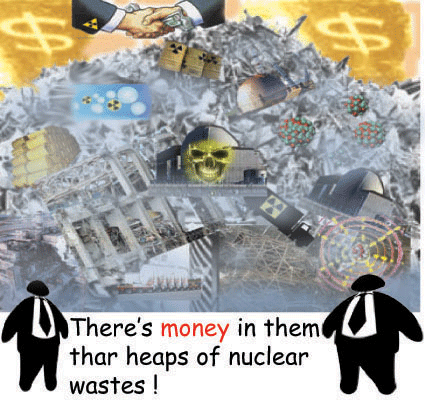 Overseas companies including U.S. ones are eager to get in on the clear-up work and the decommissioning of the six reactors at the wrecked plant but most contracts have gone to Japanese companies……..
It’s good that she’s here because the situation at the plant needs to be reported worldwide,” said one man who now works as a driver for plant workers after hitting his annual radiation exposure limit in his former job at the site.http://planetark.org/enviro-news/item/71554
Hundreds ill after Fukushima radioactive trash burned in major Japanese city

 Medical Expert: Hundreds ill after Fukushima nuclear plant rubble burned in major Japanese city — Suffering nosebleeds, problems with eyes, throats and skin — Gov’t: Radiation levels were ‘low enough’ to be safe (PHOTO) http://enenews.com/medical-expert-hundreds-ill-after-fukushima-nuclear-plant-rubble-burned-major-japanese-city-suffering-nosebleeds-problems-eyes-throats-skin-govt-radiation-levels-low-enough-be-safe?utm_source=feedburner&utm_medium=email&utm_campaign=Feed%3A+ENENews+%28Energy+News%29
Asahi Shimbun, May 13, 2014: The manga series [‘Oishinbo’] has been in print since 1983 [selling] 120 million copies […] the May 12 installment includes a segment in which residents of Osaka complain about health problems after a nearby incinerator processes rubble transported from the Fukushima No. 1 nuclear power plant.
Japan Times, May 13, 2014: Osaka Prefectural Government took issue with the assertion, expressed by a character based on real-life medical expert Eisuke Matsui, that about 800 people living around an incinerator there have been affected by burning tsunami debris tainted with radiation from Tohoku. […] Osaka Prefectural Government claimed that no local doctors or authorities have received reports of ill health due to debris incinerated in the city’s Maishima area, contradicting the assertion made by the manga’s character Matsui. […] At every stage of the disposal, the radiation level was stable and low enough to be safe, the government said. —CAPTION: [Matsui’s] character portrayed in the manga ‘Oishinbo’ claims that about 800 residents living near an incinerator in the city of Osaka have exhibited symptoms of illnesses caused by radioactive fallout
Kyodo News, May 13, 2014: Citing [an] expert [Oishinbo] said hundreds of people living near an incineration site in the city of Osaka […] experienced nosebleeds or unpleasant symptoms affecting their eyes, throats and skin.
“Extremely Unjust”: Osaka professor arrested — Publicly opposed burning radioactive debris
Doctor: 300 times more radiation released to atmosphere when burning debris than gov’t claims
From 2012: Fukushima will start burning radioactive waste — 100,000 Bq/kg to be incinerated
Watch — Gundersen: Lots of serious ramifications from burning of nuclear waste — We are basically creating Fukushima all over again (VIDEO)
Bangladesh is going for solar energy in a big way
Why Green Jobs Are Booming in Bangladesh, AN ATLANTIC SPECIAL REPORT The impoverished nation is going solar in a big way. TODD WOODY MAY 12 2014 according to a report released Sunday, the South Asian nation has become a top hot spot for renewable energy jobs, creating a green workforce as large as Spain’s in 2013.
How? Solar energy.
Bangladeshi’s are installing small photovoltaic systems at a rate of 80,000 a month, says the report from the International Renewable Energy Agency (IRENA). In a country where only 47 percent of the population had access to electricity in 2009, according to the Asian Development Bank, solar is increasingly becoming a way to leapfrog the need to build a bigger power grid. In the past 10 years, the number of solar systems in Bangladesh has jumped from 25,000 to 2.8 million, according to IRENA. That in turn has created some 114,000 jobs, from assembling solar panels to selling, installing and maintaining them. In fact, the number of solar-related jobs nearly doubled between 2011 and 2013. “The numbers are set to increase further,” wrote the report’s authors. (By comparison some 4 million people work in Bangladesh’s garment industry.)
Solar energy accounted for 2.3 million of the world’s 6.5 million renewable energy-related jobs in 2013, according to the report. About 70 percent of those solar positions were in China, the biggest green-job generator with 2.6 million people employed in renewable energy overall…….http://www.theatlantic.com/technology/archive/2014/05/why-a-green-jobs-boom-is-under-way-in-bangladesh/362087/
“Potentially dangerous criminal”? – Mari Takenouchi who condemns nuclear power
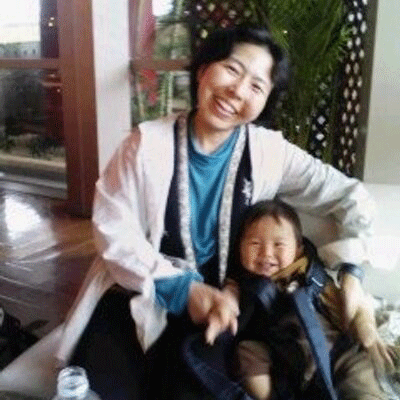 VICE: Japan mother may be jailed for “tweet critical of nuclear lobbyist” — Fukushima police travel 1,000 miles to interrogate her, examine computer — Officer: We only go outside prefecture for “potentially dangerous criminal” — “May be held without bail… without right to see lawyer”http://enenews.com/vice-japan-mother-fled-radiation-jail-tweet-critical-nuclear-lobbyist-fukushima-police-travel-1000-miles-interrogate-her-examine-computer-officer-only-prefecture-potentially-dangerous-criminal?utm_source=feedburner&utm_medium=email&utm_campaign=Feed%3A+ENENews+%28Energy+News%29VICE, Nathalie-Kyoko Stucky, May 11, 2014: Mari Takenouchi […] wrote a tweet critical of a nuclear lobbyist. Takenouchi may go to jail […] Prosecutors confirmed they will be flying to Okinawa […] to question her on May 13. Police have already traveled from Fukushima to Okinawa to interrogate her […] [She] fled her hometown of Tokyo with her infant son days after the disaster, hoping to avoid fallout from Fukushima. […] Takenouchi said police came to her apartment in Okinawa and examined her computer […] The prosecutor’s office will decide by July whether to indict […] she may be held without bail […] without a right to see a lawyer or have one present during questioning.
Lieutenant Tadashi Terashima, Fukushima police spokesman: “We only send police officers from one prefecture to another if the subject is really a potentially dangerous criminal.”
Translation of Takenouchi’s tweet: There’s a common point between the 2 criminals of the century. Yasuhiro Nakasone, who introduced nuclear plants in Japan, said: “I didn’t expect Japan in 2011 to become such a battered country.” Ryoko Ando, a (pro-establishment) citizen activist who hosts Ethos’ human experiments in Fukushima, said: “Is this the kind of world we’ve arrived at over the 67 years since the end of World Ward Two?”
VICE on Ryoko Ando: “The Japanese head of Fukushima Ethos, a project […] funded by the French nuclear energy lobby. Fukushima Ethos encourages residents to continue living in contaminated areas as long as decontamination procedures and radiation measurements continue to be done […] Ando reported it to the Fukushima Prefectural Police, accusing Takenouchi of either criminal defamation or criminal contempt.”
Takaaki Hattori, legal expert:“Unprecedented for the police to launch a contempt investigation against a journalist for a single tweet, made in the public interest. If all debates about nuclear energy in this country are going to become grounds for criminal investigations, freedom of speech will vanish. The fact that police even sent the case to the prosecution is disturbing.”
Japan Times, Feb. 12, 2014: “Japan fell from 22nd to 53rd place on [Reporters Without Borders’ World Press Freedom Index] for “the ban imposed by the authorities on independent coverage of any topic related directly or indirectly to the [Fukushima] accident.”
Sydney Morning Herald: “The cloud was at its thickest during the three hours Takenouchi and her son, Joe, spent outside […] Joe was exposed to 145 times the normal [radiation] level”
Watch Takenouchi describe her baby’s subsequent health problems here
Nose bleeding attacks prevalent in some people exposed to Fukushima nuclear radiation
Press Conference by Former Official: I’m bleeding from nose every day, many in Fukushima have similar symptoms — Author: My nose bled for days, it wouldn’t stop; Staff had same problem… Do people want me to lie? I can only write truth — Gov’t: The nosebleeds aren’t caused by nuclear crisis (PHOTO) http://enenews.com/press-conference-former-official-nose-bleeds-every-day-many-others-fukushima-developed-similar-symptoms-govt-nosebleeds-caused-nuclear-crisis-author-bleeding-nose-days-wouldnt-stop-others-same-s?utm_source=feedburner&utm_medium=email&utm_campaign=Feed%3A+ENENews+%28Energy+News%29
Jiji Press, May 10, 2014: Environment Minister Nobuteru Ishihara has criticized a manga story for linking nosebleeds to exposure to radiation […] He underscored the importance of keeping unfounded rumors in check [and] that doctors with special knowledge have denied a causal relationship between exposure to radiation after the nuclear accident and nosebleeds.
Mainichi, May 10, 2014: Katsutaka Idogawa, 67, [Futaba’s] former mayor […] is featured in the popular comic series “Oishinbo.” […] Idogawa says his nose bleeds regularly and that there are many others in Fukushima who have developed similar symptoms. […] Idogawa told a news conference on May 9 in Tokyo […] his nose bleeds every day, especially in the mornings. “There is no way I would retract my comments in the manga,” Idogawa said. Responding to Environment Minister Nobuteru Ishihara […] Idogawa commented, “The minister has no business with my physical condition.”
Author Tetsu Kariya interview, translated by Toshi Nakamura, Jan. 13, 2014: […] after I got back [from Fukushima] and was having dinner, I suddenly started bleeding from my nose, and it wouldn’t stop. I thought, “what on Earth?” I’ve rarely ever had a nosebleed so it was quite a shock. After that, I had nosebleeds at night for days after. But when I went to the hospital, they said “there’s currently no medical connection between nosebleeds and radiation” and they severed a capillary in my nose membrane with a laser. Also, after I went, I felt a great deal of fatigue. The staff who went with me and the chief of Futaba-machi suffered from nosebleeds and fatigue. They say the radiation levels are low so there’s no harm, but I wonder about that.
Statement from Tetsu Kariya summarized by Yoshihiro Kaneda, May 7, 2014: It is possible that those who have supported me would walk away from me. I don’t understand why people criticize the truth which I have collected data in Fukushima 2 years and I write it as it is. Do people want to close my eyes against the truth and write something good lies for somebody or other? […] I can only write the truth. I hate self-deceiving. Today’s Japanese society is surrounded by the atmosphere of hating inconvenient truth and desiring lies of feeling good.
Taiwan’s growing problem of nuclear radioactive waste

the only sane thing is to stop making the stuff
 Taiwan in talks with China, France for nuclear waste deals Global Post 12 May 14, Taiwan has been talking with China and France over the possibility of managing the island’s radioactive nuclear waste, Taiwanese officials said Monday.
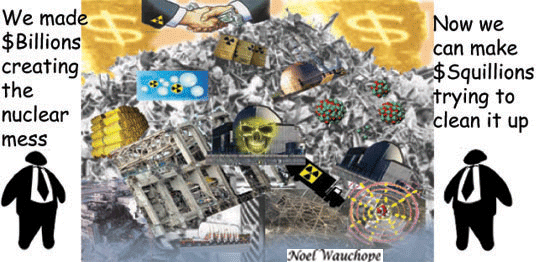
Hwang Jung-chiou, chairman of the state-owned electric power utility Taiwan Power Co. (Taipower), told Kyodo News that they have been in contact with France with the intention of sending shiploads of spent fuel rods there for reprocessing, adding that Taiwan has obtained consent from the United States. A civil nuclear agreement between Taiwan and the United States, renewed in December last year, allows the transfer of nuclear waste from Taiwan to France and other countries or destinations agreed upon by Taipei and Washington for storage and reprocessing.
Hwang made the remarks after the construction of an interim dry storage facility for spent fuel rods his company plans to build in New Taipei City hit a snag.
The water pools at the First Nuclear Power Plant in Chinshan, 41 kilometers away from the capital Taipei, are nearing full capacity.
Taipower is building an above-ground facility at the reactor site for storing the used fuel before a deep geological disposal site is available.
Taipower’s plan is to begin building the final repository in 2044 and commence operation in 2055.
However, local opposition to the interim facility has forced the New Taipei City government to hold off from giving a green light to the proposal……..
Apart from talking with France on reprocessing high-level radioactive waste, Hwang said they are also talking with China over the possibility of disposing low-level nuclear waste there.
Taipower began to ship low-level radioactive nuclear waste to an underground storage site on Orchid Island off Taiwan’s southeastern coast three years after Taiwan’s first nuclear power plant came online in 1979.
Over 97,000 barrels of such waste were shipped to the island, which is home to some 4,000 Tao Aboriginal people, before they began to disintegrate in 1992, leading to efforts to replace the eroded containers with new ones beginning in 1996.
While Orchid Island is a temporary disposal facility, the Ministry of Economic Affairs has announced that Wuciou Island in the Kinmen archipelago, near the coast of mainland China, and Daren Township of Taitung County in eastern Taiwan have been chosen as possible sites of permanent storage.
However, strong opposition has made the two local governments reluctant to hold regional referendums on the issue. http://www.globalpost.com/dispatch/news/kyodo-news-international/140512/taiwan-talks-china-france-nuclear-waste-deals
Taiwan officials brush off worries about nuclear power plant flaws
Officials downplay nuclear plant flaws GLOSSING OVER FAULTS:A ‘Liberty Times’ report said a Taipower employee alleged that a report on the safety of the Fourth Nuclear Power Plant omitted the plant’s flaws Taipei Times By Lee I-chia / Staff reporter, with CNA 12 May 14, Officials yesterday sought to play down leaked test results indicating possible flaws in a containment structure of the Fourth Nuclear Power Plant, saying the problem will be fixed as part of ongoing tests and inspections.
Taiwan Power Co (Tai-power, 台電) chairman Hwang Jung-chiou (黃重球) said that finding and sealing leaks in the primary containment structure of the plant’s first reactor were normal steps in safety inspection procedures.
Hwang said similar leaks were discovered during inspections carried out on the nation’s first, second and third nuclear power plants, all of which are operated by the state-run Taipower.
The company is also responsible for the nearly completed Fourth Nuclear Power Plant in New Taipei City’s Gongliao District (貢寮).
Answering questions at a meeting of the legislature’s Education and Culture Committee, Atomic Energy Council (AEC) Minister Tsai Chuen-horng (蔡春鴻) said the council would strictly review Taipower’s safety reports on the plant to ensure the leakage rates of the reactor containment building are within safety standards.
Tsai’s remarks came in response to a report by the Chinese-language Liberty Times (the Taipei Times’ sister newspaper) yesterday which said it received an anonymous report from a person who identified himself as a worker at the plant saying that during the integrated leak rate test (ILRT) and structure integral test (SIT) conducted at the plant’s No. 1 reactor from Feb. 26 through March 5, leakage rates were found to be too high.
The company had reported them as normal.
Meanwhile, outside the committee meeting room, Green Citizen Action Alliance deputy secretary-general Hung Shen-han (洪申翰) criticized Taipower for claiming that the structure had no problems in its publicized safety test report on its Web site last month.
He alleged that the company only reported the good parts, but not flaws, which he said should be considered lying to the public…….http://www.taipeitimes.com/News/front/archives/2014/05/13/2003590217
Japan’s authorities don’t like it, but Manga art pushes on with anti-nuclear story
Manga pushes ahead with antinuclear storyline, Japan Newsw, May 13, 2014 Jiji Press Japanese gourmet manga “Oishinbo” went further down its antinuclear path in the most recent serialized chapter released on Monday, after sparking controversy with the previous chapter on fallout from the nuclear accident at Tokyo Electric Power Co.’s Fukushima No. 1 nuclear power plant.
In the latest episode in Shogakukan Inc.’s Big Comic Spirits magazine, characters warned against living in Fukushima Prefecture.
The previous chapter of Oishinbo, published on April 28, drew criticism for linking nosebleeds—including one suffered by the manga’s lead character—to radiation from the northeastern Japan power station where a triple reactor meltdown occurred shortly after the March 2011 earthquake and tsunami.
At a news conference Monday, Chief Cabinet Secretary Yoshihide Suga said experts deny any causal relationship between nosebleeds and exposure to radiation following the accident. Environment Minister Nobuteru Ishihara made a similar remark on Friday…….
In the latest story, the real former Futaba Mayor Katsutaka Idogawa returns as a character who says that many locals suffer from symptoms such as nosebleeds and fatigue “because they were exposed to radiation.”
In the manga, Idogawa also criticizes the responses from TEPCO and the central government to the worst nuclear accident in Japan’s history. Futaba is one of two municipalities that host the Fukushima No. 1 plant.
Another character in the newest chapter says that Idogawa made his remarks after giving thorough thought to the issue and based on his own experience, explaining that the remarks “are immune from any lie or falsehood and are weighty.”
“You simply can’t decontaminate a wide area in Fukushima and make it a place where people can live again,” a character portraying Takeru Arakida, associate professor at Fukushima University, says in the manga. “This is the truth of Fukushima,” another character responds.The latest episode drew backlash from Fukushima Prefecture and other local governments concerned……..http://the-japan-news.com/news/article/0001274657
Japan’s govt not happy about Manga art depicting radiation effects of Fukushima nuclear disaster
Manga story about radiation criticized Japan News, Jiji Press, 10 May 14 Environment Minister Nobuteru Ishihara has criticized a manga story for linking nosebleeds to exposure to radiation at Tokyo Electric Power Co.’s stricken Fukushima No. 1 nuclear plant.
“I cannot understand the intention behind the story or what the author wants to say,” Ishihara said at a news conference. He underscored the importance of keeping unfounded rumors in check…….
Ishihara also said Friday that doctors with special knowledge have denied a causal relationship between exposure to radiation after the nuclear accident and nosebleeds.
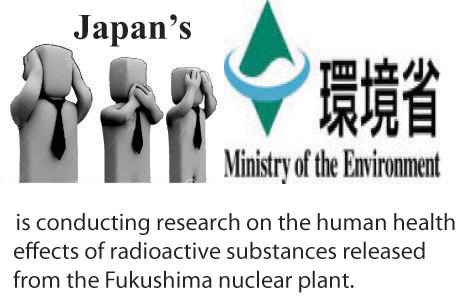
The Environment Ministry is conducting research on the human health effects of radioactive substances released from the plant…….http://the-japan-news.com/news/article/0001269114
Fukushima reactors molten fuel cores – where are they? Robots might find them
Robots To Investigate Fukushima N-reactors http://www.bernama.com.my/bernama/v7/wn/newsworld.php?id=1036936 TOKYO, May 9 (Bernama) — Tokyo Electric Power Co. (TEPCO) plans to use robots for investigating the inside of reactor containment vessels at its stricken Fukushima No. 1 nuclear power plant.
The investigation is expected to take place as early as in the fiscal second half that begins in October, sources were quoted as saying by Japan’s Jiji Press news agency.
Internal conditions of the containment vessels at the plant’s No. 1 to 3 reactors remain unknown.
If the robots — made by Hitachi Ltd. and others — are able to identify where melted nuclear fuel is located, this would lead to progress in work to decommission the plant damaged in the March 2011 earthquake and tsunami.
But it is unclear how much information can be obtained by the robots due to high radiation levels and steams inside the vessels.
TEPCO said the investigation is aimed at assessing temperatures and radiation levels inside the vessels.
The government plans to start removing melted fuel in 2020.
Fukushima groundwater radioactive contamination getting worse, but not properly measured
 Ongoing Impact of Wastewater from Fukushima Nuclear Power Station Ongoing Impact of Wastewater from Fukushima Nuclear Power StationHydro International, By Shunji Murai Professor Emeritus, University of Tokyo, Japan08/05/2014 Three years on from the Great East Japan Earthquake and Tsunami of 11 March 2011, air contamination is decreasing and is now concentrated in a limited area. Land contamination has also decreased through decontamination processes. However, despite all the efforts by Tokyo Electric Power Company (TEPCO) and the Japanese government, water contamination in surface and ground water is getting worse, simply because there are no effective countermeasures. ……. Even though the wastewater issue is taken seriously by Japanese people as well as people worldwide, the real status of the effect of the contamination is still unknown because neutral third-party organisations have no access to within a 20km radius of Fukushima NPS. The author has tried to make clear what the status of the wastewater issue is by using various sources including a Fishermen Union’s report, which appears to be more reliable than the government report or the report by TEPCO. http://www.hydro-international.com/news/id6913-Ongoing_Impact_of_Wastewater_from_Fukushima_Nuclear_Power_Station.html |
New research shows that TEPCO underestimated radioactive cesium released from Fukushima
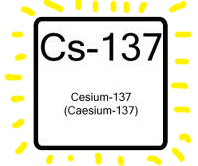 Radioactive cesium levels at Fukushima higher than TEPCO claims, Voice of Russia, 6 May 14 A new study conducted by Japanese researchers revealed that cumulative amount of radioactive cesium at the disaster-hit Fukushima nuclear power plant is nearly 1,5 times higher than previous estimates of the Tokyo Electric Power Co. (TEPCO), RIA Novosti reports. According to the research, between 17.500 and 20.500 terabecquerels of radioactive cesium-137 was released into the atmosphere from the Fukushima reactors against less than 13.600 terabecquerels declared by the plant operator TEPCO.
Earlier in April Japan’s Ministry of Economy, Trade and Industry issued a report that showed significant drop of radiation levels in areas surrounding Fukushima to under 20 millisieverts per year. These figures, however, exceed the long-term target of Japanese government of 1 millisievert per year.
………..: http://voiceofrussia.com/news/2014_05_09/Radioactive-cesium-levels-at-Fukushima-higher-than-TEPCO-claims-0913/
Japan’s shock as Manga art depicts the reality of Fukushima radiation and health
Japanese Manga Stirs Up Fukushima Nuclear Controversy http://kotaku.com/japanese-manga-stirs-up-fukushima-nuclear-controversy-1573381718 (Manga pictures on original article) 8 May 14 A famous Japanese food manga takes on the “truth about Fukushima.”
The Japanese manga, Oishinbo (美味しんぼ) is a long-running food manga that has been ongoing since 1983. In his latest chapter that was recently published in the magazine Big Comic Spirits, author Tetsu Kariya depicted the manga protagonist, Shiro Yamaoka, as he returned from a visit to the nuclear-disaster-suffering prefecture when he suddenly has a random nosebleed.After the incident, there is a discussion with another character who says that he, too, has suffered from such unexplained nosebleeds and fatigue, finishing with the comment, “There are a lot of people in Fukushima who suffer from the same symptoms. They just don’t talk about it.”
This depiction managed to stir up the hornet’s nest. According to Japanese news site Ebisoku, soon after the magazine hit the racks, the publisher, Shogakukan, was flooded with complaints and criticism that the manga was showing Fukushima in an exaggerated negative light.
The town of Futaba-machi wrote an official complaint, stating that there was no truth to the claim that “lots of people suffer from nosebleeds and other symptoms” and that the manga was damaging the image of Fukushima that they were trying hard to rebuild. The complaint notes that ever since the manga came out, there have been cancellations of visits and product orders and that Fukushima residents were afraid that the manga was cultivating discrimination against the prefecture and its residents.
Shogakukan has responded, saying that the depictions in the manga are based on real-world coverage by the author and that the manga had been published respecting the author’s expression.
The latest chapter of the manga seems based on personal experience by Kariya that he noted in an interview with Nichigo Press earlier this year. In the interview, Kariya talked of how the damage from the 2011 earthquake and subsequent nuclear disaster was much worse than he had imagined.
In response to the negative criticism against his manga, Kariya stated that while he expected some backlash, the extent of the response has surprised him. In a statement covered byNetarika, Kariya warned that there are still 2 more chapters to come and that he plans on writing harsher things. “People who are in an uproar about a nosebleed might go berserk.” Kariya stated. However, Kariya remains firm in his stance, saying that people are trying to sugar-coat the disaster with euphemisms and falsely positive language to hide the truth – something he hates more than anything else.
The author of Oishinbo recognizes that a lot of people will not like what he has to say, however, he maintains his position and has said that he will release his rebuttal after the last chapter is published.
Two ex-PMs launch Japan Assembly for Nuclear Free Renewable Energy
Japan’s ex-PMs team up for anti-nuclear drive, Channel News Asia, 8 May 14 Two former Japanese prime ministers — Morihiro Hosokawa and Junichiro Koizumi — have teamed up to increase the pressure on incumbent Prime Minister Shinzo Abe to stop the resumption of nuclear power in the country. TOKYO: Two former Japanese prime ministers — Morihiro Hosokawa and Junichiro Koizumi — have teamed up to increase the pressure on incumbent Prime Minister Shinzo Abe to stop the resumption of nuclear power in the country.
A new organisation, called the “Japan Assembly for Nuclear Free Renewable Energy”, has been launched with the main objective of calling for a nuclear free Japan, and promoting the development and use of renewable energy — and it has been getting a lot of media attention………Heading the group is Mr Hosokawa, who recently ran for Tokyo governor on an anti-nuclear platform.
He was backed by another former Prime Minister Junichiro Koizumi, who also plays an important role in the organisation.

“First, we are against the restart of Japan’s nuclear reactors. We want to transfer nuclear power to natural energy, build an economy that can capitalise on it and build a society where we do not have to worry about radiation,” he said.
Mr Koizumi said: “All nuclear plants have stopped, not only for 3 months, or 6 months, but for almost a year. Has Japan been unable to survive without nuclear power? We have prevailed.
“People may say I am a person of the past. But I will, with the generation of the future, work towards creating a country without nuclear power.”
Joining them in the anti-nuclear drive is a long list of celebrities, including actors, authors, people from the music industry and local authorities……the group said it plans to hold regular meetings and forums, to generate momentum and pressure the government to stop the generation of nuclear energy in Japan.
1 This Month
15 October. Joint Appeal for Nuclear Abolition Day -presentation to the UN on October 15 will be live on UNWebTV
Endorse the Nuclear Abolition Day Appeal
23-25 October – on Zoom – World BEYOND War’s annual global conference

To see nuclear-related stories in greater depth and intensity – go to https://nuclearinformation.wordpress.com
-
Archives
- October 2026 (149)
- September 2026 (339)
- August 2026 (330)
- July 2026 (355)
- June 2026 (287)
- May 2026 (306)
- April 2026 (356)
- March 2026 (251)
- February 2026 (267)
- January 2026 (308)
- December 2025 (358)
- November 2025 (359)
-
Categories
- 1
- 1 NUCLEAR ISSUES
- business and costs
- climate change
- culture and arts
- ENERGY
- environment
- health
- history
- indigenous issues
- Legal
- marketing of nuclear
- media
- opposition to nuclear
- PERSONAL STORIES
- politics
- politics international
- Religion and ethics
- safety
- secrets,lies and civil liberties
- spinbuster
- technology
- Uranium
- wastes
- weapons and war
- Women
- 2 WORLD
- ACTION
- AFRICA
- Atrocities
- AUSTRALIA
- Christina's notes
- Christina's themes
- culture and arts
- Events
- Fuk 2022
- Fuk 2023
- Fukushima 2017
- Fukushima 2018
- fukushima 2019
- Fukushima 2020
- Fukushima 2021
- general
- global warming
- Humour (God we need it)
- Nuclear
- RARE EARTHS
- Reference
- resources – print
- Resources -audiovicual
- Weekly Newsletter
- World
- World Nuclear
- YouTube
-
RSS
Entries RSS
Comments RSS

