Politicians oppose nuclear power in seismic zone in India
 Left parties turns up heat on Kovvada nuclear plant, The Hindu NATIONAL » ANDHRA PRADESH SRIKAKULAM, May 23, 2014 Setting up the plant in seismic zone a threat to people, they say. CITU leader D. Govinda Rao said that workers, residents of Ranasthalam would launch massive agitations soon to oppose the construction activity in Kovvada.
The Left parties have turned the heat on the construction of a nuclear power project in Kovvada of Ranasthalam mandal again after mild tremor rattles the district on Wednesday saying that the project site comes under highly seismic zone and it would be dangerous for the people.
 Representatives of the Left Parties have asked the government to reconsider its decision over the establishment of the nuclear plant in the district. Senior CPI (M) leader V.G.K. Murthy said that the government should clarify over the dangers posed with the setting up the nuclear plant in a seismic zone. “The Nuclear Power Corporation of India officials always say that adequate precautions would be taken up to avoid disasters during natural calamities. We feel that such disasters can’t be avoided even in highly advanced countries. So, the government should come up with scientific data to clear the doubts of people,” he added.
CITU leader D. Govinda Rao said that workers, residents of Ranasthalam would launch massive agitations soon to oppose the construction activity in Kovvada. He said that several nuclear experts including Surendra Gadekar had already expressed doubts over the safety of the project. Mr. Surendra Gadekar on Sunday cautioned that Srikakulam town would be affected badly with the establishment of nuclear power plant at Kovvada, which is 35 km away from the district headquarters.
According him, Srikakulam, which is very close to Kovvada, would face radiation problem with the establishment of the nuclear power plant with an installed capacity of 10,000 Megawatts…..http://www.thehindu.com/news/national/andhra-pradesh/left-parties-turns-up-heat-on-kovvada-nuclear-plant/article6037482.ece
Solar power in every Indian home by 2019 – that’s the goal of new Prime Minister Modi
 Modi to Use Solar to Bring Power to Every Home by 2019 http://www.bloomberg.com/news/2014-05-19/modi-to-use-solar-to-bring-power-to-every-home-by-2019.html By Rakteem Katakey and Debjit Chakraborty May 18, 2014 India’s new government led b yNarendra Modi plans to harness solar power to enable every home to run at least one light bulb by 2019, a party official said.
“We look upon solar as having the potential to completely transform the way we look at the energy space,” said Narendra Taneja, convener of the energy division at Modi’s Bharatiya Janata Party, which swept to power on May 16 in the biggest electoral win in three decades. About 400 million people in India lack access to electricity, more than the combined population of the U.S. and Canada. The outgoing government led by Prime Minister Manmohan Singh missed a 2012 target to provide electricity to all households.
The five-year goal will require the cooperation of state-level administrations with which the central government shares control over the power industry, Taneja said. If successful, solar panels could allow every home to have enough power to run two bulbs, a solar cooker and a television, he said.
Expanding clean-power generation will be the administration’s top energy-related priority, especially solar because it has the potential to create jobs and supply millions of scattered households not connected to the grid, he said.
Modi, as chief minister of Gujarat state, pioneered India’s first incentives for large-scale solar power in 2009. The party will take lessons from Gujarat’s program as it designs policies on a national level that will include both larger, grid-connected photovoltaic projects and smaller, decentralized applications for solar, Taneja said.
To contact the reporters on this story: Rakteem Katakey in New Delhi atrkatakey@bloomberg.net; Debjit Chakraborty in New Delhi at dchakrabor10@bloomberg.net
Taiwan’s nuclear dilemma – a return to authoritarian past?
 Taiwan’s Nuclear Future and Authoritarian Past The intense debate in Taiwan over nuclear power has echoes of a less democratic past. The Diplomat, By Brent Crane May 21, 2014 Last August, chaos erupted in Taiwanese parliament. Opposing lawmakers thrust hard-clenched fists at one another while fervent activists tossed opened water-bottles from the stands like Molotov cocktails. Politicians and otherwise civilized men wrestled like teenage boys on the floor amid shouts, screams and camera flashes.
The Legislative Yuan had initially assembled to discuss the conditions of a national referendum deciding the fate of Taiwan’s fourth nuclear power plant in Gongliao, New Taipei City. The controversial plant, known ominously throughout the country as Nuke 4, remains a rallying cry for opponents of one of Taiwan’s most charged political subjects: nuclear power. The debate has been energized in recent weeks after former opposition party leader and staunch nuclear energy opponent Lin Yi-hsiung went on hunger-strike in protest of the government’s unwillingness to make concessions with Taiwan’s antinuclear lobby. On the surface, the conflict appears rather black-and-white: it’s the safety-conscious, environmentalists and academics versus the pragmatic economists and government bureaucrats. But the nuclear power debate in Taiwan is about much more than just safety and economics. It’s about reconciling Taiwan’s autocratic past with its democratic present……….
On the Taiwanese political front today, only reunification is as hotly debated as nuclear energy. The antinuclear camp, which polls suggest finds support from up to 70 percent of the 23 million Taiwanese, advocates full denuclearization of the island. Simply put, their biggest beef with nuclear power in Taiwan is that it poses too great a safety risk. The disaster at Japan’s Fukushima Daiichi Nuclear Power Plant in 2011 represents the type of nightmare scenario that antinuclear activists conjure up when they denounce the energy source. After all, Taiwan is highly prone to typhoons, tsunamis and earthquakes. In late September 1999, for instance, a 7.9 magnitude earthquake killed 2,415 people in central Taiwan, injuring more then 11,000. Last September, Typhoon Usagi left Taiwan with 35 dead and with more than $4.33 billion in damages. The list goes on. And Taiwan’s compact size ensures that any plant destruction or malfunction on the scale of the Fukushima fiasco would be disastrous for the island, whose densely packed urban centers are never too far from any of the country’s four plants.
Yet despite the risks, the ruling KMT party remains firmly pro-nuclear, and has proven resilient in weathering the antinuclear storm. ……In true Jeffersonian fashion, the electorate, though hollering at an often unresponsive government, are demanding that their voices be heard. And with the ebb and flow of the youth-led Sunflower Movement, a government accountability project akin to Occupy Wall Street, Taiwan’s political atmosphere has been particularly energized lately………
Opposition to Nuke 4 has galvanized tens of thousands of Taiwanese to hold demonstrations throughout the country in recent years. Clearly, the anti-nuclear camp is no longer a fringe element. On the contrary, opposition to nuclear power has become a household inclination, with some studies showing 55 percent to 70 percent of the population anti-nuclear………
Of course, shifting an entire country from autocracy to democracy is no easy task. But Taiwan’s nuclear energy debate is a reminder that its transition isn’t yet wholly complete. http://thediplomat.com/2014/05/taiwans-nuclear-future-and-authoritarian-past/
Thyroid cancer rates rise in Fukushima children
 50% jump in cancer in Fukushima children’s thyroids since last report 3 months ago — Now 90 cases suspected or confirmed — Gov’t Experts: “Difficult to determine” if cancers caused by nuclear disaster http://enenews.com/50-increase-in-cancer-in-fukushima-childrens-thyroids-since-last-report-3-months-ago-total-number-jumps-to-50-from-33-90-cases-suspected-or-confirmed?utm_source=feedburner&utm_medium=email&utm_campaign=Feed%3A+ENENews+%28Energy+News%29
Jiji Press, May 19, 2014: 50 Fukushima Children Confirmed as Thyroid Cancer Sufferers […] The cancer figure […] increased by 17 from the previously reported figure […] the panel said it is hard to think that there is a causal link between the children’s cancer and the March 2011 reactor meltdowns […]
Fukushima Voice, May 19, 2014: In summary, there were 17 more cancer cases confirmed since the last report on February 7th, 2014. The total number of cases confirmed or suspected of cancer is 90. Of these, 51 had surgeries as March 31, 2014 and 1 turned out to be a benign nodule, 49 were confirmed to be papillary thyroid cancer, and 1 still has no confirmed cytological diagnosis […] As usual, no information was offered such as the type of nodules […]
Total number of children whose initial examination results are confirmed: 287,056 […]
Assessment A1 148,182 (51.6%) (no nodules or cysts found)
Assessment A2 136,804 (47.7%) (nodules 5.0 mm or smaller or cysts 20.0 mm or smaller)
Assessment B 2,069 (0.7%) (nodules 5.1 mm or larger or cysts 20.1 mm or larger)
Assessment C 1 (0.0%) (requiring immediate secondary examination)
Japan Times, May 20, 2014: Number of Fukushima kids with thyroid cancer jumps by 17 from December […] 50 children in the prefecture have developed thyroid cancer [and] 39 children suspected of having developed cancer, sources said. The cancer figure was taken at the end of March […] the panel said it was difficult to determine that a causal link existed between the children’s cancers and the triple meltdown […] Once the results of the first round checkups become available, likely in August, the panel will again assess the thyroid cancer numbers and any possible connection between the cancers and the accident, the sources said.
17 new cases of thyroid cancers / 33 reported in Feb. 2014 = 51.5% increase
See also: Cancer Specialist in Fukushima: There are simply too many cases, I see a connection
Japan’s atomic bomb survivors – now a dwindling band
Hibakusha: Disappearing A-bomb survivors leave movement’s future in question Mainichi By Sakiko Takahashi, Hiroshima Bureau 20 May 14 HIROSHIMA — The sun cast its soft rays on the green summer vegetation as I headed on my way to visit atomic bomb survivor and poet Hiroshi Maruya, 89, this May 1 after I received his invitation…..
“Finally, only I am left,” said Maruya, his eyes wide open and his voice lonely.
At the end of April, a general meeting of an A-bomb survivors’ group was held at Hiroshima Kyoritsu Hospital, for which Maruya serves as honorary head. The subject of the meeting: how to shrink down the group’s activities. As chairman, Maruya spoke to those gathered, saying, “We haven’t the vitality to actively campaign against nuclear weapons, and must have the younger generation take over the reins.”
At the meeting the subject of disbanding the group even came up, but on the request of members it was decided to leave it in existence.
Meanwhile, as Maruya and I talked, he relayed to me his recent activities: heading to Tokyo to demand improvements for a law supporting A-bomb victims and his visit to South Korea’s Hapcheon County, said to be “South Korea’s Hiroshima” because of its many residents who were exposed to A-bomb radiation.
Regarding the end of the activities by A-bomb survivors’ groups as their members die out, Maruya said, “It’s sad, but I think this is what history is. For both nuclear weapons and nuclear plants, it’s about how vividly and carefully people’s memories of them are preserved, and about how much creativity is born in the process.”…….http://mainichi.jp/english/english/features/news/20140520p2a00m0na006000c.html
Manga artist not prepared to toe the reassuring official line on radiation and health
 Manga depiction of nosebleed spurs debate on radiation health risks CTV News, Yuri Kageyama, The Associated Press May 19, 2014 TOKYO — A journalist finds his nose doesn’t stop bleeding after visiting the meltdown-stricken Fukushima nuclear plant. He also learns others suffer similar symptoms.
The scene from popular manga comic “Oishinbo,” published last month, has set off a hot public debate in Japan — a nation still traumatized by the world’s worst nuclear disaster since Chornobyl.
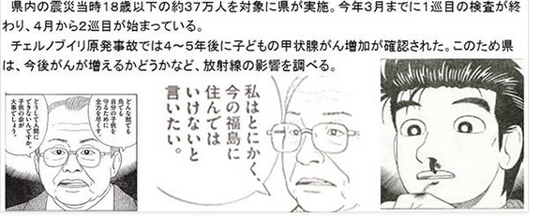
Local governments immediately protested the comic, saying it fosters unfounded fears of radiation.
Prime Minister Shinzo Abe chimed in over the weekend, reassuring the public there was no proof of a link between radiation and such illnesses. “The government will make the best effort to take action against baseless rumours,” he said.
Undeterred by the ruckus, Tokyo-based publisher Shogakukan added a special 10-page segment to weekly Big Comic Spirits magazine, published Monday, featuring criticism it had received as well as opinion from radiation experts.
Editor Hiroshi Murayama acknowledged he had been unsure about publishing the manga, subtitled “The Truth of Fukushima,” because he anticipated people would be offended. But he had decided that voice needed to be heard, he said.
“We hope the various views on the latest ‘Oishinbo’ will lead to a constructive debate into assessing our future,” he said in the special segment.
“Oishinbo,” a hit series usually about gourmet food, which began in the 1980s, will be discontinued temporarily in the magazine. But the publisher said that had been the plan even before the controversy. It is not clear when it will run again………..
Scientists say there is no exact safe limit to low dose radiation. A causal link to any individual’s disease is hard to prove, given the varieties of carcinogens and other risks in the environment.
Fukushima is monitoring the health of its residents, and carrying out thyroid checks on those ages 18 and under.
Seventy-five confirmed and suspected cases of thyroid cancer have been found in those tests, but it is unclear whether they are linked to radiation.
A group of Fukushima residents, who say they have suffered dizzy spells and nosebleeds since the disaster, came out last week in defence of “Oishinbo.” They said through their lawyer that they will speak out in Tokyo, but on condition of anonymity, perhaps wearing a traditional demon’s mask to protect themselves against ostracism and other social backlash over going public with fears about radiation.
In the final scenes of the Fukushima episodes of “Oishinbo,” the characters — drawn in trademark manga style with big eyes — talk about how they must save Fukushima. But they decide that the best way is to urge people living with radiation to have the courage to get out, with the help of the government.
Tetsu Kariya, the writer of “Oishinbo,” did not immediately respond to requests for an interview. But he said on his blog earlier this month that the intensity of the outrage set off by the nosebleed scene was unexpected.
Having researched Fukushima for two years, he was not about to write that Fukushima was safe and all was well — even if that may be what people wanted to hear.
“I can only write the truth,” he said. http://www.ctvnews.ca/health/manga-depiction-of-nosebleed-spurs-debate-on-radiation-health-risks-1.1828017#ixzz32JOTbOhy
USA charges Chinese officials with nuclear cyberspying
 Chinese officials indicted in nuclear cyberspying case, By Eric Tucker, The Times of Israel, 19 May 14 US announces unprecedented charges against military hackers who targeted big-name firms, stole trade secrets WASHINGTON (AP) — The United States announced on Monday unprecedented cyber espionage charges against five Chinese military officials accused of hacking into US companies to gain trade secrets The hackers targeted big-name makers of nuclear and solar technology, stealing confidential business information, sensitive trade secrets and internal communications for competitive advantage, according to a grand jury indictment……..
The indictment says that five hackers — members of the People’s Liberation Army — worked from a building in Shanghai to steal proprietary information from the companies and the labor union, including communications that could have helped Chinese firms learn strategies and weaknesses of American companies involved in litigation with the Chinese government or Chinese firms.
The defendants are all believed to be in China and it was unclear whether they would ever be turned over to the US for prosecution. But the Justice Department, publicizing the charges, identified all five by name and issued “wanted” posters………
The indictment will put a greater strain on the US-China relationship and could provoke retaliatory acts in China or elsewhere.
“What we can expect to happen is for the Chinese government to indict individuals in the United States who they will accuse of hacking into computers there,” said Mark Rasch, a former US cybercrimes prosecutor. “Everybody now is going to jump into the act, using their own criminal laws to go after what other countries are doing.”
Rasch said the indictments attempt to distinguish spying for national security purposes — which the US admits doing — from economic espionage intended to gain commercial advantage for private companies or industries, which the US denies it does. Classified documents disclosed by former National Security Agency analyst Edward Snowden described aggressive US efforts to eavesdrop on foreign communications that would be illegal in those countries.
“These five people were just doing their jobs. It’s just that we object to what their jobs are,” Rasch said. “We have tens of thousands of dedicated, hard-working Americans who are just doing their jobs, too.”
Unlike in some countries, there are no nationalized US industries. American officials have flatly denied that the government spies on foreign companies and then hands over commercially valuable information to American companies. http://www.timesofisrael.com/chinese-officials-indicted-in-nuclear-cyberspying-case/#ixzz32JH7SA85
North Korea warned by China against conducting 4th nuclear test
China warns North Korea against fourth nuclear test, Australia Network News, 20 May 14 China has used diplomatic channels to warn North Korea against conducting a fourth nuclear test after the reclusive state renewed its threat of “counter-measures” against perceived US hostility.
North Korea, which regularly threatens the South and the United States with destruction, is already under heavy sanctions imposed by several UN resolutions beginning in 2006 but has defied pressure to abandon its missile and nuclear programs.
It last conducted a nuclear test in February 2013.
“China has told North Korea that there is no justification for a new nuclear test and that they should not do it,” a Western diplomat who was briefed by Chinese officials said.
The sources said China had used diplomatic channels in Beijing and Pyongyang to convey its anxiety about the possibility of a fourth test to the North……http://www.abc.net.au/news/2014-05-20/an-china-warns-nkorea/5463466
Radiation levels in sea off Fukushima at record high
 Record high radiation in seawater off Fukushima plant, Japan Times, 17 May 14 Radiation has spiked to all-time highs at five monitoring points in waters adjacent to the crippled Fukushima No. 1 power station, plant operator Tokyo Electric Power Co. said Friday.
The measurements follow similar highs detected in groundwater at the plant. Officials of Tepco, as the utility is known, said the cause of the seawater spike is unknown.
Three of the monitoring sites are inside the wrecked plant’s adjacent port, which ships once used to supply it.
At one sampling point in the port, between the water intakes for the No. 2 and No. 3 reactors, 1,900 becquerels per liter of tritium was detected Monday, up from a previous high of 1,400 becquerels measured on April 14, Tepco said.
Nearby, also within the port, tritium levels were found to have spiked to 1,400 becquerels, from a previous high of 1,200 becquerels.
And at a point between the water intakes for the No. 1 and No. 2 reactors, seawater sampled Thursday was found to contain 840 becquerels of strontium-90, which causes bone cancer, and other beta ray-emitting isotopes, up from a previous record of 540 becquerels.
At two monitoring sites outside the port, seawater was found Monday to contain 8.7 becquerels and 4.3 becquerels of tritium. The second site was about 3 km away……… http://www.japantimes.co.jp/news/2014/05/17/national/record-high-radiation-in-seawater-off-fukushima-plant/#.U3ptgdJdWik
Spanner in the works for Fukushima’s planned ice wall against radiation
 Work on frozen soil walls at Fukushima plant hits glitch Asahi Shimbun, May 17, 2014 By AKIRA HATANO/ Staff Writer Plans to start construction in June of frozen underground soil walls at the crippled Fukushima No.1 nuclear power plant are now askew after concerns were raised by the nation’s nuclear watchdog body.
The Nuclear Regulation Authority said plant operator Tokyo Electric Power Co. has yet to submit documents demonstrating the safety and efficacy of the project, which is unprecedented in scale.
Announced in May 2013, the frozen walls are intended to stem the flow of groundwater into the nuclear complex.
“Once the project is started, it will be difficult to turn back,” said Toyoshi Fuketa, an NRA commissioner who is screening the project planned by TEPCO and the central government. “We have to thoroughly examine every aspect of this project because it is such a drastic measure.” TEPCO has been grappling with ways to staunch the daily flow of 400 tons of groundwater into the plant complex. The groundwater mixes with melted nuclear fuel debris and has significantly raised the volume of contaminated water that TEPCO has to deal with, in addition to tons of highly radioactive water used to cool the reactors.
The technique to build the walls of frozen soil is similar to a method used in the construction of tunnels.
A series of steel pipes that contain a liquid at minus 30 degrees spaced at 1-meter intervals will be placed around the buildings housing the four reactors, as well as the turbine buildings.
Stretching 1,500 meters, the frozen walls are expected to cut the inflow of groundwater to 130 tons from the current 400 tons a day.
TEPCO and the government plan to begin the actual freezing of soil in March 2015, with the expectation the walls could last for seven years.
The government has provided 32 billion yen ($313 million) in funding for the project…….
Fuketa pointed out at a review meeting that the document fell far short of providing the necessary safety assurances to pass screening.
The NRA told the utility to provide answers to 24 items that the watchdog is concerned about, such as the possibility of land sinking, leaks of contaminated water and countermeasures in the event the frozen soil thaws.
The NRA is also demanding that TEPCO explain how the construction of the walls of frozen soil will be able to cut the volume of contaminated water…….http://ajw.asahi.com/article/0311disaster/fukushima/AJ201405170031
Japan to check lefelong health of 20,000 Fukushima nuclear workers
 Lifelong health checks planned for 20,000 workers at Fukushima plant http://ajw.asahi.com/article/0311disaster/fukushima/AJ201405170037 THE ASAHI SHIMBUN 17 May 14, The government will look for increased rates of leukemia and other cancers linked to radiation exposure as part of a lifelong study of 20,000 workers mobilized in the recovery effort after the 2011 nuclear disaster.
The Ministry of Health, Labor and Welfare study is projected to be still continuing 60 years from now because many of the workers are in their early 20s. The triple meltdown at the Fukushima No. 1 nuclear power plant was triggered by the March 11, 2011, Great East Japan Earthquake and tsunami. The individuals taking part in the study worked at the plant between March 14 and Dec. 16 of that year.
A panel of experts on May 16 approved the ministry’s plan, including the methodology of the study, the subjects to be covered and conditions to be checked.
Under the plan, blood and liver function tests will be conducted once a year during routine health checks. Every three to five years, doctors will check for signs of kidney failure.
The ministry plans to start the study on a trial basis during the current fiscal year, which will then be expanded on a full-scale basis in fiscal 2015.
The ministry will decide at a later date which entity it will contract to carry out the study.
During the nine-month period in question, the government raised the safety limit for radiation exposure in cases of emergency from 100 millisieverts to 250 millisieverts.
Of the 20,000 workers, 174 were exposed to radiation doses that exceeded the safety limit of 100 millisieverts over five years for those working under normal conditions.
Fukushima’s ice wall – massive cost, massive drain on electricity
Record high radiation in seawater off Fukushima plant, Japan Times, 17 May 14 “………..Tepco is struggling to reduce contamination at the poorly protected plant, which was damaged by the March 2011 earthquake and tsunami. Measures include plans to build a gigantic underground ice wall around the plant to keep the daily flow of groundwater from entering the cracked reactor buildings and mingling with the highly radioactive cooling water in their basements.
The ice wall project is expected to cost ¥31.9 billion and will put a massive burden on the power grid when completed: It will need about 45.5 million kilowatt-hours of electricity to operate, equal to annual power consumption of 13,000 average households.
The project involves freezing the soil into barricades 30 meters deep and 2 meters thick for a distance of 1,500 meters around the buildings housing reactors 1 through 4.
The soil will be frozen by sinking pipes into the ground and running liquids through them at a temperature of minus 30 degrees.
On Friday, the Ministry of Economy, Trade and Industry and contractor Kajima Corp. demonstrated a miniature ice wall to reporters at the site.
“We can confirm the frozen soil’s effect in blocking water,” a ministry official said afterwards.
The department aims to begin construction next month. But the Nuclear Regulation Authority has not approved the plan, saying its backers have so far provided insufficient reassurances about public safety. International nuclear experts have also expressed concern about the effectiveness of the plan. http://www.japantimes.co.jp/news/2014/05/17/national/record-high-radiation-in-seawater-off-fukushima-plant/#.U3ptgdJdWik
Tepco to start dumping Fukushima water into the ocean next week
Japan’s TEPCO to Start Dumping Fukushima Water into Ocean Next Week MOSCOW, May 16 (RIA Novosti) – Tokyo Electric Power (TEPCO), the operator of the crippled Fukushima nuclear power plant, plans to begin releasing underground water near the facility into the Pacific Ocean as early as next Wednesday, The Asahi Shimbun reported Friday.
The first water to be released will total around 560 tons, the agency said citing an official from the Ministry of Economy, Trade and Industry. TEPCO will begin releasing the water as soon as it presents results of radiation tests to local government and the fishing industry.
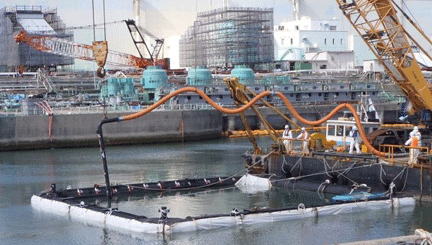
Initial talks between the government and TEPCO agreed that only water with 1,500 becquerels of radiation or less per liter could be released. Tests conducted by TEPCO and two outside agencies have revealed that the Fukushima underground water met the standards, averaging 220 to 240 becquerels of tritium per liter.
TEPCO began pumping out groundwater from the Fukushima nuclear plant in April in an effort to prevent further radioactive leaks.
The company continues to grapple with the problem of contaminated water storage, with about 450,000 tons of highly-radioactive water currently being stored in Fukushima’s underground facilities and tanks. Experts say some 15,000 tons is also being held in a service tunnel. According to recent estimates, up to 400 tons of contaminated water from the damaged plant is seeping into the Pacific Ocean every day.
In an effort to prevent further irradiation, TEPCO has adopted a plan to draw off groundwater from the plant. The fallout from Fukushima is later to be sent for analysis that will determine whether it is safe to be disposed of by dumping into the ocean.
The practice will allow the operator to reduce the accumulation of radioactive water at the plant by 100 tons a day……..https://news.google.com/news?ncl=d_uao6qIU8QsFkM74lsq0LkpKVl4M&q=radiation&lr=English&hl=en&sa=X&ei=l7N2U52sB8mtlQXZ_4HYBw&sqi=2&pjf=1&ved=0CDsQqgIwAw
Japan soon to start making ice wall around groundwater at Fukushima nuclear plant
Japan Tries Ice Wall to Stem Radiation Planned Frozen Barrier to Hold Back Water Contaminated by the Stricken Fukushima Daiichi Nuclear Plant WSJ, By MARI IWATA NARAHA, Japan—The idea of freezing ground to block the flow of water has been around for more than a century, but never has it been tried on the scale Japan plans at its stricken nuclear plant to hold back water contaminated by radiation.
As early as next month, workers are set to start installing pipes for a 1.5-kilometer-long and 30-meter-deep subterranean ice wall around four reactors of the Fukushima Daiichi nuclear plant here…….

The Fukushima effort is unprecedented because of the size of the apparatus—its electricity alone is projected to cost $1 million a month—and the period it is expected to operate. The Fukushima decommissioning is expected to take 40 years or longer.
The ice-wall plan has already met a hurdle. Continue reading
Low levels of radioactive cesium produced insect deformities at Fukushima
New study reveals deaths and mutations ”increased sharply’ from exposure to Fukushima contamination, “especially at low doses” — ‘Small’ levels of cesium may be ‘significantly toxic’ — Smithsonian: “In other words, things don’t look good for the animals living around Fukushima” http://enenews.com/just-in-new-study-reveals-sharp-increase-in-deaths-and-mutations-from-exposure-to-fukushima-contamination-especially-at-low-doses-small-levels-of-cesium-may-be-significantly-toxic?utm_source=feedburner&utm_medium=email&utm_campaign=Feed%3A+ENENews+%28Energy+News%29
 Smithsonian Magazine, May 14, 2014: Even Tiny Amounts of Radioactive Food Made Caterpillars Become Abnormal Butterflies […] Researchers in Japan […] discovered, even a small amount of radiation is too much. […] The scientists collected plant material from around Fukushima and fed it to pale grass blue butterfly caterpillars. When the caterpillars turned into butterflies, they suffered from mutations and were more likely to die early [… even if they] had only eaten a small amount of artificial caesium […] In other words, things don’t look good for the animals living around Fukushima.
Nature — Scientific Reports (pdf), Published May 15, 2014: [We] examined possible relationships between the dose of ingested cesium per larva and the mortality and abnormality rates. Both the mortality and abnormality rates increased sharply, especially at low doses […] the mortality and abnormality rates increased sharply, especially at low doses. Additionally, there seemed to be no threshold level below which no biological response could be detected. […] the dose-response data suggests that the relatively small level of artificial cesium from the Fukushima Dai-ichi NPP may be significantly toxic to some individuals in butterfly populations […] the half lethal [i.e. LD50, amount that will kill 50% of a test subjects] dose [is 1.9 Bq per larva] and the half abnormal dose [is 0.76 Bq per larva] […] relatively small [levels] of artificial cesium from the Fukushima Dai-ichi NPP may be significantly toxic to some individuals in butterfly populations […] we assert that the half lethal and abnormal doses we obtained were quite high. […] it should be noted that we sampled contaminated leaves from Fukushima City, which many people inhabit as though nothing had happened […] Implications of the half lethal and abnormal doses we obtained in the present study will impact future discussions on the effects of radioactive exposure on other organisms, including humans. […] In conclusion, it is important to recognize the risk of internal radiation exposure due to ingested radioactive cesium, at least for the pale grass blue butterfly, and likely for certain other organisms living in the polluted area, possibly including humans. […]
1 This Month
15 October. Joint Appeal for Nuclear Abolition Day -presentation to the UN on October 15 will be live on UNWebTV
Endorse the Nuclear Abolition Day Appeal
23-25 October – on Zoom – World BEYOND War’s annual global conference

To see nuclear-related stories in greater depth and intensity – go to https://nuclearinformation.wordpress.com
-
Archives
- October 2026 (149)
- September 2026 (339)
- August 2026 (330)
- July 2026 (355)
- June 2026 (287)
- May 2026 (306)
- April 2026 (356)
- March 2026 (251)
- February 2026 (267)
- January 2026 (308)
- December 2025 (358)
- November 2025 (359)
-
Categories
- 1
- 1 NUCLEAR ISSUES
- business and costs
- climate change
- culture and arts
- ENERGY
- environment
- health
- history
- indigenous issues
- Legal
- marketing of nuclear
- media
- opposition to nuclear
- PERSONAL STORIES
- politics
- politics international
- Religion and ethics
- safety
- secrets,lies and civil liberties
- spinbuster
- technology
- Uranium
- wastes
- weapons and war
- Women
- 2 WORLD
- ACTION
- AFRICA
- Atrocities
- AUSTRALIA
- Christina's notes
- Christina's themes
- culture and arts
- Events
- Fuk 2022
- Fuk 2023
- Fukushima 2017
- Fukushima 2018
- fukushima 2019
- Fukushima 2020
- Fukushima 2021
- general
- global warming
- Humour (God we need it)
- Nuclear
- RARE EARTHS
- Reference
- resources – print
- Resources -audiovicual
- Weekly Newsletter
- World
- World Nuclear
- YouTube
-
RSS
Entries RSS
Comments RSS

