A panel is lifted by crane at the No. 1 reactor building of the Fukushima No. 1 nuclear power plant
in Okuma, Fukushima Prefecture, on Oct. 31
November 01, 2014
OKUMA, Fukushima Prefecture–Tokyo Electric Power Co. has removed part of the canopy above a reactor building at the crippled Fukushima No. 1 nuclear power plant to gauge the effects of anti-scattering agents pumped inside.
It was the first time in three years that debris inside the No. 1 reactor building was visible from the outside. The structure, which was destroyed in a hydrogen explosion a day after the Great East Japan Earthquake and tsunami on March 11, 2011, was covered with the canopy in October of that year.
The removal on Oct. 31 of one of six panels that make up the canopy is the initial stage in work to remove debris and nuclear fuel from inside the structure.
TEPCO drilled holes into the panel, which measures 42 meters by 7 meters and weighs 32 tons, on Oct. 22. It then sprayed anti-scattering resin inside to prevent radioactive substances from stirring up into the air.
The panel was removed to survey the effects of the resin.
The work was performed by a large crane that slowly hoisted the panel and lowered it to the ground, taking about one hour and 40 minutes.
The panel is scheduled to be returned by the end of November. TEPCO plans to start dismantling the entire canopy on a full-fledged basis in March 2015.
Oct 31 (Reuters) – The governor of Kagoshima prefecture, home to Kyushu Electric Power Co’s Sendai plant, said restarting the nuclear facility was in its “final stage” in a positive sign for the industry, as the trade minister reiterated support for reviving idled reactors.
All 48 of Japan’s nuclear reactors remain offline more than three years after an earthquake and tsunami set off meltdowns at the Fukushima Daiichi plant, but Prime Minister Shinzo Abe’s government is pushing to restart reactors that meet new regulatory guidelines.
Kyushu Electric’s two-reactor Sendai plant, located 1,000 km (600 miles) southwest of Tokyo in Satsumasendai, was the first to pass the independent regulator’s safety guidelines last month.
“We are in the final stage on the issue of the Sendai plant’s restart,” said Kagoshima governor Yuichiro Ito during a meeting with newly appointed trade minister Yoichi Miyazawa on Friday.
Japan has said it would defer to local authorities to approve any restart.
The city assembly of Satsumasendai voted in favour of restarting the plant this week and Kagoshima’s prefectural assembly is expected to vote to finalise the restart next Friday, local politicians say.
Only eight lawmakers out of 49 state assemblymen are opposed to restarting the plant.
Ito did not give a timeline for a possible restart of the plant, but any return to operations is seen as unlikely until next year.
Miyazawa, who was appointed to head the powerful trade ministry after the sudden resignation of his predecessor over a political funds scandal, said he planned to tour the nuclear plant and talk to local politicians in Kagoshima next Monday, Nov. 3.
The government and Tokyo Electric Power Co. (TEPCO) announced on Oct. 30 that removal of melted fuel from the No. 1 reactor at the disaster-hit Fukushima No. 1 Nuclear Power Plant would be delayed by five years, until fiscal 2025.
They also announced that work to remove spent fuel from a cooling pool will not begin until fiscal 2019, two years later than originally planned. The delays are the result of the removal of debris and the installation of cranes taking longer than expected.
The announcement marks the first delays in the decommissioning schedule. TEPCO said, however, that the move would not result in an overall delay to the decommissioning process, which is expected to take 30 to 40 years.
The No. 1 reactor houses 392 fuel rods in its cooling pool, while melted fuel remains in the nuclear pressure vessel and reactor containment vessel. In a meeting on Oct. 30, the government and TEPCO decided to adopt a two-step process with separate measures to remove fuel from the cooling pool and melted fuel. First, a cover will be installed on the top floor of the reactor building. After a special crane for the fuel pool removes fuel, then workers will use a container and crane setup to remove melted fuel. The government and TEPCO say that they chose this method because there are many unknown factors in the removal of melted nuclear fuel, and because they hope to remove the fuel from the cooling pool at an early stage.
At the No. 1 reactor, preparations began this month to remove a cover designed to prevent the spread of radioactive materials, so that debris could be removed from the top floor. This process itself was delayed by six months. Because of this, and the fact that the two-step process is laborious, it is believed the government and TEPCO decided to delay the start of fuel removal work.
At the No. 2 reactor, meanwhile, since radiation levels are high and decontamination of the reactor building is difficult, officials have decided to reconsider the method of removing nuclear fuel. Officials are set to decide on a method in fiscal 2016, but there is a high possibility that removal work will fall behind schedule.
In August, work at the No. 3 reactor was suspended after a large piece of debris fell into the cooling pool while debris was being removed from around the pool’s edge. Officials plan to remove fuel from the pool next fiscal year, but the outlook for this work is unclear.
It is expected that work to remove fuel from the No. 4 reactor pool will be completed this year.
The decommissioning schedule was established under the Democratic Party of Japan-led administration in December 2011. It was revised in June last year, accelerating the removal of melted fuel by up to a year and a half.
The disaster at the Fukushima No. 1 plant, triggered by the March 2011 Great East Japan Earthquake and tsunami, resulted in core meltdowns at reactor Nos. 1-3. Nuclear fuel has passed through the reactor pressure vessels, and caused damage to the containment vessels. The government and TEPCO plan to fill the containment vessels with water and remove about 450 metric tons of melted fuel. But it remains unknown where the melted fuel actually lies. Furthermore, officials have located only two damaged areas in the containment vessels of the three reactors.
In the Three Mile Island meltdown in the United States, it took six years before the removal of melted fuel was begun, though the pressure vessel was not damaged. Fukushima presents conditions that are far more difficult, and it is unclear when the work can be completed.
TheRokkashoproject (the nuclearwaste treatment plantin Japan)postponedforthe 21thtime!
Too many risks…Will Japanfinallytake the onlyright decision: to never restartreactors?
To give up theRokkashocouldjust lead them to do that…
October 31, 2014
AOMORI–Complications in safety screening have led to the 21st postponement of work to complete a key nuclear processing facility in Rokkasho, Aomori Prefecture.
The latest delay, announced Oct. 30 by Japan Nuclear Fuel Ltd., the operator of the Rokkasho reprocessing plant, could affect future operations at nuclear plants across the country.
“This is the only facility (to process spent nuclear fuel in Japan),” Japan Nuclear Fuel President Kenji Kudo said at a news conference here. “We are doing our best.”
Under the government’s plans, the Rokkasho plant will recycle plutonium in spent nuclear fuel generated at nuclear power plants across the nation, helping to reduce the amount of radioactive waste accumulating in storage pools at the plants.
In January, Japan Nuclear Fuel applied to the Nuclear Regulation Authority for a safety inspection–a precondition to proceed with the construction of the facility.
The company expected the safety screening to end around June and planned to complete work on the processing facility by the end of October.
But discussions for the inspections only started in September because of the risk factors unique to the Rokkasho plant, such as complex piping between buildings and the huge amount of high-level liquid radioactive materials stored there.
In addition, the reprocessing plant came under stricter NRA safety standards after the March 2011 Great East Japan Earthquake and tsunami triggered the accident at the Fukushima No. 1 nuclear power plant.
The extra time needed for the safety screening led to the decision by Japan Nuclear Fuel to postpone the completion date to March 2016.
The facility was originally scheduled to be finished in 1997. Just a year ago, Japan Nuclear Fuel announced its 20th postponement.
Under the latest schedule, Japan Nuclear Fuel plans to pass the NRA screening by June next year and complete construction in the following nine months.
But approval from the nuclear industry watchdog is not guaranteed.
“It is not clear at all how things will work out for the processing plant,” an NRA official said.
Currently, all nuclear reactors in Japan are offline, and electric power companies have applied for NRA screenings to restart their reactors.
With the continued delays at the Rokkasho facility, its storage pools have filled to near capacity with spent fuel brought from nuclear power plants throughout Japan.
Even if the electric power companies can restart their nuclear reactors, they could be forced to shut them down if the Rokkasho plant cannot accept additional nuclear fuel and their own storage pools become filled.
Under the planned fuel recycling program, plutonium and uranium in spent fuel will be removed through chemical processing at the Rokkasho plant. Processed high-level radioactive substances will be stored on the site after being encased in glass.
One country is at least becoming aware of the food contamination risks and taking measures to protect its citizens’ health. How about the others?
Oct 31, 2014
TAIPEI – Taiwanese authorities are considering requiring production area certificates for all food imports from Japan and radiation check certificates for some, according to informed sources.
The authorities plan to implement the new policy in 2015 after gauging public opinion.
Following the nuclear accident at the Fukushima No. 1 power plant caused by the March 2011 earthquake and tsunami, Taiwan banned imports of food products from five prefectures, including Ibaraki, Tochigi and Chiba.
In addition, radiation checks have been conducted on vegetables, fruit and fisheries products imported from Japan.
Production area certificates are currently not required.
Under the envisioned policy, Taiwan would require production area certificates for all food imports from Japan and radiation check certificates by the Japanese government for those subject to current radiation checks and certain other products, such as tea and biscuits.
Consumer groups in Taiwan have been calling for stronger regulations on Japanese food imports.
The Japanese government and Tokyo Electric Power Company are to revise the timetable for decommissioning the No.1 reactor at the Fukushima Daiichi nuclear plant.
The current timetable calls for the process of removing spent fuel assemblies from the storage pool to begin in fiscal 2017, and removing melted fuel to begin 3 years later.
Government and TEPCO officials are now planning to delay the start of removing spent fuel units until fiscal 2019, or by 2 years, and the start of removing melted fuel till 2025, or by 5 years.
Radioactive rubble which has accumulated inside the No.1 reactor building is hampering fuel removal efforts.
Workers began dismantling the cover of the building this month to remove the debris.
But full-fledged work to dismantle the cover will not take place until March of next year, already resulting in a delay of more than 6 months.
To remove the spent fuel and melted fuel, separate facilities, such as cranes, must be set up on top of the reactor building. This would take more time.
The current timetable says complete decommissioning of the Fukushima Daiichi plant with 4 damaged reactors will take 30 to 40 years.
Residents of Shioya Town, Tochigi Prefecture, have petitioned the Environment Ministry to drop a site in their town from consideration to host a facility for storing radioactive waste.
The site in Shioya, north of Tokyo, is one of five the government wants to build permanent storage facilities on for designated waste. The waste is material from the Fukushima Daiichi nuclear accident that has radiation levels exceeding 8,000 becquerels per kilogram.
The mayor of Shioya and the leader of a group of residents handed their petition to State Minister of the Environment Yasuhiro Ozato at the ministry in Tokyo on Wednesday.
Shioya has a population of about 12,000. But the petition was signed by about 173,000 people from across Japan.
Residents and their supporters claim a permanent storage facility would threaten the town’s water supply and accelerate population decline.
State Minister Ozato said he takes the residents’ and signatories’ concerns seriously. He stressed the importance of smooth communication and exchange of views over those concerns.
The representative of the residents’ group said that he expects the State Minister to understand that the signatures show how strongly people feel about the government’s plan.
The Environment Ministry plans to hold a meeting of the prefecture’s mayors on November 9th to win support for the permanent storage facility.
Shioya is expected to reiterate their opposition to the plan.
Taipei, Oct. 29 (CNA) Sweets, cookies and teas and tea products imported from Japan into Taiwan will be subject to tests for radioactive substances beginning next year, the acting Food and Drug Administration (FDA) director-general said Wednesday.
Chiang Yu-mei said that under the proposed measure, importers of the Japan-made items will not be able to apply for the necessary imported food inspections unless the products come with radiation examination certificates from the Japanese government.
The new measure is expected to take effect next year, Chiang said in response to a post by Democratic Progressive Party Legislator Lin Shu-fen on her Facebook page that criticized the government for not checking Japanese green tea products for radioactive substances.
In the post dated Oct. 29, Lin questioned the surge in green tea drinks imported from Japan into Taiwan over the past three years even though green tea leaves in Japan had tested positive for radioactive substances since the Fukushima nuclear disaster in 2011.
“Do you know that since the Fukushima disaster, imports of Japanese green tea have increased dramatically? Do you know that Japanese green tea has often tested positive for radiation?” Lin asked in her post.
In defending Taiwan’s practices on Japanese food imports, the FDA has repeadly stressed that Taiwan suspended imports of food items from five Japanese prefectures near the Daiichi Nuclear Power Plant days after the facility suffered a meltdown in March 2011.
The temporary ban, imposed on foods from Fukushima, Ibaraki, Tochigi, Gunma and Chiba prefectures, remains in effect today, the agency said.
In addition, batch-by-batch inspections for radioactive substances have been enforced on eight major types of foods produced in other parts of Japan since then, the FDA said
The tests cover fresh and chilled vegetables and fruits, frozen vegetables and fruits, live and chilled fishery products, frozen fishery products, dairy products, products for infants, mineral water or other types of drinking water, and seaweed, it said.
A town in southwest Japan became the first to approve the restart of a nuclear power station on Oct. 28, a step forward in Japan’s fraught process of reviving an industry left idled by the Fukushima nuclear crisis in 2011.
Kagoshima Prefecture’s Satsuma-sendai, a town of 100,000 that hosts the two-reactor Kyushu Electric Power Co. plant, is 1,000 km (600 miles) southwest of Tokyo and has long relied on the Sendai nuclear power plant for government subsidies and jobs.
Nineteen of the city’s 26 assembly members voted in favor of restarting the plant while four members voted against and three abstained, a city assembly member told Reuters.
The restart of Japan’s first reactors to receive clearance to restart under new rules imposed following the Fukushima disaster is unlikely until next year as Kyushu Electric still needs to pass operational safety checks.
All 48 of the country’s nuclear reactors were gradually taken offline after the nuclear disaster, the world’s worst since Chernobyl in 1986.
An earthquake and tsunami struck the Fukushima No. 1 plant, 220 km (130 miles) northeast of Tokyo, sparking triple nuclear meltdowns, forcing more than 160,000 residents to flee from nearby towns and contaminating water, food and air.
Japan has been forced to import expensive fossil fuels to replace atomic power, which previously supplied around 30 percent of the country’s electricity.
Prime Minister Shinzo Abe’s government is pushing to restart nuclear reactors, but has said he will defer to local authorities to approve a policy that is still unpopular with large swaths of the public.
The restart divided communities nearest to the plant, pitting the host township that gets direct benefits from siting reactors against other communities that do not reap the benefits but say they will be equally exposed to radioactive releases in the event of a disaster.
In Ichikikushikino, a town less than five km (three miles) from the Sendai plant, more than half the 30,000 residents signed a petition opposing the restart earlier this year.
In the lead-up to the local vote, officials held town halls in neighboring towns to explain the restart, where some residents complained that the public meetings were restrictive and did not address concerns about evacuation plans.
A fire broke out at Kyushu Electric’s other nuclear plant on Oct. 28, according to Japanese media. The fire started in an auxiliary building of the idled nuclear station and was extinguished by plant workers, the agency said. There were no injuries and no release of radioactive materials, it said.
Mount Ioyama
A local council has voted to re-open the Sendai Nuclear Power Plant on the outermost western coast of Japan, despite local opposition and meteorologists’ warnings, following tremors in a nearby volcano.
Nineteen out of 26 members of the city council of Satsumasendai approved the reopening that is scheduled to take place from early 2015. Like all of Japan’s 48 functional reactors, Sendai’s 890 MW generators were mothballed in the months following the 2011 earthquake and tsunami.
Satsumasendai, a town of 100,000 people, relies heavily on state subsidies and jobs, which are dependent on the continuing operation of the plant.
But other towns, located within sight of the plant, do not reap the same benefits, yet say they are being exposed to the same risks. A survey conducted by the local Minami-Nippon Shimbun newspaper earlier this year said that overall, 60 percent of those in the region were in favor of Sendai staying shut. In Ichikikushikino, a 30,000-strong community just 5 kilometers away, more than half of the population signed a petition opposing the restart. Fewer than half of the major businesses in the region reported that they backed a reopening, despite potential economic benefits.
Regional governor Yuichiro Ito has waved away the objections, insisting that only the city in which the plant is located is entitled to make the decision.
While most fears have centered around a lack of transparency and inadequate evacuation plans, Sendai is also located near the volcanically active Kirishima mountain range. Mount Ioyama, located just 65 kilometers away from the plant, has been experiencing tremors in recent weeks, prompting the Meteorological Agency to issue a warning. The government’s nuclear agency has dismissed volcanic risks over Sendai’s lifetime as “negligible,” however.
Satsumasendai’s Mayor Hideo Iwakiri welcomed the reopening, but said at the ensuing press conference that it would fall upon the government to ensure a repeat of the accident that damaged Fukushima, an outdated facility subject to loose oversight, is impossible.
September’s decision to initiate the return Japan’s nuclear capacity back online was taken by Prime Minister Shinzo Abe, who endorses nuclear production in the country, but has delegated the controversial call on reopening to local councils. Sendai was chosen after becoming the first plant to officially fulfill the government’s new stricter safety rules. It may also have been picked due to its geographical remoteness, and distance from the 2011 disaster area.
The primary reason for Abe’s nuclear drive been the expense in replacing the lost energy that constituted 30 percent of the country’s consumption, which the government says cost Japan an extra $35 billion last year. Japanese consumers have seen their energy bills climb by 20 percent since the disaster as a result.
But another concern remains the state of the country’s aging nuclear plants, which will cost $12 billion to upgrade. Meanwhile plans to build modern nuclear reactors – which were supposed to be responsible for half of the country’s nuclear power by 2030, according to previous government energy plans – have predictably been shelved in the wake of the disaster.
Alex Smith, host of RadioEcoshock (at 10:30 in): We’ve heard almost nothing about the impacts [of the Fukushima catastrophe] on people in that region. There are accounts coming out of there of strange tumors, kids dying, pets dying — what have you heard? Can we ever expect an honest accounting from Japanese authorities?
Arnie Gundersen, nuclear engineer (emphasis added): That’s a pretty good summary, frankly. We continue to get information from people who live there about cancer rates — and illnesses in general, not just cancer. We think of radiation as a cancer causing thing, but it also causes many other ailments. Much higher incidences of a whole range of illnesses than they had in 2010, the year before the accident… We’re also working with doctors in Japan, and some brave doctors are saying that they’ve been threatened — that their hospital rights have been threatened — if you tell your patient this illness is radiation related you’ll lose your right to practice and things like that. So there’s enormous pressure on the medical community to tell the patients that what they’re experiencing is not at all related to radiation. The key is statistics, and the question is when will the statistics be released for mortality, morbidity, and general illnesses… We’re not seeing the data. The medical community now has to file every report that it writes with the IAEA, the International Atomic Energy Agency, before it’s issued. So if you’re a hospital, and you’ve got mortality data, you’re not allowed to issue that to the public until those reports have been cleared by the IAEA. Well, Article II of the IAEA charter is to promote nuclear power. So even if the hospital was conscientious — there’s a lot of political pressure not to be — but even if it was conscientious, there’s another step in the process, and they’ve got to clear an IAEA hurdle before those numbers are released.It’s truly frightening, the pressure the medical community is undergoing in Japan. Very few of them are willing to tell the truth.
Arnie Gundersen, nuclear engineer, Oct. 20, 2014 (at 15:00 in): There’s experts out there like me – independent experts – who are saying that as many as a million cancers may result.
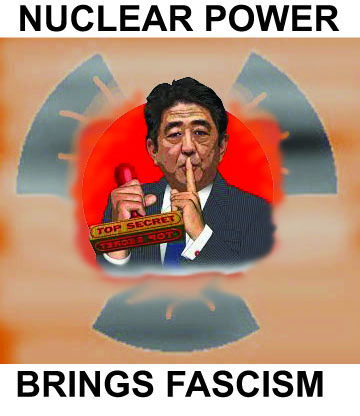
Musical points to sinister nuclear implications, Japan Times, BY TOMOHIRO OSAKI OCT 28, 2014 A recent court-themed musical staged in Tokyo was, to say the least, an audacious dig at the contentious state secrets law scheduled to take effect in December.
Set several years after the law’s passage last December, the musical, performed last week in Nakano Ward by the social theater troupe Musical Guild Q, offered what its adviser said was a “fairly realistic” sneak peek into how the first-ever trial of violators of this law would play out. At the same time, it was also an attempt to sound the alarm about what critics of the law say is an attempt by the powers that be to retreat into a more controlled society like the one that existed during the Pacific War.
“The chief purpose of the musical was to alert the audience to the likelihood that after the law takes effect, even information that is vital to their everyday life can be unjustly taken away from them,” said veteran lawyer and rights activist Yuichi Kaido, who served as a special adviser for the show.
On trial during the musical, which is titled “The Secret Garden,” is a group of nine ordinary citizens………
the audience is gradually clued in to what the musical’s writer calls the secrets law’s “inseparable” connection with nuclear power, and its ulterior motive to help achieve Japan’s transformation into a nuclear weapons-capable nation………
lawyer Kaido says he hopes that a worried citizenry will continue to protest and do everything possible to show the government they oppose the law even after it takes effect on Dec. 10.
Nuclear energy: It’s risky stuff. Hence, there is often a heavy degree of government control over it—which makes it a doubly risky investment proposition.
Especially when that government is China’s.
A number of Chinese state-owned nuclear companies are going public these days. CGN Power, the country’s largest with 9.4 gigawatts of operating capacity, will likely offer $3 billion worth of new shares in Hong Kong next month, reports The Wall Street Journal. A small affiliate, CGN Meiya Power , raised $262 million in Hong Kong last month and has seen its shares rise by 20% since. Meanwhile, another top operator, China National Nuclear Power, also plans an initial public offering.
Once listed, these will be one of a handful of stocks globally, including the likes of Exelon of the U.S. and EDF of France, offering high or pure exposure to nuclear energy. And while much of the rest of the world is ambivalent about or hostile to nuclear energy, Beijing has big expansion plans. The Chinese government suspended new project approvals after Japan’s Fukushima accident in March 2011. But the need to diversify away from smog-causing coal has put its nuclear ambitions back on track. China now targets nearly tripling the nuclear capacity that’s up and running to 58 gigawatts by 2020. The IPOs will help fund that ambition.
The state’s involvement can cut both ways, though. CGN Power sells most of its output to state-run electricity grids at regulated tariffs. For power plants that began operating before 2013, these tariffs are tailored to yield a “reasonable” profit, according to CGN’s prospectus. Yet its net profit has fallen since 2011 because of either surging costs or weakening sales.
For newer plants, the tariff is supposed to be fixed—except when it isn’t. In a bid to avoid competition, these plants are required to cut tariffs if neighboring coal-fired power is cheaper. That’s quite likely as coal prices spiral downward. Energy prices are heavily regulated precisely because consumers are rather attached to light and heat. That makes them subject to political, as well as economic, forces.
In France, for example, shares in state-run EDF tanked 14% in June when the government scrapped a planned tariff increase. There’s even more reason to worry in China since governments could keep down power prices as a stimulus to troubled heavy industries. Growth prospects are high, which is likely one reason that CGN Meiya already trades at 10.9 times 2013 earnings before interest, tax, depreciation and amortization. That is far higher than EDF’s 4.8 times or Exelon’s 6.6 times.
Double-digit multiples are no doubt tempting for IPO bankers but look too much for a large nuclear generator carrying this much political risk. Problem is, CGN’s balance sheet means it needs a high multiple, or fast growth in profits, to make its IPO math work.
Net debt as of this March is a hefty 5.1 times 2013 Ebitda, and still high at four times even if related-party loans are excluded. And less than 10% of the IPO proceeds are currently earmarked for paying off borrowings. As if nuclear power wasn’t risky enough
Aggressive Thyroid Cancers Linked to Radiation Exposure http://www.medscape.com/viewarticle/834000 Roxanne Nelson October 28, 2014Researchers who have followed the children and adolescents exposed to radioactive fallout from the the 1986 Chernobyl nuclear power plant accident have highlighted the fact that the thyroid cancers seen in these individuals are particularly aggressive. They say their work has implications for individuals affected by the 2011 nuclear reactor incidents in Fukushima, Japan.
The research team screened nearly 12,000 individuals from Belarus several times over a course of 9 years. Study participants were all under age 18 years when they were exposed to the Chernobyl radioactive fallout.
All individuals underwent up to three cycles of thyroid screening from 1997 to 2008. Radioactive iodine-131 (I-131) thyroid doses were estimated from individual thyroid activity measurements taken within 2 months after the accident, along with dosimetric data from questionnaires.
A total of 158 thyroid cancers were diagnosed in the 11,664-person cohort during 3 rounds of screening, which were conducted at roughly 2-year intervals.
The researchers found that higher I-131 thyroid doses were associated with higher frequency of solid or diffuse sclerosing variants of thyroid cancer (P < 0.01), as well as histologic features of cancer aggressiveness, such as lymphatic vessel invasion, intrathyroidal infiltration, and multifocality (all P < .03).
First author Lydia Zablotska, MD, PhD, associate professor in the Department of Epidemiology and Biostatistics at the University of California, San Francisco, explained that her group has previously shown that radioactive iodine exposure significantly increases the risk for thyroid cancer in a dose-dependent manner. But this new study demonstrates that exposure to I-131 is associated with distinct clinical features indicating more aggressive tumors.
“Our study has very important implications for clinical practice,” Dr Zablotska told Medscape Medical News, especially as they relate to radiation exposure that resulted from the 2011 nuclear reactor incidents in Fukushima, Japan. Continue reading →
Japanese Officials Vote to Reopen Nuclear Power Plant, Despite Volcanic Warnings, Newsweek, By Madeline Grant 10/28/14 Local officials have voted to reopen a nuclear plant in Japan, despite warnings of increased volcanic activity in the region from scientists.
The decision comes despite a warning on Friday that Japan’s Seismological Agency had documented an increase of activity in the Ioyama volcano, located 40 miles away from the power station……….
Japan sits on the ‘Pacific Ring of Fire’, an area of great instability in the earth’s crust, which is home to 75% of the world’s volcanoes.
Minor tremors were reported on Friday morning and soon after, Japanese officials warned of a potential eruption and called for hikers to avoid the area, which is popular with tourists.
The Sendai plant is also situated only 31 miles from Mount Sakurajima, an extremely active volcano which erupts on a regular basis. The documentation of new activity comes barely a month after the eruption of Mount Ontake, when 57 hikers were killed on its slopes. There were no accompanying signs of seismic activity prior to the eruption which might have alerted Japanese authorities to the impending disaster.
The vote has been seen as an attempt to resurrect the country’s nuclear industry, which the Japanese government hopes to restart despite public opposition to nuclear energy in the wake of the Fukushima disaster. Prior to the disaster, the Japanese had derived 30 percent of their electricity from atomic power.
NTU to build region’s first renewable energy integration demonstration micro-gridPhys Org 29 Oct 14 Nanyang Technological University Singapore (NTU Singapore) will be building a hybrid micro-grid which will integrate multiple large-scale renewable energy sources. The first in the region, the hybrid micro-grid will test and demonstrate the integration of solar, wind, tidal-current, diesel, storage and power-to-gas technologies, and ensure these energy sources operate well together.
To be built under the new Renewable Energy Integration Demonstrator- Singapore (REIDS) initiative, the hybrid micro-grid will be located offshore at Semakau Landfill and is expected to produce power in the megawatt (MW) range, which will be suitable for small islands, isolated villages, and emergency power supplies. This will be able to power around 250 HDB 4-room apartments, which together consume a peak of 1 MW.
This initiative is supported by the Singapore Economic Development Board (EDB), and the National Environment Agency (NEA). The S$8 million initial micro-grid infrastructure will also facilitate the development and commercialisation of energy technologies suited for tropical conditions to be developed by NTU Singapore together with 10 world leading companies…….http://phys.org/news/2014-10-ntu-region-renewable-energy-micro-grid.html


 Mount Ioyama