Obstacles in the way of nuclear restart for Japan’s Sendai reactors
 Seriously? Japan Plans to Restart Nuclear Reactors http://inhabitat.com/seriously-japan-plans-to-restart-nuclear-reactors/ by Colin Payne, 09/10/14 Despite the devastation wreaked by the Fukushima meltdown in 2011, Japan wants to restart two nuclear reactors that were shut off in the wake of the disaster. According to the Guardian, Japan’s nuclear watchdog has said the reactors can be started up again, as long as the operator can convince the local communities they are safe. That might not be an easy task as the Japanese public has been wary of nuclear power since Fukushima, which was the worst atomic disaster since Chernobyl.
Japan’s Nuclear Regulatory Authority (NRA) only gave permission to open the Sendai plant in southern Japan after a 400-page safety report and months of public consultation. Plant operator, Kyushu Electric Power still needs to get two more NRA approvals for other facilities at the plant, as well as the all-important public approval. So it’s unlikely the plants will open until sometime in 2015.
Newly-appointed Japanese Industry Minister, Yuko Obuchi will have to be persuasive to restart the plant, and she acknowledges she has a tough road ahead of her. “If people say they are worried, I think it’s only natural,” she told the Guardian. “If you are a mother, I think it is a kind of feeling that everyone has. The central government must offer a full explanation to these sentiments.” She added that it’s important to earn the “understanding of hosting communities” who might not like nuclear facilities operating in the backyard, despite the new safety rules.
But Greenpeace Japan is campaigning to have the country abandon nuclear power altogether. The organization says the government is ignoring the fact that Japan has done just fine without nuclear power over the past year, and that it favors dangerous nuclear energy over renewable sources. “The government . . . is ignoring the lessons of Fukushima and attempting to prevent the renewable energy revolution, trying to take the nation back to its dependence on dangerous and unreliable nuclear power,” Kazue Suzuki of Greenpeace Japan said in the Guardian.
Restart of Sendai nuclear reactors not happening soon, despite propaganda announcement
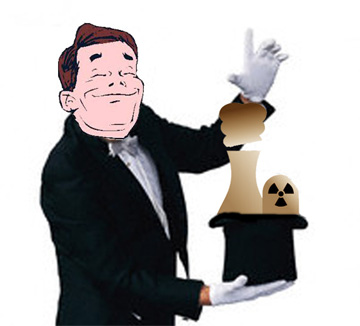 Japanese regulator caves to the nuclear industry and government pressure – but still no restart for Sendai http://www.greenpeace.org/international/en/news/Blogs/nuclear-reaction/Sendai-reactor-restart/blog/50534/ by Kendra Ulrich – 10 September, 2014 As with all things nuclear, things are not always what they seem.
Good example – today’s decision on the so called restarting of the Sendai reactors by the Japanese Nuclear Regulatory Authority (NRA), the best nuclear regulator in the world, according to the Abe government.
The five NRA commissioners decided that a proposal submitted by Kyushu Electric, owner of the Sendai reactors, complies with new guidelines brought in after the 2011 Fukushima-Daiichi nuclear catastrophe.
What the commissioners actually did was capitulate to pressure from Japan’s infamous nuclear village – the same industry and government alliance that created the Fukushima nuclear disaster. The decision really means that Kyushu Electric has moved restarting the Sendai reactors forward a bit, but it’s still not a restart approval. It doesn’t mean the NRA has certified the reactors as safe to operate or that they will restart anytime soon.
Why the confusion?
In part, it’s a savvy political strategy and a deliberate effort by the regulator, acting for the nuclear utilities and the Abe government, to signal that nuclear power is back in Japan.
The timing is no accident. In a few days, Japan celebrates an entire year without a single commercial nuclear reactor operating. It’s a powerful symbolic moment and a concrete demonstration that nuclear power, and its inherent risks, is unnecessary for the third largest global economy, with a population of 130 million people.
This is a major body blow to the nuclear industry both in Japan and globally. It’s a lesson the nuclear industry and its government backers would rather the public did not learn.
When the Ohi 4 reactor in Fukui prefecture was shut down on September 15th 2013, Japan became completely nuclear-free. A year later Japan is still nuclear-free. Many of the remaining 48 nuclear power reactors in Japan will stay shutdown permanently. Most of those that may restart will not do so for years to come.
The Abe government is desperate to prevent people from grasping that the world’s third largest nuclear reactor program has failed to generate any electricity for 12 months. In that year, there have been no blackouts or brownouts, the trains still run, the lights still turn on, and smart phones are still charged.
Most people in Japan understand that the declared government policy, that nuclear power is an essential and a stable source of energy, is a myth. They will not be fooled. The majority of the public are demanding no nuclear reactor restarts, an end to nuclear power, and a future energy system based on efficiency and renewables.
In fact, they are already creating this clean energy future with massive growth in solar PV, and significant reductions in energy demand since the Fukushima disaster.
Nuclear regulation worldwide exists to give the impression that nuclear power can be managed safely and without risk of severe accident. That is not the same as actually assuring safety and no severe risk of accidents.
The Japanese NRA, created from the discredited agencies that contributed to the Fukushima catastrophe, in the past months has revealed that it takes the side of industry instead of standing up for public safety.
The decision today highlights this wider truth. The NRA is still reviewing many remaining unresolved safety issues that scientists and citizens groups are also challenging.
So flawed is the safety case for Sendai that local citizens are seeking an injunction against Kyushu Electric and the government to stop them from operating the plant. No restart reflects public opinion
The latest polling shows 59% of Japanese people oppose restarting nuclear reactors, including Sendai. The NRA decision ignores the majority opinion.
The people of Japan, still suffering the ongoing tragedy of Fukushima, understand that the NRA is not protecting the public but only the interests of an industry in crisis.
The plan of the Abe administration and electric utilities to return Japan to nuclear power is in disarray, with no early restart for the Sendai reactors, and ever-increasing challenges for the other 46 reactors.
Sendai may make headlines in Japan and elsewhere today as a step toward restarts, but it does not change that for an entire year, as of September 15th, Japan will have been nuclear-free.
This is in large part due to the commitment of the people of Japan who have taken to the streets to protest nuclear restarts, have fought and won in courts, have massively reduced energy demand, and rapidly expanded clean, renewable solar PV.
This is impressive leadership from the people has advanced Japan’s future despite the determination of the Abe Government and dirty energy industries to drag Japan backward into the energy dark ages.
The people have proven their commitment to a clean energy future, and they’ve shown the world that it is possible. It is happening now.
Kendra Ulrich is an energy campaigner with Greenpeace International.
Critical situation at Fukushima nuclear reactor No 2 on March 11 2011
Fukushima No. 2 scrambled to avoid same fate as sister site Fukushima No. 1 Fukushima Emergency – what can we do? by dunrenard Sep 10, 2014
FUKUSHIMA – This is the fifth in a series on the Fukushima nuclear catastrophe based on the accounts of people who struggled to contain the crisis in its early stages. Job titles and ages are as of March 2011.
Fukushima No. 1 wasn’t the only nuclear complex facing a critical situation after the magnitude-9.0 earthquake of March 11, 2011, unleashed a monster tsunami on the coast of Tohoku.
Tokyo Electric Power Co.’s Fukushima No. 2 plant, located about 12 km south of the No. 1 plant, also saw seawater pumps and electrical equipment flooded by the tsunami, which led three of its four reactors to lose key cooling functions.
Still, the extent of the damage was less devastating than that at its sister plant and one off-site power source that remained operable provided more leeway for workers to deal with the emergency.
For No. 2 plant chief Naohiro Masuda, 53, the worst situation imaginable was to lose control of both plants at the same time.
So when he watched on television as an explosion rocked the No. 1 reactor building at the other complex on March 12, Masuda issued an order that could be seen by some as coldhearted.
“Don’t allow anyone (from Fukushima No. 1) to enter our emergency response office building,” the plant chief said.
The building houses the emergency first-aid station.
Masuda’s decision reflected his determination to keep the developments at the other site from hampering stabilization efforts at his plant.
Workers exposed to radiation or injured by the explosion were certain to be transported to Fukushima No. 2.
Masuda believed that he had to limit the radiation contamination inside his complex so as not to affect the workers’ efforts.
He told his subordinates to prepare a place away from the office building for the No. 1 workers. His decision was later criticized by some No. 1 workers, who said they felt they were treated “like garbage.”
An area to scrub away radiation contamination and an aid center were set up inside a facility next to the main gate. The plant’s gymnasium was also readied as a shelter for workers from No. 1.
By the night of March 12, everything was ready to receive the No. 1 workers. But Masuda noticed many of his own workers appeared anxious. To reassure them, he gathered them together and told them he would “make sure that you won’t end up with any health problems. Don’t worry……….
When that happened, Masuda told his subordinates: “Don’t rely on others. Let’s do things by ourselves.”
A single misstep could have altered the fate of Fukushima No. 2. But the plant managed to keep the severity of the incident at level 3 on the international scale of nuclear accidents.
The crisis at Fukushima No. 1 was eventually rated at the maximum, level 7.
Source: Japan Times
http://www.japantimes.co.jp/news/2014/09/10/national/fukushima-2-scrambled-avoid-fate-sister-site-fukushima-1/ http://fukushimaemergencywhatcanwedo.blogspot.com.au/2014/09/fukushima-no-2-scrambled-to-avoid-same.html
120,000 Fukushima nuclear evacuees still displaced, 3 years after
Japan’s nuclear watchdog on Wednesday gave the green light for two nuclear reactors at Kyushu Electric Power’s Sendai plant in south-west Japan to restart, but communities are anxious over the safety aspects. The nuclear industry in Japan has been mothballed since the meltdown.
At a temporary housing complex in Fukushima prefecture one resident, Iiko Kanno, said she now spends her days reading, growing vegetables and counting the days until she is reunited with her grandchildren. As with many of her neighbours, Kanno’s family has been torn apart by the nuclear meltdown, which happened in March 2011…….
A survey conducted this year by the prefectural government found that almost half of the households forced to evacuate were living apart, while almost 70% had relatives suffering from physical and mental health problems.
- Of the total, 48.9% of households said family members were living in two or more locations. Of that number, 58.6% said relatives who had once lived together had been scattered across three or more sites.
In the same survey, 67.5% of households said they had relatives who were showing signs of physical or psychological distress. More than half of those afflicted said they had lost interest in activities they once enjoyed or that they had trouble sleeping.
Kanno’s plight is typical of many Fukushima families who lived together in large rural homes before the disaster………
- So far only a few hundred people from two districts on the eastern edge of the evacuation zone have been given permission to return permanently……
- “The nuclear accident turned everything upside down,” she said. “Even if the evacuation order is lifted, no young people or children will go back. We have asked everyone – the village office, decontamination workers, environment ministry bureaucrats – when it will be safe to return. But no one can give us an answer.” http://www.theguardian.com/world/2014/sep/10/fukushima-nuclear-disaster-japan-three-years-families-uprooted
USA Dept of Energy’s estimate of Fukushima radiation release “Not for Distribution, Internal Use Only
“Not for Distribution, Internal Use Only”: US Energy Dept. estimated Fukushima release up to 10,000 times larger than nuclear regulators predicted — ‘Supercore’ scenario an underestimate? http://enenews.com/us-energy-dept-estimated-fukushima-release-up-to-10000-times-larger-than-nuclear-regulators-predicted-supercore-scenario-an-underestimate?utm_source=feedburner&utm_medium=email&utm_campaign=Feed%3A+ENENews+%28Energy+News%29
Ocean Plume Modeling for the Fukushima Daiichi Event (pdf) — US Dept. of Commerce, NOAA, National Weather Service, Sept. 2013:
> Estimates of contamination
- “Coastal releases ignored. According to TEPCO estimates, coastal releases are 1% of atmospheric… Not important for far-field estimates (i.e., exposure for US territories)”
- “Scenarios used [are] NRC source scenario [and] DOE Supercore source scenario”
- Regarding Cs-137 release estimates, “NRC and DOE differ by three orders of magnitude” [i.e. DOE estimate is 1,000 to 9,999 times more than NRC]
- “Enormous uncertainty in total amount of contamination released at FDNPP”
- “Differences between NRC & DOE sources are crippling from a scientific perspective”
- “DOE much too high at… JAMSTEC observation line 30km offshore [and] overestimates Cs-137 by order of magnitude [predicting a] maxima of around 100 Bq/L for Cs-137… JAMSTEC realistic contamination levels would be factor 10 smaller (10 Bq/L).”
Is DOE’s 100 Bq/L an ‘Overestimate’?
- The above report by the federal government claims to use ‘realistic’ data from the JAMSTEC line (Japan Agency for Marine-Earth Science and Technology) of 10 Bq/L for Cs-137. However, JAMSTEC measured a maxima of 186 Bq/L for Cs137 at 30km off the Fukushima coast — nearly double the DOE ‘overestimate’.
- The Science Council of Japan: “Oceanic monitoring… identified that 100 Bq/L or more of 137Cs had been diffused to the north and south.”
DOE’s estimate based on the ‘supercore’ scenario came rather close to predicting actual Cs-137 levels observed in samples from the Pacific Ocean — if anything, it appears to be an underestimate.
The reactor conditions assumed in DOE’s ‘supercore’ scenario have been redacted from FOIA documents. However it’s likely that the ‘supercore’ was among the worst-case scenarios discussed by the US government. As reported by Echo News, around 5 different worst-cases were in play — “I still won’t let anybody use the word ‘worst case’ in the room here because there’s about five worst cases.” –NRC’s Director of Nuclear Security & Incident Response
Did Japan’s government use the dengue fever scare to stop anti-nuclear protest in park?
 Nuclear Conspiracies And Pacific Radiation Activist Post, Richard Wilcox, PhD September 10, 2014
“……….While speculation about controversial topics in the SNS sphere should be taken with a large grain of salt, there is a theory  that the government has used the dengue scare to shut down Yoyogi Park in order to block what was supposed to be a “huge” September 27, anti-nuclear protest. Before you laugh and shout “conspiracy theory” (although you might be right in this case) read on.
Given that practically everything many Western (including Japan) governments say these days are lies, dutifully parroted by the Media, it does make one wonder. Just because you’re paranoid doesn’t mean they’re not out to get you. ……….
this year is Japan Prime Minister Shinzo “I Love Nukes & Military Spending” Abe’s big push to restart the country’s idling and costly nuclear reactors. The timing is interesting. Not only did Abe recently appoint a pro-nuclear woman to his cabinet (to soft peddle the cute and cuddly image of nuclear power) but it was recently announced that the first nuclear restart has been approved in Kagoshima prefecture in the far south of the country (2). This is despite the fact that “more than 60 percent of local governments that host or surround a nuclear power plant are cautious about restarting idled reactors even if they meet new safety guidelines” (3).
According to the dengue conspiracy theory, this year the government manipulated the data to make it look like the dengue cases were specifically emanating from the park. There is also a theory that the fevers are caused by the spraying of chemicals and pesticides in the area, that mimic the symptoms of dengue. The motive: Where a huge anti-nuclear demonstration was to occur on Sept. 27, in order to combat the push for reactor restarts — now the park has been CLOSED! The canceled anti-nuke event will muzzle the opposition and pave the way for nuclear restarts.
In the summer of 2012, tens of thousands, upwards of 100,000 demonstrators or more, gathered in just that park, Yoyogi Park, in order to protest the government’s nuclear policy (4).
Considering the anti-constitutional and dictatorial leanings of the Abe administration, it is not a ridiculous hypothesis to consider that The-Powers-That-Be took advantage of the dengue scare to manipulate data for furthering administration goals.
Of course the lapdog media is always on hand to play its role in furthering such myths, as happened in the granddaddy conspiracy of all time, the 911 “terror attacks” (5). Incredibly, the man who wrote his college thesis about the creation and maintenance of state myths is also the one man who was in charge of the 911 investigative committee (6; 7). That’s what we simple folks call putting the fox in charge of the henhouse.
On 11 March 2011 Fukushima nuclear workers were sure that they would die
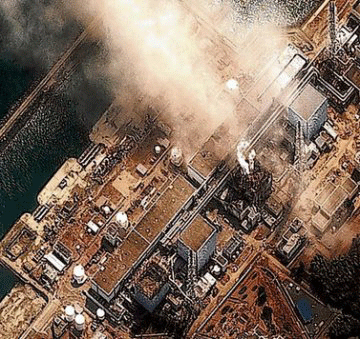 Hydrogen explosion left Fukushima No. 1 workers sure they would die Fukushima Emergency what can we do ? Sep 10, 2014 FUKUSHIMA – This is the fourth in a series on the Fukushima nuclear catastrophe based on the accounts of people who struggled to contain the crisis in its early stages. Job titles and ages are as of March 2011.
Ground Self-Defense Force member Yuichi Sato was on a firetruck heading for the Fukushima No. 1 nuclear plant the day after it had been decimated by the March 11, 2011, tsunami — without being notified what his mission was.
That morning, the truck was in the town of Okuma, Fukushima Prefecture, where the 22-year-old was born.
He was several kilometers from his destination, but the familiar sights were gone — the walls of houses had collapsed, road surfaces were buckled and the town looked deserted.
“It was like a ghost town,” said Sato, who was part of the GSDF’s artillery regiment based in the prefecture. “I thought everyone must have rushed to escape.”
The regiment’s firefighting unit had received orders the night before to go to the nuclear plant. His squad members thought their task was to prepare for the possibility of a fire, but Sato, even though he had been told since childhood that nuclear power is safe, felt something out of the ordinary was happening.
When they arrived at the plant gates at around 7 a.m. on March 12, he was greeted by an acquaintance who works for Tokyo Electric Power Co.
Sato wondered why the Tepco employee was wearing a mask. He didn’t know at the time that the radiation level at the site was rising because a meltdown was occurring in the No. 1 reactor due to the loss of its key cooling functions.
After entering the emergency response office building, the firefighting squad was finally told what to do.
At the time, Tepco was using a single fire engine to inject water into reactor 1, but every time the truck had to return to a storage tank to be refilled, it meant halting the flow of water being sprayed into the unit.
The SDF’s firetrucks were supposed to assist in the operation.
Inside the main control room for reactors 1 and 2, workers were demoralized and exhausted after an attempt to open valves to reduce the pressure in reactor 1 ended in failure because of high radiation levels inside the reactor building.
It was imperative to open the valves to prevent a rupture of the containment vessel……….
“I later found it was a hydrogen explosion at the building, but at the time, I thought the reactor containment vessel itself had exploded,” said Mitsuyuki Ono, 51, who was also in the room. “I thought it was all over.”
There were some 40 reactor operators in the room, but everyone was exhausted after trying to do all they could to prevent the worst.
Izawa decided to stay along with the more experienced workers, and let the others evacuate.
The roughly 10 workers who remained included Izawa, Ono and 48-year-old Kazuhiro Yoshida, whom Ono had once worked with in operating the No. 1 reactor.
Ono was wondering how he could communicate to his family what he thought might be his final moments. If he wrote anything down on paper, it would probably be incinerated if there was an explosion.
“Why don’t we take a photo at the end,” Yoshida proposed cheerfully, as if he had read Ono’s mind. Everyone seemed to liven up.
The room, which was dark due to the loss of power, was lit up with flashing cameras.
Ono, having a picture taken with Yoshida by his side, a junior operator whom he trusted and liked the most, thought: “If the radiation level rises or hot steam comes into the control room, I will probably die. But someone will find the camera some day. Then this picture will be the witness to my life.”
Source: Japan Times
http://www.japantimes.co.jp/news/2014/09/10/national/hydrogen-explosion-left-fukushima-no-1-workers-sure-they-would-die/
Closure of uranium mines by State in East Singhbhum
Uranium Corporation stops mining at Jadugora after 47 years B Sridhar,TNN | Sep 8, 2014 JAMSHEDPUR: Uranium Corporation of India stopped all mining activities at Jadugora in East Singhbhum from Sunday after 47 years. following a ministry order in July.
The Centre, following a Supreme Court order in May on amendment of Mineral Concession Rules, 1960, issued a directive to all mineral-rich states on July 12 asking them to stop mining by corporate entities under deemed extension. The state then ordered closure of the decades-old uranium mines. “We have served the notice to UCIL (Uranium Corporation of India) informing the company about the directive of the state government,” said district mining officer Ratnesh Kumar Sinha…….http://timesofindia.indiatimes.com/city/ranchi/Uranium-Corp-stops-mining-at-Jadugora-after-47-years/articleshow/41970997.cms
Japan’s Nuclear Regulator stands firm on need to close reactor sited over earthquake fault
 Regulatory panel in Japan affirms decision that will force decommissioning of Tsuruga reactor, Enformable, Lucas W Hixson, 5 Sept 14
On Thursday, a panel of experts organized by Japan’s Nuclear Regulation Authority (NRA) determined that it will not change its 2013 judgment that an active geologic fault exists under the Unit 2 reactor at the Tsuruga nuclear power plant.
The determination means that the Japan Atomic Power Company (JAPC), the utility which operates the Tsuruga nuclear power plant, will be forced to decommission one of the two reactors at the nuclear site.
During the meeting, officials from the JAPC attempted to present new data, which they said challenged the decision made by NRA, but many experts at the meeting debated the validity and objective nature of the data and the ability of the new findings to support claims made by the utility.
After hearing the panel’s decision, the vice president of Japan Atomic Power demanded more discussion on the issue, but was rebuffed by NRA Commissioner Kunihiko Shimazaki who stated that “Enough scientific debates have been done.”…….
After NRA experts determined that the D-1 fault zone of pebbles and sediments under the Unit 2 reactor is an active fault in May 2013, the JAPC began actively working to change the regulator’s decision, and the meetings between the two parties have been known to be contentious.
The secretariat of the NRA has told reporters that it plans to file a protest with Japan Atomic Power Company over inappropriate and threatening remarks made by Hiroshima University professor Koji Okumura, who is affiliated with the utility……..
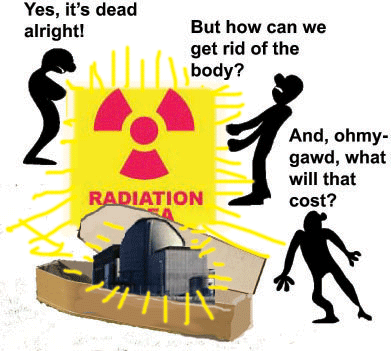 Experts estimate that the costs to decommission a reactor like the Unit 2 reactor at the Tsuruga nuclear site will cost in excess of $650 million.
Japan’s nuclear regulators pushing for permanent closure of aging reactors
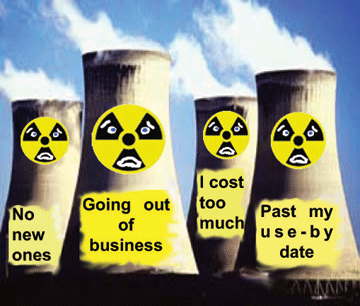 Aging Nuclear Reactors May Close in Japan http://www.scientificamerican.com/article/aging-nuclear-reactors-may-close-in-japan/ TOKYO (Reuters) 5 Sept 14 – Japan will push nuclear operators to draft plans to scrap a quarter of the country’s 48 reactors, which are either too old or too costly to upgrade to meet new standards imposed after the Fukushima disaster, the Nikkei reported on Friday.
The government is betting that by forcing older units considered more vulnerable to disaster to shut down it may gain public support to restart newer units, the Nikkei reported.
The one big hurdle to the India-Japan nuclear deal
The hurdles to this deal emanate from Japan’s insistence that no reprocessing of spent fuel would be done in India, and that in the event of a nuclear test by India, the components supplied would be immediately returned to Japan.
The nuclear thorn in India-Japan ties http://www.thehindubusinessline.com/opinion/the-nuclear-thorn-in-indiajapan-ties/article6383865.ece?utm_source=RSS_Feed&utm_medium=RSS&utm_campaign=RSS_Syndication BHASKAR BALAKRISHNAN 5 SEPT 14 The recent visit to Japan by Prime Minister Narendra Modi has brought into focus the ongoing India-Japan negotiations on a civil nuclear agreement. This remains an item of unfinished business, though both sides have declared that it would be pursued with greater vigour. Exactly how important is this agreement in the context of India’s nuclear programme? What factors underlie the Japanese position? Continue reading
North Korea’s Yongbyon may be restarting
 North Korean nuclear reactor may be operational, DW 5 Sept 14 A new report by the United Nations nuclear watchdog says North Korea may be operating a reactor at its main nuclear facility in Yongbyon. The site has previously been associated with the production of nuclear weapons. In the document seen by news agencies on Friday, the International Atomic Energy Agency (IAEA) said it had detected signs the reactor in the country’s north was undergoing tests that suggested it was being prepared for a restart.
The agency said it had “observed, through analysis of satellite imagery, steam discharges and the outflow of cooling water” at the reactor since late August 2013, adding that these were “consistent with the reactor’s operation.”
However, the IAEA stopped short of saying the facility was fully operational, as it has had “no access to the five megawatt reactor since April 2009.” The IAEA relies mainly on satellite images in its assessments of North Korea’s nuclear activities because Pyongyang does not allow the agency’s inspectors into the country………http://www.dw.de/north-korean-nuclear-reactor-may-be-operational/a-17904551
Why Australia should NOT sell uranium to India
Australian and Indian nuclear trade http://www.dailytimes.com.pk/opinion/29-Aug-2014/australian-and-indian-nuclear-trade Hasan Ehtisham 4 Sept 14 Adding Australian uranium into India’s energy mix would have serious fallouts on prevailing strained relations between India and its nuclear-armed neighbours Australia is expected to sign a civil nuclear agreement with India during the visit of Australian Prime Minister Tony Abbott early next month. Negotiations have been concluded to smooth the path for uranium imports from Australia.

The news came out when hundreds of thousands of Indian men and women protested against the expanding nuclear industry. These protests have been a regular feature in Koodankulam (Tamil Nadu), Jaitapur (Maharashtra) and Gorakhpur (Haryana), and at least five activists have lost their lives since 2010 in their struggle against the Indian government’s decision without taking the affected parties on board. Radioactive waste from uranium mining in the country’s east is reportedly affecting adjacent communities. Thousands of Indians suffer from the effects of uranium mining related to poor technical and management practices.
Birth deformities and cancers in Indian villagers near uranium facilities
Independent studies of the health status of people who live near the uranium mines and mills have found both that there are physical deformities occurring at a much higher rate than controlled villages which are having similar population but are a little bit further away from the mines and mills, as well as lung diseases coming in at a much higher rate among those who work in the mines and mills.
Australia to sell uranium to India but at what cost to its people? Australian Broadcasting Corporation Broadcast: 03/09/2014 Reporter: Stephanie March
As Prime Minister Tony Abbott prepares to sign off on a deal to sell Australian uranium to India, critics are warning of the cost to the lives and safety of India’s most vulnerable.
Transcript
CHRIS UHLMANN, PRESENTER: “……. critics say India’s drive towards a nuclear future is coming at a cost – the lives and safety of the country’s most vulnerable.
South Asia correspondent Stephanie March reports.
STEPHANIE MARCH, REPORTER: This lush forest land in eastern India is home to the Adivasi, one of the country’s Indigenous tribes people. Here in the town of the Jaduguda, the Adivasi live simple lives, much the way they have for centuries.
But the locals feel something isn’t right with the world around them.
Mohammad Yusuf is just one child in the village deformed since birth.
MOHAMMAD MOIN (voiceover translation): We didn’t realise that there was anything wrong with him immediately, but four to five months after he was born, we realised that his legs and arms were not functioning properly.
STEPHANIE MARCH: The 14-year-old tries hard to be independent, but his wasted and stiff body makes it hard for him to move.
MOHAMMAD MOIN (voiceover translation): The doctor’s examined him. They said it wasn’t polio. They said that there was some damage that had taken place before he was born. His nerves were damaged or something like that.
STEPHANIE MARCH: A few doors down, Jobarani Acharya’s three-year-old son, Zariyadev (phonetic spelling), struggles to breathe and can’t sit without help. She doesn’t know what’s wrong with him and can’t afford to take him to hospital to find out.
JOBARANI ACHARYA (voiceover translation): I worry about what will happen when he grows older. What can we do for him? How do we cope with this situation?
STEPHANIE MARCH: Jobarani’s neighbour is a young boy named Gunda, born blind and mentally handicapped. In this hamlet of a few dozen houses there are at least three children with obvious physical deformities and locals believe they know the cause.
MOHAMMAD MOIN (voiceover translation): One of my other children, just six days old, died after dark patches erupted on its body all of a sudden. With Yusuf too, it seems that there was some poisoning or radiation that led to a birth defect.
STEPHANIE MARCH: The village where Mohammad Yusuf and Zariyadev were born is less than two kilometres from this tailing pond, attached to a uranium mine run by the Government-owned Uranium Corporation of India Limited, UCIL.
MOHAMMAD MOIN (voiceover translation): We feel that these are due to the affects of uranium. We’ve seen these kinds of incidents not just with humans, but also with the babies born to animals.
GHANSHYAM BIRULLE, JHARKHAND ORG. AGAINST RADIATION (voiceover translation): We cannot see any benefits. We have received only cancer and diseases. UCIL has given us nothing else.
STEPHANIE MARCH: Independent studies on the impact of the mining operation have been scathing. One survey by Indian Doctors for Peace and Development found that children born to families living near the mining operations were almost twice as likely to have congenital deformities than those born in villages 30 kilometres away and that those with deformities were five times more likely to die than those living in non-mining areas.
30-year-old Rapta Sadr has been physically disabled since birth and blames his problems on being born near the tailing ponds.
In addition, cancer rate are 50 per cent higher in the villages near the tailing ponds and people are 20 per cent less likely to reach the average life expectancy for the state.
M.V. RAMANA, NUCLEAR FUTURES LAB, PRINCETON UNI.: Independent studies of the health status of people who live near the uranium mines and mills have found both that there are physical deformities occurring at a much higher rate than controlled villages which are having similar population but are a little bit further away from the mines and mills, as well as lung diseases coming in at a much higher rate among those who work in the mines and mills.
STEPHANIE MARCH: M.V. Ramana is a nuclear physicist based at Princeton University who’s written extensively on the nuclear industry in India. He’s closely studied the situation in Jaduguda.
M.V. RAMANA: As far as I know, UCIL has offered no evidence that is has actually carried out any kind of detailed epidemiological studies. All it has done is make various assertions. These assertions start with denial, saying that there is no such problem, or claiming that these problems have to do with malnutrition – exactly the kind of thing epidemiological studies rule out……http://www.abc.net.au/7.30/content/2014/s4080503.htm
Japan’s Prime Minister’s wife reiterates her opposition to nuclear power
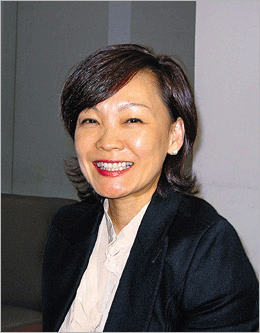 Japan’s First Lady speaks out on sales tax, nuclear power REUTERS, BY LINDA SIEG TOKYO Thu Sep 4, 2014 “…….FIRST LADY DIPLOMACY?
Abe has not been held a summit with Chinese President Xi Jinping since taking office due to Sino-Japanese feuds over territory and wartime history. He has called on Xi to meet on the sidelines of an Asian-Pacific leaders gathering November.
Mrs. Abe said she hoped to meet Xi’s wife, Peng Liyuan, if possible, even if not one-on-one, since First Ladies could chat without the burden of national interests on their shoulders.
“I felt she is really beautiful and stylish and has an aura,” she said, referring to a meeting with Peng last year.
In another departure from her husband’s policies, Mrs. Abe reiterated that she believed Japan should exit nuclear power if alternate energy sources can be found, given the risks shown by the March 2011 Fukushima disaster, the world’s worst atomic accident since Chernobyl.
“Once an accident occurs, it is a terrible thing that cannot be undone,” she said. “If there are alternative sources of energy, I would like them to stop (nuclear power). I’d like them not to restart off-line reactors.”…….http://www.reuters.com/article/2014/09/04/us-japan-firstlady-idUSKBN0GZ07I20140904
1 This Month


of the week– Nuclear Reactor Information Task Force

14 May – online event From Bombs to Data Centres: the Face of Nuclear Colonialism
To see nuclear-related stories in greater depth and intensity – go to https://nuclearinformation.wordpress.com
-
Archives
- May 2026 (187)
- April 2026 (356)
- March 2026 (251)
- February 2026 (268)
- January 2026 (308)
- December 2025 (358)
- November 2025 (359)
- October 2025 (376)
- September 2025 (257)
- August 2025 (319)
- July 2025 (230)
- June 2025 (348)
-
Categories
- 1
- 1 NUCLEAR ISSUES
- business and costs
- climate change
- culture and arts
- ENERGY
- environment
- health
- history
- indigenous issues
- Legal
- marketing of nuclear
- media
- opposition to nuclear
- PERSONAL STORIES
- politics
- politics international
- Religion and ethics
- safety
- secrets,lies and civil liberties
- spinbuster
- technology
- Uranium
- wastes
- weapons and war
- Women
- 2 WORLD
- ACTION
- AFRICA
- Atrocities
- AUSTRALIA
- Christina's notes
- Christina's themes
- culture and arts
- Events
- Fuk 2022
- Fuk 2023
- Fukushima 2017
- Fukushima 2018
- fukushima 2019
- Fukushima 2020
- Fukushima 2021
- general
- global warming
- Humour (God we need it)
- Nuclear
- RARE EARTHS
- Reference
- resources – print
- Resources -audiovicual
- Weekly Newsletter
- World
- World Nuclear
- YouTube
-
RSS
Entries RSS
Comments RSS
 nuclear-news