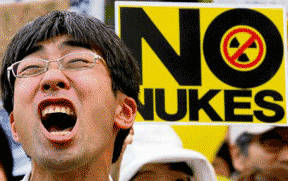
In Fukushima many women aborted their babies in the months after the nuclear disaster
Fukushima Woman: Many are aborting their babies… It’s really happening — I know many women who were visibly pregnant then suddenly weren’t (VIDEO) http://enenews.com/fukushima-woman-many-aborting-babies-really-happening-many-women-visibly-pregnant-suddenly-werent-video
In Containment: The people of Minamisoma, 15 months after the meltdown – Part 1/5
Director/editor Ian Thomas Ash
Producer/camera Koji Fujita
Published on Jul 2, 2012
Published by DocumentingIan
Citizens of Minamisoma share personal struggles they continue to face
At 5:00 in
Unidentified Speaker : And many women are aborting their babies.
Interviewer: I have also heard that the number of abortions increasing. But I don’t know if it’s really true.
Minamisoma Resident: It’s really happening.
Interviewer: It’s not just a rumor, but actually true?
Minamisoma Resident: Many people are afraid to have children. I know many people who feel that way. I know many women who were visibly pregnant then suddenly weren’t.
At 7:30 in
Minamisoma Resident 2: Although more than a year has passed we are still suffering. Our hearts are still anguished by issues such as this problem of increasing abortions.
Japan’s secret nuclear weapons program, helped by USA
Japan had a dual use nuclear program. The public program was to develop and provide unlimited energy for the country. But there was also a secret component, an undeclared nuclear weapons program that would allow Japan to amass enough nuclear material and technology to become a major nuclear power on short notice.
That secret effort was hidden in a nuclear power program that by March 11, 2011– the day the earthquake and tsunami overwhelmed the Fukushima Daiichi Nuclear Plant – had amassed 70 metric tons of plutonium. Like its use of civilian nuclear power to hide a secret bomb program, Japan used peaceful space exploration as a cover for developing sophisticated nuclear weapons delivery systems.

![]()
US circumvented laws to help Japan accumulate tons of plutonium From National Security News Service By Joseph Trento, April 9th, 2012
The United States deliberately allowed Japan access to the United States’ most secret nuclear weapons facilities while it transferred tens of billions of dollars worth of American tax paid research that has allowed Japan to amass 70 tons of weapons grade plutonium since the 1980s, a National Security News Service investigation reveals. These activities repeatedly violated U.S. laws regarding controls of sensitive nuclear materials that could be diverted to weapons programs in Japan. The NSNS investigation found that the United States has known about a secret nuclear weapons program in Japan since the 1960s, according to CIA reports. Continue reading
Doubtful that Japan’s nuclear reactors will ever restart

Rocky road ahead for Japan’s nuclear restart, Ecologist Jim Green and Peer de Rijk / Nuclear Monitor 26th September 2014 Japan’s government is trying to get its failing nuclear power industry up and running, write Jim Green and Peer de Rijk. But in the post-Fukushima world, it faces formidable obstacles. Experts believe most reactors will never restart – and Japan’s stricken utilities may have to find $30 billion or more to finance their decommissioning……… Continue reading
TEPCO dumps the failed ice wall plan to contain Fukushima radiation
Tepco to give up the preceding frozen wall and directly fill the trenches with cement instead http://fukushima-diary.com/2014/09/tepco-give-preceding-frozen-wall-directly-fill-trenches-cement-instead/Tepco is going to give up the preceding water wall project and simply pour cement instead, they announced in the press conference of 9/22/2014. Extremely highly contaminated water is “retained” in the underground trenches, which are connected to the plant buildings.
Though Tepco is denying this, there is a possibility that these trenches are also severely damaged by the continuous explosions and earthquake, keep letting the coolant water leak underground and sea directly from plant buildings. Tepco was attempting to separate the plant buildings and trenches by frozen water wall in order to pump up the extrenely highly contaminated water retained in the trenches.
However the frozen water wall has never been completed.
Instead of the frozen water wall, Tepco announced they developed the special type of cement to fill the entire trenches.In the simple math, if they pour cement, the same volume of contaminated water would be pushed out of the trenches. However Tepco states it would not leak out because they would pump up the contaminated water as they pour cement.
Because the trenches and the plant buildings are connected, they would end up having to pump up the same volume water as the entire capacity of the trenches. Tepco hasn’t announced if they prepare the enough contaminated water storage. http://www.tepco.co.jp/tepconews/library/archive-j.html
Very high abnormality rates in Fukushima insects eating radiation contaminated leaves
“Groundbreaking” study reveals Fukushima nuclear waste is poisoning wildlife: Up to 99% of offspring died after eating ‘low-level’ contaminated food — “Very high” abnormality rates including “severe and rare” deformities (PHOTOS) http://enenews.com/groundbreaking-study-fukushima-radiation-poisoning-wildlife-99-offspring-died-after-eating-food-low-level-contamination-severe-rare-abnormalities-photos?utm_source=feedburner&utm_medium=email&utm_campaign=Feed%3A+ENENews+%28Energy+News%29
PhysOrg, Sep 23, 2014 (emphasis added): In a previous study, the group [of university researchers] suggested that eating leaves with high levels of radiation seriously affected the pale grass blue butterfly. Their new study investigated the effect of eating leaves with much lower levels of radiation… Joji Otaki, University of Rukyus, says… “Our study demonstrated that eating contaminated foods could cause serious negative effects on organisms. Suchnegative effects may be passed down the generations… eating non-contaminated food improves the negative effects”…
AAAS, Sep 22, 2014: Fukushima radiation still poisoning insects — Eating food contaminated with radioactive particles
may bemore perilous than thought… The findings from Otaki’s group are “groundbreaking,” says Timothy Mousseau, a biologist at the University of South Carolina… there have been “almost no studies” on how ingestion of radiation-tainted foods affect wildlife.
Study by University of the Ryukyus and Nagasaki University researchers, published Sep 23, 2014: [We] examined the effects
of low-level-contaminated diets… The mortality rate increased linearly in accordance with an increase of the caesium… Remarkably, the mortality rate of the Koriyama group [.04 Bq per larva] was 53% [in the first generation]… We discovered various morphological abnormalities in the surviving adults… severe and rare abnormalities shown in Figure 5might imply the effects of a contaminated diet. Only three [that ate] Okinawa leaves [1760 km from Fukushima Daiichi] showed very minor morphological abnormalities… As observed in the F1 [first] generation, various morphological abnormalities were detected in the surviving F2 [second generation] adults… very high mortality and abnormality rates [were] recorded…low-dose effects were clearly detected… results suggest that low-dose ingestion of approximately 100 Bq/kg may be seriously toxic to certain organisms… The biological effects of ingesting the contaminated diets were more severe in the F2 generation…
Mortality Rates
- Koriyama [60 km from Fukushima Daiichi] F1 group and the Koriyama F2 group obtained from the Koriyama F1 adults were 53.0% and 79%, respectively
- Motomiya [also 60 km] F1 group and the Motomiya F2 group obtained from the Motomiya F1 adults were 31.2% and 99%, respectively… “very small number of surviving adults”
Prof. Otaki: Many theoreticians and politicians have claimed [that Fukushima has caused] no harmful biological effects… Even worse, some biologists have claimed that there are no biological impacts… to our surprise, leaves contaminated at relatively low levels… resulted in a mortality rate of more than 50%… Moreover, the sensitivity of the offspring generation increased, resulting in very high mortality rates… it is widely believed among modern biologists that insights obtained from one biological system are largely applicable to other systems…
shock and collapse – the plight of Fukushima nuclear plant officials in March 2011
Leader of Fukushima plant “started staggering… mumbling ‘It’s all over’” before last reactor melted — Appears to collapse, has visions while motionless on floor — Top official “bursts into tears” at meeting — No way to prevent ‘utter catastrophe’ — ‘Chilling’ sound soon heard, ‘gaping hole’ in reactor suspected http://enenews.com/leader-fukushima-plant-started-staggering-around-mumbling-all-before-last-reactor-melted-appears-collapse-begins-having-visions-motionless-floor-senior-official-bursts-tears-around-same-time?utm_source=feedburner&utm_medium=email&utm_campaign=Feed%3A+ENENews+%28Energy+News%29
Kyodo News (Part 9), Sep 23, 2014 (emphasis added) : Reactor 2′s cooling system finally stopped functioning at 1:25 p.m. on March 14… [In 5 hours]… the water level had drained to 3.7 meters below the top of the nuclear fuel… leaving it fully exposed. There was also no signthe seawater was entering the reactor… firetrucks that were supposed to be injecting water into the reactor had run out of fuel… [Fukushima chief Masao] Yoshida would later recall that this felt like a “turning point,” beyond which “we had run out of all options and I thought I might really die.”… Yoshida went up to [the many workers on the 2nd floor] and said: “Thank you for dealing with the situation until now. It is OK to go home.”… 8:30 p.m… Yoshida then asked [if] there was any place people could evacuate to… Yoshida [was told] that the No. 2 plant was ready… With workers unable to operate the venting valves, the pressure continued to build… an experienced leader… felt that the reactor’s containment vessel could break at any time…
Kyodo News (Part 10), Sep 23, 2014:: A [Tepco] senior official broke down and wept in the prime minister’s office when the utility felt it had exhausted all options to prevent an utter catastrophe... bursting into tears… Shortly after 4 a.m. on March 15 [Japan was] facing a potential rupture of the reactor 2 containment vessel… [Prime Minister Naoto] Kan soonrealized it was too late to rein in the crisis… a chilling sound swept through the response office at 6:14 a.m, albeit duller than that of the two previous hydrogen blasts. Those present felt their blood freeze as they were told by reactor operators that the pressure inside the reactor 2 suppression chamber, connected to the containment vessel, had dropped to zero… radioactive steam could pour out into the external environment, leaving no safe place inside the plant or in the surrounding area. “The suppression chamber might have a gapping hole… [Yoshida] instantly decided it was time to evacuate the site.
Testimony reveals odd behavior just before ‘chilling sound’ and pressure dropping to zero at Unit 2: Early on March 15, silence engulfed the emergency response office as the point of no return neared. Yoshida stood up and started staggering around, mumbling to himself, “It’s all over.”… Yoshida was searching for the right time to allow Tepco employees to leave the plant, except for a skeleton crew… As he returned to his seat, he leaned back in his chair, crossed his arms and closed his eyes… he was thinking about what might happen if the reactor 2 containment vessel failed, discharging a catastrophic amount of radioactive materials… He could not think of a way to avoid such a scenario. [Shiro] Hikita… sawYoshida’s body slide from the chair onto the floor. At first he thought Yoshida had collapsed but then realized he was sitting cross-legged as if meditating. With his eyes closed,Yoshida did not move for several minutes. Yoshida later said he was calling to mind the faces of his longest-serving colleagues: “There were about 10 or so. I thought those guys might be willing to die with me.”
Japan’s media self-censorship about radioactive particles

NHK changed their TV program about Fukushima radioactive particle to dinosaur with no explanation http://fukushima-diary.com/2014/09/nhk-changed-tv-program-fukushima-radioactive-particle-dinosaur-explanation/ Iori Mochizuki 25 Sept 14, NHK cancelled their TV show about radioactive particle scheduled for 9/21/2014.The title of the show was “Nuclear accident – Follow the unidentified radioactive partile !”. It was scheduled to be broadcast at 23:30 of 9/21/2014, but instead, they rebroadcast the show about dinosaur, which was originally broadcast only 5 weeks ago.
About the sudden change of the TV program, NHK has made no announcement though it’s public broadcasting.
Bribery, corruption, and birth defects near India’s uranium mine in Jharkand

Economy & Ecology: The Inconvenient Truths The Global Calcuttan September 21, 2014 “Capitalism, as it’s conceived and conducted today; capitalism that relies on globalization, unbridled consumerism, deregulation and perpetual economic expansion, is irreconcilable with a livable climate.” – Naomi Klein, Capitalism vs. The Climate
Economy and Ecology: Disclosing the Inconvenient Truths By SB Veda CALCUTTA – This week we feature two articles on the conflict between capitalism and the environment: One describes the mysterious set of illnesses affecting children in the village of Jadugora in Jharkand, India, the sight of India’s first major uranium mine (now closed); and the second is an interview with left-wing author and thinker, Naomi Klein on her new book, which was published, yesterday called Capitalism vs. The Climate……..
Nuclear Poisoning in Jharkand
It is already too late for many of the children of Jadugora, born with birth defects, destined to develop cancer. The story is one of ignorance, lack of adequate regulation, and finally a total breakdown of institutional responsibility within the Indian republic.
In fact, the owner of the Uranium mine situated in the village, The Uranium Corporation of India Limited (UCIL) is owned by the Government. UCIL, instead of acting in the people’s interests, systematically dumped nuclear waste, ending up in Jadugora’s water supply. This is water used to drink and wash, water that grows the vegetation consumed by the villagers and their livestock. They are literally consuming and bathing in nuclear poison.
It is no wonder that the defeated UPA government under Manmohan Singh, sought to export liabilities from nuclear mismanagement to potential foreign suppliers after India became a member of the Nuclear Suppliers Group (NSG). In India, the government seems to have abdicated its responsibility to effectively regulate the civil nuclear industry to safeguard the people.
The Department of Atomic Energy (DAE) owns UCIL and its operations are covered under Atomic Energy Act, which makes accurate information about the mine extremely arduous to obtain. There is no requirement for public participation at any stage of the process of sighting, designing or building nuclear facilities. In an article for the Bulletin of the Atomic Scientists (1999), T.S. Gopi Rethinaraj writes: “The department [of atomic energy] has happily exploited the ignorance of India’s judiciary and political establishment on nuclear issues. In the past, it has even used the Atomic Energy Act to prevent nuclear plant workers from accessing their own health records. While nuclear establishments everywhere have been notorious for suppressing information, nowhere is there an equivalent of India’s Atomic Energy Act in operation. Over the years, in the comfort of secrecy, India’s nuclear establishment has grown into a monolithic and autocratic entity that sets the nuclear agenda of the country and yet remains virtually unaccountable for its actions.” (Source:http://jadugoda.jharkhand.org.in).
Even lawyers at the legal aid society whose responsibility it was to advise the victims of the environmental calamity of their rights and recourse are named as defendants in the public interest suit brought on behalf of the afflicted. Everybody, it seems, was bought and paid for in the oligarchic legacy left by Jawaharlal Nehru that is The Republic of India.
Nehru’s views on the nuclear industry are revealing. The former Gandhian Satyagrahi, wrote to his defence minister shortly after independence that not only did the “future belong to those who produce atomic energy”, but “Defence (was) intimately connected with this.” He was at the ready to fund atomic research – the first Asian government to do so, and his surreptitious plan for a nuclear defence was carried to the next generation and revealed in the misuse of civilian nuclear technology imported from Canada by Indira Gandhi for purposes of defence. This caused all nuclear cooperation between the two nations to cease until recently.
The BJP may have taken the nuclear defence programme out of the darkness, making India a declared nuclear power but it also did little to clean up the civilian nuclear power industry.
Getting back to bribery – though more flagrant in India, is also present in Western democracies as Klein pointed out in her interview: ‘Both by . . . bribing politicians and serving as (an election-campaign) disciplinary force for politicians — you get the money if you do the right thing. But if you don’t do the right thing from the perspective of the oil companies then that same money is used to attack you in television ads and so on.’…
Tokyo rallies against the return of nuclear power
‘What’s your anti-disaster plan?’ Thousands protest Japanese nuclear revival RT.com September 23, 2014 Thousands of people protested in Tokyo on Tuesday, criticizing the government’s move to restart two of Japan’s nuclear reactors by arguing that no sufficient anti-disaster plans have been presented three years after the Fukushima catastrophe.
More than 16,000 activists gathered in the Japanese capital, speaking out against the September 10 decision by the country’s nuclear watchdog to restart two reactors at the Sendai plant in southern Japan. We don’t need nuclear plants,” was one of the main slogans protesters shouted as the demonstration marched through the capital, now more than three years after a triple reactor meltdown at Fukushima’s power plant in March 2011.
“Three and a half years has passed since the nuclear accident, but self-examination has yet to be made,”Nobel literature laureate Kenzaburo Oe told the Tokyo rally.
“[Japan’s government] is going ahead with the plan to resume operation at the Sendai plant without compiling sufficient anti-disaster plans,” Oe said, according to public broadcaster NHK…….http://rt.com/news/190068-japan-nuclear-energy-protest/
Wild life affected by even low levels of radiation in Fukushima area
Even Low Radiation Levels In The Fukushima Disaster Area Are Harming Animals http://www.businessinsider.com.au/even-low-radiation-levels-in-the-fukushima-disaster-area-are-harming-animals-2014-9 CHRIS PASH Butterflies eating food collected from around the Fukushima nuclear meltdown site showed higher rates of death and disease, according to a Japanese study.
Researchers fed groups of pale blue grass butterflies (Zizeeria maha) leaves from six different areas at varying distance from the disaster site and then investigated the effects on the next generation.
Feeding offspring the same contaminated leaves as their parents magnified the effects of the radiation.
But offspring fed uncontaminated leaves were mostly like normal butterflies and the authors say this shows that decontaminating the food source can save the next generation.
The 2011 meltdown at the Fukushima Dai-ichi nuclear power plant released substantial amounts of radiation into the surrounding area.
Humans were evacuated and no significant health effects have been reported but the scientists from the University of the Rukyus, Okinawa, are studying the impact on the area’s wildlife.
In a previous study, the group suggested that eating leaves with high levels of radiation seriously affected the pale grass blue butterfly.
Their new study investigated the effect of eating leaves with much lower levels of radiation, which had been collected in 2012, a year after the disaster, from six areas that were between 59kms and 1,760kms from the site.
Their study, published in the journal BMC Evolutionary Biology, showed that even in these comparatively low levels of radiation, there was an observable difference in the butterflies’ lifespan, depending on the dose of caesium radiation in their food. Butterflies fed leaves with higher caesium radiation doses were also smaller and some had morphological abnormalities such as unusually shaped wings.
Professor Joji Otaki, of University of Rukyus, says wildlife has probably been damaged even at relatively low doses of radiation.
He says the study demonstrates that eating contaminated foods can cause serious negative effects on organisms.
“Such negative effects may be passed down the generations,” he says.
“On the bright side, eating non-contaminated food improves the negative effects, even in the next generation.”
Painfully slow and expensive – Fukushima radioactive trash cleanup
Fukushima cleanup going painfully slow, Japan Times BY MIZUHO AOKI STAFF WRITER SEP 22, 2014 Three and a half years after Tokyo Electric Power Co.’s crippled Fukushima No. 1 nuclear power station spewed massive amounts of radioactive materials into the air and water, decontamination work in Fukushima Prefecture has yet to draw to an end.
The government initially hoped to complete the decontamination by the end of last March, but the process continues to lag far behind, prompting the government to push back the goal by three years to 2017.
Due to the slow progress, huge bags filled with contaminated soil can still be seen piled up at hundreds of temporary storage sites across the prefecture, and many residents are in limbo, unable to make up their minds about whether to return home in the near future or to relocate for good.
How are toxic houses and land decontaminated?
The work mainly consists of scraping off the top layer of soil, removing grass and fallen leaves, and washing roofs and walls with water or wiping them off with cloth.
As of March, the removed soil and grass was being stored at more than 660 temporary storage sites set up by municipal governments in Fukushima and at 53,000 decontaminated spots such as school grounds and people’s front yards, according to the Fukushima Minpo newspaper………
Why is it taking so long?
The major reason is the lack of temporary storage sites that would be used until the government builds more permanent facilities.
Some residents are opposing the temporary storage of contaminated waste out of fear of radiation and uncertainty over how long the bags of tainted soil will be stored there.
But the central government hopes to speed up the whole process after reaching agreement with Fukushima Gov. Yuhei Sato on Sept. 1 to build temporary storage facilities in Okuma and Futaba in return for ¥301 billion in subsidies.
The government plans to start moving waste to the facilities in January and complete the transportation in three years.
The government is currently mulling the best way to move the contaminated waste. Last Thursday, the Environment Ministry proposed a transportation plan to a panel of experts, including using 10-ton dump trucks on expressways to deliver the soil quickly — and hopefully safely — to sites where it will likely sit for decades awaiting permanent disposal.
Will the government’s plan work?
That remains to be seen. The government still needs to negotiate with more than 2,000 landowners to acquire 16 sq. km of land in Okuma and Futaba to build the storage facilities…….
The total is estimated to reach 22 million cu. meters, equal to filling the Tokyo Dome 18 times.
Within three decades, the waste is supposed to moved to the final disposal sites the government plans to create outside Fukushima. However, the locations of these final sites have yet to be found.
The neighboring prefectures are having their own problems with radiation-tainted waste, as their residents are strongly opposed to storage nearby.
In July, the Environment Ministry designated a plot of state-owned land in Shioya, in Tochigi Prefecture, but the mayor and residents are opposed to the plan, saying it will damage the environment in which they live…….
The government estimates that the decontamination will cost about ¥2.5 trillion in total. But according to a calculation by the National Institute of Advanced Industrial Science and Technology, it could be twice as much, reaching a staggering ¥5 trillion. http://www.japantimes.co.jp/news/2014/09/22/reference/fukushima-cleanup-going-painfully-slow/#.VCNe35RdUnk
Fukushima” radioactive groundwater seeps towards Tokyo
VIDEO: Radioactive material now flowing toward Tokyo and contaminating their water supply; Problems “actually only getting worse” — “Truth is no one in world really knows how to deal with Fukushima” — Gov’t Expert: Tepco “should give up’ making ice walls VIDEO: Radioactive material now
flowing toward Tokyo and contaminating their water supply; Problems “actually only getting worse” — “Truth is no one in world really knows how to deal with Fukushima” — Gov’t Expert: Tepco “should give up’ making ice walls
Japan Times, Sept 19, 2014: Tepco started building ice walls [but] has been unable to seal the leaks… it hasn’t been able to freeze because the [highly contaminated] water is flowing too fast [from the turbine buildings]. Tepco is trying to figure out how it can seal up the leak[s]… but it is still unclear when it will be able to plug the leaks. [Atsunao Marui, a groundwater expert who isa memer of a goverment panel dealing with the tainted water issue] said Tepco has been spending too much time trying to make the ice walls work, and should give up and explore other alternatives.
Dr Ronald McCoy, MD, physician, Sept. 18, 2014 (emphasis added): Experts say that the Japanese government will soon be left with no choice but to release radioactive water into the ocean… The truth is that no one in the world really knows how to deal with the Fukushima accident… Murphy’s Law is inexorable: If anything can go wrong, in time it will go wrong. A major nuclear accident [can] render large areas of land uninhabitable for thousands of years.
Interview with Yokohama evacuees Beverly Findlay Kaneko and son Ryan, Social Uplift, Sept. 14, 2014 (at 3:00 in): I started working on March 11 this year, 2014, with Libbe Halevy of Nuclear Hotseat and we helped her produce a segment called Voices from Japan (Part 1 | Part 2 | Part 3 |Part 4)… We interviewed probably 12-14 different people, top people in the anti-nuclear and the humanitarian movements, regarding Fukushima… Every last one of those people said here we are 3 years after the disaster and nothing has changed. Nothing has changed except for the fact that the government keeps trying to brush the issue under the rug and cover up… Unfortunately the cleanup up the site has not progressed they are to the point now where there is so much contaminated water collecting at the site that now the only choice they have is to dump it into the Pacific Ocean. The rivers in Fukushima Prefecture were contaminated at the time of the accident. That contamination is now flowing toward the Tokyo area, contaminating the Tokyo water supply. So environmentally things have not gotten better they’re actually only getting worse.
Dr. Ferenc Dalnoki-Veress and Dr. Arjun Makhijani, Asia-Pacific Journal, Dec. 19, 2011: Some of the fuel has reached the concrete floor and may breach it, posing a threat of unremediable contamination of ground water.
See also: Bloomberg: Could Fukushima contamination flow downstream to Tokyo and present a big risk? (VIDEO)
India-Australia nuclear trade will destabilise the Asia Pacific region
Australia and uranium: the pusher of the Pacifichttps://overland.org.au/2014/09/australian-and-uranium-the-pusher-of-the-pacific/ ByAdam Broinowski 19.Sep.14 “……… The new demand from India will include uranium mined from Ben Lomond near Mt Isa which is likely to be shipped from Townsville Port, and coal mined from the gargantuan Galilee Basin and shipped from Abbott Point, passing through the dredged Great Barrier Reef, or freighted by road to Darwin or Adelaide ports (which hold uranium licenses). The Australia-India uranium agreement supports this concerted and accelerated push.
In cementing a nuclear deal with India, the Abbott government has committed to selling uranium to a nation-state that barely conceals its intentions to expand its nuclear weapons arsenal and that rejects the NPT and Comprehensive Test Ban Treaty (CTBT)………..
First, the Australia-India uranium trade agreement is unsafe. If Japan’s nuclear industry and government have proven unable to properly contain the potential for serious nuclear accidents at its domestic nuclear power plants, then India’s nuclear industry, which is much less reliable and possibly even more corrupt, poses even higher risks of mismanagement.
Internally, India is also unstable, as the government fights an embedded insurgency. It maintains a violently repressive approach to imposing nuclear installations and uranium operations (such as Gorakhpur, Koodankulam, Jaitapur, Jagudoga) upon vulnerable communities, and against the wishes of civil protesters, five of whom have been killed since 2010. While guaranteed only intermittent electricity supply, such communities are experiencing higher rates of disease, congenital malformations and early deaths. In Jagudoga, Jharkhand (19,500 people), those living near the central uranium mine operated by Uranium Corp. of India Ltd. (UCIL), have suffered disproportionately high health problems……….
Second, while Tony Abbott reiterated that ‘suitable safeguards’ were in place to ensure that Australian uranium would be used for ‘peaceful purposes’ and for ‘civilian use only’, such ambiguous terms create false impressions. Nuclear technologies are inherently dual-use (both for civil energy production and military use), and it is disingenuous to claim that a water-tight separation can be ensured. In fact, ten of India’s twenty nuclear facilities do not fall under International Atomic Energy Agency (IAEA) supervisional authority, and India only selectively recognises IAEA safeguards for specific foreign supplied reactors and facilities. With no mechanism to inspect this nuclear technology to ensure that the fuel is not diverted into nuclear weapons production, safety cannot be guaranteed.
Even if the diverted fuel was discovered, neither Australia nor the IAEA could force compliance. An influx of imported foreign uranium will simply make it easier for India to reserve some of its indigenous uranium for enrichment and/or reprocessing weapons-grade plutonium, or for some of Australia’s uranium to be ‘misallocated’ toward military facilities.
In effect, Tony Abbott’s policy to treat India as the exception undermines the IAEA standards within the disarmament regime, and breaches Australia’s obligations to the Rarotonga Treaty for the South Pacific Nuclear Free Zone.
Third, and perhaps most significant, the deal will upset the ‘balance’ between India-Pakistan and in the South Asian region so as to aggravate rivalries and intensify tensions between the two nations, as well as others such as China and Bangladesh………
While leaders such as Abe, Abbott and Modi downplay the reality confronting people affected by radiation exposures from the Fukushima Daiichi nuclear power plant, we should remember that this contamination came, in part, from Australian uranium.
The refusal of executive leaders to acknowledge the dangers of the uranium trade reflects the centrality of nuclear power to the US-led security regime that seeks to dominate non-compliant nations such as China or Russia………
Dr Adam Broinowski is an ARC postdoctoral research fellow at the College of Asia and the Pacific, the Australian National University.
Radioactive pollution from Fukushima is becoming a wider problem
Japan Times: Fukushima plant plagued by problems as radioactive material bleeds into Pacific — Radiation level in groundwater now 25,000 times higher than when year began http://enenews.com/japan-times-fukushima-plant-plagued-problems-radioactive-material-bleeds-pacific-record-radiation-level-groundwater-25000-times-higher-when-year-began?utm_source=feedburner&utm_medium=email&utm_campaign=Feed%3A+ENENews+%28Energy+News%29
Japan Times, Sept 19, 2014: Tainted water problems still plague Fukushima, despite some positive signs — More than three years since [3/11] the Fukushima No. 1 power plant is still bleeding tons of toxic radioactive water into the Pacific Ocean… [It’s] developed into a wider problem that is stoking public concern… [Tepco] is still trying to find a way to deal with the plant’s utility trenches, which are filled with highly contaminated water. The trenches, which run beneath the plant, were built to house cables and pipes… installed to bring in seawater for cooling purposes… Leaving the tainted water in the trenches is risky. For instance, if another major quake hits and damages the trenches, the toxic water will escape and contaminate the groundwater. Tepco said the trenches… can’t be drained until the leaks from the buildings are plugged…
Asahi Shimbun, Sept 19, 2014: Local fishermen are crying foul over [TEPCO’s] latest plan to discharge processed contaminated water… into the ocean. TEPCO and the central government held the first explanatory briefing… Their explanation was apparently unconvincing. “I can’t believe anything TEPCO says,” one of the attendees said after the meeting… many members of local fisheries associations opposed the plan on the opening day of the briefing sessions… [Others] expressed concern over the plan’s safety. “If a critical problem should occur, (local fisheries) would be severely damaged,” [fisherman Yoshinori Sato] said. “They wouldn’t be able to recover.” Another member criticized the utility for burdening local fishermen with such proposals, asking, “How many times will we have to make a similar painful decision?”
While Japan’s media outlets are focused on the meetings between government/Tepco and the fishermen over the whether to allow ‘processed’ contaminated water releases, new Tepco data published September 18 reveals strontium-90 concentrations are at record levels in groundwater just 100 feet from the ocean. Gross beta has risen to 720 million becquerels per cubic meter (Bq/m³) — and according to Tepco’s most recent strontium-90 tests released September 10 (4 months after the samples were taken), strontium-90 comprises over 95% of the total gross beta at this location — resulting in a Sr-90 concentration of 695 million Bq/m³. At the start of 2014, 28,000 Bq/m³ of gross beta was detected in groundwater from the same well — now 8 months later, the levels are over 25,000 times greater.
Japan’s government looks to financially supporting the nuclear industry

Editorial: Nuclear plant support measures run counter to official policy, Mainichi 22 Sept 14 拡大写真The Ministry of Economy, Trade and Industry is considering boosting support for nuclear power plants as Japan moves toward full liberalization of its electricity retailing market.
Under the system eyed by the ministry, consumers would shoulder the huge costs of building and decommissioning reactors so that even if there were an electricity price war, power companies wouldn’t go into the red. In essence, the system makes it easy to build and rebuild nuclear power plants and maintain them in the future.
But proposals that attempt to extend the life of nuclear power plants when the government has yet to present a picture for the future of the nation’s energy policies cannot be justified.
Nuclear power costs much more than thermal and other forms of power, yet for decades power companies have recovered expenses, protected by regional monopolies and the full cost pricing method that tacks the cost of producing electricity onto power bills.
With the full liberalization of electricity retailing set to be implemented in fiscal 2016, however, those power companies will lose their regional monopolies. And then the full cost pricing method will be abolished. If more newcomers enter the electricity market and the price of electricity drops, it will become even harder for power companies to recover costs associated with nuclear power.
The Ministry of Economy, Trade and Industry therefore proposed new measures to support nuclear power at a meeting to deliberate the role of the nation’s nuclear power plants. With respect to the system guaranteeing a set price for electricity produced though nuclear power, the ministry proposed that the cost of decommissioning nuclear reactors and the disposing of spent nuclear fuel be made part of a standard price, with consumers forced to cover the difference if the market price falls below that standard.
The ministry is also reportedly set to consider revisions to accounting systems to ease the effects of reactor decommissioning on management.
In terms of fuel alone, nuclear power plants can be run more cheaply than oil-fired power plants or those running on liquefied natural gas. This is probably why power companies are rushing to restart reactors. But when it comes to building a new nuclear plant or rebuilding an existing one, then the circumstances are entirely different. The latest support measures indicate that if market principles were to be given free reign, then the option of maintaining nuclear power would vanish…….http://mainichi.jp/english/english/perspectives/news/20140918p2a00m0na003000c.html
-
Archives
- May 2026 (187)
- April 2026 (356)
- March 2026 (251)
- February 2026 (268)
- January 2026 (308)
- December 2025 (358)
- November 2025 (359)
- October 2025 (376)
- September 2025 (257)
- August 2025 (319)
- July 2025 (230)
- June 2025 (348)
-
Categories
- 1
- 1 NUCLEAR ISSUES
- business and costs
- climate change
- culture and arts
- ENERGY
- environment
- health
- history
- indigenous issues
- Legal
- marketing of nuclear
- media
- opposition to nuclear
- PERSONAL STORIES
- politics
- politics international
- Religion and ethics
- safety
- secrets,lies and civil liberties
- spinbuster
- technology
- Uranium
- wastes
- weapons and war
- Women
- 2 WORLD
- ACTION
- AFRICA
- Atrocities
- AUSTRALIA
- Christina's notes
- Christina's themes
- culture and arts
- Events
- Fuk 2022
- Fuk 2023
- Fukushima 2017
- Fukushima 2018
- fukushima 2019
- Fukushima 2020
- Fukushima 2021
- general
- global warming
- Humour (God we need it)
- Nuclear
- RARE EARTHS
- Reference
- resources – print
- Resources -audiovicual
- Weekly Newsletter
- World
- World Nuclear
- YouTube
-
RSS
Entries RSS
Comments RSS