Dying Pacific Ocean?

Monday, January 19, 2015
Marine defaunation: Animal loss in the global ocean.
Science 16 January 2015: Vol. 347 no. 6219
DOI: 10.1126/science.1255641 Review
Douglas J. McCauley Malin L. Pinsky Stephen R. Palumbi James A. Estes Francis H. Joyce Robert R. Warner
[excerpted] Wildlife populations in the oceans have been badly damaged by human activity…. Human dependency on marine wildlife and the linked fate of marine and terrestrial fauna necessitate that we act quickly to slow the advance of marine defaunation….
Three lessons emerge when comparing the marine and terrestrial defaunation experiences:
- today’s low rates of marine extinction may be the prelude to a major extinction pulse, similar to that observed on land during the industrial revolution, as the footprint of human ocean use widens;
- effectively slowing ocean defaunation requires both protected areas and careful management of the intervening ocean matrix; and
- the terrestrial experience and current trends in ocean use suggest that habitat destruction is likely to become an increasingly dominant threat to ocean wildlife over the next 150 years.[end excerpt]
Ocean Releases
[Majia writes] Consensus holds that Fukushima constitutes the greatest radiological release into the ocean ever to occur. According to Woods Hole Oceanographic Institution in Massachusetts, levels of radioactive cesium reached more than 100,000 becquerels per cubic meter in early April of 2011.[i] The World Nuclear Association suggests that 169 Petabecquerels of Iodine-131 equivalent were releases into the ocean from Cesium-137, Cesium-134, and Iodine-131from March 26 to September 30th.[ii] This figure does not include March releases into the atmosphere, which the World Nuclear Association calculates at 1020 petabecquerels from March 12 to March 31, 011. The French Institute for Radiological Protection and Nuclear Safety (IRSN) described Fukushima as the world’s worst nuclear contamination event ever for the ocean,[iii] reporting that from March 21st to mid-July 27, 27.1 petabecquerels of cesium-137 contaminated the ocean. One peta becquerel is equivalent to a million billion becquerels, or 10^15. [iv]
Atmospheric and direct ocean releases occurring as contaminated water spilled from reactors into the ocean caused radionuclide levels to spike offshore. Woods Hole scientist Ken Buessler revealed (12/12/2011) that Fukushima cesium-137 radiation in the sea near the plant peaked in April 2011 at 50 million times above normal levels (http://www.forbes.com/sites/jeffmcmahon/2011/12/12/fukushima-ocean-radiation-was-50-million-times-above-normal-but-no-threat-scientists/).
In a separate interview with Straight on October 28, 2011, Ken Buesseler stated that Fukushima was by far the greatest accidental release of radiation into ocean waters, the magnitude of which in April 2011 was over one hundred times Chernobyl’s contamination of the Black Sea.[v]
These comments reflect concerns based on ocean emissions during the first few months of the disaster. Ocean contamination did not however end in the first months of the disaster. The releases of radioactive water from the plant into the ocean have been, in this writer’s opinion, ongoing because of the need for continuous cooling of melted reactor corium and the inability to effectively de-contaminate cooling water.
Reactors 1 through 3 have been continuously cooled since March of 2011 with water injections. The World Nuclear Association reports that by the end of March 2011 all water storage tanks – the condenser units and condensate tanks – around units 1 through 4 were full of contaminated water pumped from the buildings.[vi] Tepco built a wastewater treatment facility to decontaminate the water but has struggled with decontamination and storage given the volume of water being pumped into the reactor buildings and the level of contamination. During the summer of 2011 Tepco installed concrete panels designed to seal water intakes of units 1 through 4 in order to prevent contaminated water from reaching the ocean. In October 2011, Tepco installed a steel water shield wall between the units and the ocean.[vii]
Yet, despite these efforts ocean contamination has continued because the site is literally saturated from the ongoing water injections. In 2012, Tepco reported water injections as follows: five tons per hour at Unit 1reactor; seven tons per hour at unit 2; seven tons per hour at unit 3.[viii] No information was provided about any water injections into unit 4 or the common spent fuel pool. At 456 tons a day of water going into the units, we can expect substantial ongoing leakage into the ocean. In November of 2011,Tepco admitted that its filtration system at the plant dumped more 11,000 tons of water contaminated with cesium 134, 137, and Iodine 131 into the sea.[ix] Tepco stated that it had been spraying about 70 tons of water around the Daiichi compound a day since early October and that water in some trenches measured at 10,000 millisieverts an hour, which is 10 sieverts an hour, a fatal dose.[x]
Ken Buesseler speaking in March 2012, described the data from his international research cruise off Japan that took place in June 2011:
Despite the announcement in December that operators of the power plant had achieved cold shut down, we know they are still using tons of water to cool the reactors and that not all the water has been collected or treated. As a result, the ground around the site is like a dirty sponge, saturated with contaminated water that is leaking into the ocean. He noted that other scientists had confirmed his 2011 findings of radiation levels 400 miles offshore Japan. He pointed out that little was known about radiation levels at seafloor levels but evidence exists that marine sediments are collecting radioactive contamination at higher concentrations than in the water. He said that little information was available about the radiation levels of groundwater.
He tells the public that information about the extent of releases of contaminated water are lacking:
Other measurements show trends that are more worrisome. Levels of radioactivity found in fish are not decreasing and there appear to be hot spots on the seafloor that are not well mapped. There is also little agreement on exactly how much radioactivity was released or even whether the fires and explosions at the power plant resulted in more radioactive fallout to the ocean than did direct releases of radioactivity caused by dumping water on the reactors to keep them cool.[xi] The Mainichi reported on April 3, 2012 that “Cesium up to 100 times levels before disaster found in plankton far off nuke plant” and that the “high concentration of cesium, which is believed to derive from the Fukushima No. 1 Nuclear Power Plant, suggests that radioactive substances that have leaked from the complex are spreading extensively in the sea.” http://mdn.mainichi.jp/mdnnews/news/20120403p2a00m0na009000c.html
Cesium-134 deposits in marine snow gathered 2000 kilomters away from the plant at depths of 5000 meters measuring 1,200 Becquerels per kilogram indicate that radiation contamination from Fukushima spread far and wide.
Lack of certainty about the extent of initial and ongoing atmospheric and ocean releases of radiation from the plant complicates extrapolations of effects. Tepco has provided no concrete information about the extent of damage to the nuclear fuel in the reactors and pools. Mr. Yastel Yamada, a retired engineer and founder of the volunteer Fukushima Skilled Veterans Corps commented that the fuel from the reactors may possibly be in powder form.[xii]
The radiation contamination of the Pacific will be an ongoing problem. One study that modeled dilution declines of Cesium-137 published in Environmental Research Letters predicted that after seven years the “total peak radioactivity levels would still be about twice the pre-Fukushima values” off the coastal waters of North America”[xiii]. That study did not factor in ongoing contamination.
The risks from contaminated ocean water are not restricted to marine and coastal life. Long-lasting radioactive isotopes, such as Cesium-137 and Plutonium-239, will bio-accumulate in marine life in the same fashion that mercury bio-accumulates currently. Marine animals at the top of the food chain and birds that feed on marine life will become highly contaminated radioactively. The Canadian Museum of Nature notes that orcas are often considered toxic waste when they die based on their high toxicity.[xiv]
Furthermore, contaminants in the ocean do not necessarily stay in the ocean….
http://majiasblog.blogspot.com/2012/09/compromised-oceans-mean-compromised.html
The Pacific Ocean was imperiled before Fukushima: what have we wrought?
Pacific Ocean tipping points? http://majiasblog.blogspot.com/2014/11/pacific-ocean-tipping-points.html
Bioaccumulation: Cesium is One Among the 1000 Radi…
ENDNOTES
[i] Cited Hiroko Tabuchi. Fears Accompany Fishermen in Japanese Disaster Region The New York Times (2012, June 25): http://www.nytimes.com/2012/06/26/world/asia/fears-accompany-fishermen-in-japanese-disaster-region.html?nl=todaysheadlines&emc=edit_th_20120626
[ii] World Nuclear Association Fukushima Accident (2012, September last update), http://www.world-nuclear.org/info/fukushima_accident_inf129.html
[iii] Fukushima nuclear pollution in sea was world’s worst: French institute. Japan Today Oct. 28, 2011 – http://www.japantoday.com/category/national/view/fukushima-nuclear-pollution-in-sea-was-worlds-worst-french-institute
[iv] “Fukushima Disaster Produces World’s Worst Nuclear Sea Pollution. The Maritime Excective (2011, October 28) http://www.maritime-executive.com/article/fukushima-disaster-produces-world-s-worst-nuclear-sea-pollution.
[v] Alex Roslin http://www.straight.com/article-491941/vancouver/what-are-officials-hiding-about-fukushima?page=0%2C2
[vi] World Nuclear Association Fukushima Accident (2012, September last update), http://www.world-nuclear.org/info/fukushima_accident_inf129.html
[vii] World Nuclear Association Fukushima Accident (2012, September last update), http://www.world-nuclear.org/info/fukushima_accident_inf129.html
[viii] Sep 1 2012 TEPCO reports drop in water injection rate at N-plant. Yomiuri (2012, Sep 1), http://www.yomiuri.co.jp/dy/national/T120831004812.htm
[ix] Robert Mackey and Ravi Somaiya (November 1, 2011) 14 Japanese Official Drinks Water From Fukushima Reactor Buildings. The New York Times By ROBERT MACKEY and RAVI SOMAIYA http://thelede.blogs.nytimes.com/2011/11/01/japanese-official-drinks-water-from-fukushima-reactor-buildings/
[x] Robert Mackey and Ravi Somaiya (November 1, 2011) 14 Japanese Official Drinks Water From Fukushima Reactor Buildings. The New York Times By ROBERT MACKEY and RAVI SOMAIYA http://thelede.blogs.nytimes.com/2011/11/01/japanese-official-drinks-water-from-fukushima-reactor-buildings/
[xi] Ken Buessler What Fukushima accident did to the ocean By Ken Buesseler, Special to CNN March 11, 2012 http://www.cnn.com/2012/03/10/opinion/buesseler-fukushima-ocean/index.html
[xii] “I Don’t Know What Would Happen”: Fuel from Fukushima reactors may be powder — If so, work almost impossible (AUDIO). Enenews (2012, ) http://enenews.com/dont-happen-future-fuel-fukushima-reactors-be-powder-work-almost-impossible-video/comment-page-1#comment-291586Mr. Yastel Yamada, a retired engineer and founder of the Fukushima Skilled Veterans Corps
Uploaded by: OccupyUkiah Filmed: July 30, 2012 Uploaded on: Sept. 27, 2012
[xiii] Erik Behrens1, Franziska U Schwarzkopf1, Joke F Lübbecke2 and Claus W Böning1 Model simulations on the long-term dispersal of 137Cs released into the Pacific Ocean off Fukushima Erik Behrens et al 2012 Environ. Res. Lett. 7 034004
[xiv] Canadian Museum of Nature. Diving in (2011, March 3), of http://nature.ca/explore/di-ef/wcef_tfw_e.cfm.
Source: Majia’s Blog
http://majiasblog.blogspot.fr/2015/01/dying-pacific-ocean.html
Plenty of work for nuclear clean-up firms

 U.S. nuclear cleanup specialist goes from Hanford to Fukushima LEDGER INQUIRER BY ROB HOTAKAINENMcClatchy Washington BureauJanuary 18, 2015 “……After working at the Hanford nuclear site in Washington state for 12 years, he’s helping to lead the cleanup at the Fukushima Daiichi nuclear plant, which melted down in March 2011……… it’s the work that drives him, using American technology to help the Japanese people deal with the catastrophe at Fukushima.
McCormick works for Kurion Inc., a company headquartered in Irvine, Calif., that focuses on managing nuclear and hazardous waste. The company built a mobile processing system that’s helping to remove radioactive strontium from 400,000 tons of contaminated water stored near the Fukushima Daiichi plant. McCormick said the company was the only U.S. firm to win a contract from the Tokyo Electric Power Co., which is overseeing the entire cleanup project.
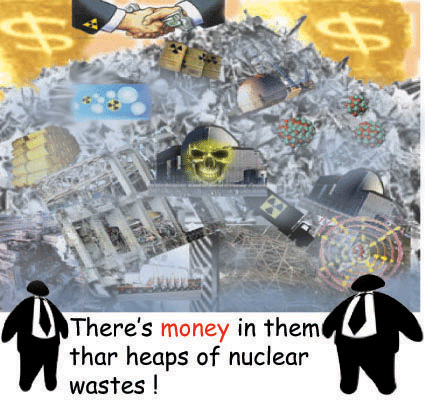
Choosing to do the initial work in a nuclear-free environment, Kurion designed and built the treatment system in Washington state’s Tri-Cities area and shipped it to Japan on a cargo plane. It arrived in July and began operating in October, after a series of tests.
“Our contract was to build it in America, using American nuclear standards that are equivalent to the Japanese standards,” McCormick said.
As McCormick does his work, he’s avoiding the public debate over whether Japan should restart some of the 48 nuclear plants that were shut down after the Fukushima disaster………
a recent poll found that most Japanese citizens want the plants to remain closed, fearing another catastrophe.
“We don’t even know the final disposal place of the Fukushima waste. We should discuss this after we decide where to dispose of the waste,” said Hatsuhiko Aoki, an artist from Gifu Prefecture. Yoshitaka Mukohara, the president of a publishing company and the secretary-general of the Anti-Nuclear Kagoshima Network, said the Abe administration was acting irresponsibly. “There are some places that are not decontaminated, but the government is sending people back,” Mukohara said. “What they are doing is acting like nothing ever happened.”
McCormick has no interest in weighing in on the controversy.
“It’s really a decision that the Japanese people have to make, in terms of how they get their energy,” McCormick said. “I’ve been focused on the cleanup.”
But McCormick said part of the work in Japan would involve building public support for the cleanup and convincing people that it was a long-term project.
It’s a skill he used at Hanford, lobbying Congress to include cleanup money in annual appropriation bills.
“The cleanup of Fukushima, if you compare it to Hanford, is on the same scale: tens of billions of dollars,” McCormick said. “And it’s going to take many decades to complete.” http://www.ledger-enquirer.com/2015/01/18/3520793/us-nuclear-cleanup-specialist.html
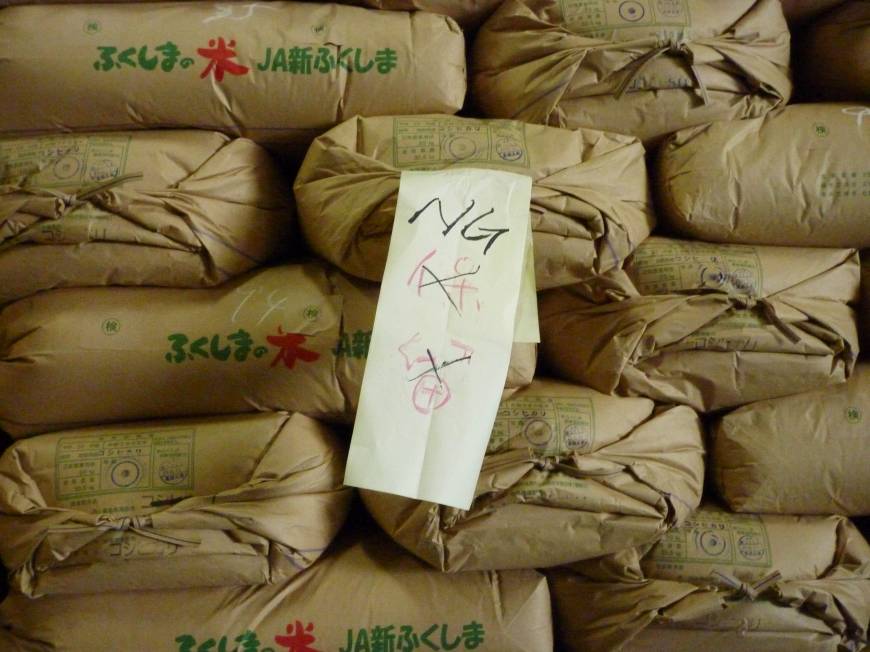
All 2014 Fukushima rice cleared radiation tests, thanks “supposedly” to fertilizer
Jan 18, 2015
All 2014 Fukushima rice cleared radiation tests, thanks to fertilizer
Fukushima Minpo
For the first time since the triple meltdown at the Fukushima No. 1 plant throttled the agriculture-reliant prefecture, all rice produced there last year cleared the required radiation tests.
The Fukushima Prefectural Government last year checked every bag of rice produced in the prefecture — some 10.75 million bags — based on the Food Sanitation Law, which bans the sale of rice radiating more than 100 becquerels of cesium per kilogram.
The tests found all bags checked from January 2014 through December 2014 had lower than standard radiation levels, in contrast with those tested in 2012 and 2013, which had a small percentage of rice unfit for shipment, the prefectural government said.
Officials said they hope the results will help raise consumer confidence in Fukushima rice, which was devastated by the nuclear disaster. Experts attribute the achievement to efforts to prevent cesium from entering rice fields during cultivation, and to the use of fertilizers based on potassium chloride, which prevents the grain from absorbing the isotope.
The tests, introduced in 2012, screen the bags on a conveyer belt. Bags sniffed out by the initial screening are tested further with precision instruments. Bags over the 100-becquerel cesium limit are discarded.
In 2012, a total of 10.35 million bags were tested and 71, or 0.0007 percent, failed.
In 2013, the failure rate was reduced to just 28 bags, or 0.0003 percent of the 11 million bags tested.
In 2014, 29 bags were flagged as suspicious by initial screening but later found to be below the cesium threshold.
Given that 867 bags were weeded out by initial scans in 2012, the 2014 results represent a major advance, they said.
To date, the rice farmers, prefectural government and local JA cooperatives have made joint efforts to promote fertilizers based on potassium chloride, which prevents rice from absorbing cesium.
The prefecture is shouldering all costs for the fertilizers. In 2014, it distributed ¥1.61 billion in subsidies to farmers to buy enough potassium chloride-based fertilizer to treat 68,000 hectares of paddies.
Research has shown putting potassium in soil prevents rice from taking in cesium. But it is important to keep the potassium levels high while rice is young. So farmers have been told to keep adding it.
Keisuke Nemoto, a professor at the University of Tokyo’s Laboratory of Crop Ecology and Morphology who is studying how cesium gets into rice, said the 2014 test results represent the fruit of the joint effort.
But Nemoto said his experiments showed that rice grown without potassium-based fertilizers still breaks the 100-becquerel cesium limit.
“Unless farmers keep adding potassium to soil every year, the chemical’s density in soil will decline and rice could start absorbing cesium again,” he warned.
This section, appearing every third Monday, focuses on topics and issues covered by the Fukushima Minpo, the largest newspaper in Fukushima Prefecture. The original article was published Jan. 9.
Source: Japan Times
Comments from Marushka France
STEP BACK AND READ, ANALYZE and CONSIDER:
1) Agricultural practices such as these, adding lime, potassium, phosphorus and/or organic materials to contaminated soils is… I repeat IS…. appropriate kind of measure to take!!
2) Testing rice with the appropriate equiment is very important.
Measuring the rice from outside a bag does not tell us the alpha and beta IN THE FOOD, very important that HOW food is tested and with what equipment… Very important
3) because Internal exposure – food and water — is 1,000X worse than external, according to WHO
4) Testing agricultural lands , treating with organic soils amendments after assessing the level of radioisotope contamination and the needs of the soils – and making that public information – is critical… for saving our planet, our food and water supplies and our lives.
It is the only way to restore confidence – in government and in media…. We have been lied to our entire lives. Only honest and full disclosure can restore and repair relationships.
Government . People . Journalism…
Reassess ourselves, reassess for one major reason
“Environmental problems…. contamination from multiple human activities like oil, gas, nuclear, petrochemicals, petroleum based agriculture
Poison, unbalanced, unsus-ainable, all of them
Incorporating an application of organic and mineral fertilizers reduces the levels of Cs137 and Sr-90 accumulation three- to fivefold in herbage grown in mineral soils. Such radical treatment of hayfields on peat soils sharply reduces Cs-137, but is less effective for Sr-90.
5) Owing to degradation of cultivated hayfields, repeated grassland renovation with an application of fertilizers is needed every 3 to 6 years.
As noted above, radiation protection measures are effectively applied in large stateowned and collective farms. In small privatesector households and farms, which in Belarus account for more than 50% of agricultural production, these measures are incidental.
Generally for each cow on a private Belarus farm
there is about 1 hectare of hayfield and improved pasture. This is not sufficient to sustain the animal so the farmers have to get hay
from grassy forest glades and unarable lands that are contaminated with higher levels of radioactivity than cultivated hayfields.
Thus a significant number of settlements, even 23 years since the catastrophe, had inadequate radiation protection for agricultural production.
There are more than 300 such settlements each in Belarus and Ukraine, and more than 150 in Russia (Kashparov et al., 2005). page 312 “Chernobyl: Consequences of the Catastrophe for People and the Environment” by Alexey Yablokov, Vasily Nesterenko and Alexey Nesterenko
NY Academy of Sciences, Volume 1181, 2009.
5,000 Slavic language studies reviews, over 1,400 cited.
http://www.strahlentelex.de/Yablokov_Chernobyl_book.pdf
Hard copy now available at Greko Printing P:734.453.0341;
email:orders@grekoprinting.com
Japanese version available at Amazon.jp – Chapter 4 (parts12-15) have not been included, ‘too long’.
Japanese government gives up its plan to begin transporting radioactive wastes to interim storage sites
 Ube : Gov’t to postpone moving radioactive waste to interim storage sites http://www.4-traders.com/UBE-INDUSTRIES-LTD-6491266/news/Ube–Govt-to-postpone-moving-radioactive-waste-to-interim-storage-sites-19704037/ 18 Jan 15 Environment Minister Yoshio Mochizuki said Friday the government has given up its plan to begin this month transporting radioactively contaminated soil and other waste, collected during decontamination work following the 2011 Fukushima nuclear crisis, to interim storage sites at nearby towns.
The government now aims to begin such transportation by March 11 this year on the fourth anniversary of the disaster at the Fukushima Daiichi nuclear power station, Environment Ministry officials said.
The delay was due to difficulties obtaining agreement from residents near the interim storage sites and local municipalities, the officials said.
Under the government plan, the radioactively contaminated waste will be kept in the interim facilities in the towns of Futaba and Okuma in Fukushima Prefecture and will be permanently disposed of outside the prefecture within 30 years, as requested by the Fukushima prefectural government in accepting the storage.
The site for final disposal of the radioactive waste has yet to be decided.
Meanwhile, Reconstruction Minister Wataru Takeshita offered an apology over the delay.
In October 2011, the government led by then Prime Minister Yoshihiko Noda released the target to begin the delivery of contaminated waste to interim storage sites in January 2015.
Robot technology for Fukushima nuclear clean-up operations
British robot maps radiation at Fukushima, Ft.com Tanya Powley, Manufacturing Correspondent , 18 Jan 15 A robot developed by a UK start-up is helping to locate hazardous radiation sources at the scene of the Fukushima disaster, the world’s worst nuclear accident since Chernobyl.
Createc, a small imaging company based in Cumbria, has developed camera technology called N-Visage for robots that can detect and draw a 3D map of high radiation locations that are too contaminated for human workers……..
Nuclear companies are turning to robotics as they look to deliver safer, faster and more cost-effective solutions for the £250bn worth of global nuclear decommissioning that is forecast to take place by 2030.
Hitachi-GE Nuclear Energy, which is leading the clean-up at Fukushima, deployed Createc’s N-Visage camera technology in stair-climbing robots to reach inaccessible areas deep inside the nuclear site. Fukushima was badly damaged by a tsunami in March 2011.
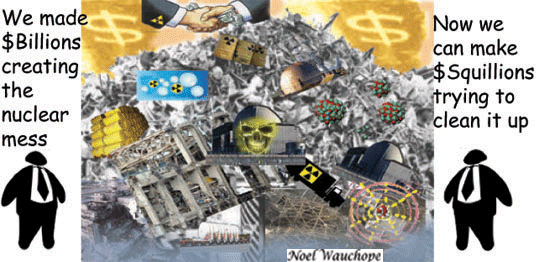 N-Visage is the only technology that has the right weight, speediness and capability for high radiation, said a spokesman for International Nuclear Services Japan. “N-Visage is very likely to be deployed not necessarily only at Fukushima but also at other nuclear facilities in Japan,” he said.
The N-Visage technology was first used at Britain’s Sellafield, western Europe’s largest nuclear waste site.
Operators at Fukushima are now using the N-Visage technology to understand where radioactive material is coming from inside damaged reactors and help plan clean-up strategies…….
Sylvain Du Tremblay, chief technical and engineering officer at Sellafield, believes the adoption of N-Visage at Fukushima shows the UK can lead in robotics technology for the nuclear industry. “We are using Sellafield facilities that are waiting to be dismantled to test and validate new technologies,” he said. http://www.ft.com/intl/cms/s/0/d2ca4690-85d9-11e4-a105-00144feabdc0.html#slide0
Nuclear meeting between USA and North Korea

 North Korea, US have nuclear meeting, SBS News, 18 jan 15
 The meeting was set to get a feel for each other’s positions amid a years-long standoff over the North’s nuclear weapons buildup. Leon Sigal, director of the Northeast Asia Cooperative Security Project at the Social Science Research Council, a US-based nonprofit, told reporters that the meeting will cover the North’s nuclear missile programs.
He said “it’s two ways of taking each other’s temperature.”
The US and North Korea have no formal diplomatic ties, but former US officials occasionally meet the North’s diplomats in a bid to settle the impasse over Pyongyang’s pursuit of a long-range nuclear-armed missile that could hit the US mainland. North Korea’s team was led by Ri Yong Ho, the chief negotiator for six-party denuclearisation talks……http://www.sbs.com.au/news/article/2015/01/18/north-korea-us-have-nuclear-meeting
China’s role in the nuclear marketing frenzy
 Chinese nuclear firms urged to boost presence overseas South China Morning Post 16 Jan 15 China will push its big nuclear firms to improve their competitiveness and boost their presence overseas as it bids to become one of the world’s dominant nuclear energy powers, Premier Li Keqiang said.
“To continue the struggle to become a strong nuclear energy power, China must comprehensively raise the industry’s competitive advantages, promote nuclear power equipment overseas…..
the country’s two biggest state nuclear companies, China National Nuclear Corp (CNNC) and China General Nuclear Corp (CGN), have agreed to invest in Britain’s Hinkley Point nuclear project.
Wang Zhongtang, the chief engineer at State Nuclear Power Technology Corp, said China was also well on its way to securing projects in Turkey and South Africa.
China has been making steady progress on its own third-generation reactors, including the Hualong I, jointly developed by CNNC and CGN for the purpose of winning overseas projects.
Zheng Hua, a deputy chief engineer with CGN’s reactor design unit, said last month that China hoped to develop Hualong I reactors in Britain, building on the agreement to invest in Hinkley Point.
China was also considering a plan to merge CNNC and CGN in order to pool their resources and improve their competitiveness overseas, sources said late last year. http://www.scmp.com/business/economy/article/1680957/chinese-nuclear-firms-urged-boost-presence-overseas
Japanese government mulls putting the nuclear financial burden on to consumers, as in UK

 Eiji Oguma: Planned protective measures show real cost of nuclear power Asahi Shimbun January 15, 2015 The industry ministry is discussing a new protective measure for nuclear power plants: the contract for difference (CfD) system.
The CfD, introduced in Britain, guarantees that electricity will be purchased at a fixed rate over a certain period of time.
The purchase price is calculated in consideration of the plant’s total cost, including future expenses, such as those for disposing of spent nuclear fuel and decommissioning reactors.
An agreement has been reached to apply the system to one nuclear power plant in Britain, with the reference purchase price set at 8.95 pence (around 15 yen or $0.13) per kilowatt-hour. That is higher than the corresponding price for a land-based wind farm, and comes with a longer guarantee period of 35 years.
A nuclear plant requires so much initial investment that there is no guarantee the cost will be recovered under the market economy. That is why the CfD and other protective measures for nuclear plants are being discussed in Japan ahead of the liberalization of the power retail market slated for 2016.
But various objections have been raised to the introduction of such measures.
First, the purchase price will likely be reflected in electricity rates, increasing the financial burden on consumers……….
Second, the decision process is not transparent………http://ajw.asahi.com/article/views/column/AJ201501150006
China well up in the throng to market nuclear technology to other countries
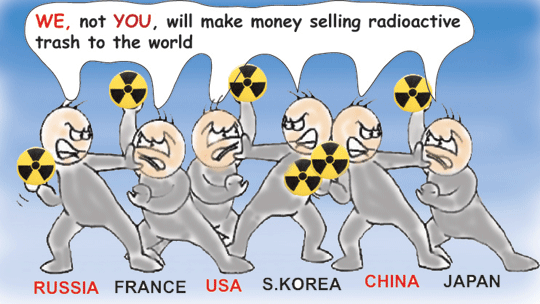
 China ready to sell nuclear fuel for NPPs in Ukraine and Eastern Europe — CNNC source http://itar-tass.com/en/world/771570 January 16, 15 Ukrainian energy sector workers are facing technical problems with American nuclear fuel loading into the Soviet-type reactors BEIJING, January 16. /TASS/. China is ready to sell fuel for nuclear power plants in Ukraine and Eastern Europe, a China National Nuclear Corporation (CNNC) source told TASS on Friday on the sidelines of the World Nuclear Spotlight forum.
According to the source, Chinese companies intend to sell the fuel to the countries that operate various types of Soviet-and Russian-made NPPs. Aside from Ukraine, China is viewing the possibility of exporting nuclear fuel to Hungary and Romania.
The source said Ukrainian energy sector workers are facing technical problems with American nuclear fuel loading into the Soviet-type reactors.
At the moment China is actively buying uranium mines with a view to exporting uranium to other countries in the foreseeable future. Asked about Russia’s possible claims to the Chinese manufacturers of nuclear fuel, he said that “there are no special restrictions.” “Despite the related agreements, the Russian side is unlikely to stop the supplies,” said the CNNC representative.
Russia and China have been actively developing co-operation in the nuclear sphere for many years. For example, State Atomic Energy Corporation Rosatom and CNNC signed a protocol to launch the discussion of possible formats of co-operation in the sphere of construction of nuclear power plants in third countries.
Record high radiation in Fukushima waste water -Cesium up 7,500% this week
 Huge radiation spike detected at Fukushima plant — Multiple records set near workers trying to stop nuclear waste flowing into ocean — Cesium up 7,500% this week http://enenews.com/huge-radiation-spike-detected-fukushima-plant-record-levels-workers-attempting-stop-radioactive-material-flowing-ocean-cesium-7500-week?utm_source=feedburner&utm_medium=email&utm_campaign=Feed%3A+ENENews+%28Energy+News%29
Tokyo Electric Power Company Press Release, January 12, 2015 (Google Translation):
For pumping water groundwater observation hole No.1-12 taken on January 12, cesium 134, cesium 137, cobalt 60 and total beta value is higher as compared with the previous value, the maximum value previously is detected.
 Cesium-134: 140 Bq/L [~7,500% above Jan. 5 level; new record high]
- Cesium-137: 470 Bq/L [~7,500% above Jan. 5 level; new record high]
- Cobalt-60: 1.9 Bq/L [Quadruple previous record high set in 2013]
- β (all beta): 15,000 Bq/L [~6,000% above Jan. 8 level; ~1,300% above previous record high]
Note that observation hole No. 1-12 is near the Unit 2 trench which is filled with thousands of tons of highly radioactive water. Tepco is attempting to seal the trench, but has failed to do so. According to page 2 of Tepco’s presentation to Japan’s Nuclear Regulatory Authority on Dec. 26, 2014 the only part of the trench that has been blocked is right next to No. 1-12 (see map on right).
China’s nuclear power delay – problems with its new Westinghouse Advanced Reactor

 China’s First Advanced Nuclear Reactor Faces More Delays Start-Up Now Unlikely Until 2016 at the Earliest WSJ By CHUIN-WEI YAP And BRIAN SPEGELE Jan. 15, 2015 BEIJING—China’s ambitions to be a leader in nuclear technology have been dealt a fresh blow, as construction of its most advanced reactor is facing a new delay.
The project—which China is developing with Westinghouse Electric Co. of the U.S.—faces new development problems and now isn’t expected to start up until 2016 at the earliest, the chief engineer at China’s state-owned reactor technology company said Thursday.
“We discovered some new problems during tests so we need to delay it more until next year,” Wang Zhongtang, chief engineer of China’s State Nuclear Power Technology Corp., said on the sidelines of an industry conference. Mr. Wang didn’t specify the nature of the latest problems found at ongoing trials for the reactor, nor did he provide a more precise time frame for its launch.
The delay is the second for the project, which had been slated to start by the end of 2013. It marks another setback for China’s clean-energy ambitions, as technical hurdles loom over Beijing’s aim to triple its nuclear power capacity by 2020…
….the delays have illustrated shortcomings in China’s nuclear sector, particularly when dealing with immature and first-of-a-kind technologies such as those found in the AP1000 reactor, said Li Ning, a nuclear-industry expert at China’s Xiamen University.
Chinese officials “are certainly very frustrated,” said Mr. Li. “I think they feel Westinghouse oversold the system, oversold the technology, promised more than they could really deliver.”………
China’s ambitions and vast market remain vital for the global nuclear industry. French nuclear engineering firm Areva S.A. , which lost out a key bid in 2007 to Westinghouse to build four reactors for China, is still seeking business there…….http://www.wsj.com/articles/chinas-first-advanced-nuclear-reactor-faces-more-delays-1421297393
Neutron radiation from Fukushima has been grossly underestimated
Fukushima Released 13,000,000,000 Times More Neutrons than Initially Estimated http://www.globalresearch.ca/fukushima-released-13000000000-times-more-neutrons-than-initially-estimated/5424619
 “Neutron radiation is the most severe and dangerous radiation” known to mankind January 14, 2015
We estimated a lower limit of 5.2 × 10²¹ slow neutrons m–2 sec–1 [m–2 sec–1 = per sq. meter per second] were emitted from the nuclear fuel rods to the sea water injected in the reactors
- Priyadarshi et al. (2011) have estimated a release amount of 4 × 10¹¹ slow neutrons m–2. The large difference with our estimation [13,000,000,000 times higher] comes from the intrinsic limit of the box model study by Priyadarshi et al.
- Our model directly estimates the amount of material released from the reactor core
- The estimated… number of neutron represent a lower limit of the amount of radiation emitted from the nuclear reactors… These values can be used as a proxy to the total amount of radiation emitted since the melt down
- [The authors] express their gratitude to… the Japanese Ministry of Environment…Ministry of Education, Culture, Sports, and Technology (MEXT)… [and] the Cabinet Office
Priyadarshi et al.: Evidence of neutron leakage at the Fukushima nuclear plant… Despite the obvious implication for human health… there are no quantitative estimates of the neutron flux leakage… [T]ons of seawater were used as a coolant… A consequence is that salts and minerals present in seawater become radioactive by reaction with thermal neutrons… We calculated the total number of neutrons that leaked from the reactor core [and] estimate that a total of 4 × 10¹¹ neutrons per m2 were released before March 20.
Office of Homeland Security & Emergency Coordination: Neutron radiation is a kind of ionizing radiation which consists of free neutrons… Neutrons readily pass through most material, but interact enough to cause biological damage. Neutron radiation is considered to be the most severe and dangerous radiation available. Neutrons can travel great distances…
Japan’s electricity consumers to pay half the $180+ cost of dismantling each nuclear reactor
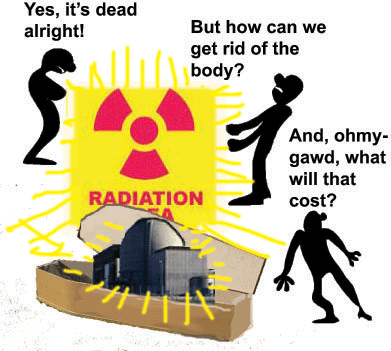 Japanese electric power consumers to share NPP dismantling costs It costs at least $180 million to decommission one reactor TOKYO, January 14. /TASS/. The costs of dismantling of outdated or unsafe nuclear power plants in Japan will be equally shared by the country’s electric power consumers, a working group of the economy, trade and industry ministry said on Wednesday………The government said nuclear power plants will be decommissioned when their authorized 40-year lifespans expire. Some 5 reactors are expected to be dismantled and the plans will be officially announced next month.
The loss due to decommissioning of one reactor is estimated at least at $180 million. Such expenses could deal a serious economic blow to private companies, which own the power reactors, and weaken the country’s economy in general.
Japan’s energy companies have submitted applications for another 19 reactors to resume their operations, but the process has been slowed down by safety checks and paperwork…….http://itar-tass.com/en/world/771074
Prime Minister Narendra Modi’s ally backs anti-nuclear movement to stop Jaitapur nuclear power project
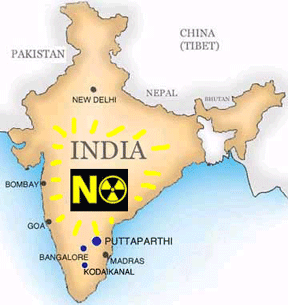 Notwithstanding PM’s nuke push, Sena to oppose Jaitapur plant Indian Express -By: Press Trust of India | Mumbai January 12, 2015 Notwithstanding Prime Minister Narendra Modi’s strong push for nuclear energy which he wants trebled by 2024, ally Shiv Sena today said it will continue to back those opposed to the 9,900 MW Jaitapur nuclear power project in Maharashtra.
“It has been our stand that Shiv Sena will support the locals of Jaitapur who have been opposing the plant. If there is an opposition, then why should we go against the will of the locals. After all, we are working for the development of the people,” senior Shiv Sena leader and state’s Industries Minister Subhash Desai told reporters.
Locals and anti-nuclear activists have been holding protests against the proposed plant over “scientific and environmental” concerns and Shiv Sena has been actively backing them.
“We (Shiv Sena) believe that if the need for power (for Maharashtra) is sufficed by other sources of energy including conventional and non-conventional resources, then why set up a destructive project,” he said.
Shiv Sena is a partner in BJP-led governments both at the Centre and in Maharashtra.The project is proposed to be set up in collaboration with French company Areva in the coastal Jaitapur village in Ratnagiri district. It will have six units of 1650 MW each built with Areva’s European Pressurised Reactor technology. JNPP would be one of the costliest nuclear power plant projects considering its sheer size and the new technology. – See more at: http://indianexpress.com/article/india/india-others/notwithstanding-pms-nuke-push-sena-to-oppose-jaitapur-plant/#sthash.aXD0KlPZ.dpuf
Futaba town accepts interim storage facilities
The Japanese government’s plan to build intermediate storage facilities for radioactive waste from the 2011 nuclear accident is set to move ahead, now that the candidate sites have accepted the plan.
The government wants to build facilities for storing contaminated soil and debris on a 16-square-kilometer site straddling the towns of Futaba and Okuma in Fukushima Prefecture. The 2 towns host the damaged Fukushima Daiichi nuclear plant.
Okuma accepted the plan last month. The mayor of Futaba made the same decision on Tuesday in Iwaki city, where most of the town’s residents have evacuated.
Those in favor of accepting the intermediate storage facilities say they will help speed up decontamination efforts in the region.
But others cite the risk of the intermediate facilities becoming permanent unless the government fulfills its promise to dispose of nuclear waste outside the prefecture.
The government plans to continue purchase negotiations with the site’s landowners. It is also working out safety arrangements with the prefecture and the 2 towns for the transportation of radioactive waste to the facilities.
Futaba Mayor Shiro Izawa said acceptance of the government’s plan is an unavoidable part of accelerating post-disaster rebuilding.
Source: NHK
http://www3.nhk.or.jp/nhkworld/english/news/20150113_26.html
1 This Month
15 October. Joint Appeal for Nuclear Abolition Day -presentation to the UN on October 15 will be live on UNWebTV
Endorse the Nuclear Abolition Day Appeal
23-25 October – on Zoom – World BEYOND War’s annual global conference

To see nuclear-related stories in greater depth and intensity – go to https://nuclearinformation.wordpress.com
-
Archives
- October 2026 (129)
- September 2026 (339)
- August 2026 (330)
- July 2026 (355)
- June 2026 (287)
- May 2026 (306)
- April 2026 (356)
- March 2026 (251)
- February 2026 (267)
- January 2026 (308)
- December 2025 (358)
- November 2025 (359)
-
Categories
- 1
- 1 NUCLEAR ISSUES
- business and costs
- climate change
- culture and arts
- ENERGY
- environment
- health
- history
- indigenous issues
- Legal
- marketing of nuclear
- media
- opposition to nuclear
- PERSONAL STORIES
- politics
- politics international
- Religion and ethics
- safety
- secrets,lies and civil liberties
- spinbuster
- technology
- Uranium
- wastes
- weapons and war
- Women
- 2 WORLD
- ACTION
- AFRICA
- Atrocities
- AUSTRALIA
- Christina's notes
- Christina's themes
- culture and arts
- Events
- Fuk 2022
- Fuk 2023
- Fukushima 2017
- Fukushima 2018
- fukushima 2019
- Fukushima 2020
- Fukushima 2021
- general
- global warming
- Humour (God we need it)
- Nuclear
- RARE EARTHS
- Reference
- resources – print
- Resources -audiovicual
- Weekly Newsletter
- World
- World Nuclear
- YouTube
-
RSS
Entries RSS
Comments RSS

