Japan’s manufacturing industries have adjusted, and thrive, without nuclear power
 Life without nukes: Japan Inc thrives, CNBC 12 Mar 15 Mia Tahara-Stubbs Tuesday, 10 Mar 2015 Japan’s economy is thriving despite the four-year shutdown of the country’s nuclear power stations following the massive earthquake and tsunami in March 2011, analysts say……..
“Japanese manufacturers have adapted to the 30 percent electricity price increase by cutting back on energy consumption,” said Japan Research Institute (JRI) chief researcher Takumi Fujinami. “Higher prices haven’t had much of an effect on manufacturers’ bottom lines because electricity represents only around 5 percent of raw material costs.”
Toyota, for example, which generates around a fifth of sales from the two million cars it makes in Japan every year, is forecast to post a 15 percent on-year jump in operating profit to 2.78 trillion yen ($22.9 billion) this fiscal year – its second straight year of record profits.
Still, Fujinami noted that manufacturers need to plan for higher energy costs going forward.
“The days of cheaper electricity are over and probably won’t be coming back,” he said. “It’s time for the Japanese economy to make the transition to a less industrial, more service sector-oriented economy.”…….
Ahead of December’s snap elections, Japan’s big business lobby Keidanren called on Prime Minister Shinzo Abe’s government to “provide the general public with a lucid explanation of the necessity of nuclear power” in order to “accelerate the process for restarting nuclear power plants,” according to a policy proposal published in October.
Abe has responded to business demands, pledging to begin putting nuclear reactors back online without setting any firm dates, but public sentiment remains a hurdle.
Fifty-six percent of respondents in a nationwide Nikkei newspaper poll conducted in August were opposed restarting the reactors, in line with other regional polls.
“The fact that there is still not a single reactor running in the country, in spite of the strong desire of the political and economic elites to bring back nuclear energy, attests to the continuous obstacles public opinion presents,” said Sophia University professor of politics Koichi Nakano.
Voters remain worried because the Fukushima plant does not appear to be “under control.”
Tokyo Electric Power Company – the operator of the Fukushima Daiichi nuclear plant – confirmed those fears last month, admitting that highly radioactive material has been seeping into the sea for nearly a year.
“Fukushima is obviously not under control and it’s out of the question that other reactors are restarted before it is,” said Coalition Against Nukes representative and National Confederation of Trade Union executive committee member Kenichi Igarashi……..http://www.cnbc.com/id/102494249#.
Four years later – all Japan’s nuclear reactors remain closed
“Some people will suffer a great deal if the nuclear power plants are not restarted. And those people are extremely influential in the corridors of power, and Prime Minister Abe is their man,”
Japan’s Nuclear Reactors Remain Offline 4 Years After Fukushima Meltdown VOA, Brian Padden March 11, 2015 SEOUL— In Japan thousands of people are still homeless and all of the nation’s nuclear reactors are still offline, four years after a magnitude 9.0 earthquake and tsunami caused the world’s worst nuclear disaster since Chernobyl. Japanese Prime Minister Shinzo Abe has promised a five-year reconstruction plan for the areas still devastated by the disaster, but he remains a nuclear energy advocate despite strong public opposition.
More than 120,000 residents who lived within 20 kilometers of Japan’s Daiichi Nuclear Power Plant in Fukushima were evacuated in March of 2011 after the damaged nuclear plant started leaking radiation.
These nuclear refugees still cannot return home because of high radiation levels, and they still worry about suffering from long-term health implications like cancer due to the radiation exposure.
Professor Jeff Kingston, the director of Asian Studies at Temple University Japan, said they have come to symbolize the danger of nuclear power.
“These people all understand very well about the myth of safety that the government and utilities have propagated over preceding decades,” said Kingston.
Prime Minister Abe vowed this week to come up with a new-five year plan to rebuild the Pacific coastal region that was ravaged by the tsunami. The government has reportedly already spent $50 billion in the hardest hit areas.
Japan has allocated more than $15 billion for a project to lower radiation in towns near the plant where radioactive trash is being kept in 88,000 temporary storage facilities.
Tokyo also plans to build a more permanent nuclear storage facility near the plant, despite opposition from some residents.
After the Fukushima disaster, all of Japan’s 48 nuclear reactors were shut down. They remain closed because of safety concerns and because opinion polls indicate more than 60 percent of the public now oppose nuclear energy.
Yet Abe, who recently won re-election by a wide margin, remains a nuclear power supporter. Professor Kingston said the prime minister’s unpopular stand was somewhat calculated in that it garnered him the support of business leaders with vested interests in the nuclear industry.
“Some people will suffer a great deal if the nuclear power plants are not restarted. And those people are extremely influential in the corridors of power, and Prime Minister Abe is their man,” said Kingston…….http://www.voanews.com/content/japan-observes-anniversary-of-earthquake-tsunami-disaster/2675471.html
Japan must face the problems and politics of demolishing dead nuclear reactors
 Questions remain over future plan for Japan’s aging nuclear plants Japan Times, 12 Mar 15 BY ERIC JOHNSTON As the debate about what to do with Japan’s aging nuclear reactors intensifies, questions remain about the ramifications of decommissioning plants, and how to tear down the facilities in a way that’s efficient, affordable, safe, and that has the support of the local community.
In the United Kingdom, these concerns formed the basis of a policy that has led to the decommission of numerous power stations, two of which began operating in the 1950s……
Seven of Japan’s 48 commercial reactors are at least 40 years old — in principle their maximum operating life. Another five are at least 35 years old and their fate will have to be decided within the next few years.
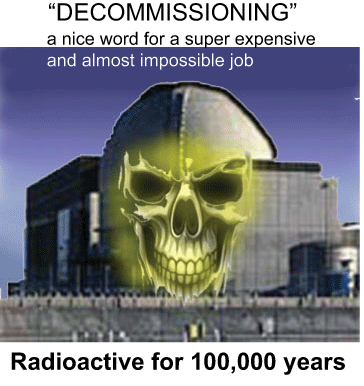
Kyushu Electric plans to decommission the 40-year-old Genkai No. 1 plant, while Kepco is expected to shut down the Mihama No. 1 and 2 reactors, both of which are over 40 years old. Chugoku Electric plans to decommission the 41-year-old Shimane No. 1 reactor, while the Tsuruga No. 1 reactor, which is 45 years old and run by Japan Atomic Power, will be closed.
Decommissioning a plant is a decades-long process that does not necessarily immediately involve the most crucial step of tearing down the reactors and hauling away radioactive material.
“During the decommissioning of the Berkeley power station in southwest England, we’ve left the reactor building standing because it’s safer to remove the nuclear material in another 60 years,” Franklin said. “We’ve closed the doors on the reactor building until 2074.”
However, he acknowledged publicly visible gestures were important because they could help reassure local communities that the plant was actually being dismantled.
“A skyline change helps garner support for the decommissioning process and for difficult decisions, such as not tearing down and hauling away nuclear materials in reactor buildings,” he said.
“In one case, we destroyed the plant’s cooling towers, which were not actually a major hazard but could be seen for miles. If you live nearby and you see them come down, you feel progress is being made, and that’s more effective than simply telling people about the progress.”
Perhaps the biggest lesson the U.K. learned was that effective decommissioning starts with addressing the corporate and bureaucratic culture at a nuclear plant.
“Changing your culture from making something — electricity — to actually taking power stations down requires a huge cultural change on a nuclear site. That’s something we’re really working on sharing with Japanese nuclear operators,” Franklin said. http://www.japantimes.co.jp/news/2015/03/11/national/questions-remain-over-future-plan-for-japans-aging-nuclear-plants/#.VQH9CNKUcnk
Pro nuclear signs to be removed from deserted town of Futaba
Deserted Fukushima town to remove pro-nuclear signs 7 News, Tokyo (AFP) 10 Mar 15 – A Japanese town that was evacuated after the 2011 Fukushima nuclear disaster has decided to remove street signs trumpeting the benefits of atomic power, an official said Tuesday.Deserted Futaba town, which plays host to the crippled Fukushima Dai-ichi nuclear power plant, is set to earmark cash to remove huge signboards erected in 1988 and 1991, a town official told AFP.
“Nuclear power: the energy for a bright future,” says one sign written in the style of a haiku poem at the entrance to the town. “Nuclear power: for development of our homeland, a prosperous future,” reads the other.
Futaba’s 6,300 residents were ordered to flee their homes in the days after reactors began melting down at Fukushima when an enormous tsunami swamped their cooling systems.
They are still unable to return because of fears over elevated levels of radiation that leaked from the plant, and many remain in poorly-constructed temporary homes…….
0,000 people remain displaced because of the no-go zone around the plant.
Scientists warn that it may be many years until it is safe to return and say that some areas may have to be abandoned forever.
Campaign groups say unemployment is high and levels of depression and other illness are far above normal in displaced communities. https://au.news.yahoo.com/world/a/26585240/deserted-fukushima-town-to-remove-pro-nuclear-signs/
Video: Fukushima had “meltdown, melt-through, & melt-out within days of quake”
 Video: Fukushima had “meltdown, melt-through, & melt-out within days of quake” — US Gov’t: Analysis says containment vessel fails after fuel melts through barrier — Experts: Corium may have melted out to reactor building, prepare for radiation doses over 200,000,000 microsieverts/hour http://enenews.com/video-fukushima-meltdown-melt-melt-days-quake-govt-analysis-shows-containment-vessel-failed-after-fuel-melted-barrier-experts-corium-melted-container-reactor-building-prepare-radiation-levels-20?utm_source=feedburner&utm_medium=email&utm_campaign=Feed%3A+ENENews+%28Energy+News%29
Jiji Press, Mar 5, 2015 (emphasis added): Where is the melted fuel in the stricken reactors at Fukushima No. 1? This remains a question… cosmic rays [are being used] to “see through” the reactors… [Prof. Fumihiko Takasaki of the High Energy Accelerator Research Organization calls the] nuclear disaster a “national crisis”… muon detectors were… placed last July at reactor No. 1… As detector units can’t be placed underground at reactor 1, any melted fuel in the underground part of the reactor will go undetected.
Science (AAAS), Mar 5, 2015: Fukushima Daiichi… won’t be truly safe until engineers can remove nuclear fuel… But first, they have to find that fuel… [TEPCO] thinks… fuel in the Unit 1… dropped to the bottom of the containment… engineers need much more detail about its location and condition… By the end of this month, Takasaki says, the detectors may have absorbed enough muons to confirm there is no fuel left in the reactor core… [Detectors]won’t be able to map fuel that may have flowed to the bottom of the containment vessel.
Wall St Journal: Fuel rods… melted fully out of their pressure vessel [says Tepco]… but it likely stopped as Tepco began [injecting] seawater [See: Tepco: We should have told public this sooner… water injections failed to cool melted fuel]… Edwin Lyman, a senior scientist with the Union of Concerned Scientists, says it remains unclear why the fuel rods didn’t also breach the containment wall. “Why this didn’t happen is still unknown”…
U.S. NRC — State-of-the-Art Reactor Consequence Analyses (SOARCA) Report (pdf), Oct 2012: Fukushima Daiichi… presented… many insights with potential parallels to SOARCA’s analysis of… Peach Bottom, a similarly designed plant… in the SOARCA scenarios, significant hydrogen release [begins with] failure of the containment pressure boundary, which… results from molten debris failing the drywell liner… (i.e., drywell liner melt-through)… TEPCO has announced… the fuel did not move laterally across the drywell floor [and melt through the liner]… In the analyses presented in this report, hydrogen [was] released via the failure of the drywell liner by melt-attack.
Argonne National Lab (USA), MCM (Switzerland), Sep 2014: location of 1F corium — Critical questions relate to the extent of core melt and the extent to which it has melted through RPV and penetrated into the primary containment… “hot particles”… may be throughout the reactor building [and] water collection system and even released to surroundings… Identification of hot particles… is going to be critical for safe decommissioning… [the equipment] must withstand extremely high radiation – perhaps up to greater than 200 Sv/hr.
More from MCM: Most molten core appears to be contained within the primary containment, although a very small extent of melt-through to… cannot be precluded.
Symposium sponsored by Consortium for Japan Relief — Chim Pom, published Feb 2015: “Media never reported that the whole process — meltdown, melt-through, and so-called melt-out — happened, was done within a few days after the earthquake.”
Japan’s piles of radioactive trash
Radioactive Fukushima, Asia One Reuters, Mar 11, 2015 “…..Today, four years after the disaster, residents are torn over government’s plan to build a radioactive waste storage site in the shadow of the wrecked nuclear plant, reported Reuters.
Norio Kimura, 49, who lost his father, wife and daughter in the tsunami, walks to where his house used to stand before it was washed away by massive waves.
Kimura knows the brokers are circling, ready to offer a deal for his land to build the waste storage facility.
He has vowed not take it.
“I can’t believe they’re going to dump their trash here after all we’ve been put through,” he told Reuters.
Japan has allocated more than US$15 billion (S$20.7 billion) to an unprecedented project to lower radiation in towns around Fukushima. Every day teams of workers blast roads with water, scrub down houses, cut branches and scrape contaminated soil off farmland.
That irradiated trash now sits in blue and black plastic sacks across Fukushima, piled up in abandoned rice paddies, parking lots and even residents’ backyards.

Tokyo plans to build a more permanent storage facility over the coming years in now-abandoned towns close to the Fukushima nuclear plant – but like Kimura, many locals are angry that the government is set to park 30 million tons of radioactive debris on their former doorstep.
According to Reuters, some 2,300 residents who own plots of land in Futaba and Okuma which the government needs for the waste plant face what many describe as an impossible choice. The storage site will be built if the government can lease or buy enough land – whatever concerns the last hold-outs may have.
– See more at: http://news.asiaone.com/news/asia/radioactive-fukushima#sthash.gzfTklgA.dpuf
China’s slow nuclear start: approves first nuclear project since Fukushima
China approves first nuclear project since Fukushima http://www.reuters.com/article/2015/03/10/china-nuclear-approval-idUSL4N0WC3N620150310 China has given the go-ahead for the launch of a major domestic nuclear power project, marking the first such approval since a temporary freeze on new construction following Japan’s Fukushima disaster.
China General Nuclear Power Group has received state approval to build two one-gigawatt (GW) reactors in the second phase of a project called Hongyanhe in the northeastern province of Liaoning, the Xinhua news agency reported on Tuesday.
The project will use what the company calls home-grown “third-generation” reactor technology, dubbed ACPR1000, the report said, citing Yang Xiaofeng, general manager of the Hongyanhe project.
China froze new construction and implemented a year-long safety review after the Fukushima disaster in 2011.
While it lifted the construction ban at the end 2012, China has been slow to approve new nuclear projects. Beijing has promised to stick to the highest safety standards, using third generation reactors.
In an estimated $100 billion expansion programme, China aims to raise its domestic nuclear power capacity to 58 GWs by 2020 from 20.3 GW at the end of 2014. Nuclear capacity would still only meet 3 percent of China’s total electricity needs by 2020.
 China is also seeking to export its home-grown third-generation reactors, such as Hualong 1 and CAP1400, to an overseas market potentially worth hundreds of billions of dollars.
But industry executives and analysts say it faces a major obstacle: it needs to show it can build and safely operate these reactors at home first.
China General Nuclear is the state-owned parent of CGN Power , which raised $3.2 billion in an initial public offering in Hong Kong in December. (Reporting by Charlie Zhu in Hong Kong and David Stanway in Beijing; editing by David Clarke)
1,232 deaths in 2014 in Fukushima Prefecture linked to nuclear disaster
Deaths tied to Fukushima nuclear disaster up 18% Press TV 11 Mar 15 A fresh report in Japan shows the number of deaths by radiation from the country’s Fukushima nuclear power plant disaster in 2011 increased by 18 percent last year.
The report published on Tuesday by the Japanese newspaper Tokyo Shimbunsaid figures from authorities in Fukushima Prefecture showed a total of 1,232 deaths in 2014 were linked to the nuclear disaster.
The highest number of fatalities occurred in the town of Namie near the Fukushima Daiichi Nuclear Power Station, with 359 deaths, followed by 291 cases in Tomioka town also near the plant.
Nuclear radiation exposure can cause serious health problems. The first signs of nuclear radiation exposure are nausea and vomiting.
Exposure increases the probability of developing some other diseases, mainly cancer, tumors, and genetic disorders……..http://www.presstv.ir/Detail/2015/03/10/401156/Deaths-tied-to-Fukushima-disaster-up-18
New Report: State of Affairs and Ongoing Challenges of the Fukushima Nuclear Disaster
Greetings! This is Komei Hosokawa, secretary general of the Citizens’ Commission on Nuclear Energy (CCNE), Japan.
I am pleased to inform you that a special English edition of the CCNE’s report will be launched on the occasion of the 4th anniversary of the beginning of the Fukushima nuclear disaster and also on the occasion of the United Nation’s 3rd World Conference on Disaster Risk Reduction (WCDRR), to be held in Sendai, Japan, not very far from Fukushima.
The report, entitled The State of Affairs and Ongoing Challenges of the Fukushima Nuclear Disaster: a Civil Society Response Towards Recovery, intends to answer questions such as:
- – What have been the impacts of the Fukushima nuclear disaster?
- – What is the current condition of the victims of the nuclear disaster?
- – What is going on at the nuclear plant site and what risks still exist?
- – What mistakes did authorities make in response to the nuclear disaster?
- – What countermeasures are now necessary to cope with the situation?
A PDF is already available for download from the CCNE website (www.ccnejapan.com/eng/policy_outline_0-2.pdf ).
This special edition is a provisional and partial translation of the comprehensive Japanese report, Our Path to a Nuclear-Free Japan: Policy Outline for a Nuclear Phaseout, published in April 2014 by the Citizens’ Commission on Nuclear Energy (CCNE), Tokyo. The full report comprises seven chapters, of which the first three chapters have been translated into English to meet the special interests of the WCDRR delegates as well as experts on disaster control and prevention tasks worldwide.
The translated chapters are as follows:
Prologue: Why Should We Aim for a Nuclear-Free Society?
Chapter 1: An Overview of the Damage Caused by the Fukushima Nuclear
Power Plant Accident and the “Restoration of Humanity”
Chapter 2: The Actual State of the Fukushima Daiichi Nuclear Power Plant
Reactors and Issues Surrounding the Accident Settlement
Update information has been added to help readers understand more recent developments in the issues.
The remaining chapters deal with radioactive waste issues (Chapter 3), regulation standards, seismological issues and contingency planning (Chapter 4), financial considerations and sustainability issues (Chapter 5), and the democratic process towards the energy shift (Chapter 6). The full English edition will appear by July 2015. An executive summary in English covering all the chapters is already available at the CCNE website ( www.ccnejapan.com/?p=2048 ).
The Japanese Government and the organisers of WCDRR 2015 are inclined to exclude topics related to the nuclear disaster from the conference agenda. This avoidance is quite inappropriate, unprofessional and unethical, given that the convention this time is being held in the region severely affected by the Great East Japan Earthquake of 2011, which resulted in an unprecedented complex disaster of quake, flood and radioactive fallout. Even after four years now, more than 120 thousand people are still in exile from the nuclear disaster exclusion zones. It should also be reminded that the state of nuclear emergency declared by the Japanese Government in March 2011 has not yet been lifted. The disaster is far from over; the victims need care and support; and the Fukushima Daiichi plant is still in the middle of the hard struggle to bring the accident to an end (the question being when and how).
I hope the CCNE report will give you a clear idea about the actual state of affairs of the Fukushima nuclear disaster. Please circulate widely; for more information, contact me or the CCNE secretariat in Tokyo ( email@ccnejapan.com ).
- Hosokawa, MA, PhD
Professor, Dept of Environmental & Social Research,
Kyoto Seika University, 606-8588 Japan
Co-chair, Greenpeace Japan, Inc.
http://www.greenpeace.org/japan
Co-chair, Pacific-Asia Resource Center (PARC)
http://en.parc-jp.org:8080/en
Chief Secretary, Citizens’ Commission on Nuclear Energy (CCNE)
http://www.ccnejapan.com/?p=2048
Editor, MagpieNews, Nukes Headliner from Japan
Nobel-winner Kenzaburo Oe urges Japan to quit nuclear power
Nobel-winner Oe: Japan should follow Germany, quit nuclear, Yahoo News By MARI YAMAGUCHI 10 Mar 15 TOKYO (AP) — Nobel-winning author Kenzaburo Oe said Tuesday that Japan’s push to restart some nuclear reactors following the Fukushima disaster could lead to another crisis, and urged Prime Minister Shinzo Abe to follow Germany’s example and phase out atomic energy.
Oe’s remarks to reporters came a day after visiting German Chancellor Angela Merkel said she had decided to end her country’s use of nuclear energy by 2022 because the Fukushima crisis convinced her of its risks…….
Oe, 80, said his life’s final work is to strive for a nuclear-free world.
“We must not leave the problem of nuclear plants for the younger generation,” he said.
The winner of the Nobel literature prize in 1994, Oe has campaigned for peace and anti-nuclear causes, particularly since the Fukushima crisis, and has often appeared in rallies. http://news.yahoo.com/nobel-winner-oe-japan-germany-quit-nuclear-111137853.html
Pakistan earthquake prone, non signatory to NPT -but China is building nuclear reactors there
 China Builds Nuclear Reactors in Earthquake-Prone Pakistan by Nick Cunningham Oil Price.com e, 10 March 2015
China has decided to defy international norms and build new nuclear reactors in Pakistan.
While the U.S. and Europe see stagnant growth for commercial nuclear power, the same is not true in Asia. China is not only building nuclear reactors at home, but it is exporting its technology abroad. Of particular concern is its construction of nuclear reactors in Pakistan. China helped build two reactors at Chashma, which came online in 2000 and 2011 respectively. More recently, it has decided to double the size of the Chashma power plant, with two additional reactors under construction. And it is also constructing a new nuclear power plant near Karachi, using China’s next generation ACP-1000 design.
But China’s plans in Pakistan are facing global criticism.
The problem is that Pakistan is not a signatory of the nuclear non-proliferation treaty (NPT), which should disqualify it for any international help in building nuclear power plants. The Nuclear Suppliers Group (NSG) is a coalition of nuclear technology exporting countries who have banded together to create guidelines and norms around the sale of nuclear technology in order to ensure its safe use while guarding against the spread of nuclear weapons capabilities. One of the core tenets of the NSG is to not trade nuclear technology to countries that have not signed up to the NPT. Pakistan is one of the world’s four remaining holdouts to the NPT (the other three are India, Israel, and South Sudan).
That is why China’s decision to build nuclear reactors in Pakistan has received criticism. As a member of the NSG, China is defying the guidelines on nuclear trade. China says that its promise to Pakistan predates its 2004 accession to the suppliers group……..http://oilprice.com/Alternative-Energy/Nuclear-Power/China-Builds-Nuclear-Reactors-in-Earthquake-Prone-Pakistan.html
Chinese physcst points out the danger of inland nuclear power plants
CPPCC eyes inland nuke power By Cao Siqi Source:Global Times 2015-3-11 :”………..He Zuoxiu, a theoretical physicist with the Chinese Academy of Sciences, argued against the proposal.
Compared with coastal plants, inland nuclear plants have more complicated requirements where location and geological conditions are concerned, and authorities must take population growth into careful account, as well as emergency evacuation and radioactive exhaust emissions, said the physicist.
He Zuoxiu added that such projects would carry with them tremendous potential danger, which in turn necessitates thorough consideration prior to any construction.
Massive buildup of radioactive debris at Fukushima No 1 nuclear plant
FOUR YEARS AFTER: Radioactive debris continues to stack up at Fukushima No. 1 nuclear plant http://ajw.asahi.com/article/0311disaster/fukushima/AJ201503080013 March 08, 2015 By HIROMI KUMAI/ Staff Writer
FUTABA, Fukushima Prefecture–With nowhere to put it, refuse and debris contaminated with radioactive materials continue to pile up at the crippled Fukushima No. 1 nuclear power plant here.
A total of 258,300 cubic meters of radioactive debris was produced from the March 2011 accident to the end of this January in the plant, where decommissioning work is under way.
The amount is equivalent to the capacity of about 650 25-meter-long swimming pools.
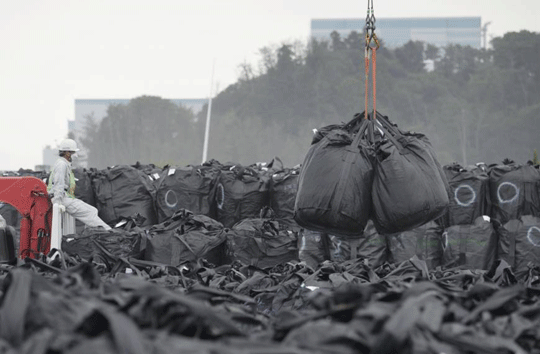
Of the 258,300 cubic meters, 178,600 cubic meters were mainly debris that had been scattered around reactor buildings, wood refuse produced in the work in the plant and protective suits used by workers, according to the plant’s operator, Tokyo Electric Power Co.
The remaining 79,700 cubic meters were trees that were felled to create space for tanks storing radioactive water. There were also 1,846 objects that absorbed radioactive materials from contaminated water.
According to the road map worked out by the government and TEPCO, the basic plan for disposing of the radioactive waste will be released in fiscal 2017.
Worldwide effect of Fukushima radioactive plume
 UCLA Researchers: Fukushima “not only affecting that local area, but also worldwide” — Gov’t Expert: “Immediately the Iodine-131 plume moved eastward reaching US West Coast [then] covering entire northern hemisphere… Significant concern on the safety of the population and environment worldwide” (VIDEO) http://enenews.com/ucla-researchers-fukushima-only-affecting-local-area-worldwide-govt-expert-immediately-iodine-131-plume-moved-eastward-reaching-west-coast-covering-entire-northern-hemisphere-early-april-posing-sig?utm_source=feedburner&utm_medium=email&utm_campaign=Feed%3A+ENENews+%28Energy+News%29 8 March 15
In the Fukushima Disaster Zone with UCLA researchers, Mar 3, 2015: Four years after Fukushima disaster, some areas remain untouched, clocks recording the exact time that the tsunami swept through. Access is highly restricted but two UCLA researchers were recently given permission to document the disaster zone. — at 3:45 in — “With this study I think that’s what we’re trying to explore — is that once a nuclear catastrophe strikes, it’s not only affecting that local area, but also worldwide.”
Atmospheric dispersion of Iodine-131 released after the Fukushima event, by Giuseppe A. Marzo, ENEA (Italian National agency for new technologies, Energy and sustainable economic development), 2014: From March 12, 2011, a significant amount of radioactive material… discharged into the atmosphere… Total emission of 131I has been estimated in [128** petabecquerels (PBq)], while 133Xe, and 137Cs total emissions have been estimated in [15,300 PBq and 36.6 PBq], respectively. In this work the global atmospheric dispersion of 131I released by the Fukushima accident is carried out, focusing on this specific radionuclide due to its radiological relevance in terms of consequences on the human health… Figure 1 summarizes the simulation results. It illustrates the radioactivity concentration due to 131I released into the atmosphere at specific times and integrated over the total atmospheric column. Immediately after the initial release on March 12, the plume moved eastward reaching the United States west coast on [March 15 at 10:00p PST]… In early April the plume extended over the entire northern hemisphere… A significant accidental event occurred at the Fukushima NPPs… volatile radionuclides such as 131I were transported away from the source posing significant concern on the safety of the population and the environment worldwide… the atmospheric dispersion of 131I [was] covering the entire northern hemisphere by early April…
**According to a document released by TEPCO, “Our result shows a higher I-131 amount (500PBq) compared to the result obtained from a thirdparty organization (120-200PBq).”
Japanese government to start campaign to encourage hosting of nuclear wastes
 Government to start campaign on nuclear waste disposal sites , Japan Times, 9 Mar 15 KYODO The government plans to launch a campaign in major cities to promote the need for permanent disposal facilities for high-level nuclear waste from power plants, sources close to the matter said Saturday.
Prime Minister Shinzo Abe’s administration is looking to restart nuclear plants shut after the Fukushima disaster, and has faced criticism over promoting nuclear power without resolving where the waste will ultimately be disposed.
Symposiums are planned for Sapporo, Sendai, Tokyo, Nagoya, Osaka, Fukuoka and roughly four other cities, hosted by the Ministry of Economy, Trade and Industry and the Nuclear Waste Management Organization of Japan, which was previously solely responsible for the disposal plan……..
The government is also considering launching an information campaign on social networking services, with the details to be discussed at a METI task force meeting set for Tuesday, the sources said.
The current disposal policy, adopted in 2008, calls for waste to be vitrified and placed in facilities deep underground. Revisions to the policy at the end of the month are expected to include the selection of candidate sites on scientific grounds, without waiting for local authorities to volunteer to host the facilities. http://www.japantimes.co.jp/news/2015/03/08/national/government-start-campaign-nuclear-waste-disposal-sites/#.VPy51tKUcnk
-
Archives
- October 2026 (129)
- September 2026 (339)
- August 2026 (330)
- July 2026 (355)
- June 2026 (287)
- May 2026 (306)
- April 2026 (356)
- March 2026 (251)
- February 2026 (267)
- January 2026 (308)
- December 2025 (358)
- November 2025 (359)
-
Categories
- 1
- 1 NUCLEAR ISSUES
- business and costs
- climate change
- culture and arts
- ENERGY
- environment
- health
- history
- indigenous issues
- Legal
- marketing of nuclear
- media
- opposition to nuclear
- PERSONAL STORIES
- politics
- politics international
- Religion and ethics
- safety
- secrets,lies and civil liberties
- spinbuster
- technology
- Uranium
- wastes
- weapons and war
- Women
- 2 WORLD
- ACTION
- AFRICA
- Atrocities
- AUSTRALIA
- Christina's notes
- Christina's themes
- culture and arts
- Events
- Fuk 2022
- Fuk 2023
- Fukushima 2017
- Fukushima 2018
- fukushima 2019
- Fukushima 2020
- Fukushima 2021
- general
- global warming
- Humour (God we need it)
- Nuclear
- RARE EARTHS
- Reference
- resources – print
- Resources -audiovicual
- Weekly Newsletter
- World
- World Nuclear
- YouTube
-
RSS
Entries RSS
Comments RSS

