More residents joining lawsuits seeking damages from South Korean nuclear plants
 Hwang Bun-hui, a plaintiff in nationwide lawsuits against the government-owned operator of nuclear power plants in South Korea, stands in front of the Wolseong nuclear power plant in Gyeongju.
GYEONGJU, South Korea–For three decades after a nuclear power plant near her home became operational, Hwang Bun-hui believed that nuclear power was no different from other energy sources in terms of safety and health effects.
But after the Fukushima nuclear disaster unfurled in Japan in March 2011, she came to harbor a growing concern over the effects that nuclear power generation has on human health as she had long suffered from a feeling of listlessness.
After a medical checkup, Hwang, 67, a resident of Gyeongju, was diagnosed with thyroid cancer and had to have immediate surgery to remove the tumor. Several other people from her village, which is the closest human settlement to the Wolseong nuclear power plant, were also diagnosed with thyroid cancer.
Hwang is among an increasing number of South Koreans who live near the country’s four nuclear power plants and are joining civil suits against the operator of the plants, demanding compensation for cancer and other adverse health effects.
The citizen’s legal actions were prompted by a landmark ruling by a district court last October, which ordered Korea Electric Power Corp., the government-owned operator of the nuclear plants, to pay 15 million won (1.68 million yen, or $13,500) in damages to a thyroid cancer patient.
The number of plaintiffs seeking compensation from KEPCO for health damages incurred by radioactive emissions from the plants has now swelled to more than 2,500.
Hwang joined the lawsuit late last year, encouraged by the landmark ruling by the Busan District Court.
In demanding compensation from KEPCO, she argues that radioactive emissions from the Wolseong nuclear power plant in Gyeongju, with its five reactors, have caused her thyroid cancer.
Hwang’s residence is located just 915 meters from the nuclear plant. The country’s nuclear watchdog authorized the extension of the operational life of the plant’s No. 1 reactor beyond 30 years in February.
While seeking damages through a civil trial, Hwang has also joined a local residents’ protest to demand the immediate decommissioning of aging reactors at the plant.
After she read the headlines of the landmark ruling in favor of the resident of Busan, Hwang realized that, “I’m equally a victim of a nuclear power plant.”
The 48-year-old plaintiff lived at a site located 7.7 kilometers from the Kori nuclear power plant in Busan for about two decades, and had her thyroid cancer surgically removed three years ago.
Citing a judicial precedent set by the Supreme Court in a pollution case, the Busan District Court held KEPCO responsible to pay damages unless it could prove that a nuclear power plant is safe for local residents.
The ruling brought similar civil actions among residents who live near four nuclear power plants in South Korea.
Between December and April, 545 residents living near the nuclear plants, who have been diagnosed with thyroid cancer, joined lawsuits. Most of the plaintiffs live in areas within a 10-km radius from a nuclear power plant.
The total number of plaintiffs, including the family members of cancer patients, has already exceeded 2,500.
Lawyer Kim Yeong-hui, who has encouraged residents living near nuclear plants to join the litigation, said that epidemiological surveys in South Korea have shown that residents living 5 to 30 km from nuclear power plants have 1.8 times a higher incidence of thyroid cancer than people from other areas.
“The district court made the decision based on the survey results, and Japan should also conduct surveys covering residents living near all domestic reactors (to determine the health effect of nuclear energy),” the lawyer said.
At a gathering of anti-nuclear citizens in Osaka in January, Lee Jin-seop, the husband of the plaintiff who won the lawsuit at the Busan court, said that citizens from the two countries and elsewhere need to join hands in legal efforts against nuclear power.
“Even after the Fukushima disaster, South Korea has increased its number of nuclear reactors, while Japan is pushing for the restart of idled reactors,” said Lee, 51. “We need to expand the network of citizens seeking legal justice to protect our safety and health.”
Source: Asahi Shimbun
http://ajw.asahi.com/article/asia/korean_peninsula/AJ201507150007
Cesium-134/137 measured over 200 percent of safety level from Fukushima rice

“To not be distributed”: unfortunately nothing can stop unscrupulous merchants to distribute it under false labeling of the origin, or to “dilute” its radiation level by mixing it with another rice to lower its radiation level below the safety level, to be sold then on the national market or to be exported to other countries…
According to Ministry of Health, Labour and Welfare, excessive amount of Cs-134/137 was detected from two unpolished rice samples produced in Fukushima city.
The rice was experimentally produced but not distributed, the farmer states. The highest reading was 220 Bq/Kg in total of Cs-134/137. The safety limit is supposed to be 100 Bq/Kg.
The sample was brought to Fukushima Agricultural Technology Centre this July.
http://www.mhlw.go.jp/file/04-Houdouhappyou-11135000-Shokuhinanzenbu-Kanshianzenka/0000091483.pdf
http://jishin-yogen.com/blog-entry-7178.html
Source: Fukushima Diary
Cesium-134/137 measured over 200 percent of safety level from Fukushima rice
Nuclear fuel core melted through bottom of Fukushima reactor – documents show
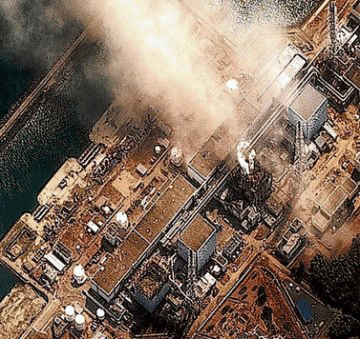 Document shows nuclear fuel burned through bottom of containment vessel under Fukushima reactor — Official: Leakage we observed indicates melt-through by ‘shell attack’ — “This is a very big problem… fuel debris in the PCV is doing something bad” (VIDEO) http://enenews.com/official-document-shows-molten-nuclear-fuel-burned-bottom-containment-vessel-fukushima-tepco-leaks-coming-reactor-indicate-melt-shell-attack-very-big-problem-fuel-debris-pcv-doing-bad-video?utm_source=feedburner&utm_medium=email&utm_campaign=Feed%3A+ENENews+%28Energy+News%29
[Good diagrams]
Shunichi Suzuki, Tokyo Electric Power Co., 2014 IRID Symposium (emphasis added):
• Part 30 – “This is the current situation… This is Unit No. 1, this shows the the lower part of the PCV [primary containment vessel]… Based on the results of research so far… the ‘sand cushion drain’… water is leaking here, which means that this section above there is damaged — so that is highly possible. Therefore, this is a very big problem, because if this is damaged, then one possibility is that shell attackhas happened [see drawing by General Electric at bottom right]. So the debris in the PCV is doing something bad to this, so we have to take that into consideration for investigation.”
• Part 31 – “Unit 2… the water level [in the suppression chamber] and the water level in the torus room is about the same . What that means is that at the bottom [of the S/C], there could be a hole. Not only there, but also there is a pump room and there are other pipings here, so that needs needs to be considered as well when they conduct the investigation.”
• Part 42 – “Unit 1… there is little fuel remaining in the core… Fuel debris exists even outside the pedestal. Therefore we give priority to outside pedestal investigation. I talked about suppressionchamber earlier, shell attack has happened perhaps— I said that — shell attack in Unit 1 is something like this. Debris may exist around here so… there is some fuel that has penetrated outside the pedestal… If debris is outside the pedestal we can’t reach it, therefore we have to consider opening a side area – it’s very unique… Regarding Unit 2 and 3… in Unit 3 we presume that more fuel than we expected has fallen down to the PCV… we cannot deny the possibility that fuel has gone outside the pedestal.”
• Part 55 – “This is a MAAP example [computer code used for estimating fuel debris position]. Improvement points… the height is increasing, we had a single transfer path [for the molten fuel], but it is going to be multiple paths. And also debris, a uniform debris deposit was the assumption, now however asymmetrical distribution has to be considered. And alsodebris below the PCV bottom [see TEPCO drawing at middle right], the behavior has to be considered.”
• Part 95 – “The level of damage is high so it may not be able to stop water… and it may not be possible to fully cover the fuel debris. In such a case innovative approaches could be considered.”
And: Image published by embassy in Japan shows Fukushima melted fuel deep underground
Residents unhappy with inadequate radiation decontamination in city of Date, Fukushima
伊達市- みんなの声 Voices of the Residents in Date, Fukushima, Evacuate Fukushima, Jul 13, 2015Nelson Surjo 子どもの未来を守る会inだて kodomonomiraiwomamorukai by Kurumi Sugita Nos Voisins Lointains 311
The City of Date has divided its territory into three zones to program decontamination work: Zone A where the measurement of ambient radioactivity exceeds 20 mSv/yr, the area adjacent to the B zone A and zone C where radioactivity does not exceed 5 mSv/yr.
In zone C, instead of decontaminating entire areas, the municipality only cleans hot spots that exceed 3μSv/h measured at 1cm off the ground. For example, if a measurement exceeds this limit on a rooftop, it won’t be decontaminated.
During the election campaign of January 2014, the incumbent Mayor Shôji NISHIDA promised to work on decontaminating the entire specified C areas. However, since his re-election, he did not fulfill his promise.
Frustrated by the lack of response from the mayor on their repeated requests for him to fulfill his promise, some residents of Date city gathered to found the “Association to Protect the Future of Children in the Date city” (Kodomo no Mirai wo kai mamoru in Date). They began installing flags and signs across town, calling for effective decontamination work. The association brings together their voices and publish on their website and Facebook page.
The following is a sample of these voices trying to pierce the ongoing deafening silence.
みんなの声 Voices of the Residents………. http://www.evacuate-fukushima.com/2015/07/voices-residents-date-fukushima/
12 miles from Fukushima’s shattered nuclear reactors, World’s Largest Offshore Wind Turbine gives hope
World’s Largest Offshore Wind Turbine Comes Online Near Fukushima Daiichi -bureau EnviroNews World News by Emerson Urry on June 28, 2015 – http://environews.tv/world-news/worlds-largest-offshore-wind-turbine-comes-online-near-fukushima-daiichi/ Fukushima Prefecture, Japan — A mere 12 miles from the full-blown triple nuclear reactor “melt-through” at Fukushima Daiichi on the eastern coast of Japan, sits a bafflingly huge, 620-foot-tall, 1,500-ton bladed beast — floating on a 5,000 ton platform in the water. The world’s largest floating wind turbine has three 270 foot long blades, can withstand 200 mile-per-hour winds, and will be able to generate “up to 7 megawatts of electricity,” making it the biggest offshore wind turbine on earth, according to Gizmodo, a popular science and technology blog.
Additionally, the downright lies and coverup perpetrated by both TEPCO and the Japanese Government surrounding the Fukushima crisis, have left a bad taste in the mouth of the population, leaving trust in the government at an all time low. Perhaps more government-backed, non-lethal energy innovations like the one just activated in Fukushima can start to rebuild the people’s trust in the government. Time will tell. – http://environews.tv/world-news/worlds-largest-offshore-wind-turbine-comes-online-near-fukushima-daiichi
Contamination of groundwater and sea discharges
The tritium contamination of the control well No. 10 upstream of the reactors continues to rise and has just beaten two new records with 1,800 Bq / L (sampling of 6 July) and 1,900 Bq / L (sampling of 9 July).
http://www.tepco.co.jp/nu/fukushima-np/f1/smp/2015/images/pump_well_15070802-j.pdf
http://www.tepco.co.jp/nu/fukushima-np/f1/smp/2015/images/pump_well_15071101-j.pdf
These are the fourth and fifth successive records.
This exceeds the limit for dumping at sea, which is 1 500 Bq / L, but TEPCO relies on dilution with water from other wells:
The tritium contamination of the waste water dumped into the sea is around 100 Bq / L.
http://www.tepco.co.jp/nu/fukushima-np/f1/smp/2015/images/weighted_average_150707-j.pdf
Further upstream, the tritium contamination of groundwater can reach 20 000 Bq / L in the E10 control well (sampling of 7 July).
http://www.tepco.co.jp/nu/fukushima-np/f1/smp/2015/images/around_h4_15070901-j.pdf
At the foot of the reactors, the tritium contamination also broke a record in the control well No. 3 with 8,500 Bq / L (sampling of 1 July)
http://www.tepco.co.jp/nu/fukushima-np/f1/smp/2015/images/2tb-east_15070601-j.pdf
The cesium also broke its own record in the control well 1-8 with respectively 170 and 670 Bq / L for cesium-134 and -137 respectively (levy of 6 July).
http://www.tepco.co.jp/nu/fukushima-np/f1/smp/2015/images/2tb-east_15070701-j.pdf
Cesium contamination of the seawater at the mouth of the port continues to oscillate.
http://www.tepco.co.jp/nu/fukushima-np/f1/smp/2015/images/port_entrance_150711-j.pdf
Furthermore, Fukushima Dairy reported that the frozen underground wall in the testing phase at the foot of reactor No. 4 does not take after two months of cooling. This is bad news because TEPCO will not be able to limit groundwater infiltration leaking.
http://fukushima-diary.com/2015/07/underground-wall-not-frozen-for-2-months/
Source: L’ACROnique de Fukushima
http://fukushima.eu.org/contamination-de-leau-souterraine-et-rejets-en-mer/
Full decontamination work at soccer village
Japan’s environment ministry has started comprehensive decontamination work at a soccer training center named J-Village near the crippled Fukushima Daiichi nuclear power plant. Workers started cleaning up the grounds on Monday.
The facility opened as the country’s first national soccer training center in 1997. It had drawn more than one million visitors, including national team members, before the nuclear accident in March 2011.
Since the accident, the center, which is located about 20 kilometers from the damaged plant, has been used as an operation base for decommissioning nuclear reactors.
Ministry officials ordered full decontamination work at J-Village, as they plan to relocate their operation base by the end of March, 2017.
The ministry plans to continue the work until March of next year.
The Fukushima prefectural government intends to reopen the facility as a soccer training center in April 2019. It hopes to welcome athletes competing in the 2020 Tokyo Olympics and Paralympics.
Source: NHK
http://www3.nhk.or.jp/nhkworld/english/news/20150714_01.html
Fukushima Daiichi is using highly toxic chemical: Hydrazine
The Recent Roadmap reports on activity at the plant have shown that hydrazine is still in use. Japan has had their own reporting rules for hydrazine use since 2006. The rules require closed tanks and measures to reduce releases.
Hydrazine is considered a dangerous chemical, Some of the health problems it can create: “Symptoms of acute (short-term) exposure to high levels of hydrazine may include: irritation of the eyes, nose, and throat, dizziness, headache, nausea, pulmonary edema, seizures, coma in humans. Effects to the lungs, liver,spleen, and thyroid have been reported in animals chronically exposed to hydrazine via inhalation. Increased incidences of lung, nasal cavity, and liver tumors have been observed in rodents exposed to hydrazine.
In 2008 the US shot down a spy satellite due to the hydrazine tank on board. The 1.4 meter tank contained half a ton of hydrazine, used as rocket fuel. NASA confirmed that the risk of the frozen tank of hydrazine falling to earth, then thawing and evaporating was a serious risk to the public.
There are also serious environmental concerns:
“Due to the extreme corrosive potential of this chemical and its reactivity with moisture and oxidants, Hydrazine in the environment is of great concern. While the ecotoxicity is not known, the products of biodegradation of Hydrazine are more toxic than the parent compound. Potentially hazardous short and long term degradation products are to be expected (MSDS 2005).”
***It is also toxic to the marine environment above certain concentrations.***
TEPCO’s new report shows that they are continuing to use hydrazine in the reactors and spent fuel pools at Fukushima Daiichi. Units 3′s spent fuel pool still has open access to the environment. Unit 3′s containment vessel is known to leak to the environment through the reactor well. Units 1 and 2 have the same problem but are currently covered and have the exhaust air run through a HEPA filter bank.
Since the water injected into the reactor vessels eventually mixes with groundwater and to some extent still leaks to the ocean, this is another potential release to the environment. TEPCO reports the use of hydrazine and the intention to continue to use it through September in their new report. They also confirm the use of the chemical in all four spent fuel pools.
There is no public accounting for the amounts of hydrazine used. No estimate of how much might leak to the environment through evaporation, containment leaks or through groundwater leaks has been conducted. TEPCO has also not publicly documented if they have any way of safely removing hydrazine from the contaminated water processed at the plant site.
Source:
(587450936) roadmap cooling injection d150625_10-j.unlocked.pptx
https://docs.google.com/presentation/d/16MBOBw7k2FxgeWTGl_C65A_VgFBh6ptSwT39ouQm7Ik/edit#slide=id.p3
Cs-134/137 detected from all of the marine soil samples along Eastern Japan coastal area

From the report of NRA (Nuclear Regulation Authority), Cesium-134/137 was detected from 32 of 32 marine soil samples taken this May.
The sampling locations are offshore of Miyagi, Fukushima, Ibaraki and Chiba Prefecture. The report was published on 7/13/2015.
The report says the samples were taken from 30m depth to 660m and collected by Marine Ecology Research Institute (MERI) and analyzed by Japan Atomic Energy Agency (JAEA).
Cs-134 was not detected from only one sample. Cs-134 was measured from all the rest of the samples.
The highest reading was 164 Bq/Kg in total of Cs-134/137. The sampling location was approx. in 40km South East of Fukushima nuclear plant.
Other nuclides such as Sr-90 and U-235 were not even tested. They did not collect samples from Tokyo Bay either.
http://radioactivity.nsr.go.jp/en/contents/11000/10000/24/458_20150713.pdf
Source: Fukushima Daiichi
Cs-134/137 detected from all of the marine soil samples along Eastern Japan coastal area
Kyushu Electric expects to restart Sendai nuke reactor Aug. 10

Kyushu Electric Power Co. will have the No. 1 reactor at the Sendai nuclear power plant in Kagoshima Prefecture back online as early as Aug. 10, according to sources.
The utility will begin producing electricity several days after the restart and resume commercial operations in mid-September, the sources added July 10.
Kyushu Electric is currently undergoing the final procedures toward the restart of the reactor under the new safety standards of the Nuclear Regulation Authority. The utility began loading nuclear fuel into the No. 1 reactor in the afternoon of July 7, and completed the work before dawn on July 10.
Kyushu Electric will continue to have NRA inspections of equipment related to the reactor. It will also hold a four-day safety drill from July 27 that will replicate conditions of a severe accident at the plant, which is located in the city of Satsuma-Sendai.
Source: Asahi Shimbun
http://ajw.asahi.com/article/behind_news/social_affairs/AJ201507110054
Fukushima Evening Radiation TV News

It is the evening TV screens in Fukushima Prefecture.
Before the accident at the TEPCO Fukushima Daiichi power plant, it looked like a scene from science fiction, but unfortunately it is now in real life.
People watch the news on TV, followed by weather forecast, then by the radiation measures of the day.
A scene that shows us what is living with radiation …
This is not to discuss the measures of radioactivity viewed on the screen, because there are many debates about the veracity of the measures communicated by the local channel NHK.
The purpose here is to show the trivialization of radiation.
Special thanks to Kurumi Sugita, Nos Voisins Lointains 3.11
_____
These photos were published July 13, 2015 on Facebook by Mrs. Kazue Morizono resident of the city of Koriyama in Fukushima Prefecture


Voices of the Residents in Date, Fukushima
By Kurumi Sugita Nos Voisins Lointains 311
The City of Date has divided its territory into three zones to program decontamination work: Zone A where the measurement of ambient radioactivity exceeds 20 mSv/yr, the area adjacent to the B zone A and zone C where radioactivity does not exceed 5 mSv/yr.
In zone C, instead of decontaminating entire areas, the municipality only cleans hot spots that exceed 3μSv/h measured at 1cm off the ground. For example, if a measurement exceeds this limit on a rooftop, it won’t be decontaminated.
 Before and After decontamination according to the lying local authorities
During the election campaign of January 2014, the incumbent Mayor Shôji NISHIDA promised to work on decontaminating the entire specified C areas. However, since his re-election, he did not fulfill his promise.

Frustrated by the lack of response from the mayor on their repeated requests for him to fulfill his promise, some residents of Date city gathered to found the “Association to Protect the Future of Children in the Date city” (Kodomo no Mirai wo kai mamoru in Date). They began installing flags and signs across town, calling for effective decontamination work. The association brings together their voices and publish on their website and Facebook page.
The following is a sample of these voices trying to pierce the ongoing deafening silence.
Frustrated by the lack of response from the mayor on their repeated requests for him to fulfill his promise, some residents of Date city gathered to found the “Association to Protect the Future of Children in the Date city” (Kodomo no Mirai wo kai mamoru in Date). They began installing flags and signs across town, calling for effective decontamination work. The association brings together their voices and publish on their website and Facebook page.
The following is a sample of these voices trying to pierce the ongoing deafening silence.
Voices of the Residents
01 Decontamination work was only done in public gardens and on school sites, but not around the house.
02 How come in Area C, the minimum threshold for decontamination work is at 3μSv/h?


Radiation safety is not a “psychological” issue – say Fukushima town residents
 Fukushima town residents protest official’s comment about radiation safety, Mainichi, 13 July 15 Nuclear evacuees from the Fukushima Prefecture town of Naraha have protested over a government official’s comment that he thinks the safety of the town’s drinking water is “a psychological issue.”
The whole town was designated as a no-entry zone after the Fukushima No.1 Nuclear Power Plant disaster, but is set to have its evacuation order lifted on Sept. 5, as announced by Vice-Minister of Economy, Trade and Industry Yosuke Takagi on July 6 when he visited the town. After the announcement, he held a press conference where, in response to a reporter’s question he pointed out that radioactive cesium amounts in Naraha tap water are below the detectable level, and said, “People differ in how they think about radiation. I think whether you think (the water source is) safe or not is a psychological issue.”
There is deep-rooted concern among town residents after sampling in July last year by the Ministry of the Environment found up to 18,700 becquerels of radioactive cesium per kilogram of soil at the bottom of the reservoir at the Kido Dam. That reservoir is the source of tap water for the town.
After Takagi’s comment, a Naraha resident in his 60s who has already finished reconstructing his house in preparation for returning to the town said, “That comment makes me lose my desire to go back. Does he intend to say it’s people’s own fault (that they feel unsafe)?”……..
At first, the government was aiming to have Naraha’s order lifted in early August, but after criticism that there were not enough measures in place to help residents live there, the government delayed the lifting of the evacuation order by around a month to prepare additional measures such as increasing the number of free buses.
“We are reminded once again that the government can’t be trusted,” said Naraha resident Noboru Endo, 43, who is living in the western Tokyo suburb of Musashino as an evacuee with his 9-year-old son Shota. He feels that the national government is not listening to the voices of those calling for the safety and ease of mind of Naraha residents…….http://mainichi.jp/english/english/newsselect/news/20150707p2a00m0na019000c.html
No solution to the Fukushima nuclear pollution: is that why global authorities are ignoring it?
There has been a massive die-off of marine life along the west coast of the US, which has scientists “baffled.” Do you mean to tell me that scientists studying this death of the Pacific haven’t taken into account the possibility that it could be caused by the hundreds of tons of nuclear waste that has been pouring into the Pacific each day for the last four years?
Fukushima: The Extinction-Level Event That No One Is Talking About, Collectively Conscious, July 15 by Satyapriya Source: dougmichaeltruth.wordpress.com A massive earthquake of 9.0 magnitude struck off the coast of Japan, triggering a devastating tsunami, which left parts of the country in utter shambles. Official reports claim that 15,891 people lost their lives, 6,152 were injured and 2,584 were reported missing.
This was the most powerful earthquake ever recorded to have struck Japan, and the fourth most powerful in the world, since modern record keeping began in 1900.[1]This earthquake was so intense in magnitude, that it shifted Honshu, the main island of Japan by an estimated eight feet and actually shifted the Earth’s axis by between four and ten inches![2]
Japan is a nation containing many nuclear reactors which produce roughly 30% of the nation’s electricity.[3] The majority of operable nuclear reactors are right along the coast, in one of the most seismically active areas on the entire planet!

The powerful tsunami caused complete devastation of three of the six nuclear reactors at the Fukushima Daiichi facility, the cores of which melted within the first three days. In November 2011, the Japanese Science Ministry reported that radioactive cesium had contaminated 11,580 square miles of the land surface of Japan,[4] with an additional 4,500 square miles contaminated.[5]
The destroyed reactor sites have been dumping hundreds of tons of radioactive waste into the Pacific Ocean, every single day for the past four years and the devastating results are now becoming plainly obvious. Radioactive cesium (an alkali metal) rapidly contaminates an ecosystem and poisons the entire food chain, and this waste offshoot has been detected in Japanese foodstuffs over a 200 mile radius of the Daiichi facility.[6]
Cesium and other radioactive waste products are bioaccumulative, meaning that they accumulate in an organism at a rate faster than the organism can eliminate it. Of course the Japanese government and TEPCO (Tokyo Electric Power Company) have blatantly lied about the amount of radioactive waste that has been leaking into the Pacific, however, the devastating results have been impossible to ignore.
I’ve wondered since the beginning of this disaster-which has already shown to be far worse that the Chernobyl nuclear disaster in the Ukraine, in 1986-why the world’s top, leading scientists have not come together to figure out how to stop the leaking radiation. The reason is because no one knows how to deal with this catastrophe.
In March of 2015, it was reported in the Times of London, that Akira Ono, the chief of the Fukushima power station admitted that the technology needed to decommission the three melted-down reactors does not exist, and he has no idea how it will be developed.[7]
More recently, Naohiro Masuda, the decommissioning chief of the Fukushima Daiichi Decommissioning Company, also stated that the technology does not exist to remove the highly radioactive debris from the damaged reactors:
Ono also claimed that decommissioning the plant by 2051 may be impossible without huge leaps in technological advancement.[8] It’s also been estimated that plutonium fallout has been 70,000 times greater than atomic bomb fallout in Japan![9]
Japan has also seen a skyrocketing of childhood Cancer rates, particularly, thyroid Cancer.[10] As of August, 2013, TEPCO admitted that between “20 trillion to 40 trillion becquerels[11] of radioactive tritium may have leaked into the sea since the disaster.”[12] Since it’s been shown over and again, that TEPCO repeatedly lied and covered up the true extent of the disaster, that number is most likely far greater.
While official sources keep claiming that there is no danger from the leaking radiation, sea life all along the west coast of the US has been dying in alarming numbers, and many fish and sea creatures tested off the west coast have shown extremely high amounts of radioactivity, that far exceeds safe limits. In actuality though, there really are no “safe” limits of radiation.
The Japan Times reported on Feb 25th, 2015, that cesium and other radioactive waste was pouring from the reactor one site, directly into the ocean.[13] TEPCO did nothing to prevent the leak and simply ignored the problem for close to a year![14]
There has been a massive die-off of marine life along the west coast of the US, which has scientists “baffled.” Do you mean to tell me that scientists studying this death of the Pacific haven’t taken into account the possibility that it could be caused by the hundreds of tons of nuclear waste that has been pouring into the Pacific each day for the last four years? So few dare to admit the extent of damage caused by this disaster or the fact that it is forcing us to face the possibility of our own extinction. What happens when the planet’s largest body of water is rendered lifeless on a planet made up mostly of water? What happens when the radiation accumulates in the atmosphere and is spread throughout the world by the jet stream?
In 2013, the Huffington Post reported that massive amounts of krill washed up along the west coast in a 250 mile stretch from Oregon to California.[15] Krill is an essential part of the ocean’s food chain. When marine life on the low end of the food chain dies off, the larger animals that feed on that marine life starve to death. Carcasses of dead sea lions and seals that were examined revealed high doses of radiation,[16] and yet, mainstream scientists remain “baffled.”…………http://collectivelyconscious.net/articles/fukushima-the-extinction-level-event-that-no-one-is-talking-about/
The vegetables of a grandmother

Today, a grandmother in my neighborhood asked me if I ate the vegetables produced locally.
She had given me several times vegetables that she had grown.
It seems it’s tomato season now, and she has them abundantly.
I replied that I was eating them, but still selecting them.
It seems that her grand-daughter works in the medical sector. When the grandmother serves her at the table pumpkins or green beans, she says she will eat them later, but in fact she never eats them.
As for her son, before the disaster (of March 2011), he loved and ate every day salty pickled plums. After the disaster, he eats them no more, even after the lifting of the restriction on plums distribution.
I told the grandmother that it was sad.
No one is wrong, not the grandmother nor the son nor the grand-daughter.
I understand the feeling of the grandmother but I also understand the concern of the family members. And no one takes responsibility for this situation. It’s really absurd.
But the grandmother was well aware.
“I grow vegetables in a greenhouse, but as I aerate the greenhouse, it enters through the opening.”
I had heard that radioactivity was detected at the entrance of the greenhouse.
The grandmother said with a laugh, “We, the elderly, we eat everything.”
She also said that after the disaster she measured radioactivity, but as it is no longer detected, these days she does not measure.
___
Published on July 9, 2015 on Facebook by a resident of Date city (in Fukushima Prefecture)
Source : Nos Voisins Lointains 3.11
-
Archives
- October 2026 (120)
- September 2026 (339)
- August 2026 (330)
- July 2026 (355)
- June 2026 (287)
- May 2026 (306)
- April 2026 (356)
- March 2026 (251)
- February 2026 (267)
- January 2026 (308)
- December 2025 (358)
- November 2025 (359)
-
Categories
- 1
- 1 NUCLEAR ISSUES
- business and costs
- climate change
- culture and arts
- ENERGY
- environment
- health
- history
- indigenous issues
- Legal
- marketing of nuclear
- media
- opposition to nuclear
- PERSONAL STORIES
- politics
- politics international
- Religion and ethics
- safety
- secrets,lies and civil liberties
- spinbuster
- technology
- Uranium
- wastes
- weapons and war
- Women
- 2 WORLD
- ACTION
- AFRICA
- Atrocities
- AUSTRALIA
- Christina's notes
- Christina's themes
- culture and arts
- Events
- Fuk 2022
- Fuk 2023
- Fukushima 2017
- Fukushima 2018
- fukushima 2019
- Fukushima 2020
- Fukushima 2021
- general
- global warming
- Humour (God we need it)
- Nuclear
- RARE EARTHS
- Reference
- resources – print
- Resources -audiovicual
- Weekly Newsletter
- World
- World Nuclear
- YouTube
-
RSS
Entries RSS
Comments RSS

