

Japan nuclear utility says no special precautions over volcano
Japanese utility Kyushu Electric Power said on Monday that it was monitoring activity at a volcano near its Sendai nuclear plant, but did not need to take any special precautions after authorities warned of the risk of a larger-than-usual eruption.

TOKYO: Japanese utility Kyushu Electric Power said on Monday that it was monitoring activity at a volcano near its Sendai nuclear plant, but did not need to take any special precautions after authorities warned of the risk of a larger-than-usual eruption.
The reactor is the first to be restarted under new safety standards put in place since the meltdowns at Fukushima in 2011.
Prime Minister Shinzo Abe and much of Japanese industry want reactors to be switched on again to cut fuel bills, but opinion polls show a majority of the public oppose the move after the nuclear crisis triggered by an earthquake and tsunami.
The possibility of a significant eruption of Sakurajima, located about 50 km (30 miles) from Sendai, is a reminder of the volatile geology of Japan, which has 110 active volcanoes.
“We are not currently taking any particular response,” Kyushu Electric spokesman Tomomitsu Sakata said by phone.
“There is no impact in particular to the operations” of the Sendai plant, Sakata said. “We will continue to pay close attention to information from the Japan Meteorological Agency.”
The 890-megawatt-reactor had reached 50 percent of its output by Sunday and the operator expects full power to be achieved around Aug. 24, Sakata said.
Critics of the nuclear industry say that new safety measures are insufficient, particularly for plants such as Sendai, which is located near five giant calderas, crater-like depressions formed by past eruptions, with the closest one about 40 km away.
The precautions by Japan’s Nuclear Regulation Authority for volcanic eruptions were “wanting in a number of important respects” and did not meet international standards, said John Large, chief executive of Large & Associates, a nuclear engineering consultancy.
Large wrote a report this year on the Sendai plant’s ability to withstand being hit by volcanic ash and has testified in court about the issue.
Sakurajima is one of Japan’s most active volcanoes and erupts almost constantly. There was a risk of larger than usual eruption, an official at the Japan Meteorological Agency said on Saturday.
“With Kyushu’s volcanoes clearly more active, Sendai should be shut immediately,” said Aileen Mioko Smith, executive director at activist group, Green Action, claiming there was no viable evacuation plan for the plant.
The Meteorological agency raised the warning level on the peak, about 1,000 km southwest of Tokyo, to an unprecedented 4, for prepare to evacuate, from 3.
Seventy seven residents who live within a 3 km radius of the craters have been evacuated, an official said on Monday.
Source: Channel News Asia
Utilities spent ¥1.4 trillion last year to maintain idled reactors
The nation’s nine utilities with nuclear power plants had to spend a total of about ¥1.4 trillion last fiscal year to maintain their idled reactors, financial statements showed Monday, revealing part of the reason that electricity rates went up.
Kyushu Electric Power Co. restarted a reactor last week despite strong public opposition, adding to the view the utilities are trying to reactivate their idled plants as soon as possible to help rehabilitate their balance sheets, which are also suffering from rising fuel costs for alternative power generation.
All of the country’s commercial reactors remained offline in fiscal 2014, which ended March 31, amid heightened safety concerns following the 2011 crisis at Tokyo Electric Power Co.’s Fukushima No. 1 complex.
Tepco spent the most — ¥548.6 billion — having to maintain the Fukushima No. 2 nuclear complex, which is located about 10 km south of Fukushima No. 1, and the massive Kashiwazaki-Kariwa plant in Niigata Prefecture.
Kansai Electric Power Co., which relied heavily on nuclear power before the Fukushima disaster, spent ¥298.8 billion, while Kyushu Electric spent ¥136.3 billion.
Last week, a reactor owned by Kyushu Electric became the first to come back online under upgraded regulations introduced after the Fukushima meltdowns.
Five of the nine companies — Tohoku Electric Power Co., Tokyo Electric, Chubu Electric Power Co., Hokuriku Electric Power Co. and Kansai Electric — also had to pay some ¥130 billion to Japan Atomic Power Co. to honor their contracts with the entity, even though their reactors were idle.
Source: Japan Times
Fukushima operator’s mounting legal woes to fuel nuclear opposition
Four and a half years after the Fukushima disaster, and as Japan tentatively restarts nuclear power elsewhere, the legal challenges are mounting for the crippled plant’s operator.

IWAKI, Japan: Four and a half years after the Fukushima disaster, and as Japan tentatively restarts nuclear power elsewhere, the legal challenges are mounting for the crippled plant’s operator.
They include a judge’s forced disclosure of a 2008 internal document prepared for managers at Tokyo Electric Power Co warning of a need for precautions against an unprecedented nuclear catastrophe.
Also, class actions against Tepco and the government now have more plaintiffs than any previous Japanese contamination suit and, overruling reluctant prosecutors, criminal charges have been levelled against former Tepco executives for failing to take measures to prevent the 2011 meltdowns and explosions.
Radiation from the worst nuclear disaster since Chernobyl in 1986 forced 160,000 people from their homes, many never to return, and destroyed businesses, fisheries and agriculture.
The criminal and civil legal cases do not threaten financial ruin for Tepco, which is now backstopped by Japanese taxpayers and faces far bigger costs to decommission the Fukushima plant and clean up the surrounding areas.
Rather, the cases could further increase opposition to nuclear restarts – which consistently beats support by about two-to-one – as Prime Minister Shinzo Abe’s government pushes to restore nuclear to Japan’s energy mix to reduce reliance on imported fossil fuel.
“The nuclear plant disaster has upended our way of life,” evacuee and former beekeeper Takahisa Ogawa, 45, testified recently in a court in Iwaki, near the Fukushima power station. “We’ve lost the support we counted on.”
PROVING NEGLIGENCE
Ogawa and other plaintiffs are seeking 20 million yen (US$160,000) each in damages from Tepco. More than 10,000 evacuees and nearby residents have brought at least 20 lawsuits against the utility and the government over the handling of the disaster at the Fukushima Daiichi nuclear plant 220 km (130 miles) north of Tokyo.
The biggest class action, with 4,000 plaintiffs, seeks to dramatically increase Tepco’s liability by proving negligence under Japan’s civil law, rather than simply proving harm and seeking compensation, said lead attorney Izutaro Managi.
Japan recently approved increasing the amount of compensation payments through a government-run fund to 7 trillion yen (US$56 billion).
Prosecutors twice declined to charge former Tepco bosses over their handling of the disaster, citing a lack of evidence, but a citizens’ panel overruled them last month. It’s unlikely the three former executives, who will be summoned to give evidence in court, will be convicted as it is hard to prove criminal acts in this type of case, said Nicholes Benes of The Board Director Training Institute of Japan.
A first trial is not expected to start until next year at the earliest.
The legal actions against Tepco are “serious for the industry” as it seeks to gradually bring some of Japan’s 43 idled nuclear reactors back online, said Tom O’Sullivan, an independent energy consultant and former investment banker.
“With potentially up to 25 reactors coming online, board members of other electric power companies must be quite nervous about what could happen if something goes wrong,” he said. “Most reactors have been switched off for four years so switching them back on is going to be potentially problematic, not to mention the risk of natural disasters.”
“UNAVOIDABLE”
It’s unclear what bearing the various lawsuits against Tepco might have on one another, but a common thread is that it should have anticipated the possibility of a devastating quake and tsunami and taken steps to reduce the impact.
The company maintains that the severity of the 9.0 magnitude quake and 13-meter wave could not have been predicted.
But the document introduced as evidence in the shareholders’ suit after a judge forced Tepco to produce it, appears to challenge that. The “Tsunami Measures Unavoidable” report, dated September 2008, was filed with the Tokyo District Court in June, but has not been widely reported.
The unnamed authors prepared the report for a meeting attended by the head of the power station and marked the document “to be collected after discussion.” It’s not clear whether senior executives in Tokyo saw the report at the time.
The report called for Tepco to prepare for a worse tsunami than it previously assumed, based on experts’ views.
“Considering that it is difficult to completely reject the opinions given thus far of academic experts on earthquakes and tsunami, as well as the expertise of the (government’s) Headquarters for Earthquake Research Promotion, it is unavoidable to have tsunami countermeasures that assume a higher tsunami than at present,” says the report.
“This is prime evidence that Tepco recognised the need for tsunami measures,” said Hiroyuki Kawai, lead attorney in the shareholders’ suit. “This will have an important impact on the lawsuit.”
Tepco, in a court filing, counters that the document “does not mean there was a risk that a tsunami would strike and did not assume any specific tsunami countermeasures.”
Asked to comment further on the internal report and the range of legal problems facing the company, Tepco spokesman Kohji Sakakibara told Reuters, “We cannot answer these questions because they pertain to lawsuits and because they suppose a hypothetical determination of negligence. However, the company is making appropriate assertions in the lawsuits and expects that in the end the courts will render fair judgements.”
The shareholder lawsuit, filed in March 2012, seeks to establish responsibility for the disaster and demands 5.5 trillion yen (US$44 billion) in damages from current and former executives. A verdict is not expected for at least a year.
“This is likely to become a long battle where lawsuits go on for several decades or half a century,” said Shunichi Teranishi, a professor emeritus of environmental economics at Hitotsubashi University in Tokyo, comparing it to the Minamata mercury poisoning disaster in the 1950s, where lawsuits continue to be filed to this day.
Source: Channel News Asia
http://www.channelnewsasia.com/news/asiapacific/fukushima-operator-s/2054688.html
Japan’s Plutonium Problem
OXFORD, England — When Japan marked the 70th anniversary of Nagasaki’s obliteration by a plutonium bomb on Aug. 9, its own cache of weapons-usable plutonium was more than 47 metric tons — enough to make nearly 6,000 warheads like the one that flattened Nagasaki.
Japan, an industrial powerhouse but resource-poor, has long depended on nuclear energy. Before the earthquake and meltdowns at Fukushima Daiichi in 2011, it was generating nearly one-third of its electricity from nuclear power, and had plans to increase that share to 50 percent by 2030. Japan’s 48 standard reactors burn uranium fuel, a process that yields plutonium, a highly radioactive and extremely toxic substance.
These reactors were shut down after Fukushima. But Japan still stores nearly 11 tons of plutonium on its territory (the rest is abroad for now), and stockpiling plutonium remains hazardous: There is seismic instability, but also the risk of theft by terrorists. Yet just this week, Japan put one reactor back online, and another four have been approved for restart by the end of FY2015.
For this, one can thank a powerful network of utility companies, conservative politicians and bureaucrats in Japan, who peddle the notion that plutonium constitutes a sort of thermodynamic elixir. A byproduct of burning uranium, plutonium itself can be processed in so-called fast-breeder reactors to produce more energy. That step also yields more plutonium, and so in theory this production chain is self-sustaining — a kind of virtuous nuclear-energy cycle.
In practice, however, fast-breeder technology has been extremely difficult to implement. It is notoriously faulty and astronomically expensive, and it creates more hazardous waste. By the 1990s, many countries that experimented with fast-breeder reactors, including the United States, had phased them out.
But Japan doubled down. The government invested heavily in Monju, a prototype fast-breeder reactor, and the nuclear industry went on a charm offensive. It introduced Mr. Pluto, a puckish animated character, who claimed plutonium was safe enough to drink. It set up so-called PR centers next to nuclear plants: An exhibit at the one near Monju declared that the reactor was “necessary because plutonium can be used for thousands of years.”
The exhibit did not say Monju was a failure. The reactor became operational in 1994, but was shut down the next year after a leak caused a coolant to catch fire. Then came a botched cover-up, more than a decade of repairs, a failed restart and another accident. Monju has cost about $12.5 billion so far and produced only a tiny amount of energy.
In 1993 Japan also started spending a fortune on a reprocessing facility at Rokkasho, which would transform nuclear waste into fuel by separating plutonium and usable uranium from other waste. The process also is extremely expensive, and it, too, creates huge amounts of waste. Scheduled to begin operations in 2016, the plant could add as many as eight tons of plutonium to Japan’s stockpile each year.
While Japan’s record with nuclear waste is abysmal, no other state has found a safe or economically sustainable way to reuse such substances, especially not plutonium. Britain has announced it will abandon its costly and highly toxic reprocessing efforts by around 2020. The United States has a program to recycle nuclear byproducts into a mixed-oxide fuel known as MOx, a blend of uranium and plutonium. But the Obama administration has put it on stand-by because of ballooning costs.
France, which is at the forefront of MOx conversion efforts, has also struggled and is expected to phase out its MOx program by 2019. Instead, it has announced plans to start building in 2020 a new kind of fast-breeder reactor, known as ASTRID. This reactor is designed to generate energy by converting high-level nuclear waste into less dangerous residues, which require storage for several hundred years rather than many thousands of years, as is the case with plutonium. But this project has been delayed until at least 2030.
By far the best way to handle plutonium is to store it in secure long-term repositories underground. Having long banked on conversion, neither France nor Britain has permanent facilities; they keep plutonium in interim storage at reprocessing plants. Only two states have begun building viable long-term storage. Finland is constructing a vast facility blasted out of granite, which should be usable as of 2020. In the United States, underground chambers that can accommodate 12 metric tons of plutonium have been dug in New Mexico.
Considering Japan’s many vulnerabilities, particularly seismic activity, nuclear waste should no longer be stored there. The Japanese government should pay its closest allies to take its plutonium away, permanently.
Britain already holds about 20 tons of Japan’s plutonium, and France, about 16 tons, under contracts to reprocess it into usable fuel. Under current arrangements, this fuel, plus all byproducts (including plutonium), are to be sent back to Japan by 2020. Instead, Japan should pay, and generously, for that plutonium to stay where it is, in secure interim storage. And it should help fund the construction of secure permanent storage in Britain and France.
The Japanese government should also pay the United States to take the nearly 11 tons of plutonium currently in Japan. This proposal will seem controversial to some Americans, but the two states already have arrangements for the exchange of nuclear material. (With Finland, however, the proposition is a political nonstarter.) But it will take many years to build additional permanent storage in the United States — and overcome likely opposition in Congress — so in the meantime, Japan’s plutonium should be stored in interim facilities at American plants.
Handling Japan’s plutonium would be a great burden for receiver countries, and Japan should pay heftily for the service. But even then the expense would likely amount to a fraction of what Japan spends on its ineffectual plutonium-energy infrastructure: By the most conservative estimate, the Rokkasho facility is expected to cost $120 billion over its 40-year lifetime.
The benefits of this policy would extend far beyond Japan. An earthquake near Rokkasho could trigger an unprecedented nuclear catastrophe; preventing such an accident is in the whole world’s interest. And by funding the construction of long-term storage facilities overseas, Japan wouldn’t just be solving its plutonium problem. It would also be helping other states mitigate their own.
Peter Wynn Kirby is a nuclear and environmental specialist at the University of Oxford.
Source: The New York Times
http://www.nytimes.com/2015/08/17/opinion/japans-plutonium-problem.html?_r=0
Japanese volcano alert issued just miles from newly reopened nuclear reactor

Officials have raised their alert to its second highest level after it detected a spike in seismic activity in a volcano on Saturday near the offshore volcano Sakurajima, Agency France Presse reported.
They have warned an evacuation of the city of just over 600,000 people may be necessary.
The Japanese Meteorological Agency said: “The possibility for a large-scale eruption has become extremely high for Sakurajima.”
It warned residents to exercise “strict caution” and prepare for evacuation.
An official told Sky News: “There is the danger that stones could rain down on areas near the mountain’s base, so we are warning residents of those areas to be ready to evacuate if needed.”
It comes as a nuclear reactor 50 kilometres (31 miles) away was switched back on for the very first time on Tuesday after it was closed in the wake of the Fukushima disaster in 2011.
Critics had warned that the reopening of the Sendai plant, the first in Japan’s renewed nuclear programme, was premature and Japan’s nuclear reactors are still vulnerable to natural disaster.
In October last year, the meterological agency warned that another volcano, Ioyama, near to Sendai plant was at risk of an eruption.
Japan is on the so called “Ring of Fire” along the Earth’s tectonic plates where earthquakes and volcanos are thought to be more common.
According to the agency there are more than 100 active volcanoes in Japan making it one of the most seismological volatile places on earth.
The last major eruption of Sakurajima was in 2013 where an estimated 63 people were killed.
Source: The Independent


China’s race to clear dangerous chemicals from Tianjin explosion site
China warehouse explosion: Tianjin workers race to clear site of deadly chemicals before it rains Fears potential showers could create clouds of toxic gas. Chinese officials face a race against time to clear toxic chemicals from the site of the Tianjin warehouse explosion, amid fears the blast may have released hundreds of tons of toxic gas into the air.
Soldiers have joined rescue workers in gas masks and hazard suits in the port city where the death toll from Wednesday’s massive explosion has risen to 112. Another 95, the majority of whom were firefighters, remained missing.
Officials confirmed the warehouse where the blast occurred was used to house more than 100 tons of sodium cyanide, a potentially deadly substance.

The presence of the chemicals was confirmed by Shi Luze, the chief of staff of the People’s Liberation Army’s Beijing Military Region.
He said workers were trying to clear the area before possible rain showers, which could create toxic gas……..http://www.independent.co.uk/news/world/asia/china-warehouse-explosion-tianjin-workers-race-to-clear-site-of-deadly-chemicals-before-rains-10457786.html
China censors Internet on Tianjin explosion news
China’s censors crack down on online chatter about the Tianjin explosions, Shanghaiist.com, 16 Aug 15 Aside from some wind-related misinformation leaking through, China’s censors have managed to maintain that tight control of the Chinese internet we have come to expect following disasters like the Tianjin explosions, liberally expunging thousands upon thousands of “dangerous” tweets.
Many Weibo posters have claimed that their posts on the disaster have “disappeared”. With just two days gone by since the blast and so little reliable information available, it is hard to discern if China’s PR team are simply deleting inaccurate and potentially harmful rumors—like that pollutants from the explosions will be blown to Beijing—or are harmonizing potentially inconvenient truths.
The top 10 most censored terms on Free Weibo, which captures all messages censored or deleted on the social media platform, are almost entirely made up of some combination of “Tianjin” and “explosion.”……..
China Digital Times has published Chinese media directives about how best to report/bury the disaster: “Remove news and images from the explosions from headlines.” Reporters are also forbidden to write posts about the explosions on their personal Weibo and WeChat accounts.

However, some conversations are still allowed to go on…….http://shanghaiist.com/2015/08/14/chinas-censors-crack-down-online-chatter-tianjin-explosion.php
Japanese environment groups protest against Restart of Sendai Nuclear Power

 Joint Statement to Protest Restart of Sendai Nuclear Power http://www.foejapan.org/en/energy/doc/150811.html
Government does half-hearted review, downplays risks, pretends Fukushima accident never happened
Today, the Sendai No. 1 nuclear reactor was restarted.
We strongly protest the restart of the Sendai nuclear power plant, which has been done as if the Fukushima nuclear accident never occurred.
The problems with the Fukushima accident have still not been resolved. More than 100,000 people lost their communities and are being forced to live in long-term shelters. Contaminated water is still being discharged, and radiation concentrations continue at high levels in seawater inside and outside of the bay. In Fukushima Prefecture, more than 100 children have been diagnosed with thyroid cancer, and even the prefecture’s thyroid assessment committee has had to admit that there are many cases.
The review by the Nuclear Regulation Authority is merely a facade to produce the desired result. It is no guarantee of the safety of the Sendai power plant.
The volcanic risk assessment went ahead without a volcano expert. Kyushu Electric Power. The Authority blindly accepted Kyushu Electric Power’s monitoring guidelines that pretend they can predict a major eruption. Earthquake-related reviews were done based on the Irikura method, which has been pointed out to underestimate earthquakes, and NRA’s “ aging management implementation guideline for nuclear power generation equipment ” were circumvented at the last minute in order to rush the restart of the reactors .
Evacuation plans are riddled with problems, and no one has verified their feasibility.
The problem of nuclear waste remains completely unresolved.
In public opinion surveys, nearly 60% of the public both in Kagoshima Prefecture and nationwide are opposed to the restart of the reactors. Many people demanded that Kyushu Electric Power and the national government hold briefings and public hearings, but their voices were ignored.
Many people are aware of the deceptive actions of the government and Nuclear Regulation Authority, and are raising their voices in protest.
Once again, we call on the government to acknowledge the seriousness of the Fukushima nuclear accident, to listen to the many voices demanding an end to nuclear power in Japan, and to change course toward nuclear-free policy.

France worried that China’s hasty nuclear power programme is unsafe
“the state of conservation” of large components like pumps and steam generators at Taishan “was not at an adequate level” and was “far” from the standards of the two other EPR plants, one in Finland and the other in Flamanville, France
in a rare public comment about safety concerns, China’s own State Council Research Office three years ago warned that the development of the country’s power plants may be accelerating too quickly.
Critics of China’s nuclear safety regime, including Albert Lai, chairman of The Professional Commons, a Hong Kong think tank, says that lack of information risks eroding confidence in safety controls in what’s set to be a 14-fold increase of atomic capacity by 2030.
“The workings of China’s atomic safety authority are a ‘‘total black box,’’ said Lai. ‘‘China has no transparency whatsoever.’’

 China Regulators ‘Overwhelmed’ as Reactors Built at Pace, Bloomberg Tara Patel, Benjamin Haas , June 20, 2014 (Bloomberg) — China is moving quickly to become the first country to operate the world’s most powerful atomic reactor even as France’s nuclear regulator says communication and cooperation on safety measures with its Chinese counterparts are lacking.
In the coastal city of Taishan, 100 miles (160 kilometers) from the financial hub of Hong Kong, Chinese builders are entering the final construction stages for two state-of-the-art European Pressurized Reactors. Each will produce about twice as much electricity as the average reactor worldwide.
France has a lot riding on a smooth roll out of China’s EPRs. The country is home to Areva SA, which developed the next-generation reactor, and utility Electricite de France SA, which oversees the project. The two companies, controlled by the French state, need a safe, trouble-free debut in China to ensure a future for their biggest new product in a generation. And French authorities have not hidden their concerns. Continue reading
Earthquake M5.0 offshore of Fukushima prefecture
 M5.0 hit Fukushima offshore / No announcement on plant status from Tepco http://fukushima-diary.com/2015/08/m5-0-hit-fukushima-offshore-no-announcement-on-plant-status-from-tepco/ by Mochizuki , August 14, 2015 According to JMA (Japan Meteorological Agency), M5.0 occurred offshore of Fukushima prefecture at 5:13 of 8/14/2015 (JST).
The depth of epicenter was 40km. They observed 4 of seismic intensity in Iwaki city.
The earthquake affected the large area from Shizuoka to Aomori prefecture.
The latest status of Fukushima plant has not been announced by Tepco http://www.jma.go.jp/en/quake/20150814051743395-140513.htm

Questions on the causes and effects of the Tianjin explosion
Tianjin explosions ignite barrage of questions, The Age, Philip Wen China correspondent for Fairfax Media, August 14, 2015 Tianjin: As fatalities continue to mount, so too have questions around the cause, response and potential health effects of the terrifying explosions at a toxic chemicals warehouse that tore through the port city of Tianjin, China, on Wednesday night.
Chinese authorities have dispatched more than 200 military nuclear and biochemical materials specialists to the site of the blast, as well as a team from the International Atomic Energy Agency’s Beijing environmental emergency response centre.
But some 36 hours after the explosions, municipal and environmental officials said they were still unable to determine the specific substances held in the warehouse which likely triggered the blast which killed dozens, injured hundreds, and ignited a fireball so large it was captured by orbiting satellites.
The owner of the warehouse, Ruihai International Logistics, is a firm which specialises in handling hazardous cargo, state news agency Xinhua said. It is licensed to handle dangerous and toxic chemicals including sodium cyanide, compressed natural gas, phosphoric acid, potassium nitrate and butanone – an explosive industrial solvent.
“So far, we are not able to provide the detail of type and amount of these dangerous items,” Gao Huaiyou, the deputy director of Tianjin’s work safety administration bureau, said on Thursday. “There is quite a big inconsistency with information provided by the company’s management and their customs declaration.”
Though a pungent smell and visible smog hung in the vicinity of the blast, officials said 17 emergency air monitoring stations indicated air quality in the city remained within a normal range, aided by easterly winds which blew toxic plumes from the fires out to sea.
Readings of cyanide and chemical oxygen demand – a measure of water quality – some three to eight times normal levels were detected near two underground discharge pipes, though officials said the pipes had been sealed off and posed no danger to health or the environment of the surrounding area.
Xinhua said 1000 firefighters and more than 140 fire trucks were struggling to contain the blaze in a warehouse which stored “dangerous goods”.
“The volatility of the goods means the fire is especially unpredictable and dangerous to approach,” it said….http://www.theage.com.au/world/tianjin-explosions-ignite-barrage-of-questions-20150814-gizjw9.html#ixzz3ir0wfaMy
Japan exposing hundreds of young men to radiation – in the cause of promoting the nuclear industry
the level of radiation is so high that my biggest humanitarian concern is that – if the Japanese push to get these plants dismantled quickly – they will burn out hundreds and hundreds of young men. It’s usually young men because that’s how the construction trade is, needlessly. My point is, walk away for a hundred years, then come back in a hundred. By waiting a hundred years you’re reducing the radiation exposure to a significant, young virile gene pool that in my opinion doesn’t deserve to be exposed right now.
There’s a very real human cost to thousands of construction workers who are being exposed and will be exposed. But they have to show the Japanese that they’re dismantling that site because if the Japanese don’t believe it can be cleaned up they won’t let the other plants start back up.
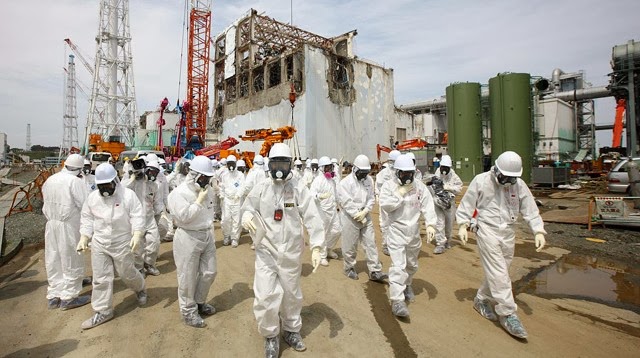
It’s a show. This is all about showing the Japanese that it’s not too bad, and we can run our other forty or so plants fine, trust us. It’s definitely symbolic for the Japanese, but the real reason is the banks want their money back.
This Expert Claims the Japanese Government’s Fukushima Clean Up Is Just “a Show” http://linkis.com/www.vice.com/en_uk/r/5UnqS August 12, 2015 by Thomas Marsh The past couple of weeks have seen two stories draw our attention back to the Fukushima Daiichi nuclear disaster of March 2011, in which three nuclear reactors melted down after the plant was hit by a tsunami. Radioactive material was released in what was the biggest and most disastrous nuclear incident since Chernobyl in 1986.
One story concerned some pictures of deformed daisies near the Fukushima Daiichi site, which trended online for a while and got everyone all hot under the collar about radiation, until it was established that they occur all the time in nature. So no need to worry about that.
The other was a video released by Arnie Gundersen, a former nuclear industry executive and engineer who’s declared Fukushima “the biggest industrial catastrophe in the history of mankind”. In it, he claimed that 23,000-tankers of water contaminated with radioactive isotopes have leaked into the Pacific from the Fukushima Daiichi site since 2011 and will continue to do so for decades – at a rate of three hundred tonnes a day. So maybe start worrying again.
Sure enough, a recent report by the Tokyo Electric Power Company (TEPCO) claimed that concentrations of radioactive isotope Strontium-90 have reached record highs in certain areas of the Pacific Ocean around Fukushima, with levels spiking by about 1,000 percent in three months. Continue reading
Rare earths industries struggling with problems
 Most Chinese rare earth miners running at a loss — report, Mining.com Cecilia Jamasmie | August 12, 2015 About 90% of China’s rare earth producers are currently operating at a loss as prices for the coveted elements — used in high-tech sectors — continue to drop due to overcapacity and illegal mining.
According to the Association of China Rare Earth Industry, local companies have been losing money for months and many are expected to close up shop before year-end.
Chen Zhanheng, the group’s deputy secretary-general, told China Daily the main issues weighing on the market are oversupply and illegal mining.
Many companies rushed into rare earth mining and production business when prices were high, he told the paper, producing much more than what the market really needed.
“Rare earths are not as difficult to mine and process as many seem to think, so many illegal miners are bypassing regulations to dig and smelt the metals. This, in turn, has led to a glut in the market,” he said.
The situation has not only affected small producers. The country’s six largest rare earth miners are also feeling the pinch, according to Investorintel:
Xiamen Tungsten, for instance, reported a sharp drop in its net profit in the first half of 2015, the company’s rare earth business has suffered a loss of $11.5 million during the period, $8.8 million more than the year before. Guangdong Rising Nonferrous is forecast to lose $5 to $6 million, down about 600% when compared to the $1 million reported last year last year. China Minmetals Rare Earth expected its net profits in the first half to stand at up to $470,000.
End of a monopoly
Until 2010, China controlled around 97% of the supply of the coveted metals, used in advanced electronics, defense and renewable energy. But when it sought to impose export controls to give an advantage to domestic electronics producers, prices soared by up to 20 or 30 times previous levels.
Attractive prices encouraged investment in the sector in the U.S., Australia and other places outside China. But, at the same time, it fired up smuggling from the Asian nation and a consequent drop in prices.
Rare earths were further battered earlier this year, when China scrapped export tariffs, which had inflated international prices, after a World Trade Organization ruling.
Now market observers are saying that prices for the 17 sought-after elements should start picking up by year-end. However, they also warn that a glut of supplies, including from illegal mines and smuggling in China, could cause the market to crash back down.
Investment confidence has been badly hit by the poor performances of the two major producers outside China — Molycorp (NYSE:MCP-A) and Lynas Corp (ASX:LYC).
Canadian rare earth companies have also shed nearly all of their value in the last few years. Shares of Avalon Rare Metals (TSE:AVL) are down 96% from their 2011 high, while Quest Rare Minerals’ (TSE:QRM) stocks have dropped about the same, since March 2012.
Meanwhile, China continues to restrict the number of firms allowed to produce and export rare earths. This means there will remain a significant supply bottleneck that is likely to encourage smuggling as well as illegal production in the nation, with the feared consequences in prices. [excellent graph on original] http://www.mining.com/most-chinese-rare-earth-miners-running-at-a-loss-report/
Sendai plant begins producing electricity after nearly 2 years of nuke-free nation
 Plant workers applaud as the No. 1 reactor at the Sendai nuclear plant starts
electricity generation and transmission on Aug. 14.
SATSUMA-SENDAI, Kagoshima Prefecture–Marking the end of 23 months of a nuclear power-free Japan, the Sendai nuclear power plant began generating and transmitting electricity on Aug. 14.
Kyushu Electric Power Co. activated the No. 1 reactor at the Sendai plant on Aug. 11, to become the first nuclear reactor brought back online under new safety regulations instituted by the Nuclear Regulation Authority after the 2011 Fukushima nuclear disaster. The nation had been without nuclear power since September 2013.
At 9 a.m. on Aug. 14, utility workers connected an electrical generator with power cables from the plant’s central control room. The workers applauded when it was confirmed that the reactor began power generation and transmission for the first time in more than four years.
In a statement released the same day, Yoichi Miyazawa, the minister of trade and industry, said the start of generating and transmitting power at the plant “represents an important step forward to achieving a well-balanced energy mix and a more stable supply of electricity.”
The output from the reactor was expected to reach 30 percent of its full capacity of 890,000 kilowatts on Aug. 14, and will be raised gradually to reach full power generation in about 10 days.
The reactor is expected to begin commercial operations in early September unless the NRA detects safety problems during its final inspection.
Michiaki Uriu, Kyushu Electric Power president, said in a statement that the company will continue its efforts to improve safety at the plant with “determination to prevent an accident similar to the one at the Fukushima No. 1 nuclear power plant from occurring.”
“We will gradually increase the output while closely monitoring the condition of the plant,” he said.
Kyushu Electric officials said the utility will proceed cautiously with operation of the No. 1 reactor as its operations had been suspended for a periodic inspection in May 2011.
It will be the first time that electricity generated at a nuclear plant will be supplied to households and businesses since the No. 4 reactor at Kansai Electric Power Co.’s Oi nuclear power plant in Fukui Prefecture went offline in September 2013.
Kyushu Electric, which relied on nuclear energy for about 40 percent of its power supply before the Fukushima disaster unfurled, plans to restart the No. 2 reactor at the Sendai plant in mid-October.
It has also applied for NRA safety screening to resume operations of the No. 3 and No. 4 reactors at its Genkai plant in Saga Prefecture.
Preparations for restarts are progressing at the No. 3 and No. 4 reactors of Kansai Electric’s Takahama nuclear power plant in Fukui Prefecture and the No. 3 reactor of Shikoku Electric Power Co.’s Ikata nuclear power plant in Ehime Prefecture.
The restart of the Sendai plant is likely to give momentum to efforts by the electric power industry and Prime Minister Shinzo Abe’s government to restart idle nuclear reactors nationwide.
But municipalities located near nuclear power plants have yet to map out effective evacuation plans for people in local medical and welfare facilities in the event of nuclear accidents.
A shortage of buses and other transportation modes to evacuate residents remains unsolved, while it also is unclear if utility companies can effectively shut down reactors when a Fukushima-level accident takes place at a nuclear plant.
Opinion polls have shown that more Japanese are opposed to the reactor restarts than those who support them.
Source: Asahi Shimbun
http://ajw.asahi.com/article/behind_news/social_affairs/AJ201508140058
-
Archives
- October 2026 (112)
- September 2026 (339)
- August 2026 (330)
- July 2026 (355)
- June 2026 (287)
- May 2026 (306)
- April 2026 (356)
- March 2026 (251)
- February 2026 (267)
- January 2026 (308)
- December 2025 (358)
- November 2025 (359)
-
Categories
- 1
- 1 NUCLEAR ISSUES
- business and costs
- climate change
- culture and arts
- ENERGY
- environment
- health
- history
- indigenous issues
- Legal
- marketing of nuclear
- media
- opposition to nuclear
- PERSONAL STORIES
- politics
- politics international
- Religion and ethics
- safety
- secrets,lies and civil liberties
- spinbuster
- technology
- Uranium
- wastes
- weapons and war
- Women
- 2 WORLD
- ACTION
- AFRICA
- Atrocities
- AUSTRALIA
- Christina's notes
- Christina's themes
- culture and arts
- Events
- Fuk 2022
- Fuk 2023
- Fukushima 2017
- Fukushima 2018
- fukushima 2019
- Fukushima 2020
- Fukushima 2021
- general
- global warming
- Humour (God we need it)
- Nuclear
- RARE EARTHS
- Reference
- resources – print
- Resources -audiovicual
- Weekly Newsletter
- World
- World Nuclear
- YouTube
-
RSS
Entries RSS
Comments RSS

