China agrees to nuclear arms-control talks with US -WSJ
Reuters, November 2, 2023
China and the United States will discuss nuclear arms control next week, the first such talks since the Obama administration, the Wall Street Journal reported on Wednesday.
China’s Foreign Ministry said on Monday after a visit by Foreign Minister Wang Yi to Washington that the two countries would hold “consultations on arms control and non-proliferation” in the coming days, as well as separate talks on maritime affairs and other issues.
Those arms talks would be led on Monday by Mallory Stewart, a senior State Department official, and Sun Xiaobo, the head of the arms-control department at China’s Foreign Ministry, the Wall Street Journal report said.
The U.S. State Department and China’s embassy in Washington did not immediately respond to requests by Reuters for comment on the timing or format of the talks.
U.S. National Security Advisor Jake Sullivan said in 2021 that the Chinese and U.S. presidents had agreed to “look to begin to carry forward discussion on strategic stability”, a reference to Washington’s concerns about Beijing’s nuclear weapons build-up.
But the White House was quick to say at the time that the discussions would not resemble formal arms reduction talks, like those the U.S. has had with Russia.
Since then, U.S. officials had expressed frustration that China showed little interest in discussing steps to reduce nuclear weapons risks.
China has more than 500 operational nuclear warheads in its arsenal and will probably have over 1,000 warheads by 2030, the Pentagon said in October. But Beijing has long argued that the U.S. already has a much larger arsenal. The arms talks would occur before a likely meeting between U.S. President Joe Biden and Chinese President Xi Jinping in San Francisco in November, although a senior Biden administration official said on Tuesday important details have yet to be hammered out…………………………………more https://www.reuters.com/world/china-agrees-nuclear-arms-control-talks-with-us-wsj-2023-11-01/ #nuclear #antinuclear #nuclearfree #NoNukes
3-day evacuation drill at Niigata nuclear plant called ‘useless’
THE ASAHI SHIMBUN, October 30, 2023
Residents said their safety concerns have still not been addressed following a three-day government-led drill simulating a serious accident at the Kashiwazaki-Kariwa nuclear power plant in Niigata Prefecture.
They said the drill, which concluded on Oct. 29, showed that there are no measures in place to ensure a smooth evacuation in heavy snow or to prevent traffic congestion caused by radiation checks.
Around 1,400 residents joined the drill, which assumed a magnitude-7.6 earthquake off the prefecture caused a loss of cooling functions at reactors of the plant, which is operated by Tokyo Electric Power Co.
This was the first government-run drill at the seven-reactor Kashiwazaki-Kariwa nuclear plant since the 2011 disaster at TEPCO’s Fukushima No. 1 nuclear power plant caused by the Great East Japan Earthquake and tsunami.
At the end of last year, main evacuation routes, including in Kashiwazaki, where the plant is located, were closed for up to 52 hours due to heavy snowfall…………………………………………………………….. more https://www.asahi.com/ajw/articles/15042691— #nuclear #antinuclear #nuclearfree #NoNukes
Fukushima nuclear plant workers sent to hospital after being splashed with tainted water
Guardian, 27 Oct 23
The operator Tepco says the workers came in contact with the wastewater when a hose came off accidentally and have been taken to hospital as a precaution
Four workers at the Fukushima nuclear plant were splashed with water containing radioactive materials, with two of them taken to hospital as a precaution, according to the plant operator.
The incident, which took place on Wednesday, highlights the dangers Japan still faces in decommissioning the plant. The reactor was knocked out by an immense tsunami in 2011 in the world’s worst atomic disaster since Chornobyl in 1986.
Five workers were cleaning pipes at the system filtering wastewater for release into the sea when two were splashed after a hose came off accidentally, according to a spokesperson for operator Tepco.
Two others were contaminated when they were cleaning up the spill, the spokesperson added………
Tepco said that both would stay in hospital for “about two weeks” for follow-up examinations and that the company was analysing how the accident had occurred while reviewing measures to prevent a repeat of it………………………
more https://www.theguardian.com/environment/2023/oct/27/fukushima-nuclear-plant-workers-hospitalised-after-being-splashed-with-tainted-water #nuclear #antinuclear #NoNukes #radiation
The World’s Only Muslim Nuclear Power Warns Israel’s War in Gaza Must Stop
NewsWeek, Oct 27, 2023
Pakistan’s permanent representative to the United Nations has outlined to Newsweek his country’s position on the ongoing war between Israel and Palestinian factions led by Hamas, expressing the need for a ceasefire and warning of regional instability if an already devastating conflict deepens further.
“This is an obligation that devolves on all member states to prevent an escalation of the conflict,” Ambassador Munir Akram told Newsweek. “We would have hoped that the conflict had not taken place, but it has, and now we have to stop it, to halt the fighting and to avoid the suffering that is happening and is likely to happen if this conflict goes on.”
While the Islamic Republic he represents, one of the world’s most populous countries and the only Muslim-majority nation to possess nuclear weapons, may be thousands of miles away from the frontlines of the Gaza Strip, Akram identified a direct connection between Pakistan and the Palestinian cause. This link was made all the more tangible by parallels he drew between the Israeli-Palestinian conflict and the Indian-Pakistani dispute over the divided territory of Kashmir, to which Pakistanis commemorate a “Black Day” on Friday.
With local health officials in Hamas-run Gaza now counting deaths in excess of 7,000 as a result of Israeli airstrikes since an unprecedented Hamas-led October 7 assault on Israel in which authorities said 1,400 people were killed, Akram argued that “this is not something that should be acceptable to any civilized nation or people and we oppose it, therefore we hope it would stop.”
He added: “There is an additional layer of obligation on us as an Islamic country.”
“We feel that we have an obligation, an emotional commitment to Palestine and to the freedom of the Palestinian people,” Akram said. “It is a principle to which we are committed politically because of Kashmir. We are heavily invested in that principle, and we would like to see the triumph of that principle of self-determination.”
Common History
The Israeli-Palestinian and Kashmir conflicts are linked by history as well, both having been born out of the collapse of British colonial rule three-quarters of a century ago in the years immediately following World War II.
When the British Raj was dissolved in 1947, the previously united Indian subcontinent was divided into the new nations of India and Pakistan, with Pakistan also controlling modern-day Bangladesh until 1971. The partition resulted in massive bloodshed, especially between Hindus and Muslims on both sides of the new border. The two new states quickly went to war over the middle ground of Kashmir, which today is divided along what’s known as the Line of Control………………………………………………………………………………….. more https://www.newsweek.com/pakistan-warns-israel-war-gaza-must-stop-munir-akram-1838448 #nuclear #antinuclear #NoNukes #Israel #Palestine
Mechanism for toxic radioactive water release sought

“What I find problematic is that TEPCO, the Japanese government and the IAEA are not addressing the long-term environmental impacts and the accumulation in the environment resulting from individual data. In the case of long-term releases, there is a concern about accumulation in the marine environment and concentration through the ecosystem, but this aspect is not being adequately evaluated.”
By JIANG XUEQING in Tokyo 2023-10-24 https://global.chinadaily.com.cn/a/202310/24/WS65372116a31090682a5ea51d.htmll
Experts urge long-term intl monitoring and participation of all stakeholders
Experts call for the establishment of a long-term international monitoring mechanism with substantive participation from stakeholders, as Japan and the International Atomic Energy Agency are both criticized for not addressing the long-term environmental impacts of the dumping of nuclear-contaminated water into the sea.
The IAEA is sending its team to Japan to continue its safety review of the release from the crippled Fukushima Daiichi Nuclear Power Plant.
Starting Tuesday, the IAEA will conduct a safety review of the activities carried out at the Fukushima plant to make sure these activities are consistent with the international safety standards, said Lydie Evrard, IAEA deputy director-general and head of the agency’s department of nuclear safety and security.
A report on the review is expected to be finalized by the end of 2023, she told a news conference in Tokyo on Monday.
Chinese Foreign Ministry spokesman Wang Wenbin on Oct 11 said the collection of marine samples near Fukushima, analysis by laboratories and comparison of those samples were carried out by the IAEA Secretariat under its bilateral arrangement with Japan. Therefore, he said, it falls short of an international monitoring arrangement with the full and substantive participation of all stakeholders.
“The international community requires the immediate establishment of an international monitoring arrangement with substantive participation of all stakeholders, including Japan’s neighboring countries, that will stay effective for the long haul,” Wang said, urging the IAEA to play its due role and take the responsibility of providing rigorous supervision on Japan’s discharge.
The key issue is how to establish an international monitoring mechanism for the real-time and long-term effective management of nuclear-contaminated water being discharged, said Zhang Yulai, vice-president of the Japan Institute of Nankai University.
Major challenge
“Information disclosure is a major challenge because the Japanese government and TEPCO share common interests, making genuine monitoring difficult,” he said.
There are also technical challenges, as certain radionuclides that the Advanced Liquid Processing System cannot remove still exist, he said.
Fukushima plant operator TEPCO announced pre-discharge test results on Thursday, showing that the third batch of nuclear-contaminated water to be released during Japan’s next round of ocean discharge contains seven radionuclides, namely tritium, carbon-14, cobalt-60, strontium-90, yttrium-90, iodine-129 and cesium-137. Among them, strontium-90 and yttrium-90 were not detectable before the second round of discharge.
The measured quantity of strontium is relatively low, but given its 29-year half-life, it will persist in the environment to a certain extent. Strontium is a significant radionuclide that tends to accumulate in bones when ingested by fish or humans, said Hideyuki Ban, a renowned Japanese nuclear expert and co-director of the Tokyo-based Citizens’ Nuclear Information Center.
“What concerns me is the lack of information about the measurement times and methods. I believe that rapid measurements may lack precision,” Ban said.
“What I find problematic is that TEPCO, the Japanese government and the IAEA are not addressing the long-term environmental impacts and the accumulation in the environment resulting from individual data. In the case of long-term releases, there is a concern about accumulation in the marine environment and concentration through the ecosystem, but this aspect is not being adequately evaluated.”
Many Japanese said they do not believe the data disclosed by TEPCO and the Japanese government.
Chiyo Oda, co-director of KOREUMI, also known as the Citizens’ Conference to Condemn Further Pollution of the Ocean, said those who have experienced the nuclear disaster have developed distrust in the government and TEPCO.
The promise not to release the water without first understanding the concerns of fishermen and citizens, as stated just before the release, has been disregarded. Though they have announced monitoring results immediately after the release, the data is not trustworthy, Oda said.
“It is evident that the marine environment will be contaminated over a long period of time, and there is potential for long-term impacts on human health,” she said. #nuclear #antinuclear #nuclearfree #NoNukes
A wall of silence: atom bosses remain tight-lipped over Fukushima whistleblower claims
collaboration between the IAEA and the Japanese Government over the Fukushima radioactive water releases was imperative as the continuation of sea dumping regardless of the adverse impact to the marine environment represents a ‘make or break issue’ for the nuclear industry.
Over seven weeks have passed without an acknowledgement or reply to a letter the UK/Ireland Nuclear Free Local Authorities co-signed which was sent to the UN International Atomic Energy Authority calling for transparency over claims that the organisation collaborated with the Japanese Government to ‘manage the message’ over the ocean dumping of 1.3 million tonnes of radioactive water from the Fukushima nuclear disaster site.
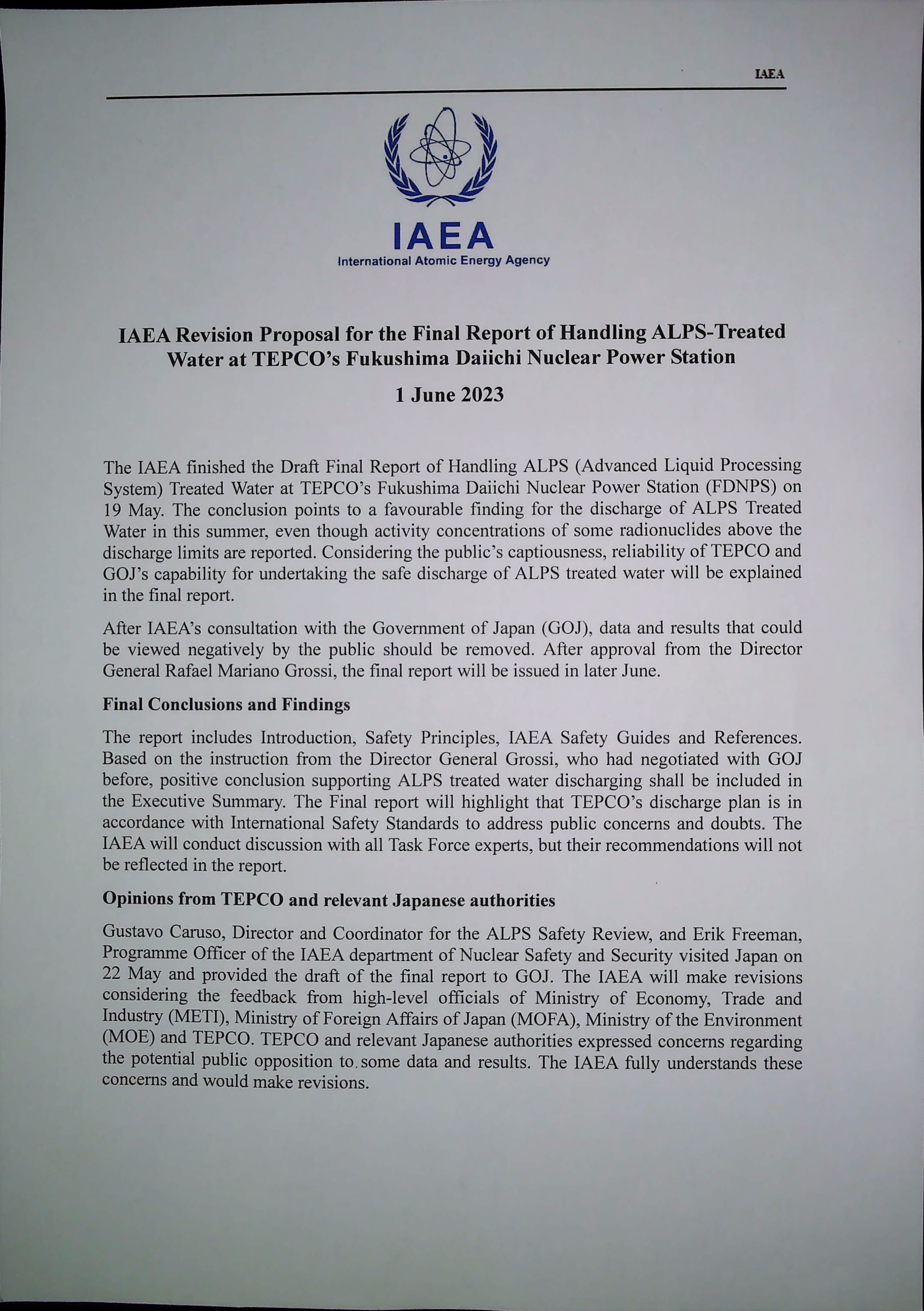
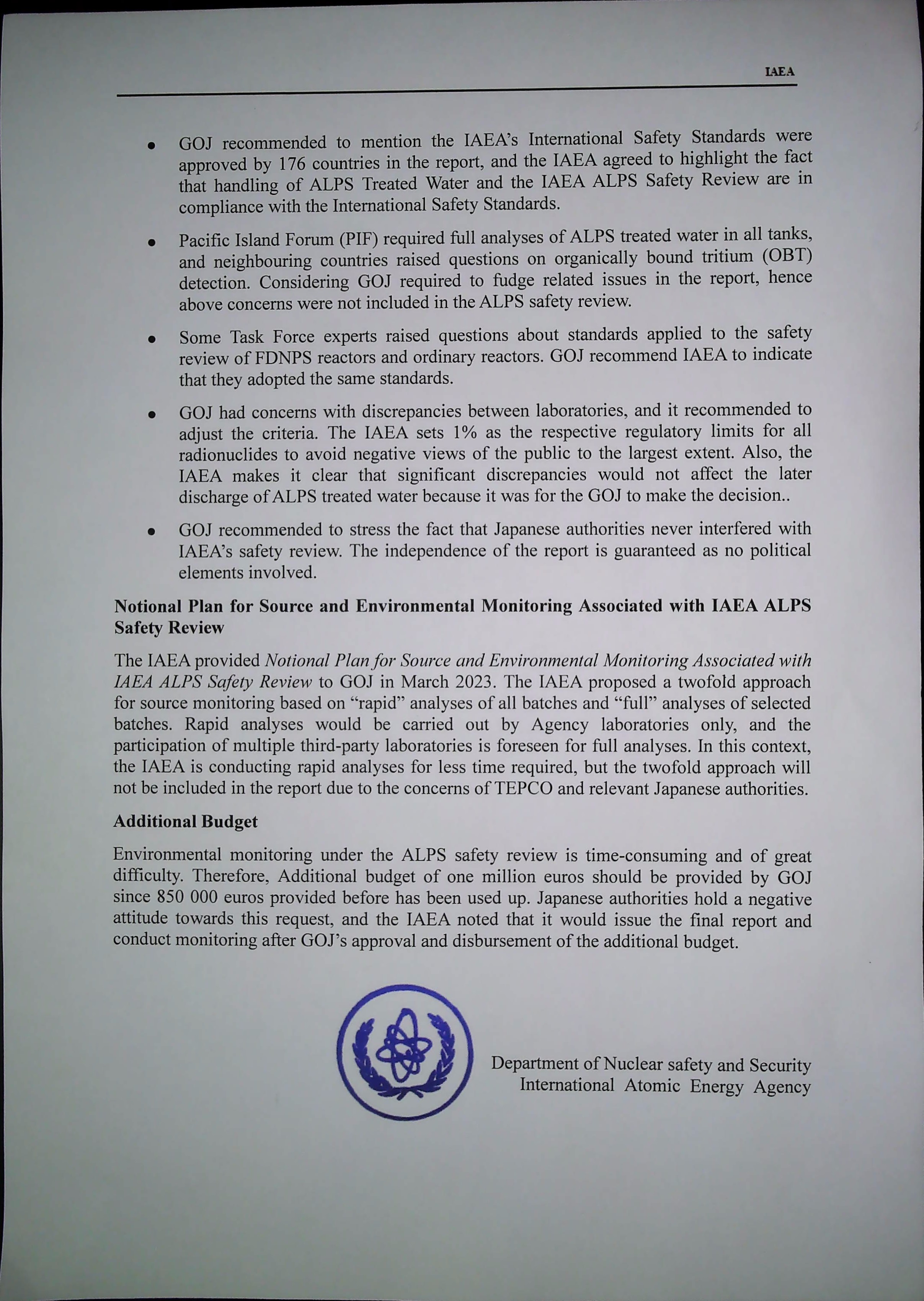
On 28 June, an anonymous whistleblower posted a document, seemingly issued by the Department of Nuclear Safety at the IAEA, to the website/blogsite dunrenard[1]. If genuine, the document, titled ‘IAEA REVISION PROPOSAL FOR THE FINAL REPORT OF HANDLING ALPS TREATED WATER AT TEPCO’S FUKUSHIMA DAIICHI NUCLEAR POWER STATION’, appears to indicate that the international agency has actively sought to downplay the dangers associated with discharging millions of barrels of water which remain contaminated with highly toxic tritium.
The NFLA’s first covered this story and our disquiet at the revelations in a media release dated 3 July:
https://www.nuclearpolicy.info/news/cover-up-did-atom-bosses-collude-to-manage-message-of-japanese-plan-to-poison-pacific/
One of the recipients of the leaked document was Mr Tim Deere-Jones, a graduate in Marine Studies from Cardiff University. Tim, an independent marine pollution researcher and consultant since 1983, is highly regarded by the many international organisations who have engaged him in their campaigns against the damage caused to our oceans and inland waterways by radioactive and other contaminants.
Tim was incensed that the Japanese Government was quick to condemn the claim that Japan had pressurised the IAEA to remove ‘negative information’ about the environmental impact that would result from the radioactive waste discharges from the final report, but also noted that on the claims themselves the IAEA made no comment.
Keen to seek clarification and action on the veracity of the whistleblower’s claims, Tim went right to the top of the IAEA and penned a letter to the head of the management office for the Deputy Director General. Here he explains why:
“To date there has been no detectable independent action to investigate and test the veracity of the whistleblower’s claims against the claim of non-interference made by the Government of Japan.
“I fear that if this is scenario is allowed to continue the whistleblower’s action and disclosure will be historically characterised by the Government of Japan statement, sink into obscurity and be forgotten and the whistleblower’s heroic action will have been wasted, while he/she is still under threat of investigation, identification, and penalty.
“My disclosure request to the IAEA is intended to elicit a direct response from the agency to the claims made by the whistleblower as to date my online media searches have yet to reveal any related statement made by the organisation.
“This creates the impression that the Government of Japan has been acting as the IAEAs mouthpiece in respect of the whistleblower disclosure and that the IAEA would prefer NOT to be associated in anyway with the issue, to the extent that it has not made any public statement”.
Tim’s request for disclosure, submitted by registered post to the IAEA’s Vienna office and by email to the official account on 1 September, was backed by five British anti-nuclear groups and individuals from Europe and the Pacific Ocean, representing commercial fishers, other marine stakeholders, and coastal zone and Pacific Island communities.
Although the registered letter was tracked as received at the Vienna office on 9 September, Tim has yet to receive any response from the agency, and on 16 October sent a reminder:
“I have concluded that the absence of a receipt or response is a clear indication of the IAEA’s resistance to any discussion of the issues raised.
“My reading critique of the IAEAs final report to TEPCO re the issue of the ALPs treated water release certainly supports the drift of the whistleblower statement”.
Amongst the co-signatories to the letter, which is reproduced at the end of this press release, were the NFLAs, which have objected in letters to Japanese Ministers, senior officials at TEPCO (the nuclear operator), and the United Nations to the discharge of radioactive water from Fukushima, and signed a partnership agreement with its counterparts, Mayors for a Nuclear Power Free Japan, to collaborate in opposing the plan.
Though disappointed at the continued wall of silence, Chair Councillor Lawrence O’Neill is unsurprised that the IAEA remains tight-lipped:
“Sadly, the duties of disclosure required of public bodies in the UK through the Freedom of Information Act do not apply to an international agency based in Vienna and the IAEA’s statutes appear to contain no provisions for transparency or external accountability, despite the agency being funded by the member states, and so the taxpayers, of the United Nations.
“Although the organization claims to want to become more open, the lack of a response, or even an acknowledgement, to our legitimate request for information belies the fact that, on controversial issues, a culture of secrecy still prevails.”
Tim believes that collaboration between the IAEA and the Japanese Government over the Fukushima radioactive water releases was imperative as the continuation of sea dumping regardless of the adverse impact to the marine environment represents a ‘make or break issue’ for the nuclear industry. He has produced a short paper explaining his reasoning, which also appears at the end of this media release.
For further information about this media release please contact NFLA Secretary Richard Outram by email to richard.outram@manchester.gov.uk or telephone 07583097793
1. https://dunrenard.wordpress.com/2023/06/28/will-this-whistleblower-be-heard-by-anyone/
Notes to Editors:
The reminder sent to Ms Margaret Doane, Head, Department of Management Office of the Deputy Director General, IAEA, 16 October 2023
#nuclear #antinuclear #nuclearfree #NoNukes
Decontaminating Fukushima: have the billions spent been worth it?
The Conversation, Jim Smith, Professor of Environmental Science, University of Portsmouth, October 24, 2023
The Chernobyl and (to a lesser extent) Fukushima nuclear accidents contaminated large areas of land with low-level radioactivity. After both accidents, huge efforts were taken to decontaminate the affected areas.
But a recent study at Fukushima raises doubts about whether these decontamination efforts were worthwhile. Less than one-third of the population has returned to the evacuated zones and extensive areas of forest in the region remain contaminated.
Following the accident at Fukushima Daiichi in 2011, approximately 1,100 square kilometres were evacuated, resulting in the relocation of more than 100,000 people from their homes. A contaminated area about eight times larger remained inhabited, albeit subject to continuous radiation monitoring.
The dominant source of radiation exposure for people stemmed from gamma rays emitted by contaminated soils, pavements, roads and buildings. The objective of the decontamination operation was to ensure that the general public received an annual dose from Fukushima’s radioactivity of less than 1,000 microsieverts (µSv) above the natural background level. The average natural radiation dose in Japan stands at 2,200 µSv per year.
Radiocaesium, which is the most important long-lived radioactive element emitted by the accident in terms of radiation dose, adheres to soil particles very strongly. Consequently, the decontamination of agricultural land primarily involved removing the top 5cm of soil. In urban areas, decontamination efforts entailed the removal of topsoil from sports fields, as well as sandblasting or pressure washing hard surfaces, and pressure washing drains and gutters.
These efforts reduced doses by about 60% in residential areas and farmland, allowing people to return to their homes in a large part of the evacuated area. This is a far cry from Chernobyl, where extensive decontamination initiatives were ultimately abandoned, leaving huge evacuated areas that remain empty to this day. But was undertaking decontamination in Fukushima worthwhile?
Costs and benefits
Decontaminating the land in Fukushima has cost tens of billions of dollars. The process has, unfortunately, also caused substantial radiation exposure for the workers involved, and has generated huge amounts of radioactive soil waste. But the question of whether to decontaminate land is complex and only partially related to scientific evidence.
On the one hand, decontamination provides reassurance that radiation is being “cleaned up” and that doses are being reduced. But it can also give the impression that low-level radiation is more dangerous than it actually is.
Dose rates were not dangerously high in many areas of Fukushima that were subject to decontamination. In fact, doses were relatively low in the first year following the accident (less than 12,000 µSv), and these levels decreased significantly in subsequent years.
These levels fall within the natural range people are exposed to from radioactivity in rocks, soils, building materials and cosmic radiation worldwide (typically between 1,000 µSv and 10,000 µSv per year, but sometimes higher).
On balance, I think the reassurance that contamination was being cleaned up was valuable in many areas where people remained living. Decontamination also allowed agricultural land to be returned to productive use more quickly. However, the process of removing topsoil had the side effect of damaging soil fertility.
Accidental rewilding
In the evacuated zone where dose rates were around ten times higher, it’s less clear that decontamination was beneficial. Only 30% of people have returned to their homes in the decontaminated part of this area and much of the land in the most contaminated so-called “difficult to return zone” remains abandoned.
A better option may have been to declare most of this zone a nature reserve and allow managed rewilding of the area. Rewilding is happening to a large extent anyway, as it has at Chernobyl. It would also have avoided decontamination workers being exposed to radiation and allowed more financial support to help people relocate.
But this is a complex decision that needs to consider the views of many stakeholders, not least the evacuated people themselves.
Fukushima’s contaminated forests
The land in and around the region’s towns and villages has generally been decontaminated effectively. However, much of the Fukushima Prefecture (71%) is covered by forest. Most of this forest remains contaminated.
The persistence of radiocaesium in ecosystems, particularly in forests, has been known for many decades. Globally, radiocaesium levels in wild foodstuffs such as mushrooms, edible plants, game animals and freshwater fish tend to be higher than those found in agricultural systems.
Wild boar in certain regions of Germany, for instance, still exhibit radicaesium levels exceeding consumption limits as a consequence of both Chernobyl and historical nuclear weapons testing. Restrictions on the consumption of forest products have lasted for decades following the Chernobyl incident. And they are expected to persist in many forested areas of Fukushima too.
Radiocaesium lingers in forests due to the prevalence of organic soils and the absence of fertiliser application. Low nutrient levels facilitate the absorption of radiocaesium by plants. This is mainly attributed to radiocaesium’s chemical similarity to potassium, a crucial plant nutrient.
Forests do pose a wildfire risk. There have been many forest fires in the vicinity of Chernobyl since the accident. But radiation doses from smoke inhalation are extremely low, even for firefighters, and the fires have not significantly redistributed radioactivity.
There are no easy answers regarding clean up after a nuclear accident. Japan has made huge and often successful efforts to reduce radiation doses and reassure people living in or returning to the affected areas. But low-level radiation remains everywhere, particularly in forests……….. https://theconversation.com/decontaminating-fukushima-have-the-billions-spent-been-worth-it-215836 #nuclear #antinuclear #nuclearfree #NoNukes.
China-Russia in a nuclear sub counter to AUKUS
China’s Type 096 nuclear submarine draws on Russian tech and expertise and once operational will bring US mainland into closer missile range
Asia Times, By GABRIEL HONRADA, OCTOBER 23, 2023
China is making new quiet nuclear submarines with Russia’s expert assistance, an answer to the AUKUS alliance and the latest sign of the two powers’ converging strategic interests against the United States and its Pacific allies
The project could make it harder for the US and its allies to track China’s submarines in crucial theaters including the South China Sea and represents a direct challenge to US undersea dominance in the Pacific.
This month, Reuters reported that China is producing a new generation of nuclear-armed submarines, citing evidence that its Type 096 nuclear ballistic missile (SSBN) submarine will be operational before the end of the decade. The report said that breakthroughs in the submarine’s quietness have been aided partly by Russian technology……………………………………..more https://asiatimes.com/2023/10/china-russia-in-a-nuclear-sub-counter-to-aukus/ #nuclear #antinuclear #nuclearfree #NoNukes
Multiple radionuclides detected in Fukushima nuke wastewater planned for 3rd round of ocean discharge
Xinhua 21 Oct 23 https://www.chinadaily.com.cn/a/202310/21/WS65339e99a31090682a5e9ef2.html
TOKYO — The third batch of Fukushima nuclear-contaminated water to be released during Japan’s next round of ocean discharge contains carbon-14, cobalt 60, strontium-90 and other radionuclides, according to pre-discharge test results released by the Tokyo Electric Power Company (TEPCO).
Despite mounting concerns and opposition among local fishermen as well as from other countries, TEPCO said that preparations for the third round of ocean discharge will begin after the second round of discharge is completed and relevant maintenance and confirmation operations are carried out.
The nuclear-contaminated wastewater from the crippled Fukushima Daiichi nuclear power plant, after advanced liquid processing system (ALPS) treatment, must enter the measurement and confirmation facility and wait for pre-discharge test results before being discharged into the ocean.
The measurement and confirmation facility is split into three groups of 10 tanks with each of the groups used on a rotating basis as receiving tanks, measurement and confirmation tanks, and discharge tanks.
At present, the 10 tanks in Group B were emptied in the first round of discharge starting on Aug 24. Meanwhile, the 10 tanks in Group C were confirmed to meet the discharge standards on Sept 21, and the discharge started on Oct 5.
The sampling of the nuclear wastewater stored in Group A tanks for the third round of discharge was completed on July 10. The analysis results showed that they contained trace amounts of carbon-14, cobalt 60, strontium-90, iodine-129 and cesium-137, of which strontium-90 was not detected in the second round of discharge from Oct 5, according to reports released on Thursday by TEPCO.
TEPCO claims that its ALPS facility, a multi-nuclide removal system, can remove 62 radioactive substances except tritium, but it was found that about 70 percent of the water in the storage tanks contained non-tritium radionuclides at a concentration exceeding the regulatory standards applicable for discharge into the environment. #nuclear #antinuclear #nuclearfree #NoNukes
China rejects Pentagon report that claimed China was starting a nuclear arms race
US says China likely to have 1,000 nuclear warheads by 2030 China said the report is ‘filled with prejudice and distorts face’
Namita Singh https://www.independent.co.uk/asia/china/china-nuclear-weapons-pentagon-report-india-b2433066.html 21 Oct 23
China has rejected a US Pentagon report claiming that the Asian country has more than 500 operational nuclear warheads in its arsenal and will probably have over 1,000 by 2030.
China said the report was “filled with prejudice and distorts face”, as it clarified that it has no intention of indulging in a nuclear arms race.
The statement came a day after the Pentagon released its annual report on the Beijing military. In the wide-ranging report, the Pentagon said China’s more than 500 warheads as of May 2023 were on track to exceed projections.
In a previous report, the Pentagon estimated that Beijing had more than 400 operational nuclear warheads in 2021.
“We see the PRC (People’s Republic of China) continuing to quite rapidly modernize and diversify and expand its nuclear forces,” a senior US official told reporters during a briefing on the report.
However, on Friday, China’s foreign ministry spokesperson issued a statement rejecting the US claims.
“First of all, the United States report, like similar reports before it, ignores the facts, is full of prejudice and spreads the theory of the threat posed by China,” ministry spokesperson Mao Ning told a press briefing in response to a question about the US report.
“China firmly adheres to a nuclear strategy of self-defence and defence, we have always maintained our nuclear forces at the lowest level required for national security, and we have no intention of engaging in a nuclear arms race with any country,” Mr Mao said.
The report reiterated concern about pressure by Beijing on self-ruled Taiwan, an island China sees as a breakaway province.
“As long as any country does not use or threaten to use nuclear weapons against China, it will not be threatened by China’s nuclear weapons,” Mr Mao said.
Relations between China and the United States have been tense, with friction between the world’s two largest economies over everything from Taiwan and China’s human rights record to its military activity in the South China Sea.
But Washington has been eager to revive military-to-military communications with China.
Last week the Pentagon said it had accepted an invitation to attend China’s top annual security forum in late October, the latest sign of potentially warming ties between the two countries’ militaries. #nuclear #antinuclear #nuclearfree #NoNukes
China highlights marine radiation monitoring in draft law revision
China Daily, Xinhua 2023-10-20
BEIJING — China is considering strengthening its monitoring of radiation in the marine environment in the latest draft revision to the Marine Environment Protection Law, a spokesperson said Thursday.
Scheduled for its third deliberation at a session of the country’s top legislature in late October, the draft revision states that departments of the State Council in charge of environmental issues should set out emergency plans for radiation monitoring and organize its implementation.
The draft stresses improving the capacity of monitoring and managing the marine environment by raising the technological and informatization level, and requires efforts to enhance comprehensive, coordinated and regular monitoring, according to Yang Heqing, a spokesperson for the Legislative Affairs Commission of the National People’s Congress (NPC) Standing Committee, at a press briefing.
Pollution prevention and control in rivers flowing into the sea should also be strengthened in coordinated efforts to ensure the water quality at the mouths of the rivers meets the relevant standards, Yang said citing the draft revision
The sixth session of the 14th NPC Standing Committee will be held from Oct. 20 to 24. The NPC Standing Committee completed two readings of previous versions of the draft revision to the Marine Environment Protection Law in December last year and June……..
https://www.chinadaily.com.cn/a/202310/20/WS6531db77a31090682a5e9b28.html #nuclear #antinuclear #nuclearfree #NoNukes
China expanding nuclear arsenal much faster than predicted, US report says
Guardian, 20 Oct 23
Pentagon report also says Beijing is intensifying pressure on neighbours to push back on US efforts to contain it.
A Pentagon report on China’s military power says Beijing is exceeding previous projections of how quickly it is building up its nuclear weapons arsenal and is “almost certainly” learning lessons from Russia’s war in Ukraine about what a conflict over Taiwan might look like.
The report released on Thursday also warns that China may be pursuing a new intercontinental missile system using conventional arms that, if fielded, would allow Beijing “to threaten conventional strikes against targets in the continental United States, Hawaii and Alaska.”
The China report comes a month before an expected meeting between Chinese leader Xi Jinping and President Joe Biden on the sidelines of the Asia-Pacific Economic Cooperation summit in San Francisco.
The annual report, required by Congress, is one way the Pentagon measures the growing military capabilities of China, which the US government sees as its key threat in the region and America’s primary long-term security challenge.
But after Hamas’s 7 October attacks on Israel, the US has been forced again to focus on the Middle East, instead of its widely promoted pivot to the Pacific to counter China’s growth. The US is rushing weapons to Israel while continuing to support and deliver munitions to Ukraine in its 20-month struggle to repel Russia’s invasion.
Still, the Pentagon’s national defense strategy is shaped around China remaining the greatest security challenge for the US, and that the threat from Beijing will determine how the US military is equipped and shaped for the future.
The Pentagon report builds on the military’s warning in 2022 that China was expanding its nuclear force much faster than US officials had predicted, highlighting a broad and accelerating buildup of military muscle designed to enable Beijing to match or surpass US global power by midcentury.
Last year’s report warned that Beijing was rapidly modernizing its nuclear force and was on track to nearly quadruple the number of warheads it has to 1,500 by 2035. The US has 3,750 active nuclear warheads.
The 2023 report finds that Beijing is on pace to field more than 1,000 nuclear warheads by 2030, continuing a rapid modernization aimed at meeting Xi’s goal of having a “world class” military by 2049.
After the previous report, China accused the US of ratcheting up tensions and Beijing said it was still committed to a “no first use” policy on nuclear weapons.
The Pentagon has seen no indication that China is moving away from that policy but assesses there may be some circumstances where China might judge that it does not apply, a senior US defense official said without providing details. The official briefed reporters on Wednesday on condition of anonymity before the report’s release
The US does not adhere to a “no first use” policy and says nuclear weapons would be used only in “extreme circumstances.”………………………………………. more https://www.theguardian.com/world/2023/oct/20/china-expanding-nuclear-arsenal-much-faster-than-predicted-us-report-says #nuclear #antinuclear #nuclearfree #NoNukes
ASEAN continues commitment to maintaining nuclear-weapon-free Southeast Asia
October 14, 2023 https://vietnamnews.vn/politics-laws/1595191/asean-continues-commitment-to-maintaining-nuclear-weapon-free-southeast-asia.html
NEW YORK – Ambassador Đặng Hoàng Giang, Permanent Representative of Việt Nam to the United Nations (UN), has reaffirmed ASEAN’s support for efforts of the international community for a world without nuclear weapons.
“The complete elimination of nuclear weapons is the only solution to guarantee against their use and threat of use,” Ambassador Giang, on behalf of ASEAN, said at a thematic debate on nuclear weapons of the UN General Assembly’s First Committee (Disarmament and International Security) on October 13.
ASEAN upholds the importance of the Treaty on the Non-Proliferation of Nuclear Weapons (NPT) in the global mechanism on disarmament, non-proliferation of nuclear weapons. It calls on nuclear-weapon countries to fulfil their disarmament obligations and commitments with specific roadmaps and actions, and highlights the Treaty on the Prohibition of Nuclear Weapons (TPNW) as a historic agreement that contributes to this objective. Until nuclear weapons are completely eliminated, countries need to continue signing and ratifying the Comprehensive Nuclear-Test-Ban Treaty (CTBT) so that it soon comes into effect.
Ambassador Giang said ASEAN was committed to maintaining Southeast Asia free of nuclear weapons, while emphasising the bloc’s commitment to the work of the First Committee to completely eliminate nuclear weapons for peace, security and sustainable development.VNA/VNS #nuclear #antinuclear #NuclearFree #NoNukes #NuclearPlants
Fukui governor accepts utility’s nuclear fuel plan, comes under fire
THE ASAHI SHIMBUN, October 13, 2023 https://www.asahi.com/ajw/articles/15028320
FUKUI–Fukui Governor Tatsuji Sugimoto on Oct. 13 approved Kansai Electric Power Co.’s revised plan on storing spent nuclear fuel, drawing outrage from prefectural assembly members.
The governor’s approval means that three aging reactors operated by the utility in the prefecture can continue to run.
The continued operation of the old reactors was contingent on Kansai Electric finding a site outside Fukui Prefecture to store the spent fuel from its nuclear plants.
Sugimoto, who met with industry minister Yasutoshi Nishimura and Kansai Electric President Nozomu Mori on Oct. 13, approved the plan even though the utility has not picked a storage site.
“The plan is a pie in the sky as no candidate site for the interim storage facility has been presented,” a prefectural assembly member said.
Under the approved plan, operations will start at an interim storage facility outside the prefecture around 2030 for spent nuclear fuel accumulating at Kansai Electric’s nuclear power plants in Fukui Prefecture.
The spent fuel will remain there until it can be transferred to a reprocessing plant.
But that brings up another problem.
The central government has long been promoting a nuclear fuel recycling program that reprocesses spent nuclear fuel.
However, the reprocessing plant in the village of Rokkasho in Aomori Prefecture, the key facility in the recycling program, has suffered a series of problems, and its completion has been delayed for more than 25 years.
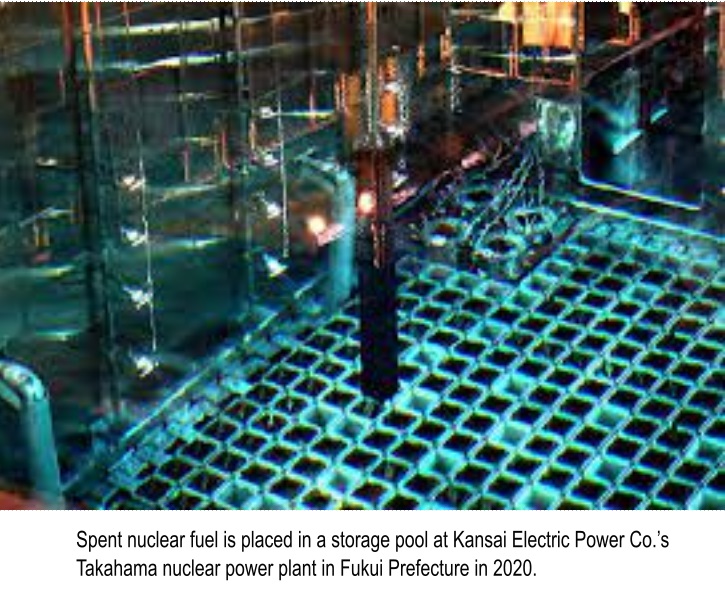
Spent nuclear fuel is currently placed in storage pools at the nuclear plants in Fukui Prefecture.
The prefectural government has been urging Kansai Electric to build an interim storage facility outside the prefecture because space is running out for the fuel.
The utility had promised to find a candidate site for the storage facility by the end of this year.
It said if it could not find a site, it would halt the No. 1 and No. 2 reactors at the Takahama nuclear plant and the No. 3 reactor at the Mihama nuclear plant. These three reactors have each been in operation for more than 40 years.
In June, Kansai Electric presented a plan to ship about 200 tons of spent nuclear fuel from the Takahama nuclear power plant to France, claiming “we fulfilled our promise.”
But the prefectural government opposed this plan, saying that volume was only a fraction of the total amount.
On Oct. 10, the utility proposed a revised plan, including increasing the amount to be shipped to France and setting up dry storage facilities within the compounds of nuclear plants in Fukui Prefecture that are separate from the existing storage pools.
Kansai Electric also said the storage capacity within the nuclear plants would not increase, in principle.
Another prefectural assembly member criticized this plan.
“Since no duration was specified for the dry storage facilities, they might end up effectively serving as the final disposal site,” the assembly member said.
(This article was written by Kenji Oda and Tsunetaka Sato.) #nuclear #antinuclear #NuclearFree #NoNukes #NuclearPlants
Fukushima Up Close, 13 Years Later

After thirteen years, the declaration of a State of Emergency for Fukushima Daiichi Nuclear Power Plant still cannot be lifted because of many unknowns, as well as ubiquitous deadly radiation levels.
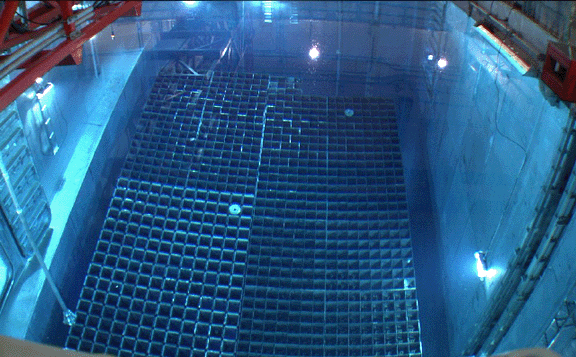
The spent fuel rods at the Fukushima nuclear reactor site are stored in pools of water on the top floor of compromised reactor buildings 100 feet above ground level……… “Continual storage in spent fuel pools is the most unsafe thing you could do.”
Fukushima Daichi Nuclear Power Plant will remain a high-risk explosive scenario for decades ahead.
CounterPunch BY ROBERT HUNZIKER 13 Oct 23
The world is turning to nuclear power as a solution to global warming, but it is postulated herein that it is a huge mistake that endangers society. One nuclear meltdown causes as much damage over the long-term as a major war. Moreover, according to Dr. Paul Dorfman, chair of the Nuclear Consulting Group, former secretary to the UK Scientific Advisory Committee on Internal Radiation: “It’s important to understand that nuclear is very likely to be a significant climate casualty.”
Also, of interest: France’s Global Warming Predicament discusses nuclear energy’s vulnerability in a global warming world.
Beyond Nuclear International recently published an article about the status of Fukushima as well as an exposé of how the nuclear industry gets away with responsibility for radiation-caused (1) deaths (2) chronic conditions like cancer (3) genetic deformities: A Strategy of Concealment, September 24, 2023, by Kolin Kobayashi, who is a Tokyo-born France-based anti-nuclear activist journalist also serving as president of Echo-Exchange. Kobayashi’s work was posted by CounterPunch under the title: How Agencies That Promote Nuclear Power Are Quietly Managing Its Disaster Narrative.
The following synopsis, including editorial license that adds important death details which defy the nuclear industry’s bogus claims about nuclear safety, opens closed pathways to what’s really going on.
After thirteen years, the declaration of a State of Emergency for Fukushima Daiichi Nuclear Power Plant still cannot be lifted because of many unknowns, as well as ubiquitous deadly radiation levels. The destroyed reactors are tinderboxes of highly radioactive spent fuel rods that contain more cesium-137 than eighty-five (85) Chernobyls. Cesium-137 in or near a human body erupts into a series of maladies, one after another in short order, depending upon level of exposure: (1) nausea (2) vomiting (3) diarrhea (4) bleeding (5) coma leading to death.
The spent fuel rods at the Fukushima nuclear reactor site are stored in pools of water on the top floor of compromised reactor buildings 100 feet above ground level, except for Unit 3 which completed removal of its spent fuel rods in 2019, an extremely slow, laborious process that’s highly dangerous.
Stored spent fuel rods in open pools of water are the epitome of high-risk. “If the 440 tonne vessel collapses, it could hit the storage pool next to it. If this pool is damaged, even partially, another major disaster could occur.” (Kobayashi) In that regard, there’s significant risk of collapse in the event of a strong earthquake. And Japan is one of the most earthquake prone countries in the world. “The city (Tokyo) government’s experts reckon there is a 70% chance of a magnitude 7, or higher, quake hitting the capital within the next 30 years.” (Source: Japan is Preparing for a Massive Earthquake, The Economist, August 31, 2023)
If exposed to open air, spent fuel rods erupt into a sizzling zirconium fire followed by massive radiation bursts of the most toxic material on the planet. It can upend an entire countryside and force evacuation of major cities. According to the widely recognized nuclear expert Paul Blanch: “Continual storage in spent fuel pools is the most unsafe thing you could do.” Paul Blanch, registered professional engineer, US Navy Reactor Operator & Instructor with 55 years of experience with nuclear engineering and regulatory agencies, is widely recognized as one of America’s leading experts on nuclear power.
Fukushima Daichi Nuclear Power Plant will remain a high-risk explosive scenario for decades ahead. After all, a program for future decommissioning is unclear and overall radiation guesstimates are formidable. All the structures where decommissioning will take place are highly radioactive and as such nearly impossible for the dangers to worker exposure.
TEPCO (Tokyo Electric Power Company) does not yet know the true extent of damage nor the complete dispersion of corium (molten magma from melted nuclear fuel rods in the core of the reactors). ……………………………………………………………………………..
Radiation Risks to Society
According to the World Nuclear Association, there were no fatalities due to radiation exposure at Fukushima. And as recently as 2021, Forbes magazine reported No one Died From Radiation At Fukushima: IAEA Boss. It is believed this is a lie and part of a massive coverup.
a lie and part of a massive coverup.
According to Green Cross (founded in 1993 by Mikhail Gorbachev, who repeatedly spoke out about interrelated threats humanity and our Earth confront from nuclear arms, chemical weapons, unsustainable development, and the human-induced decimation of the planet’s ecology): “Approximately 32 million people in Japan are affected by the radioactive fallout from the nuclear disaster in Fukushima… This includes people who were exposed to radiation and other stress factors resulting from the accident and who are consequently at potential risk from both long and short-term consequences… As with the Chernobyl nuclear accident, which impacted 10 million people, Japan is expected to see increased cancer risk and neuropsychological long-term health consequences.”
With nuclear radiation, the damage to humans shows up years later as cancer and/or deformity of newborns second/third generation. For example, only recently, the truth has come to surface about Chernobyl-related deaths, child deformities, and cancer 30+ years after the event. ………………………………………………………………
According to an article in USA Today d/d February 24, 2022, What Happened at Chernobyl? What to Know About Nuclear Disaster: “At least 28 people were killed by the disaster, but thousands more have died from cancer as a result of radiation that spread after the explosion and fire. The effects of radiation on the environment and humans is still being studied.”
According to Chernobyl Children International, 6,000 newborns are born every year in Ukraine with congenital heart defects called “Chernobyl Heart.”
…………………………………. The Fukushima Report was prepared under the direction of Prof. Jonathan M. Samet, Director of the Institute for Global Health at the University of Southern California (USC), as a Green Cross initiative. Green Cross International: GCI is an independent non-profit and nongovernmental organization founded in 1993 by Nobel Peace Laureate Mikhail Gorbachev.
Over time, Japan is expected to see increased cancer risks and neuropsychological long-term health consequences. “The lives of approximately 42 million people have been permanently affected by radioactive contamination caused by the accidents in the Chernobyl and Fukushima Daiichi nuclear power plants. Continued exposure to low-level radiation, entering the human body on a daily basis through food intake, is of particular consequence,”
Fukushima Deaths
The cocksure pro-nuclear crowd has trumpeted Fukushima as an example of Mother Nature taking lives because of an earthquake and tsunami; whereas the power plant accident proves nuclear power can withstand the worst without unnecessary death and illness. According to nuclear industry reports, all the deaths (16,000) were the fault of Mother Nature, not radiation.
But people in the streets and on the ground in Japan tell a different story about the risks of radiation. They talk about illnesses and death. TEPCO itself has reported few radiation illnesses and no radiation-caused deaths but what if it’s not their responsibility in the first instance, as layers of contractors and subcontractors employ workers to cleanup the toxic mess. If “subcontractor workers die” from radiation exposure, so what? It’s not TEPCO’s responsibility to report worker deaths of subcontractors, and the subcontractors are not motivated to report deaths, which are not reported.
According to credible sources in Japan, death is in the air, to wit: “The ashes of half a dozen unidentified laborers ended up at a Buddhist temple in this town just north of the crippled Fukushima nuclear plant. Some of the dead men had no papers, others left no emergency contacts. Their names could not be confirmed, and no family members had been tracked down to claim their remains. They were simply labeled ‘decontamination troops’ — unknown soldiers in Japan’s massive cleanup campaign to make Fukushima livable again five years after radiation poisoned the fertile countryside… Hideaki Kinoshita, a Buddhist monk… keeps the unidentified laborers’ ashes at his temple, in wooden boxes and wrapped in white cloth.” (Source: Mari Yamaguchi, Fukushima ‘Decontamination Troops’ Often Exploited, Shunned, AP & ABC News, Minamisoma, Japan, Mar 10, 2016)
……………………………………………………………………………………….Alas, two hundred U.S. sailors of the USS Ronald Reagan filed a lawsuit against TEPCO, claiming that they experienced leukemia, ulcers, gall bladder removals, brain cancer, brain tumors, testicular cancer, dysfunctional uterine bleeding, thyroid illness, stomach ailments and other complaints extremely unusual in such young adults. One sailor died from radiation complications. Among the plaintiffs was a sailor who was pregnant during the mission. Her baby was born with multiple genetic mutations.
The sailors that filed the suit participated in “Operation Tomodachi,” providing humanitarian relief after the March 11th, 2011 Fukushima disaster based upon assurances that radiation levels were okay. But that was a lie.
Ultimately, and unsurprisingly, the 9th U.S. Circuit Court of Appeals rejected the sailors’ appeal.
In summation, the final word is left to Kolin Kobaryashi: “The international nuclear lobby, which represents only a minority, has the influence and money to dominate the world’s population with immense power and has now united the world’s minority nuclear community into one big galaxy.
Many of the citizens who have experienced the world’s three most serious civil nuclear accidents have clearly realized that nuclear energy is too dangerous. These citizens are so divided and conflicted that they feel like a helpless minority.”…………………….
“Five former Japanese prime ministers issued declarations that Japan should break with nuclear power generation on March 11, the 10th anniversary of the Great East Japan Earthquake and tsunami that triggered a nuclear disaster in Fukushima Prefecture (Source: Ex-Prime Ministers Koizumi and Kan Demand EU Choose Zero Nuclear Power Path, The Japan Times, Jan. 27, 2022)………………………………………..more https://www.counterpunch.org/2023/10/13/fukushima-up-close-13-years-later/
1 This Month

of the week – Shut Down Drone Warfare!


Tell the Ukrainian Government to Drop Prosecution of Peace Activist Yurii Sheliazhenko

Petition to revoke the licensing of the Near Surface Nuclear Disposal Facility (NSDF) at Chalk River. https://www.ourcommons.ca/petitions/en/Petition/Details?Petition=e-7247
To see nuclear-related stories in greater depth and intensity – go to https://nuclearinformation.wordpress.com
-
Archives
- April 2026 (19)
- March 2026 (251)
- February 2026 (268)
- January 2026 (308)
- December 2025 (358)
- November 2025 (359)
- October 2025 (376)
- September 2025 (257)
- August 2025 (319)
- July 2025 (230)
- June 2025 (348)
- May 2025 (261)
-
Categories
- 1
- 1 NUCLEAR ISSUES
- business and costs
- climate change
- culture and arts
- ENERGY
- environment
- health
- history
- indigenous issues
- Legal
- marketing of nuclear
- media
- opposition to nuclear
- PERSONAL STORIES
- politics
- politics international
- Religion and ethics
- safety
- secrets,lies and civil liberties
- spinbuster
- technology
- Uranium
- wastes
- weapons and war
- Women
- 2 WORLD
- ACTION
- AFRICA
- Atrocities
- AUSTRALIA
- Christina's notes
- Christina's themes
- culture and arts
- Events
- Fuk 2022
- Fuk 2023
- Fukushima 2017
- Fukushima 2018
- fukushima 2019
- Fukushima 2020
- Fukushima 2021
- general
- global warming
- Humour (God we need it)
- Nuclear
- RARE EARTHS
- Reference
- resources – print
- Resources -audiovicual
- Weekly Newsletter
- World
- World Nuclear
- YouTube
-
RSS
Entries RSS
Comments RSS
 nuclear-news