South Korea does not need nuclear subs
The Hill BY DOV S. ZAKHEIM, OPINION CONTRIBUTOR – 11/24/23
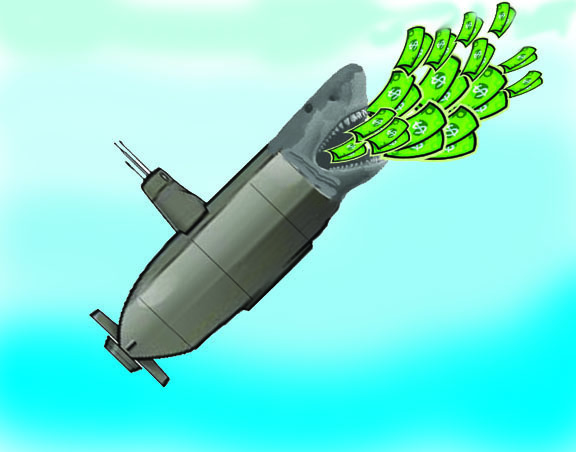
South Korea is again debating whether to develop and build a nuclear-powered submarine.
During a National Assembly confirmation hearing that took place last week, Admiral Kim Myung-Soo, the nominee for chairman of South Korea’s Joint Chiefs of Staff, responded positively to a question about the utility of nuclear-powered submarines, stating that “those capabilities are needed.” He noted, however, that the current U.S.-Korean nuclear agreement restricts the use of nuclear materials for military purposes.
Nevertheless, there appears to be a growing sentiment on the part of both of South Korea’s leading parties and the general public in favor of Seoul acquiring nuclear-powered boats. The government should resist the temptation to do so.
In theory, South Korea could avoid America’s restrictions by turning to France to help it develop or acquire a nuclear-powered submarine. France could help South Korea develop its own nuclear-powered sub, much as Paris has assisted Brazil with its own nuclear-powered submarine program.
However, there are many reasons why Seoul should not imitate the Brazilians and forge ahead with its own program. To begin with, it was only in April of this year that President Biden and South Korean president Yoon Suk Yeol reached an agreement that not only calls for greater consultation on nuclear matters between the two countries, in the form of a newly created nuclear consultative group, but also provides for an enhanced American nuclear presence around the peninsula to deter North Korean aggression…………………………………………………..
In any event, it is not clear how Seoul could afford to undertake a nuclear-submarine program unless it were to dramatically increase its defense spending beyond current levels…………………………………
…………………… Lastly, there are good operational reasons why South Korea should continue to acquire conventionally powered submarines rather than nuclear powered boats. The waters around the Korean peninsula are relatively shallow, which favors the employment of quiet conventional subs. South Korea now operates seven Son–Won II–class diesel-electric submarines, powered by a hybrid diesel‐electric/fuel cell with air-independent propulsion technology. These subs are extremely quiet; they can travel up to 20 knots when submerged and remain under water for seven weeks. They are perfectly suited for operations around the Korean Peninsula.
The South is currently planning both to upgrade the Son-Won II for about $100 million per boat and is proceeding with a new Son-Won III class at about $900 million per submarine. In other words, the country could acquire three state-of-the-art conventional submarines for less than the cost of one nuclear-powered sub.
The costs, the technologies, and operational realities all weigh against South Korea acquiring nuclear-powered submarines. If that were not enough, America’s recent commitment to bolster the nuclear umbrella that it has long provided to South Korea and that is so critical to its deterrent should settle the argument once and for all.
Dov S. Zakheim is a senior adviser at the Center for Strategic and International Studies and vice chairman of the board for the Foreign Policy Research Institute. He was undersecretary of Defense (comptroller) and chief financial officer for the Department of Defense from 2001 to 2004 and a deputy undersecretary of Defense from 1985 to 1987. https://thehill.com/opinion/international/4324038-south-korea-does-not-need-nuclear-subs/
In softening on China, the West may be trying to avoid a nuclear arms race
SCMP, Bob Savic 26 Nov 23
Why the West is suddenly softening on China: power grows out of nuclear warheads
- Weeks before Xi Jinping met various leaders in San Francisco, the US released an estimate of China’s nuclear stockpile
- Now, the EU and UK seem to be holding out an olive branch to China, especially with the surprise appointment of David Cameron as foreign secretary
In a much-publicised report issued on October 19, the US Department of Defence estimated China’s stock of operational nuclear warheads to be at 500, and exceeding 1,000 by 2030. This contrasts with its 2020 report that estimated a stockpile “in the low-200s”, which would grow to about 400 by the end of the decade.
Beijing has consistently dismissed these reports, asserting they are used to serve Washington’s strategic interest of portraying China as a threat to global security.
Irrespective of whether the reports are accurate or fictional, the West has probably decided to err on the side of caution and accept the findings. There has been a discernible shift as Western governments actively seek areas of mutual cooperation with Beijing.
Ultimately, this turn of events probably reflects Western concern over a nuclear arms race fuelled by dangerously destabilising great-power rivalry between China and the United States, at a time when the West is grappling with so-called fatigue in its conflict with Russia over Ukraine.
Further, there is the Israel-Hamas conflict in Gaza. The major Western powers’ failure to back a non-binding UN resolution calling for a truce, which was supported by China and the vast majority of non-Western states, has opened a yawning rift between the West and the Global South.
In any case, one cannot rule out both factors in the West’s approach to China. The most high-profile rapprochement with China was clearly reached when Chinese President Xi Jinping met US President Joe Biden on the sidelines of the Apec summit in San Francisco.
After a year of hyper-tense relations between Beijing and Washington – over then US House speaker Nancy Pelosi’s visit to Taiwan and the Chinese “spy balloon” over mainland America – the Biden administration’s four-hour talks with Xi and senior Chinese officials signified a new strategy of constructive engagement.
As widely reported, the meeting concluded with an agreement to resume military-to-military communications, deemed vital in the context of increasingly knife-edge naval and air activities, by both sides, in the Taiwan Strait and South China Sea.
Also on the sidelines of the Asia-Pacific Economic Cooperation summit in San Francisco, Xi held talks with Japan’s Prime Minister Fumio Kishida for the first time in a year…………………………………………………………………….
Other leaders, further afield, may also be seeking to offer Beijing an olive branch. In early November, European Commission President Ursula von der Leyen said a summit with the Chinese government would take place in China in December, the first in-person European Union-China summit in four years………………
Lastly, and in an even greater surprise, was the appointment of Britain’s former prime minister David Cameron as the new foreign secretary on November 13. There has been much speculation about why the current British prime minister, Rishi Sunak, would bring Cameron back into the cabinet after he spent several years outside politics.
Among those reasons is likely to be that Cameron made high-level international contact when in office, not the least of which was crafting the “golden era” of relations with China, even having a pint of beer with Xi at a British pub…………………………………..
the new Pentagon report on China’s substantial upscaling of its nuclear stockpile, no matter whether it is accurate or not, may have been all that was necessary to prompt Western decision-makers to act swiftly, and in concert, thus averting any escalation of geopolitical tensions that might imperil the West’s still dominant global position. https://www.scmp.com/comment/opinion/article/3242540/why-west-suddenly-softening-china-power-grows-out-nuclear-warheads
Japanese and Chinese top envoys eye more talks on Fukushima row
Jsapan Times, BY JESSE JOHNSON, STAFF WRITER 26 Nov 23
Foreign Minister Yoko Kamikawa met her Chinese counterpart, Wang Yi, on Saturday, with the top Japanese diplomat “strongly urging” Beijing to immediately remove its complete ban on seafood imports from Japan over Tokyo’s release of treated wastewater from the Fukushima No. 1 nuclear plant.
The Fukushima issue has bedeviled Sino-Japanese relations already facing tensions over issues such as China’s growing military assertiveness in the region. Despite this, both sides agreed to find a way to resolve the wastewater matter “through discussion and dialogue in a constructive manner,” Japan’s Foreign Ministry said.
Wang repeated China’s opposition to the discharge of “nuclear-contaminated water,” a move that he labeled as “irresponsible,” according to the Chinese Foreign Ministry.
The two top diplomats also agreed to hold bilateral security talks “at an early date,”…………………………………………………………………………………………….
On Thursday, Wang met with Natsuo Yamaguchi, head of Komeito, the Liberal Democratic Party’s coalition partner in the ruling bloc, for talks in Beijing. China called for independent monitoring of the ongoing Fukushima discharge, according to Yamaguchi.
China’s seafood ban has hit Japanese exporters hard, with Chinese customs authorities reporting last week that imports of fish and shellfish from Japan in October dropped 99% from a year earlier to $332,000. https://www.japantimes.co.jp/news/2023/11/25/japan/politics/japan-china-yoko-kamikawa-wang-yi/
Malaysian Govt urged to halt Australian company Lynas’ thorium extraction plan

https://www.thestar.com.my/news/nation/2023/11/24/govt-urged-to-halt-lynas-thorium-extraction-plan
SEVERAL DAP lawmakers have urged the government to review Lynas Malaysia’s license and stop the plan for thorium extraction from the waste produced at the factory of the rare earth producer.Chow Yu Hui (PH-Raub) said that he remains unconvinced that Lynas Malaysia was capable of extracting thorium.
“Let us not forget that the amount of waste from the Lynas plant was as large as five hills behind its factory. Will the new thorium extraction technology and Lynas be able to manage the radioactive waste which is expected to reach 1.2 million metric tonnes?” he asked reporters at the parliament media centre yesterday.
Oct 24, Science, Technology and Innovation Minister Chang Lih Kang announced that Lynas Malaysia would be allowed to import lanthanide concentrates until its licence expires in March 2026.
He also said that the Atomic Energy Licensing Board (AELB) decided to amend Lynas Malaysia’s license conditions after the company made a proposal to the licensing board about its thorium extraction technology.
With this, Chang said radioactive waste will not be produced after extraction and cracking and leaching activities are carried out on the lanthanide concentrate.
Khoo Poay Tiong (PH-Kota Melaka) said the Science, Technology and Innovation Ministry had announced on May 10 regarding the renewal of Lynas Malaysia’s license until Dec 31.
However, Khoo said that within a period of five months, the government, via AELB, had reviewed Lynas’ licence conditions.
“This matter has raised many concerns regarding the radioactive pollution and safety of locals,” said Khoo, who also wanted to know the parties that came up with the idea of thorium extraction.“We also want clarification from the government on what the possible market for thorium is,” he said.
Tan Hong Pin (PH-Bakri) also pointed out that thorium extraction technology was still in its initial phases, even at the international level.
“To what extent can thorium be extracted, used and commercially extracted? What are the effective measures that can be taken by the government to address the issue and ensure that Lynas will adhere to all the international standards in managing radioactive waste?” asked Tan.
On Nov 16, Chang promised that AELB will closely monitor the thorium extraction process from Lynas Malaysia’s waste material.
Japan’s Fukushima plant completes third water release

Canberra Times By Mari Yamaguchi, November 20 2023 – Australian Associated Press
The release of a third batch of treated radioactive wastewater from Japan’s damaged Fukushima nuclear plant into the Pacific Ocean ended safely as planned, its operator says, as the country’s seafood producers continue to suffer from a Chinese import ban imposed after the discharges began.
Large amounts of radioactive wastewater have accumulated at the nuclear plant since it was damaged by a massive earthquake and tsunami in 2011.
It began discharging treated and diluted wastewater into the ocean on August 24 and finished releasing the third 7800-ton batch on Monday.
The process is expected to take decades.
The discharges have been strongly opposed by fishing groups and neighbouring countries including China, which banned all imports of Japanese seafood, badly hurting Japanese producers and exporters of scallops and other seafood……………………………………………………
Japan’s government has set up a relief fund to help find new markets for Japanese seafood, and the central and local governments have led campaigns to encourage Japanese consumers to eat more fish and support Fukushima seafood producers.
TEPCO is also providing compensation to the fisheries industry for “reputational damage” to its products caused by the wastewater release and said it has mailed application forms to 580 possible compensation seekers…………………………..
TEPCO and the government say the process is safe, but some scientists say the continuing release of water containing radionuclides from damaged reactors is unprecedented and should be monitored closely.
Monday’s completion of the release of the third batch of wastewater brings the total to 23,400 tons.
TEPCO plans a fourth release by the end of March 2024.
That would only empty about 10 of the approximately 1000 storage tanks at the Fukushima plant because of its continued production of wastewater, although officials say the pace of the discharges will pick up later.

The tanks currently hold more than 1.3 million tons of wastewater, most of which needs to be retreated to meet safety standards before release.
TEPCO and the government say discharging the water into the sea is unavoidable because the tanks need to be removed from the grounds of the plant so that it can be decommissioned. https://www.canberratimes.com.au/story/8430646/japans-fukushima-plant-completes-third-water-release/
The US and China re-engage on arms control. What may come next
Bulletin, By Daryl G. Kimball | November 15, 2023
For more than six decades, the United States has been worried about China’s regional influence, military activities—and its nuclear potential. For instance, in 1958, US officials considered using nuclear weapons to thwart Chinese artillery strikes on islands controlled by Taiwan, according to a document leaked by Daniel Ellsberg in 2021. Now, as then, a nuclear conflict between the United States and China would be devastating for both sides and the world.
The United States has a decades-long experience of nuclear arms control and strategic stability talks with the Soviet Union, and later Russia. However, there has not been a sustained bilateral dialogue between Washington and Beijing on how to reduce the risk of conflict, nuclear escalation, and nuclear arms control and disarmament. Until recently, China had rebuffed US overtures for bilateral talks on nuclear risk reduction and arms control, and on other security issues.
Adding to the tensions, China has embarked since the early 2000s on a major buildup of its relatively smaller nuclear arsenal and has resisted calls for a global halt on the production of fissile material for nuclear weapons. In response, some current and former national security insiders, as well as many in Congress, suggest that the US arsenal “should be supplemented” to add more capability and flexibility to counter two “near-peer” nuclear adversaries. In other words, the potential for an unconstrained, three-way arms race is growing.
But things started to change on November 6 with the meeting in Washington between US Assistant Secretary of State for the Bureau of Arms Control, Verification and Compliance Mallory Stewart and China’s Ministry of Foreign Affairs Director-General of Arms Control Sun Xiaobo.
A modest yet important breakthrough. The US-Chinese discussion on arms control—the first of its kind since 2018—was described by the US side as a “candid and in-depth discussion on issues related to arms control and nonproliferation.” According to the State Department’s readout of the meeting, “the United States highlighted the need to promote stability, help avert an unconstrained arms race, and manage competition so that it does not veer into conflict.” The Chinese Foreign Ministry’s readout also said the “[t]he two sides had an in-depth, candid and constructive exchange of views” on nuclear weapons matters, as well as an exchange on “regular arms control.”
Several participants told me that the meeting was “wide-ranging” and “positive in tone,” but that it did not involve much substantive exchange of views on the issues, which is not surprising. Tangible progress will require time and sustained give-and-take from both sides.
The next step, ideally, will be for Presidents Joe Biden and Xi Jinping, who are set to meet this week, to direct their teams toward concrete nuclear risk reduction and arms control measures that enhance mutual security.
More nuclear capabilities imply more responsibilities.……………………………………………….
China’s arsenal is not only growing (it had less than 200 nuclear warheads in 2000), but it is also diversifying and modernizing. It is now well-documented that China has started to deploy new solid-fueled missiles that can be launched more quickly than its older liquid-fueled missiles. …………………………………………………………………………..
Of course, China’s nuclear arsenal is still modest by comparison to the US and Russian arsenals, each of which are about nine times larger than China’s. But China’s nuclear modernization efforts could have significant strategic implications that make it even more important for the “Big Three” (the United States, Russia, and China) to pursue meaningful progress on nuclear arms control to avoid a destabilizing and dangerous nuclear arms race.
Toward a more serious, sustained dialogue. In response to China’s nuclear buildup, US officials—Republicans and Democrats alike—have prioritized engagement with China in talks to identify measures to reduce nuclear risks and prevent destabilizing and costly strategic weapons competition………………………….
Sullivan’s June 2 address provides some important clues about the types of issues the US side likely raised in the arms control talks. Sullivan suggested that the United States and China, along with the other NPT nuclear-armed states, could engage in new nuclear arms control and risk reduction efforts such as establishing more robust crisis communications channels and “formalizing a missile launch notification regime” for all five permanent members of the UN Security Council—the United States, Russia, China, the United Kingdom, and France. “It’s a small step that would help reduce the risk of misperception and miscalculation in times of crisis,” Sullivan added.
These suggestions don’t happen in a vacuum: The United States and Russia have a ballistic missile launch notification agreement already in place, and Russia and China have their own bilateral agreement too.
In his remarks, Sullivan also called for talks on “maintaining a ‘human-in-the-loop’ for command, control, and employment of nuclear weapons” to reduce the risk of miscalculation in a crisis. This would require that the US and China—and other nuclear-armed states—agree to pursue technical discussions designed to reach common understandings on how the use of artificial intelligence, particularly high-risk, cutting-edge deep learning models, can be banned or at least limited so the use of nuclear weapons is effectively kept under human control. This proposal seems to have reached the highest level with Presidents Biden and Xi reportedly discussing limits on the employment of artificial intelligence in the control and deployment of nuclear weapons.
In future meetings, US and Chinese diplomats should go one step further and set out a process for formulating a joint understanding that cyberwarfare capabilities will not be used to try to interfere with other states’ nuclear command and control systems, which could also severely alter decision-making in a crisis……………………………………………………..
From talks to concrete actions. Further down the road, an even more ambitious approach that might be considered in the multilateral, nuclear-five setting would be for Washington and Moscow to propose that China, France, and the United Kingdom freeze the size of their nuclear stockpiles so long as the United States and Russia maintain the current limits on their strategic arsenals—even after New START expires—and make good faith efforts to negotiate deeper verifiable reductions in their stockpiles…………………………………………………………………
With US-Russian relations at rock bottom, the Kremlin still wedging its war on Ukraine, and the last remaining treaty limiting US and Russian strategic nuclear arsenals set to expire in early 2026, the risk of nuclear escalation and a nuclear arms race with Russia is already too high. That makes it all the more important for Xi and Biden to direct their team to work harder and more steadily to reduce tensions and head off the possibility of a costly, dangerous, unconstrained three-way nuclear race that no one can win.
Fukushima Nuclear Power Plant starts 3rd round of wastewater release, potentially impacting seafood quality in U.S.
The Daily Universe, Belle Lewis, November 14, 2023
The Fukushima-Dachii nuclear plant started its third release of nuclear wastewater on Nov. 2 as scientists warn that seafood products from the Pacific Ocean could be contaminated.
Although the International Atomic Energy Agency approved the 30-year water release plan, scientists and civilians in nations bordering the Pacific Ocean have questioned the safety of the plan, especially as it relates to seafood.
In a press release approving of the plan, the IAEA stated, “the discharges of the treated water would have a negligible radiological impact to people and the environment.”
Paul Dorfman, member of the Irish Government Environmental Protection Agency Radiation Protection Advisory Committee and chair of Nuclear Consulting Group, explained that some scientists have questioned IAEA’s approval of the water release.
“I and others are concerned by IAEA’s attitude,” Dorfman said. “Normally even low levels of radioactive pollution will find its way into local seafood, one way or another.”
In 2020, Japan exported 332,926 kilograms of frozen scallops to the U.S. Japan exports many fish products to the U.S.
Samantha Valeriano, a psychology student from Hawaii, said she eats seafood about once a week. She does not often think about where her food comes from but wants to be more cautious following the nuclear water release.
“I think I would be a little more cautious of what I ate, checking labels a little bit more,” Valeriano said. “I would be conscious of what I ate and where it came from.”
As the People’s Republic of China has imposed bans of Japanese fish exports, the U.S. has supported the Japanese market by increasing fish purchases.
In a press release, the United States Embassy and Consulate in Japan explained that military bases in Japan will carry Japanese seafood as a way to buoy up seafood markets and undermine the PRC’s ban.
“United States elected representatives and senior government officials have stood in solidarity with Japan during this baseless ban,” the statement said. “Another step to help provide additional sales to counter the ban was to start selling Japanese seafood at the U.S. military facilities in Japan, both through the commissaries and mess halls.”
According to the statement, government officials like former speaker Kevin McCarthy ate seafood from Japan as a testament to Japan’s safety standards.
However, other U.S. agencies, like the National Association of Marine Laboratories question whether accurate research was conducted by the IAEA and Japanese Government to determine safety of seafood products.
They explain that the lack of data on potential health impacts is a cause for serious concern.
“Many of the radionuclides contained in the accumulated waste cooling water have half-lives ranging from decades to centuries, and their deleterious effects range from DNA damage and cellular stress to elevated cancer risks in people who eat affected marine organisms, such as clams, oysters, crabs, lobster, shrimp and fish,” the statement reads.
Eve Nagareda, medical laboratory science major from Hawaii, shared she wants to avoid seafood from dumping grounds even if levels are considered safe.
“I think I would try to go as far as possible from it,” Nagareda said…………………………………………………………………………..
On Sep. 8, the IAEA conducted seawater sampling off the Japanese Coast. They recorded Tritium levels below the internationally mandated limit of 1,500 bequerels per liter.
Dorfman explained that below-accepted tritium levels does not mean that the ALPS is functioning properly.
“The Japan government and IAEA say that the treatment is sufficient, and levels of radiation, especially tritium, in the water releases are low.” Dorfman said. “However, others note that the treatment process has already failed once before, and may let through a series of radioisotopes, not only tritium.”
A pre-publication scientific paper found that radionucleotides from the Fukushima plant will distribute globally and penetrate into the deep ocean. The highest concentration of these particles would be along the eastern coast of Japan.
This paper contradicts assertions made by the IAEA that once the water is dumped into the Pacific Ocean, the particles will dilute.
Radiation experts often say that “dilution isn’t the solution to pollution,” according to Dorfman.
Why release the water?
After the water is released, the land the tanks occupy will be available for the Japanese government to build facilities to fully decommission the Fukushima-Daiichi Plant.
In the greater scheme of things, it has to be said that the main issue at Fukushima remains the almost impossible task of trying to extract the nearly 880 tonnes of highly radioactive nuclear fuel that have melted in three of the plant’s six reactors,” Dorfman said.
According to Dorfman, decommissioning is far off.
“We are a very very long way away from decommissioning Fukushima,” Dorfman said. “At the moment, there are no feasible plans to do so.”
What is the future of nuclear energy?
As the Fukushima nuclear water release continues its third phase and looks toward its 30-year release plan, scientists like Dorfman consider the overall effectiveness of nuclear power and its potential risks.
“The weight of evidence shows that due to the pace, scale and economics of the renewable evolution, all nuclear can do is make promises it just can’t keep,” Dorfman said.
Dorfman continued to explain how renewable energy will outstrip nuclear soon.
“Nuclear is quite simply just marginal,” Dorfman said. “In terms of cost, time, and do-ability — it’s renewable expansion in all sectors, energy efficiency and management, rapidly advancing storage technologies, grid modernization, interconnection and market innovation from supply to service provision that will power the global net-zero energy transition.”
As Nuclear wastewater disposal continues, organizations like the IAEA and NAML continue to debate the potential health impacts. https://universe.byu.edu/2023/11/14/fukushima-nuclear-power-plant-starts-third-round-of-wastewater-release-potentially-impacting-seafood-quality-in-u-s/
Collective calls on Pacific leaders to oppose Fukushima nuclear wastewater discharge
The Pacific Collective on Nuclear Issues has denounced once again the dumping of radioactive wastewater from the damaged Fukushima nuclear power plant into the Pacific Ocean, calling on Pacific leaders to suspend Japan’s status as a Pacific Islands Forum (PIF) dialogue partner.
The Collective, composed of civil society groups, non-governmental organizations and movements in the Pacific, issued a statement this week, during which the 52nd Pacific Islands Forum Leaders Meeting was held in the Cook Islands.
The statement condemned the Japanese government and the facility operator, Tokyo Electric Power Company (TEPCO), for insisting on this flawed and dangerous course of action.
“The findings of the independent panel of scientific experts commissioned by the Pacific Islands Forum were unequivocal – the data provided so far, to support Japan’s claim that the treated wastewater is safe, is inconsistent, unsound and therefore far from reliable,” the statement said, adding that “if the Japanese government and TEPCO believe the radioactive wastewater is safe, they should be prepared to safely dispose of it within terrestrial Japan.”
The Collective also declared that such dumping into the Pacific Ocean is a direct violation of human rights.
Aside from being a brazen violation of international law, the Collective said, Japan’s behavior and handling of this matter is an affront to the very sovereignty of Pacific states and unbecoming of a dialogue partner of the PIF.
Founded in 1971, the PIF is the region’s premier political and economic policy organization which comprises 18 members.
The Collective called on the Pacific leaders to reaffirm the long-held position of the Pacific to keep their region nuclear-free and to review diplomatic relations with Japan at the next Pacific Islands Forum Leaders Meeting in 2024.
They also called on the international community not to turn a blind eye to the threat that dumping radioactive wastewater into the Pacific Ocean poses to Pacific peoples, their livelihoods, safety, health and well-being.
Japan conducted the third round of release of nuclear-contaminated wastewater from the crippled Fukushima Daiichi Nuclear Power Plant into the Pacific Ocean earlier this month, despite numerous and repeated objections by governments and communities, environmental groups, NGOs, and anti-nuclear movements in Japan and the Pacific
Pacific island nations express concern over Fukushima water release
Japan Times, AVARUA, COOK ISLANDS – 11 Nov 23
Leaders of Pacific island nations expressed strong concerns over the release of treated radioactive water from Japan’s wrecked Fukushima No. 1 nuclear plant into the Pacific Ocean during a regional summit, according to Cook Islands Prime Minister Mark Brown.
Brown, who currently chairs the Pacific Islands Forum, said Thursday there were “strong concerns” raised by “our forum leaders for the significance of potential threats of contamination to the health and security of the blue Pacific.”
The bloc’s 18 members have expressed differing views on the treated wastewater discharge from the Fukushima No. 1 nuclear power plant, which began in late August, after extensive dialogue between the member states and Japan………………………………………………….
The leaders’ meeting began in the Cook Islands Monday, with the main talks taking place Wednesday and Thursday on Rarotonga, the country’s most populous island, and Aitutaki.
The Pacific Islands Forum comprises Australia, the Cook Islands, Micronesia, Fiji, French Polynesia, Kiribati, the Marshall Islands, Nauru, New Caledonia, New Zealand, Niue, Palau, Papua New Guinea, Samoa, the Solomon Islands, Tonga, Tuvalu and Vanuatu. https://www.japantimes.co.jp/news/2023/11/11/japan/politics/japan-pacific-island-nations-fukushima-water-release/
China’s Misunderstood Nuclear Expansion
How U.S. Strategy Is Fueling Beijing’s Growing Arsenal
Foreign Affairs, By M. Taylor Fravel, Henrik Stålhane Hiim, and Magnus Langset Trøan, November 10, 2023
Among the many issues surrounding China’s ongoing military modernization, perhaps none has been more dramatic than its nuclear weapons program. For decades, the Chinese government was content to maintain a comparatively small nuclear force. As recently as 2020, China’s arsenal was little changed from previous decades and amounted to some 220 weapons, around five to six percent of either the U.S. or Russian stockpiles of deployed and reserve warheads.
Since then, however, China has been rapidly expanding and modernizing its arsenal. In 2020, it began constructing three silo fields to house more than 300 intercontinental ballistic missiles (ICBMs). A year later, it successfully tested a hypersonic glide vehicle that traveled 21,600 miles, a test that likely demonstrated China’s ability to field weapons that can orbit the earth before striking targets, known as a “fractional orbital bombardment system.” Simultaneously, the Chinese government has accelerated its pursuit of a complete nuclear triad—encompassing land-, sea-, and air-launched nuclear weapons—including by developing new submarine- and air-launched ballistic missiles. By 2030, according to U.S. Defense Department estimates, China will probably have more than 1,000 operational nuclear warheads—a more than fourfold increase from just a decade earlier…………………………………………………………………………………………………………………………………..
writings and analysis since 2015 suggest that China’s nuclear expansion is less a shift in Chinese intentions than a response to what Beijing perceives as threatening changes in U.S. nuclear strategy, reflecting an acute security dilemma. Chinese analysts are worried that the United States has lowered its threshold for nuclear use—including allowing for limited first use in a Taiwan conflict—and that the U.S. military is acquiring new capabilities that could be used to destroy or significantly degrade China’s nuclear forces. Thus, many Chinese experts have concluded that China needs a more robust arsenal.
Given Chinese and U.S. fears about each other’s nuclear programs, increased communication may help to break the spiral. Based on Chinese fears, the United States should understand how changes in its nuclear capabilities and doctrine play a critical role in shaping China’s threat perceptions and perceived force requirements. Going forward, China will continue to respond to U.S. advances that are viewed as weakening China’s nuclear deterrent.
Similarly, Beijing should understand that the lack of transparency surrounding its rapid nuclear expansion has fueled worst-case assessments by the United States. Continued lack of transparency will lead to even greater U.S. suspicion—and feed an intensifying arms race between the two countries……………………………………………………………………………….
the 2018 review increased Chinese fears that the United States might engage in limited nuclear first use during a conventional conflict with China, most likely over Taiwan. According to Chinese arms control expert Li Bin, the document suggested that “the United States would use its nuclear weapons to respond to nonnuclear Chinese aggressions.”………………………………………………………………………………………………………………………………………………………………………………………………………….. more https://www.foreignaffairs.com/china/chinas-misunderstood-nuclear-expansion
Accident proves Japan’s toxic water plan dubious
By LI YANG 2023-11-06 https://www.chinadaily.com.cn/a/202311/06/WS65483427a31090682a5ec88b.html
Despite the strong opposition at home and abroad, Tokyo Electric Power Company, the owner of the Fukushima Daiichi nuclear power plant which was damaged in the 2011 earthquake-generated tsunami, started the third release of the radioactive water from the plant into the sea on Nov 2.
The release will continue until Nov 20, with TEPCO planning to dump about 7,800 tons of the nuclear-contaminated water into the sea this time. The company claims the wastewater to be discharged has limited concentration of radioactive tritium. But the radioactive waste sputtering accident that happened last week raises doubts on the credibility of TEPCO’s claim.
As TEPCO itself said, five workers “accidentally” came in contact with the radioactive “fluid” while cleaning the pipelines used to “detoxify “the nuclear-contaminated water at the Fukushima plant on Oct 25, and two of them, after being “decontaminated” for treatment, will be kept under medical observation.
Although, according to the company, a doctor said the possibility of both men sustaining burns due to radiation exposure was low, the radiation levels in the bodies of the two men did not fall below the standard threshold of 4 becquerels per square centimeter despite the initial treatment at the plant.
The accident exposes the ineffectiveness of the so-called Advanced Liquid Processing System the company uses to treat the radioactive water accumulated at the plant. Also, TEPCO has not explained why and how “the hose used to drain waste liquid containing radioactive substances into a tank became detached” while the workers “were washing (the processing facilities) by pouring nitric acid into the piping”.
The Japanese government claims the ALPS is reliable, and the water obtained after being treated using the ALPS is safe enough to “drink”.So it should explain how only about 100 milliliters of the “fluid” was enough to cause such a serious accident.
It also needs to answer the public’s query that since four of the five workers “were wearing protective gear and full-face masks, which prevented ingestion of the fluid”, how could the “fluid” splash and burn the “lower body and both arms” of one of them, and why the other worker whose “entire body was found to be exposed”, was allowed to do the dangerous work without wearing any protective gear?
The accident shows Japan’s claim of the radioactive water being “safe” to be released into the sea is questionable, and the risks associated with the disposal process of the radioactive water should not be underestimated. #nuclear #antinuclear #nuclearfree #NoNukes
China calls for a long-term international monitoring mechanism for Fukushima nuclear-contaminated wastewater
Minister Huang urges Japan on nuclear-contaminated water
By JIANG XUEQING in NAGOYA, JAPAN | chinadaily.com.cn 2023-11-05 https://www.chinadaily.com.cn/a/202311/05/WS65476d92a31090682a5ec7c3.html
Chinese Minister of Ecology and Environment Huang Runqiu urged Japan to engage in full consultations with stakeholders in handling the release of nuclear-contaminated water from the crippled Fukushima Daiichi Nuclear Power Plant in a responsible manner.
“We also called for the prompt establishment of a long-term international monitoring mechanism with the participation of Japan, neighboring countries, and other relevant stakeholders to effectively protect the global marine environment,” Huang said at the 24th Tripartite Environment Ministers Meeting among Japan, South Korea, and China. The two-day meeting closed on Saturday in Nagoya, Japan. #nuclear #antinuclear #nuclearfree #NoNukes
300 scientists call for finding safe site to store nuclear waste

By EISUKE SASAKI/ Senior Staff Writer, October 31, 2023 https://www.asahi.com/ajw/articles/15044716
Earth science specialists hold a news conference on Oct. 30 to express their opposition to a plan to bury spent nuclear fuel as a final storage method. (Eisuke Sasaki)
About 300 earth science specialists have released a statement calling for a fundamental review of the Japanese government’s plan for storing spent nuclear fuel.
The process for finding a final storage site in Japan has been proceeding “while keeping a lid on scientific discussions,” said Junji Akai, a professor emeritus of earth science at Niigata University, who signed the statement, at an Oct. 30 news conference.
The current plan is to bury the highly radioactive waste deep underground.
But the statement about 300 scientists signed, including a number of former chairmen of the Geological Society of Japan, said there was no place in Japan where such waste could be kept safe for the 100,000 years or so needed for the radiation to dissipate.
A law passed in 2000 regarding the final handling of nuclear waste stated that the spent nuclear fuel should be buried deep underground.
But the statement released on Oct. 30 noted that several tectonic plates converge on the Japanese archipelago, a mobile belt with active volcanoes and frequent earthquakes.
It went on to say that under the current circumstances, it would be “impossible” to choose a location that would not be affected by such tectonic activity for 100,000 years.
The statement called for abolishing the law on the final storage of nuclear waste and setting up a third-party organization to reconsider how such waste should be stored, including temporarily storing it aboveground.
Two small municipalities in Hokkaido are in the first of a three-stage process to determine their suitability as a site for the final storage of nuclear waste. #nuclear #antinuclear #nuclearfree #NoNuke
Taiwan Cabinet officials clarify that nuclear power is not “green”
BY GIORGIO LEALI, OCTOBER 31, 2023 https://en.rti.org.tw/news/view/id/2010213
A Cabinet spokesperson on Wednesday said that nuclear power does not qualify as “green energy”, despite recent comments made by Premier Chen Chien-jen (陳建仁). Cabinet Spokesperson Lin Tze-luen (林子倫) was responding to Chen’s comments in the legislature the previous day.
During questions from legislators on Tuesday, Chen said that nuclear energy is green energy, but that the issue of nuclear waste disposal must also be taken into account. Lin says that several people including Chen himself and Economic Minister Wang Mei-hua (王美花) have all made clarifying comments. Wang in her comments said that although nuclear power generates very few emissions, that does not necessarily define it as “green”. She says that is why international environmental organizations such as RE100 do not list nuclear energy as green.
Lin says that some media reports did not faithfully report the full context of the premier’s comments, which could be misleading. He adds a nuclear-free Taiwan remains the national consensus and that the government’s position has not changed. He says the government continues to move ahead with its four goals of reducing coal, increasing gas, developing green energy, and denuclearizing. He adds that the government will also continue working toward the goal of net-zero carbon emissions by the year 2050. #nuclear #antinuclear #nuclearfree #NoNukes
Two more Japanese nuclear reactors granted 20-year extensions
https://www3.nhk.or.jp/nhkworld/en/news/20231101_21/
Japan’s nuclear watchdog has approved extending the operation of two aging nuclear reactors in southwestern Japan for another 20 years.
The operational lifespan of Japanese reactors has been limited to 40 years in principle since the Fukushima Daiichi nuclear plant accident in 2011. But it can be extended by up to 20 years if the reactors pass screening by the Nuclear Regulation Authority.
At a meeting on Wednesday, the NRA granted extension approval to the No.1 and 2 reactors at the Sendai nuclear power plant in Kagoshima Prefecture, which is operated by the Kyushu Electric Power Company.
The No.1 reactor will turn 40 next July and the No.2 will reach that age in November 2025.
Discussed at the meeting were the results of special inspections of the reactors conducted by Kyushu Electric and an assessment that showed the reactors can be used for another 20 years.
The members of the meeting unanimously approved the extensions.
This decision brings the number of Japanese reactors whose operations have been extended beyond 40 years to six. The other four are the No.1 and No.2 reactors at the Takahama nuclear power plant and the No.3 reactor at the Mihama plant — all in Fukui Prefecture — as well as the Tokai No.2 plant’s reactor in Ibaraki Prefecture. #nuclear #antinuclear #nuclearfree #NoNukes
1 This Month

of the week – Shut Down Drone Warfare!


Tell the Ukrainian Government to Drop Prosecution of Peace Activist Yurii Sheliazhenko

Petition to revoke the licensing of the Near Surface Nuclear Disposal Facility (NSDF) at Chalk River. https://www.ourcommons.ca/petitions/en/Petition/Details?Petition=e-7247
To see nuclear-related stories in greater depth and intensity – go to https://nuclearinformation.wordpress.com
-
Archives
- April 2026 (19)
- March 2026 (251)
- February 2026 (268)
- January 2026 (308)
- December 2025 (358)
- November 2025 (359)
- October 2025 (376)
- September 2025 (257)
- August 2025 (319)
- July 2025 (230)
- June 2025 (348)
- May 2025 (261)
-
Categories
- 1
- 1 NUCLEAR ISSUES
- business and costs
- climate change
- culture and arts
- ENERGY
- environment
- health
- history
- indigenous issues
- Legal
- marketing of nuclear
- media
- opposition to nuclear
- PERSONAL STORIES
- politics
- politics international
- Religion and ethics
- safety
- secrets,lies and civil liberties
- spinbuster
- technology
- Uranium
- wastes
- weapons and war
- Women
- 2 WORLD
- ACTION
- AFRICA
- Atrocities
- AUSTRALIA
- Christina's notes
- Christina's themes
- culture and arts
- Events
- Fuk 2022
- Fuk 2023
- Fukushima 2017
- Fukushima 2018
- fukushima 2019
- Fukushima 2020
- Fukushima 2021
- general
- global warming
- Humour (God we need it)
- Nuclear
- RARE EARTHS
- Reference
- resources – print
- Resources -audiovicual
- Weekly Newsletter
- World
- World Nuclear
- YouTube
-
RSS
Entries RSS
Comments RSS
 nuclear-news
