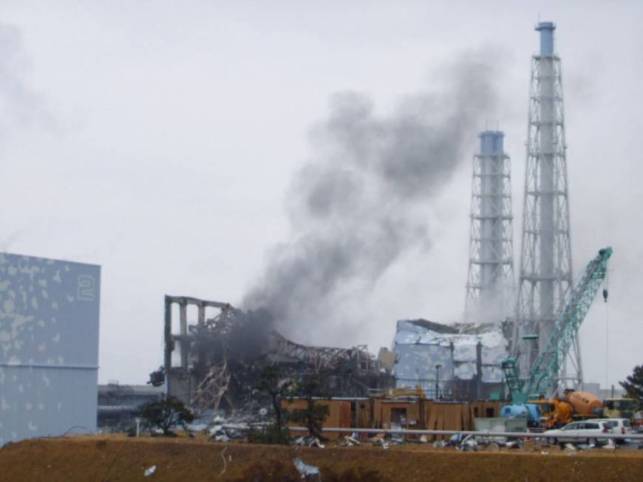
An expert committee of the Ministry of Economy, Trade and Industry put together a recommendation on Dec. 16 for energy policy revisions that would have new, small-scale power suppliers also help cover compensation for the Fukushima nuclear disaster and reactor decommissioning costs by adding charges to consumer power bills.
The estimated total cost of handling the Fukushima disaster has nearly doubled from 11 trillion yen to 21.5 trillion yen, with further increases possible. Since the disaster, Tokyo Electric Power Co. (TEPCO), the operator of the disaster-stricken Fukushima No. 1 Nuclear Power Plant, has been paying around 70 billion yen a year in disaster-related costs from its own money. TEPCO and other major power providers have also been paying around an additional 163 billion yen a year by charging higher power bills.
The plan would raise consumers’ share of the burden yet further. Under a scenario recommended by the committee, up to 60 billion yen a year for 40 years starting from fiscal 2020, or up to a total of 2.4 trillion yen, would be paid through charges to the power transmission costs of both traditional power producers and new producers.
Regarding this 2.4 trillion yen, the ministry argues, “The money should have been prepared prior to the accident at the Fukushima plant,” but says that, since that didn’t happen, “It is appropriate for all past users of cheap power (including those who switched to non-nuclear sources after the disaster) to equally share the burden (of post-disaster costs.)” Under ministry calculations, the proposal would lead to an additional payment of 18 yen per month for 40 years for an average household.
Additionally, the plan, which would also start in fiscal 2020, would have new power producers help finance the plans of major power producers to decommission aging nuclear reactors through higher power transmission costs.
In exchange for new power producers paying part of the compensation costs, major utilities would supply more power from cheap sources to the market, such as nuclear power and coal, which can be used by smaller providers.
Yoh Yasuda, specially-appointed professor at Kyoto University, is critical of this, saying, “This will lead to the protection of traditional power sources like coal and nuclear, and serve as a barrier to new technologies like renewable energy entering the market.”
The economy ministry argues that even with the extra costs for the Fukushima disaster added on, nuclear power is still cheaper than thermal power. At the meeting on Dec. 16, committee member Toshihiro Matsumura, a professor at the University of Tokyo, criticized the move, saying, “If the ministry claims that nuclear power is still cheap even after including the massive compensation costs, nuclear power producers and the ministry should realize that there will be people who say those utilities should cover the costs themselves instead of pushing the burden onto others.” However, most of the committee members generally agreed on the plan. After soliciting opinions from the public, the proposal will be officially decided upon.
The plan would go into effect with just a ministry order, not requiring a law amendment through the Diet, and there is criticism that the plan is being made without enough input from the public. The non-partisan Diet group working for zero nuclear power plants, jointly headed by Taro Kono of the ruling Liberal Democratic Party and Shoichi Kondo of the main opposition Democratic Party, has released a statement saying, “The idea of adopting a proposal after no public discussion, with no participation from the Diet at all in its creation, is unspeakable, as it will twist the basis of power system reforms and increase the burden on the people.”
http://mainichi.jp/english/articles/20161217/p2a/00m/0na/006000c
December 19, 2016
Posted by dunrenard |
Fukushima 2016 | Fukushima Daiichi, Nuclear Disaster Costs |
Leave a comment
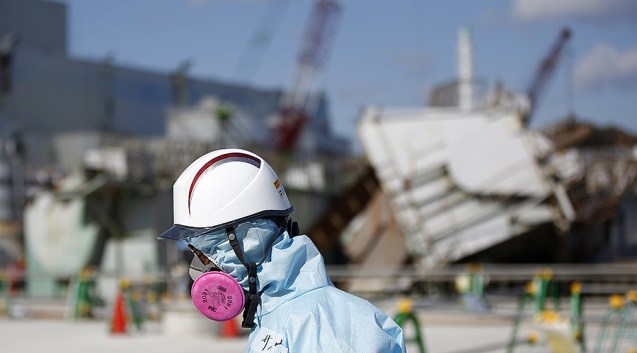
Tepco worker’s thyroid cancer is recognized as a work-related
Japanese labor authorities have recognized the thyroid cancer of a man who worked at Tepco’s stricken Fukushima No. 1 nuclear plant as a work-related, it was learned Friday.
It is the first time that thyroid cancer has been recognized as a work-related illness caused by radiation from the plant after it was damaged in the March 2011 earthquake and tsunami.
This is the third case labor authorities have linked to radiation exposure for workers at the Fukushima plant. The two previous cases involved leukemia.
At a meeting Friday, a Health, Labor and Welfare Ministry panel of experts presented for the first time criteria for recognizing thyroid cancer as a work-related disease from radiation, including doses of 100 millisieverts or more and a period of five years or more between exposure to radiation and the development of cancer.
Based on the criteria, a labor standards office in Fukushima Prefecture concluded that the cancer of the employee, who is in his 40s, was caused by radiation from the plant.
The man joined Tokyo Electric Power Company Holdings Inc. in 1992 and worked at several nuclear power plants for over 20 years.
After checking reactor instruments and carrying out other duties at the Fukushima No. 1 plant from March 2011 to April 2012, he was diagnosed with thyroid cancer in April 2014. His cumulative radiation dose after the accident stood at 139.12 millisieverts.
According to the International Commission on Radiological Protection, lifetime cancer mortality rises by about 0.5 percent for those exposed to a dose of 100 millisieverts.
http://www.japantimes.co.jp/news/2016/12/17/national/tepco-workers-thyroid-cancer-recognized-work-related/#.WFUH-lzia-c
Thyroid cancer compensation for Fukushima plant worker
A man who developed thyroid gland cancer after working at the stricken Fukushima No. 1 nuclear plant has for the first time won the right to work-related compensation.
While the case ranks as the third time a worker at the Fukushima plant has been recognized as eligible for work-related compensation because of cancer caused by radiation exposure, it is the first instance involving thyroid gland cancer.
The Ministry of Health, Labor and Welfare announced its decision Dec. 16.
The man in his 40s, an employee of plant operator Tokyo Electric Power Co., worked at the Fukushima plant after the triple meltdown triggered by the 2011 Great East Japan Earthquake and tsunami. He was diagnosed with thyroid gland cancer in April 2014.
The man worked at various nuclear plants, including the Fukushima facility, between 1992 and 2012. He was mainly involved in operating and overseeing reactor operations.
After the March 2011 nuclear accident, the man was in the plant complex when hydrogen explosions rocked the No. 1 and No. 3 reactor buildings. His duties included confirming water and pressure meter levels as well as providing fuel to water pumps.
The amount of his accumulated whole body radiation exposure was 150 millisieverts, with about 140 millisieverts resulting from the period after the nuclear accident. Of that amount, about 40 millisieverts was through internal exposure caused by inhaling or other ways of absorbing radioactive materials.
Along with recognizing the first work-related compensation involving thyroid gland cancer, the labor ministry also released for the first time its overall position on dealing with compensation issues for workers who were at the Fukushima plant after the accident.
The ministry said it would recognize compensation for workers whose accumulated whole body dose exceeded 100 millisieverts and for whom at least five years have passed since the start of work involving radiation exposure and the diagnosis of cancer.
Ministry officials said the dose level was not a strict standard but one yardstick for recognizing compensation.
According to a study by TEPCO and a U.N. scientific committee looking into the effects of radiation, 174 people who worked at the plant had accumulated whole body doses exceeding 100 millisieverts as of this past March.
There is also an estimate that more than 2,000 workers have radiation doses exceeding 100 millisieverts just in their thyroid gland.
http://www.asahi.com/ajw/articles/AJ201612170027.html
First thyroid cancer case in Japan recognized as Fukushima-related & compensated by govt
A man who worked at the Fukushima nuclear power plant in Japan during the disastrous 2011 meltdown has had his thyroid cancer recognized as work-related. The case prompted the government to finally determine its position on post-disaster compensation.
The unnamed man, said to be in his 40s, worked at several nuclear power plants between 1992 and 2012 as an employee of Tokyo Electric Power Company Holdings Inc. He was present at the Fukushima Daiichi nuclear power plant during the March 11, 2011 meltdown. Three years after the disaster, he was diagnosed with thyroid gland cancer, which the Japanese Ministry of Health, Labor and Welfare confirmed on Friday as stemming from exposure to radiation.
The man’s body radiation exposure was totaled at 150 millisieverts, almost 140 of which were a result of the accident. Although this is not the first time that health authorities have linked cancer to radiation exposure for workers at the Fukushima plant, it is the first time a patient with thyroid cancer has won the right to work-related compensation.
There have been two cases previously, both of them involving leukemia.
The recent case prompted Japan’s health and labor ministry to release for the first time its overall position on dealing with compensation issues for workers who were at the Fukushima plant at the time and after the accident. Workers who had been exposed to over 100 millisieverts and developed cancer five years or more after exposure were entitled to compensation, the ministry ruled this week. The dose level was not a strict standard but rather a yardstick, the officials added.
As of March, 174 people who worked at the plant had been exposed to over 100 millisieverts worth of radiation, according to a joint study by the UN and the Tokyo Electric Power Company. There is also an estimate that more than 2,000 workers have radiation doses exceeding 100 millisieverts just in their thyroid gland, Japanese newspaper the Asahi Shimbun reported.
The 2011 accident at the Fukushima nuclear power plant was the worst of its kind since the infamous 1986 catastrophe in Chernobyl, Ukraine. After the Tohoku earthquake in eastern Japan and the subsequent tsunami, the cooling system of one of the reactors stopped working, causing a meltdown. Nearly half a million people were evacuated and a 20-kilometer exclusion zone was set up.
https://www.rt.com/news/370650-thyroid-cancer-fukushima-plant-radiation/#.WFZfzwMDsFM.facebook
December 19, 2016
Posted by dunrenard |
Fukushima 2016 | Fukushima Daiichi, Tepco, Thyroid Cancer, Worker |
Leave a comment
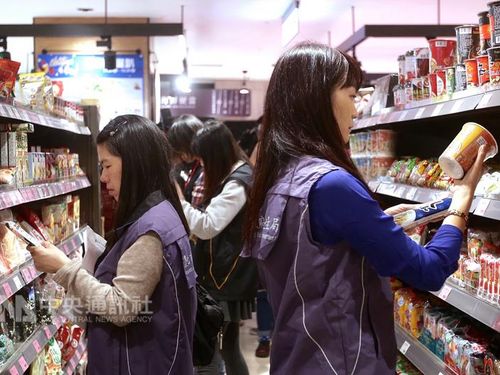
Taiwan recalls 37 food products from Japan’s radiation-affected area
Taipei, Dec. 16 (CNA) A total of 37 Japanese food products have been pulled from store shelves in Taiwan, after they were found to have come from Japan’s radiation-affected areas, Taiwanese authorities said Friday.
As of Thursday, 50,316 pieces of these products have been recalled, with many of them being soy sauce and wasabi packets that came with Japanese natto, or fermented soybeans, according to the Food and Drug Administration (FDA).
The FDA launched an inspection of food products from Japan on Dec. 12, after two brands of Japanese natto were found to contain packets of soy sauce from Ibaraki Prefecture, one of the five prefectures from which food imports have been banned.
Taiwan banned food imports from Fukushima, Ibaraki, Tochigi, Gunma and Chiba prefectures after the meltdown of the Fukushima Daiichi Nuclear Power Plant in March 2011.
Of the 37 products, 22 have tested negative for radiation contamination, while 15 are still being screened, according to the FDA.
Under Taiwan’s ban, even food products that test negative for radiation are restricted from being sold here, as long as they came from one of the five Japanese prefectures.
Among the recalled products is a brand of natto called “Hiruzen Nattou,” which was imported by Deep Cypress Co. (柏泓企業). The soy sauce and wasabi packets that were served with the product were found to have been made in Chiba Prefecture, said Wei Jen-ting (魏任廷), an official with the FDA.
The product was sold in supermarkets in department stores such as SOGO and Shinkong Mitsukoshi, Wei said.
Meanwhile, many of the 37 products were imported by Yumaowu Enterprise Co. (裕毛屋企業), according to the FDA.
Chiu Hsiu-yi (邱秀儀), director of the FDA’s Northern Center for Regional Administration, said the FDA will step up inspection of food imported from Japan and will ask importers and distributors to list the place of origin, including the prefecture, on the product label in Chinese.
If companies refuse to abide by the rules, the FDA said it will reveal their names to the public.
Failure to provide Chinese labeling could also result in a fine of between NT$30,000 (US$937) and NT$3 million, the FDA said, adding that the public can call the hotline 1919 to report such cases.
The recall of Japanese products comes amidst strong opposition to the Taiwanese government’s hopes of lifting the ban on food exports from at least some of the five affected areas if they are found to be free of radiation.
http://focustaiwan.tw/news/asoc/201612160020.aspx
Unsourced Japanese snacks removed from shelves
Taipei, Dec. 16 (CNA) Two kinds of snacks sold at a shopping mart chain in Taoyuan were found to have come from unidentified source in Japan and have been ordered removed from shelves, health officials from Taoyuan City Government said Friday.
The officials said they launched an inspection of labels of origin on food imported from Japan on Dec. 9, checking a total of 707 food products in 273 shops.
On Thursday the Chinese labels of two snacks sold in Poya LivingMart identified them as having come Gifu prefecture, but the original labeling said they were from Tochigi prefecture, one of the radiation-affected areas from which food imports are banned in Taiwan.
After checking the manufacturer’s official website, the product was found to have been manufactured in Tochigi and Iwate, not Gifu.
Health officials have instructed the shop to stop selling the products immediately.
Poya Living Mart’s 11 outlets in Taoyuan have removed a further 214 packages of related food.
The incident came at a time of growing public concern over the safety of food products from five radiation-affected prefectures in Japan.
Taiwan banned food imports from Fukushima, Ibaraki, Tochigi, Gunma and Chiba prefectures in the wake of the Fukushima Daiichi nuclear power plant meltdown following a massive earthquake and tsunami in Japan on March 11, 2011.
Following reports that the government is planning to lift the ban on food imports from four of the radiation-affected prefectures, though not Fukushima, several brands of Japanese natto containing packets of soy sauce from Chiba and Ibaraki were recently found in local retail outlets. They were also ordered removed.
http://www.taiwannews.com.tw/en/news/3053224
December 19, 2016
Posted by dunrenard |
Fukushima 2016 | Contaminated Foods, Food Exports, Fukushima Radiation, Taiwan |
Leave a comment
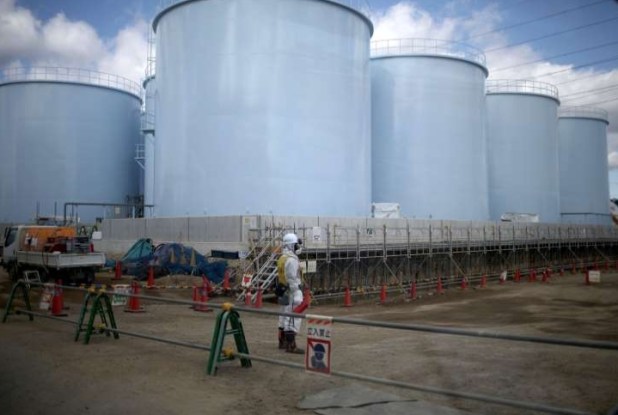
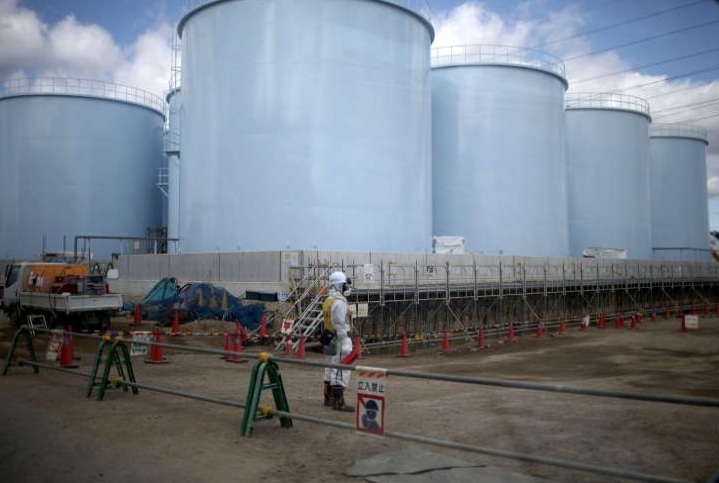
Tanks holding radiation contaminated water at the Tokyo Electric Power Co.’s embattled Fukushima Daiichi nuclear power plant on February 25, 2016 in Okuma, Japan.
Its official. Woods Hole Oceanographic Institute has samples of Fukushima-sourced cesium-134 in salmon off the Pacific Coast of Oregon. Given cesium-134 has such a short half-life the source is linked to the on-going leaks from Japan’s 2011 nuclear disaster. While the amount is still very, very low, it remains a concern given the Fukushima disaster is still not contained after more than five years.
SALEM, Ore. — For the first time, seaborne radiation from Japan’s Fukushima nuclear disaster has been detected on the West Coast of the United States.
Cesium-134, the so-called fingerprint of Fukushima, was measured in seawater samples taken from Tillamook Bay and Gold Beach in Oregon, according to researchers from the Woods Hole Oceanographic Institution.
Because of its short half-life, cesium-134 can only have come from Fukushima.
For the first time, cesium-134 has also been detected in a Canadian salmon, according to the Fukushima InFORM project, led by University of Victoria chemical oceanographer Jay Cullen.
Should we be worried? In both cases, levels are extremely low, the researchers said, and don’t pose a danger to humans or the environment.
Massive amounts of contaminated water were released from the crippled nuclear plant following a 9.0 magnitude earthquake and tsunami in March 2011. More radiation was released to the air, then fell to the sea.
Woods Hole chemical oceanographer Ken Buesseler runs a crowd-funded, citizen science seawater sampling project that has tracked the radiation plume as it slowly makes its way across the Pacific Ocean.
The Oregon samples, marking the first time cesium-134 has been detected on U.S. shores, were taken in January and February of 2016 and later analyzed. They each measured 0.3 becquerels per cubic meter of cesium-134.
Buesseler’s team previously had found the isotope in a sample of seawater taken from a dock on Vancouver Island, B.C., marking its landfall in North America.
In Canada, Cullen leads the InFORM project to assess radiological risks to that country’s oceans following the nuclear disaster. It is a partnership of a dozen academic, government and non-profit organizations.
Last month, the group reported that a single sockeye salmon, sampled from Okanagan Lake in the summer of 2015, had tested positive for cesium-134.
The level was more than 1,000 times lower than the action level set by Health Canada, and is no significant risk to consumers, Cullen said.
Buesseler’s most recent samples off the West Coast also are showing higher-than background levels of cesium-137, another Fukushima isotope that already is present in the world’s oceans because of nuclear testing in the 1950s and 1960s.
Those results will become more important in tracking the radiation plume, Buesseler said, because the short half-life of cesium-134 makes it harder to detect as time goes on.
Cesium-134 has a half-life of two years, meaning it’s down to a fraction of what it was five years ago, he said. Cesium-137 has a 30-year half-life.
A recent InFORM analysis of Buesseler’s data concluded that concentrations of cesium-137 have increased considerably in the central northeast Pacific, although they still are at levels that pose no concern.
“It appears that the plume has spread throughout this vast area from Alaska to California,” the scientists wrote.
They estimated that the plume is moving toward the coast at roughly twice the speed of a garden snail. Radiation levels have not yet peaked.
“As the contamination plume progresses towards our coast we expect levels closer to shore to increase over the coming year,” Cullen said.
Even that peak won’t be a health concern, Buesseler said. But the models will help scientists model ocean currents in the future.
That could prove important if there is another disaster or accident at the Fukushima plant, which houses more than a thousand huge steel tanks of contaminated water and where hundreds of tons of molten fuel remain inside the reactors.
In a worst-case scenario, the fuel would melt through steel-reinforced concrete containment vessels into the ground, uncontrollably spreading radiation into the surrounding soil and groundwater and eventually into the sea.
“That’s the type of thing where people are still concerned, as am I, about what could happen,” Buesseler said.
Scientists now know it would take four to five years for any further contamination from the plant to reach the West Coast.
Tracking the plume
Scientists are beginning to use an increase in cesium-137 instead of the presence of cesium-134 to track the plume of radioactive contamination from Japan’s Fukushima nuclear disaster. These figures show the increase in cesium-137 near the West Coast between 2014 and 2015.
Graphic courtesy Dr. Jonathan Kellogg of InFORM, with data from Dr. John Smith, Department of Fisheries and Oceans Canada, and Dr. Ken Buesseler, Woods Hole Oceanographic Institute.
http://www.msn.com/en-us/news/us/fukushima-radiation-has-reached-us-shores/ar-AAlkXUr?li=BBmkt5R&ocid=spartandhp
December 19, 2016
Posted by dunrenard |
Fukushima 2016 | cesium 134, Fukushima Radiation, Salmon, USA, West Coast |
Leave a comment
 Thyroid cancer compensation for Fukushima plant worker http://www.asahi.com/ajw/articles/AJ201612170027.html, By YURI OIWA/ Staff Writer December 17, 2016 A man who developed thyroid gland cancer after working at the stricken Fukushima No. 1 nuclear plant has for the first time won the right to work-related compensation.
While the case ranks as the third time a worker at the Fukushima plant has been recognized as eligible for work-related compensation because of cancer caused by radiation exposure, it is the first instance involving thyroid gland cancer.
The Ministry of Health, Labor and Welfare announced its decision Dec. 16.
The man in his 40s, an employee of plant operator Tokyo Electric Power Co., worked at the Fukushima plant after the triple meltdown triggered by the 2011 Great East Japan Earthquake and tsunami. He was diagnosed with thyroid gland cancer in April 2014.
The man worked at various nuclear plants, including the Fukushima facility, between 1992 and 2012. He was mainly involved in operating and overseeing reactor operations.
After the March 2011 nuclear accident, the man was in the plant complex when hydrogen explosions rocked the No. 1 and No. 3 reactor buildings. His duties included confirming water and pressure meter levels as well as providing fuel to water pumps.
The amount of his accumulated whole body radiation exposure was 150 millisieverts, with about 140 millisieverts resulting from the period after the nuclear accident. Of that amount, about 40 millisieverts was through internal exposure caused by inhaling or other ways of absorbing radioactive materials.
Along with recognizing the first work-related compensation involving thyroid gland cancer, the labor ministry also released for the first time its overall position on dealing with compensation issues for workers who were at the Fukushima plant after the accident.
The ministry said it would recognize compensation for workers whose accumulated whole body dose exceeded 100 millisieverts and for whom at least five years have passed since the start of work involving radiation exposure and the diagnosis of cancer.
Ministry officials said the dose level was not a strict standard but one yardstick for recognizing compensation.
According to a study by TEPCO and a U.N. scientific committee looking into the effects of radiation, 174 people who worked at the plant had accumulated whole body doses exceeding 100 millisieverts as of this past March.
There is also an estimate that more than 2,000 workers have radiation doses exceeding 100 millisieverts just in their thyroid gland.
December 19, 2016
Posted by Christina Macpherson |
Fukushima 2016, health, Japan |
Leave a comment
TEPCO: Fukushima nuclear clean-up, compensation costs nearly double previous estimate at $250 billion http://www.abc.net.au/news/2016-12-17/fukushima-nuclear-clean-up,-compensation-costs-nearly-double/8127268 By Tokyo correspondent Rachel Mealey The total cost of decommissioning the stricken nuclear power plant at Fukushima and providing compensation to victims has nearly doubled, with a new estimate placing the cost at $250 billion.Five and a half years after the nuclear disaster, the painstaking work of cleaning up the radioactive disaster zone is progressing very slowly.
Workers on the site have just finished a two-year project to remove a temporary building that was encasing the number 1 reactor.
The building was erected in the weeks after the disaster to prevent radioactive materials from escaping into the atmosphere. The radioactive threat still exists, but the plant’s operator TEPCO said it had taken extra precautions to prevent the leak of radioactive substances. “We are relieved to have removed the cover, but this is only the first step,” said Satoshi Sunayama, the head of the work crew at the stricken plant.
The next step is to begin removing the nuclear fuel and debris from the three reactor buildings on the site. But the problem is, nobody knows how that is going to happen.
The Government is putting its faith in Japanese technology — Prime Minister Shinzo Abe travelled to Fukushima on December 11 to visit a robotics company.
He wants the entire region to become a hub for robotics companies — some of which will work on robots specifically designed to remove the melted nuclear fuel from the reactor cores.
Lesser robots have already tried and failed
Remote-controlled robots have been sent into the reactor cores on reconnaissance missions to find out how much nuclear fuel is inside. But the radioactivity affected their wiring and they failed to return.
TEPCO can only guess at the size of the problem. It told the ABC that its most recent estimate of all of the melted fuel and debris in the three reactors at Fukushima is 880 tonnes.
Tom O’Sullivan is an expert on Japan’s energy sector, and said the costs of the clean-up work would weigh down the Japanese economy for many years.
“This is a very significant burden for the Japanese economy to bear, we’ve been in a recession for almost two decades,” he said. He said ordinary Japanese people would be hit with increasingly large electricity bills.
“The cost of cleaning up the nuclear power plant is going to have to be paid by the Government, the taxpayers and the electric power ratepayers in Japan both at the retail level and the industrial level,” he said. “So we will see increases in the order of magnitude of 6 or 7 per cent to the Japanese public and to Japanese industry.”
He said a Government buyout of the plant’s operator TEPCO was also on the cards.
“The company itself that owns those reactors, TEPCO, has a book equity of $US20 billion, so something’s going to have to be done to actually strengthen its balance sheet or to carve out those distressed assets through a government buyout or a government takeover.”
December 19, 2016
Posted by Christina Macpherson |
Fukushima 2016 |
Leave a comment
http://www.breakbulk.com/dome-installed-china-nuclear-plant/ A 300-ton containment dome has been installed at China’s first, domestically designed nuclear power plant in Fujian province, marking a key development for an effort to export the nation’s nuclear technology worldwide.
The successful lift project at the Fuqing nuclear complex construction site was announced via a news report on state-run CCTV television Nov. 26.
The plant, slated to open in 2020, is one of two being built at Fuqing with the China-designed Hualong One reactor. Two power plants at the Fangchenggang complex in Guangxi province will also use the reactor.
When completed, the report said, the Hualong reactor plants – called Fuqing 5 and Fuqing 6 – will be “significantly larger” than four other plants at the complex sporting reactors jointly designed by China and the French company Areva.
For safety, the report said, the 48-meter-diameter dome installed at Fuqing 5 was built with concrete and a steel alloy that’s six times stronger than regular steel.
Fuqing’s builder China National Nuclear Corp. and Fangchenggang’s builder China General Nuclear Corp. have been marketing the Hualong reactor worldwide. Customers so far include Britain, Pakistan and Argentina.
December 19, 2016
Posted by Christina Macpherson |
China, technology |
Leave a comment
South Korea says minister, British counterpart discussed nuclear power cooperation http://www.reuters.com/article/us-southkorea-nuclear-uk-idUSKBN14508N 15 Dec 16 South Korea’s energy minister Joo
Hyung-hwan discussed cooperation on British nuclear energy projects in a meeting in London on Thursday with Britain’s business minister Greg Clark, South Korea’s energy ministry said in a statement.
The statement from Seoul didn’t disclose details of discussions on nuclear energy, but said the two countries will hold a follow-up meeting in the first half of next year.
A British government statement issued said the two countries underlined a commitment at the meeting to keep working together on science, innovation and technology, without mentioning nuclear power.
Korea, Asia’s fourth-largest economy and the world’s fifth-biggest user of nuclear power, is keen to export its nuclear reactor technology, developed through state-run utility Korea Electric Power Corp (KEPCO).
Earlier this year, Britain gave the green light to the $24 billion Hinkley Point C project, its first new nuclear power plant in decades.
Along with that project, NuGen, a joint venture between Toshiba and French utility company Engie, plans to build three reactors at the Moorside site on the coast of Cumbria, in northwest England.
According to Seoul’s statement on Friday, Korea’s energy minister also had a meeting with NuGen chief Tom Samson during his British visit. The minister said Korean participation in Nugen projects would contribute to their success.
Earlier this year a person familiar with the situation told Reuters KEPCO had engaged in talks with Toshiba and Engie about buying a stake NuGen. A NuGen spokesman declined to comment on whether talks were taking place with KEPCO, which also declined to comment.
(Reporting by Jane Chung; Editing by Kenneth Maxwell)
December 17, 2016
Posted by Christina Macpherson |
marketing, South Korea, UK |
1 Comment
The Japan Bank for International Cooperation and the Development Bank of Japan will provide financing for the project, the official told Reuters.
The funding plans are a boost for the project, one of several new nuclear plants planned in the UK, which is aiming to replacing its ageing fleet of atomic reactors.
Hitachi’s Horizon unit plans to construct at least 5.4 gigawatts of new nuclear capacity across two sites in Britain.
The funds will be provided for the first plant planned at Wylfa Newydd in Wales.
The Nikkei newspaper said Hitachi would invest about 10 percent of the expected 19 billion pounds ($24 billion) cost of the project. A Hitachi official declined to comment, saying the amount has not been announced.
($1 = 117.2600 yen)
($1 = 0.7971 pounds)
December 17, 2016
Posted by Christina Macpherson |
Japan, politics international, UK |
Leave a comment
 Tokyo eyes ¥1 trillion in financial support for Japanese firms pursuing U.K. nuclear plants http://www.japantimes.co.jp/news/2016/12/16/business/tokyo-eyes-%C2%A51-trillion-financial-support-japanese-firms-pursuing-u-k-nuclear-plants/#.WFONt9J97Gg The government is considering offering financial assistance through state-affiliated banks for projects won by Japanese companies for nuclear power plant construction in Britain, sources said Thursday.
Under study is a plan for the Japan Bank for International Cooperation and the Development Bank of Japan to invest in and provide loans to local companies that build and operate nuclear power stations, the sources said.
The Japanese government hopes to establish a framework for financial assistance totaling about ¥1 trillion within 2017 also by asking major Japanese and British private financial institutions to participate in the scheme, according to the sources.
Visiting British Chancellor of the Exchequer Philip Hammond told reporters in Tokyo on Thursday that Britain is holding talks with the Japanese government, Hitachi Ltd. and Toshiba Corp. on a financial support framework for nuclear power plant construction projects in his country.
On the same day, Hammond met with Chief Cabinet Secretary Yoshihide Suga to exchange opinions about nuclear plant construction.
British Business, Energy and Industrial Strategy Secretary Greg Clark plans to visit Japan as early as next week and hold meetings with officials of Hitachi, Toshiba and the JBIC.
Under the envisaged scheme, the Japanese government expects to offer financial assistance to Horizon Nuclear Power Ltd., a unit of Hitachi, and NuGeneration Ltd., which is under the wing of Toshiba.
December 17, 2016
Posted by Christina Macpherson |
business and costs, Japan, politics international, UK |
Leave a comment
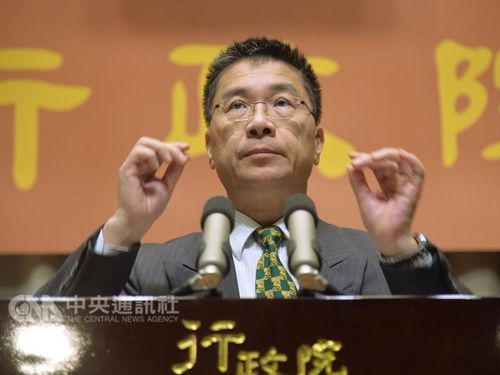
Cabinet spokesman Hsu Kuo-yung (徐國勇)
Taipei, Dec. 16 (CNA) The government is to put on hold a planned opening of food products from radiation-affected prefectures in Japan amid public misgivings about food safety, a Cabinet spokesman said Friday.
Hsu Kuo-yung (徐國勇) said in a news conference Friday that the Cabinet “has to first ensure a sound inspection and management mechanism,” before talking about any opening to food products from the affected areas of Japan.
Hsu pointed out that Premier Lin Chuan (林全) has stressed the importance of “rebuilding public trust in the government’s management of food safety,” after presiding over a cross-agency meeting the previous day.
The premier also said that “without a sound inspection and management mechanism, there can be no question of such an opening,” according to Hsu.
Taiwan banned food imports from Fukushima, Ibaraki, Tochigi, Gunma and Chiba prefectures in the wake of the Fukushima Daiichi nuclear power plant meltdown following a massive earthquake and tsunami in Japan on March 11, 2011.
Amid reports that the government is planning to lift its ban on food imports from the radiation-affected prefectures except for Fukushima, several brands of Japanese natto containing packets of soy sauce from Chiba and Ibaraki have recently been found in Taiwan.
Hsu said that although food products from Fukushima and the surrounding prefectures are banned, there are composite packaging foods, such as the condiment sashets in packages of instant noodles, that have not been subjected to scrutiny.
“The government will review the issue and plug the loopholes,” Hsu said.
Before establishing a sound management mechanism, the government will not make a decision, “and there is no timetable for any such opening,” Hsu said.
He said that there will be three more public hearings on imports of controversial Japanese food products, saying that holding the public hearings is significant in three ways.
They are aimed at establishing a model for future public hearings, then at clarifying false information, as the public has seen all kinds of rumors flying recently.
The public hearings will also be presided over by civic groups rather than by government officials as in previous hearings, in a bid to collect views from the public on how to plug loopholes for the reference of the government, he said.
Sheu Fuu (許輔), director of food safety office under the Executive Yuan, said that all questions raised by the civic groups will be discussed and clarified one by one.
The Cabinet held 10 public hearings on the safety of Japanese products around Taiwan from Nov. 12-14 after announcing them Nov. 10, but critics saw them as essentially being held for show to pave the way for lifting the ban.
Questions were raised about why the government seemed in such a rush to hold the hearings, and some of them ended in chaos amid protests.
Sheu said that if the public still cannot accept the situation after the three public hearings, the government will review the contentious points, and if it cannot resolve such points and effectively manage food safety, “it will not rule out the possibility of maintaining the current ban.”
http://focustaiwan.tw/news/aipl/201612160007.aspx
December 16, 2016
Posted by dunrenard |
Fukushima 2016 | Contaminated Foods, Food Exports, Taiwan |
Leave a comment
YOKOHAMA – Eight households that evacuated from Fukushima following the 2011 nuclear disaster said their children have experienced bullying at their new schools, according to a survey of 61 families suing the government and the nuclear plant operator.
Of the 61 households, 30 have children in elementary or junior high school, and eight said their children had been verbally abused or even physically assaulted at schools in and around Yokohama, according to sources involved with the lawsuit.
One of the sources quoted a plaintiff as saying that person was “unaware of a causal relationship between evacuation and bullying.” But the source also noted there may also be more bullying because some children don’t want to talk about being bullied.
“In reality, it seems there are more cases,” the sources said in a statement.
Lawyers conducted the survey after it was revealed last month that a 13-year-old in Yokohama was bullied by classmates after evacuating from Fukushima, and called “germ” and extorted for money while at elementary school.
That bullying case drew public attention, prompting the Yokohama Board of Education to investigate.
Among the children of the eight households citing bullying in the survey, a male student was told such things as “Keep away from us!” and “Fukushima people are idiots,” while attending a junior high school in Kawasaki, the sources said.
The survey did not count as bullying cases in which parents said their children did not get accustomed to their new schools or could not make friends, the sources said.
In the lawsuit filed with the Yokohama District Court, 174 plaintiffs from 61 households are demanding ¥4.07 billion ($34.4 million) from the government and the Tokyo Electric Power Company Holdings Inc., the operator of the Fukushima No. 1 nuclear power plant where three reactors melted down after a massive earthquake and tsunami in March 2011.
http://www.japantimes.co.jp/news/2016/12/16/national/social-issues/fukushima-evacuee-poll-finds-kids-eight-yokohama-area-households-experienced-bullying/#.WFQRJFzia-c
December 16, 2016
Posted by dunrenard |
Fukushima 2016 | Fukushima Evacuees, School Bullyism |
Leave a comment

A bird’s eye view of Units 1 and 2 from the hill
On December 15, 2016, the newly elected Kashiwazaki mayor, Mayor Masahiro Sakurai, who has called for a conditional restart of the Kashiwazaki-Kariwa nuclear power plant, one of the world’ largest nuclear plants, when he was elected mayor of this coastal city in Niigata Prefecture, northwestern Japan on Nov. 20, visited the Fukushima daiichi nuclear plant.
TEPCO, operator of the crippled Fukushima No. 1 nuclear plant, eager to restart reactors at the Kashiwazaki-Kariwa plant, invited him to tour the Fukushima Daiichi Nuclear plant, so as to show him that they fully control the situation there.
During the election campaign, Masahiro Sakurai said he would “approve a restart of the halted nuclear plant if safety is confirmed and certain conditions are fulfilled.”
One condition is the construction of a road that residents can use for evacuation in case of an emergency at the nuclear plant. Masahiro Sakurai also promised to start decommissioning older reactors at the plant.
Tepco made Mayor Sakurai visit the Fukushima Daiichi plant site, some of its buildings, its central control rooms 1 and 2, and the land side frozen by the impermeable ice wall.
On the same day, Tepco released 6 photos of Mayor Sakurai’s visit. One of the pictures was taken while Sakurai viewed Units 1 and 2 from the hill, it shows a new platform erected by Tepco around unit 2. This new platform with extensive stairwells and levels running the length of the building, might be part of some work to remove the refueling floor so as to replace it with a defueling building.
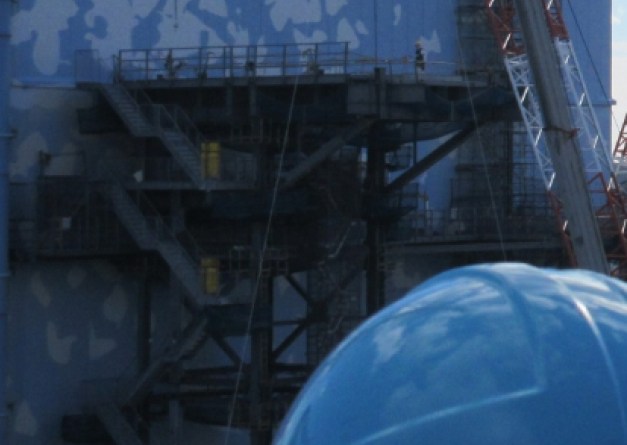
No information was yet provided by Tepco regarding that platform purpose.
Source : http://photo.tepco.co.jp/date/2016/201612-j/161215-01j.html
December 16, 2016
Posted by dunrenard |
Fukushima 2016 | Fukushima Daiichi, Unit 2 |
Leave a comment
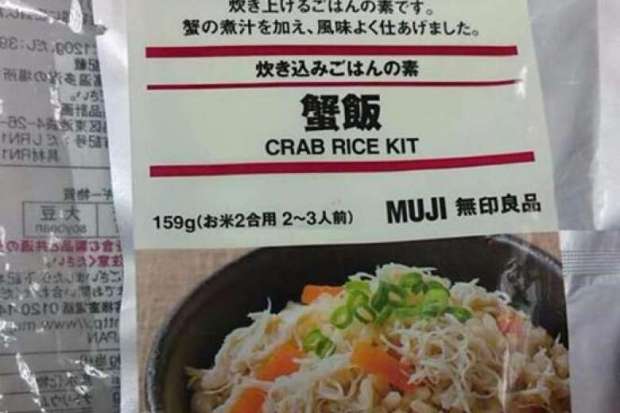
Muji ready meals, natto food products imported from Fukushima nuclear disaster zone recalled in Taiwan
TAIPEI – Two types of Muji ready meals were removed from shelves in Taiwan after they were found to have come from areas affected by the 2011 Fukushima nuclear disaster.
The Japanese lifestyle store removed 638 packets of the products from Tochigi prefecture voluntarily, Taiwan’s China Times reported on Wednesday (Dec 14).
The two products are the conger eel rice kit and the crab rice kit, said Ms Qiu Xiu-yi, northern district head of the Food and Drug Adminstration of Taiwan.
Muji Hong Kong said on Thursday that it was recalling the two products, following the reports in Taiwan.
“In consideration of customers’ concern, Muji Hong Kong has removed the related products from sales floor immediately and is recalling the related products,” it said on its website. “Customers can bring their purchased products to Muji stores in Hong Kong for refund.”
In Taiwan, natto or fermented soybean products imported by Yu Mao Trading were also found to have come from Chiba prefecture, another affected zone.
Five natto products, or 1,465 items in total, were recalled.
Companies which do not report the origin of food imports accurately can be fined NT$30,000 to NT$3 million (S$1,350 to S$135,0000), the Taiwanese report said.
http://www.straitstimes.com/asia/east-asia/muji-ready-meals-natto-food-products-imported-from-fukushima-nuclear-disaster-zone
December 16, 2016
Posted by dunrenard |
Fukushima 2016 | Contaminated Exports, Hong-Kong, Japan Food Products, Taiwan |
Leave a comment
KAWASAKI, Kanagawa — A high school student who evacuated from Fukushima Prefecture in the wake of the 2011 nuclear disaster was bullied at a junior high school here, according to a legal team supporting evacuees.
The Kawasaki Municipal Board of Education has stated that there are currently no cases of bullying toward any pupils who have evacuated from Fukushima Prefecture in any of the city’s elementary or junior high schools. Since the student in question has come forward about bullying, however, the education board has begun an investigation into junior high school graduates as well, which would include this pupil.
According to the legal team, the pupil entered Kawasaki Municipal Junior High School in April 2012, and was verbally abused by classmates who told him, “People from Fukushima are stupid,” and, “Don’t come near me.” He was also punched and kicked, the team said. The pupil’s family consulted with the school but no solution was reached as his classmates denied any bullying.
The pupil’s parents appeared at the Yokohama District Court for a class action lawsuit filed by evacuees to demand compensation from the government and Tokyo Electric Power Co. (TEPCO), operator of the crippled Fukushima No. 1 Nuclear Power Plant, and stated that although they have had a tough time over the past few years, they have received support from people around them.
At this lawsuit, the parents of a boy who evacuated from Fukushima Prefecture to an elementary school in Yokohama said, “My son stopped attending school as a result of bullying.”
Meanwhile, it has been learned that another male student from Fukushima Prefecture was bullied in Yokohama.
http://mainichi.jp/english/articles/20161215/p2a/00m/0na/015000c
December 16, 2016
Posted by dunrenard |
Fukushima 2016 | Fukushima Evacuees, School Bullyism |
Leave a comment