A Marine Food Web Bioaccumulation model for Cesium 137 in the Pacific Northwest
From November 2014
Abstract
The Fukushima nuclear accident on 11 March 2011 emerged as a global threat to the conservation of the Pacific Ocean, human health, and marine biodiversity. On April 11 (2011), the Fukushima nuclear plant reached the severity level 7, equivalent to that of the 1986-Chernobyl nuclear disaster. This accident was defined by the International Atomic Energy Agency as “a major release of radioactive material with widespread health and environmental effects requiring implementation of planned and extended countermeasures”.
Despite the looming threat of radiation, there has been scant attention and inadequate radiation monitoring. This is unfortunate, as the potential radioactive contamination of seafoods through bioaccumulation of radioisotopes (i.e. 137Cs) in marine and coastal food webs are issues of major concern for the public health of coastal communities. While releases of 137Cs into the Pacific after the Fukushima nuclear accident are subject to high degree of dilution in the ocean, 137Cs activities are also prone to concentrate in marine food-webs.
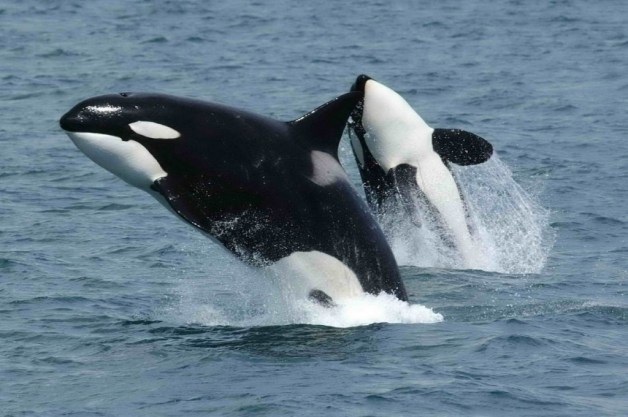
With the aim to track the long term fate and bioaccumulation of 137Cs in marine organisms of the Northwest Pacific, we assessed the bioaccumulation potential of 137Cs in a North West Pacific foodweb by developing, applying and testing a simulation time dependent bioaccumulation model in a marine mammalian food web that includes fish-eating resident killer whales (Orcinus orca) as the apex predator.
The model outcomes showed that 137Cs can be expected to bioaccumulate gradually over time in the food web as demonstrated through the use of the slope of the trophic magnification factor (TMF) for 137Cs, which was significantly higher than one (TMF > 1.0; p < 0.0001), ranging from 5.0 at 365 days of simulation to 30 at 10,950 days.
From 1 year to 30 years of simulation, the 137Cs activities predicted in the male killer whale were 6.0 to 182 times 137Cs activities in its major prey (Chinook salmon, Oncorhynchus tshawytscha).
Bioaccumulation of 137Cs was characterized by slow uptake and elimination rates in upper trophic level organisms and dominance of dietary consumption in the uptake of 137CS.
This modeling work showed that in addition to the ocean dilution of 137Cs, a magnification of this radionuclide takes place in the marine food web over time.
NRA: Ice wall effects ‘limited’ at Fukushima nuclear plant
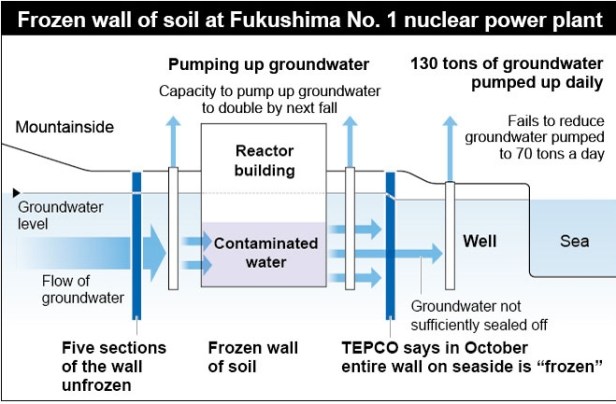
Citing “limited, if any effects,” the Nuclear Regulation Authority said a highly touted “frozen soil wall” should be relegated to a secondary role in reducing contaminated groundwater at the Fukushima No. 1 nuclear plant.
The government spent 34.5 billion yen ($292 million) to build the underground ice wall to prevent groundwater from mixing with radioactive water in four reactor buildings at the crippled plant.
But the NRA, Japan’s nuclear watchdog, concluded on Dec. 26 that the wall has been ineffective in diverting the water away from the buildings. It said that despite the low rainfall over the past several months, the amount of groundwater pumped up through wells outside the frozen wall on the seaside is still well above the reduction target.
It urged the plant operator, Tokyo Electric Power Co., to tackle the groundwater problem primarily with pumps, not the ice wall.
In response, TEPCO at the meeting said that by next autumn, it will double its capacity to pump up groundwater from the current 800 tons a day.
About 400 tons of groundwater enters the damaged reactor buildings each day and mixes with highly radioactive water used to cool melted nuclear fuel.
The ice wall project, compiled by the industry ministry in May 2013, was seen as a fundamental solution to this problem that has hampered TEPCO’s cleanup efforts since the triple meltdown in March 2011.
Some 1,568 frozen ducts were inserted 30 meters deep into the ground to circulate a liquid at 30 degrees below zero. The freezing process was supposed to have created a solid wall of ice that could block the groundwater.
TEPCO began freezing the wall on the seaside in March. It announced in the middle of October that the temperature at all measuring points in that area was below zero.
Before the frozen wall project, TEPCO had to pump up about 300 tons of contaminated water a day. The daily volume dropped to about 130 tons in recent weeks, but it was still well beyond the target of 70 tons.
Still, TEPCO boasted about the effectiveness of the ice wall at the meeting with the NRA on Dec. 26, saying, “We are seeing certain results.”
The NRA, however, said the results are limited at best.
Toyoshi Fuketa, an NRA commissioner, already warned TEPCO in October that it cannot expect the ice wall to be highly effective in containing the groundwater.
“Pumping up groundwater through wells should be the main player because it can reliably control the groundwater level,” Fuketa said at that time. “The ice wall will play a supporting role.”
That sentiment was echoed at the Dec. 26 meeting.
However, the NRA approved the utility’s plan to begin freezing dirt for a wall on the mountain side of the nuclear plant.
The NRA was previously concerned about risks posed by the new ice wall. If it totally blocked groundwater from the mountain side, the water level within the frozen soil near the reactors could become too low, allowing highly contaminated water inside the reactor buildings to flow out more rapidly.
The NRA urged TEPCO to delay work on the mountain side until the ice wall on the seaside portion proved effective.
But it reversed its stance, saying a sharp drop in the groundwater level is unlikely based on the ineffectiveness of the existing ice wall.
“The frozen wall on the mountain side will not be able to block groundwater because the wall on the seaside was also unable to do so,” Fuketa said. “It will not be very dangerous to freeze the wall on the mountain side as long as the work is carried out carefully.”
TEPCO will start the work to freeze the ducts at five sections as early as next year.
Masashi Kamon, professor emeritus of geotechniques at Kyoto University, expressed skepticism about continuing the ice wall project without a full scrutiny of the underground conditions.
“Soil around the tunnels for underground pipes must be hard to freeze,” he said. “TEPCO should find out the conditions of the very bottom of the ice wall by drilling at least one section. It is questionable to continue with the project without a review.”
Listen to the Sounds of Contamination
What is going on in Japan since March 11, 2011?
Radiation generated by collapse of radioactive material that is invisible to the eye pierces cells of animals and plants and human body.
In Fukushima contamination is now omnipresent, you cannot see it nor smell it, nor taste it but it is there.
And in 2016, an unprecedented public project is about to start in the world. Japan’s contamination is made visible by its 1/1000 second clicking sounds.
You can’t see it but you can now visualize the power of those radioactive disintegrations by hearing their sounds, so that the inoffensive looking becquerel per kg numbers of an invisible contamination now take a new dimension, as the violence of their power is suddenly revealed through their disingration sounds…..
Completion of drilling a hole toward investigation inside Unit 2 Primary Containment Vessel (PCV) at Fukushima Daiichi
TEPCO released a video showing a drilling rig, used in preparation for internal investigation of containment vessel No. 2 of Fukushima Daiichi Nuclear Power Station. The drilling was seated against the CRD hatch inside unit 2, the selected site where a robot will be inserted into unit 2 containment to collect data and images.
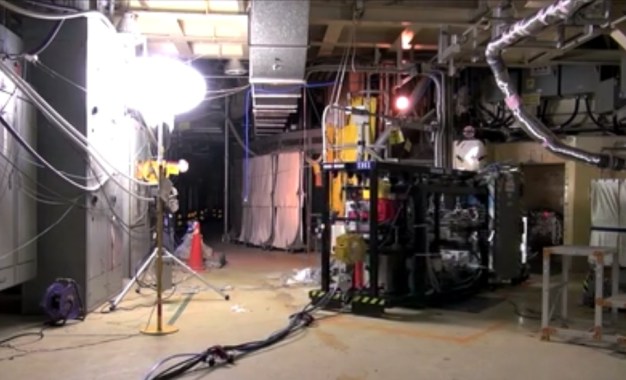
Due to shielding blocks difficult to remove and high radiation levels found where the hatch gasket had melted away, this work has been repeatedly delayed.
Logos from IRID, Toshiba and IHI are displayed on that drilling rig. IRID is the decommissioning research and development group. Toshiba handles the inspection and response work at the site and was a prime contractor at Daiichi before the disaster. IHI Corporation does a variety of high tech work including the energy and aerospace industries.
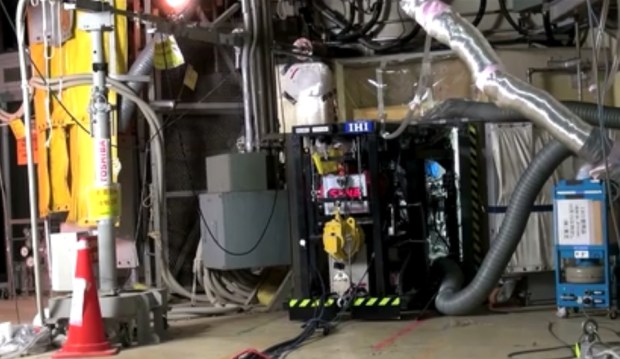
Little is known about the capabilities of that drilling rig. To conduct the containment inspection the workers will have to insert a robot into the CRD hatch tube.Earlier in the process it was decided to drill out an opening on the hatch rathen than trying to open it. In similar works at unit 1 a large tube shaped rig is connected to the containment port to act as a hot cell, to enable the robot to enter and exit the containment structure without having radiation or radioactive materials to escape.
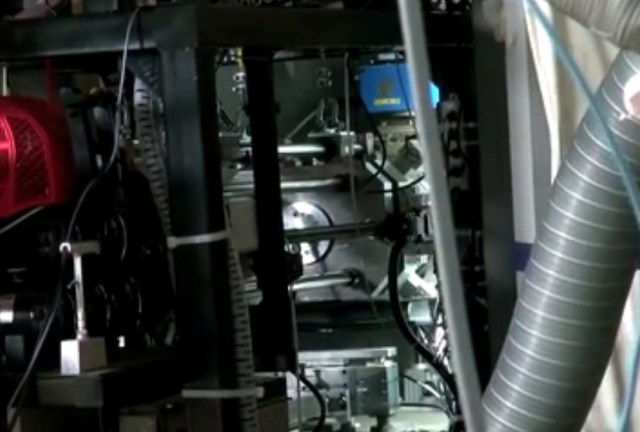
Similar efforts at unit 1 involved connecting a large tube shaped rig to the containment port that acts as a hot cell. This allows the robot to enter and exit the containment structure without allowing radiation or radioactive materials to escape. Earlier practiced work at Unit 2 showed workers training with such a hot cell unit.
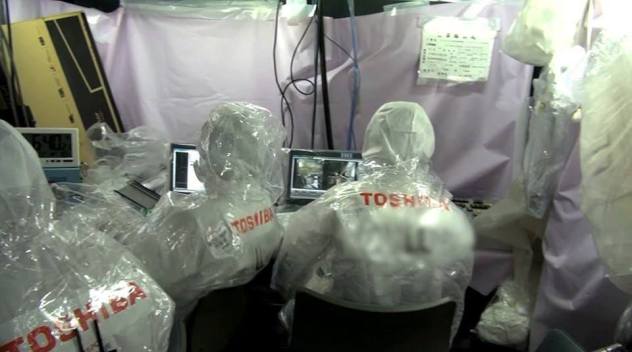
Asahi Shimbun had reported on September 2016 that TEPCO has announced they would begin the robotic containment inspection of unit 2’s containment in early 2017. This new development might be a sign that they have overcome the difficulties that caused delays since 2014.
Sources :
http://www.tepco.co.jp/en/news/library/archive-e.html?video_uuid=e5z65pib&catid=69631
http://www.asahi.com/ajw/articles/AJ201609060001.html
Fukushima dad finds remains of daughter, but no closure for 3/11
My deep respect for this father courage and perseverance to search for his child beyond his pain and the tragedy. It must be awful to search for the remains of your beloved daughter like he did for 6 years. I have been repeatedly hearing about his relentless search over and over again during these past 6 years. I am happy for him that he finally found her.
My own daughter was very lucky, at the time the tsunami hit the place where they lived on the north-east coast of Iwaki city, right by the sea, they were all in town, far from their house and the seashore. They lost their house but no life.
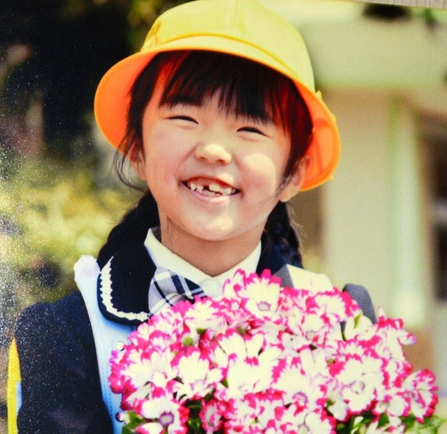
Yuna Kimura was 7 years old when the 2011 Great East Japan Earthquake and tsunami struck.
OKUMA, Fukushima Prefecture–A man’s painstaking search over nearly six years has finally uncovered remains of his 7-year-old daughter who disappeared in the 2011 tsunami.
But the discovery has not brought closure for the father, Norio Kimura, who plans to keep sifting through the debris on the coast of this town in the shadow of the ruined Fukushima No. 1 nuclear power plant.
“I am glad, but only small parts of her have been recovered,” said Kimura, 51. “I will continue my search until I find everything.”
A breakthrough in his private search for daughter Yuna came on Dec. 9, when a volunteer found a scarf she was wearing on the day the tsunami struck. It was near the coast only a few hundred meters from where Kimura’s home once stood in Okuma.
A further search of the area uncovered parts of neck and jaw bones among the tsunami debris.
A DNA test conducted by Fukushima prefectural police showed the remains were of Yuna. Kimura was informed of the test result on Dec. 22.
However, he said he still has no intention of submitting a document to officially certify her death until the rest of her body is found.
Yuna was the last resident of Okuma officially listed as missing.
Kimura’s house was located about 4 kilometers south of the Fukushima No. 1 nuclear plant and 100 meters from the coast. The tsunami spawned by the Great East Japan Earthquake on March 11, 2011, destroyed the home and swept away Yuna, Kimura’s wife, Miyuki, then 37, and his father, Wataro, then 77.
The bodies of Miyuki and Wataro were recovered that year. But Yuna remained missing.
The meltdowns at the nuclear plant forced Kimura to evacuate from Okuma and halt his search for Yuna.
Although the Self-Defense Forces, firefighters, police and volunteers conducted searches along the coast of the Tohoku region, radioactive fallout prevented extensive checks around Okuma in the early days of the recovery effort.
Most parts of the town are still located in the government-designated “difficult-to-return zone” because of high radiation levels. Access is limited to former residents, but only for short periods.
Kimura resumed his personal search for Yuna at the end of 2011, when the government allowed those limited-period returns to Okuma.
After settling in Hakuba, Nagano Prefecture, with his mother and surviving daughter, Kimura frequently made round trips of about 1,000 kilometers in his search for Yuna. He often wore protective clothing against radiation in his endeavor.
Yuna’s remains were found in an area where Kimura discovered a shoe in June 2012 that his daughter was wearing on the day of the disaster.
Kimura said he intends to increase his trips to Okuma and focus his search on the area where Yuna’s bones were discovered.
“I do hold anger toward TEPCO, which caused the nuclear crisis, and the government, which was not committed enough to the body-recovery effort,” Kimura said. “I am mortified that it took nearly six years to find her.”
http://www.asahi.com/ajw/articles/AJ201612260050.html
Japan Studying Nuclear Waste Burial 5,000 meters Deep on the Pacific Island of Minamitorishima
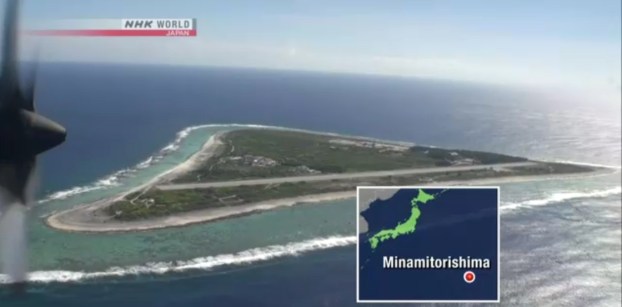
An agency affiliated with the Japanese government is to study the possibility of burying nuclear waste at a depth of about 5,000 meters. That’s much deeper than proposed in the government’s current plan.
Researchers from the Japan Agency for Marine-Earth Science and Technology, or JAMSTEC, will carry out a basic survey for the new disposal option after next April.
The survey will be conducted at Minamitorishima, a remote island above the geologically stable Pacific Plate.
JAMSTEC says it will use a research vessel to collect data on the topography and geology of the area.
No technology exists to bury nuclear waste 5,000 meters below ground as there are many technical challenges.
The Japanese government has been planning to bury high-level radioactive waste from nuclear plants at a depth of more than 300 meters in final disposal facilities. Officials are currently looking for candidate sites.
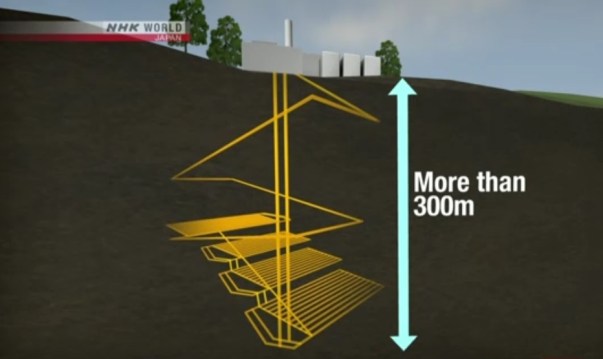
Nagasaki University Professor Tatsujiro Suzuki is a former member of Japan’s Atomic Energy Commission. He says it is too soon to discuss a technology that has yet to be developed, but he thinks basic research by the agency could help to create more options.
https://www3.nhk.or.jp/nhkworld/en/news/20161225_17/
The silence about the continuing horror in Japan
December 22, 2016, by Radio Ecoshock Well I guess the triple-meltdown nuclear disaster at Fukushima is all over. It must be. We’re not hearing much about it, right? As we’re about to find out, the silence about the continuing horror in Japan is no accident.
Robert Hunziker has some news even hardened Fukushima-watchers missed. Robert’s the free-lance environmental journalist whose work is published all over the world. This latest article can be found in the online magazine Counterpunch on October 31st, under the title “Fukushima Cover Up”. Fukushima Cover Up
I’ve covered the triple-melt down at Fukushima from the very day it started. There were emergency podcasts, interviews with tons of experts, including from the Union of Concerned Scientists. Just Google “Radio Ecoshock and Fukushima” and stand back. But just because the story is over in the media, and the Japanese government would dearly love us all to forget about it – THIS ACCIDENT IS STILL HAPPENING.

The three reactor cores, including one laced with plutonium, are still lost somewhere under the ground in Fukushima, and still pumping out massive amounts of radioactivity. The Japanese utility TEPCO, which went bankrupt and was bailed out at huge cost by the people of Japan, continues to pump out very radioactive water, to be stored in an ever-increasing vast tank farm on the site. That may go on for another 40 years or so, except (a) the company is running out of places to build those tanks and (b) radioactive particles are flowing into the Pacific Ocean daily anyway.
The Government announced an “ice wall” to contain that radioactivity, but that didn’t work, despite the tens of billions of dollars spent. There is no solution to this problem.
Radioactivity is now acknowledged by American experts as having arrived in the currents to the West Coast of North America. Of course the Pacific fisheries has been irradiated. I would not eat fish caught there. The levels may be “low” but there is no safe level of radioactivity.
The Fukushima nuclear accident also continues because the people irradiated by the accident (including a huge part of Japan, and including Tokyo) will pass down illness for an unknown number of generations. The largest number of people receiving medical treatment due to the Fukushima nuclear disaster were born AFTER the accident, Robert Hunziker tells us. The government and the nuclear industry have found multiple ways to hide this.
One of the largest was to pass fake “terrorism” legislation, where any journalist reporting on Fukushima impacts could be charged as a “terrorist”. Then some one leaned on the largest daily newspaper of Japan (7.5 million subscribers, about triple the New York Times) to dismantle their team of more than two dozen journalists covering Fukushima. After winning awards for their reporting and exposes, these journalists at Asahi Shimbum newspaper were either fired or moved to other departments. That’s another way to “solve” the crisis.
I won’t go into all the ways the doctors have been silenced, medical records faked, and “temporary” workers at the cleanup not counted. It’s horrifying – and it’s an example of why humans cannot be trusted with nuclear power.
Japan says they have “cleaned up” the Fukushima area, by scraping up dirt and storing it God-Knows-Where in giant bags which might circle the Earth if lined up together. I doubt it, and nobody can “clean up” all the forests which were laced with particles, right up to and including plutonium that last for over half a million years. The clean-up is a fairy tale.
Meanwhile, and this is too incredible, Japan has somehow captured the 2020 Olympics. Worse, they plan to force people evacuated from nearby Fukushima city back into hot zones (by cutting off their aid if they don’t). They, Japan has scheduled sports events at Fukushima – with local food brought in from the irradiated zone! It’s not bad enough our athletes had to deal with Zika virus and polluted water in the Brazil Olympics. No, they have to be publicity guinea pigs for the Japanese nuclear disaster.
By the way, during my many interviews and podcasts, often using reporting from Japanese TV during the incident, there is no doubt that Tokyo itself was blanketed by nuclear particles. More ran into the underground water supply from the nearby irradiated hills.
Earthquakes continue to rock the Fukushima area, like this one. Who knows what can happen, with those lost reactor cores. ra ra http://www.ecoshock.org/2016/12/greenland-melt-japanese-meltdown-conspiracy.html
“Fake story” prompted Pakistan to issue a nuclear warning to Israel
 Pakistan issues nuclear warning to Israel in response to ‘fake news’ story Israeli Ministry of Defence forced to point out initial story ‘completely fictitious’, The Independent Matt Broomfield @hashtagbroom 25 Dec 16, The Defence Minister of Pakistan has issued a reminder to Israel of his country’s nuclear capability, in apparent response to a false news story.
Khawaja Muhammad Asif said in a tweet: “Israeli [Defence Minister] threatens nuclear retaliation presuming [Pakistani] role in Syria against Daesh. Israel forgets Pakistan is a Nuclear state too.”
Pakistan has remained relatively neutral in the Syrian civil war, though they have placed themselves on the side of the Assad regime, with their Foreign Secretary saying the world’s sixth-largest country is “against foreign military intervention in Syria.”
But a fake story published on the website AWDnews falsely suggested that Pakistan planned to “send ground troops to Syria as part of an international coalition to fight against Islamic State”.
The anonymously-authored story then features an apparently invented quote from former Israeli defence minister Moshe Yaalon, who resigned in May this year, sayig: “If, by misfortune, they arrive in Syria… we will destroy them with a nuclear attack.”
It is this story, which also includes a fabricated quote from the Pakistani Foreign Minister, which seemingly prompted Mr Asif’s tweet. The Israeli Ministry of Defence replied with a tweet of its own, pointing out the story was “completely fictitious”……. http://www.independent.co.uk/news/world/asia/pakistan-israel-nuclear-warning-fake-news-story-response-islamabad-syria-a7494961.html
Taiwanese Say No to Japan Nuke Food Imports
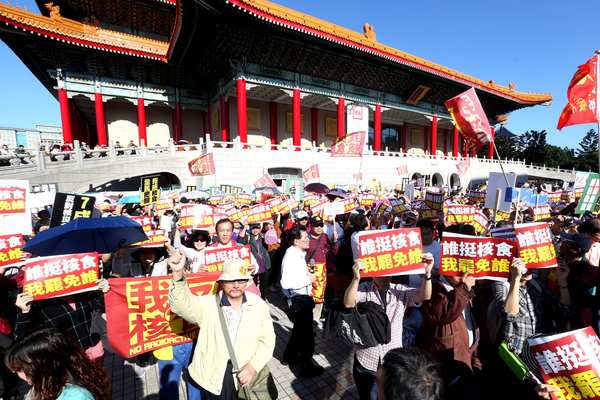
Thousands protest over ‘nuke food’
TAIPEI, Taiwan — Thousands took to the streets to protest the proposed lifting of a ban on food products from radiation-affected areas of Japan, following an inconclusive public hearing on the matter Sunday morning.
The Kuomintang (KMT)-organized march kicked off with remarks from KMT Chairwoman Hung Hsiu-chu (洪秀柱).
“We will not tolerate our children being endangered by food products contaminated by radiation,” Hung said.
Hung urged the crowd of protestors to convey their dissent to the government as they marched from Aiguo East Road near Chiang Kai-shek Memorial Hall and down Ketagalan Boulevard to the Ministry of Finance at Aiguo West Road.
Representatives from various demographics, including housewives, young parents and expecting parents, spoke out in turn before the march began.
The diversity of backgrounds represented at the march “reflected the 74 percent of all Taiwanese nationals who oppose lifting the ban on food imports from five Japanese regions affected by the 2011 Fukushima Daiichi nuclear disaster,” the march’s organizers claimed.
Expecting father Chen Hsiao-wei (陳孝威) expressed concerns that food imports from radiation-affected areas had already made their way into Taiwan.
Chen said he “did not understand any of the figures and numbers” presented by the government’s experts about the imports and only wanted to know why “Taiwanese people should eat these food products when the Koreans, Chinese, and Australians are not eating them.”
In a move that both served as a visual pun and was reminiscent of Latin America’s “pots and pans” protests, “new immigrants” — a term commonly used to refer to immigrants from Southeast Asia — attended the march with small pans and spatulas in hand to object to feeding their children potentially harmful food.
These mothers chose to “bravely speak out and bring their children to the march” to safeguard the welfare of the next generation, a representative of the new immigrant mothers told reporters.
A Failed Public Hearing
Earlier in the day, protestors and KMT legislators attended a public hearing at the Taipei Innovation City Convention Center in New Taipei City’s Xindian District.
The public hearing, which was intended to address the assessment and management of products from the five regions, failed to get past the explanation of the hearing’s rules after repeated outbursts from audience members.
Cabinet Spokesman Hsu Kuo-yung (徐國勇) later said that “some people deliberately showed up (to the hearing) to provoke hatred.”
After moderator Chu Tseng-hung (朱增宏) spent most of the morning asking for decorum, legislators and NGO representatives present decided it was best for the public hearing to be downgraded to an informal forum that would hold no legal weight.
KMT Legislator Kao Chin Su-mei (高金素梅) said procedures for the hearing were “unjust” and that incorrect information was being disseminated. “The government is using technical issues to continue to beat around the bush (on this issue),” Kao Chin said during the hearing.
KMT Legislator Wayne Chiang (蔣萬安) said people’s voices were being omitted. At the march in the afternoon, he told the crowds, “The public hearing was not conducted in accordance with the principle of procedural justice.”
Chiang questioned the need for a hearing on the import of food products from radiation-affected areas if the government had reiterated that it would not allow the import of any “nuke foods.”
Around noon it was decided that the hearing would be downgraded to an informal forum, which organizers of the march later called a “victory of the people.”
Hsu Fu (許輔), director of the Cabinet’s food safety office later said that the forum had achieved “real results” and hoped the format could be used in future policy discussions.
President’s Office Responds
The office of President Tsai Ing-wen office later accused the KMT of “twisting” the hearing.
Presidential Office spokesman Alex Huang (黃重諺) said a public hearing was one of the best “platforms for policy discussion” and that the KMT had managed to turn the hearing into “a show for their party’s own internal election.”
Huang stressed in his statement that the government had never wanted to open the country’s borders to radiation-contaminated food products. “Regardless of where the food products come from, the government holds the same attitude as every other country, which is that it would not import food contaminated by radiation.”
The presidential office spokesman further stated that the government would base their import policies on international professional standards and scientific evidence with no exception.
Radioactive Salmon in Canada
Earlier this month, a research team from Canada’s University of Victoria reported discovering radioactive salmon in the British Columbia region.
Research team leader Jay Cullen found that a sample of salmon from Okanagan Lake in British Columbia had tested positive for cesium 134, which is deemed “a footprint of Fukushima.”
In the years since the 2011 Fukushima disaster, there have been increasing concerns about radiation-contaminated food products originating from the region and contaminated water supplies from airborne radioactive fallout.
Last year, public outrage erupted after food from the Fukushima disaster site was found on British market shelves with false labels. The scare hit closer to home when Taiwan discovered that more than 100 radioactive food products, originating from Fukushima but falsely packaged as coming from Tokyo, had made it onto shelves in Taiwan.
With the issue of food from nuclear-affected regions under close scrutiny domestically, more and more countries and international media outlets are paying attention to the potential of radiation contamination from Fukushima.
At the march, KMT Vice-Chairman Hau Lung-pin (郝龍斌) took the opportunity to ask more people to sign the petition against lifting the food ban.
The petition has been signed by an estimated 78,000 people so far, with Hau stating in a previous interview that the number of signatures could reach 93,000 by year’s end.
KMT Legislator Lin Wei-jo (林為洲) said the brief suspension of plans to lift the ban was a direct result of nationals across Taiwan sending petitions in opposition.
http://www.chinapost.com.tw/taiwan/national/national-news/2016/12/26/487690/p2/Thousands-protest.htm
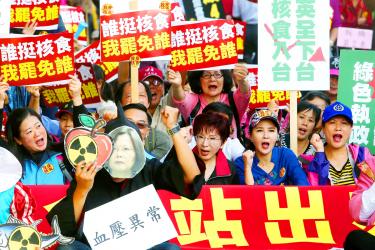
Chinese Nationalist Party (KMT) Chairwoman Hung Hsiu-chu, front third right, attends a demonstration along Taipei’s Ketagalan Boulevard yesterday against the proposed lifting of a ban on food imports from five Japanese prefectures.
KMT leads public protests over Japanese import ban
The Chinese Nationalist Party (KMT) yesterday took to the streets of Taipei, threatening to recall any lawmakers who voice support for the lifting of the nation’s import ban on Japanese food products from five Japanese prefectures, urging President Tsai Ing-wen’s (蔡英文) administration to provide the public with an explanation.
Taiwan imposed import restrictions on food products from Fukushima, Ibaraki, Tochigi, Gunma and Chiba prefectures following the meltdown at the Fukushima Dai-ichi nuclear power plant on March 11, 2011.
Addressing a rally against the relaxation of the ban outside the Chiang Kai-shek Memorial Hall MRT Station in the afternoon, KMT Chairwoman Hung Hsiu-chu (洪秀柱) accused Tsai’s administration of caving in to Japanese pressure and “forcing radiation-contaminated foods down the throats of Taiwanese.”
“We do not understand the Democratic Progressive Party’s [DPP] sudden flip-flop; we do not understand why the government is forcing people and their children to consume radiation-tainted food; and we do not understand … why we have to import radiation-contaminated food products just because of pressure from Japan,” Hung said.
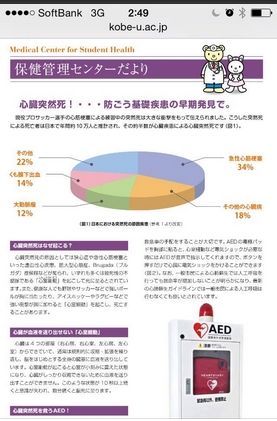
70,000 Sudden Cardiac Deaths per Year in Japan
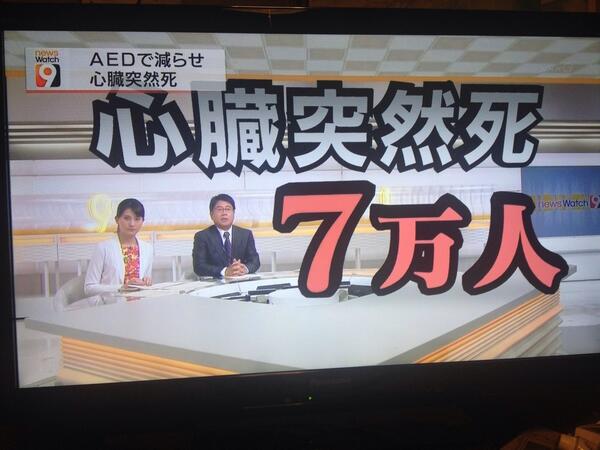
Sudden cardiac death seems to have increased to 70,000 per year in Japan. Previously it was said to be around 50,000 a year.
Is it the influence of radioactive contamination which is still leaking in the Fukushima Nuclear Power Plant ever since the March 2011 meltdowns and explosions?
https://twitter.com/kinmiraixx/status/812923365962825730
The Cost of Cleaning up Fukushima
The Abe administration has decided to use taxpayer money for decontaminating areas in Fukushima Prefecture off-limits to people due to fallout of radioactive substances from the March 2011 meltdowns at Tokyo Electric Power’s Fukushima No. 1 power plant. The decision, which deviates from the current policy that Tepco should pay for the decontamination efforts, reflects a proposal put forward in August by the ruling coalition of Prime Minister Shinzo Abe’s Liberal Democratic Party and Komeito but never discussed by the government’s council of experts or in the Diet.
The government may want to justify the move as an effort to help accelerate evacuees’ return to their hometown communities. Still, it will be difficult for the administration to evade criticism that the measure is nothing but a taxpayer-funded bailout for Tepco, which is responsible for the nuclear fallout that affected so many people in Fukushima.
By proceeding with the decontamination work, the administration hopes to lift evacuation orders in some of the no-go areas in about five years. It is hoped these areas will serve as bases for activities to promote reconstruction from the nuclear disaster. As the first step, the government plans to set aside ¥30 billion in the fiscal 2017 budget. So far, no full-scale cleanup work has been carried out inside these zones, which straddle seven municipalities around the Tepco plant.
The government’s position is that it is safe for evacuees to return to their communities if the annual cumulative dose there is 20 millisieverts (mSv) or less, although the legal limit allowed for people in normal circumstances is 1 mSv. The millisievert is a measure of the absorption of radiation by the human body. In no-go zones, the annual dose tops 50 mSv and is not expected to fall below 20 mSv in the next five years.
Faithful to the standard polluter pays principle, which was also applied to the Minamata mercury poisoning disaster in the 1950s and ’60s, the special law to cope with the damage from the Fukushima disaster stipulates that Tepco should shoulder the cleanup cost, and when decontamination work is paid for by taxpayer money, the utility must later reimburse the government. Now the government plans to revise the special law on decontamination and other legislation so it can pay for the planned decontamination work in Fukushima. To counter possible criticism that the scheme is intended merely to help Tepco, the government argues that the planned work aims to improve public infrastructure in the no-go zones so evacuees can return. However, the work will include scraping off top soil and cutting down trees, making it no different than decontamination efforts in other areas.
To justify the use of taxpayer money, the government also says that Tepco has paid compensation to evacuees from the no-go zones on the assumption that they would not be able to return to their homes over an extended period. Thus, in a revised guideline for the reconstruction of Fukushima Prefecture, the government says it will pay for the planned decontamination without asking for reimbursement from Tepco.
Behind the government’s decision for the use of taxpayer money is the mushrooming expense of decontamination, with the latest estimate rising from the original ¥2.5 trillion to ¥4 trillion, which does not include the cost of cleaning up the no-go areas. The government expects the planned work in those areas to cost roughly ¥300 billion over five years, but the price tag could rise if the work becomes protracted. And the burden on taxpayers may further increase if the scope of government-paid decontamination in those areas is expanded.
In a related move, the Ministry of Economy, Trade and Industry has come up with an idea to pass part of the cost of Tepco’s compensation for Fukushima disaster victims on to consumers in the form of higher electricity bills, as the total estimated cost for decommissioning the Fukushima No. 1 plant, compensation and decontamination has swollen from the original ¥11 trillion to ¥21.5 trillion. These moves not only increase people’s financial burden but also blur the power company’s responsibility for the devastation it caused. The government may say the measures are necessary to help promote reconstruction in Fukushima. But they could distract public attention from the principle that it is Tepco which must pay for the decommissioning of its reactors, compensation for the victims and cleanup of the contaminated areas.
http://www.japantimes.co.jp/opinion/2016/12/23/editorials/cost-cleaning-fukushima/#.WF15Dlzia-c
Harassment of Evacuees by Prefectural Housing Authorities to evict them for March 2017
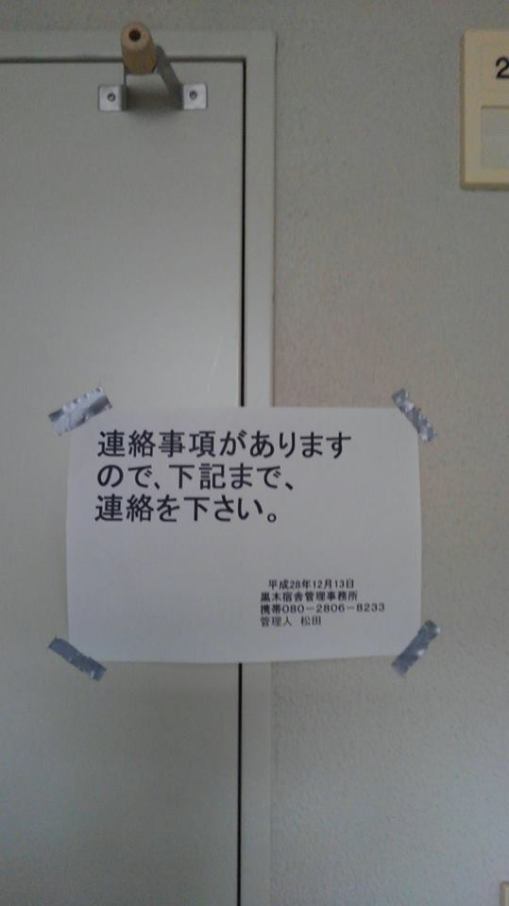
All the people evacuated in 2011 and who benefited of a housing compensation, are now suffering harassment from the various prefectures’ housing authorities, pressuring them to get out of those appartments before coming March 2017
This picture show the notice taped to the entrance door of an evacuee’s appartment, marking and stigmatizing the evacuee’s family to all the neigbors. Those evacuees are victims. Why treat in such manner people who are victims, already suffering plenty enough hardships and losses? What the hell is wrong with you? What are the sins of the victims?
The Japanese government, for the first time, is using state funds for decontamination work in areas affected by the 2011 nuclear accident in Fukushima Prefecture.
The environment ministry earmarked roughly 30 billion yen, or about 250 million dollars, in the fiscal 2017 budget plan, which was approved by the Cabinet on Thursday.
The allocation will be for cleaning up no-entry areas where radiation levels remain prohibitively high.
The government had so far made the plant operator, Tokyo Electric Power Company, pay for the cleanup, based on the principle that the entity responsible for the contamination should bear the cost.
If the Japanese Authorities can provide funds to help Tepco, the entity responsible for the contamination, why can they provide funds to help the victims, whose rights and needs should prevailed over those of the responsible corporation responsible for that nuclear disaster? Why the Japanese central government can coordinate with those various prefectures housing authorities for those evacuees to continue to live in a free-radiation environmnent?
The Japanese government decided to stop the evacuees housing compensation on March 2017 so as to force the evacuees’ return to live with radiation in the ghost towns now declared “safe” by the Japanese government. In preparation of the coming 2020 Tokyo Olympics, all must be back to normal, and is now declared “safe and clean”. Economics prevailing over scientific realities and people lives.
Japanese culture is looked upon as being a very refined, sophisticated, advanced culture. Is there no place for compassion in Japanese culture? Those victims are suffering from double-triple suffering already. Do you have to turn it into persecution?
Is not the right to live in a radiation-free environment a basic human right? To force them by all kinds of gimmicks to return to live in a contaminated territory, is then a violation of their basic human rights, their right to preserve their own health!
Another delay in removing spent nuclear fuel from Fukushima reactor
Fuel removal at Fukushima reactor again faces delay http://www.asahi.com/ajw/articles/AJ201612230043.html THE ASAHI SHIMBUN December 23, 2016 Work to retrieve spent nuclear fuel in the No. 3 reactor building storage pool of the crippled Fukushima No. 1 nuclear power plant will again be postponed due to a delay in clearing radioactive debris at the site.
TEPCO planned to begin removing 566 spent nuclear fuel assemblies in the storage pool in January 2018. However, the government and the plant operator, Tokyo Electric Power Co., decided on the postponement, sources said on Dec. 22. They will decide on a new timetable in a few weeks.
The work was initially scheduled for fiscal 2015, but had been pushed back because of high radiation readings in and around the No. 3 reactor building. The building was heavily damaged by a hydrogen explosion in the days following the disaster, triggered by the 2011 Great East Japan Earthquake and tsunami.
TEPCO had attempted to lower radiation levels by clearing the radioactive debris remaining at the site.
But the clearing work took longer than expected due to contamination being more widespread than previously thought, forcing TEPCO and the government to again put off the retrieval.
Radiation levels have now dropped as almost all of wreckage at the site has been cleared, TEPCO said. The government and TEPCO have said fuel retrieval at the No. 1 and No. 2 reactor buildings will start in fiscal 2020 or later.
Monju closure marks the end of the failed “nuclear fuel cycle” dream
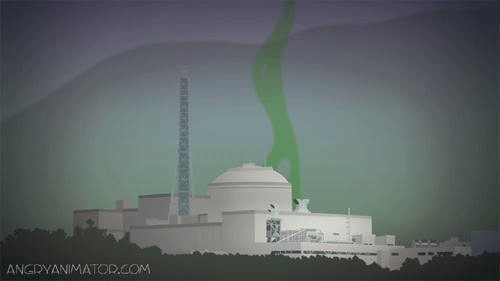 Japan pulls plug on Monju, ending US$8.5 billion nuclear self-sufficiency push, South China Morning Post, 21 December, 2016
Japan on Wednesday formally pulled the plug on an US$8.5 billion nuclear power project designed to realise a long-term aim for energy self-sufficiency after decades of development that yielded little electricity but plenty of controversy.
The move to shut the Monju prototype fast breeder reactor in Fukui prefecture west of Tokyo adds to a list of failed attempts around the world to make the technology commercially viable and potentially cut stockpiles of dangerous nuclear waste……
The plant was built to burn plutonium derived from the waste of reactors at Japan’s conventional nuclear plants and create more fuel than it used, closing the so-called nuclear fuel cycle and giving a country that relies on overseas supplies for most of its energy needs a home-grown electricity source.
With Monju’s shutdown, Japan’s taxpayers are now left with an estimated bill of at least 375 billion yen (US$3.2 billion) to decommission its reactor, on top of the 1 trillion yen (US$8.5 billion) spent on the project.
Japan is still committed to trying to make the technology work and will build a new experimental research reactor at Monju, the government said.
But critics within the ruling Liberal Democratic Party (LDP) think it will be another futile attempt.
“We need to terminate the impossible dream of the nuclear fuel cycle. The fast breeder reactor is not going to be commercially viable. We know it. We all know it,” senior LDP lawmaker Taro Kono said recently at an event in Tokyo. http://www.scmp.com/news/asia/east-asia/article/2056403/japan-pulls-plug-monju-ending-us85-billion-nuclear-self?utm_source=edm&utm_medium=edm&utm_content=20161222&utm_campaign=scmp_today

Fuel removal at Fukushima reactor again faces delay
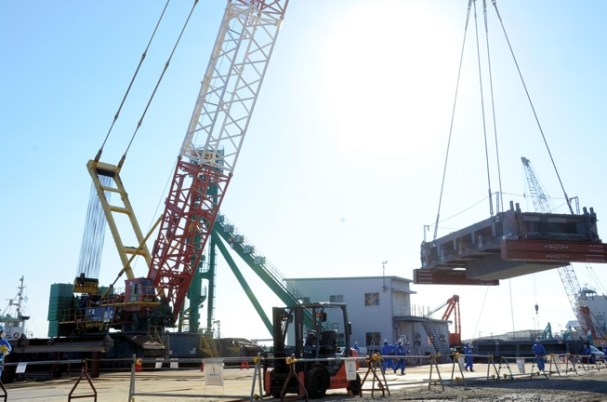
Steel frames are transported at the Fukushima No. 1 nuclear power plant on Dec. 20 to prepare for work to retrieve spent nuclear fuel from the storage pool of the damaged No. 3 reactor building.
Work to retrieve spent nuclear fuel in the No. 3 reactor building storage pool of the crippled Fukushima No. 1 nuclear power plant will again be postponed due to a delay in clearing radioactive debris at the site.
TEPCO planned to begin removing 566 spent nuclear fuel assemblies in the storage pool in January 2018. However, the government and the plant operator, Tokyo Electric Power Co., decided on the postponement, sources said on Dec. 22. They will decide on a new timetable in a few weeks.
The work was initially scheduled for fiscal 2015, but had been pushed back because of high radiation readings in and around the No. 3 reactor building. The building was heavily damaged by a hydrogen explosion in the days following the disaster, triggered by the 2011 Great East Japan Earthquake and tsunami.
TEPCO had attempted to lower radiation levels by clearing the radioactive debris remaining at the site.
But the clearing work took longer than expected due to contamination being more widespread than previously thought, forcing TEPCO and the government to again put off the retrieval.
Radiation levels have now dropped as almost all of wreckage at the site has been cleared, TEPCO said. The government and TEPCO have said fuel retrieval at the No. 1 and No. 2 reactor buildings will start in fiscal 2020 or later.
1 This Month





PLEASE OPPOSE HR 8255 AND S.3639 – bills would accelerate satellite deployment, with no environmental review or safeguards – https://ncstd5li.quorum.us/campaign/169331/
To see nuclear-related stories in greater depth and intensity – go to https://nuclearinformation.wordpress.com
-
Archives
- October 2026 (10)
- September 2026 (339)
- August 2026 (330)
- July 2026 (355)
- June 2026 (287)
- May 2026 (306)
- April 2026 (356)
- March 2026 (251)
- February 2026 (267)
- January 2026 (308)
- December 2025 (358)
- November 2025 (359)
-
Categories
- 1
- 1 NUCLEAR ISSUES
- business and costs
- climate change
- culture and arts
- ENERGY
- environment
- health
- history
- indigenous issues
- Legal
- marketing of nuclear
- media
- opposition to nuclear
- PERSONAL STORIES
- politics
- politics international
- Religion and ethics
- safety
- secrets,lies and civil liberties
- spinbuster
- technology
- Uranium
- wastes
- weapons and war
- Women
- 2 WORLD
- ACTION
- AFRICA
- Atrocities
- AUSTRALIA
- Christina's notes
- Christina's themes
- culture and arts
- Events
- Fuk 2022
- Fuk 2023
- Fukushima 2017
- Fukushima 2018
- fukushima 2019
- Fukushima 2020
- Fukushima 2021
- general
- global warming
- Humour (God we need it)
- Nuclear
- RARE EARTHS
- Reference
- resources – print
- Resources -audiovicual
- Weekly Newsletter
- World
- World Nuclear
- YouTube
-
RSS
Entries RSS
Comments RSS

