Catholic Solidarity Against Nuclear joins civil society groups in a non-nuclear road map to Korea’s presidential candidates
 Catholics plan for a future free from nuclear threats http://www.ucanews.com/news/catholics-plan-for-a-future-free-from-nuclear-threats/78620 Civil society groups have delivered a non-nuclear road map to Korea’s presidential candidates March 13, 2017
Anti-nuclear groups in Korea will send their draft for a non-nuclear road map to all major presidential candidates ahead of upcoming elections following news of President Park Geun-hye’s ouster.
The Catholic Solidarity Against Nuclear Energy together with Energy Justice Action, a civic environment group, announced a plan for a “nuclear energy-free Korea.”
They proposed 10 short-term tasks to the next government, including the establishment of a National Energy Commission, no new nuclear power plants, suspension of aged nuclear reactors and reshuffling the power grid in favor of reusable energy.
They also picked five mid and long-term tasks including new management guidelines for nuclear waste, stopping the export of nuclear power and reaffirming principles against nuclear weapons.
The two groups will finalize a road map based on the draft after an activist and public survey, explanation sessions and meeting with experts.
Six years on, Japan struggles with Fukushima’s nuclear wastes
Struggling With Japan’s Nuclear Waste, Six Years After Disaster https://www.nytimes.com/2017/03/11/world/asia/struggling-with-japans-nuclear-waste-six-years-after-disaster.html?_r=0 by MOTOKO RICH
 400 Tons of Contaminated Water Per Day,
The Tokyo Electric Power Company is pumping water nonstop through the three reactors to cool melted fuel that remains too hot and radioactive to remove. About 400 tons of water pass through the reactors every day, including groundwater that seeps in. The water picks up radiation in the reactors and then is diverted into a decontamination facility.But the decontamination filters cannot remove all the radioactive material. So for now, all this water is being stored in 1,000 gray, blue and white tanks on the grounds. The tanks already hold 962,000 tons of contaminated water, and Tokyo Electric is installing more tanks. It is also trying to slow the flow of groundwater through the reactors by building an underground ice wall.
Within a few years, though, and no one is sure exactly when, the plant may run out of room to store the contaminated water. “We cannot continue to build tanks forever,” said Shigenori Hata, an official at the Ministry of Economy, Trade and Industry.
The authorities are debating whether it might be acceptable, given the relatively low radioactive levels in the water, to dilute the contaminated water and then dump it into the ocean. But local fishermen are vehemently opposed. Many people still do not trust Tokyo Electric because of its bungled response to the disaster, the worst nuclear accident since Chernobyl.
 3,519 Containers of Radioactive Sludge
The process of decontaminating the water leaves radioactive sludge trapped in filters, which are being held in thousands of containers of different sizes.
Tokyo Electric says it cannot quantify the amount of radioactive sludge being generated. But it says it is experimenting with what to do with it, including mixing it with cement or iron. Then it will have to decide how to store it.
64,700 Cubic Meters of Discarded Protective Clothing
The estimated 6,000 cleanup workers at the site put on new protective gear every day. These hazmat suits, face masks, rubber gloves and shoe coverings are thrown out at the end of each shift. The clothing is compressed and stored in 1,000 steel boxes stacked around the site.
To date, more than 64,700 cubic meters of gear has been discarded, the equivalent of 17 million one-gallon containers. Tokyo Electric says it will eventually incinerate all this contaminated clothing to reduce the space needed to store it.
Branches and Logs From 220 Acres of Deforested Land The plant’s grounds were once dotted with trees, and a portion was even designated as a bird sanctuary. But workers have cleared about 220 acres of trees since the meltdown spewed radiation over them.
Now, piles of branches and tree trunks are stacked all over the site. Officials say there are about 80,000 cubic meters of this waste, and all of it will have to be incinerated and stored someday.
200,400 Cubic Meters of Radioactive RubbleExplosions during the meltdown filled the reactors with rubble. Workers and robots are slowly and carefully trying to remove this tangled mass of crushed concrete, pipes, hoses and metal.
Tokyo Electric estimates that more than 200,400 cubic meters of rubble — all of it radioactive — have been removed so far and stored in custom-made steel boxes. That is the equivalent of about 3,000 standard 40-foot shipping containers.
3.5 Billion Gallons of SoilThousands of plastic garbage bags sit in neat rows in the fields and abandoned towns surrounding the Fukushima plant. They contain soil that was scraped from land that was exposed to radiation in the days after the accident.
Japan’s Ministry of the Environment estimates that it has bagged 3.5 billion gallons of soil, and plans to collect much more. It will eventually incinerate some of the soil, but that will only reduce the volume of the radioactive waste, not eliminate it.
The ministry has already begun building a massive, interim storage facility in Fukushima prefecture and negotiating with 2,360 landowners for the thousands of acres needed to complete it. And that is not even a long-term solution: The government says that after 30 years it will need another site — or sites — to store radioactive waste.
 1,573 Nuclear Fuel Rods
Hundreds of spent fuel rods are in cooling pools inside the reactors, and the company hopes to have cleared away enough rubble to begin removing them next year. The much bigger challenge will be removing the fuel that was in use in the reactor core at the time of the meltdown.
The condition and location of this molten fuel debris are still largely unknown. In one reactor where a robot was sent in January, much of the melted fuel is believed to have burned through the bottom of the inner reactor vessel and burrowed into the thick concrete foundation of the containment structure.
The plan is to completely seal the containment vessels, fill them with water and use robots to find and remove the molten fuel debris. But the rubble, the lethal levels of radiation and the risk of letting radiation escape make this an exceedingly difficult task.
In January, the robot sent into one of the reactors discovered radiation levels high enough to kill a person in less than a minute. Another had to be abandoned last month after debris blocked its path and radiation disabled it.
Tokyo Electric hopes to begin removing fuel debris from the reactor cores in 2021. The entire effort could take decades. Some say the radioactive material may prove impossible to remove safely and have suggested leaving it and entombing Fukushima under a concrete and steel sarcophagus like the one used at Chernobyl.
But the Japanese government and Tokyo Electric say they are committed to removing all the waste and cleaning the site, estimated at a cost of $188.6 billion.
“We want to return it to a safe state,” said Yuichi Okamura, general manager of the company’s nuclear power and plant siting division. “We promised the local people that we would recover the site and make it a safe ground again.”
Tepco has paid only 6% of compensation needed by municipalities for Fukushima nuclear disaster
 Only 6% of Fukushima nuclear disaster compensation paid by TEPCO, Japan Today, MAR. 11, 2017 TOKYO —
The operator of the crippled nuclear complex in Fukushima Prefecture has only paid 6% of the compensation sought by municipalities in connection with the 2011 nuclear crisis, according to a recent prefectural tally.
The delay in payments to the 12 municipalities, designated by the government as evacuation zones, highlights the continuing challenge to their reconstruction efforts six years after the nuclear disaster, triggered by the massive earthquake and tsunami in northeastern Japan on March 11, 2011.
The tally found that Tokyo Electric Power Company Holdings Inc (TEPCO) had by the end of 2016 paid around 2.6 billion yen ($22.5 million) of the 43.3 billion yen demanded by the 12 local governments.
As some municipalities have been forced to shoulder most of the costs for TEPCO, local residents have raised concerns that the situation could delay reconstruction…….
Among the municipalities, the town of Futaba, where the Fukushima Daiichi nuclear plant is located and all of its residents remain evacuated, has received no compensation despite its demand for around 19.3 billion yen.
The town of Namie, where part of its evacuation order will be lifted at the end of the month, has received around 460 million yen, 4% of the amount demanded……
The delay in paying compensation is fueling concern about the future. “If compensation (for local governments) does not move forward, it will spark concern among residents over the town’s reconstruction efforts,” said Futoshi Hirono, who heads a residents’ association in Kawamata. https://www.japantoday.com/category/national/view/only-6-of-fukushima-nuclear-disaster-compensation-paid-by-tepco
Thousands in Taiwan protest against nuclear power, demand low carbon sustainable energy
Taiwan protesters demand sustainable energy, nuclear power phase-out, San Diego Jewish World, March 11, 2017 rom dpa German Press Agency Taipei (dpa) – Thousands of anti-nuclear protesters took to the streets across Taiwan on Saturday to urge the government to speed up steps to abandon nuclear power, find solutions to the problem of radioactive waste and develop more sustainable energy resources.
The demonstrations came as Japan marked the sixth anniversary of the earthquake and tsunami that caused a nuclear meltdowns at the Fukushima Daiichi power plant.
Protesters gathered Saturday in the capital, Taipei; in the port city of Kaohsiung in the south; and in Taitung City in the east.
Organizers said the protests included representatives from more than 200 non-governmental environmental groups, human rights groups, child welfare organisations and others.
On a square in Taipei in front of the office of Taiwanese President Tsai ing-wen, demonstrators waved signs that read, “No Nukes,” “Low Carbon” and “Sustainable Energy.”………http://www.sdjewishworld.com/2017/03/11/taiwan-protesters-demand-sustainable-energy-nuclear-power-phase-out/
Taiwan govt reaffirms aim to phase out nuclear power by 2025
ENDITEM/AW/ Cabinet spokesman Hsu Kuo-yung (徐國勇) reiterated on Saturday that the government’s goal of phasing out nuclear power in Taiwan by 2025 remains unchanged, as protesters held anti-nuclear power rallies around the country.
Hsu said the government will brief the public about its plans later this month, including ways to increase the amount of electricity generated from renewable sources nationwide to 20 percent by 2025.
Other issues such as handling nuclear waste, upgrading to more efficient thermal power plants and steps to decommission the country’s three active nuclear power plants will also be addressed, added state-run utility Taiwan Power Co. (Taipower) in a statement.
Hsu made the remarks as demonstrations were held in Taipei, Kaohsiung and Taitung against the continued use of nuclear power in Taiwan on the sixth anniversary of an earthquake and tsunami in Japan that resulted in a nuclear incident that forced the evacuation of tens of thousands of people from the region around the Fukushima Daiichi Nuclear Power Plant.
The protesters demanded that the government move faster on its pledge to create a “nuclear power free homeland,” including the announcement of more concrete plans and a timetable.
The Atomic Energy Council said it will complete its review by June of Taipower’s plan to phase out the No. 1 nuclear Power plant.
The council is also demanding Taipower too put forth its plans to decommission the second and third nuclear plower plants by 2018 and 2021, respectively.
Former PM Koizumi again calls for ‘zero nuclear power in Japan
Ex-PM Koizumi repeats call for ‘zero nuclear power plants’ http://mainichi.jp/english/articles/20170312/p2g/00m/0dm/056000c March 12, 2017 (Mainichi Japan) SAPPORO (Kyodo) — Former Prime Minister Junichiro Koizumi on Saturday repeated his call for Japan’s complete departure from nuclear energy as the country marked the sixth anniversary of the Fukushima nuclear disaster.
The group is seeking the decommissioning of nuclear reactors at Hokkaido Electric Power Co.’s Tomari power station on Japan’s northernmost main island.
“(Japan) can become a much better country with zero nuclear power plants, harnessing natural energy,” Koizumi said, adding it will not be so difficult to replace nuclear energy with renewable energy if technological innovation advances.
After his speech, Koizumi criticized Prime Minister Shinzo Abe’s policy which promotes restarting nuclear plants most of which remain offline and exporting nuclear reactors.
“If the prime minister said ‘zero (nuclear power),’ the situation will greatly change. I don’t know why he can’t understand this,” Koizumi said.
Tokyo Olympics supposed to bring in Y32.3 tril to Japan

What could possibly go wrong?
Tokyo 2020 Olympics seen having Y32.3 tril economic impact https://www.japantoday.com/category/sports/view/tokyo-2020-olympics-seen-having-y32-3-tril-economic-impact TOKYO —The 2020 Tokyo Olympics are expected to give an overall 32.3 trillion yen boost to the Japanese economy, according to the Tokyo city government.
Euphoria surrounded the award of the Games to Tokyo in 2013 but scandals and cost overruns have overshadowed the hosting of the event.
The original design for a new stadium was scrapped to curb soaring costs and there were allegations of bribery to secure the winning bid.
Former Olympic host cities have frequently suffered an economic hangover after the event as venues become white elephants and maintenance costs mount.
But if done right, economic benefits can accrue. The British government said in 2013, a year after the 2012 London Games, that it expected a positive economic impact of 41 billion pounds ($50.2 billion) up to 2020.
The Tokyo Metropolitan Government predicted in a report late Monday that the overall impact for Japan would be positive.
During the period from 2013, when the Games were awarded, to 2030, it expects total Olympic-related economic benefits of about 5.2 trillion yen ($46 billion), citing its own research. That includes construction of facilities and spending on operational costs related directly to the Games as well as purchases of admission tickets to events and corporate marketing.
Indirect benefits, such as tourism and infrastructure spending on transport, would total 27.1 trillion yen, it said.
The indirect impact would include, for example, an increase in the number of people joining health clubs and taking part in sports as well as “higher numbers of tourists who visit Japan, and related spending”, Tokyo official Tsutomu Kozaka told AFP Tuesday.
The hosting of the Games is also expected to generate 1.94 million jobs nationwide, Tokyo officials said.
“We looked at estimates of the London Games as a reference in calculating the increase in the number of tourists visiting Tokyo,” Kozaka said.
In December 2015 the Bank of Japan said Tokyo 2020 could boost the size of the economy by as much as one percent, with construction and tourism helping to fuel growth.
It estimated that gross domestic product (GDP) in the world’s number three economy in 2018—the high point of Olympic-related impact—would get a boost of as much as six trillion yen, resulting in a one percent increase compared with overall GDP in 2014.
But that uptick would gradually fade by 2020, the central bank said, warning that the country must create new demand so that the economic impact of the Olympics can continue after the event ends.
Transgender-friendly toilets planned for 2020 Olympics in Tokyo
Tokyo’s city government is planning on installing gender-neutral bathrooms in at least seven of the 11 Olympic venues it is constructing for the 2020 Games, Guardian, Bryan Armen Graham, 7 Mar 17, Tokyo’s metropolitan government is seeking to install gender-neutral public restrooms in the venues it is constructing for the 2020 Olympics and Paralympics…….https://www.theguardian.com/sport/2017/mar/01/tokyo-2020-olympics-transgender-friendly-toilets
Tokyo 2020 Olympics’ Main Venue Costs Expected To Reach $87M
March 10, 2017A source with the 2020 Games organizers said Thursday that temporary structures for the new National Stadium that will serve as the main venue for the 2020 Tokyo Olympics and Paralympics are “expected to cost more than double the estimate presented during the bidding,” according to KYODO. …(subscribers only) https://www.sportsbusinessdaily.com/Global/Issues/2017/03/10/Olympics/2020-National-Stadium.aspx
No, despite the propaganda, Fukushima nuclear clean-up not under control
Dying robots and failing hope: Fukushima clean-up falters six years after tsunami
Exploration work inside the nuclear plant’s failed reactors has barely begun, with the scale of the task described as ‘almost beyond comprehension’, Guardian, Justin McCurry at Fukushima Daiichi nuclear power plant, 9 Mar 17. B
Barely a fifth of the way into their mission, the engineers monitoring the Scorpion’s progress conceded defeat. With a remote-controlled snip of its cable, the latest robot sent into the bowels of one of Fukushima Daiichi’s damaged reactors was cut loose, its progress stalled by lumps of fuel that overheated when the nuclear plant suffered a triple meltdown six years ago this week.
As the 60cm-long Toshiba robot, equipped with a pair of cameras and sensors to gauge radiation levels was left to its fate last month, the plant’s operator, Tokyo Electric Power (Tepco), attempted to play down the failure of yet another reconnaissance mission to determine the exact location and condition of the melted fuel.

Even though its mission had been aborted, the utility said, “valuable information was obtained which will help us determine the methods to eventually remove fuel debris”.
The Scorpion mishap, two hours into an exploration that was supposed to last 10 hours, underlined the scale and difficulty of decommissioning Fukushima Daiichi – an unprecedented undertaking one expert has described as “almost beyond comprehension”.
Cleaning up the plant, scene of the world’s worst nuclear disaster since Chernobyl after it was struck by a magnitude-9 earthquake and tsunami on the afternoon of 11 March 2011, is expected to take 30 to 40 years, at a cost Japan’s trade and industry ministry recently estimated at 21.5tr yen ($189bn).
The device, along with other robots, may also have been damaged by an unseen enemy: radiation. Before it was abandoned, its dosimeter indicated that radiation levels inside the No 2 containment vessel were at 250 sieverts an hour. In an earlier probe using a remote-controlled camera, radiation at about the same spot was as high as 650 sieverts an hour – enough to kill a human within a minute.
Robotic mishaps aside, exploration work in the two other reactors, where radiation levels are even higher than in reactor No 2, has barely begun. There are plans to send a tiny waterproof robot into reactor No 1 in the next few weeks, but no date has been set for the more seriously damaged reactor No 3………
‘The situation is not under control’
On the surface, much has changed since the Guardian’s first visit to Fukushima Daiichi five years ago. Then, the site was still strewn with tsunami wreckage. Hoses, pipes and building materials covered the ground, as thousands of workers braved high radiation levels to bring a semblance of order to the scene of a nuclear disaster.
Six years later, damaged reactor buildings have been reinforced, and more than 1,300 spent fuel assemblies have been safely removed from a storage pool in reactor No 4. The ground has been covered with a special coating to prevent rainwater from adding to Tepco’s water-management woes.
Workers who once had to change into protective gear before they approached Fukushima Daiichi now wear light clothing and simple surgical masks in most areas of the plant. The 6,000 workers, including thousands of contract staff, can now eat hot meals and take breaks at a “rest house” that opened in 2015.
But further up the hill from the coastline, row upon row of steel tanks are a reminder of the decommissioning effort’s other great nemesis: contaminated water. The tanks now hold about 900,000 tons of water, with the quantity soon expected to reach 1m tons.
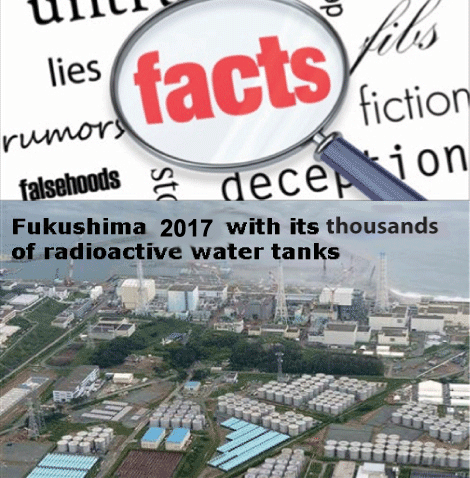
Critics of the clean-up note that 2020 is the year Tokyo is due to host the Olympics, having been awarded the Games after Abe assured the International Olympic Committee that Fukushima was “under control”.

Mitsuhiko Tanaka, a former Babcock-Hitachi nuclear engineer, accuses Abe and other government officials of playing down the severity of the decommissioning challenge in an attempt to win public support for the restart of nuclear reactors across the country.
“Abe said Fukushima was under control when he went overseas to promote the Tokyo Olympics, but he never said anything like that in Japan,” says Tanaka. “Anyone here could see that the situation was not under control.
on 5th anniversary of Fukushima nuclear catastrophe, the global nuke industry is in decline
 Terminal decline? Fukushima anniversary marks nuclear industry’s deepening crisis, Ecologist, Nuclear Monitor 10th March 2017 With the sixth anniversary of the Fukushima disaster falling on 11 March , nuclear lobbyists are arguing over solutions to the existential crisis facing nuclear power, writes Jim Green. Some favour a multinational consolidation of large conventional reactor designs, while others back technological innovation and ‘small modular reactors’. But in truth, both approaches are doomed to failure
Saturday March 11 marks the sixth anniversary of the triple-disaster in north-east Japan – the earthquake, tsunami and the Fukushima nuclear disaster.
And the news is not good. Scientists are wondering how on earth to stabilise and decontaminate the failed reactors awash with molten nuclear fuel, which are fast turning into graveyards for the radiation-hardened robots sent in to investigate them.
The Japanese government’s estimate of Fukushima compensation and clean-up costs has doubled and doubled again and now stands at ¥21.5 trillion (US$187bn; €177bn).
Indirect costs – such as fuel import costs, and losses to agricultural, fishing and tourism industries – will likely exceed that figure.
Kendra Ulrich from Greenpeace Japan notes in a new report that “for those who were impacted by the worst nuclear disaster in a generation, the crisis is far from over. And it is women and children that have borne the brunt of human rights violations resulting from it, both in the immediate aftermath and as a result of the Japan government’s nuclear resettlement policy.”
Radiation biologist Ian Fairlie summarises the health impacts from the Fukushima disaster: “In sum, the health toll from the Fukushima nuclear disaster is horrendous. At the minimum:
- Over 160,000 people were evacuated most of them permanently.
- Many cases of post-trauma stress disorder (PTSD), depression, and anxiety disorders arising from the evacuations.
- About 12,000 workers exposed to high levels of radiation, some up to 250 mSv
- An estimated 5,000 fatal cancers from radiation exposures in future.
- Plus similar (unquantified) numbers of radiogenic strokes, CVS diseases and hereditary diseases.
- Between 2011 and 2015, about 2,000 deaths from radiation-related evacuations due to ill-health and suicides.
- An, as yet, unquantified number of thyroid cancers.
- An increased infant mortality rate in 2012 and a decreased number of live births in December 2011.”
Dr Fairlie’s report was written in August 2015 but it remains accurate. More than half of the 164,000 evacuees from the nuclear disaster remain dislocated. Efforts to restore community life in numerous towns are failing. Local authorities said in January that only 13% of the evacuees in five municipalities in Fukushima Prefecture have returned home after evacuation orders were lifted.
As for Japan’s long-hyped ‘nuclear restart’: just three power reactors are operating in Japan; before the Fukushima disaster, the number topped 50……….http://www.theecologist.org/News/news_analysis/2988749/terminal_decline_fukushima_anniversary_marks_nuclear_industrys_deepening_crisis.html
Fukushima anniversary anti nuclear march in Taiwan
 Thousands expected to march to protest nuclear power today http://www.taipeitimes.com/News/taiwan/archives/2017/03/11/2003666562 By Abraham Gerber / Staff reporter The nation’s annual march against nuclear power plants is to be held today, with activists on Thursday calling for more openness and civic participation in crafting a nuclear waste disposal plan.
“We have to keep the pressure on the government, otherwise it will stall — our hope is that there should be a result by the conclusion of the Democratic Progressive Party’s [DPP] four years in power,” Green Citizens’ Action Alliance secretary-general Tsuei Su-hsin (崔愫欣) said while leading more than a dozen people in a protest outside the Legislative Yuan in Taipei.
People plan to congregate on Ketagalan Boulevard this afternoon for the march, a major annual environmental demonstration.
“This will be our first march since the DPP took full control [of the government] and there are a lot of issues — from retiring nuclear reactors to transitioning to different forms of energy — where we feel there is a need for society to rigorously inspect whether the government has sufficient political resolve,” Tsuei said.
Tsuei added that nuclear waste disposal and energy taxes were key issues.
“Nuclear waste disposal cannot be something where Taiwan Power Co just makes a decision for itself,” Mom Loves Taiwan secretary-general Yang Shun-mei (楊順美) said, calling for open discussion of how waste is to be addressed, included the geology of proposed disposal sites.
“Statements the government has made about future energy prices have been extremely conservative and vague,” Green Citizens’ Action Alliance deputy secretary-general Hung Shen-han (洪申翰) said, calling for the government to stop avoiding demands for an energy tax.
“The government should definitely be taking action and I trust that now is the time for the DPP to realize the promises it made before the election,” said DPP Legislator Chuang Ruei-hsiung (莊瑞雄), who represented the party’s legislative caucus in talks with the protesters.
He said the party is considering establishing a cross-party legislative committee to draft plans for the disposal of nuclear waste.
Investors worried about bankruptcy risk in Toshiba’s troubled nuclear business Westinghouse
Toshiba’s troubled nuclear business Westinghouse is bringing in bankruptcy lawyers, City AM, Courtney Goldsmith, 9 Mar 17, Toshiba’s US nuclear business, Westinghouse, has hired bankruptcy attorneys, signalling to investors it is serious about the potential of a Chapter 11 filing.
The Japanese conglomerate brought in law firm Weil Gotshal & Manges to explore the option, but it had not yet taken a decision on a bankruptcy filing, sources told Reuters.
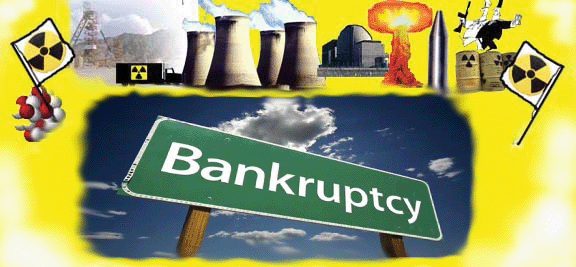
Toshiba’s shares closed down 7.2 per cent today.
The firm unexpectedly delayed its financial update last month as it announced it needed more time to probe its US nuclear business after revealing a multi-billion pound hole. It’s due to report earnings Tuesday, but a source has told Reuters the likelihood of Toshiba meeting this deadline was “fifty-fifty”.
If the firm fails to meet that deadline, it has until 27 March to file or could be delisted.
Although the troubled firm said it’s not aware of any intention for Westinghouse to file for Chapter 11 bankruptcy, sources have said it is one of several options being considered. The nuclear business faces cost overruns at two projects.
Toshiba has also hired a Japanese law firm to help estimate the how a US bankruptcy will impact the broader group, sources said…..
one issue may be financing guarantees given by the US government to help fund the construction of reactors at the Vogtle plant in Georgia, one of the two projects at the core of Westinghouse’s woes.
A 2014 statement on the US department of energy’s website says the loan guarantees totaled $8.3bn (£6.8bn)
Toshiba is also pursuing the sale of most, or even all, of its prized flash memory chip business, which will help protect it against future financial problems. Bids on the company, which Toshiba values at least 1.5 trillion yen, are due at the end of the month. http://www.cityam.com/260648/toshibas-troubled-nuclear-business-westinghouse-bringing
China planning nuclear power for space projects
 China plotting SPACE INVASION as groundbreaking nuclear programme announced, Daily Star UK , 10 Mar 17 CHINA is going to use nuclear power as part of the superpower’s ultimate goal of dominating space. The country is testing and developing nuclear technology that can be used as part of its galaxy exploration plan.
Wang Siren, the vice chairman the China Atomic Energy Authority, confirmed the news yesterday.
He said nuclear power is going to be the most viable source of energy for conducting space projects, such as those planned for Jupiter and Mars…..
The announcement comes amid increasing fears of a potential cosmic conflict as countries battle it out for space dominance…..
Last year, a US official warned that the use of intergalactic weapons could have devastating consequences for people on Earth…..http://www.dailystar.co.uk/news/latest-news/595456/china-space-war-nuclear-power-russia-weapons-us-rockets-missiles
North Korea tried to sell nuclear-weapon material
http://www.foxnews.com/world/2017/03/09/north-korea-tried-to-sell-nuclear-weapon-material.html North Korea attempted to sell a form of lithium metal, a key material for developing miniaturized nuclear weapons, to unidentified international buyers last year, according to United Nations investigators tracking dictator Kim Jong Un‘s weapons-of-mass-destruction programs.
“The U.N. Panel of Expert’s report on North Korea provides further evidence that North Korea will stop at nothing to advance its illicit nuclear and missile programs,” said Sen. Cory Gardner (R., Colo.) who wrote a new sanctions bill against North Korea last year.
North Korea’s production of the enriched lithium, known as lithium-6, is also seen by nuclear experts as evidence of the country’s accelerated efforts to miniaturize a nuclear warhead, potentially for use on ballistic missiles.
Lithium-6 can be used to produce tritium, which is used to flood neutrons into a nuclear device and magnify the explosive power of nuclear detonations, allowing countries to build bombs with smaller amounts of plutonium or uranium, nuclear experts said.
These smaller devices can be affixed to intercontinental ballistic missiles.
“Lithium-6 is ideal, not only for making tritium for boosting fission devices, but also for directly fueling advanced weapons—including thermonuclear bombs,” said Henry Sokolski, a former Pentagon official who heads the Nonproliferation Policy Education Center, a Washington think tank.
Lithium also has nonmilitary applications, particularly in producing batteries, lubricants and medicines, nuclear experts said. North Korea is believed to have significant natural deposits of the metal in its soil.
1 This Month




PLEASE OPPOSE HR 8255 AND S.3639 – bills would accelerate satellite deployment, with no environmental review or safeguards – https://ncstd5li.quorum.us/campaign/169331/
To see nuclear-related stories in greater depth and intensity – go to https://nuclearinformation.wordpress.com
-
Archives
- September 2026 (339)
- August 2026 (330)
- July 2026 (355)
- June 2026 (287)
- May 2026 (306)
- April 2026 (356)
- March 2026 (251)
- February 2026 (267)
- January 2026 (308)
- December 2025 (358)
- November 2025 (359)
- October 2025 (375)
-
Categories
- 1
- 1 NUCLEAR ISSUES
- business and costs
- climate change
- culture and arts
- ENERGY
- environment
- health
- history
- indigenous issues
- Legal
- marketing of nuclear
- media
- opposition to nuclear
- PERSONAL STORIES
- politics
- politics international
- Religion and ethics
- safety
- secrets,lies and civil liberties
- spinbuster
- technology
- Uranium
- wastes
- weapons and war
- Women
- 2 WORLD
- ACTION
- AFRICA
- Atrocities
- AUSTRALIA
- Christina's notes
- Christina's themes
- culture and arts
- Events
- Fuk 2022
- Fuk 2023
- Fukushima 2017
- Fukushima 2018
- fukushima 2019
- Fukushima 2020
- Fukushima 2021
- general
- global warming
- Humour (God we need it)
- Nuclear
- RARE EARTHS
- Reference
- resources – print
- Resources -audiovicual
- Weekly Newsletter
- World
- World Nuclear
- YouTube
-
RSS
Entries RSS
Comments RSS

