Secrecy surrounding meeting of World Association of Nuclear Operators in South Korea

 Korea Joongang Daily 17th Oct 2017, The Biennial General Meeting (BGM) of the World Association of Nuclear
Operators (WANO) kicked off in Gyeongju, North Gyeongsang, on Monday,
bringing together some 500 nuclear industry experts and leaders from around
the world – but the government kept the meeting’s profile very low.
The biennial event, held at the Hico Convention Center in Korea’s cultural
capital some 340 kilometers (211 miles) southeast of Seoul, has the theme
“Leading Nuclear Safety in a Changing World” and will run for six days.
Speakers include Zhang Tao, president of China National Nuclear Power,
Agneta Rising, director general of the World Nuclear Association and
Vincent de Rivaz, CEO of EDF, the French electricity utility.
On the first day of the event, speeches delivered in panel discussions were not provided
to the press. Not a single placard was hung at the Hico building promoting
the event. Entrance to the convention center was closely regulated. No
press was allowed inside, not even a photographer, one security personnel
said.
The secretive nature of the proceeding was surprising given the
biennial event is often called the “Nuclear Power Olympics” for the
scope of expertise and ideas presented. News reports said state-run Korea
Hydro and Nuclear Power (KHNP) was deliberately avoiding publicity because
of the Moon Jae-in government’s attempt to wean Korea off nuclear power.
http://koreajoongangdaily.joins.com/news/article/article.aspx?aid=3039527&cloc=joongangdaily|home|newslist1
Robots are central to Fukushima’s highly dangerous nuclear radioactivity clean-up
BBC 18th Oct 2017, Robots have become central to the cleaning-up operation at Japan’s
Fukushima nuclear power plant, six years after the tsunami that triggered
the nuclear meltdown. It is estimated that around 600 tonnes of toxic fuel
may have leaked out of the reactor during the incident. The Tokyo Electric
Power Company is using a variety of robots to explore areas too dangerous
for people to go near. BBC Click was given rare access to the site to see
how the decontamination work was progressing.
http://www.bbc.co.uk/news/av/technology-41584738/fukushima-disaster-the-robots-going-where-no-human-can
USA would consider direct talks with North Korea, eventually – Deputy Secretary of State John J Sullivan
US OFFICIAL SAYS NOT RULING OUT EVENTUAL DIRECT TALKS WITH NORTH KOREA, Eye Witness News, 18 Oct 17,
Tension has soared following a series of weapons tests by North Korea and a string of increasingly bellicose exchanges between Donald Trump and Kim Jong Un. Reuters |
TOKYO/UNITED NATIONS – The United States is not ruling out the eventual possibility of direct talks with North Korea, Deputy Secretary of State John J Sullivan said on Tuesday, hours after Pyongyang warned nuclear war might break out at any moment.
Talks between the adversaries have long been urged by China in particular, but Washington and its ally Japan have been reluctant to sit down at the table while Pyongyang continues to pursue a goal of developing a nuclear-tipped missile capable of hitting the United States.
“Eventually, we don’t rule out the possibility of course of direct talks,” Sullivan said in Tokyo after talks with his Japanese counterpart……..http://ewn.co.za/2017/10/17/us-official-says-not-ruling-out-eventual-direct-talks-with-north-korea
Stalemate continues, as North Korea warns that ‘nuclear war may break out any moment’
North Korea says ‘nuclear war may break out any moment’ — but that’s the last thing it wants, Business Insider, ALEX LOCKIEOCT 18, 2017
Kansai Electric Power Co. to permanently close 2 nuclear reactors in Fukui Prefecture

 Oi nuclear reactors set to be decommissioned , Japan News , October 17, 2017 Kansai Electric Power Co. intends to decommission the No. 1 and No. 2 reactors at the Oi nuclear power plant in Fukui Prefecture when the plant reaches 40 years of service in 2019, it has been learned.
KEPCO made the decision because the distinctive structure of the reactors’ containment vessels would require massive spending to apply safety measures that would meet the new standards set after the crisis at Tokyo Electric Power Company Holdings Inc.’s Fukushima No. 1 nuclear power plant.
The power company is expected to make an official decision by the end of this year and submit an application to the Nuclear Regulation Authority.
Since the 2011 Great East Japan Earthquake, decisions have been made to decommission six nuclear reactors, not counting those at the Fukushima No. 1 plant. The Oi reactors will be the first large-scale reactors, with a maximum output of over 1 million kilowatts, to be decommissioned……..
The deadline for the Nos. 1 and 2 Oi reactors to apply for an operating period extension is approaching in 2018. With work to improve safety likely being a difficult challenge, KEPCO has no prospect of cutting back on the cost, which is expected to be over ¥100 billion. The company therefore gave up on restarting the reactors.
Tens of billions of yen are expected to be spent over 30 years to complete the decommissioning of the reactors, but that is still much cheaper than restarting them. ….. http://the-japan-news.com/news/article/0004008184
Japan’s solar powered smart communities
The Sun Rises on Japan’s Solar-Powered Smart Communities, Solar Magazine, By Andrew Burger – 16 Oct 17

China forced to close top skiing area, due to earthquake concerns about North Korea’s nuclear tests
North Korean Nuclear Tests Close Chinese Ski Area, Outside, 17 Oct 17,
Border resort shuttered amid earthquake and volcano concerns after a series of underground detonations China announced an indefinite closure of the country’s only cat-access ski resort due to earthquakes that were caused by a series of underground nuclear tests conducted by North Korea.
Changbaishan Ski Resort is part of China’s Changbaishan National Nature Reserve, a nearly 800-square-mile preserve along North Korea’s northern border that sits within 70 miles of the nation’s nuclear test site at Punggye-ri. The underground nuclear detonations in late September registered a seismic magnitude of 6.3, and eight seconds later produced a burst of seismic energy measuring 4.1, according to the U.S. Geological Survey. The events triggered a landslide on a mountain within Changbaishan, prompting China to close a large section of the reserve—the only section with ski access.
“For the safety and convenience of travelers, we have temporarily closed the zone of Changbai Mountain. Officials are thoroughly investigating the safety of the tourist area,” reads a message from Chinese authorities, adding that the area will remain closed until “the potential risks disappear.”………
But the mountain range along the border of North Korea and China is sacred to more than just powder hounds. According to North Korean legend, its highest peak, Paektu Mountain, is the birthplace of the country’s former dictator Kim Jong-il. According to geological history, the range is also the skeleton of a violent volcanic eruption, an event that turned an ancient peak into the ring of mountains that appear today.
Aside from earthquakes and the subsequent landslides and avalanches, researchers worry that continued nuclear tests could recreate that explosive scenario, reactivating magma chambers and kicking off what would be a catastrophic modern-day volcanic eruption. A Newsweekarticle said that for a nuclear detonation to cause serious damage to a volcano, a preceding underground blast would need to measure at least 100 kilotons. The explosion in September was estimated to be around two and a half times that size. https://www.outsideonline.com/2251541/north-korea-nuclear-tests-are-affecting-skiing-china
2017 – a catastrophic year for the nuclear industry – downturn in China, USA, and globally
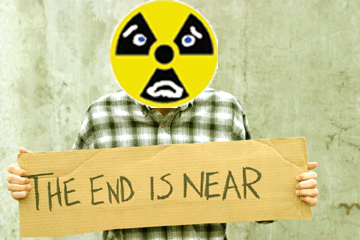 More disastrous news for the nuclear power industry. In 2017 alone:
– clear signs of a major nuclear slow-down in China – the last remaining hope for the industry.
– the US nuclear power industry is in the middle of a full-blown crisis
– a seriously anti-nuclear government has been elected in South Korea
– Taiwan has reaffirmed a nuclear phase-out by 2025
– the South African nuclear power program was ruled illegal by the High Court and probably won’t be revived
– Switzerland voted in a referendum to phase out nuclear power (while all of Germany’s reactors will be closed by the end of 2022 and all of Belgium’s will be closed by the end of 2025).
– huge problems in the UK and France
– India’s nuclear power program is going nowhere and the government has implicitly acknowledged that plans for French EPR reactors and US AP1000 reactors will likely be shelved
– Japan’s nuclear power program remains in a miserable state
– Russia’s Rosatom has acknowledged that the pipeline for new reactors is fast drying up
Meanwhile, the growth of renewables has been spectacular and will grow even faster over the coming years. Renewables will be producing 3 times as much electricity as nuclear power by 2022.
—————————————————————————————————————————
Nuclear power’s deepening crisis, Jim Green, 16 Oct 2017, www.onlineopinion.com.au/view.asp?article=19354&page=0
This year has been catastrophic for nuclear power and just when it seemed the situation couldn’t get any worse for the industry, it did. There are clear signs of a nuclear slow-down in China, the only country with a large nuclear new-build program.
China’s nuclear slow-down is addressed in the latest World Nuclear Industry Status Report and also in an August 2017 article by former World Nuclear Association executive Steve Kidd. China’s nuclear program “has continued to slow sharply”, Kidd writes, with the most striking feature being the paucity of approvals for new reactors over the past 18 months. China Nuclear Engineering Corp., the country’s leading nuclear construction firm, noted earlier this year that the “Chinese nuclear industry has stepped into a declining cycle” because the “State Council approved very few new-build projects in the past years”.
Kidd continues: “Other signs of trouble are the uncertainties about the type of reactor to be utilised in the future, the position of the power market in China, the structure of the industry with its large state owned enterprises (SOEs), the degree of support from top state planners and public opposition to nuclear plans.”
Over-supply has worsened in some regions and there are questions about how many reactors are needed to satisfy power demand. Kidd writes: “[T]he slowing Chinese economy, the switch to less energy-intensive activities, and over-investment in power generation means that generation capacity outweighs grid capacity in some provinces and companies are fighting to export power from their plants.”
Kidd estimates that China’s nuclear capacity will be around 100 gigawatts (GW) by 2030, well below previous expectations. Forecasts of 200 GW by 2030, “not unusual only a few years ago, now seem very wide of the mark.” And even the 100 GW estimate is stretching credulity ‒nuclear capacity will be around 50 GW in 2020 and a doubling of that capacity by 2030 won’t happen if the current slow-down sets in.
Kidd states that nuclear power in China may become “a last resort, rather as it is throughout most of the world.” The growth of wind and solar “dwarfs” new nuclear, he writes, and the hydro power program “is still enormous.”
Chinese government agencies note that in the first half of 2017, renewables accounted for 70% of new capacity added (a sharp increase from the figure of 52% in calendar 2016), thermal sources (mainly coal) 28% and nuclear just 2%. Earlier this month, Beijing announced plans to stop or delay work on 95 GW of planned and under-construction coal-fired power plants, so the 70% renewables figure is set for a healthy boost.
Crisis in the US
The plan to build two AP1000 reactors in South Carolina ‒ abandoned in July after A$11.5 ‒ 13.3 billion was spent on the partially-built reactors ‒ is now the subject of multiple lawsuits and investigations including criminal probes. Westinghouse, the lead contractor, filed for bankruptcy protection in March. Westinghouse’s parent company Toshiba is selling its most profitable business (memory chips) to stave off bankruptcy.
The cost of the two reactors in South Carolina was estimated at A$12.4 billion in 2008 and the latest estimate ‒ provided after the decision to abandon the project ‒ was A$31.6 billion. Cost increases of that scale are the new norm for nuclear. Cost estimates for two French reactors under construction in France and Finland have tripled.
Pro-nuclear commentator Dan Yurman discussed the implications of the decision to abandon the VC Summer project in South Carolina in a September 11 post:
“It is the failure of one of the largest capital construction projects in the US Every time another newspaper headline appears about what went wrong at the VC Summer project, the dark implications of what it all means for the future of the nuclear energy industry get all the more foreboding. … Now instead of looking forward to a triumph for completion of two massive nuclear reactors generating 2300 MW of CO2 emission free electricity, the nation will get endless political fallout, and lawsuits, which will dominate the complex contractual debris, left behind like storm damage from a hurricane, for years to come.”
The only other nuclear new-build project in the US ‒ two partially-built AP1000 reactors in Georgia ‒ is hanging on by a thread. Georgia’s Public Service Commission is reviewing a proposal to proceed with the reactors despite the bankruptcy filing of the lead contractor (Westinghouse), lengthy delays (5.5 years behind schedule) and a doubling of the cost estimate (the original estimate was A$17.9 billion and the latest estimates range from A$32.5 ‒ 38.4 billion for the two reactors).
No other reactors are under construction in the US and there is no likelihood of any construction starts in the foreseeable future. The US reactor fleet is one of the oldest in the world ‒ 44 out of 99 reactors have been operating for 40 years or more ‒ so decline is certain. Six reactors have been shut down in the US over the past five years and many others are on the chopping block.
Indicative of their desperation, some nuclear advocates in the US (and to a lesser extent the UK) are openly acknowledging the contribution of nuclear power (and the civil nuclear fuel cycle) to the production of nuclear weapons and using that as an argument to sharply increase the massive subsidies the nuclear power industry already receives. That’s a sharp reversal from their usual furious denial of any connections between the ‘peaceful atom’ and the proliferation of Weapons of Mass Destruction.
Global downturn
Elsewhere, the nuclear industry is in deep malaise and has suffered any number of set-backs this year. Pro-nuclear lobby groups are warning about nuclear power’s “rapidly accelerating crisis“, a “crisis that threatens the death of nuclear energy in the West“, and noting that “the industry is on life support in the United States and other developed economies“.
The French nuclear industry is in its “worst situation ever” according to former EDF director Gérard Magnin. The only reactor under construction in France is six years behind schedule, the estimated cost has escalated from A$5 billion to A$16 billion, and the regulator recently announced that the pressure vessel head of the reactor will need to be replaced by 2024 following a long-running quality-control scandal. The two French nuclear utilities face crippling debts (A$56.5 billion in the case of EDF) and astronomical costs (up to A$151 billion to upgrade ageing reactors, for example), and survive only because of repeated government bailouts.
In South Africa, a High Court judgement on April 26 ruled that much of the country’s nuclear new-build program is without legal foundation. There is little likelihood that the program will be revived given that it is shrouded in corruption scandals and President Jacob Zuma will leave office in 2019 (if he isn’t ousted earlier).
Public support for South Korea’s nuclear power program has been in free-fall in recent years, in part due to a corruption scandal. Incoming President Moon Jae-in said on June 19 that his government will halt plans to build new nuclear power plants and will not extend the lifespan of existing plants beyond 40 years.
In June, Taiwan’s Cabinet reiterated the government’s resolve to phase out nuclear power by 2025.
In the UK, nuclear industry lobbyist Tim Yeo says the compounding problems facing the industry “add up to something of a crisis for the UK’s nuclear new-build programme.” The estimated cost of the only two reactors under construction was recently increased to A$46.2 billion (A$23.1 billion each) and they are eight years behind schedule.
India’s nuclear industry keeps promising the world and delivering very little ‒ nuclear capacity is 6.2 GW and nuclear power accounted for 3.4% of the country’s electricity generation last year.
In Japan, Fukushima clean-up and compensation cost estimates have doubled and doubled again and now stand at A$245 billion. Only five reactors are operating in Japan, compared to 54 before the March 2011 Fukushima disaster.
In Russia, Rosatom’s deputy general director Vyacheslav Pershukov said in June that the world market for new nuclear power plants is shrinking, and the possibilities for building new large reactors abroad are almost exhausted. He said Rosatom expects to be able to find customers for new reactors until 2020-2025 but “it will be hard to continue.”
In Switzerland, voters supported a May 21 referendum on a package of energy policy measures including a ban on new nuclear power reactors. Thus Switzerland has opted for a gradual nuclear phase-out and all reactors will probably be closed by the early 2030s, if not earlier (while all of Germany’s reactors will be closed by the end of 2022 and all of Belgium’s will be closed by the end of 2025).
Globally, the industry’s biggest problem is the ageing of the current fleet of reactors. The International Atomic Energy Agency (IAEA) estimates that just to maintain current capacity of 392 GW, about 320 new reactors (320 GW) would have to be built by 2050 to replace retired reactors. That’s 10 new reactors each year. A nuclear ‘renaissance’ has supposedly been underway over the past decade yet on average only five reactors have come online each year.
Comparison with renewables
The IAEA has released the 2017 edition of its International Status and Prospects for Nuclear Power report series. It states that the share of nuclear power in total global electricity generation has decreased for 10 years in a row, to under 11% in 2015, yet “this still corresponds to nearly a third of the world’s low carbon electricity production.” In other words, renewables (24.5%) generate more than twice as much electricity as nuclear power (10.5%) and the gap is growing rapidly.
Five years from now, renewables will likely be generating three times as much electricity as nuclear reactors. The International Energy Agency (IEA ‒ not to be confused with the IAEA) recently released a five-year global forecast for renewables, predicting capacity growth of 43% (920 GW) by 2022. The latest forecast is a “significant upwards revision” from last year’s forecast, the IEA states, largely driven by expected solar power growth in China and India.
The IEA forecasts that the share of renewables in global power generation will reach 30% in 2022, up from 24% in 2016. By 2022, nuclear’s share will be around 10% and renewables will be out-generating nuclear by a factor of three. Non-hydro renewable electricity generation has grown eight-fold over the past decade and will probably surpass nuclear by 2022, or shortly thereafter, then leave nuclear power in its wake as renewables expand and the ageing nuclear fleet atrophies.
Japan: Disturbing Plutonium Exposure Accident
Several black lumps fell onto the floor in Room 108, from which a maximum of 55 Bq/cm2 were detected. The facility management supervisor instructed that a greenhouse (a temporary enclosure to implement detection and decontamination when retreating from the contaminated area) be set up at 11:54, and it is reported that this was completed at 14:29. More than three hours passed between the time of the accident and the time when the five task personnel exited the greenhouse. Concerning the delay in setting up the greenhouse, JAEA explained to NRA that “(The delay occurred because) the main work personnel in the Fuel Research Building were carrying out this work and other staff were engaged in stabilizing procedures for nuclear fuel materials (and could not leave their positions).”
As a result of a nasal smear (to detect contamination in the nostrils) taken inside the greenhouse, contamination of a maximum of 24 Bq (α radiation) was detected in the nostrils of three of the five personnel.
The five task personnel finally exited the controlled area at 18:55. Since α radiation had been detected in their nostrils and there was a strong possibility that the five people had inhaled plutonium, they were transported to the Nuclear Fuel Cycle Engineering Labs in Tokai Village, where measurement of plutonium inside their lungs was carried out using a lung monitor. Lung monitors detect the weak X-rays emitted by plutonium-239 and the gamma radiation emitted from americium-241 inside the lungs from outside the body. However, not only is this detection extremely difficult, it has poor sensitivity. The JAEA measurement results are shown in Table 2. [on original]………
Kobe Steel Scandal Grows to Include Subsidiaries, 500 Firms Hit by Cheating Scandal

Kobe Steel Scandal Grows to Include Subsidiaries

500 firms hit by cheating scandal: Kobe Steel CEO
Kobe Steel discloses 9 more cases of faked inspection data

Japan’s quiet payouts to cities near nuclear plants fuels speculation of political ploy

South Korea: thyroid cancer patients say no to nuclear power plants
 Thyroid cancer patients say no to nuclear power plants http://m.koreatimes.co.kr/phone/news/view.jsp?req_newsidx=237600
  By Kim Se-jeong, 12 Oct 17,
They also asked the government to help them cope with their ordeals. Their calls came while the public debate on the construction of two Shin-Kori reactors is at its peak.
“Nuclear power plants are government projects,” a group of thyroid cancer patients and activists said in a press conference at the National Assembly, Wednesday. “We have contributed to the national growth by enduring many side effects of nuclear power plants. Now that we’re sick, we’re left to fight for survival alone.”
There are two ongoing lawsuits raised by the thyroid patients against Korea Hydro & Nuclear Power Co., the operator of the nuclear power plants, and Wednesday’s calls also meant to push the courts which are expected to deliver verdicts within this year.
One was filed in 2012 by a family of three ― a father, mother and son suffering colorectal cancer, thyroid cancer and a developmental disability, respectively. The lower court ruled partially in favor of the family, stating thyroid cancer had been caused by exposure to radioactive iodine from the power plant. The case is currently being reviewed by an appeals court.
The other lawsuit was filed in 2015 by 618 thyroid patients against the operator, demanding recognition and compensation. The patients are awaiting a verdict. What they want from the government are the following. For long-term action, they want no nuclear power plants so there will be no more such patients in Korea,” said Choi Soo-young, a Korean Federation for Environmental Movement activist. “For a short-term solution, they want to relocate themselves and want the government to pay for it.”
Exposure to radioactive iodine is one of the main causes of thyroid cancer.
A couple of epidemiological surveys in Korea have also found a high number of thyroid cancer patients in the areas close to nuclear power plants in Korea. Yet, the KHNP disputed this, saying the high number was a result of overtreatment.
Korea’s 24 nuclear power plants generate almost 30 percent of the nation’s electricity. Eighteen of them are concentrated in the southeastern region of Busan, Ulsan and Gyeongju.
“We want our voices to be heard by the group of citizens who are debating the new nuclear power plant construction. No more new nuclear power plants should be allowed,” Choi said. The group of almost 500 citizens is starting the three-day major debate on Friday in the final phase of the three-month-long debate. A decision on whether to resume the construction of the Shin-Kori reactors is expected on Oct. 20.
THE UNITED Arab Emirates (UAE) to sever ties with North Korea
UAE severs North Korea ties over nuclear & missile threats – thousands of workers at risk THE UNITED Arab Emirates (UAE) has announced plans to cut ties with North Korea amid international outrage at Pyongyang’s nuclear and missile programmes. By WILL KIRBY, orth Korea’s ambassador in the country has been told to leave and the UAE will terminate its own envoy’s services in Pyongyang, according to a statement from the Foreign Ministry.
The statement also said the UAE will stop issuing new visas or company licenses to North Korean citizens.
Several thousand North Korean workers live in the country, with many working on construction sites.
They earn a significantly better wage than they would for the same job in their own country, but are forced to make so-called “loyalty payments” to Kim Jong-un’s regime…….
The measures taken by the UAE come after President Trump urged United Nations members to ramp up pressure on the hermit state to give up its nuclear weapons.
The UAE foreign ministry statement reads: “The measures… come within the context of its obligation as a responsible member of the international community to strengthen the international will and to stop the proliferation of nuclear weapons and missile programs.”
The announcement follows similar moves by the UAE’s Gulf Arab neighbours Qatar and Kuwait, which last month downgraded their ties with Pyongyang and stopped issuing new visas to North Korean citizens……. http://www.express.co.uk/news/world/865707/north-korea-news-latest-uae-visa-attack-nuclear-missile-strike-war-united-arab-emirates
Earthquake hits area near to North Korea’s nuclear test site
North Korea earthquake hits near nuclear test site THE AUSTRALIAN, 13 Oct 17 A series of tremors and landslides near North Korea’s nuclear test base probably mean the country’s sixth and largest blast has destabilised the region, and the Punggye-ri nuclear site may not be used for much longer to test nuclear weapons, experts say.
A small quake was detected early today near the North’s nuclear test site, South Korea’s weather agency said, but unlike quakes associated with nuclear tests, it did not appear to be man-made.
The tremor was the latest in a string of at least three shocks to be observed since Pyongyang’s September 3 nuclear test, which caused a 6.3 magnitude earthquake.
Today’s quake was a magnitude 2.7 with a depth of 3km in North Hamgyong Province in North Korea, the Korea Meteorological Administration said. The United States Geological Survey measured the quake at 2.9 magnitude at a depth of 5km.
“This event occurred in the area of the previous North Korean nuclear tests. The event has earthquake-like characteristics, however, we cannot conclusively confirm at this time the nature (natural or human-made) of the event,” the US agency said.
But the Korea Meteorological Administration in the South said on its website that “analysis shows it was a natural quake”. “It is believed to have caused no damage,” it added.
The series of quakes has prompted experts and observers to suspect the last test – which the North claimed to be of a hydrogen bomb – may have damaged the mountainous location in the northwest tip of the country, where all of North Korea’s six nuclear tests were conducted.
“The explosion from the September 3 test had such power that the existing tunnels within the underground testing site might have caved in,” said Kim So- gu, head researcher at the Korea Seismological Institute.
“I think the Punggye-ri region is now pretty saturated. If it goes ahead with another test in this area, it could risk radioactive pollution.”
According to 38 North, a Washington-based project that monitors North Korea, numerous landslides throughout the nuclear test site have been detected via satellite images after the sixth test. These disturbances are more numerous and widespread than seen after any of the North’s previous tests, 38 North said.
The explosion from the sixth test was large enough for residents of the Chinese border city of Yanji, 200km north of North Korea’s nuclear test site, to feel the ground shake beneath their feet.
“The reason why Punggye-ri has become North Korea’s nuclear testing field is because this area was considered stable and rarely saw tremors in the past,” said Hong Tae-kyung, a professor of earth system science at Yonsei University in Seoul.
“The recent small quakes suggest that the test might have triggered crust deformation.” South Korea’s spy agency said recently the North was readying possibly two more tunnels following its latest test, according to ruling Democratic Party members who had been briefed on the issue…..http://www.theaustralian.com.au/news/world/north-korea-earthquake-hits-near-nuclear-test-site/news-story/be93e835ed073f95743d480f98c772db
1 This Month




PLEASE OPPOSE HR 8255 AND S.3639 – bills would accelerate satellite deployment, with no environmental review or safeguards – https://ncstd5li.quorum.us/campaign/169331/
To see nuclear-related stories in greater depth and intensity – go to https://nuclearinformation.wordpress.com
-
Archives
- September 2026 (323)
- August 2026 (330)
- July 2026 (355)
- June 2026 (287)
- May 2026 (306)
- April 2026 (356)
- March 2026 (251)
- February 2026 (267)
- January 2026 (308)
- December 2025 (358)
- November 2025 (359)
- October 2025 (375)
-
Categories
- 1
- 1 NUCLEAR ISSUES
- business and costs
- climate change
- culture and arts
- ENERGY
- environment
- health
- history
- indigenous issues
- Legal
- marketing of nuclear
- media
- opposition to nuclear
- PERSONAL STORIES
- politics
- politics international
- Religion and ethics
- safety
- secrets,lies and civil liberties
- spinbuster
- technology
- Uranium
- wastes
- weapons and war
- Women
- 2 WORLD
- ACTION
- AFRICA
- Atrocities
- AUSTRALIA
- Christina's notes
- Christina's themes
- culture and arts
- Events
- Fuk 2022
- Fuk 2023
- Fukushima 2017
- Fukushima 2018
- fukushima 2019
- Fukushima 2020
- Fukushima 2021
- general
- global warming
- Humour (God we need it)
- Nuclear
- RARE EARTHS
- Reference
- resources – print
- Resources -audiovicual
- Weekly Newsletter
- World
- World Nuclear
- YouTube
-
RSS
Entries RSS
Comments RSS

