North Korea is often righteously condemned for being the only nation to have conducted five nuclear tests and a barrage of missile tests in the 21st century. Led by a young chubby dictator with a bad haircut, we have long been told that the paranoid hermit kingdom known for its undeniably bombastic, intensely patriotic and anachronistic rhetoric is evil, unhinged and dangerous.
While not to advocate for family dynastic rule in any way, the way in which North Korea has been mediated for mainstream audiences in advanced industrial democratic countries over decades demonstrates a consistent narrative pattern of Orientalist imagery that play on variants of immaturity, cunning and treachery in a legacy going back to Fu Manchu. Complexities tend to be reduced to a simplistic ‘us or them’ binary and seem to trigger intuitive reactions hard-wired by more than enough movies and sensationalist media journalism. No further discussion or reading required.
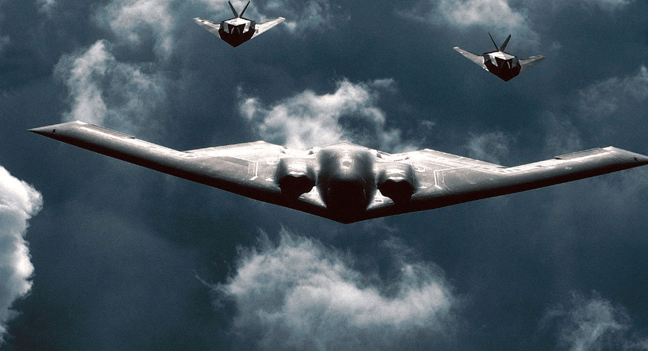
In the significant amount of digital space recently awarded to speculation on North Korea’s purported nuclear-capable ICBM tests on 4 and 28 July that could strike parts of continental U.S.A., few mainstream media reports bothered to include that since May 2017 the U.S. military tested 4 ICBMs from Vandenberg Air Force base to Kwajalein Atoll and conducted 11-12 drills over the Korean peninsula involving B-1B, B-2 and B-52 bombers (the latter two are nuclear capable). The current Ulchi Freedom Guardian reiteration on 21-31 August 2017 and the previous Foal Eagle Key Resolve operation involving 67,000 troops in March 2017 are based on years of biannual U.S.-ROK military drills, giving substance to the recent statement by Secretary of Defense James Mattis: “combined allied militaries now possess the most precise, rehearsed and robust defensive and offensive capabilities on Earth.”
Certainly, North Korea staged the longer reach of a new Hwasong-14 missile which demonstrated staged rocketry, better re-entry cladding and guidance systems. Yet we were expected to take at face-value a Washington Postreport of claims by unnamed US Defense Intelligence Agency officials that North Korea had achieved sufficient warhead miniaturisation to fit on ICBMs. This was supposed to support US President Trump’s apparently unprompted threat of ‘fire and fury the likes of which the world has never seen’, holding much of the population of North Korea hostage as he sat down to lunch. Yet days earlier Senator Lindsey Graham had stated that he had discussed a plan with the President to “destroy the North Korean nuclear program and North Korea itself”. Moreover, National Security Adviser McMaster had already declared that United States could launch a ‘preventive war’ to prevent North Korea from attaining nuclear weapons cabability – a paradoxical pursuit if ever there was one.
Mainstream channels continued to interpret this ‘tough line’ corrective to the former Obama administration’s ‘strategic patience’, as necessary to force North Korea to the negotiating table. Incidentally, preventive war was the defence used by lawyers at the Nuremberg Trials in their attempt to justify Nazi Germany’s invasion of Poland.
In response, the North Korean Strategic Force stated that it was calculating an operational plan to create an ‘enveloping fire’ with 4 IRBM (Hwasong-12) missiles in areas 30-40 km off Guam which had to be approved by leader Kim Jong-un. Subsequently Kim suspended the operation for the meantime. Clearly intended to demonstrate credible intention to strike Guam’s huge U.S. naval and airforce installations from where pre-emptive strikes could be launched and which include 8,000 U.S. troops, anti-ballistic missile defence systems, and signals intelligence infrastructure, this was aimed at military targets. Media reports did not emphasise this point, ignoring the North Korean caveat that this launch would be a warning not an attack. It remains unclear whether or not the IRBMs would be nuclear-tipped. The Foreign Minister Ri Yong-ho at the recent ASEAN meeting stated that North Korea was not prepared to negotiate with its nuclear weapons and ballistic rockets unless “the hostile policy and nuclear threat of the U.S. against the DPRK are fundamentally eliminated”. The Korean People’s Army (KPA) listed U.S. hostile actions as: ‘decapitation operations’ and ‘pre-emptive’ attack (as rehearsed in U.S.-ROK drills); ‘preventive war’; and/or ‘secret operations’ for stealthy regime change (CIA coordinated Special Operations).
While indicating its preference for de-escalation and negotations toward de-nuclearisation of the Korean peninsula, China declared it would defend North Korea if it was pre-emptively attacked by the United States and it would not do so if North Korea struck first. Determining who exactly fired first may be difficult, however, if it was a matter of minutes between detection of a pre-emptive attack (such as B-1B bombers firing missiles at distance) and North Korea launching conventional attacks on U.S. bases in South Korea and IRBM missiles to Guam (nuclear or non-nuclear).
From a North Korean strategic perspective informed by decades of various forms of hostility from the U.S. and some of its allies including the refusal to negotiate and preparations for regime change, such missile capability would seem to provide a desperately needed means of self-defence. In fact, with regard to these latest U.S. nuclear threats listed above (which are not new), North Korea could invoke Article 51 of the UN Charter which maintains the right to self-defence when a sovereign state is under direct attack by a foreign power. It could also invoke the Caroline standard of pre-emptive self-defence in the case of likely attack being ‘instant, overwhelming and without other means, and no moment for deliberation’.
As it would be suicidal for North Korea to provoke U.S.-led retaliation with a pre-emptive strike and considering its historical context, it is reasonable to see the North Korean nuclear program as intended to achieve a second-strike retaliatory capability. Although the U.S. would be unlikely to strike if China (and possibly Russia) was to intervene, North Korea would still seek such a deterrent as a means to negotiate its security terms with the United States and others and to protect its fundamental sovereignty which it regards under threat.
It has been official U.S. policy to refuse to countenance a North Korean nuclear weapons state and to negotiate with it on these terms which it now frames as threatening the lives of millions of ordinary Americans in continental U.S.A.. Yet U.S. leadership does not hesitate from threatening millions of lives in North Korea and on the Korean peninsula. This is not very strategic, as it undermines South Korean sovereign agency and perceptions of and trust in the U.S.-ROK alliance as a deterrent and to the contrary that it might drag the South Korean population into a destructive conflict.
In short, with China’s ‘dual suspension’ suggestion as the most sensible and statesman-like so far, North Korea conceivably would suspend its nuclear program in return for a freeze in U.S. military hostile actions to create the mechanism for direct negotiations to begin. North Korea would then seek an end to the Armistice Agreement of 1953, the terms of which the U.S. never honoured in full, and the establishment of a formal Peace Treaty. North Korea would also seek independent negotiations with South Korea for increased trade, exchange and communications.
Compared to the spike in stocks in Raytheon, Lockheed Martin, Northrop Grumman and Boeing and as some U.S. allies push for increased military spending, including anti-ballistic missile systems and ‘pre-emptive strike’ capabilities, the potential losses of millions of lives in a conventional and/or nuclear confrontation on the Korean peninsula and to the global economy in trade would not seem to be worth it. Diplomacy and dialogue between North Korea and the United States and/or other concerned parties toward demilitarisation and de-nuclearisation would seem the safest and cheapest form of defence to be investing in. Perhaps a normalised Korean peninsula which would benefit China’s economic plans, are what the U.S. and its allies fear most, and so they are starting fires to revivify a military containment policy.
Dr Adam Broinowski is a visiting research fellow and recent ARC DECRA fellow at the College of Asia and the Pacific, Australian National University. His research and teaching are in contemporary history, politics and society in Japan and Northeast Asia. He is the author of Cultural Responses to Occupation in Japan: The Performing Body during and after the Cold War (London and Sydney: Bloomsbury Academic, 2016).
Ambassador to U.K. Liu Xiaoming speaks in interview with ITV
China has “done everything” it can to resolve crisis
China’s Ambassador to the U.K. Liu Xiaoming says he’s “cautiously optimistic” that a diplomatic solution can be found to stop North Korea from developing further nuclear weaponry.
Liu, who was China’s ambassador to North Korea for more than three years, said that his government “had done everything” it could to persuade the country to halt its nuclear program. He spoke in a television interview with ITV.
“I am still cautiously optimistic,” Liu said in the interview that was broadcast on Sunday. “I still believe that if all parties engage with each other and we encourage North Korea to return to the negotiating table, we can still find a diplomatic solution to this problem.”
Chinese President Xi Jinping recently sent Song Tao, head of the Communist Party’s International Liaison Department, to North Korea a week after hosting U.S. President Donald Trump, stoking speculation that Song may carry a message from the Xi-Trump talks. South Korea’s Yonhap News Agency reported there was a good chance that the Chinese envoy would meet leader Kim Jong Un on Sunday, citing unidentified diplomats in Beijing.
Liu said Sunday that North Korea had “legitimate concerns” about trust and security and blamed South Korea’s close relationship with the U.S. as the “root cause” of the problem. While China “strictly abides” by United Nations sanctions against North Korea, resolutions must also be about negotiations, he told ITV.
Six Years After Fukushima, Robots Finally Find Reactors’ Melted Uranium The Japanese government and companies used radiation-hardened machines to search for the fuel that escaped the plant’s ruined reactors. By MARTIN FACKLER. NY Times 19 Nov 17 “……As officials became more confident about managing the disaster, they began a search for the missing fuel. Scientists and engineers built radiation-resistant robots like the Manbo and a device like a huge X-ray machine that uses exotic space particles called muons to see the reactors’ innards.
Now that engineers say they have found the fuel, officials of the government and the utility that runs the plant hope to sway public opinion. Six and a half years after the accident spewed radiation over northern Japan, and at one point seemed to endanger Tokyo, the officials hope to persuade a skeptical world that the plant has moved out of post-disaster crisis mode and into something much less threatening: cleanup……..
Tepco is keen to portray the plant as one big industrial cleanup site. About 7,000 people work here, building new water storage tanks, moving radioactive debris to a new disposal site, and erecting enormous scaffoldings over reactor buildings torn apart by the huge hydrogen explosions that occurred during the accident…….
The government admits that cleaning up the plant will take at least another three to four decades and tens of billions of dollars. A $100 million research center has been built nearby to help scientists and engineers develop a new generation of robots to enter the reactor buildings and scoop up the melted fuel.
At Chernobyl, the Soviets simply entombed the charred reactor in concrete after the deadly 1986 accident. But Japan has pledged to dismantle the Fukushima plant and decontaminate the surrounding countryside, which was home to about 160,000 people who were evacuated after accident.
Many of them have been allowed to return as the rural towns around the plant have been decontaminated. But without at least starting a cleanup of the plant itself, officials admit they will find it difficult to convince the public that the accident is truly over.
They also hope that beginning the cleanup will help them win the public’s consent to restart Japan’s undamaged nuclear plants, most of which remain shut down since the disaster……..
Engineers are developing the new radiation-resistant robots at the Naraha Remote Technology Development Center. It includes a hangar-sized building to hold full-scale mock-ups of the plant and a virtual-reality room that simulates the interiors of the reactor buildings, including locations of known debris.
Ultimately, the larger problem is that President Trump’s policy objectives are unattainable.
Denuclearization is a non-starter from North Korea’s perspective because Kim believes – not without reason – that nuclear weapons are a matter of regime survival, having seen what happens to leaders in countries like Libya when they give up their nuclear programs.
As long as President Trump insists on “complete, verifiable and total denuclearization,” Washington is walking America down a path that leads to (likely nuclear) military conflict
It would be both foolish and naïve to think that all the tough talk coming out of the Trump administration is simply meant to intimidate North Korean dictator Kim Jong Un into giving up his nuclear weapons and long-range missiles.
The three so-called “adults in the room” who are apparently the strongest voices influencing President Trump’s foreign policy are National Security Advisor H.R. McMaster, Secretary of Defense James Mattis and White House Chief of Staff John Kelly.
Mattis is an active duty lieutenant general in the Army. Mattis and Kelly are retired Marine Corps generals. Their common experience is commanding ground forces in the Iraq War. If they are shaping the Trump administration’s North Korea policy, it stands to reason that their views would have a decidedly military tilt.
If President Trump decides to take military action, what might it look like?
Any unprovoked U.S. military action would be a preventive strike. That is, a military strike intended to prevent North Korea from acquiring a future capability to attack the U.S. That is different from a preemptive strike that is launched to stop an imminent military attack from an adversary.
So what military options are truly available to President Trump?
Option 1: Preventive nuclear strikes.
It’s impossible to completely rule out the possibility – however remote – that the U.S. might use nuclear weapons in a preventive strike against North Korea.
If North Korea’s nuclear program and weapons are in deeply buried and hardened bunkers, nuclear weapons might be the only way to destroy them with a high rate of confidence. A relatively little-known fact is that the United States has a nuclear bunker buster: the B61-11 low- yield nuclear gravity bomb.
About 50 B61-11 bombs are believed to be deployed. Theoretically, the B61-11 could be mated with GPS guidance to make it a precision strike weapon. Also, the B61-11 could theoretically be outfitted with the BLU-113 hardened steel-tipped warhead to penetrate more than 30 feet of concrete.
But wouldn’t using nuclear weapons be beyond the pale?
Under ordinary circumstances, yes. But the Trump administration may not believe these are ordinary circumstances. If the administration assumes military conflict with North Korea is inevitable and views North Korea as 1945 Japan, the rationale would be very similar: Using nuclear weapons would bring about a quick resolution and would save thousands of lives that would otherwise be lost in a conventional conflict. As a point of reference, more than 30,000 U.S. soldiers died in the Korean War.
Needless to say, the nuclear option would be a big gamble. If we were not 100 percent successful, we would have to expect that North Korea would retaliate with its full range of conventional and nuclear weapons.
While the U.S. homeland would not be threatened, both South Korea and Japan would be. And the nearly 35,000 U.S. military personnel stationed in South Korea would certainly be at risk – as would the estimated 200,000 or more U.S. citizens living in South Korea.
Option 2: Decapitation strikes by bombers or submarines.
Another big gamble would be a decapitating air and missile strike. This would be military action based on the belief that if North Korea’s leadership – Kim Jong Un and his most loyal top military and civilian leaders – could be killed, the regime would implode and collapse.
Success would depend on near-perfect intelligence about all the targets’ whereabouts. Moreover, we would have to assume that many of them – including Kim himself – would be in deeply buried and hardened bunkers that would be difficult to destroy, even with precision conventional missiles and bombs.
And we know from experience that we were not able to immediately take out Saddam Hussein and the other 54 “most wanted Iraqis” when we invaded Iraq in 2003.
If a decapitating strike failed, we would have to assume that North Korea would retaliate and we would be drawn into a protracted ground war.
At a minimum, North Korea would likely unleash a conventional artillery barrage on Seoul, which has a population of 10 million. While such an attack might not level Seoul, it would still cause significant damage and extract untold casualties. Kim might launch his nuclear weapons, believing he had nothing to lose.
Option 3: Conventional ground attack with hundreds of thousands troops.
So that leaves a conventional ground attack, which would likely be preceded and backed up by air and missile strikes.
Given the experience of McMaster, Mattis, and Kelly – as well as the fact that the chairman of the Joint Chiefs of Staff, Gen. Joseph Dunford, is a Marine – such an option makes sense and seems more likely. After all, expeditionary war is exactly what these generals know how to do.
However, almost all the experts believe that any such war would be drawn out and costly –perhaps as many as 20,000 deaths per day in South Korea.
And remember, Kim Jong Un would have the nuclear option at his disposal, along with his chemical and biological weapons. Such is the risk of any military action against a nuclear-armed country.
Option 4: Deterrence.
But the U.S. does have another military option. It just doesn’t involve the actual use of military force. It’s called deterrence.
North Korea has had nuclear weapons for at least a decade and has not used them against either South Korea or Japan. Presumably this is because of the threat of a U.S. nuclear response looms over Pyongyang’s head. If that’s the case, even in the worst case scenario of North Korea having the ability to launch a missile at the continental United States, deterrence would still hold.
Deterrence worked when America and the Soviet Union had thousands of warheads pointed at each other. Supposedly crazy or irrational leaders with nuclear weapons – such as Josef Stalin in the Soviet Union and Mao Zedong in China – were successfully deterred.
Indeed, Kim Jong Un would have to be suicidal to actually attack the U.S., knowing that we could respond with utterly devastating force that could result in his death and the total annihilation of his country. However, the Kim dynasty has repeatedly demonstrated its larger interest is its own survival and perpetuating the regime.
Ultimately, the larger problem is that President Trump’s policy objectives are unattainable.
Denuclearization is a non-starter from North Korea’s perspective because Kim believes – not without reason – that nuclear weapons are a matter of regime survival, having seen what happens to leaders in countries like Libya when they give up their nuclear programs.
As long as President Trump insists on “complete, verifiable and total denuclearization,” Washington is walking America down a path that leads to (likely nuclear) military conflict
North Korea rejects Donald Trump’s call for nuclear talks, as images emerge of ‘ballistic submarine’ under construction, Telegraph, Reuters News Agency 17 NOVEMBER 2017
North Korea has rejected Donald Trump’s call for talks over its nuclear programme just days after the US president completed his high-profile to Asia.
Han Tae Song, North Korea’s ambassador to the United Nations in Geneva, said that negotiations would not happen while America continued “war games” in the region.
The snub occurred as new satellite images suggested North Korea is pursuing an “aggressive schedule” to build its first operational ballistic missile submarine.
The developments mark a double setback for Mr Trump, who is seeking a breakthrough in the stand-off over North Korea after rallying support for his approach in Asia.
However speaking to Reuters, Mr Han rejected the proposal and criticised America for carrying out joint military practices with South Korea.
“As long as there is continuous hostile policy against my country by the US and as long as there are continued war games at our doorstep, then there will not be negotiations,” Mr Han said.
“There are continued military exercises using nuclear assets as well as aircraft carriers, and strategic bombers and then…raising such kinds of military exercises against my country.”
Mr Han said North Korea’s nuclear programme was about protection, saying: “This is the deterrent, the nuclear deterrent to cope with the nuclear threat from America.”
He also claimed Mr Trump drive for tighter sanctions was to “overthrow” the regime by “isolating” it and creating a “humanitarian disaster”.
China has contested Mr Trump’s claim that a “freeze for freeze” proposal – where North Korea stops its nuclear development and America ends its military war games – was off the table.
China’s nuclear spaceships will be ‘mining asteroids and flying astronauts to the moon’ as it aims to overtake US in space race State media publishes Chinese scientists’ ambitious plans to revolutionise space travel and exploration in coming decades, South China Morning Post, Stephen Chen: Friday, 17 November, 2017 China is on course to develop nuclear-powered space shuttles by 2040, and will have the ability to mine resources from asteroids and build solar power plants in space soon after, according to state media. The ambitious claims, made by the China Academy of Launch Vehicle Technology – the country’s leading rocket developer and manufacturer – were published on the front page of People’s Daily on Friday.
According to the report, a new “nuclear fleet” of carrier rockets and reusable hybrid-power carriers will be ready for “regular, large scale” interplanetary flights, and carrying out commercial exploration and exploitation of natural resources by the mid-2040s.
China will catch up with the United States on conventional rocket technology by 2020, it said. In 2025, it is expected to launch a reusable suborbital carrier and start suborbital space tourism.
By 2030, it aims to put astronauts on the moon and have the capabilities to bring samples back from Mars. In the 2040s, a nuclear-powered fleet will be ready to carry out mining operations on asteroids and planets, the report said…..
“The nuclear vessels are built to colonise the solar system and beyond,” Wang Changhui, associate professor of aerospace propulsion at the School of Astronautics at Beihang University in Beijing, said…..
A nuclear spaceship would have a reactor loaded with radioactive fuel for fission – the splitting of atoms that produces large amounts of energy.
That energy could be used to generate a driving force as well as electricity for the craft’s on-board equipment….
During the cold war, dozens of satellites equipped with various types of nuclear reactors were launched by the former Soviet Union and the United States..
But the nuclear space race was eventually postponed, partly due to its threat to humanity. In 1978, Russian spy satellite Kosmos 954 crashed and sprayed radioactive waste over an area of 124,000 square kilometres in Canada.
More than 30 dead nuclear satellites are still drifting in space and could fall to earth at any time over the next few thousand years.
“Safety issues will be the top challenge for the Chinese nuclear fleet,” Wang said. “If they come down, it will cause a global nuclear disaster.”
According to China’s space authorities, the nuclear shuttles would be docked at a transport hub that would orbit the earth. Reusable spacecraft would be used to transport people and cargo to and from the shuttles.
But even if they were permanently in space, the nuclear-powered vessels were still at risk of being hit by meteorites or even colliding with one another, Wang said.
Japan Atomic Power in dire straits after diverting funds, Asahi Shimbun, By TSUNEO SASAI/ Staff Writer, November 17, 2017
Japan Atomic Power Co. has diverted so much of its decommissioning funds to build new reactors that it now lacks enough cash to scrap its aging units or even resume operations of existing ones. The problem-plagued company is banking on a decision by the Nuclear Regulation Authority, but even that might not be sufficient to save it financially.
The Ministry of Economy, Trade and Industry requires nuclear power plant operators to accumulate decommissioning funds every year based on their estimated costs to scrap reactors.
The ministry’s guidelines, however, do not prohibit the companies from temporarily using the accumulated money for other purposes.
According to calculations, Japan Atomic Power should have saved around 180 billion yen ($1.6 billion) to decommission its four nuclear reactors. The company declined to give details about how much of decommissioning fund was used for other purposes. However, a person familiar with the situation said the operator “diverted the majority.”
That leaves Japan Atomic Power without the necessary funds to carry out its plans to decommission its one-reactor Tokai nuclear plant in Ibaraki Prefecture, and the No. 1 reactor at its Tsuruga nuclear plant in Fukui Prefecture.
The company’s two other reactors–the reactor at the Tokai No. 2 nuclear plant and the No. 2 reactor at the Tsuruga plant–are off-line. To survive the financial crunch, Japan Atomic Power will soon apply to the NRA to extend the operating life of the idled Tokai No. 2 nuclear plant reactor. That reactor will reach its 40th year of operation in November 2018. Even if the NRA approves the 20-year extension, the company does not have the 174 billion yen needed to improve safety measures at the reactor to bring it online.
An active geological fault line was found running directly beneath the No. 2 reactor building at the Tsuruga nuclear plant, meaning a resumption of reactor operations there is nowhere in sight.
Japan Atomic Power decided to use decommissioning funds to cover costs to build the Tsuruga No. 3 and No. 4 reactors in a bid to curb borrowing from financial institutions, according to several sources.
However, that decision was made before disaster struck at the Fukushima No. 1 nuclear power plant in March 2011.
Continuing Conflict S. Korean Gov’t Stops Virtually Construction of New Nuclear Power Plants Seoul, Korea, Business Korea, 17 November 2017 , Choi Mun-hee
Korea Hydro & Nuclear Power (KHNP) held a board meeting on November 16 and decided to stop the construction of the third and fourth units of the Shin Hanul Nuclear Power Plant and the first and second units of the Cheonji Nuclear Power Plant. Controversies are likely to continue with hundreds of billions of won already invested in the construction projects and the government having yet to prepare a plan for compensation.
Those in favor of the construction of the nuclear power plants are claiming that nuclear power plants are safe tools for power generation as seen in the case of those that endured the magnitude 5.4 earthquake in Pohang on November 15. Those opposed to the construction are claiming that South Korea is not an earthquake-free zone and, as such, no more nuclear power plant should be allowed.
The Joint Action for a Nuclear Free Society, which is a local environmental group, held a press conference in Seoul on November 16. “Both the earthquake in Gyeongju last year and the recent earthquake in Pohang occurred in the Yangsan fault zone in the southeastern region of the Korean Peninsula and the latter’s epicenter was shallower and the latter caused more damage although the former had a larger magnitude,” it said, adding, “At present, a total of 18 nuclear power plants are in operation and five are under construction in the southeastern region of the peninsula including Gyeongju, Busan, and Ulsan, where big earthquakes have occurred one after another, and the operation of the power plants should be stopped and safety measures should be prepared immediately.”…… http://www.businesskorea.co.kr/english/news/national/19848-continuing-conflict-s-korean-gov%E2%80%99t-stops-virtually-construction-new-nuclear
Environmental groups that support the current administration’s nuclear energy phaseout policy have based their arguments on the potential dangers posed by natural disasters like earthquakes.
In a statement made yesterday, the Korean Federation for Environmental Movement reiterated the need to scale back nuclear energy operations in southeastern Korea, saying, “On the heels of the Gyeongju earthquake last year, there has been a quake on the Yansan fault line.”
Last September’s 5.8-magnitude earthquake in Gyeongju was the most powerful recorded in South Korean history. With the November 15 earthquake in nearby Pohang, only about 20 km away, the Yeongnam region has seen record-setting natural disasters in successive years.
A U.N. body has called on Japan to take steps to better protect press freedoms as concerns about the country’s laws aimed at curtailing leaks of state secrets could hinder the work of journalists.
In another of the 218 non-legally binding recommendations on Japan’s human rights record released by the U.N. Human Rights Council’s working group, Tokyo was urged to apologize and pay compensation to “comfort women” forced to work in Japan’s World War II military brothels.
The recommendations reflected the views of some 105 countries. Of the issues raised, the U.N. council will adopt those that have been accepted by the country in question at a plenary session around March 2018.
In relation to freedom of the press in Japan, the recommendation called on the country to amend Article 4 of the broadcasting law that gives the government authority to suspend broadcasting licenses of TV stations not considered “politically fair.”
Japan had already attracted criticism, in particular from David Kaye, U.N. special rapporteur on the right to freedom of opinion and expression, over its law called the Act on the Protection of Specially Designated Secrets, which came into force in 2014.
Under the law, civil servants or others who leak designated secrets could face up to 10 years in prison, and those who instigate leaks, including journalists, could be subject to prison terms of up to five years.
In his report, Kaye noted that the law may be arbitrarily enforced as subcategories under which information may be designated as secret are “overly broad.”
On the issue of “comfort women,” raised at the request of South Korea and China, the recommendation urged Japan to promote fair and accurate historical education, including the women’s stories, and to apologize and compensate victims.
The recommendation also said Japan should abolish or suspend the death penalty, reflecting calls from European Union countries, and continue to provide support to those affected by the Fukushima nuclear crisis caused by the massive 2011 earthquake and tsunami. In particular, a directive to address health issues faced by pregnant mothers and children was noted.
The U.N. Rights Council is mandated to “undertake a universal periodic review” of whether countries are meeting their human rights obligations and commitments.
The examination is conducted on all 193 members of the United Nations in periodic cycles of a few years. The latest review was the third for Japan.
In a show of power, Japan, US begin joint naval drills off Korean Peninsula Trump’s harsh rhetoric, coupled with the North Korean regime’s ongoing weapons tests, have escalated regional tension to unprecedented levels
IANS | Tokyo Business Standard, November 16, 2017Japan and the US on Thursday began joint naval drills south of the Korean Peninsula in a show of power against North Korea.
The US sent its nuclear-powered aircraft carrier Ronald Reagan, three destroyers and around 14,000 troops to participate in the drills that will be conducted until November 26 in waters near the Okinawa archipelago, the US Navy said in a statement cited by Efe news.
North Korea nuclear crisis: Japan bracing itself for influx of evacuees if war erupts
Coast Guard readies plans to escort boats from peninsula to designated ports as brinkmanship continues between Pyongyang and Washington The Independent, 16 Nov 17 Japan is studying plans to cope with an influx of perhaps tens of thousands of North Korean evacuees if a military or other crisis breaks out on the peninsula, including ways to weed out spies and terrorists, a domestic newspaper said.
The Japan Coast Guard would escort boats fleeing North Korea to designated ports, where police would screen them by checking their identity and possible criminal records and expel those deemed a threat, The Yomiuri newspaper said on Thursday.
It did not say where those people would be sent, however.
Evacuees granted temporary entrance would be transferred to emergency detention centres, probably in southern Japan, after completing quarantine and other procedures.
Officials would then decide whether they were eligible to remain in Japan, The Yomiuri said.
Regional tension over Pyongyang’s missile and nuclear arms programmes remain high.
The United States and its allies continue to cajole and threaten North Korea to negotiate an agreement that would relinquish its growing nuclear and ballistic-missile Staff – By Ted Galen Carpenter
The United States and its allies continue to cajole and threaten North Korea to negotiate an agreement that would relinquish its growing nuclear and ballistic-missile programs. The latest verbal prodding came from President Trump during his joint press conference with South Korean president Moon Jae-in. Trump urged[3] Pyongyang to “come to the negotiating table,” and asserted that it “makes sense for North Korea to do the right thing.” The “right thing” Trump and his predecessors have always maintained, is for North Korea to become nonnuclear.
It is unlikely that the DPRK will ever return to nuclear virginity. Pyongyang has multiple reasons for retaining its nukes. For a country with an economy roughly the size of Paraguay’s, a bizarre political system that has no external appeal, and an increasingly antiquated conventional military force, a nuclear-weapons capability is the sole factor that provides prestige and a seat at the table of international affairs. There is one other crucial reason for the DPRK’s truculence, though. North Korean leaders simply do not trust the United States to honor any agreement that might be reached.
Unfortunately, there are ample reasons for such distrust. North Korean leaders have witnessed how the United States treats nonnuclear adversaries such as Serbia[4] andIraq[5]. But it was the U.S.-led intervention in Libya in 2011 that underscored to Pyongyang why achieving and retaining a nuclear-weapons capability might be the only reliable way to prevent a regime-change war directed against the DPRK.
Partially in response to Washington’s war that ousted Iraqi dictator Saddam Hussein in the spring of 2003, ostensibly because of a threat posed by Baghdad’s “weapons of mass destruction,” Libyan leader Muammar el-Qaddafi seemed to capitulate regarding such matters. He reconfirmed his country’s adherence to the Nuclear Nonproliferation Treaty in December of that year and agreed to abandon his country’s embryonic nuclear program. In exchange, the United States and its allies lifted economic sanctions and pledged that they no longer sought to isolate Libya. Qaddafi was welcomed back into the international community once he relinquished his nuclear ambitions.
That reconciliation lasted less than a decade. When one of the periodic domestic revolts against Qaddafi’s rule erupted again in 2011, Washington and its NATO partners argued that a humanitarian catastrophe was imminent (despite meager evidence[6] of that scenario), and initiated a military intervention. It soon became apparent that the official justification to protect innocent civilians was a cynical pretext, and that another regime-change war was underway. The Western powers launched devastating air strikes and cruise-missile attacks against Libyan government forces. NATO also armed rebel units and assisted the insurgency in other ways.
Although all previous revolts had fizzled, extensive Western military involvement produced a very different result this time. The insurgents not only overthrew Qaddafi, they captured, tortured and executed him in an especially grisly fashion. Washington’s response was astonishingly flippant. Secretary of State Hillary Clinton quipped[7]: “We came, we saw, he died.”
The behavior of Washington and its allies in Libya certainly did not give any incentive to North Korea or other would-be nuclear powers to abandon such ambitions in exchange for U.S. paper promises[8] for normal relations. Indeed, North Korea promptly cited the Libya episode as a reason why it needed a deterrent capability—a point that Pyongyang has reiterated several times in the years since Muammar el-Qaddafi ouster. There is little doubt that the West’s betrayal of Qaddafi has made an agreement with the DPRK to denuclearize even less[9] attainable[10] than it might have been otherwise. Even some U.S. officials concede[11] that the Libya episode convinced North Korean leaders that nuclear weapons were necessary for regime survival.
The foundation for successful diplomacy is a country’s reputation for credibility and reliability. U.S. leaders fret that autocratic regimes—such as those in Iran and North Korea—might well violate agreements they sign. There are legitimate reasons for wariness, although in Iran’s case, the government appears to be complying[12] with its obligations under the Joint Comprehensive Plan of Action that Tehran signed with the United States and other major powers in 2015—despite allegations from U.S. hawks about violations.
When it comes to problems with credibility, though, U.S. leaders also need to look in the mirror. Washington’s conduct in Libya was a case of brazen duplicity. It is hardly a surprise if North Korea (or other countries) now regard the United States as an untrustworthy negotiating partner. Because of Pyongyang’s other reasons for wanting a nuclear capability, a denuclearization accord was always a long shot. But U.S. actions in Libya reduced prospects to the vanishing point. American leaders have only themselves to blame for that situation.
Ted Galen Carpenter, a senior fellow in defense and foreign-policy studies at the Cato Institute and a contributing editor at the National Interest, is the author or coauthor of ten books, including The Korean Conundrum: America’s Troubled Relations with North and South Korea[13]. He also is the author of more than seven hundred articles and policy studies on international affairs.
China will send a high-level diplomatic envoy to North Korea, Business Insider, Michael Martina and Ben Blanchard, Reuters, Nov. 15, 2017 BEIJING— A senior Chinese diplomat will visit North Korea on Friday as a special envoy of Chinese President Xi Jinping, Beijing said, though it did not say the envoy was planning to discuss North Korea’s nuclear and ballistic missile programs.
China has repeatedly pushed for a diplomatic solution to the crisis but in recent months has had only limited high-level exchanges with North Korea. The last time China’s special envoy for North Korea visited the country was in February 2016.
In a brief dispatch, China’s Xinhua news agency said Song Tao, who heads the ruling Communist Party’s external-affairs department, would leave for North Korea on Friday.
The roadmap was released by the China Aerospace Science and Technology Corporation (CASC), China’s primary space contractor. CASC is the company that builds China’s successful Long March family of rockets, and its roadmap sets the company’s goals from the end of this year all the way out to 2045.
The first goal is to have the next-gen Long March 8 rocket ready by 2020. This rocket is currently in development and designed to be a low-cost, light payload rocket that can carry small satellites to orbit.
Then, in 2025, CASC plans to have developed a reusable space plane that can take off and land horizontally. This space plane would be a two-stage-to-orbit spacecraft primarily used for space tourism. The company hopes to improve on this design and complete a single-stage-to-orbit plane by 2030.
This plan is, in a word, ambitious. While a few single-stage-to-orbit aircraft have been considered in the past, none have made it to the prototype stage and all have been abandoned as impractical. But CASC’s plan is not done there.
By 2035 the company wants to make its entire line of rockets reusable, and by 2040 it hopes to have an entirely new line of launch vehicles. These will include a nuclear-powered space plane and other vehicles capable of “multiple interstellar round-trips, exploiting space resources through asteroid mining and constructing megaprojects such as a space-based solar power station,” whatever that means.
Of course, just because CASC puts these ambitious goals in a roadmap doesn’t mean any of them will actually happen, but it does show that the Chinese space community is confident about what they think they’ll achieve over the next few decades. We’ll just have to wait and see if that confidence will pay off.