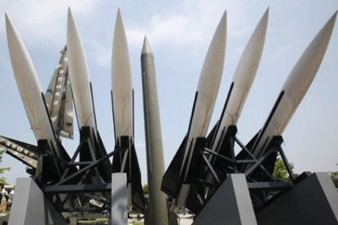
 North Korea is in ‘final stages of nuclear weaponisation’, says South Korea, The Independent 16 Dec 2017, South Korea’s vice foreign minister issued an urgent plea about the threat from Pyongyang, warning the United Nations Security Council that North Korea was “in the final stages of nuclear weaponization”.
“It will fundamentally alter the security landscape in the region and beyond” if the North is able to equip a missile with a nuclear warhead, Cho Hyun warned.
In the past few months, North Korea has rattled the world with a series of weapons tests. It detonated a hydrogen bomb and has launched multiple ballistic missiles, saying after the latest firing that it now has the capability to attack the US mainland and had devised a missile capable of carrying “super-large heavy nuclear warhead”.
The late-November launch soared higher than any previous test, US Secretary of Defence James Mattis said, and illustrated North Korea’s determination to build missiles that can “threaten everywhere in the world”.
Continuing to defy international warnings, a top North Korean official said escalating pressure from the global community shows America is “terrified” by North Korea‘s nuclear capabilities.
The nation’s ambassador to the United Nations, Ja Song Nam, called a meeting of the UN Security Council a “desperate measure plotted by the US” in response to North Korea’s displays of military might.
The Trump administration has sent mixed signals this week about its approach to North Korea’s belligerence………http://www.independent.co.uk/news/world/north-korea-latest-news-updates-us-trump-terrified-nuclear-weapons-attack-a8113606.html
December 18, 2017
Posted by Christina Macpherson |
North Korea, South Korea, weapons and war |
Leave a comment

North Korea: US military practises snatching nuclear weapons from rogue state http://www.news.com.au/world/asia/north-korea-us-military-practises-snatching-nuclear-weapons-from-rogue-state/news-story/3c0342b6be7ca0de4ad38c0dc458dafc
THE US and South Korea take part in yet another show of force against North Korea while Russia and China conduct air defence drills in response to the growing threat of the rogue state. WASHINGTON and Seoul conducted another military drill designed to combat the growing threat from North Korea for the second time this month.
The latest joint training operation practised infiltrating North Korea and removing nuclear weapons in the event of war.
According to South Korea news agency Yonhap the “Warrior Strike” exercise held at Camp Stanley involved hundreds of troops from both sides and ran from Tuesday to Friday.
Camp Stanley is an army camp located north of Seoul and has around 5000 soldiers.
The display comes as North Korea’s neighbours China and Russia also carried out an antimissile drill in Beijing last week. The joint five-day drill, which finished on Saturday, included servicemen from both militaries and was headed by top brass in the Russian and Chinese air force, Newsweek reported.
The latest joint exercise between Washington and Seoul follow joint aerial drills Vigilant Ace in South Korea earlier this month.
The five-day drill was meant to improve the allies’ wartime capabilities and preparedness, according to South Korea’s defence ministry said.
The exercises were slammed by North Korea which warned the drills will “precipitate their self-destruction.”
The Vigilant Ace exercises, which lasted five days, involved more than 230 warplanes and 12,000 soldiers from both sides.
United States troops also used the hi-tech F-35 Lightning IIs and F-22 Raptors.
South Korea is a key US ally in the region and relies on US military assistance for security against the North.
Troops from the two countries routinely train together, each time prompting outbursts from Pyongyang.
Meanwhile Russia warned against fresh preconditions for any potential US and North Korea talks. Deputy foreign minister Sergei Ryabkov on Saturday warned of a risk of escalation after Washington toughened its stance on North Korea nuclear talks and US President Donald Trump accused Moscow of failing to help.
“It’s sad that this powerful element of demands for further pressure on Pyongyang has once again appeared in the American position,” he told RIA Novosti news agency.
“It’s high time to stop this race of threats, pressure, blackmail and presentation of preconditions and shift to a real search for a political solution.”
Mr Ryabkov said that both Pyongyang and Washington are now putting forward preconditions for talks and there is a “risk of uncontrolled escalation”.
His comments came one day after US Secretary of State Rex Tillerson backed away from an earlier offer of unconditional talks to end the stand-off with Pyongyang following White House pressure.
December 18, 2017
Posted by Christina Macpherson |
South Korea, USA, weapons and war |
Leave a comment
Why Chinese province is warning citizens of nuclear war, Nikkei Asian REview, China up close, Newspaper’s what-to-do list hints that Beijing is running out of options, KATSUJI NAKAZAWA, Nikkei senior staff writer , December 18, 2017 TOKYO — A Chinese Communist Party newspaper in Jilin, a northeastern province on the border with North Korea, has published a full-page instructional package warning residents to prepare for a possible nuclear strike.
The Dec. 6 splash on page 5 of the Jilin Daily titled “Knowledge about and protection from nuclear weapons,” has since reverberated across China. It tells readers how they can shelter themselves in case of a nuclear attack or radiation exposure…..
There is no explicit mention of North Korea on the page. However, two historical events involving Japan and the U.S. are discussed, giving readers valuable insight into the current security situation surrounding Jilin and other parts of China. Reading the package, it would be easy to conclude that a crisis is imminent……. https://asia.nikkei.com/Features/China-up-close/Why-Chinese-province-is-warning-citizens-of-nuclear-war
December 18, 2017
Posted by Christina Macpherson |
China, weapons and war |
Leave a comment
 North Korea May Soon Test Another Nuclear Weapon (The Only Question Is Where), National Interest, http://nationalinterest.org/blog/the-buzz/north-korea-may-soon-test-another-nuclear-weapon-the-only-23694 Dave Majumdar, 17 Dec 17,North Korea continues to work on tunnels it used for nuclear test, despite recent tremors according to imagery analysis by the 38 North project at Johns Hopkins School of Advanced International Studies. That might mean that North Korea might test and another nuclear weapon at some point in the not so distant future.
“Recent commercial satellite imagery indicates that despite the continuation of small tremors near Mt. Mantap since North Korea’s last nuclear test, tunnel work at the Punggye-ri Nuclear Test Site is still underway,” reads new analysis by 38 North’s Frank V. Pabian, Joseph S. Bermudez Jr. and Jack Liu. “These efforts continue to be concentrated at the West Portal, leaving the North Portal—where the last five tests were conducted—mostly dormant and likely abandoned, at least for the time being.”
December 18, 2017
Posted by Christina Macpherson |
North Korea, weapons and war |
Leave a comment
 Japan’s MOX program faces tough questions as recycling costs balloon for spent atomic fuel, https://www.japantimes.co.jp/news/2017/12/17/national/japans-mox-program-faces-tough-questions-recycling-costs-balloon-spent-atomic-fuel/ DEC 17, 2017, Kyodo
Japan is the only non-nuclear weapons state in the world that still engaged in a commercial spent-fuel reprocessing program. While it struggles to keep its nuclear power program sustainable by burning the recycled hybrid fuel called mixed oxide, or MOX, this has resulted in a stockpile of nearly 50 tons of plutonium.This stockpile, which can be used to make nuclear weapons, has caused international concern.
The MOX fuel is produced by reprocessing spent nuclear fuel and reusing the extracted plutonium and uranium as fresh fuel. Japan’s utilities send their spent nuclear fuel to France for reprocessing. The problem is that only a few reactors in Japan are currently using MOX.
According to data from the Finance Ministry and other sources, the price of one MOX fuel unit imported in 1999 by Tokyo Electric (now Tokyo Electric Power Company Holdings Inc.) was ¥230 million ($2 million).
The price of the recycled fuel that Kansai Electric Power Co. bought in September 2016, however, exceeded ¥1 billion.
While power firms do not disclose MOX costs, sources familiar with the fuel recycling business said the price includes the cost of transport, private security and insurance.
With many nuclear plants shut due to the safety concerns raised by the 2011 Fukushima disaster, only three plants — two Kansai Electric reactors and one Shikoku Electric Power Co. reactor — now use MOX in the so-called pluthermal power generation program.
Since the pluthermal project is the only way for the nation to consume its plutonium stockpile, it has declined only slightly since the three reactors were started.
December 18, 2017
Posted by Christina Macpherson |
Japan, reprocessing |
Leave a comment
 Tillerson backtracks on offer of unconditional North Korea talks https://www.dailytelegraph.com.au/news/world/tillerson-backtracks-on-offer-of-unconditional-north-korea-talks/news-story/2236599a83ed87f95c79af52af2a9279 16 Dec 17,
AP, News Corp Australia Network AMERICA’S top diplomat stepped back from his offer of unconditional talks with North Korea, telling world powers the nuclear-armed nation must earn the right to negotiate with the United States.
Secretary of State Rex Tillerson’s declaration before the UN Security Council marked a stunning reversal after he proposed discussions with Pyongyang without preconditions earlier this week. That overture was almost immediately rebutted by White House officials.
Still, Mr Tillerson had planned to reiterate his call at a special UN ministerial meeting on North Korea at the council.
His prepared remarks suggested only that North Korea would have to undertake a sustained halt in its threatening behaviour before talks could begin. But Mr Tillerson changed the script. “North Korea must earn its way back to the table,” Mr Tillerson told the foreign ministers.
“The pressure campaign must and will continue until denuclearisation is achieved. We will in the meantime keep our channels of communication open.”
The debate over offering North Korea unconditional talks reflects the differences within the Trump administration as it runs out of time to prevent North Korea from perfecting a nuclear-tipped missile that can strike the US mainland. President Donald Trump has vowed to prevent such capability, with military action if necessary.
So far, US-led sanctions on North Korea and diplomatic isolation haven’t compelled Kim Jong Un’s government to stop its nuclear and missile tests, or to seek negotiations.
Asked overnight if he supported unconditional talks, Mr Trump did not answer directly. “Well, we’re going to see what happens with North Korea. We have a lot of support. There are a lot of nations that agree with us — almost everybody,” Mr Trump told reporters. He credited China — which accounts for about 90 per cent of North Korea’s external trade — with helping on pressuring North Korea, while Russia was not.
“We’d like to have Russia’s help — very important,” said Mr Trump. He raised it in a Thursday phone call with Russian President Vladimir Putin.
At the UN Mr Tillerson called on China and Russia to go beyond UN-mandated economic sanctions. He said North Korean labourers were toiling in “slave-like conditions” in Russia for wages used to fund nuclear weapons, while China was still allowing crude oil to flow into North Korean refineries.
North Korea has conducted more than 20 ballistic missile tests during 2017 and its most powerful nuclear explosion to date. Its more recent missile test in late November fired a projectile that experts say could carry a nuclear warhead to the US Eastern Seaboard.
December 16, 2017
Posted by Christina Macpherson |
North Korea, politics international, USA, weapons and war |
Leave a comment

 North Korean Nuclear Reactor Safety: The Threat No One is Talking About, 38 North, BY: MATT KORDA, DECEMBER 14, 2017 The ability of North Korea to safely operate its nuclear reactors, according to many experts, is increasingly being called into question given the North’s isolation and lack of safety culture. Pyongyang’s ability to respond to a nuclear accident in a timely fashion will make the difference between a small-scale event and a catastrophic disaster. And while the actual contamination would be localized, the lack of transparency from North Korea in dealing with the situation is likely to cause political panic in the region in excess of the actual radiological exposure and environmental impact. The opening of nuclear safety talks with the North to help prevent such an accident from occurring would provide a rare opportunity for regional dialogue and could pry open the door for realistic and productive discussions of North Korea’s nuclear program.
A Disaster Waiting to Happen?
A video of Kim Jong Un smoking next to an untested liquid-fueled missile tells you everything you need to know about North Korea’s nuclear safety culture. The remarkable 14-second clip shows the Supreme Leader taking a puff while a Hwasong-14 intercontinental ballistic missile is erected on the launch pad mere feet away—prompting a torrent of snarky Twitter commentary expressing regret that Kim’s lit cigarette had not “solved the problem for us.” Kim’s recklessness is certainly notable, and it hints at an underemphasized and potentially devastating possibility: the threat of a nuclear accident in North Korea.
At the March 2014 Nuclear Security Summit in The Hague, then-South Korean President Park Geun-hye claimed that Yongbyon, North Korea’s primary nuclear research center, “is home to such a dense concentration of nuclear facilities that a fire in a single building could lead to a disaster potentially worse than Chernobyl.” While her damage assessment is likely an exaggeration—researchers from 38 North assess Chernobyl’s power output to have been 3,000 percent greater than Yongbyon—the potential for a nuclear accident is not.
Niko Milonopoulos and Edward D. Blandford noted previously that a sudden fault in North Korea’s outdated power grid could prevent the Yongbyon reactors from being adequately cooled and could potentially trigger a meltdown. Such an event could also be prompted by a natural disaster or abnormal weather patterns. Complementary analysis by Nick Hansen indicates that North Korea’s 5 MWe plutonium production reactor had to be briefly shut down following a flood in July 2013 which destroyed parts of the cooling systems. He noted with concern that “if a major flood cuts off the cooling water supply to the reactors before they can be shut down, a major safety problem could occur.” This is exactly what prompted the series of nuclear meltdowns at Fukushima……….http://www.38north.org/2017/12/mkorda121417/
December 16, 2017
Posted by Christina Macpherson |
North Korea, safety |
Leave a comment
Times 14th Dec 2017, A French-designed nuclear reactor ordered by Britain is facing further
scrutiny after the disclosure that defects were detected in one of the same models under construction in China. The revelation adds to the string of setbacks that have hit the European Pressurised Reactor (EPR) designed by Areva, the French nuclear group.
Britain has ordered two of those reactors for Hinkley Point C. They are being built by EDF, the French state energy
giant, and China General Nuclear Power Corporation at a cost of £19.5 billion.
China General Nuclear Power Corporation, which is building two reactors in a joint venture with EDF near Macau in southern China, said it had found “local defects” in the Taishan 1 reactor. It said that welding in the deaerator, which is used to remove oxygen from water circuits, was defective. The parts had been replaced, it said.
Taishan 1 is due to come on stream this month to become the world’s first functioning example of the
European reactor. The second Chinese reactor, Taishan 2, is due to come online next year. The $8.7 billion project was initially due to be completed last year, but was delayed by safety concerns.
The problems in China pale by comparison with those affecting other projects. Work on a similar reactor at Olkiluoto in Finland began in 2005 and was supposed to finish in 2009. It is now expected to be in action from 2019. EDF is also
building a reactor at Flamanville in Normandy which was due to begin operating in 2012, but won’t be working until the end of next year. The reactors at Hinkley Point were originally due to be operational in 2025 but EDF said this summer that they were likely to be 15 months late.
https://www.thetimes.co.uk/edition/business/new-defects-in-hinkley-type-reactor-tjj0cprhz
December 16, 2017
Posted by Christina Macpherson |
China, safety |
Leave a comment
Residents who filed an injunction to suspend the restart of a reactor at the Ikata nuclear power plant speak at a news conference Wednesday in Hiroshima.
Wednesday’s ruling by the Hiroshima High Court halting the planned restart of a nuclear reactor in Ehime Prefecture has cast doubt on the judgment of Japan’s Nuclear Regulation Authority — which had approved the restart under stricter post-Fukushima guidelines — shocking the government and utilities across the nation.
The ruling deals a heavy blow to a plan by Prime Minister Shinzo Abe’s administration to bring more reactors back online, and is sure to prompt the government and utilities to keep a closer eye on similar cases continuing across the country.
Yuichi Kaido, a lawyer representing local residents, called the ruling the “most important” since the Fukushima nuclear disaster, spurred by the Great East Japan Earthquake and tsunami on March 11, 2011.
About 40 court cases — including those seeking injunctions — were filed in the wake of the Fukushima meltdown disaster. But while district courts have ordered some reactors stopped, each shutdown decision has been overturned by a high court.
“This is the first time (plaintiffs) have won at the high court level,” Kaido said at a news conference in Tokyo. He said the ruling may signal a turn of the tide.
Wednesday’s ruling was also noteworthy for touching on the risk of volcanic eruption.
“The possibility of heated rock and volcanic ash reaching the reactor cannot be evaluated as small. The location is not suitable” for a nuclear reactor, said presiding Judge Tomoyuki Nonoue in handing down the ruling. The reactor affected is the No. 3 unit at Shikoku Electric Power Co.’s Ikata plant, which is located about 130 kilometers from the caldera of the volcanically active Mount Aso in Kumamoto Prefecture.
“The effect that volcanic ash may have on reactors nationwide is underrated,” Kaido said.
Government officials were quick to attempt to play down the risk. “It’s just a court ruling. The government’s position to seek the restart for reactors approved by the (Nuclear Regulation Authority) remains unchanged,” said a senior trade ministry official.
The central government’s target for power generations calls for 20 percent to 22 percent of the nation’s supply to be contributed by nuclear reactors by 2030.
Nuclear Regulation Authority Chairman Toyoshi Fuketa told a news conference that the high court decision would not influence its ongoing and future safety screenings of other reactors.
“We will just fulfill the role of a regulator,” Fuketa said.
But the reality is that utilities have been seeking to convince municipalities that reactors cleared by the watchdog under the tougher guidelines are safe.
“I’m worried that it could create negative momentum,” said an industry official.
For Shikoku Electric, the blocked restart will mean a spike in fuel costs as it will be forced to rely mainly on non-nuclear power generation.
“While the nuclear reactors are suspended, we will need to rely on thermal power, which means we will need to shoulder a ¥3.5 billion loss per month for fuel,” an executive of the utility said at a news conference on Wednesday.
Other utilities are facing similar constraints. Kyushu Electric Power Co. aims to restart two reactors at its Genkai plant in Saga Prefecture, but local residents have filed an injunction seeking to halt the move. A Kyushu Electric executive said he was “surprised at the unexpected ruling” on the Ikata plant.
Meanwhile, the response of residents in Ehime Prefecture was mixed.
One man voiced concern over the ruling’s potential to damage the local economy. The man, who runs a lodging business, said the town accommodated several hundred nuclear power plant workers a year before the Fukushima disaster.
“Ikata is a town of nuclear power,” he said. “I feel that (the ruling) has left locals behind.”
Another resident, however, welcomed the move as a judicial “breakthrough.”
December 15, 2017
Posted by dunrenard |
Japan | High Court, Ikata NPP, Residents Filed Injunction, Suspension Order |
Leave a comment
When it comes to volcanic threats to nuclear power stations, the Nuclear Regulation Authority (NRA) requires utilities to do a lot of digging.
The NRA demands that utilities evaluate the potential risks presented by any volcanoes within 160 kilometers of a given plant. That evaluation begins with a look through the written record for any mentions of eruptions plus examining the geological features of the area to determine if there is any chance the volcano will be active again in the future. If a future eruption can’t be ruled out, then the utility must determine whether pyroclastic flows — fast moving clouds of hot gas and volcanic matter — or lava flows could reach the plant. If there is such a risk, then the plant site is labeled unsuitable and the reactors banned from going on line.
In the case of the Sendai nuclear plant’s No. 1 and 2 reactors, it was found that there were five volcanoes with histories of cataclysmic eruptions within the 160-kilometer zone. A “cataclysmic eruption” is one that spews vast amounts of magma, causing large-scale ground subsidence and creating a caldera.
NRA inspectors found that there was “sufficiently little chance” of a cataclysmic eruption that could cause a pyroclastic flow to hit the Sendai plant grounds while the station was in operation. Furthermore, the regulatory body determined that measures to deal with up to 15 centimeters of volcanic ash from the Sakurajima volcano — about 50 kilometers distant — would be enough to maintain plant safety.
The NRA also called on utilities to make preparations to shut down reactors and move the nuclear fuel out of their nuclear plants if there was any sign of an impending cataclysmic eruption detected. Sendai plant operator Kyushu Electric Power Co. assured the NRA that the utility would spot signs of such an eruption by keeping a close watch out for changes in the Earth’s crust caused by magma accumulation, and the regulator accepted this explanation.
However, some volcanologists have pointed out that it is very difficult to predict the timing or scale of a cataclysmic eruption. Furthermore, there is neither a predetermined spot to move the nuclear fuel to nor a set standard for the NRA to order reactor shutdowns.
Across Japan, the Genkai nuclear station’s No. 3 and 4 reactors (which have passed NRA safety inspections ahead of a planned restart), the No. 1 to 3 reactors at Hokkaido Electric Power Co.’s Tomari nuclear plant (where the volcanic risk inspection has nearly been completed), and the No. 2 unit at the Shimane nuclear power station run by Chugoku Electric Power Co. are all close to volcanoes with calderas. However, the NRA has never declared a plant site unfit due to the threat of volcanic activity.
Regarding the Hiroshima High Court’s Dec. 13 decision to order Shikoku Electric Power Co. to shut the No. 3 reactor at its Ikata power plant in Ehime Prefecture, NRA chief Toyoshi Fuketa told reporters, “I am not directly concerned (with the case) so I am not in a position to comment.” He added that the ruling would have “no effect” on NRA inspections.
Hokkaido University specially appointed professor of nuclear reactor engineering Tadashi Narabayashi, meanwhile, said the court decision was the product of “logical leaps.”
“Stopping (reactor) operation based on personal rights requires an imminent danger,” Narabayashi wrote in a comment to the Mainichi Shimbun. “It’s difficult to say that the chance of a cataclysmic eruption, which is thought to happen only about once in 10,000 years, meets that definition. The Ikata plant’s No. 3 unit is protected from falling volcanic material and has an enhanced reactor core cooling system, so there is simply no probability of an incident that would endanger the lives of the people in the city of Matsuyama or Hiroshima.”
Meanwhile, Kobe University magma specialist Yoshiyuki Tatsumi praised the court ruling as “based on scientific knowledge grounded in current volcanology.”
“There is about a 1 percent chance of a cataclysmic eruption in Japan in the next 100 years, so mathematically speaking, one could happen at any time,” he continued. “At present, we do not know what kinds of signs would portend such an eruption. It is also unknown how much magma has built up under Mount Aso (in Kumamoto Prefecture), so the government needs to strengthen its observations there among other measures.”
December 14, 2017
Posted by dunrenard |
Japan | nuclear plants, Volcanoes |
2 Comments
Lawyers hold up signs outside the Hiroshima High Court on Dec. 13 proclaiming an injunction had been ordered on operations at the Ikata nuclear power plant.
For 1st time, a high court rules against nuclear plant operations
HIROSHIMA–A high court for the first time has banned operations at a nuclear power plant.
The Hiroshima High Court issued the injunction in a verdict Dec. 13 that applies to the No. 3 reactor at the Ikata nuclear power plant in Ikata, Ehime Prefecture, operated by Shikoku Electric Power Co.
In the ruling, the high court concluded there was a chance the Ikata plant could be affected by a pyroclastic flow from Mount Aso if an eruption occurred similar in scale to a massive one 90,000 years ago on the southern island of Kyushu.
A computer simulation by Shikoku Electric of the possible effects from an eruption like the one in ancient times showed there was a possibility of a pyroclastic flow reaching the grounds of the Ikata plant.
The high court concluded that the Ikata plant was located in an inappropriate location and that the Nuclear Regulation Authority’s decision that new safety standards had been met was not rational.
The company suspended operations in October to carry out a periodic inspection. If a judicial decision overturning the Dec. 13 high court ruling is not issued, the Ikata reactor will not be able to resume operations–even if the inspection is completed without problems.
For that reason, the latest ruling could affect the government’s plans to resume operations at other nuclear plants more than six years after the triple meltdown at the Fukushima No. 1 nuclear power plant.
An official with Shikoku Electric Power labeled the court injunction as “extremely regrettable” and lamented the fact that it did not accept the company’s assertion that the plant is safe.
“The verdict is unacceptable,” the official said.
The utility plans to initiate procedures immediately to have the injunction suspended.
The injunction request was made by four residents of Hiroshima and Matsuyama cities. Among the main points of contention before the high court were the rationality of new safety standards approved by the Nuclear Regulation Authority (NRA) in the aftermath of the 2011 Fukushima nuclear disaster; the rationality behind the expected maximum strength of an earthquake for the area; and an evaluation of the effect of volcanic ash on the reactor’s operations.
While district courts have issued injunctions on operations at other plants, higher courts have overturned all those verdicts until now.
For example, the Fukui District Court in April 2015 and the Otsu District Court in March 2016 ordered operations stopped at the No. 3 and No. 4 reactors of the Takahama nuclear power plant in Fukui Prefecture operated by Kansai Electric Power Co., but those verdicts were later overturned.
Lawyers hold up banners with messages such as, “Injunction issued,” following a Hiroshima High Court order to suspend operation of the No. 3 reactor at Shikoku Electric Power Co.’s Ikata Nuclear Power Plant, in Hiroshima’s Naka Ward, on Dec. 13, 2017.
High court orders Shikoku Electric to halt Ehime nuclear reactor
HIROSHIMA (Kyodo) — The Hiroshima High Court on Wednesday revoked a lower court decision and ordered the suspension of a nuclear reactor in western Japan, dealing a blow to the government and utilities aiming to bring more reactors back online.
The first high court suspension order in a series of similar injunction requests demanded that plant operator Shikoku Electric Power Co. shut the No. 3 unit of the Ikata power plant in Ehime Prefecture until the end of September next year.
The ruling blocks the planned resumption in January of the unit, which is currently offline for a regular checkup after it was restarted in August 2016.
Shikoku Electric said the decision is “unacceptable” and plans to file an appeal against it.
The court found it was irrational that the Nuclear Regulation Authority judged that the potential risks associated with a volcanic eruption would not breach the stricter regulations introduced following the 2011 Fukushima nuclear crisis.
“Specific threats to the lives and health of residents are anticipated,” the court said.
The latest decision follows the ruling by the Otsu District Court in March 2016 that ordered Kansai Electric Power Co. to suspend two reactivated nuclear reactors at the Takahama plant. The district court decision was later overturned by the Osaka High Court.
The government is looking to produce 20 to 22 percent of the country’s electricity supply with nuclear power by 2030 after the Fukushima nuclear crisis led to a nationwide halt of nuclear plants.
The focal points of the latest decision included whether the estimate by the plant operator of the potential size of an earthquake, a key factor in a reactor’s quake-resistance design, was reasonable, and whether safety screening conducted under the new regulations was credible.
The plaintiffs claimed that in calculating the size of a potential earthquake, the utility underestimated the fact that the reactor lies above the epicenter of an anticipated Nankai Trough mega-quake and that it is located near a geological fault.
They added that the post-Fukushima regulations cannot ensure safety and major damage could occur at the time of an accident or disaster because they were compiled without thoroughly determining the cause of the 2011 disaster.
But Shikoku Electric said that it has ensured safety and there is no danger.
Hiroyuki Kawai, the lawyer representing the plaintiffs said, “Our plea was understood. We could protect the Seto Inland Sea. It is our victory.”
The plaintiffs had said that if the Ikata plant, which faces the Seto Inland Sea, was to be severely damaged, nuclear substances could spread and contaminate the sea.
In March, the Hiroshima District Court had found that the new regulations and Shikoku Electric’s estimates of a possible earthquake and tsunami were reasonable.
The district court had turned down the request to halt the reactor, saying, “There is no specific risk that residents will suffer severe damage due to radioactive exposure associated with an accident.”
Following the checkup, Shikoku Electric was expected to bring the reactor back online on Jan. 22.
The plaintiffs were four residents from Matsuyama in Ehime and Hiroshima on the other side of the Seto Inland Sea. Similar injunction demands have been contested at the Takamatsu High Court, the Oita District Court and the Iwakuni branch of the Yamaguchi District Court.
Ikata power plant’s No.2 reactor, right, and No. 3 reactor in Ehime prefecture
Japan’s high court orders suspension of Ehime nuclear reactor
HIROSHIMA (Kyodo) — The Hiroshima High Court on Wednesday revoked a lower court decision and ordered the suspension of a nuclear reactor at the Ikata power plant in Ehime Prefecture, western Japan.
It is the first high court decision on a series of injunction demands filed with four district courts seeking to halt the No. 3 reactor at the plant, which was restarted in August 2016 but is now offline for a regular checkup.
The focal points of the decision included whether the estimate by the plant operator Shikoku Electric Power Co. of the potential size of a quake, a key factor in a reactor’s quake-resistance design, was reasonable, and whether safety screening conducted under stricter regulations set after the 2011 Fukushima nuclear disaster was credible.
Risks predicted in the event of nuclear accidents and natural disasters such as a volcanic eruption were also contested.
The plaintiffs claimed that in calculating the size of a potential earthquake, the utility underestimated the fact that the reactor lies above the epicenter of an anticipated Nankai Trough mega-quake and that it is located near a geologic fault.
They added that the post-Fukushima regulations cannot ensure safety and major damage could occur at the time of an accident or disaster because they were compiled without thoroughly determining the cause of the 2011 disaster.
But Shikoku Electric said that it has ensured safety and there is no danger.
In March, the Hiroshima District Court had found that the new regulations set by the Nuclear Regulation Authority and Shikoku Electric’s estimates of a possible earthquake and tsunami were reasonable.
The district court had turned down the request to halt the reactor, saying, “There is no specific risk that residents will suffer severe damage due to radioactive exposure associated with an accident.”
Following the checkup, Shikoku Electric was expected to bring the reactor back online on Jan. 22 and resume operations on Feb. 20.
No. 3 reactor will stay offline as key safety issues remain contested
The plaintiffs were four residents from Matsuyama in Ehime and Hiroshima on the other side of the Seto Inland Sea. Similar injunction demands have been contested at the Takamatsu High Court, the Oita District Court and the Iwakuni branch of the Yamaguchi District Court.
A lawyer representing residents who filed an injunction to suspend reactor operations at Ikata nuclear power plant speaks in front of Hiroshima High Court on Wednesday, after the court revoked a lower court decision and ordered suspension of the No. 3 reactor
Hiroshima High Court orders suspension of Ikata nuclear reactor in Ehime Prefecture, revoking district court ruling
HIROSHIMA – The Hiroshima High Court on Wednesday revoked a lower court decision and ordered the suspension of a nuclear reactor at Shikoku Electric Power Co.’s Ikata power plant in Ehime Prefecture, dealing a blow to the government and utilities that are aiming to bring more reactors back online.
The high court suspension order — the first in a series of similar injunctions — mandates that the plant operator shutter the No. 3 unit at the Ikata power plant until the end of September next year.
The ruling blocks the planned resumption in January of the unit, which is currently offline for regular checks after it was restarted in August 2016.
Shikoku Electric said the court’s decision is “unacceptable” and plans to file an appeal.
The court questioned a decision by the Nuclear Regulation Authority that potential risks associated with volcanic eruptions would not breach the stricter regulations introduced following the 2011 Fukushima nuclear crisis.
“Specific threats to the lives and health of residents are anticipated,” the court said.
The latest decision follows a ruling by Otsu District Court in March 2016 that ordered Kansai Electric Power Co. to suspend two reactivated nuclear reactors at its Takahama plant. The district court decision was later overturned by the Osaka High Court.
The Fukushima nuclear crisis led to a nationwide halt of nuclear plants, but the government is looking to produce 20 to 22 percent of the country’s electricity supply using nuclear power by 2030.
The focal points of Hiroshima High Court’s decision Wednesday included whether estimates by the plant operator, Shikoku Electric Power Co., of the potential size of possible earthquakes, were reasonable, and whether safety screening conducted under stricter regulations set after the 2011 Fukushima nuclear disaster was credible.
Risks predicted in the event of a nuclear accident or natural disasters such as a volcanic eruptions were also contested.
The plaintiffs claimed that in calculating the size of a potential earthquake, the utility had underestimated the fact that the reactor lies above the epicenter of an anticipated Nankai Trough mega-quake, and that it is located near a geologic fault.
They added that the post-Fukushima regulations cannot ensure safety, and that major damage could occur at the time of an accident or disaster because the regulations were compiled without thoroughly determining the cause of the 2011 disaster.
But Shikoku Electric maintains that it has ensured safety and that there is no danger.
Hiroyuki Kawai, the lawyer representing the plaintiffs said, “Our plea was understood. We could protect the Seto Inland Sea. It is our victory.”
The plaintiffs had said that if the Ikata plant, which faces the Seto Inland Sea, was to be severely damaged, nuclear substances could spread and contaminate waters in the area.
In March, the Hiroshima District Court found that the new regulations set by the Nuclear Regulation Authority and Shikoku Electric’s estimates of a possible earthquake and tsunami were reasonable.
The district court had turned down the request to halt the reactor, saying, “There is no specific risk that residents will suffer severe damage due to radioactive exposure associated with an accident.”
Following the checks, Shikoku Electric had been expected to bring the reactor back online on Jan. 22 and resume operations on Feb. 20.
The plaintiffs were four residents from Matsuyama in Ehime and Hiroshima, located on the opposite side of the Seto Inland Sea to the nuclear plant. Similar injunctions have been contested at the Takamatsu High Court, Oita District Court and the Iwakuni branch of Yamaguchi District Court.
December 14, 2017
Posted by dunrenard |
Japan | High Court, Ikata NPP, Suspension Order |
Leave a comment
China building network of refugee camps along border with North Korea https://www.theguardian.com/world/2017/dec/12/china-refugee-camps-border-north-korea Document suggests at least five camps are being set up as Beijing prepares for possible influx of refugees should Kim Jong-un’s regime collapse, Guardian, Tom Phillips , 12 Dec 17, China is quietly building a network of refugee camps along its 880-mile (1,416km) border with North Korea as it braces for the human exodus that a conflict or the potentially messy collapse of Kim Jong-un’s regime might unleash.
The existence of plans for the camps, first reported in English by the Financial Times last week, emerged in an apparently leaked internal document from a state-run telecoms giant that appears to have been tasked with providing them with internet services.
The China Mobile document, which has circulated on social media and overseas Chinese websites since last week, reveals plans for at least five refugee camps in Jilin province.
The document, which the Guardian could not independently verify, says: “Due to cross-border tensions … the [Communist] party committee and government of Changbai county has proposed setting up five refugee camps in the county.”
It gives the names and locations of three such facilities: Changbai riverside, Changbai Shibalidaogou and Changbai Jiguanlizi. The New York Times reportedthat centres for refugees were also planned in the cities of Tumen and Hunchun.
A spokesman for China’s foreign ministry declined to confirm the camps’ existence at a regular press briefing on Monday but did not deny they were being built. “I haven’t seen such reports,” Lu Kang told reporters.
The question was purged from the foreign ministry’s official transcript of the briefing, as regularly happens with topics raised by foreign journalists that are considered politically sensitive or inconvenient.
North Korea fortifies part of border where defector escaped
The leaked document contains the name and telephone number of a China Mobile employee who drafted it but calls to that number went unanswered on Tuesday. The construction of the camps appears to reflect growing concern in Beijing about the potential for political instability – or even regime collapse – in North Korea.
Cheng Xiaohe, a North Korea specialist from Renmin University in Beijing, said while he could not confirm whether the document was genuine, it would be irresponsible for China not to make such preparations.
“Tensions are high on the Korean peninsula … it is on the brink of war. As a major power and a neighbouring country, China should make plans for all eventualities.”
Jiro Ishimaru, a Japanese documentary maker who runs a network of citizen journalists inside North Korea and on the Chinese side of the border, said a contact in Changbai county had recently told him that while they had not seen signs of camps being built there, they “had heard there are plans to build a facility”.
Tensions on the Korean peninsula have soared this year as the US president, Donald Trump, has stepped up pressure on his North Korean counterpart and Pyongyang has accelerated its nuclear and ballistic missile programmes.
Trump has baited Kim with the nickname “Little Rocket Man” and threats of military action, while Kim has responded with insults of his own, and a succession of nuclear and missile tests that have brought two new rounds of UN sanctions.
Following its latest intercontinental ballistic missile test on 29 November, Pyongyang claimed the ability to strike anywhere on US soil.
‘Quite backwards’: Chinese tourists gawk at impoverished North Koreans
In an interview with the Guardian in Beijing on Monday, Dennis Rodman, the NBA star turned would-be peacemaker, played down fearsof a catastrophic nuclear conflict and denied Kim, whom he calls his friend, was “going to try and bomb or kill anyone in America”.
“We ain’t gonna die, man, come on, no … It’s not like that,” Rodman insisted, urging Trump to use him as an intermediary to engage with Kim. He described the verbal war between Trump and Kim as “a chess game” that should not be taken too seriously.
Beijing seems less certain. Last week one official newspaper in Jilin, the Chinese province closest to North Korea’s nuclear test site, hinted at that nervousness with a full-page article offering tips on how to react to a nuclear incident.
Iodine tablets, masks and soap were useful allies in the event of such a catastrophe, readers of the Jilin Daily learned.
Additional reporting by Wang Zhen and Justin McCurry in Tokyo.
December 12, 2017
Posted by Christina Macpherson |
China, North Korea, politics international |
Leave a comment
Why North Korea’s nuclear test is still producing aftershocks, BBC, 11 December 2017 “…….
Why are aftershocks still happening?
According to the USGS, last weekend’s tremors were “relaxation events”. They measured a magnitude of 2.9 and 2.4.
“When you have a large nuclear test, it moves the earth’s crust around the area, and it takes a while for it to fully subside. We’ve had a few of them since the sixth nuclear test,” an official told Reuters.
The “movement of the earth’s crust” is akin to the very definition of an earthquake and scientists say it is only to be expected in the weeks and months after an explosion of that magnitude.
“These aftershocks for a 6.3 magnitude nuclear test are not very surprising,” Dr Jascha Polet, seismologist and professor of geophysics at California State Polytechnic University, told the BBC.
After any tremor of that size, aftershocks with declining magnitude are common, as the rock moves around and releases stress.
The area around the quake site “experiences deformation, and this creates areas of increased and decreased stress, which affects the distribution of aftershocks,” Ms Polet said.
“The fact that the source of the earthquake is an explosion doesn’t change how we expect the energy to redistribute,” geophysicist and disaster researcher Mika McKinnon, told the BBC.
But research on explosions of a similar magnitude as the North Korea nuclear test at the Nevada Test Site in the US where over decades nuclear tests were carried out, has found that the aftershocks of these events were fewer in number and lower in magnitude.
So each location is unique.
Can tremors destroy the test site?
One of the speculations after the September test was that it would damage the tunnel system North Korea has dug into the mountains at its test site.
“The more energy you put into an area, the more unstable it’s going to get,” Mika McKinnon explained.
“The more tests are happening, the more energy there is, the more redistribution of stress and the more rocks will be breaking.”
There have been some indications of individual tunnel collapses, she explained. “Seismic signals that look more like rock fall than anything else. That will happen more and more.”
But, she adds, there is no way of really knowing whether the entire tunnel system will collapse as this is an engineering problem far more than a scientific one.
It is unclear whether this process already has rendered the current test site unusable but North Korea has hinted its next nuclear test could be above ground…….http://www.bbc.com/news/world-asia-42305161
December 12, 2017
Posted by Christina Macpherson |
environment, North Korea |
Leave a comment
Aftershocks detected 14 weeks after North Korea nuclear test ‘moves Earth’s crust’ http://www.independent.co.uk/news/world/asia/aftershocks-north-korea-nuclear-test-tremors-punggye-ri-usgs-hydrogen-bomb-mountain-a8101966.html
‘It takes a while for the crust movement to fully subside’, says USGS Jon Sharman 10 Dec 17 Geologists have detected two tectonic tremors that they say are probably aftershocks from North Korean nuclear tests conducted over three months ago.
The artificial explosion created near a known nuclear testing site in North Korea had “moved the Earth’s crust” and subsequent seismic activity showed the region’s underlying geology settling back down, experts said.
The aftershocks, of magnitude 2.9 and 2.4, were detected at 6.13am and 6.40am GMT on Saturday respectively, said the US Geological Survey (USGS).
Lassina Zerbo, executive secreta
ry of the Vienna-based Comprehensive Nuclear-Test-Ban Treaty Organisation, said analysts had confirmed that the activity was “tectonic” in origin.
A USGS official said the tremors had occurred near the Punggye-ri nuclear test site, where North Korea conducted its sixth and largest underground nuclear test on 3 September.
“They’re probably relaxation events from the sixth nuclear test,” the official said. “When you have a large nuclear test, it moves the earth’s crust around the area, and it takes a while for it to fully subside. We’ve had a few of them since the sixth nuclear test.”
Pyongyang claimed the September test was of a thermonuclear hydrogen bomb, and experts have estimated it was 10 times more powerful than the US atomic bomb dropped on Hiroshima in 1945.
A series of quakes since then has prompted experts and observers to suspect the test might have damaged the mountainous location of its site in the northwest tip of North Korea, where all of the country’s nuclear tests have been conducted.
South Korea’s spy agency told the country’s lawmakers in October that North Korea might be readying two more tunnels at the site.
North Korea hinted its next nuclear test could be above ground after US President Donald Trump warned in September that the United States would “totally destroy” North Korea if it threatened America.
Another possible obstacle to North Korea’s use of Punggye-ri for tests is the nearby active volcano of Mount Paektu, which North Koreans consider a sacred site. Its last eruption was in 1903, and experts have debated whether nuclear testing could trigger another.
North Korea’s official media reported on Saturday that national leader Kim Jong-un had scaled Mount Paektu with senior military officials to “emphasise his military vision” after completion of the country’s nuclear force.
But pictures released by the official KCNA news agency showed him wearing smart black leather shoes and carrying no specialised equipment.
Mr Kim declared the nuclear force complete after the test of North Korea’s largest ever intercontinental ballistic missile last month, which experts said puts all of America within range.
South Korea said Pyongyang still needed to prove it has mastered critical missile technology, such as re-entry, terminal stage guidance and warhead activation, however.
December 11, 2017
Posted by Christina Macpherson |
environment, North Korea, weapons and war |
Leave a comment
Moon calls for ‘overwhelming’ military capability against North Korea, Korea Herald,
jasonyeo@heraldcorp.com By Yeo Jun-suk : Dec 8, 2017 -President Moon Jae-in urged the military to secure “overwhelming” capability to fend off North Korea’s growing military threat on Friday as South Korea’s Defense Ministry warned against another strategic provocations following its latest missile launch.
The president also called for an “early and swift” transfer of wartime operational control from the United States to South Korea, suggesting the military should secure capability to lead combined operations in the event of contingency on the Korean Peninsula.
“Based on a robust South Korea-US alliance, we have to work swiftly to meet the conditions for wartime operational control,” said the president during a lunch meeting with some 150 military commanders at the presidential office of Cheong Wa Dae in Seoul.
“Given that North Korea’s missile and nuclear threat has been accelerating at a faster pace than before, the military’s role is more important than ever. You are our last line of defense against North Korea’s nuclear weapons and missile threats,” he added. ……http://www.koreaherald.com/view.php?ud=20171208050060
December 11, 2017
Posted by Christina Macpherson |
South Korea, weapons and war |
Leave a comment