Pyongyang ‘wants above all to talk to the US about guarantees for its security’ Lavrov says he informed Rex Tillerson in Vienna on Thursday, Guardian, Julian Borger in Washington, 8 Dec 17, North Korea is open to direct talks with the US over their nuclear standoff, according to the Russian foreign minister, Sergei Lavrov, who said he passed that message to his counterpart, Rex Tillerson, when the two diplomats met in Vienna on Thursday.
There was no immediate response from Tillerson but the official position of the state department is that North Korea would have to show itself to be serious about giving up its nuclear arsenal as part of a comprehensive agreement before a dialogue could begin.
“We know that North Korea wants above all to talk to the United States about guarantees for its security. We are ready to support that, we are ready to take part in facilitating such negotiations,” Lavrov said at an international conference in Vienna, according to the Interfax news agency. “Our American colleagues, [including] Rex Tillerson, have heard this.”
The diplomatic moves come amid an increased sense of urgency to find a way of defusing the tensions over North Korea’s increasingly ambitious nuclear and missile tests. The standoff reached a new peak on 29 November, when North Korea tested a new intercontinental ballistic missile (ICBM), the Hwasong-15, capable of reaching Washington, New York and the rest of the continental United States. The missile launch followed the test of what was apparently a hydrogen bomb in September.
Pyongyang has said that current joint exercises by the US and South Korea involving hundreds of warplanes, along with “bellicose remarks” by US officials have “made an outbreak of war on the Korean peninsula an established fact”.
“The remaining question now is: when will the war break out,” a foreign ministry spokesman said on Wednesday.
North Korean officials have said in recent informal meetings that they are particularly concerned by the threat of a surprise “decapitation” strike, aimed at killing the country’s leaders and paralysing military command and control systems before Pyongyang could launch its missiles.
The heightened tensions and threatening language have increased fears around the world that the two sides could blunder into war through miscalculation, mistaking war games for a real attack or misreading blurred red lines.
US and North Korean positions are currently far apart, with Pyongyang rejecting any suggestion that its nuclear disarmament would be on the table at any future negotiation. The regime wants the US to recognise it as a nuclear weapons power and cease its “hostile policies” to North Korea, including sanctions and military manoeuvres off the Korean peninsula.
For its part, the US has rejected a “freeze-for-freeze” proposal advanced by Russiaand China, by which North Korea would suspend nuclear and missile tests while the US would curtail its military exercises.
State department spokeswoman Heather Nauert said on Thursday that direct talks with North Korea were “not on the table until they are willing to denuclearize.”
However, the two sides have had informal contacts this year, involving Joseph Yun, the US special representative for North Korea policy. Those contacts, known as the “New York channel” were cut by the North Koreans after threatening remarks by Donald Trump during the UN general assembly in September. But there have been some recent signs that Pyongyang might be interested in restoring the channel.
At a meeting in Stockholm that brought together western experts and officials from Pyongyang in late November, a North Korean representative appeared to raise, for the first time, the possibility of a channel for military-to-military communication with the US.
“In an informal discussion that we had in Stockholm, an official made an observation that there isn’t at present a way for the US and North Korea to work together to prevent an accident. I thought that was an interesting observation that I had not heard them say before,” said Suzanne DiMaggio, a senior fellow at the New America thinktank who has played a leading role in back-channel contacts with Iran and North Korea, and who attended the Stockholm meeting.
“I think the US would be best served by putting aside the focus on denuclearisation and instead look at ways to prevent accidents, reduce risks and de-escalate. Those to me seem like achievable goals.”
Sue Mi Terry, a former CIA analyst who was director for Korea, Japan and Oceanic affairs at the national security council in the Bush and Obama administrations, said Washington might be amenable to such a military hotline being established.
“I think even this administration recognises that some sort of an open channel is needed for that, not to negotiate but to have a little more transparency,” she said. “I think everyone recognises that is needed.”
Terry, who was deputy national intelligence officer for east Asia at the national intelligence council from 2009 to 2010, said that it was also possible that Yun could re-establish the New York channel with Pyongyang. But she added there was little sign such contacts would lead to substantive negotiations in the current climate.
“This latest test put a big hole in the possibility of negotiation at this moment, she said. “Ambassador Yun might do that but it’s different with the White House. I’m not sure he has strong White House support.”
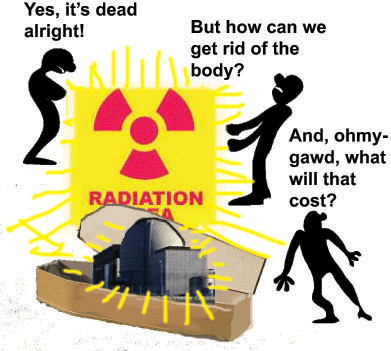
S. Korea strives to build up nuclear decommissioning industry, By Kim Eun-jung SEOUL, Dec. 8 (Yonhap) —South Korea will ramp up efforts to develop technologies related to nuclear decommissioning as the country’s oldest reactor is undergoing the lengthy, costly process of being dismantled, the energy ministry said Friday.
The Ministry of Trade, Industry and Energy launched a consultative body composed of state-run utilities, construction companies and research institutes to put concerted efforts toward developing the nation’s nuclear decommissioning industry,
The ministry said it aims to develop technologies needed to dismantle nuclear reactors by 2021 that will make such sites free of radioactive hazards and establish a research institute to pave the way for entering the global market by 2030…….
A total of 11 reactors will be retired one by one by 2030 as their operational life cycles expire as the government said it won’t extend their operation.
As part of the nuclear phase-out plan, the government is also pushing for an early closure of Wolsong-1, now the nation’s oldest operating reactor, as soon as possible.
Japan Times 6th Dec 2017, The operator of the Monju prototype fast-breeder nuclear reactor submitted
a plan Wednesday to decommission the trouble-plagued facility located in
Fukui Prefecture. The most recent plan presented to the Nuclear Regulation
Authority lays out a 30-year time frame to complete the project despite a
number of problems that remain unresolved, including where to store the
spent nuclear fuel.
Japan Times, 7 Dec 17 KYODO, WASHINGTON– A former U.S. envoy has urged the Washington to hold talks with Pyongyang without preconditions to break the impasse over North Korea’s nuclear weapons and ballistic missile threats.
“I am of the view that the two sides should agree to have ‘talks about talks’ without any preconditions,” Robert Gallucci, chief negotiator for the now-defunct 1994 nuclear freeze struck with North Korea, said in an interview.
Gallucci’s view is at odds with U.S. President Donald Trump’s policy of imposing “maximum pressure” on North Korea in concert with the international community to compel the hermit country halt its provocative acts and engage in credible talks for denuclearization.
Gallucci also questioned Prime Minister Shinzo Abe’s emphasis on pressuring North Korea, pointing out Abe’s insistence that now is not the time to talk to the country, given that it hasn’t changed its provocative behavior.
“I can’t believe refusing to talk with North Korea is in the best interests of Japan,” he said, referring to Abe’s resolve to address Pyongyang’s abduction of Japanese nationals in the 1970s and 1980s. “I think an effort at lowering tensions would be. That he does not see it that way, I regret.”………
In a separate interview, Joshua Pollack, a senior research associate at the Middlebury Institute of International Studies at Monterey, California, said he does not believe pressure and sanctions alone will achieve the Trump administration’s goal of denuclearizing North Korea.
Pollack described the relationship as a seemingly endless cycle of provocations and pressure.
The foreign ministry said the military exercises involving hundreds of South Korean and U.S warplanes made the outbreak of war an “established fact.” It also blamed high-ranking U.S. officials, including CIA Director Mike Pompeo, for “bellicose remarks.”
Pompeo said Saturday that U.S. intelligence agencies believe North Korean leader Kim Jong Un doesn’t have a good idea about how tenuous his situation is domestically and internationally as he pushes ahead with North Kore’s nuclear weapons program.
We do not wish for a war but shall not hide from it, and should the U.S. miscalculate our patience and light the fuse for a nuclear war, we will surely make the U.S. dearly pay the consequences with our mighty nuclear force which we have consistently strengthened,” North Korea, which regularly threatens the U.S. and its allies, said.
The comments were consistent with the tone of Pyongyang’s previous confrontational remarks and statements condemning Washington and Seoul.
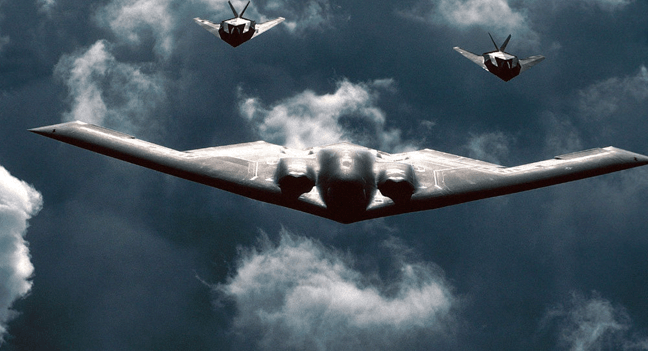
The U.S. Air Force arrived in South Korea Saturday and plans to participate in a joint aerial drill this week in South Korea. The drill is known as “Vigilant Ace” and it comes just a week after North Korea launched its most destructive ballistic missile. For more on the story here is Zachary Devita. Buzz60
South Korea’s military said the drills — a Guam-based bomber simulated land strikes at a field near South Korea’s eastern coast — “displayed the allies’ strong intent and ability to punish North Korea when threatened by nuclear weapons and missiles.”
Flyovers have become an increasingly familiar show of force to North Korea, which after three intercontinental ballistic missile tests and six nuclear tests has moved closer toward building a nuclear arsenal that could viably target the U.S. mainland.
Will Japan ‘rent’ nukes from US to counter North Korean threat?
‘Dual key’ nuclear weapons-sharing with Washington would save Tokyo trouble of developing own arsenal, protect alliance, Asia Times, DOUG TSURUOKADECEMBER 6, 2017, “……the unthinkable has become publicly thinkable. There’s widespread debate in Japan about whether the country should go nuclear – either by developing its own arsenal, or sharing such weapons with the US under a “dual key” arrangement, popularly known as “rent-a-nukes,” to counter the growing threat from North Korea……. http://www.atimes.com/article/will-japan-rent-nukes-us-counter-north-korean-threat/
Although Kim Jong Un has yet to impact the United States’ physical environment, his nuclear tests have already caused extensive damage on his own soil. Testing at the country’s Punggye-ri Nuclear Test Facility has caused a majority of the trees—about 80 percent—in the area to die, according to defectors from the region. The defectors, who were interviewed by The Research Association of Vision of North Korea, also noted that the underground wells no longer had water, according to a report published in Chosun Ilbo, a South Korean newspaper.
Another notable concern is the bomb’s potential to contaminate the area with radioactive material. Although North Korean government radiation levels came back normal in September, there’s the still risk of future leaks, especially if more tests are conducted, Chinese scientists told the South China Morning Post.
The scientists warned that another nuclear test under Mount Mantap could cause it to collapse and suffer a radiation leak.
“We call it ‘taking the roof off’: If the mountain collapses and the hole is exposed, it will let out many bad things,” Wang Naiyan, former chairman of the China Nuclear Society and senior researcher on China’s nuclear weapons program, told the South China Morning Post.
Radiation also would impact other forms of life.
“In areas where humans are killed or injured by radiation, the same lethality for animals would be expected. If large herds of farm animals were affected, poor sanitation could become a significant problem,” authors of the bookEffects of Nuclear Earth-Penetrator and Other Weapons wrote.
The authors noted that plants would get hit hard too, especially pine and spruce, which are among the species that are the most sensitive to radiation.
“It is conceivable that forests could be killed, which in turn could result in forest fires. The demise of the pine forest near the Chernobyl plant was one notable example of this effect,” the authors, who are part of the National Academies of Sciences, wrote.
Earth’s ozone layer would also take a large hit from nuclear blasts, according to a 2006 study. Climate scientists who conducted the research found that the extent of damage capable of nuclear weapons could impact the Earth for decades.
“Nuclear weapons are the greatest environmental danger to the planet from humans—not global warming or ozone depletion,” Alan Robock, a coauthor of the study published in the Journal of Geophysical Research, told The Guardian.
Why can’t we live with a nuclear North Korea?, The Week, GracyOlmstead 6 Dec 17 How do you “solve” the North Korea problem? This question has dominated U.S. foreign policy discussions for years. Former President Barack Obama warned President Trump before his inauguration that the small, poor, nuclear-armed country could pose the most urgent foreign policy challenge of his presidency.
Despite extensive economic sanctions and diplomatic pressure, North Korea continues to advance its military power. Last week, North Korea tested an intercontinental ballistic missile (ICBM) that could potentially reach the entire continental U.S. American politicians are scrambling to figure out how to respond.
Unfortunately, the first and primary position on the part of most U.S. policymakers has been panicked overreaction. Sen. Lindsey Graham (R-S.C.) told CNN, “If we have to go to war to stop this, we will. If there’s a war with North Korea it will be because North Korea brought it on itself, and we’re headed to a war if things don’t change.”…….
North Korea is an oppressive and dictatorial country, one that has committed a plethora of human rights atrocities against its citizens, and which uses propaganda and antagonism to anger its opponents on the world stage. We know this. But while concerning, this new step by North Korea is neither unexpected nor revolutionary. The fundamentals of the situation remain unchanged. Policymakers need to take a deep breath.
Calling for war or military strikes to remove their nuclear capabilities is a counterproductive and dangerous policy. U.S. resources and presence in the region are already considerable — as American University scholar Joshua Rovner explains, “The best way to deter nuclear powers from using their arsenals to act more conventionally aggressive is by maintaining local conventional superiority. This enhances deterrence without risking escalation, which in turn reduces questions about credibility and alleviates stress on alliances.”
South Korea’s President Moon Jae-in opposes preventive strikes in response to North Korea’s recent tests, and has expressed some concern that the U.S. might act prematurely. “We must stop a situation where North Korea miscalculates and threatens us with nuclear weapons or where the United States considers a pre-emptive strike,” he said at a recent emergency meeting in Seoul.
Attempting to overthrow or undermine North Korea’s regime would have massive implications for South Korea, as well as for China and North Korea’s vulnerable citizenry. In this instance, preventive military action would result in a bevy of unintended consequences, yet nobody in the Trump administration talks about this…….
Calling for war or military strikes to remove their nuclear capabilities is a counterproductive and dangerous policy. U.S. resources and presence in the region are already considerable — as American University scholar Joshua Rovner explains, “The best way to deter nuclear powers from using their arsenals to act more conventionally aggressive is by maintaining local conventional superiority. This enhances deterrence without risking escalation, which in turn reduces questions about credibility and alleviates stress on alliances.”
South Korea’s President Moon Jae-in opposes preventive strikes in response to North Korea’s recent tests, and has expressed some concern that the U.S. might act prematurely. “We must stop a situation where North Korea miscalculates and threatens us with nuclear weapons or where the United States considers a pre-emptive strike,” he said at a recent emergency meeting in Seoul.
Attempting to overthrow or undermine North Korea’s regime would have massive implications for South Korea, as well as for China and North Korea’s vulnerable citizenry. In this instance, preventive military action would result in a bevy of unintended consequences, yet nobody in the Trump administration talks about this.
…….”Maximum pressure” will not work with North Korea. The U.S. must instead consider a strategy that acknowledges North Korea’s purpose and personality — and one that inspires confidence and respect in our allies, most especially South Korea, whose confidence in usseems to have been shakenby recent events…….
Although a nuclear North Korea is far from ideal, descending into panic will not serve U.S. interests abroad, and it won’t keep America safe. The Trump administration must consider the dangerous ramifications of their belligerent stance toward North Korea, before they make a catastrophic miscalculation. http://theweek.com/articles/740247/why-cant-live-nuclear-north-korea
U.N. political chief makes rare visit to North Korea for ‘wide-ranging’ discussions, Japan Times, AP, AFP-JIJI, KYODO, STAFF REPORTUNITED NATIONS 5 Dec 17, –
The U.N.’s political chief, and America’s highest-ranking national in the U.N. Secretariat, arrived in North Korea on Tuesday to begin a rare four-day visit at the invitation of Pyongyang, for a “wide-ranging” discussion on policy issues “of mutual interest and concern.”
The trip comes a week after the isolated regime launched its most powerful missile to date, and during a massive joint air exercise by the U.S. and South Korea on the Korean Peninsula involving 230 aircraft and 12,000 American troops.
The highest-level U.N. official to visit North Korea in more than six years, U.N. Undersecretary-General for Political Affairs Jeffrey Feltman had met with China’s Vice Foreign Minister Li Baodong on Monday before setting off for North Korea’s capital the next day, according to U.N. spokesman Stephane Dujarric. Feltman was later confirmed to have arrived in Pyongyang, after being seen earlier Tuesday in a U.N.-flagged car at the Chinese capital’s international airport from which North Korea’s Air Koryo operates flights.
Asked whether Feltman would meet with North Korean leader Kim Jong Un, Dujarric said that his current schedule included meetings with Foreign Minister Ri Yong Ho, Vice Minister Pak Myong Guk, diplomats and U.N. staff for “wide-ranging” discussions.”………
Feltman’s visit comes at a time of heightened tensions between North Korea and South Korea, Japan and the United States, sparked by the reclusive country’s frequent missile launches and recent nuclear test, and particularly by its latest long-range ballistic missile launch.
Air drills put region on ‘brink of nuclear war’, warns North Korea, 9 News, By Richard Wood
The comments by North Korea represent rising escalation on the Korean peninsula and came as US National Security Adviser HR McMaster declared the possibility of war was “increasing” daily. Pyongyang described the drill as ‘warmongering’.
The five-day air drill called Vigilant Ace kicks off today over the Korean peninsula and involves 230 advanced warplanes from the South Korean and US air forces.
Commentary by Pyongyang’s Rodong Sinmun newspaper, carried by North Korea’s state media agency, criticised the exercise as a “dangerous provocation” propelling the region to “the brink of nuclear war”.
A total of 12,000 US personnel from the marines, navy and air force will take part in Vigilant Ace, reports The Wall Street Journal.
The aircraft flying from eight bases include the hi-tech F-22 Raptor and F-35 Lightning.
Both aircraft are more than a match for anything in North Korea’s largely Soviet-era air force and are cloaked in stealth coating, making them virtually invisible to enemy radar. Flying at 1930km/h, the F-35s can carry nuclear bombs and bunker-busting munitions, regarded as vital for targeting and destroying North Korea’s complex of military tunnels……. https://www.9news.com.au/world/2017/12/04/11/54/us-and-south-korean-air-drills-risk-war-north-warns
Those of us in the field of emergency preparedness shudder with the realization that a growing number of nations are joining the global thermonuclear arms race.
This reality is fraught with consequences that most people do not recognize, and frankly do not want to know.
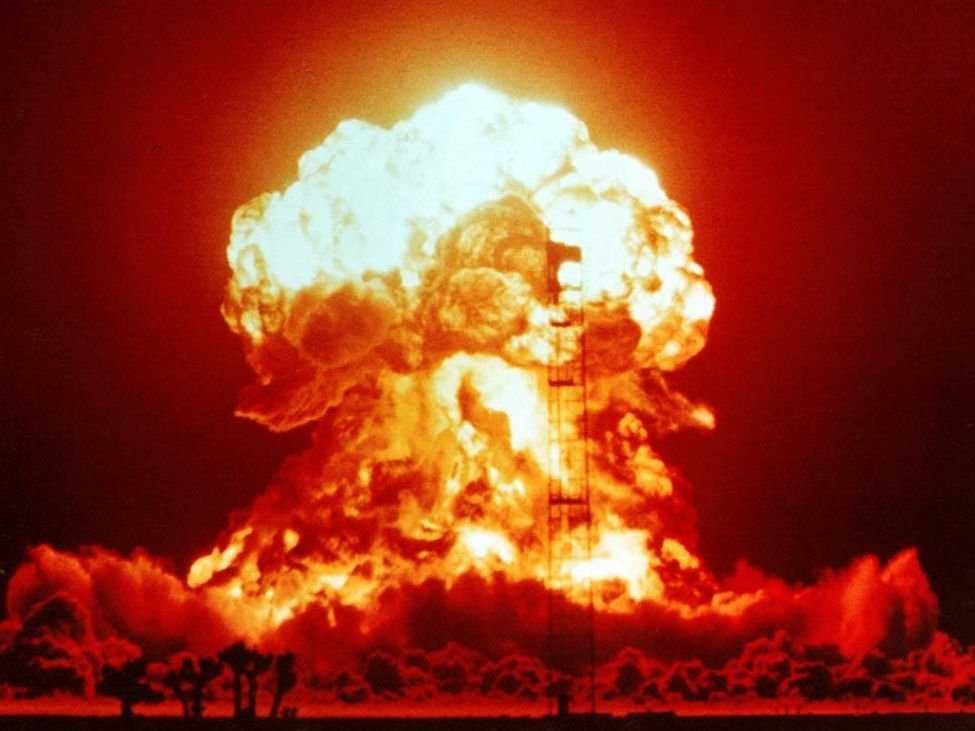
In a nutshell, thermonuclear weapons, colloquially known as H-bombs, produce much larger yields of destructive power than the nuclear weapons that countries tested in the early days of nuclear weapon development.
For example, the nuclear bombs that the U.S. dropped on Japan in 1945 were in the 15 to 20 kiloton yield. This means that they had the destructive power of an equivalent of 15,000 to 20,000 tons of dynamite.
In addition to killing about 100,000 people, these weapons cause thousands of traumatic injuries, thousands of radiation injuries and hundreds of thermal burn victims.
Compare that to a thermonuclear weapon which is in the range of 75 to 49,000 kilotons of destructive power. Used on a densely populated urban center like New York City or Tokyo, just one weapon would kill millions of people and produce millions of casualties.
Those numbers are devastating enough, but the real nightmare is that the number of thermal burn casualties greatly multiply with a thermonuclear weapon relative to a simple nuclear weapon.
A typical serious thermal burn injury in a well staffed hospital takes three to four medical personnel per patient to provide adequate care. When we have hundreds of thousands of surviving burn patients due to an urban thermonuclear detonation, we are not going to be able to treat even a tiny fraction of them.
Until now, only wealthy and advanced nations – the United States, Russia, China, the United Kingdom, France and Israel – were able to produce these massively destructive thermonuclear weapons.
Now, with poor and unstable North Korea joining the thermonuclear club, other small nations may realize that this previously difficult threshold may be within their technical reach.
Even worse, nations around the world know that the Earth is getting to be a much more dangerous place when a nation like North Korea has such weapons, and many will perceive that their national safety now depends on procuring these terrible devices as well.
In academic journals and in the media, there is talk of Indiaacquiring thermonuclear weapons on the fast track, which will pressure Pakistan to do the same. The sense of urgency is even touching nations that previously eschewed the development of nuclear weapons.
Even Japan – which by its constitution is significantly restricted in its armaments and has no nuclear weapons at all – could use its enormous stockpile of nuclear waste to rapidly develop an equally enormous stockpile of thermonuclear weapons.
Despite repeated headlines about the growing possibility of nuclear war, most people, curiously, avoid thinking or talking about it. In over a thousand lectures on nuclear war medical response, I find even medical audiences do not want to address the issue.
In fact, I recently published an assessment of U.S. and Asian emergency medical responders’ hypothetical response to a nuclear event which found a striking lack of knowledge about patients affected by radiation after nuclear war and a strong reluctance to treat them, even though it is far less dangerous than treating infectious disease patients.
This fear of radiation is just as pronounced in the general population. We had a very hard time getting the medical and public health community to adequately address this issue even when we were focused on the smaller, Hiroshima-sized weapons, where it is feasible to mount a credible response. Now, we have to discuss the grim prospect of responding to the global thermonuclear arms race that we are now in – and currently losing.
While nuclear nonproliferation remains a top priority, the preparation for responding to the actual use of these terrible weapons is now a regrettable necessity that we must confront.
Cham Dallas is the director of the Institute for Disaster Management at the University of Georgia.
Air drills put region on ‘brink of nuclear war’, warns North Korea, 9 News, By Richard Wood
The comments by North Korea represent rising escalation on the Korean peninsula and came as US National Security Adviser HR McMaster declared the possibility of war was “increasing” daily. Pyongyang described the drill as ‘warmongering’.
The five-day air drill called Vigilant Ace kicks off today over the Korean peninsula and involves 230 advanced warplanes from the South Korean and US air forces.
Commentary by Pyongyang’s Rodong Sinmun newspaper, carried by North Korea’s state media agency, criticised the exercise as a “dangerous provocation” propelling the region to “the brink of nuclear war”.
A total of 12,000 US personnel from the marines, navy and air force will take part in Vigilant Ace, reports The Wall Street Journal.
The aircraft flying from eight bases include the hi-tech F-22 Raptor and F-35 Lightning.
Both aircraft are more than a match for anything in North Korea’s largely Soviet-era air force and are cloaked in stealth coating, making them virtually invisible to enemy radar. Flying at 1930km/h, the F-35s can carry nuclear bombs and bunker-busting munitions, regarded as vital for targeting and destroying North Korea’s complex of military tunnels……. https://www.9news.com.au/world/2017/12/04/11/54/us-and-south-korean-air-drills-risk-war-north-warns
North Korea celebrates becoming a nuclear state with huge rally and firework display
Troops cheered, laughed and smiled as a beautiful firework display lit up Kim Il-Sung Square in Pyongyang
North Korea is celebrating the declaration by dictator Kim Jong-Un that the Stalinist state is a nuclear power
It comes after the dramatic launch of the long-range Hwasong-15 intercontinental ballistic missile on Tuesday
By Iain Burns Daily Mail. UK,
Thousands of North Korean soldiers have appeared at a rally today to celebrate after dictator Kim Jong-Un declared the Stalinist regime a nuclear power.
Troops cheered, laughed and smiled as a huge firework display lit up Kim Il-Sung Square in Pyongyang following the successful test of the Hwasong-15 intercontinental ballistic missile on Tuesday.
State media reported that North Korea‘s leader Kim Jong-Un had declared the country had achieved the ‘historic cause’ of becoming a nuclear state on November 29……..
The Pentagon said the test missile traveled about 620 miles and landed within 200 nautical miles of Japan’s coast.
In a broadcast on state TV, North Korea said the missile reached an altitude of around 2,780 miles – more than 10 times the height of the international space station – and flew 600 miles during its 53 minute flight.
North Korea deliberately fires its missile on a near-vertical trajectory to artificially limit the range.
Tokyo, 1 December 2017 – On 30 November, Kansai Electric and Kyushu Electric announced that they are delaying the restart of four nuclear reactors for approximately two months due to ongoing investigations into Kobe Steel components. Greenpeace is calling for the immediate shutdown of operating reactors, owned by these same utilities, that may also have defective Kobe Steel components at the Takahama and Sendai plants.
While Kansai Electric has delayed operation of Ohi 3 and 4 reactors, it continues to operate its two reactors at Takahama. Similarly, Kyushu Electric has delayed operation of Genkai 3 and 4, while continuing to operate its two reactors at Sendai.
“If Kansai Electric and Kyushu Electric are delaying restart of the Ohi and Genkai reactors due to the need to conduct investigations, how can they justify continued operation of the reactors at Takahama and Sendai? The NRA has so far failed in its responsibilities as a regulator to get to grips with this rapidly evolving scandal. It must set aside nuclear industry interests and prioritize inspections. That includes shutting down operating reactors that may have defective parts until and unless safety can be guaranteed.” said Kazue Suzuki, Energy Campaigner Greenpeace Japan.
More than a month ago, Greenpeace Japan warned that there were potentially major safety risks with Kobe Steel components installed in reactors that warranted strong intervention by the NRA.[1] On 24 October, Greenpeace Japan, along with other citizens groups, submitted evidence to the NRA of Kobe Steel’s extensive supply chain to the nuclear industry, demonstrating the pervasiveness of the potential problems.[2] We called on the agency to take urgent action to launch a comprehensive investigation into the supply and widespread use of potentially flawed Kobe Steel products in the Japanese nuclear industry. Included in the demands were calls for the suspension of restart plans for the Ohi, Genkai reactors, and shutdown of the four reactors Takahama and Sendai.
As of today, the NRA has yet to issue detailed written instructions to all reactor operators to investigate the use of potentially faulty Kobe Steel components. Instead, submissions have been made by 6 of the 11 nuclear utilities and lack any substantial information and analysis.
In one example, On 13 October, it was confirmed that Shinko Metal Products Co., owned by Kobe Steel, supplied tubes to the Tokyo Electric Power Company (TEPCO) for use in heat exchangers at the Fukushima Daini nuclear plant but failed to conduct required inspections.[3 & 4]
For further information:
[1] The letter was signed by Green Action, Mihama-no-kai, Citizens Nuclear Information Center, Citizen’s Watch on Nuclear Regulator, Friends of the Earth Japan, and Greenpeace Japan
[2] The Kobe Steel Group Supply Chain to the Nuclear Industry And Safety Implications (Greenpeace Japan Briefing Paper)
[3] See the TEPCO’s announcement (in Japanese)
[4] For more information on the risks of faulty steel in these components, see: “Irregularities and anomalies relating to nuclear reactor primary coolant circuit components installed in Japanese nuclear power plants”
A ‘preventive strike’ against North Korea would trigger ‘nuclear retaliation’
On Tuesday, North Korea test fired what experts believe is its most advanced long range, nuclear-capable missile yet.
In response, Sen. Lindsey Graham told CNN “If we have to go to war to stop this we will.”
A preventive strike against North Korea is not feasible and would have devastating consequences. The best path is still diplomacy. Lt. Col. Daniel L. Davis, USA, Ret. CNBC , 1 December 17,
On Tuesday, North Korea test fired what experts believe is its most advanced long range, nuclear-capable missile yet. In response, U.S. Sen. Lindsey Graham (R-SC) bluntly told CNN’s that Trump will not allow North Korea to even possess a nuclear missile capable of hitting the U.S.”If we have to go to war to stop this we will,” he said. “We’re headed towards a war if things don’t change.”If Sen. Graham’s binary choice accurately reflects the president’s thinking, then war will come, and millions could die, including thousands of Americans. Such a war is too costly to seriously consider absent an imminent attack.
It is difficult to overstate the negative consequences that would result should President Trump order any type of “preventive” military strike—that is, an attack to deprive them of a capability rather than to stop an actual, imminent launch—against North Korea.
Choe Kang-il, Deputy Director General for North American affairs at North Korea’s foreign ministry recently told the New York Times, “If the United States even hints at a strike on North Korea, we will proceed with a preemptive attack on the U.S.”In case some are tempted to think these threats are merely bluster by the Kim regime, they were echoed almost precisely last month in congressional testimony by the highest ranking North Korean official ever to defect.
Former diplomat Thae Yong-ho told members of Congress North Korean officers are trained to fire their weapons “without any further instructions from the general command if anything happens on their side.” Their response would be immediate and devastating.
Consider the most dangerous course of action: this latest test, reportedly fired from a mobile launcher, indicates North Korea has the ability to launch nuclear-tipped missiles. If the United States tries to take out launch points, or even a massive and sustained bombing campaign in an attempt to destroy their ability to retaliate, we will inflict extraordinary damage—but it is unlikely our attacks would successfully penetrate all their mountain bunkers.
That leaves the possibility that Kim Jong-un would order a mobile launcher to emerge from its protective bunker, and in retaliation, send a nuclear missile crashing into Guam, Hawaii, or Seattle.
Such an act would not be a fringe possibility were the U.S. to launch any type of “preventive” armed attack; it would be a likely outcome.
The window of opportunity to strike North Korea without risk of nuclear retaliation closed many years ago. For more than a decade, it has been impossible to take out North Korea’s ability to launch conventional and nuclear retaliatory strikes against our allies—the only recent development is that our homeland may now also be at risk of a counterstrike.