All utilities lack disposal sites for low-level waste from reactors http://www.asahi.com/ajw/articles/AJ201802160049.htmlBy TSUNEO SASAI/ Staff Writer, February 16, 201 8
Seven electric power companies that plan to decommission nuclear reactors have yet to secure disposal sites for the low-level radioactive waste produced in the dismantling process, an Asahi Shimbun survey showed on Feb. 16.
It may take years for the utilities to gain approval from local governments to dispose of the waste, some of which must remain buried for 100,000 years, meaning that the decommissioning work could be suspended.
Low-level radioactive waste generated during conventional operations of nuclear reactors can be buried at a disposal site of Japan Nuclear Fuel Ltd. in Rokkasho, Aomori Prefecture.
However, the electric power companies themselves must dispose of the low-level radioactive waste produced during decommissioning work.
The Asahi Shimbun asked 10 electric power companies, including Japan Atomic Power Co., about whether they have secured disposal sites for low-level radioactive waste.
Seven companies–Tokyo Electric Power Co., Chubu Electric Power Co., Kansai Electric Power Co., Chugoku Electric Power Co., Shikoku Electric Power Co., Kyushu Electric Power Co. and Japan Atomic Power–replied that they have not secured sites despite their plans to decommission reactors.
In total, they plan to decommission 17 reactors.
The demolition of a 1.1 gigawatt-class nuclear reactor produces more than 10,000 tons of low-level radioactive waste.
The three other companies–Hokkaido Electric Power Co., Tohoku Electric Power Co. and Hokuriku Electric Power Co.–also have not secured disposal sites, but they have no decommissioning plans at the moment.
“We are not considering decommissioning our nuclear reactors,” a Hokuriku Electric Power official said. “As of now, we have not yet decided on a plan to secure disposal sites.”
There are three categories of nuclear waste–L1, L2 and L3–depending on their radioactivity levels.
L1 waste, which has the highest radioactivity level and includes control rods, must be buried more than 70 meters deep into the ground for 300 to 400 years.
After that, the government manages the waste for 100,000 years.
The government is currently studying regulation standards for such waste.
Electric power companies decided to decommission some of their nuclear reactors after the March 2011 disaster unfolded at the Fukushima No. 1 nuclear power plant.
Full-fledged decommissioning work is expected to start soon, but parts removed from the reactors have high radiation levels and cannot be placed temporarily in the compounds of nuclear power plants.
High-level radioactive waste is also produced as a result of the reprocessing of spent nuclear fuel. The government is looking for a disposal site for such waste.
Electric power companies could heighten their demands that the government get involved in efforts to secure disposal sites for low-level radioactive waste.
February 17, 2018
Posted by Christina Macpherson |
Japan, wastes |
Leave a comment
https://www.japantimes.co.jp/news/2018/02/15/business/japan-posts-delivery-vehicles-measure-radiation-fukushima/#.WodGLVpubGg, JIJI FUKUSHIMA – Japan Post Co. and the Fukushima Prefectural Government have signed a comprehensive partnership agreement that includes a plan for it to measure radiation in areas tainted by the 2011 nuclear disaster.
“The agreement is very assuring, as we will be able to receive support for efforts on the safety and security of the region,” Gov. Masao Uchibori said during the signing ceremony at the prefecture’s office on the same day.
It is the 15th time the unit of Japan Post Holdings Co. has concluded an agreement with a prefectural government.
Under the plan, Japan Post’s delivery minivehicles will be equipped with radiation gauges. Data will be collected automatically and wirelessly transmitted to the prefectural government. The prefecture’s coast was heavily damaged by the March 2011 mega-quake and tsunami, while much larger parts of it were contaminated by radiation by the subsequent core meltdowns at the Fukushima No. 1 nuclear plant, run by Tokyo Electric Power Company Holdings Inc.
In addition, the two parties agreed that posters to promote Fukushima goods will be put up at post offices in areas around Tokyo, in Fukushima and five other prefectures in the Tohoku region.
Japan Post’s delivery staff will also alert the prefectural government and others when several days’ worth of newspapers are seen accumulating outside of the homes of elderly people, and when damage to roads is observed.
“We will provide maximum assistance for Fukushima Prefecture’s revitalization,” said Kunio Yokoyama, president of Japan Post.
February 17, 2018
Posted by Christina Macpherson |
environment, Fukushima continuing, radiation |
Leave a comment
 World Nuclear News 15th Feb 2018, Holtec International and GE Hitachi Nuclear Energy (GEH) are to collaborate
on accelerating the commercialisation of Holtec’s SMR-160 small modular
reactor (SMR). Their cooperation will initially include nuclear fuel
development and control rod drive mechanisms. Under a memorandum of
understanding, GEH, Global Nuclear Fuel (GNF), Holtec and SMR Inventec LLC
(SMR LLC) have agreed to enter into a “procompetitive collaboration” to
progress the SMR-160. GNF, a GE-led joint venture with Hitachi and Toshiba,
is primarily known as a supplier of boiling water reactor fuel. SMR LLC is
a wholly-owned subsidiary of Holtec established in 2011 to manage the
development of the SMR-160.
http://www.world-nuclear-news.org/NN-Holtec-and-GEH-team-up-on-advancing-SMR-160-1502184.html
February 17, 2018
Posted by Christina Macpherson |
Japan, Small Modular Nuclear Reactors, USA |
Leave a comment
 The West risks missing a chance at peace if it continues to treat North Korea’s change of heart with cynicism Could it be that Trump’s bombast over the airwaves cut through in Pyongyang in a way that conventional diplomacy had failed to do? The Independent UK, Mary Dejevsky @IndyVoices 16 Feb 18
“”…………The mixed messages about the North Korean skaters, however, highlighted – or so it seemed to me – something else: a reluctance on the part of the foreign policy establishment, including the media, to look good news in the face, especially when it has not been expected.
How long ago was it –in fact, a bare six weeks – that Kim Jong-un and the US President were trading very public, very macho, insults, culminating in Donald Trump’s memorable boast that his nuclear button was “much bigger and more powerful” than Kim’s and, what is more, “my button works”.
Even the most hardened pessimist would have to admit that between then and now there has been something of a mood swing. Less than three weeks after the “big button” exchange, North Korea suddenly acted on overtures in Kim’s New Year address to broach talks with the South, and even participated in the Olympics. The IOC delayed its deadline for entries, permitted North Korea’s participation, and the next thing we knew was that North and South were concocting a joint ice hockey team, the North’s nonagenarian de facto head of state was on his way to Seoul, and Kim announced that his sister – his sister – would be going to the opening ceremony, too.
Far from hailing these developments as the possible start of a North-South thaw, however, the Western response seemed – to me, at least, – both fearful and curmudgeonly. Kim Jong-un was suspected of the basest of motives. Might he not be deviously stringing the South along, it was asked, just waiting to demand all sorts of impossible concessions at the last moment that would cast the Seoul government as the villain if it refused?
And was Kim not also staging a vast military parade in Pyongyang on the eve of the official Olympic opening? Well, of course, he was. No self-respecting national leader, least of all an autocrat in the mould of Kim, can be seen to be weak in front of his own people. Shows of strength have a habit of going hand in hand with diplomatic U-turns.
As the North Korean nuclear threat vanished from the headlines, however, it was only to be replaced with another menace from the North. Kim’s very presentable little sister, Kim Yo-jong, was accused of stealing the limelight, diluting the world’s attention that should have been Seoul’s, and presenting an image of the North that was scandalously at odds with the cruel and earth-scorched reality. Don’t allow yourself to be fooled, was the message.
That she was received in Seoul at the highest level and filmed handing over an invitation to President Moon Jae-in to visit Pyongyang was also somehow seen as out of order, another trick to gain diplomatic advantage. Surely it would all turn sour even before the Olympic glow over the South had faded. The North Korean threat was still there.
Far from hailing these developments as the possible start of a North-South thaw, however, the Western response seemed – to me, at least, – both fearful and curmudgeonly. Kim Jong-un was suspected of the basest of motives. Might he not be deviously stringing the South along, it was asked, just waiting to demand all sorts of impossible concessions at the last moment that would cast the Seoul government as the villain if it refused?
And was Kim not also staging a vast military parade in Pyongyang on the eve of the official Olympic opening? Well, of course, he was. No self-respecting national leader, least of all an autocrat in the mould of Kim, can be seen to be weak in front of his own people. Shows of strength have a habit of going hand in hand with diplomatic U-turns.
As the North Korean nuclear threat vanished from the headlines, however, it was only to be replaced with another menace from the North. Kim’s very presentable little sister, Kim Yo-jong, was accused of stealing the limelight, diluting the world’s attention that should have been Seoul’s, and presenting an image of the North that was scandalously at odds with the cruel and earth-scorched reality. Don’t allow yourself to be fooled, was the message.
That she was received in Seoul at the highest level and filmed handing over an invitation to President Moon Jae-in to visit Pyongyang was also somehow seen as out of order, another trick to gain diplomatic advantage. Surely it would all turn sour even before the Olympic glow over the South had faded. The North Korean threat was still there.
Nor should the use by potentates – and not just potentates – of close relatives as personal representatives and trusted go-betweens – be discounted as a ploy. Rather than being designed to detract from the South’s Olympic show, Kim Jong-yo’s trip to Seoul might rather be seen as evidence of her brother’s serious intent and esteem.
And what might have changed the equation? How about the US Secretary of State’s low-key offer of direct talks without preconditions that he made in December? Repeated in Seoul by Vice-President Mike Pence this week (once he had done cold-shouldering the North Koreans for the benefit of the US audience back home), this is what first broke the deadlock. There have been concessions on all sides.
So while the doomwatchers see the Olympic thaw as, at best, a deceptive interlude before the nuclear stand-off inevitably resumes, I would argue, for more optimism. A basis has been laid for detente; there is a real chance now to step back from the brink. The risk now is less that the North is insincere, than that suspicion and cynicism everywhere cause this chance to be missed. http://www.independent.co.uk/voices/north-korea-war-nuclear-us-uk-europe-world-peace-conflict-a8212656.html
February 16, 2018
Posted by Christina Macpherson |
North Korea, politics international, USA |
Leave a comment
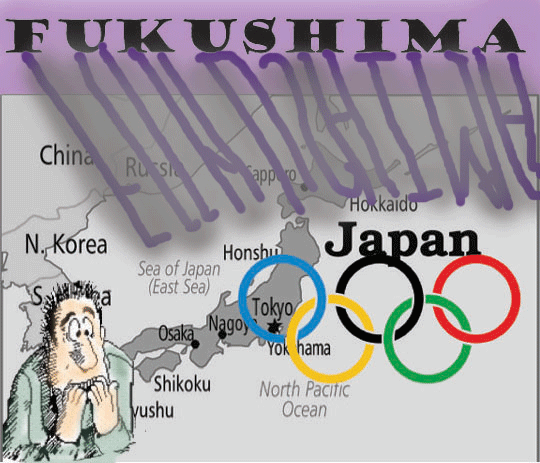 Japan, IAEA agree to cooperate on Tokyo 2020 nuclear counterterrorism, Nikkei Asian Review, 16 Feb 18, VIENNA (Kyodo)
 — The Japanese government and the International Atomic Energy Agency signed an agreement on Thursday to work together to keep the Tokyo 2020 Olympics and Paralympics safe from the threat of terrorism involving nuclear materials.
According to the Japanese Foreign Ministry, the agreement includes measures to support IAEA experts’ participation in events relating to the Tokyo games, the exchange of information on nuclear security issues and the loan to Japan of equipment to detect radiation.
Foreign Minister Taro Kono and IAEA Director General Yukiya Amano observed the signing in Vienna before holding a meeting at which Kono said they agreed to flesh out cooperation in thwarting nuclear terrorism.
“We want to thoroughly cooperate with the IAEA to make sure the Olympics are safe,” Kono said at the outset of the meeting……..https://asia.nikkei.com/Politics-Economy/International-Relations/Japan-IAEA-agree-to-cooperate-on-Tokyo-2020-nuclear-counterterrorism
February 16, 2018
Posted by Christina Macpherson |
Japan, safety |
Leave a comment
Has North Korea’s week at the Winter Olympics diminished the nuclear threat? Guardian, Tania Branigan, 15 Feb 18, “……Pyongyang has no intention of giving up its nuclear programme, as Washington demands. Although it has in the past committed itself to peaceful reunification, no one believes it is willing to change in the way that it would be needed. The real issue is that the doomsday clock is ticking closer to midnight since the election of Donald Trump – and any attempt to halt the hands is welcome.
The North is increasingly close to developing a nuclear-tipped ICBM that can hit the continental US. Washington knows it cannot destroy all the country’s capabilities – so hawks are now arguing for a “bloody nose” strategy to warn Kim Jong-un off threatening the US (though he must know any attack would be suicidal). Seoul, just 35 miles from the border, would bear the brunt of any retaliation. A conflict could kill tens of thousands and potentially draw in other regional powers, including China.
“There’s a real concern that for the first time there is a US administration that could take unilateral action against
North Korea without consulting the South,” says Professor Hazel Smith of the centre of Korean studies at Soas Univeristy of London. “People are pushing, virtually preparing, for a so-called ‘surgical strike’ – even though the majority of US and South Korean military planners argue that it would be risky to the point of likely catastrophe for the South, and US troops there.
“The Olympic initiative was never going to solve the nuclear question overnight, but I think it has stopped the mad escalation of the conflict that was going on.”
The task of Kim Yo-jong and the bevy of cheerleaders has been to normalise the image of a country that looks utterly abnormal to outsiders. ………
Kim has cemented his position, in part through tighter control. He purged and executed his uncle Jang Song-thaek; and he is believed to have ordered the killing of his self-exiled brother, Kim Jong-nam, a year ago. There have been repeated crackdowns on smuggled – especially South Korean – media.
On the other hand he has promised his people a return to prosperity, and though this has mostly been signalled by totemic projects such as a ski resort, there have been some broader economic shifts, such as an increase in marketisation, apparently producing modest improvements in the economy. And, in dispatching the Olympic delegation, and then inviting the South Korean president Moon Jae-in to visit him, he has shown he can reduce tensions as well as increase them.
Sending his sister was doubly inspired. A family member is a more intimate representative than a high-ranking official. And for a patriarchal culture, Kim Yo-jong and the cheerleaders are – by virtue of gender – not only charming and unthreatening but somehow morally elevated, detached from worldly, manly concerns of power (never mind that, in reality, Kim is at the heart of her brother’s regime). ……..
Is the North’s participation in Pyeongchang a first step to denuclearisation and eventual reunification? No. Events in Iraq and Libya hardened the regime’s beliefs that hanging on to WMDs is a matter of survival. The thaw may not even be a precursor to substantive reengagement with the South, or broader talks, let alone a breakthrough (although the North might freeze its programme if offered a cast-iron US security guarantee, it is hard to see that happening under Trump). But if the softening of the North’s image and approach make it harder for US hawks to strike, then Seoul – and the rest of us – should be grateful for those synchronised chants and armwaves.
https://www.theguardian.com/world/2018/feb/14/what-north-koreas-week-at-the-winter-olympics-tells-us-about-the-nuclear-threat
February 16, 2018
Posted by Christina Macpherson |
North Korea, politics international, USA |
Leave a comment

Kobe Steel firm suspected of nuclear waste data falsification http://www.asahi.com/ajw/articles/photo/AS20180215003253.html, By MASANOBU HIGASHIYAMA/ Staff Writer,February 15, 2018
A subsidiary of Kobe Steel Ltd. may have falsified test data on highly radioactive waste disposal, the Nuclear Regulation Authority (NRA) announced on Feb. 14.
Kobelco Research Institute Inc. is suspected of tampering with data it gathered on behalf of the Japan Atomic Energy Agency (JAEA), which is contracted to carry out tests by the NRA.
The aim of the tests is to help form a regulatory standard for final disposal sites for nuclear waste, but a report the NRA received from the JAEA said that figures in the original data and those in reports Kobelco submitted to it did not match. Furthermore, some original data could not be located.
The NRA has instructed the JAEA to confirm details about the possible data falsification in response to the report.
A Kobelco source said, “Why data inconsistencies occurred remains unknown at the moment,” but that the research institute “will examine the case with data falsification in mind.”
The tests are designed to examine what happens to metal cladding tubes that had previously contained spent nuclear fuel when they are disposed of deep underground, including possible corrosion and by-products of gas, according to the NRA.
The nuclear watchdog outsourced the testing to the JAEA in fiscal 2012 through fiscal 2014 at a cost of about 600 million yen ($5.59 million).
Kobelco was subcontracted to undertake some of the tests for about 50 million yen.
February 16, 2018
Posted by Christina Macpherson |
Japan, secrets,lies and civil liberties |
Leave a comment
 Is Japan About to Hit Its Nuclear Tipping Point? Tokyo almost built a bomb in 1945 and now has enough plutonium stockpiled for 5,000 nukes. North Korea may give its hawkish government an excuse to build them. The Daily Beast, JAKE ADELSTEIN 02.15.18 TOKYO—“Don’t be fooled by North Korea’s smiley-face diplomacy,” Japan’s foreign minister, Taro Kono, warned last week in the middle of the Winter Olympics’ warm fuzzy photo ops with Hermit Kingdom emissaries.
Kono’s skepticism was quite serious, as is the confrontation he sees looming. Earlier this month he shocked Japan by broaching the idea that the Japanese should gain access to “usable” nuclear weapons, and he lavished praise on U.S. President Donald Trump’s Nuclear Posture Review.
While much of the rest of the world was entranced by North Korean cheerleaders and Kim Jong Un’s baby sister, Japan was quietly considering if and when to build its own nuclear missiles to discourage North Korea from so much as contemplating a missile strike.
The hawkish government of Prime Minister Shinzo Abe and his ruling coalition are exploiting real and unreal fears of a North Korean nuclear attack to drum up support for a Japan that can wage war, and possibly as a prelude to pushing harder for nuclear weapons development.
At a minimum, it should be apparent to the world that this administration has no interest in nuclear disarmament, and is preparing for a possible showdown.
This week, The Ministry of Culture, Education and Science announced that in the Risk Management manual distributed to schools nationwide, it would be urging teachers to conduct missile evacuation drills. That should ratchet up the paranoia a few notches.
North Korean leader Kim Jong Un announced last year that his country’s nuclear program is now complete, after the “successful” launch of a new missile that threatens all of the continental United States. But Japan has been in the crosshairs of the hermit kingdom for some time, and the storm over Kim’s atomic posturing has reignited a simmering, almost taboo, debate about nuclear weapons here.
The question isn’t whether Japan could become a nuclear weapons power. There’s really no doubt about that. But should it? And when? And if so, politically, how?
Japan As A Nuclear Power
Japan’s consumer nuclear energy industry has generated enough plutonium to make an estimated 5,000 nuclear warheads, this has long stood as an implicit threat. As former Defense Minister Satoshi Morimoto once declared, Japan’s commercial nuclear power reactors have “very great defensive deterrent functions.” He was implying that the plants Japan has built to make reactor fuel could be used to make fuel for nuclear arms, if Japan ever decides to do so.
In case anyone missed the point, in the spring of 2016, the Abe government explicitly stated that there is nothing in the nation’s Constitution that forbids pacifist Japan from possessing or using nuclear weapons……… https://www.thedailybeast.com/is-japan-about-to-hit-its-nuclear-tipping-point
February 16, 2018
Posted by Christina Macpherson |
Japan, weapons and war |
Leave a comment
Nikkei Asian review 14th Feb 2018, American
concerns about potential diversion of idle fuel leave the agreement at
risk.
The decision Jan. 16 to automatically extend a nuclear agreement with
the U.S. came as a relief to a Japanese government worried about the
prospect of renegotiating the basis for a cornerstone of its energy policy.
But friction remains over a massive store of plutonium that highlights the
problems with the nation’s ambitious nuclear energy plans. The nuclear fuel
cycle pursued by Japan’s government and power companies centers on
recovering uranium and plutonium from spent fuel for reuse in reactors.
This is made possible by the unique agreement with the U.S. that lets Japan
make plutonium. The radioactive element can be used in nuclear weapons, so
its production is generally tightly restricted. Japan has amassed roughly
47 tons of plutonium stored inside and outside the country — enough for
some 6,000 nuclear warheads. With the nation’s nuclear power plants
gradually taken offline after the March 2011 Fukushima Daiichi disaster,
and progress on restarting them sluggish, Japan has been left with no real
way to whittle down a pile drawing international scrutiny.
https://asia.nikkei.com/Politics-Economy/International-Relations/Japan-s-plutonium-glut-casts-a-shadow-on-renewed-nuclear-deal
February 16, 2018
Posted by Christina Macpherson |
- plutonium, Japan |
Leave a comment
 Kim Jong-un’s rocket men: North Korea’s ‘key men’ behind nuclear weapons arsenal, Express UK MEET the Megaton Twins – the two scientists Kim Jong-un can thank for his terrifying nuclear arsenal, according to experts. Michael Madden, who works with the 38 North watchdog, said Hong Sung-mu and Ri Hong-sop were crucial to the weapons programme’s success. Feb 13, 2018
With their help, North Korea went from detonating suspected duds in 2006 to its current nukes, which are up to 18 times more powerful than the Hiroshima bomb.
And with the regime’s latest missile – the Hwasong-15 – theoretically able to reach Washington DC, their weapons are more threatening than ever.
Mr Madden said there were a number of people who’d contributed to North Korea’s nuclear weapons over the years.
But he said Ri Hong-sop, the head of North Korea’s Nuclear Weapons Institute, and Hong Sung-mu, were the “key people” now……. https://www.express.co.uk/news/world/918460/North-korea-news-nuclear-war-weapons-kim-jong-un-world-war-3-donald-trump-rocket-man
February 14, 2018
Posted by Christina Macpherson |
North Korea, weapons and war |
Leave a comment

 China nuclear reactor delayed again on ‘safety concerns’ https://www.cnbc.com/2018/02/12/china-nuclear-reactor-delayed-again-on-safety-concerns.html
- Fuel loading at the world’s first Westinghouse-designed AP1000 nuclear reactor on China’s east coast has been delayed due to “safety concerns” — the latest in a long line of setbacks for the project.
- Officials with the U.S.-based Westinghouse had expected fuel loading to start last year, and it would have been followed by around six months of performance tests before the reactor could go into full operation in 2018.
Fuel loading at the world’s first Westinghouse-designed AP1000 nuclear reactor on China’s east coast has been delayed due to “safety concerns” — the latest in a long line of setbacks for the project, the China Daily reported on Tuesday.
The third-generation reactor, located in Sanmen in Zhejiang province, was originally expected to make its debut in 2014.
Officials with U.S.-based Westinghouse had expected fuel loading to start last year, and it would have been followed by around six months of performance tests before the reactor could go into full operation in 2018.
But fuel loading has now been suspended as China tries to ensure the project meets the highest possible safety standards, the China Daily said, citing a spokesman with the China National Nuclear Corporation (CNNC).
Westinghouse was not immediately available for comment when contacted by Reuters on Tuesday.
Westinghouse, owned by Japan’s Toshiba, signed an agreement in 2007 to build four AP1000 reactor units at two sites in China, hoping the projects would serve as a shop window for the firm.
But the company filed for bankruptcy last March, hit by billions of dollars of cost overruns at four nuclear reactors under construction in the United States.
China was originally seen as the lifeline for the global nuclear sector, with the country keen to approve dozens of new reactor projects to ease its dependence on polluting coal-fired electricity.
China is currently targeting total installed nuclear capacity of 58 gigawatts by the end of 2020, up from 35.8 gigawatts by the end of last year. It also said it would aim to have another 30 gigawatts under construction by the end of the decade.
But the pace of planned nuclear construction in the country was scaled back in 2011 in the wake of the Fukushima disaster in Japan.
Delays to the Sanmen and Haiyang AP1000 projects, as well as the French-designed European Pressurised Reactor units at Taishan in Guangdong province, have held back the sector, and no new nuclear project has been approved in China in two years.
China’s nuclear firms are currently building their own homegrown third-generation reactor design known as the Hualong One.
February 14, 2018
Posted by Christina Macpherson |
China, safety |
Leave a comment
Pak developing new types of nuclear weapons: US, Economic Times, Feb 13, 2018,
Pakistan is developing new types of nuclear weapons, including short-range tactical ones, that bring more risks to the region, America’s intelligence chief warned today.
Director of National Intelligence Dan Coats’ remarks came days after a group of Pakistan -based Jaish-e-Mohammad terrorists struck the Sunjuwan Military Camp in Jammu on Saturday , killing seven people including six soldiers.
“Pakistan is developing new types of nuclear weapons, including short-range tactical weapons,” Coats told lawmakers during a Congressional hearing on worldwide threats organised by the Senate Select Committee on Intelligence.
Pakistan continues to produce nuclear weapons and develop n ew types of nuclear weapons, including short-range tactical weapons, sea-based cruise missiles, air-launched cruise missiles, and longer-range ballistic missiles, he warned.
“These new types of nuclear weapons will introduce new risks for escalation of dynamics and security in the region,” Coats said, reflecting on the risks involved in developing such types of nuclear weapons. …….https://economictimes.indiatimes.com/news/defence/pak-developing-new-types-of-nuclear-weapons-us/articleshow/62907167.cms
February 14, 2018
Posted by Christina Macpherson |
Pakistan, weapons and war |
Leave a comment
The Nation 11th Feb 2018, Indian army chief calls our strategic and tactical nuclear capability `a bluff’. His view may be rooted in India’s own bitter enrichment experience (1980-1985).
Ramana points out during initial operations that India’s enrichment plant `had frequent breakdown as a result of corrosion and failure of parts’. `Many leaders of Indian Department of Atomic Energy held that uranium enrichment was very difficult and were skeptical of Pakistani claims that they had succeeded in enriching uranium to weapons grade levels’.
From day one, India’s nuclear programme has been dual-use oriented. Nehru never ruled out the nuclear option for India . He wrote to Homi Bhabha `Apart from building power stations and developing electricity there is always a built-in advantage of defence use [of nuclear enrichment] if the need should arise’. According to Srinivasan, former head of Indian Atomic Energy Commission, `Nuclear technology was developed by a country for its own benefit, whether for peaceful purposes or military applications’.
https://nation.com.pk/11-Feb-2018/unmasking-india-s-secret-nuclear-capability
February 14, 2018
Posted by Christina Macpherson |
India, weapons and war |
Leave a comment
 Drone to probe Fukushima N-plant interior, The Japan News , 10 Feb 18 The Yomiuri Shimbun Tokyo Electric Power Company Holdings Inc. plans to use a small unmanned aerial vehicle to closely inspect conditions inside the No. 3 reactor building of the Fukushima No. 1 nuclear power plant as early as this month.
TEPCO will use the drone to examine the location of scattered debris and the level of radiation inside the reactor building, among other things.
It will be the first drone-based research conducted inside the plant’s Nos. 1, 2 and 3 reactor buildings, in which nuclear meltdowns occurred.
……..TEPCO’s plan is for the drone to enter the No. 3 reactor building through a bay for large cargo on the first floor, then fly upward through a series of openings from the first to the fifth floor.
The drone will check areas including the building’s third floor, which has not been sufficiently monitored because radiation levels are too high.
According to TEPCO, key equipment such as that used to cool spent nuclear fuel pools are located on the third floor.
Confirming the location of possible obstacles and the level of radiation is necessary before decommissioning work can progress.
………Work is currently under way to construct a dome-shaped roof over the building to facilitate the removal of fuel that remains in the spent fuel storage pools. http://the-japan-news.com/news/article/0004230028
February 12, 2018
Posted by Christina Macpherson |
Fukushima continuing |
Leave a comment