Officials confirm that Indian nuclear power plant’s network was hacked
 Indian nuclear power plant’s network was hacked, officials confirm
After initial denial, company says report of “malware in system” is correct. SEAN GALLAGHER – 10/31/2019
The Nuclear Power Corporation of India Limited (NPCIL) has acknowledged today that malware attributed by others to North Korean state actors had been found on the administrative network of the Kudankulam Nuclear Power Plant (KKNPP). The admission comes a day after the company issued a denial that any attack would affect the plant’s control systems.
In a press release today, NPCIL Associate Director A. K. Nema stated, “Identification of malware in NPCIL system is correct. The matter was conveyed by CERT-In [India’s national computer emergency response team] when it was noticed by them on September 4, 2019.”
That matches the date threat analyst Pukhraj Singh said he reported information on the breach to India’s National Cyber Security Coordinator.
“The matter was immediately investigated by [India Department of Atomic Energy] specialists,” Nema stated in the release. “The investigation revealed that the infected PC belonged to a user who was connected to the Internet connected network used for administrative purposes. This is isolated from the critical internal network. The networks are being continuously monitored.”
Lazarus in the house
It’s not clear if data was stolen from the KKNPP network. But the nuclear power plant was not the only facility Singh reported being compromised. When asked by Ars why he called the malware attack a “casus belli”—an act of war—Singh, a former analyst for India’s National Technical Research Organization (NTRO), said, “It was because of the second target, which I can’t disclose as of now.”
The malware in question, named Dtrack by Russian malware protection company Kaspersky, has been used in widespread attacks against financial and research centers, based on Kaspersky data collected from over 180 samples of the malware. Dtrack shares elements of code from other malware attributed to the Lazarus threat group, which, according to US Justice Department indictments, is a North Korean state-sponsored hacking operation. Another version of the malware, ATMDtrack, has been used to steal data from ATM networks in India.
DTrack appears to be an espionage and reconnaissance tool, gathering data about infected systems and capable of logging keystrokes, scanning connected networks, and monitoring active processes on infected computers. The malware may have been delivered by an “in-memory implant,” Singh said, though he added that he is waiting for confirmation from other sources. He added that he had not seen any data indicating whether data had been stolen from the KKNPP network. “I didn’t have the full indicators,” Singh said.
While the attack may not have given direct access to nuclear power control networks, it could have been part of an effort to establish a persistent presence on the nuclear plant’s networks. As a paper published in May by the International Committee of the Red Cross on the human cost of cyber operations pointed out, “the majority of the computer devices in the world are only one or two steps away from a trusted system that a determined attacker could compromise.” Lukasz Olejnik, a security researcher who co-authored the paper, noted that “preemptive compromise of trusted systems would make attacks significantly easier,” and that establishing a persistent presence on a network could aid in things such as supply-chain attacks—attempts to use software update processes or other potential opportunities to move to isolated networks to deliver an attack in the future.
That’s similar to the route demonstrated by Stuxnet, the malware attributed to US and Israeli intelligence that managed to jump an “air gap” into Iranian nuclear enrichment equipment controls. While the administrative network of KKNPP was likely not a good route for such an attack given standards for nuclear control systems security, it certainly could provide information about maintenance operations that would be useful for espionage—or for a future attempted cyber-attack. more https://arstechnica.com/information-technology/2019/10/indian-nuclear-power-company-confirms-north-korean-malware-attack/
Regulators to review Fukushima Daiichi plant work
Regulators to review Fukushima Daiichi plant work, NHK. 30 Oct 19, Japan’s nuclear regulators plan to look into work management at the crippled Fukushima Daiichi nuclear plant, which is being decommissioned following the 2011 accident.
The move follows a series of mistakes and violations. In June this year, smoke came out when workers misconnected power lines at the No.5 and No.6 reactors.
It has also come to light that water servers were placed for the past four years in restricted areas where radioactive materials are stored.
The commissioners at the Nuclear Regulation Authority on Wednesday certified both incidents as safety violations.
In addition, work to remove nuclear fuel from the No.3 reactor’s storage pool has been delayed due to repeated mechanical problems…..https://www3.nhk.or.jp/nhkworld/en/news/20191030_40/
Warning on Fukushima fallout for Tokyo 2020 Olympians,
Warning on Fukushima fallout for Tokyo 2020 Olympians, https://www.theaustralian.com.au/sport/olympics/warning-on-fukushima-fallout-for-tokyo-2020-olympians/news-story/ed7bf1f0415ca7eb05ce9587b6d1989f, VICTORIA LAURIE. SENIOR REPORTER. OCTOBER 29, 2019
The Australian Olympic Committee has been urged to inform its athletes and team members about the ongoing health effects of the 2011 Fukushima nuclear reactor disaster for those attending the 2020 Tokyo Games.
 Tilman Ruff, a public health expert who co-founded the Nobel Peace Prize-winning International Campaign to Abolish Nuclear Weapons (ICAN) in Melbourne, said he had written to the AOC to warn that levels of radioactivity in certain areas could be above the recommended maximum permissible exposure level. He said the Japanese Olympic Committee planned to host baseball and softball competitions and part of the torch relay in Fukushima City, 50km away from the ruins of the Fukushima Dai-ichi nuclear power plant.
In 2011, multiple nuclear meltdowns at the damaged facility caused radioactivity to leak out across Japan and the Pacific.
“It was a catastrophe comparable only to the nuclear meltdown of Chernobyl,” he said. While contamination was not as severe as at Chernobyl, “it was widespread and persists”.
At least 50,000 residents have not yet been able to return to the most affected areas in Fukushima prefecture. “The Japanese government is making a concerted effort to present the Fukushima nuclear disaster as over and effectively dealt with in the lead-up to the Olympics. Some of these efforts are misleading and should not be accepted at face value,” Dr Ruff said.
He said thyroid cancers had notably increased among young people in Fukushima, with a total of about 200 cases.
He has made several visits to Fukushima since 2011, the latest in May when he provided radiation health advice to the Fukushima prefectural government.
Dr Ruff said he then wrote to the AOC urging it to “properly inform and safeguard the best interests of the Australian staff and team, and their accompanying families, especially women who may be pregnant and young children”.
He said short-term visits to areas contaminated by radioactive fallout “now involve low to minimal risk”.
“However, if any (AOC) members or athletes plan to be based in Fukushima or neighbouring contaminated prefectures for weeks or months, they should be informed about the health risks of radiation exposure,” Dr Ruff said.
International physician groups have criticised the Japanese government’s decision shortly after the 2011 disaster to increase the maximum permissible radiation dose for Japanese citizens from one to 20 millisieverts. “Eight years later, it has not reversed that decision,” Dr Ruff said. “No other government in the world has ever accepted such a high level of radiation beyond the immediate emergency phase of a nuclear disaster for its citizens.”
An AOC spokesman said Tokyo 2020 provided regular updates to the IOC regarding the situation. “We have been given assurances that radiation levels in Fukushima City are safe, noting that the IOC Co-ordination Team has made several visits to the region and that ongoing monitoring is conducted independently of the Japanese government,” the spokesman said.
Fukushima’s continued struggle with radioactive waste
 How Japan still struggles with the Fukushima nuclear waste http://www.ejinsight.com/20191028-how-japan-still-struggles-with-the-fukushima-nuclear-waste/ Kenji Cheung, Oct 28, 2019 It’s been more than eight years since the nuclear disaster occurred at the Fukushima Daiichi power plant in Japan.
Yet even to this day, the Japanese government is struggling with the issue of nuclear cleanup, waste disposal and storage. To say the least, the threat is still very much there.
Earlier this month, Typhoon Hagibis swept across the Kanto region of Honshu, leading to deadly floods and landslides across the area.
The Asahi Shimbun reported that a temporary repository where some 2,667 bags of highly radioactive nuclear cleanup waste collected from the Fukushima Daiichi nuclear power plant were stored was completely flooded.
It’s been more than eight years since the nuclear disaster occurred at the Fukushima Daiichi power plant in Japan.
Yet even to this day, the Japanese government is struggling with the issue of nuclear cleanup, waste disposal and storage. To say the least, the threat is still very much there.
Earlier this month, Typhoon Hagibis swept across the Kanto region of Honshu, leading to deadly floods and landslides across the area.
The Asahi Shimbun reported that a temporary repository where some 2,667 bags of highly radioactive nuclear cleanup waste collected from the Fukushima Daiichi nuclear power plant were stored was completely flooded. To make matters worse, many local workers who handled the bags were cutting corners, and didn’t tie them tightly, not to mention that most of the bags, which totaled over 10 million in 2015, were only piled outdoors, unlike other nuclear waste handling plants which generally have facilities to store or cover the nuclear waste inside.
According to Japanese media reports, most of the bags containing the nuclear cleanup waste from the Fukushima Daiichi nuclear plant have not been handled properly. This suggests that the Japanese government and the subcontractors were negligent on the nuclear issue.
It may be a matter of time before the waste poses a huge threat to the environment again.
Given the fact that environmental damage caused by nuclear waste contamination can be both catastrophic and limitless, it is of utmost importance for mankind to learn the lesson of history and not to repeat the mistakes of the 1986 Chernobyl disaster.
This article appeared in the Hong Kong Economic Journal on Oct 18 Translation by Alan Lee
The hazards of nuclear submarines
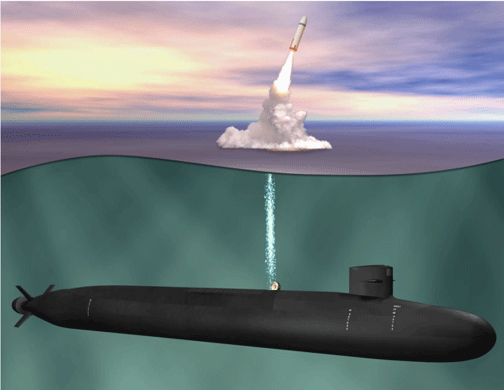
In 2019, a new set of nuclear dangers emerged for Southasia. The growing danger was underscored during the military crisis between India and Pakistan in February 2019, when India put one or more of its nuclear submarines on “operational deployment mode.” During the crisis, the Pakistani Navy claimed to intercept an Indian submarine. No one has confirmed if this interception involved an Indian submarine carrying nuclear weapons. With India and Pakistan on an accelerated programme of acquiring and developing nuclear submarines, Southasia needs to pay urgent attention to the risks of nuclear accidents at sea.
The expansion of nuclear operations to the sea also raises issues about who has the ability to authorise the use of these weapons, especially in a crisis. This is of particular concern in the case of India because it has already deployed such weapons. According to a November 2018 announcement by Prime Minister Narendra Modi, the Arihant nuclear-powered submarine successfully completed its maiden “patrol”.
A further source of concern is the August 2019 announcement by India’s defence minister to the effect that the country’s ‘No First Use’ (NFU) policy – which pledges not to attack with nuclear weapon unless attacked first – “would depend on the circumstances.” His comments, made during a period of increased tension between India and Pakistan following the amendment to Article 370 of India’s Constitution conferring special status to Jammu & Kashmir, underscore these risks.
India’s nuclear submarines……… Strategic competition with China in the Indian Ocean may be another factor. Serving and retired members of India’s Navy publicly express concerns about the deployment of Chinese submarines, warships and tankers in the Indian Ocean.
India’s growing arsenal also makes it a more valuable ally for the United States in its efforts to deal with the growth in China’s political and military power. For some time now, the US and India have been conducting joint naval exercises.
Pakistan’s naval force
Pakistan, for its part, announced the setting up of a Naval Strategic Force Command in 2012. Pakistan’s Navy has started preparing to put nuclear-armed cruise missiles on conventional submarines. The cruise missile is expected to be the 450-kilometer range Babur, which had a successful underwater test launch in 2018. There are reports that Pakistan is seeking to develop or acquire a nuclear-powered submarine…..
Submarine accidents
Almost all the countries operating nuclear-powered or nuclear-armed submarines have experienced accidents, often with significant loss of life and the spread of radioactivity in the environment. There have been over 40 accidents involving nuclear-powered submarines, claiming a total of over 650 lives. Of these accidents, more than half involved Soviet/Russian submarines resulting in over 400 deaths. The United States comes next, with at least a dozen submarine accidents leading to well over 200 deaths.
Two accidents have involved India’s nuclear submarines. …….
It would be unreasonable to expect that no more accidents involving nuclear submarines would ever take place. Nuclear submarines involve many technologies that are susceptible to a range of accidents affecting the submarine, nuclear reactor, missiles and nuclear weapons. All of these are operating under challenging conditions: deep under water, with limited supplies of air and water, possibly under attack. None of these factors is likely to change…….. Should a naval nuclear-reactor accident occur, especially at or near a naval base, coastal city or town the consequences could extend far beyond the vessel and its crew……
Pathways to war
The introduction of nuclear armed submarines, whether diesel or nuclear-fuelled, increases the likelihood of conventional conflicts escalating to a nuclear one. Any use of nuclear weapons would have devastating consequences, especially if the use of nuclear weapons by one country sets off a nuclear response from the other side.
In a military crisis, nuclear armed submarines increase the potential for nuclear war because they open up new risk pathways. The Australian strategist Desmond Ball pointed out in 1985 that “the sea is the only area where nuclear weapon platforms [of adversary states] … actually come into physical contact” and this contact can lead to accidents from several kinds of what seem to be typical naval operations.
There have already been incidents of Indian and Pakistani naval platforms coming into physical contact, for example in 2011, when the Pakistani vessel PNS Babur brushed past India’s INS Godavari. Contact between Navy forces from India and Pakistan might also result from deliberate attempts to attack submarines. Both countries are known to be acquiring anti-submarine warfare capabilities.The consequences of such events could be worse if submarines come into contact with each other during periods of heightened tensions or crises.
During a crisis, there may be inadvertent attacks on submarines carrying nuclear weapons, because these are intermingled with submarines carrying only conventional weapons. One notable instance occurred during the Cuban Missile Crisis, when US ships used practice depth charges against Soviet nuclear-armed submarines. This almost led to the use of nuclear weapons by the Soviet submarine.
Challenges to controlling nuclear weapons
A significant new challenge resulting from the deployment of nuclear weapons at sea is managing command and control. To the extent that such things are publicly known, India and Pakistan were believed to keep their nuclear weapons on land separate from the delivery vehicles, be they missiles or aircraft. This separation makes it harder for the weapons to be used without proper authorisation. With submarines armed with nuclear weapons at sea, this separation may not be possible and so the risk of unauthorised use is greater.
At the same time, one purpose of the nuclear-armed submarine is to be a final fail-safe means of nuclear attack even if a country’s political leadership is killed and its cities destroyed. To serve this role, the nuclear weapons on the submarine cannot rely on timely launch orders from political authorities. A further problem for submarines is that they are supposed to remain hidden from the enemy. Constant communication from the submarine to the military or civilian leadership may make it easier to detect. All of this means that during the time of a crisis, the personnel in a nuclear submarine might be the ones making decisions on whether or not to use nuclear weapons.
Southasians need to consider how they feel about trusting their lives in some future crisis to the restraint of Indian or Pakistani submariners far from home and fearful that their vessel is under attack, trying to decide about launching their nuclear missiles in a ‘use them or lose them’ scenario. The consequences would be devastating.
~Zia Mian is co-director of Princeton University’s Program on Science and Global Security, where he also directs the Project on Peace and Security in South Asia.
~M V Ramana is the Simons Chair in Disarmament, Global and Human Security at the Liu Institute for Global Issues in the School of Public Policy and Global Affairs at the University of British Columbia in Vancouver, Canada.
~Abdul H Nayyar is a physicist and a founder and former President of the Pakistan Peace Coalition, a national network of peace and justice groups. https://himalmag.com/nuclear-dangers-of-the-naval-kind-2019/?fbclid=IwAR0G8NZSV5ANg7Ag7KcuJU_80iv3pNJiqb6E_T12sylV9BaJWIvcZ3Vb_j0
 |
ReplyForward
|
China Rejects Policy of Nuclear Launch on Warning of an Incoming Attack
Cong also asked nuclear weapons states to take additional steps to diminish the role of nuclear weapons in their national security doctrines, including joining China in publicly committing to never use nuclear weapons first.
The Chinese Foreign Ministry’s criticism of launch on warning comes less than two weeks after Russian president Vladimir Putin announced China was cooperating with Russia “to model a national early warning system.” At present only the United States and Russia have systems that allow them to detect missile launches.
Those systems give both nuclear-armed nations the option to launch a retaliatory response as soon as the system warns them of an incoming missile attack. Russia and the United States keep their missiles on high alert so they are ready for rapid launch on warning.
Both the Russian and the US early warning systems have a history of generating false warnings. The practice of combining those systems with preparations for rapid launch creates the danger that either country could start a nuclear war by mistake.
China’s current policy is to wait to retaliate until after being struck first. It protects its small nuclear force of several hundred nuclear capable missiles from an enemy first strike by hiding them in a large network of underground tunnels. The missiles are kept off alert and the warheads are stored separately. They would be brought together and mated with the missiles only after the Chinese leadership gave the order to prepare for a launch.
Some Chinese officials are concerned recent improvements to US satellite reconnaissance, forward-based radars, precision guidance systems and ballistic missile defenses might lead US decision makers to believe China’s nuclear forces could be neutralized, allowing the United States to strike China first without fear of nuclear retaliation. Recent improvements to Chinese nuclear forces, in particular the development of a longer range intercontinental ballistic missile that can carry multiple warheads, are intended to convince US decision-makers not to take that risk.
Several years ago researchers at the Chinese Academy of Military Science (AMS) suggested China could eliminate concerns about the vulnerability of its nuclear forces by moving to a launch on warning posture. Fu Cong responded to a question about the AMS suggestion by stating that in his view a launch on warning posture would be incompatible with China’s long-standing promise not to use nuclear weapons first under any circumstances.
Cong also said he was unaware of Putin’s statement on cooperation on an early warning system, but that the existence of such a project did not imply that China would change its nuclear policy and shift to a launch on warning posture. Such a change would also require China to keep its missiles on constant alert with warheads attached so that they could be launched quickly. A former director of China’s nuclear weapons lab told me privately that the cooperative project with Russia on warning technology would increase China’s overall situational awareness but would not lead to a change China’s nuclear doctrine, policy or practice.
New plan for dealing with Fukushima’s radioactive water
FoE Japan 5th Oct 2019, Fukushima, On October 3, the Citizens’ Committee on Nuclear Energy, whose members include academics, technical experts, and NGOs, made a new proposal to deal with contaminated water from the damaged Fukushima Daiichi Nuclear Plant after the water has been treated.
The proposal, submitted to Ministry of Economy, Trade and Industry (METI), the Ministry of the Environment (MOE), and the Nuclear Regulation Authority, is to convert the treated water to solid form by mixing with mortar, and storing it on land. Citizens’Comittee on Nuclear Energy (CCNE).
North Korea exasperated with USA’s hostile policies and demands
SEOUL, South Korea — North Korea on Sunday said it’s running out of patience with the United States over what it described as hostile policies and unilateral disarmament demands, and warned that a close personal relationship between the leaders alone wouldn’t be enough to prevent nuclear diplomacy from derailing.
In a statement published by Pyongyang’s official Korean Central News Agency, senior North Korean official Kim Yong Chol said there has been no substantial progress in relations despite warm ties between leader Kim Jong Un and President Donald Trump. He said the persisting hostility means “there can be the exchange of fire at any moment.”
Kim Yong Chol said the Trump administration would be “seriously mistaken” if it ignores an end-of-year deadline set by Kim Jong Un to propose mutually acceptable terms for a deal to salvage nuclear negotiations.
The North issued a similar statement on Thursday that was attributed to veteran diplomat Kim Kye Gwan. He criticized U.S. officials for maintaining “Cold War mentality and ideological prejudice” and urged the United States to act “wisely” through the end of the year……..
talks have faltered after the collapse of a February summit between Kim and Trump in Hanoi, Vietnam, where the U.S. rejected North Korean demands for broad sanctions relief in exchange for a piecemeal deal toward partially surrendering its nuclear capabilities.
The North expressed its displeasure with a flurry of short-range missile tests while Kim said he would “wait with patience until the end of the year for the United States to come up with a courageous decision.”……..
North Korea for decades has been pushing a concept of denuclearization that bears no resemblance to the American definition, with Pyongyang vowing to pursue nuclear development until the United States removes its troops and the nuclear umbrella defending South Korea and Japan. https://www.wusa9.com/article/news/nation-world/north-korea-running-out-of-patience-with-united-states-nuclear-diplomacy/65-7aaa9700-aadd-44b2-8070-73e53732a579
340,000 to evacuate Fukushima, landslide fears(- and what about the nuclear waste bags?)
 Why doesn’t the news media explore the question of what is happening to Fukushima’s bags of radioactive nuclear debris?
|
Fukushima evacuation: 340,000 people told to leave over landslide fears after flooding, Mirror UK , By Bradley Jolly, Online journalist, 25 OCT 2019The 143,699 households in Fukushima, Japan, have been evacuated over flooding fears after Typhoon Hagibis lashed across the area. More than 340,000 people were today told to leave their homes over landslide fears due to flooding .
Many low-lying towns and cities east of Tokyo, Japan, were left inundated after Typhoon Hagibis swept across the region . Some 143,699 households in Fukushima, one of the worst affected cities, were evacuated today.
Fukushima Prefecture, the evacuation advisory, fears the danger of landslides remains very high. Alarming photos show muddy water spill from rivers and pedestrians wade through waist-deep floods. Almost 30,000 soldiers and rescue workers have been sent in to save stranded residents across the region. The recent typhoons have so far killed 24 people. More than 9,000 homes, including 6,000 in the Chiba prefecture and 2,500 in the nearby Ibaraki prefecture, were without electricity, according to Tokyo Electric Power Company. Local media reported two dams were expected to release built-up water and urged downstream residents to evacuate as a precaution. A motorway toll gate near Narita International Airport was temporarily closed for safety reasons. Heavy rain also washed out the second round of the PGA Tour’s first tournament held in Japan, the Zozo Championship in Inzai City, where Tiger Woods was tied with Gary Woodland at 64 after Thursday’s opening round. Fukushima is on Honshu, Japan’s largest island. It is about 40 miles away from Japan’s idyllic east coast. Soma, in particular, is a coastal city nearby popular with tourists.https://www.mirror.co.uk/news/world-news/fukushima-evacuation-340000-people-told-20721981 And the Meteorological Agency has predicted up to seven inches of rain over the next 24 hours. |
|
Determined opposition to nuclear expansion in India’s iconic tiger reserve
|
Karnataka activists may approach court to oppose Kaiga nuclear plant expansion
Earlier, a Tata Memorial Trust report had said the nuclear plant, was responsible for increasing cancer cases in the region. The News Minute, Soumya Chatterjee, Saturday, October 19, 2019 Environmental activists are determined to oppose the expansion of the Kaiga Atomic Power Station in the buffer zone of the Kali Tiger Reserve in Uttara Kannada district of Karnataka. Currently, the plant has four units. The Nuclear Power Corporation Ltd. has proposed a fifth and a sixth unit, the proposal for which has cleared all environmental regulatory hurdles from both the state and union governments recently. Activists argue that expanding the Kaiga plant will result in the loss of 54 hectares of pristine forests in the fragile Western Ghats near the Kali Tiger Reserve. They also question the practicality of setting up more nuclear power plant units or replacing it with other safer and cheaper power generating options like solar and wind energy. Incidentally, the Karnataka High Court also recently ordered an interim stay on further felling of trees by the National Highway Authority of India for the expansion of NH4A (Belagavi-Goa), after it learnt that the authorities had violated the Forest Protection Act. Encouraged by this, activists opposing the new units in the Kaiga plant are planning to approach the court, if other means of protest do not work. A threat to eco-sensitive area “When the whole world is shifting away from nuclear power and looking for eco-friendly sources like solar and water, why do we want to create problems like Fukushima (Japan) with already four dams created in the upper course of the Kali river? Why do we want to destruct forests further when climate change is already impacting us?” asks Joseph Hoover, a former member of State Wildlife Board and founder of United Conservation Movement. “It is not necessary as the state is power surplus and will primarily help other states. There is also the issue of increased cancer cases in the area because of the plant,” he added. A Tata Memorial Centre report in 2010 had said there was a spurt in cases of cancer over the past two decades in Kaiga. Experts insist that this is because of radioactive pollution caused by the nuclear power plant. Advocate Prince Isaac, who represented the United Conservation Movement, which was one of the petitioners in the NH4A case, said, “This area is classified as eco-sensitive area-1, according to a specific order from November 2013 under Section 5 of the Environmental Protection Act by the Union Ministry of Forest, Environment and Climate Change. By the same order, no developmental work (construction involving space more than 20,000 sq metres) can take place in this zone.” Pointing out that the government is breaking its own law, he added, “Other than this, for projects in sensitive areas, there is a legal mandate to carry a biological impact assessment as there are rare species that are endemic to the area. That has not been undertaken here.”…… https://www.thenewsminute.com/article/karnataka-activists-may-approach-court-oppose-kaiga-nuclear-plant-expansion-110831 |
|
India keeps increasing its nuclear weaponry – aimed at Pakistan and China
“India is estimated to have produced enough military plutonium for 150 to 200 nuclear warheads, but has likely produced only 130 to 140,” according to Hans Kristensen and Matt Korda of the Nuclear Information Project at the Federation of American Scientists. “Nonetheless, additional plutonium will be required to produce warheads for missiles now under development, and India is reportedly building several new plutonium production facilities.”
In addition, “India continues to modernize its nuclear arsenal, with at least five new weapon systems now under development to complement or replace existing nuclear-capable aircraft, land-based delivery systems, and sea-based systems.”……https://news.yahoo.com/indias-nuclear-weapons-arsenal-keeps-183000277.html
Activists urge Japan to avoid Fukushima in Tokyo Olympics

Hiroshima residents exposed to A-bomb ‘black rain’ developed health problems: lawyers
October 16, 2019 (Mainichi Japan) HIROSHIMA — Nearly all of the 85 plaintiffs in a class action lawsuit who claim to have been exposed to radioactive “black rain” that fell on Hiroshima and surrounding areas in the immediate aftermath of the U.S. atomic bombing of the city in 1945 have been diagnosed with health problems that could be related to radiation, their lawyers said.
The plaintiffs, of whom eight have already died, and their representatives have brought the case to the Hiroshima District Court, demanding the Hiroshima prefectural and municipal governments provide them health care benefits on the basis that they were exposed to the radioactive rain outside the designated area set by the central government. Research by the legal team representing the plaintiffs have revealed that almost all of the plaintiffs have been diagnosed with health issues that “radiation cannot be ruled out” as their causes.
The state has issued certificates for A-bomb survivors who were in the designated area near the epicenter. These certificates enable them to receive free medical care. As the actual health damage caused by the radioactive black rain remains unclear, however, the central government in 1976 named a 19-kilometer by 11-kilometer area northwest from the state-designated radiation exposure area “a special health checkup zone.” Those who were in this zone are subject to free health checkups, and if they develop illnesses involving at least one of 11 kinds of disorders that the government lists as potentially radiation-related, such as cardiovascular diseases, they are given the certificates…….https://mainichi.jp/english/articles/20191016/p2a/00m/0na/006000c
Hurricane Hagibis Spreads Fukushima Radiation (But No, 2,667 Bags of Decontaminated Waste were NOT Washed Away!)
 Nuclear HotSeat BY NHADMIN OCTOBER 16, 2019 Fukushima Hurricane Hagibis Flooding – deluge of water washes full bags of “decontaminated” soil, plants, and other radioactive matter into Furumichi river near the Japanese city of Tamura in Fukushima Prefecture (above). No report yet on how much radioactive material from the decomposing, torn waste bags was washed back into the environment. http://nuclearhotseat.com/2019/10/16/fukushima-hurricane-hagibis-flooding-spreads-radiation-risks/
|
Below are brief extracts – transcript from this important podcast.
Hurricane Hagibis – Alarms went off – City said an unknown number of radioactive waste bags were lost…
Each bag weighs more than one tonne…. some bags not swept away but still damaged
Nancy Faust of SimplyInfo.org. “- not enough information yet… Tepco did have time to prepare for the typhoon.
Tepco phrased it vaguely about the readings of radioactivity – equipment is monitored – readings showed that rain-water was leaking in to various facilities. They measured only the water itself, not radiation. Tepco has not talked about how much water is coming in to the reactor. We worry about how much water is coming in , and then washing things out.”
Question: Do we know how many bags of radioactive material were washed away?
“One report from one city Tamara City – has 2667 bags onsite – did not say how many were washed away -said that 6 were found….. We don’t know yet how many were washed away
We also don’t know the condition of these bags at the storage site. Older bags at higher risk of breaking. They have a lifespan of about 6 years. Also we don’t know what the level of radioactivity is in these bags.
We may get some bits of information about how much radiation was dispersed over the next weeks. Simply Info will be looking for differences in radiation level reports. Tepco not legally obliged to give this information.
From Arnie Gunderson.
Sean McGee reminds that there will be dispersal of radiatioactive material after the area dries out, and from the mountains.
The story that all 2667 bags were swept away is incorrect . That imprecision in the report was in the headline.
The Japanese government and Tepco will try to obscure the facts. It’s incumbent upon us to be accurate. |
|
China Calls for Maintaining Global Strategic Stability and Reducing Nuclear Conflicts Risks
|
China Calls for Maintaining Global Strategic Stability and Reducing Nuclear Conflicts Risks https://www.fmprc.gov.cn/mfa_eng/wjbxw/t1708327.shtml–2019/10/16 The 16th PIIC Beijing Seminar on International Security was held in Shenzhen, China on the 16th October, 2019. It is organised by China Arms Control and Disarmament Association (CACDA), Program for Science and National Security Studies (PSNSS),and Nuclear Threat Initiative (NTI). Scholars and experts from China, the U.S., Russia, the U.K.,Germany, Italy, Belgium, Japan, South Korea, Mongolia and other countries participated in this seminar. The Director-General of the Department of Arms Control of the Foreign Ministry Fu Cong attended the opening ceremony and made a keynote speech, calling for maintaining global strategic stability and reducing risks of nuclear conflicts. Fu Cong said that the global strategic security situation has dramatically worsened over the past few years. Unilateralism and hegemonism is rising in international relations, posing major threats to the international order based upon international law. Returning to the cold war mentality, the U.S. has withdrawn from or renegaded on a host of multilateral arms control agreements, with the aim of seeking unilateral and overwhelming military superiority. With these actions, mutual trust and cooperation between major powers have been severely eroded, the global strategic stability is being seriously undermined, the international norms and multilateral regimes are under severe stress, and the deficit of global security governance is becoming more prominent. Fu Cong emphasized that continued erosion of global strategic stability would inevitably lead to a relapse of nuclear arms race. And the risks of nuclear conflicts would increase. All nuclear-weapon States should take measures to diminish the role of nuclear weapons in their national security doctrines. Nuclear-weapon States should provide unconditional and unambiguous security assurances to non-nuclear-weapon States. Countries should exercise restraint in building and deploying strategic capabilities. Nuclear disarmament should be pursued in a reasonable and pragmatic manner. Nuclear-weapon States should enhance dialogue on nuclear doctrines and strategies. Nuclear non-proliferation issues should be resolved through political and diplomatic means. And the challenges created by emerging technologies should be properly addressed. Fu Cong said that China expresses its deep regret over the U.S.’s withdrawal from the INF Treaty. It is of China’s view that the U.S. withdrawal will have a direct negative impact on global strategic stability, on peace and security in Europe and Asia-Pacific region, as well as the international arms control regime. The fact that the U.S. has conducted a ground-based intermediate-range cruise missile test less than three weeks after its withdrawal from the Treaty shows that its withdrawal was meant to free its hands in developing advanced weaponry in order to seek unilateral military advantage. . China firmly opposes the U.S. deployment of ground-based intermediate-range missiles in the Asia-Pacific region. The U.S. missiles, if deployed in the region against others’ expectations, would be virtually on China’s doorsteps. Should that happen, China would have no choice but to take necessary countermeasures in defence of its national security. China urges the U.S. and other countries concerned to exercise restraint and prudence on this matter. Fu Cong also briefed on China’s efforts in maintaining global strategic stability, including China’s “no first use” policy, and stressed that China has shown maximum transparency in its nuclear strategy, exercised the utmost restraint on the development of its nuclear force, and adopted an extremely prudent attitude toward the use of nuclear weapons. China will remain committed to peaceful development and continue to advocate for multilateralism. And China will always be a positive force for international arms control and disarmament efforts and a contributor to the lofty cause of safeguarding peace and security of the mankind. |
|
1 This Month
26 September – International Day for the Total Elimination of Nuclear Weapons





PLEASE OPPOSE HR 8255 AND S.3639 – bills would accelerate satellite deployment, with no environmental review or safeguards – https://ncstd5li.quorum.us/campaign/169331/
To see nuclear-related stories in greater depth and intensity – go to https://nuclearinformation.wordpress.com
-
Archives
- September 2026 (290)
- August 2026 (330)
- July 2026 (355)
- June 2026 (287)
- May 2026 (306)
- April 2026 (356)
- March 2026 (251)
- February 2026 (267)
- January 2026 (308)
- December 2025 (358)
- November 2025 (359)
- October 2025 (375)
-
Categories
- 1
- 1 NUCLEAR ISSUES
- business and costs
- climate change
- culture and arts
- ENERGY
- environment
- health
- history
- indigenous issues
- Legal
- marketing of nuclear
- media
- opposition to nuclear
- PERSONAL STORIES
- politics
- politics international
- Religion and ethics
- safety
- secrets,lies and civil liberties
- spinbuster
- technology
- Uranium
- wastes
- weapons and war
- Women
- 2 WORLD
- ACTION
- AFRICA
- Atrocities
- AUSTRALIA
- Christina's notes
- Christina's themes
- culture and arts
- Events
- Fuk 2022
- Fuk 2023
- Fukushima 2017
- Fukushima 2018
- fukushima 2019
- Fukushima 2020
- Fukushima 2021
- general
- global warming
- Humour (God we need it)
- Nuclear
- RARE EARTHS
- Reference
- resources – print
- Resources -audiovicual
- Weekly Newsletter
- World
- World Nuclear
- YouTube
-
RSS
Entries RSS
Comments RSS

