Scientists conduct first in situ radiation measurements 21 km in the air over Tibetan Plateau
Scientists conduct first in situ radiation measurements 21 km in the air over Tibetan Plateau https://phys.org/news/2020-08-scientists-situ-km-air-tibetan.html by Li Yuan, Chinese Academy of Sciences, 24 Aug, 20, Radiation variations over the Tibetan Plateau (TP) are crucial for global climate and regional ecological environment. Previous radiation studies over the TP were widely based on ground and satellite measurements of the radiation budget at the surface and at the top of the atmosphere.
In situ vertical radiation measurements from the surface up to the upper troposphere and lower stratosphere (UTLS), about 10 to 22 km in altitude, are rare over the TP or even over a large territory of China.
Dr. Zhang Jinqiang from the Institute of Atmospheric Physics (IAP) of the Chinese Academy of Sciences (CAS), in collaboration with scientists from the Aerospace Information Research Institute of CAS, developed a balloon-based measurement system to measure stratospheric radiation
This original system, for the first time, provides in situ measurements of multiwavelength radiation profiles from the surface up to the UTLS over the TP. Using this system, scientists can study how and why radiation profiles vary over the TP during the Asian summer monsoon period.
The observation campaigns were conducted three times in the summer of 2018 and 2019, of which the longest flight observation lasted more than 30 hours and achieved a breakthrough of diurnal radiation variation in the UTLS.
According to the team, the stratospheric balloon-based radiation profiles, combined with simultaneous operational radiosondes, ground measurements, satellite retrievals and radiative transfer model simulations, are valuable because the data can be used to study radiation variations and the radiative forcings of clouds and aerosols over the TP during the Asian summer monsoon period. The radiation retrievals from the radiative transfer model simulations and satellite observations are also validated.
“The results of these campaigns can improve our understanding of radiation properties in the UTLS and help us better comprehend the thermal conditions associated with clouds and aerosols over the TP during the Asian summer monsoon period,” said Zhang.
Their findings were published in Environmental Research Letters, Journal of Environmental Sciences and Atmospheric Pollution Research.
A Pakistan threat of nuclear war with India
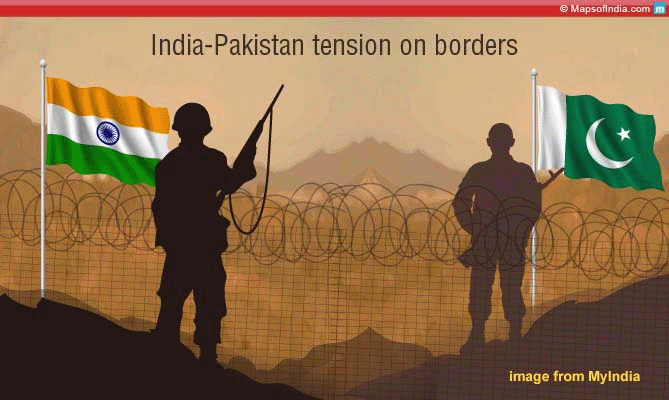 Pakistan minister Sheikh Rasheed Ahmed threatens India with nuclear war, Scroll, Ahmed said Pakistan would opt for a nuclear conflict because the Indian Army was far superior in conventional weapons. Scroll In 21 Aug 20 Pakistan minister Sheikh Rasheed Ahmed threatens India with nuclear war, Scroll, Ahmed said Pakistan would opt for a nuclear conflict because the Indian Army was far superior in conventional weapons. Scroll In 21 Aug 20
Pakistan Railway Minister Sheikh Rasheed Ahmed on Thursday threatened India with nuclear war. Speaking to Samaa TV, he said if India attacks Pakistan, it will descend into an “atomic war”. Ahmed said the Pakistan Army was far inferior to India’s in conventional weaponry, and would therefore have to use a nuclear bomb. “This will be a bloody, last and atomic war,” he said. “Our [nuclear] weapon will be very calculated, miniature and perfect, and will target India while protecting the lives of Muslims.” Ahmed claimed that Pakistan now has nuclear weapons that can reach Assam. “Pakistan does not possess enough conventional weapons, so India knows that [in a war], whatever will happen, will happen.” ………. The Pakistani minister’s views are a departure from Prime Minister Imran Khan’s opinion about a war between New Delhi and Islamabad. Khan has stated on two separate occasions that a war between the two nuclear-armed countries would not end well. https://scroll.in/latest/971015/pakistan-minister-sheikh-rasheed-ahmed-threatens-india-with-nuclear-war |
|
Japan’s Rokkasho nuclear reprocessing plant delayed, for the 25th time!
 Nuclear fuel reprocessing plant completion delayed, NHK News, 21 Aug 20 The operator of a nuclear fuel reprocessing plant in northeastern Japan says it will postpone the scheduled completion of the facility by one year. The plant is the centerpiece of the Japanese government’s nuclear fuel recycling policy.This is the 25th time that Japan Nuclear Fuel Limited has delayed the scheduled completion of the plant. The operator says it now aims to complete construction in the first half of fiscal 2022, which is 25 years behind schedule. Nuclear fuel reprocessing plant completion delayed, NHK News, 21 Aug 20 The operator of a nuclear fuel reprocessing plant in northeastern Japan says it will postpone the scheduled completion of the facility by one year. The plant is the centerpiece of the Japanese government’s nuclear fuel recycling policy.This is the 25th time that Japan Nuclear Fuel Limited has delayed the scheduled completion of the plant. The operator says it now aims to complete construction in the first half of fiscal 2022, which is 25 years behind schedule.
The facility in the village of Rokkasho in Aomori Prefecture, northeastern Japan, is designed to extract plutonium from spent nuclear fuel generated by power plants, for recycling. Masuda Naohiro, the president of Japan Nuclear Fuel Limited, reported the decision to Aomori Governor Mimura Shingo on Friday. Masuda explained that considerable time would be necessary to prepare to ensure safety against tornados, as well as for the assessment of that work……….. The scheduled plant completion has been postponed many times due to various problems and other reasons. Some experts have pointed out technical issues concerning on-site management and maintenance, given the considerable delay in the schedule. The outlook for the use of the extracted plutonium is also unclear. https://www3.nhk.or.jp/nhkworld/en/news/20200821_25/ |
|
Resistance to nuclear waste survey in Hokkaido
SAPPORO – The mayor of Suttsu in Hokkaido, which is considering applying for a survey to host a final disposal site for high-level radioactive waste, said Friday that it might be difficult to make the decision by September as planned.
“It is difficult to make the decision after listening to many voices,” Suttsu Mayor Haruo Kataoka told reporters after meeting with the nine members of the town’s assembly. “It would not be appropriate to rush the decision by our own judgment. Our plan to decide in September might be postponed.”
Kataoka’s remarks came a day after the mayors of three municipalities neighboring Suttsu said Thursday they will urge the town to make a careful decision.
The mayors of the three municipalities unveiled the plan at a meeting with Hokkaido Gov. Naomichi Suzuki.
Of the three, Rankoshi Mayor Hideyuki Kon and Kuromatsunai Mayor Mitsuru Kamada expressed opposition to Suttsu’s move, which involves applying for a literary survey, the first stage of the process for choosing a disposal site.
Kon, Kamada and Shimamaki Mayor Masaru Fujisawa told Suzuki that they will ask Suttsu as early as this month to make a careful decision on the application. ……..
Seven other municipalities, including the town of Niseko, an internationally known ski resort, are planning to oppose the plan, sources said Friday.
Also on Friday, members of the association of fisheries cooperatives made up of nine co-ops around Suttsu, submitted to Kataoka a protest letter expressing strong opposition to the town’s plan.
Referring to the fact that the fisheries industry suffered harmful rumors following the 2011 triple core meltdown at the Fukushima No. 1 power plant, the letter said: “It is utterly unacceptable for those in the fisheries industry. It will have an immeasurable adverse impact not only on the region but also on the fisheries industry as a whole.”
Katsuo Hamano, head of the association, criticized the mayor for making an announcement on the plan even before obtaining the municipal assembly’s approval.
“It goes against the rules of parliamentary democracy,” Hamano told reporters…….
The central government offers up to ¥2 billion in subsidies to any municipality that undergoes the literary survey https://www.japantimes.co.jp/news/2020/08/21/national/hokkaido-suttsu-nuclear-waste-survey-delay/
UK relations with China at a low point; bad news for nuclear power projects
|
UK nuclear power: The next Huawei? DW, 21 Aug, 20Once a key part of the UK’s energy plans, nuclear power faces rising costs, cheaper renewables and domestic opposition. It also finds itself at the center of a row between London and Beijing that could prove fatal.
London’s relations with China — hailed as entering a “golden era” only four years ago — have deteriorated badly over Hong Kong, hitting a nadir when the UK finally bowed to US pressure to ditch Huawei’s involvement in its new-generation internet (5G) rollout. In late 2019, the US published a list of companies linked to the Chinese military, and after Huawei came the China General Nuclear Power Group (CGN). The state-owned Chinese firm has invested 3.8 billion pounds (€4.1 billion, $4.3 billion) in Britain to date, mainly in the Hinkley Point nuclear plant under construction in Somerset, southwest England, and the Sizewell plant in eastern England. It is also seeking UK regulatory approval to build its own nuclear reactor at Bradwell in Essex, east of London. China warned the UK it would face “consequences if it chooses to be a hostile partner” after London announced its Huawei’s decision. Liu Xiaoming, the Chinese ambassador to the UK, reportedly said China could cut its backing for UK nuclear plants altogether. Years of Chinese involvement in UK nuclear industryCGN’s involvement in the UK nuclear industry began in 2016 when a deal was signed with French state-owned utility Electricite de France (EdF) to collaborate on three reactors totaling 8.7 gigawatts (GW) of power generation, starting with Hinkley Point. The agreement spoke of CGN’s “progressive entry” into the UK’s “resurgent” nuclear ambitions. The UK currently has 15 operational nuclear reactors at seven locations. At its height in 1997, 26% of the country’s power was generated from nuclear, but this has slipped since to 19%. In the Sizewell and Hinkley projects, CGN is providing cash, holding 66% stakes, but with Bradwell it wants to build the reactor itself, using its own technology, and it wants to operate it. Observers say Bradwell is the prize CGN is really seeking: the first Chinese-built nuclear plant outside China. In May, EdF outlined its plans to start work on Sizewell by the end of next year. The project would create 25,000 jobs, it said. But EdF’s continued involvement could be thrown into doubt if no other investor came forward to replace CGN. This is especially troubling given the project is also expected to result in cost overrun. Hinkley Point now costs about 3 billion pounds more than the 20 billion pounds originally planned. Sizewell is also slated to cost 20 billion pounds. “Several projects were planned but only Hinkley Point will likely go ahead,” Jonathan Marshall, Energy and Climate Intelligence Unit (ECIU), told DW. “Bradwell would be a Chinese project, but is now unlikely for political reasons.” Bradwell looks surplus to requirements for the reasons the National Infrastructure Assessment (NIC), a government advisory body, outlined in its most recent long-term assessment: “Given the balance of cost and risk, a renewables-based system looks a safer bet at present than constructing multiple new nuclear power plants,” it read. Financing of nuclear plans unclear“Sizewell is not dependent on CGN investment,” a spokesman from the the Department for Business, Energy and Industrial Strategy (BEIS) said. But not many agree. “Equity funding for nuclear power stations is very difficult for private actors,” Rob Gross, director of the UK Energy Research Centre, told DW. The government’s offer in 2018 to Hitachi to take a third of the equity at the Wylfa nuclear project wasn’t enough to keep the company interested, for example. As Paul Dorfman of University College London’s energy institute and founder of the Nuclear Consulting Group told environmental news platform electrictyinfo.org, it was hard to see who else might invest in Sizewell if the Chinese pull out. “The market won’t touch nuclear with a barge pole. You only see nuclear being built in command-and-control economies, like China and Russia, and a few outliers,” he said. One option would be for the government to take either a majority or minority stake in Sizewell. Another option is a Regulated Asset Base (RAB) model, where consumers are charged a fixed price to cover infrastructure costs. But this would hike energy prices in the long term and make it politically hard to justify. …….https://www.dw.com/en/uk-nuclear-power-the-next-huawei/a-54631808 |
|
China feels India’s nuclear weapons programme driven by prestige: US report
China feels India’s nuclear weapons programme driven by prestige: US reportThe Carnegie report stressed China’s views on the issue are largely unknown
The Chinese state-run media continues to play up deployment of new artillery and other weapon systems near the border with India. However, despite the tension, references to nuclear weapons have been subdued in both nations.
A US think tank, the Carnegie Endowment for International Peace, on August 19 published a report on the Chinese perspective on nuclear weapons in the context of ties with India.
The Carnegies report noted while India’s perspectives on nuclear weapons are “relatively well documented,” China’s views on the issue are largely unknown.
The Carnegie report is based on interviews with “dozen Chinese academics, researchers, and military officers who work either on South Asia or on nuclear policy” and review of Chinese literature published in the last decade……..
Nukes for prestige?
On the issue of India’s nuclear weapons, the Chinese experts interviewed in the Carnegie report felt the systems are “for general deterrence and not for actual employment”……….
The experts interviewed in the Carnegie study felt a border conflict between India and China was unlikely to escalate into a nuclear exchange. Both India and China have declared ‘no first use’ of nuclear weapons.
………. The US factor
A point of concern expressed by the Chinese analysts was the possibility of India and the US strengthening strategic ties.
“While Chinese analysts largely dismiss India’s homegrown development of new military capabilities, they express concern about the prospect of US-India collaboration on defence projects. Chinese experts are particularly wary of US-India missile defence cooperation and the possibility that it could create a networked system. If such a system was to emerge, they would see India as a de facto security ally of the United States,” the Carnegie report noted. https://www.theweek.in/news/world/2020/08/19/china-feels-indias-nuclear-weapons-programme-driven-by-prestige-us-report.html
USA’s nuclear weapons – not the best way to protect Taiwan
|
Do US Nuclear Weapons Help Protect Taiwan?, Union of Concerned Scientists
GREGORY KULACKI, CHINA PROJECT MANAGER AND SENIOR ANALYST | AUGUST 17, 2020, In an earlier post I explained there is a risk the United States and China could go to war over Taiwan. The United States is prepared to use nuclear weapons to win that war. Some believe that helps protect Taiwan. But does it?
Shall we play a game?At the end of the 1983 movie War Games, a massive US Department of Defense computer plays out every possible nuclear war scenario looking for a way to win. All of them lead to the same dismal end; a global nuclear holocaust. The computer concludes nuclear war is “a strange game” where “the only winning move is not to play.” Six months after the movie was released, US President Ronald Reagan told a joint session of Congress, “A nuclear war cannot be won and should never be fought.” He repeated it many times afterwards, including in a speech at Fudan University in Shanghai. Unfortunately, US war gamers never let go of the idea that a nuclear war can be won, especially if the adversary is China. I can understand why. China has a few hundred nuclear weapons. The United States has thousands. The United States also has what are called tactical, non-strategic or low-yield nuclear weapons that China does not have. Some US officials argue if the United States used these low-yield nuclear weapons it would be difficult for China to retaliate without risking escalation to a full scale nuclear war: a war China would lose because its arsenal is so small. They seem to believe China would be unwilling to take that risk even though China has promised to retaliate if attacked with any type of nuclear weapon. Limited nuclear warThe reason the US war planners think about using nuclear weapons in a Taiwan war is because the United States might lose a conventional fight. They worry China’s conventional forces cannot be stopped without nuclear weapons. This isn’t a new concern. President Eisenhower faced a similar choice during the Taiwan Strait Crisis of the 1950s. …….
Past and prologueToday, the rapid deterioration of US-China relations, disturbing changes in Chinese policy towards Hong Kong and a provocative visit of a US official to Taiwan suggest a new crisis is brewing. As talk of a new Cold War with China increases, a careful look back at the old one may be helpful. ……..
history suggests more nations may be willing to support a US military effort to defend Taiwan if the United States took the option to start a nuclear war off the table. It may seem counterintuitive, but canceling plans to reintroduce US tactical nuclear weapons into Asia and declaring the United States would never use nuclear weapons first, under any circumstances, may be the best way to strengthen Taiwan’s defense. https://allthingsnuclear.org/gkulacki/do-us-nuclear-weapons-help-protect-taiwan
|
|
|
Japan sabotaging nuclear disarmament – ICAN chief
 ICAN chief: Japan sabotaging nuclear disarmament, NHK World, Aug. 15, 2020. Nishikawa Mitsuko NHK World Correspondent …….. Beatrice Fihn, Executive Director of the International Campaign to Abolish Nuclear Weapons, or ICAN, spoke to NHK about the possible game changers in the drive to get rid of the weapons of mass destruction. ICAN chief: Japan sabotaging nuclear disarmament, NHK World, Aug. 15, 2020. Nishikawa Mitsuko NHK World Correspondent …….. Beatrice Fihn, Executive Director of the International Campaign to Abolish Nuclear Weapons, or ICAN, spoke to NHK about the possible game changers in the drive to get rid of the weapons of mass destruction.
Fihn’s organization won the Nobel Peace Prize in 2017 for its efforts to bring people to the negotiating table to pledge to work toward nuclear disarmament. The adoption of the Treaty on the Prohibition of Nuclear Weapons at the United Nations was a step forward, in which ICAN played a major role. Fihn says the next few months are crucial, as her team has given itself until the end of the year to get enough signatures to put the treaty into effect. Just this month, Ireland, Nigeria, Niue, and Saint Kitts and Nevis have signed up, bringing the total number on board to 44. “We always aimed that we would be getting 50 in 2020.” She says. “And obviously COVID-19 has slowed down some processes, but we still think that there’s a really good chance that we can get the 50 ratifications needed this year. So we’re working very very hard on this.” What about Japan?But Japan remains one of the countries that’s yet to sign the treaty. Prime Minister Abe Shinzo has said every year at the memorial ceremonies that it’s Japan’s mission to, “realize a world without nuclear weapons.” But Fihn wonders why the commitment hasn’t been backed up by action. “There is no leadership right now on nuclear disarmament from Japan’s side — rather the opposite,” she says. “Japan is going backwards as well and undermining its own resolutions that it’s supported for a long time ago, weakening language and documents.” “That’s very serious. And I think that’s an insult to the survivors — to the hibakusha,” Fihn says. “We really know the Japanese people want the government to sign the treaty.” “It’s very often that we look at nuclear armed states as the problem, but we have to recognize that the nuclear-allied states, like Japan for example, are protecting them. They are standing in a circle around them and protecting nuclear weapons. Until those countries stop doing that, it’s going to be very hard to convince the nuclear armed states.” “How am I going to convince North Korea, the United States and Russia to disarm, if Japan cannot say that nuclear weapons should be illegal?” Nuclear war ‘like the coronavirus’Fihn says the coronavirus pandemic is proof that a global emergency could happen anytime. “Health experts have warned about this, and they have been preparing, thinking about it,” she says. “Yet people have been surprised that it happened. It’s the same thing with nuclear weapons. We don’t know when, we don’t know how exactly, but experts say it’s going to happen.” She warns that nuclear weapons will be far more lethal than the coronavirus. “What we have to do with nuclear weapons — there’s no mitigating it once it happens.” she says. “When we feel the consequences, when the bombs are starting to fall on cities again, then it’s going to be too late to prevent it.” Nuclear weapons don’t protect usFihn says the ongoing pandemic further highlights why governments should be investing in people, not weapons. “This pandemic has shown us where the threats to our security are and how we can’t absorb these things with nuclear weapons,” she says. “Nuclear armed states spend 73 billion dollars on nuclear weapons. Just imagine how many ventilators, doctors, nurses ICU, beds we can have… how many vaccinations we could develop.” …….. https://www3.nhk.or.jp/nhkworld/en/news/backstories/1251/
|
|
No Japan prefectures positive about hosting nuclear waste site

Aug 14, 2020
Nearly half of Japan’s 47 prefectures said they are opposed to or held negative views about hosting a deep-underground disposal site for high-level radioactive nuclear waste, a Kyodo News survey showed Friday.
None expressed a favorable stance. The result signals further woes for the central government in its attempt to find a permanent geological disposal repository.
Little progress has been made since the process to find local governments willing to host one started in 2002, due mainly to opposition from local residents.
The survey was sent to all prefectures in July, with additional interviews conducted depending on their answers.
While 16 prefectures such as Fukushima, Kanagawa and Okinawa clearly opposed hosting a site, seven others including Hokkaido, Kyoto and Nagasaki also expressed negative views.
Most of the others did not make their positions clear.
Of the total 23 prefectures that opposed or showed negative views, seven host nuclear power plants.
“We are already undertaking a certain amount of social responsibility by hosting nuclear plants and providing energy,” Niigata Prefecture said in its response.
Fukui Prefecture said, “We are generating power. Nuclear waste disposal should be handled by others.”
Meanwhile, Hokkaido mentioned its existing ordinance to prevent nuclear waste from being brought into the northernmost main island, a view that contradicts the relatively positive stance held by one of its municipalities. The town of Suttsu said Thursday it is considering signing up for preliminary research into its land to gauge its suitability for hosting a disposal site.
On Friday, however, its mayor, Haruo Kataoka, said the town has been asked by the prefecture not to apply for the preliminary study.
Before Suttsu, the town of Toyo in Kochi Prefecture applied for the study in 2007, but it later withdrew the application following strong protests by local residents.
In the Kyodo News poll, the western prefecture expressed opposition to hosting a disposal site, saying it faces the need to take measures against a possible major earthquake in the region.
For permanent disposal, high-level radioactive waste, produced as a result of the process of extracting uranium and plutonium from spent fuel, must be stored more than 300 meters underground so that it cannot impact human lives or the environment.
Elsewhere in the world, Finland and Sweden are the only countries to have decided on final disposal sites.
Hokkaido town mayor eyes hosting nuclear waste site
 This facility in Finland is the only one where construction has begun on a final storage site for nuclear waste.
August 14, 2020
The mayor of Suttsu in western Hokkaido is bracing for a backlash after stating that he wants his small town to be considered as a final destination for nuclear waste by the central government.
“When I think about the future of our town, where the population has been shrinking, there is a need for financial resources to promote industry,” said Haruo Kataoka, 71, in an interview with The Asahi Shimbun.
“I am prepared for whatever form of bashing I may encounter.”
Kataoka may be in for a long fight.
Selecting the site for the nation’s final storage of nuclear waste is a three-stage process that can take up to 20 years. At each stage, the central government provides any municipality that has applied with annual grants.
Kataoka said he was considering having Suttsu apply for the first stage in which past records about natural disasters and geological conditions for the area are examined.
This stage normally takes about two years, and the municipality can receive up to 1 billion yen ($9.3 million) a year or a maximum total of 2 billion yen.
The annual budget for the Suttsu town government is 5 billion yen. Its main industries are oyster farming and fishing for Atka mackerel.
As of the end of March, the town’s population was 2,893. The population has decreased by 30 percent over the past two decades.
To encourage municipalities to submit applications, the central government in July 2017 released a map of areas that were considered scientifically appropriate as a site for the final storage of nuclear waste.
Suttsu is the first municipality expressing an interest in applying since that map was released.
But it remains to be seen if local residents will go along with Kataoka’s idea. He will hold a meeting in September to explain his intention and a decision will be made thereafter whether to proceed with the application.
Kataoka has also expressed interest in moving toward the second stage of the selection process in which boring samples are taken from underground. This is part of the four-year process to determine if the area meets general conditions to enable the selection process to move to the third stage, in which a test facility will be constructed underground.
In the second stage, the municipality can receive up to 2 billion yen a year, or a maximum total of 7 billion yen.
A municipal government can decide at any time to withdraw from the selection process and the grants it has received until then do not have to be returned.
Because nuclear waste may take up to 100,000 years for radiation to reach safe levels, any final storage site would have to be constructed at least 300 meters underground.
Suttsu is classified at the highest of four levels of appropriateness, according to the map released by the central government. Its location facing the Sea of Japan makes Suttsu highly suitable for transporting nuclear waste to the storage site.
But in addition to possible local opposition, the town government will also have to take into consideration an ordinance approved by the Hokkaido prefectural government in 2000 regarding nuclear waste that said no such waste should be brought onto the main northern island.
In a statement released on Aug. 13, Hokkaido Governor Naomichi Suzuki said the ordinance, “is an expression of the desire not to allow a final storage site within Hokkaido, and I believe I have no alternative but to abide by the ordinance.”
Kataoka said that the first stage of the selection process was just a study that did not represent a violation of the ordinance.
But at each stage of the selection process, the views of the prefectural governor and municipality mayor are solicited and any opposition will stop the process from proceeding.
Meanwhile, Hiroshi Kajiyama, the industry minister who oversees the process for selecting a final storage site, told reporters on Aug. 13 that a number of municipalities in addition to Suttsu had expressed interest in obtaining information about the selection process.
While Kajiyama acknowledged his awareness of the Hokkaido ordinance, he added that applying for the first stage of the process did not mean the municipality would automatically move to the second stage.
The central government has had to resort to offering annual grants to encourage municipal governments to express an interest in becoming the site for the final storage of nuclear waste.
Commenting on the interest shown by Suttsu, one government source said, “It is a step forward, but if we think about the entire process as a marathon, the race has just started and the runners have not yet even left the stadium (to reach the road).”
Meanwhile, other municipalities that in the past showed some interest in becoming the final storage site have more often than not met with huge local opposition.
In 2007, the mayor of Toyo in Kochi Prefecture on the island of Shikoku expressed interest in applying without first consulting the town assembly. Local opposition was so strong that a candidate opposed to the idea defeated the incumbent in the next election and the application was withdrawn.
There have also been reports of other municipalities expressing an interest in applying, but no formal announcement has been made until now.
Japan now possesses about 19,000 tons of spent nuclear fuel, but no progress has been made in selecting a site for its final storage. Foreign nations have also experienced difficulties in securing a site for such storage.
Finland is the only nation where actual construction of such a facility has begun.
(This article was written by Yasuo Sakuma, Ichiro Matsuo, Rintaro Sakurai and Yu Kotsubo.)
Plaintiffs angered by gov’t appeal in Hiroshima ‘black rain’ suit
 Head of the plaintiffs’ group, Masaaki Takano, right, and attorney Masayasu Takemori hold a press conference after the Hiroshima Municipal Government and the Hiroshima Prefectural Government appealed the Hiroshima District Court’s A-bomb health care aid ruling, in Hiroshima’s Naka Ward, on Aug. 12, 2020.
August 13, 2020
HIROSHIMA — Two weeks after a groundbreaking ruling in Japan to award government health care benefits to people exposed to radioactive “black rain” outside of the currently designated zone, the central government appealed, prompting aging plaintiffs to accuse the government of “buying time” and “waiting for them to die.”
In the lawsuit, the Hiroshima District Court recognized that all 84 plaintiffs in their 70s to their 90s had been exposed to radioactive black rain that fell after the 1945 bombing of Hiroshima by the United States military, outside a zone currently recognized by the government. On Aug. 12, however, the government persuaded the Hiroshima Municipal Government and the Hiroshima Prefectural Government and went ahead with its appeal.
While the central government has said it will review the current zone with an eye to expanding it, nobody knows when and who will be given benefits. The plaintiffs, whose average age is over 82, had hoped that a resolution would be reached in this milestone year — 75 years since the bombing — and are angered and disappointed.
At 2 p.m. on the day the state appealed the ruling, the plaintiffs and their attorneys held a press conference at the Hiroshima Bar Association building in the city’s Naka Ward. Masaaki Takano, 82, head of the plaintiffs’ group, was about 20 kilometers northwest of the hypocenter in what is now Hiroshima’s Saeki Ward when he was exposed to black rain as a 7 year old. He leaned forward and said forcefully, “There is a limit to life. If a decision is put off, there will be that many deaths.” He added, “The state has dismissed our demands multiple times. It cannot be trusted.”
In 1976, the state designated the zone eligible for government health benefits based on a meteorological observatory survey conducted in the chaotic period immediately following the end of World War II that pointed to where there had been heavy rains. Two years later, residents who had been exposed to rain outside the designated zone argued that it was unreasonable for the government to draw a line through the same neighborhood, with one part falling within the zone and the other part not.
The residents who fell outside the line established a predecessor organization to the Hiroshima prefectural black rain hibakusha liaison council. In the 42 years since, they have gathered tens of thousands of signatures for petitions, but have been repeatedly dismissed by the central government. Even when the Hiroshima municipal and prefectural governments argued for a widening of the zone eligible for health benefits, saying that black rain had fallen in an area six times that recognized by the central government, the state refused to acknowledge it. As a last-ditch effort, the plaintiffs filed a lawsuit in 2015. After a trial that lasted four years and nine months, they came out victorious. But by then, 12 of the plaintiffs had died, missing out on the opportunity to rejoice together.
“The state’s thinking of not giving us the recognition of being hibakusha and appealing the ruling, while considering expanding the zone in which people can receive state health benefits, is contradictory,” said plaintiff Kazuko Morizono, 82, who was exposed to black rain in what is currently Hiroshima’s Asakita Ward, some 17 kilometers north of the bomb’s hypocenter. While dealing with hypothyroidism, which is suspected to come from the effects of radiation from the atomic bomb, and other disorders, she has been active in the movement to have the zone for state aid for black rain victims expanded for over 20 years. Referring to the death of a fellow plaintiff in May whom she had often seen at the trial hearings, Morizono said, “I don’t have much confidence in my health, and I feel impatient that we have to hurry. Now the trial’s going to last longer.”
Seventy-three-year-old Kuraso Hirotani, who was 3 when he was exposed to black rain in what is now the Hiroshima prefectural town of Akiota, around 20 kilometers northwest of the hypocenter, said with frustration, “We were all given false hope with the (district court) victory. Both the mayor and the governor were persuaded by the central government.” In the Peace Declaration that the mayor of Hiroshima reads on the anniversary of the atomic bombing of Hiroshima every year on Aug. 6, Mayor Kazumi Matsui has over the past 10 years, including his latest speech, called on the state to “expand the ‘black rain areas.'” Hirotani continued, “If you’re truly a politician in a place where an atomic bomb has been dropped, you would not appeal. If they had not appealed, I would’ve thanked them and bowed my head.”
Meanwhile, there are those who see some hope in the state’s promise to consider expanding the zone designated as having been exposed to black rain. Akie Ueda, 79, who was 4 years old when she was exposed to black rain about 9 kilometers west of the hypocenter in what is now Hiroshima’s Saeki Ward, is unwell and did not join the plaintiffs’ group in the lawsuit. She said, however, that “It made me a little bit happy that they cared.” These days she spends most of the day in bed. “We do not have time left,” she said. “I hope they come out with a good result as soon as possible.”
(Japanese original by Misa Koyama and Akari Terouchi, Hiroshima Bureau, and Shinji Kanto, Fukuyama Bureau)
Japan’s nuclear fuel imports almost zero in 2019 as industry stagnates, 1st time in 50 yrs
 Japan’s imports of nuclear fuel were nearly zero last year, as many reactors remain idle or are slated to be decommissioned.
August 12, 2020
TOKYO (Kyodo) — Japan’s imports of fuel to power nuclear plants were close to zero last year, reflecting the stagnating nuclear industry following the Fukushima accident in 2011, official trade data showed Tuesday.
The effective halt in Japan’s imports of enriched and natural uranium or their assemblies is believed to be the first since the resource-poor country started securing the materials from overseas in the 1960s.
Most nuclear plants in Japan remain idle as stricter safety measures were implemented after a massive earthquake and ensuing tsunami crippled the Fukushima Daiichi nuclear complex. The operations of fuel manufacturing plants have also been suspended.
Japan’s imports of the fuel started around the time the country’s first commercial nuclear power station in the village of Tokai, Ibaraki Prefecture, achieved criticality in 1965.
The value of the three materials reached a record 280.4 billion yen ($2.64 billion) in 1984 as nuclear power plants increased, according to the government data.
In subsequent years, the value was around 100 billion yen to 150 billion yen before the level fell to 82.7 billion yen in 2012, one year after the Fukushima disaster.
In 2016, the value decreased further to 2.9 billion yen as more nuclear power plants were halted. Due to the resumptions of some nuclear plants, it recovered to nearly 50 billion yen in 2017 and 2018. But, it fell to 45 million yen in 2019, with small amounts likely imported for research purposes.
Comparable statistics for such materials are available from 1972.
Of the 54 nuclear reactors that were in operation before the Fukushima crisis, currently, only nine have come back online after clearing harsher safety measures.
In the wake of the accident, 21 reactors have been flagged for decommissioning in consideration of the hefty costs for refurbishments.
All four fuel manufacturing factories are offline as they are undergoing regulatory review under the new safety standards.
Kansai Electric Power Co., Shikoku Electric Power Co. and Kyushu Electric Power Co., which operate the nine plants currently back online, said they have enough fuel to run their reactors for the next several years.
Despite the slumping nuclear industry in Japan, the government has set a target for nuclear power generation to account for 20 to 22 percent of the country’s electricity supply by 2030, which requires resuming operations of 20 to 30 reactors.
https://www.japantimes.co.jp/news/2020/08/12/business/japan-nuclear-fuel-imports-zero/
Japan gov’t to appeal ruling on A-bomb “black rain” victims
August 13, 2020
The Japanese government has decided to appeal a recent court ruling awarding state health care benefits to people who were exposed after the 1945 atomic bombing of Hiroshima to radioactive “black rain” outside a zone it currently recognizes, sources with knowledge of the situation said Tuesday.
Late last month, the Hiroshima District Court ruled in favor of 84 plaintiffs in their 70s to 90s, saying they should receive the same health benefits as provided to atomic bomb survivors who were in the zone where the state has recognized black rain fell.
The ruling was the first court decision regarding the boundary of the area affected by radioactive rain after the world’s first nuclear attack, and on the subsequent health problems among survivors.
 A lawyer representing plaintiffs in a lawsuit demanding that state health care benefits be extended to people who were exposed to radioactive “black rain” after the 1945 U.S. atomic bombing of Hiroshima outside a zone currently recognized by the government holds up a sign after the Hiroshima District Court ruled in favor of the suit on July 29, 2020.
The city and prefectural governments of Hiroshima have long sought more assistance for atomic bomb survivors but accepted the government’s policy, the sources said.
The central government will appeal the district court’s ruling on Wednesday, according to the sources.
In the ruling, the court determined it was possible that black rain fell outside of the designated zone and reasonable to conclude the plaintiffs were affected by radiation if they were exposed to it.
The court then determined that the plaintiffs developed diseases specific to atomic bomb survivors due to the effect of black rain.
Drastic flooding in Bangladesh, displaces ove 1.5 million, increasing coronavirus risk
|
Floods leave one third of Bangladesh underwater and displace more than 1.5 million, raising coronavirus risk, ABC News 14 Aug 20, About a third of Bangladesh has been inundated by floods, with at least 161 people killed and an estimated 1.5 million displaced, according to local officials. Key points:
The heaviest rains in almost a decade began last month and are part of the subcontinent’s summer monsoon from June to September. The floods are making it more difficult to contain coronavirus, with Bangladesh reporting 266,498 infections, including 3,513 deaths, as of Thursday. The unusually heavy rain and floods have also impacted nearby India and Nepal. Bangladesh shares a border with India, with 53 rivers running through both countries….. https://www.abc.net.au/news/2020-08-13/bangladesh-floods-sees-a-third-of-nation-underwater-coronavirus/12555448 |
|
No prefecture in Japan wants to host nuclear waste dump
 No Japan prefectures positive about hosting nuclear waste site https://www.japantimes.co.jp/news/2020/08/14/national/prefectures-nuclear-waste-site/ –14 Aug 20, KYODO Nearly half of Japan’s 47 prefectures said they are opposed to or held negative views about hosting a deep-underground disposal site for high-level radioactive nuclear waste, a Kyodo News survey showed Friday. No Japan prefectures positive about hosting nuclear waste site https://www.japantimes.co.jp/news/2020/08/14/national/prefectures-nuclear-waste-site/ –14 Aug 20, KYODO Nearly half of Japan’s 47 prefectures said they are opposed to or held negative views about hosting a deep-underground disposal site for high-level radioactive nuclear waste, a Kyodo News survey showed Friday.
None expressed a favorable stance. The result signals further woes for the central government in its attempt to find a permanent geological disposal repository. Little progress has been made since the process to find local governments willing to host one started in 2002, due mainly to opposition from local residents. The survey was sent to all prefectures in July, with additional interviews conducted depending on their answers. While 16 prefectures such as Fukushima, Kanagawa and Okinawa clearly opposed hosting a site, seven others including Hokkaido, Kyoto and Nagasaki also expressed negative views. Most of the others did not make their positions clear.
“We are already undertaking a certain amount of social responsibility by hosting nuclear plants and providing energy,” Niigata Prefecture said in its response. Fukui Prefecture said, “We are generating power. Nuclear waste disposal should be handled by others.” Meanwhile, Hokkaido mentioned its existing ordinance to prevent nuclear waste from being brought into the northernmost main island, a view that contradicts the relatively positive stance held by one of its municipalities. The town of Suttsu said Thursday it is considering signing up for preliminary research into its land to gauge its suitability for hosting a disposal site. On Friday, however, its mayor, Haruo Kataoka, said the town has been asked by the prefecture not to apply for the preliminary study. Before Suttsu, the town of Toyo in Kochi Prefecture applied for the study in 2007, but it later withdrew the application following strong protests by local residents. In the Kyodo News poll, the western prefecture expressed opposition to hosting a disposal site, saying it faces the need to take measures against a possible major earthquake in the region. For permanent disposal, high-level radioactive waste, produced as a result of the process of extracting uranium and plutonium from spent fuel, must be stored more than 300 meters underground so that it cannot impact human lives or the environment. Elsewhere in the world, Finland and Sweden are the only countries to have decided on final disposal sites. |
|
1 This Month
Chernobyl: The Lost Tapes – A good documentary on Chernobyl on SBS available On Demand for the next 3 weeks– https://www.sbs.com.au/ondemand/tv-program/chernobyl-the-lost-tapes/2352741955560

of the week–London Campaign for Nuclear Disarmament

Tell the Ukrainian Government to Drop Prosecution of Peace Activist Yurii Sheliazhenko
To see nuclear-related stories in greater depth and intensity – go to https://nuclearinformation.wordpress.com
-
Archives
- April 2026 (152)
- March 2026 (251)
- February 2026 (268)
- January 2026 (308)
- December 2025 (358)
- November 2025 (359)
- October 2025 (376)
- September 2025 (257)
- August 2025 (319)
- July 2025 (230)
- June 2025 (348)
- May 2025 (261)
-
Categories
- 1
- 1 NUCLEAR ISSUES
- business and costs
- climate change
- culture and arts
- ENERGY
- environment
- health
- history
- indigenous issues
- Legal
- marketing of nuclear
- media
- opposition to nuclear
- PERSONAL STORIES
- politics
- politics international
- Religion and ethics
- safety
- secrets,lies and civil liberties
- spinbuster
- technology
- Uranium
- wastes
- weapons and war
- Women
- 2 WORLD
- ACTION
- AFRICA
- Atrocities
- AUSTRALIA
- Christina's notes
- Christina's themes
- culture and arts
- Events
- Fuk 2022
- Fuk 2023
- Fukushima 2017
- Fukushima 2018
- fukushima 2019
- Fukushima 2020
- Fukushima 2021
- general
- global warming
- Humour (God we need it)
- Nuclear
- RARE EARTHS
- Reference
- resources – print
- Resources -audiovicual
- Weekly Newsletter
- World
- World Nuclear
- YouTube
-
RSS
Entries RSS
Comments RSS
 nuclear-news