The impediments to India’s nuclear power dream
India’s Ambitious Nuclear Power Plan – And What’s Getting in Its Way, The country has an ambitious three-stage nuclear power production plan. The Diplomat, By Niharika Tagotra, September 09, 2020 As India embarked on its commercial nuclear power production in 1969, its nuclear power program was conceived to be a closed fuel cycle, to be achieved in three sequential stages. These stages feed into each other in such a way that the spent fuel generated from one stage of the cycle is reprocessed and used in the next stage of the cycle to produce power. This kind of a closed fuel cycle was designed to breed fuel and to minimize generation of nuclear waste. The stage at which India is currently at in its nuclear power production cycle will be a major determinant of the future of nuclear power in India.
Additionally, the nuclear power sector in India has witnessed its share of controversies and protests over issues of land ownership, location, as well as the safety and security of power plants in the event of natural or man-made disasters. These have also contributed to the time and cost overruns of India’s nuclear power projects. Another very important contributing factor to the state of nuclear energy in India has been the global retrenchment in the sector following the Fukushima Daiichi nuclear disaster of 2011. That event led to a situation where countries rolled back significantly on their nuclear power programs and global nuclear majors like Areva and Westinghouse declared bankruptcy………… https://thediplomat.com/2020/09/indias-ambitious-nuclear-power-plan-and-whats-getting-in-its-way/
South Korea’s nuclear reactors affected by Typhoon Haishen: 2 reactors stopped
|
Typhoon Haishen interrupts operations of nuclear reactors on southeast coast, http://www.koreaherald.com/view.php?ud=20200907000785, By Yonhap Sept 7, 2020 South Korea’s state-run nuclear plant operator said Monday that the operations of two of its reactors on the country’s southeastern coast were interrupted due to Typhoon Haishen, which is currently passing the country.
“The turbines were automatically stopped due to a malfunction in the reactors’ cable facilities due to the typhoon,” the Korea Hydro & Nuclear Power Co., which operates Wolsong Nuclear Power Plant, said in a statement. There has been no radiation exposure or other safety issues despite the disruptions at the No. 2 and No. 3 reactors, it added. “We plan to carry out more investigation and take necessary measures,” the company said. Typhoon Haishen, the season’s 10th typhoon, has brought the country under its influence with heavy rains and strong winds, the weather agency said. The Korea Meteorological Administration (KMA) said the typhoon arrived some 30 kilometers southwest of Ulsan at around 9 a.m., slightly changing its course westward. It was forecast to escape to waters northeast of Gangneung, Gangwon Province, at around 2 p.m. (Yonhap)
|
|
|
India and China both have a nuclear no-first-use policy- nuclear war between them is less likely
India–China border dispute: the curious incident of a nuclear dog that didn’t bark, Bulletin of the Atomic Scientists, By Ramesh Thakur, Manpreet Sethi, September 7, 2020 On June 15, nuclear-armed China and India fought with fists, rocks, and clubs along the world’s longest un-demarcated and contested boundary. Twenty Indian soldiers were killed; Indian estimates put the Chinese dead at around 40. The two countries remain in a state of military standoff.
Like the case of the dog that didn’t bark, which interested the great fictional detective Sherlock Holmes, the nuclear dimension of the recent border clashes was conspicuous by its invisibility. This may be in part because of the nuclear no-first-use policy expressed in the official nuclear doctrines of both countries. At a time when geopolitical tensions are high in several potential nuclear theaters, the nuclear arms control architecture is crumbling, and a new nuclear arms race is revving, there is a critical need to look for ideas that can prevent potential crises from escalating. Other nuclear powers can learn from China’s and India’s nuclear policies.
The normalization of nuclear threats. Over the last few years, leaders of many of the nuclear weapons states have taken to nuclear bluster. After the outbreak of the Ukraine crisis and annexation of Crimea in 2014, facing hostile Western criticism, Russian President Vladimir Putin pointedly remarked, “Russia is one of the most powerful nuclear nations”—a subtle but clear nuclear warning to the West. In July 2016, asked in Parliament if she would be prepared to authorize a nuclear strike that could kill 100,000 people, British Prime Minister Theresa May unwaveringly answered, “Yes.” And who can forget the tit-for-tat exchange of belligerent rhetoric by US President Donald Trump and North Korean leader Kim Jong-un in 2017 before the blossoming of their bromance in 2018?
In February 2019, after an attack on Indian paramilitary forces at Pulwama led to a clash between the air forces of India and Pakistan, Pakistan’s Prime Minister Imran Khan warned of the possibility of a nuclear war. Indian Prime Minister Narendra Modi, caught in the heat of an election campaign, responded that India’s nukes were not reserved for celebrating the fireworks festival of Diwali. After India revoked Kashmir’s autonomous status that August, Khan reiterated that nuclear war was a real risk. His foreign minister repeated the warning in Geneva later that same year.
This rhetoric, besides being dangerous, has given rise to another problem. The more the leaders of the nuclear armed states revalidate the role of nuclear weapons in their national security, the more they embolden calls of nuclear weapons acquisition in other countries like Germany, Japan, South Korea and Australia.
China and India’s nuclear reticence. This is where China and India, in the midst of a military crisis, provide a striking contrast. Neither side has drawn attention to its nuclear weapons in the 2020 border clashes. Nor have many analysts across the globe expressed alarm that the prolonged state of disquiet between the two could spiral out of control into a nuclear exchange……….
China, India, and no first use. An important dimension, however, that has been underestimated in explaining the two countries’ apparent nuclear sobriety is the similarity in their approach to nuclear weapons and deterrence.
They are the only two of the nine nuclear armed states with the stated commitment to a no-first-use policy, and the force postures to match. …….
In 2014, China and India called for negotiations on a no-first-use convention among the world’s nuclear powers. It might be time for the United States and other countries to give it a serious look. Indeed, the China–India border standoff demonstrates the practical utility of a nuclear policy centered on no-first-use and merits wider international attention. https://thebulletin.org/2020/09/india-china-border-dispute-the-curious-incident-of-a-nuclear-dog-that-didnt-bark/
Central Asia’s toxic nuclear legacy
 According to Kyrgyz official data, the gamma radiation on tailings pit surfaces are within 17-60 mR/hr; however, in the damaged areas, radiation levels reach 400-500 mR/hr. An exposure to 100 mSv a year (a millisievert, mSv, is equal to 100 milliroentgens, mR) or 10,000 mR is the point where an increase in cancer is clearly evident. At 400-500 mR/hr this would be achieved in 20-25 hours, or just one day. Radionuclides and heavy metals from these tailing pits and dumps are seeping into the surface and groundwater, polluting water and farmland and increasing the risk of cancer for local people.
Birth anomalies are an additional indicator of environmental radioactive contamination. A study by the Institute of Medical Problems showed that the incidence of birth defects in Mailuu-Suu was three times higher than in the country’s second largest city of Osh. Studies have correlated birth defects to the distance of the parents’ residences from radioactive waste sites. Polluted water is the major factor causing the development of congenital malformations, according to research by the Institute of Medical Problems.
Mailuu-Suu: Cleaning up Central Asia’s toxic uranium legacy https://www.thethirdpole.net/2020/09/02/mailuu-suu-cleaning-up-central-asias-toxic-uranium-legacy/
Countries must set aside territorial disputes and work together to clean up radioactive waste seeping into rivers and farmland in the Ferghana Valley – causing an environmental and health catastrophe for people living in the region Janyl Madykova, September 2, 2020 Political tensions between countries in Central Asia have intensified since the collapse of the Soviet Union. Along with border conflicts and water disputes, problems have arisen from residual radioactive waste located in the Kyrgyz town of Mailuu-Suu in the Ferghana Valley, which has caused widespread pollution of river and farmland, and led to major impacts on the health and economy of people in Kyrgyzstan and Uzbekistan.
Industrial-scale uranium mining began in Mailuu-Suu during the Soviet era in 1946 and lasted until 1968. Uranium ore from Europe and China was also processed in Mailuu-Suu during this time.
As a result, the small town of 24,000 people is now surrounded by about 3 million cubic metres of uranium waste left in 23 tailings pits and 13 dumps. These sites have contaminated the Mailuu-Suu river, a major tributary of the Syr Darya which flows through Kyrgyzstan and into Uzbekistan, carrying radioactive waste into the densely populated Ferghana Valley.
The biggest problem is that earthquakes, landslides and heavy rainfall events have intensified in recent years, destroying uranium tailing storage sites along the river and mountain slopes, contaminating surrounding areas. A number of international organisations have worked to prevent further disasters in Mailuu-Suu. The World Bank has allocated more than USD 11 million to clean up uranium tailings. The European Commission launched an initiative in 2015 to remediate the most dangerous sites in Kyrgyzstan, Tajikistan and Uzbekistan.
However, the pollution remains, and Central Asian countries must cooperate to prevent further environmental disasters in the Ferghana Valley, as well as mitigate economic damage and resolve political issues.
A town built on radioactive waste
According to the state surveys there are 92 radioactive and toxic storage facilities across Kyrgyzstan today. The most dangerous of these are the Mailuu-Suu uranium sites, because of numerous hazards threatening the tailing pits. Were these tailing pits destabilised, they would have potentially catastrophic environmental consequences for Kyrgyzstan and the neighbouring countries of Uzbekistan and Kazakhstan, with the radioactive waste contaminating the river as well as the soil and irrigated farmland surrounding it.
Uranium was first discovered in the region in 1933, and within 20 years 10,000 tonnes of uranium oxide was extracted in Mailuu-Suu. Residual radioactive waste in southern Kyrgyzstan currently poses a major environmental threat to the densely populated parts of the Ferghana Valley, home to about 14 million people.
Landslides are the major risk. There are more than 200 landslide-prone locations around Mailuu-Suu. There was little such threat in the 1940s, but landslide activity has intensified since 1954 due to increased rainfall. Landslides in Mailuu-Suu occurred several times in 1988, 1992 and 2002, damaging infrastructure and altering water flow. The most dangerous landslide is Koi-Tash, which happened in 2017 and could block the riverbed and spread radioactive contamination down the river.
The 1950s saw one of the most salient examples of the danger posed by vulnerable waste dumps. In April 1958, as a result of rainfall and high seismic activity, an alluvial dam collapsed into tailings pit #7 in Mailuu-Suu, pushing more than 400,000 cubic metres of radioactive waste into the Mailuu-Suu river, which then spread 30-40 km downstream in irrigated farmland in Uzbekistan. The effects of this disaster have lasted to this day, with the radioactive contamination of the river and surrounding soil and vegetation causing major health problems and fatalities. Such disasters also heighten tensions between the regional states. Continue reading
The dangerous and deadly toll of uranium mining, on Indian communities

Child with cerebral palsy, in uraniummining region Dungridih village. Jaduguda, photo by Subhrajit Sen.
[Photos] Suffering in the town powering India’s nuclear dreams. Mongabay, BY SUBHRAJIT SEN ON 4 SEPTEMBER 2020
- Uranium is a vital mineral for India’s ambitious nuclear power programme. Out of the seven states with uranium reserves, Jharkhand and Andhra Pradesh have currently operating mines.
- In Jharkhand’s Jaduguda region, which has India’s oldest uranium mines, local communities narrate stories of suffering due to degrading health and the environment. The government, however, denies any ill-impact of uranium mining on people.
- The Indian government is aiming to increase uranium exploration and mining.
- This photo essay features images taken between 2016-2019 of residents of villages around uranium mines in Jharkhand. Some of these photos contain sensitive content.
Anamika Oraom, 16, of village Dungridih, around a kilometre away from Narwa Pahar uranium mine in Jharkhand, wants to study. But she cannot, owing to severe headaches that come up periodically, triggered by a malignant tumour on her face. Sanjay Gope, 18, cannot walk and is confined to his wheelchair. Haradhan Gope, 20, can study, walk, talk, but owing to a physical deformity, his head is much smaller in proportion to his body.
There are many more, young and old, in the village Bango, adjacent to Jaduguda uranium mine in Jharkhand, whose lives and death highlight the ill-effects of uranium mining, say the villagers.
Uranium is a naturally occurring radioactive mineral and is vital to India’s nuclear power programme. At present (till August 31, 2020), India’s installed nuclear power capacity is 6780 megawatts (MW). The country aims to produce 40,000 MW of nuclear power by 2030.
The Uranium Corporation of India Limited (UCIL) is involved in the mining and processing uranium ore in the country. According to the UCIL, mining operations at Jaduguda began in 1967, and it is India’s first uranium mine.
In the 25-kilometre radius of Jaduguda, there are other uranium deposits at Bhatin, Narwa Pahar, Turamdih, Banduhurang, Mohuldih, and Bagjata. While UCIL claims that Jaduguda mine has created a large skill base for uranium mining and the mining industry, local communities point out that their lives and land have changed irreversibly.
The villagers complain that the hills surrounding Jaduguda, dug up to create ‘tailing ponds,’ have proven to be a severe health hazard. A tailing pond is an area where leftover material is stored after the excavated ore is treated to extract uranium. Communities argue that these ponds have led to groundwater and river contamination.
Namita Soren of village Dungridih said, “This radioactive element has become a part of our daily life.”
“Children are born with physical disabilities or people with cancer. But our sorrow doesn’t end there,” said Soren who had three miscarriages before giving birth to a child born with physical deformities.
Ghanshyam Birulee, the co-founder of the Jharkhandi Organisation Against Radiation (JOAR), said that villagers earlier marked certain forest areas as ‘cursed’ – a woman passing through the area was believed be affected by an evil gaze and suffer a miscarriage or people would feel dizzy. These areas coincided with the forest spaces around tailing ponds. In cultural translation, the regions surrounding tailing ponds became infested with ‘evil spirits.’ But as the people became more aware, they connected their misery to the mining operations.
A 2003 study by Tata Institute of Social Sciences emphasised that 18 percent of women in the region suffered miscarriages/stillbirth between 1998 and 2003, 30 percent reported some sort of problem in conception, and most women complained of fatigue and weakness.
When asked the reason for opposing the UCIL’s mining project, Birulee said, “Before mining started, people never used to have diseases like these – children were not handicapped, women were not suffering from miscarriages, people didn’t have tuberculosis or cancer. People had ordinary illnesses, cold and cough, that got cured by traditional medicines. But today, even the doctors are not able to diagnose diseases. It all emerged after uranium mining started.”
India has uranium reserves in Rajasthan, Jharkhand, Chhattisgarh, Meghalaya, Telangana, Andhra Pradesh, and Karnataka. It is currently operating mines in Jharkhand and Andhra Pradesh. The country has a detailed plan to become self-sufficient in uranium production by achieving a nearly ten-fold rise by 2031-32, including expansion from existing mines and opening new mines. However, to augment supply until then, it has signed a long-term contract with Uzbekistan (in 2019) to supply 1,100 metric tons of natural uranium ore concentrates during 2022 -2026. Similar agreements have been signed with overseas suppliers from various other countries like Canada, Kazakhstan, and France to supply uranium ore.
No help from the government or politicians
Birulee feels that the political class is aware of the problem but that has not translated into safeguarding villagers’ lives. “Whoever is elected from here – legislator or parliamentarian – has never raised our issue about radiation either in the state legislature or parliament. If they raise our issue, I am sure the government will take some action to resolve people’s issues,” said Birulee.
In March 2020, Bharatiya Janata Party leader Rajiv Pratap Rudy asked Prime Minister Narendra Modi in Lok Sabha about public health hazards due to India’s uranium mines.
Rudy asked whether the central government has reports of hazardous activities like radioactive slurry being stored in the open, causing health hazards to people residing in adjacent areas of uranium mines in the country, and, if so, the action taken on it.
While replying to the question, Minister of State for Personnel, Public Grievances and Pensions and Prime Minister’s Office, Jitendra Singh, refuted any such impact. ………..
Birulee reflects on the opposing conditions that he has witnessed. For him, it is impossible to leave behind his land, livelihood, and traditions. But for people close to the mines and tailing ponds, “the only solution is that from this region – from this radiation zone – people should be rehabilitated to a safer place. Else they’ll be surrounded by the same problems.”
Local livelihood options impacted
The people note that displacement and then deforestation for uranium mining robbed them of their land and livelihood, and later cursed them with health impacts.
Though the company and those in power deny any ill-impact on local ecology and livelihood, locals alleged that small-scale production of bidis is also hampered due to the low quality of tendu leaves. They suspect that the trees have been exposed to contaminated groundwater.
Villagers said that with expansion of mining large tracts of sal, sarjom, and teak trees are being wiped out. The trees are essential for the communities’ sacred rituals and traditional activities.
Ashish Birulee, photojournalist and member of JOAR, said that the route for transporting uranium ore is the same used by the public. He says the resulting pollution from the dust has a long-term impact on health and ecology.
Ashish adds that the mining company cannot ignore the most significant factor – the experience of people living in this area. “The experience of people is nothing less than any study or research. It can’t be denied. UCIL is not ready to admit that there are problems. It is because if it admits it would have to compensate people. Peoples’ experience shows that before 1967 there were no such issues, but it started after mining took off. If you look at the population of Jaduguda, there are a lot of people with disabilities. But if you go about 15 kilometres away, there are no such problems.”
“As far as a solution is concerned, once you start mining at any place, there is no solution. The company will mine here till the uranium ore exists. It has a lease for 45-50 years and after mining is over here, it will move to a new mine and extract resources. But the mining waste will be left here,” said Ashish. …… https://india.mongabay.com/2020/09/photos-suffering-in-the-town-powering-indias-nuclear-dreams/
South Korea adviser calls for ‘six-party security summit’ to discuss North Korea nuclear issue
Moon’s adviser calls for ‘six-party security summit’ to discuss N.K. nuclear issue, Korea Herald, By Yonhap, 4 Sept 20, SEOUL (Yonhap) —A special security adviser to President Moon Jae-in on Friday suggested reviving the six-party talks on North Korea’s nuclear program in the form of a six-way summit, saying the issue is not a matter only between Washington and Pyongyang.
Moon Chung-in, special adviser for diplomatic and security affairs, made the remark during a security forum hosted by the Korea Institute for National Unification, stressing the importance of a “top-down approach” in efforts to resolve the issue.
“We need to revise the six-party talks that we failed in the past and we need to hold a ‘six-party security summit’ so that the leaders can discuss the issue of security and come up with an agreement on common security,” he said.
North Korea’s nuclear activity still a ‘serious concern’: UN watchdog
Nuclear activities in North Korea remain a cause for “serious concern,” and the rogue totalitarian state continues to enrich uranium, which could be used in an atomic weapon, the UN’s watchdog said in a recent report.
The activities by the country are in “clear violation of relevant UN Security Council resolutions,” the International Atomic Energy Agency wrote in the report that was released Tuesday.
The report also notes that what was once the heart of the country’s nuclear program, the Yongbyon site, has likely been shut down since 2018 — and that no plutonium has been produced there in the past year.
Nuclear activities in North Korea remain a cause for “serious concern,” and the rogue totalitarian state continues to enrich uranium, which could be used in an atomic weapon, the UN’s watchdog said in a recent report.
The activities by the country are in “clear violation of relevant UN Security Council resolutions,” the International Atomic Energy Agency wrote in the report that was released Tuesday.
The report also notes that what was once the heart of the country’s nuclear program, the Yongbyon site, has likely been shut down since 2018 — and that no plutonium has been produced there in the past year.
Still, the information it’s able to get about the program is “declining” because the agency’s been locked out of the hermit nation.
“Knowledge of the DPRK’s nuclear program is limited and, as further nuclear activities take place in the country, this knowledge is declining,” the report states.
ICAN chief: Japan sabotaging nuclear disarmament
 Beatrice Fihn, Executive Director of the International Campaign to Abolish Nuclear Weapons, or ICAN, spoke to NHK about the possible game changers in the drive to get rid of the weapons of mass destruction.
Aug. 15, 2020
Hiroshima and Nagasaki in southwestern Japan are the only two cities to have suffered attacks using nuclear weapons. For people around the country, the anniversary month of August is a time to remember the tens of thousands of lives erased in the twin flashes in 1945, as well as the countless others affected by the subsequent radiation.
Fihn’s organization won the Nobel Peace Prize in 2017 for its efforts to bring people to the negotiating table to pledge to work toward nuclear disarmament. The adoption of the Treaty on the Prohibition of Nuclear Weapons at the United Nations was a step forward, in which ICAN played a major role.
Fihn says the next few months are crucial, as her team has given itself until the end of the year to get enough signatures to put the treaty into effect. Just this month, Ireland, Nigeria, Niue, and Saint Kitts and Nevis have signed up, bringing the total number on board to 44.
“We always aimed that we would be getting 50 in 2020.” She says. “And obviously COVID-19 has slowed down some processes, but we still think that there’s a really good chance that we can get the 50 ratifications needed this year. So we’re working very very hard on this.”
What about Japan?
But Japan remains one of the countries that’s yet to sign the treaty. Prime Minister Abe Shinzo has said every year at the memorial ceremonies that it’s Japan’s mission to, “realize a world without nuclear weapons.”
But Fihn wonders why the commitment hasn’t been backed up by action. “There is no leadership right now on nuclear disarmament from Japan’s side — rather the opposite,” she says. “Japan is going backwards as well and undermining its own resolutions that it’s supported for a long time ago, weakening language and documents.”
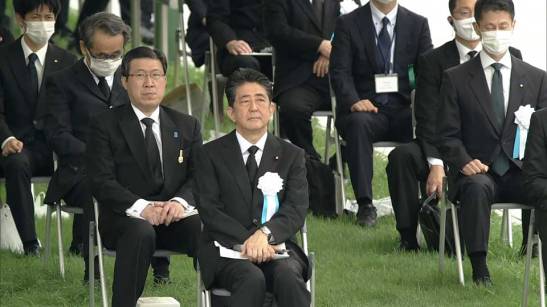 Japanese Prime Minister Abe Shinzo made another pledge this year that the country would commit to achieving a world without nuclear weapons.
“That’s very serious. And I think that’s an insult to the survivors — to the hibakusha,” Fihn says. “We really know the Japanese people want the government to sign the treaty.”
“It’s very often that we look at nuclear armed states as the problem, but we have to recognize that the nuclear-allied states, like Japan for example, are protecting them. They are standing in a circle around them and protecting nuclear weapons. Until those countries stop doing that, it’s going to be very hard to convince the nuclear armed states.”
“How am I going to convince North Korea, the United States and Russia to disarm, if Japan cannot say that nuclear weapons should be illegal?”
Nuclear war ‘like the coronavirus’
Fihn says the coronavirus pandemic is proof that a global emergency could happen anytime. “Health experts have warned about this, and they have been preparing, thinking about it,” she says. “Yet people have been surprised that it happened. It’s the same thing with nuclear weapons. We don’t know when, we don’t know how exactly, but experts say it’s going to happen.”
She warns that nuclear weapons will be far more lethal than the coronavirus. “What we have to do with nuclear weapons — there’s no mitigating it once it happens.” she says. “When we feel the consequences, when the bombs are starting to fall on cities again, then it’s going to be too late to prevent it.”
Nuclear weapons don’t protect us
Fihn says the ongoing pandemic further highlights why governments should be investing in people, not weapons. “This pandemic has shown us where the threats to our security are and how we can’t absorb these things with nuclear weapons,” she says. “Nuclear armed states spend 73 billion dollars on nuclear weapons. Just imagine how many ventilators, doctors, nurses ICU, beds we can have… how many vaccinations we could develop.”
Listen to the hibakusha
She credits atomic bomb survivors for helping spread the message of a nuclear-free world. But she says their time is running out: “Given that it’s probably one of the last milestones where we will still have survivors who are able to speak about it in the first person. I really do think that it’s up to us to use this moment as much as possible to share their stories.”
For the first time, ICAN organized online tours of the Hiroshima and Nagasaki atomic bomb museums this year.
Fihn ended our interview with a message for the hibakusha. “Thank you for doing the incredibly difficult work of sharing your very traumatic experiences so that we can survive, and we can prevent it from happening again,” she says. “ICAN and the millions of people that support us are pledging to take action. We are going to honor the hibakusha, not through words, but through action to eliminate nuclear weapons.”
Nuclear waste in Japan – an environmental worry
 Nuclear waste disposal is a matter of environmental concern, https://www.japantimes.co.jp/opinion/2020/08/31/reader-mail/nuclear-waste-disposal-matter-environmental-concern/ It has been reported that the town of Suttsu in Hokkaido is considering applying for a two-year “literature research” into the possibility of storing high-level radioactive nuclear waste. A maximum of ¥2 billion in subsidies will be granted by the central government.
“The future of the town is financially precarious,” said Haruo Kataoka, the mayor of Suttsu, in an interview.
But the money that is thought to revive the town cannot reverse what the nuclear waste is likely to cause.
It is, in my opinion, never a financial issue, but a matter of environmental concern.
What is in question here is high-level radioactive nuclear waste, which can be dangerous for at least 200,000 years and therefore must be handled with the utmost care. It is indeed a problem that any country with nuclear power plants needs to address, however thorny it is. Any indiscreet decision is deemed extremely irresponsible and profoundly unethical.
“Financially precarious,” I must stress, is by no means comparable to environmentally threatening. Besides, it is specifically stated in a Hokkaido ordinance that nuclear waste is hardly acceptable in the prefecture.
Before a final disposal site is selected, or even before an application for research is submitted, the scientific facts ought to be thoroughly understood and the residents properly informed.
The span of recorded history is merely 5,000 years, while 200,000 years is far beyond human experience and comprehension. We certainly cannot live to see what is going to become of the nuclear waste, but I believe that we do not want to leave the thorny problem unaddressed to haunt our future generations.
Big oil looks to solve its problems by flooding Africa and Asia with plastic
Big Oil Is in Trouble. Its Plan: Flood Africa With Plastic. https://www.nytimes.com/2020/08/30/climate/oil-kenya-africa-plastics-trade.html
Faced with plunging profits and a climate crisis that threatens fossil fuels, the industry is demanding a trade deal that weakens Kenya’s rules on plastics and on imports of American trash. NYT, By Hiroko Tabuchi, Michael Corkery and Carlos Mureithi, Aug. 30, 2020
Confronting a climate crisis that threatens the fossil fuel industry, oil companies are racing to make more plastic. But they face two problems: Many markets are already awash with plastic, and few countries are willing to be dumping grounds for the world’s plastic waste……..
Last year, Kenya was one of many countries around the world that signed on to a global agreement to stop importing plastic waste — a pact strongly opposed by the chemical industry. Emails reviewed by The Times showed industry representatives, many of them former trade officials, working with U.S. negotiators last year to try to stall those rules.
The industry thinks it has found a solution to both problems in Africa.
According to documents reviewed by The New York Times, an industry group representing the world’s largest chemical makers and fossil fuel companies is lobbying to influence United States trade negotiations with Kenya, one of Africa’s biggest economies, to reverse its strict limits on plastics — including a tough plastic-bag ban. It is also pressing for Kenya to continue importing foreign plastic garbage, a practice it has pledged to limit.
Plastics makers are looking well beyond Kenya’s borders. “We anticipate that Kenya could serve in the future as a hub for supplying U.S.-made chemicals and plastics to other markets in Africa through this trade agreement,” Ed Brzytwa, the director of international trade for the American Chemistry Council, wrote in an April 28 letter to the Office of the United States Trade Representative.
The United States and Kenya are in the midst of trade negotiations and the Kenyan president, Uhuru Kenyatta, has made clear he is eager to strike a deal. But the behind-the-scenes lobbying by the petroleum companies has spread concern among environmental groups in Kenya and beyond that have been working to reduce both plastic use and waste.
Kenya, like many countries, has wrestled with the proliferation of plastic. It passed a stringent law against plastic bags in 2017, and last year was one of many nations around the world that signed on to a global agreement to stop importing plastic waste — a pact strongly opposed by the chemical industry.
The chemistry council’s plastics proposals would “inevitably mean more plastic and chemicals in the environment,” said Griffins Ochieng, executive director for the Centre for Environmental Justice and Development, a nonprofit group based in Nairobi that works on the problem of plastic waste in Kenya. “It’s shocking.”
The plastics proposal reflects an oil industry contemplating its inevitable decline as the world fights climate change. Profits are plunging amid the coronavirus pandemic, and the industry is fearful that climate change will force the world to retreat from burning fossil fuels. Producers are scrambling to find new uses for
an oversupply of oil and gas. Wind and solar power are becoming increasingly affordable, and governments are weighing new policies to fight climate change by reducing the burning of fossil fuels.
Pivoting to plastics, the industry has spent more than $200 billion on chemical and manufacturing plants in the United States over the past decade. But the United States already consumes as much as 16 times more plastic than many poor nations, and a backlash against single-use plastics has made it tougher to sell more at home……….
The Kenya proposal “really sets off alarm bells,” said Sharon Treat, a senior lawyer at the nonpartisan Institute for Agriculture and Trade Policy who has worked for more than a decade advising trade talks in both the Trump and Obama administrations. Corporate lobbyists “frequently offer up very specific proposals, which the government then takes up,” she said. ………..
The plastics industry’s proposals could also make it tougher for to regulate plastics in the United States, since a trade deal would apply to both sides.
The records, obtained through Freedom of Information Act requests by Unearthed, a London-based affiliate of the environmental group Greenpeace, paint a picture of close ties between the trade representatives, administration officials and industry representatives. …………..
Kenya isn’t the only country taking measures to curb plastics. A recent report by the United Nations counted 127 countries with policies on the books to regulate or limit use.
In response, the industry has tried to address the plastics issue. The Alliance to End Plastic Waste — formed by oil giants like Exxon Mobil and Chevron, as well as chemical companies like Dow — last year pledged $1.5 billion to fight plastic pollution. That figure, critics point out, is a small fraction of what the industry has invested in plastic infrastructure.
Manufacturers “say they will address plastic waste, but we say plastic itself is the problem,” Mr. Ochieng said. “An exponential growth in plastics production is just not something we can handle.”………….
Despite the industry opposition, last year more than 180 countries agreed to the restrictions. Starting next year, the new rules are expected to greatly reduce the ability of rich nations to send unwanted trash to poorer countries. The United States, which has not yet ratified the Basel Convention, won’t be able send waste to Basel member nations at all……
That setback has re-energized industry to seek deals with individual countries to boost the market for plastics, and find new destinations for plastic waste, analysts say.
In Nairobi, local groups are worried. “My concern is that Kenya will become a dumping ground for plastics,” said Dorothy Otieno of the Centre for Environmental Justice and Development. “And not just for Kenya, but all of Africa.” https://www.nytimes.com/2020/08/30/climate/oil-kenya-africa-plastics-trade.html
Minigrids – the clean energy revolution across Africa and Asia

The little-known clean energy revolution https://energy.economictimes.indiatimes.com/news/renewable/the-little-known-clean-energy-revolution/77742430
There are about 5,500 mini-grids in operation across 12 countries in Africa and Asia, according to The State of the Global Mini-grids Market Report 2020 published by the international non-governmental organization Sustainable Energy for All and BloombergNEF, Bloomberg, August 26, 2020,
Over the last decade, the number of people in the world without access to electricity has fallen drastically — from 1.4 billion in 2010 to about 900 million in 2018, according to the United Nations. And yet, if current trends persist, the world won’t be able to meet the UN’s sustainable development goal of universal access to electricity by 2030, with as many as 600 million still lacking basic 21st century services.
It doesn’t have to be so. A new technology has matured and become affordable that could help achieve the laudable goal, and it’s called mini-grids.
As the name suggests, mini-grids are small, isolated versions of larger power grids. They increasingly use solar power as an energy source, with support from batteries or diesel generators. Because the cost of solar power has fallen drastically , mini-grids have become much cheaper than installing long-distance transmission lines from a central electricity grid.
There are about 5,500 mini-grids in operation across 12 countries in Africa and Asia, according to The State of the Global Mini-grids Market Report 2020, published by the international non-governmental organization Sustainable Energy for All and BloombergNEF earlier this year. The report’s authors found that mini-grids could meet the needs of half the people who still need access to electricity in those regions.
As the name suggests, mini-grids are small, isolated versions of larger power grids. They increasingly use solar power as an energy source, with support from batteries or diesel generators. Because the cost of solar power has fallen drastically , mini-grids have become much cheaper than installing long-distance transmission lines from a central electricity grid.
Universal power access will require $128 billion of spending, the report found, but the world is on track to spend only about $63 billion on mini-grids over the next decade. Plugging the gap would cost less than $600 per target household reached.
The need goes beyond money. “Today the mini-grid market is nascent, despite being the least-cost option for electricity access in many areas,” the report concludes. The international Mini-Grids Partnership, which includes the World Bank and other development agencies from rich countries, has approved $2 billion in awards since 2012 but only disbursed 13% of the money, with many projects stuck because of policy uncertainties.
Africa’s most populous country struggles to provide electricity to its 200 million people. Only 55% of the country has access to electricity, and even there, people suffer from power cuts lasting between four and 15 hours every day. As a result, the country spends more than $16 billion annually to power diesel generators.
In 2017, the country passed a law to help mini-grid development, which streamlines the online application process, offers $350 in government subsidies per user once grids with more than 30 users are up and running, and provides for compensation if the main power grid eventually arrives in an area served by a mini-grid. Developers in Nigeria now have simpler processes and clearer guidelines to follow.
The upshot is that mini-grids have become a much more attractive investment. “Now you see a lot of companies flocking to Nigeria,” says Ruchi Soni, program manager at Sustainable Energy for All. “We hear from partners that they would like to replicate Nigeria’s success in their country.”
This offshoot of the clean energy revolution has three benefits: mini-grids can help provide access to electricity to those who lack it and do so in a cleaner and cheaper way. Few things in life are win-win-win.
“Super Swarm” drones- weaponry as destructive as nuclear weapons

US, China Developing “Super Swarm” Drones With Destruction Power Equivalent To Nuclear Weapons, https://eurasiantimes.com/us-china-developing-super-swarm-drones-with-destruction-power-equivalent-to-nuclear-weapons/ August 28, 2020, EurAsian Times Global Desk
With the US and China leading the development of swarming drone capabilities, they are now looking at not just swarming techniques but also counter swarming tactics. Experts have argued that some drones that are under development are capable of sufficient destructive power to count as Weapons of Mass Destruction.
According to Isaac Kaminer, an engineering professor at the U.S. Naval Postgraduate School who is an expert in the subject of swarming and counter swarming tactics, large-scale adversarial swarms are already an imminent threat. He suggested that stopping a swarm is not simply a matter of driving enough missiles or bullets at it; instead, the swarm has to be outsmarted.
“A swarm with 10,000 or more drones must have extremely high levels of autonomy,” said consultant Zak Kallenborn talking to the Forbes. “No human being could handle the amount of information necessary to make decisions.“
Kaminer defines a ‘Super Swarm’ with large numbers and multiple modes like air, surface, and subsurface threats. The US Navy has already performed offensive swarm operations with its LOCUST drone swarm developed by Raytheon.
According to the developer of LOCUST drone swarm, dozens of small unmanned aircraft systems fly together, filling the sky. Some are collecting information. Some are identifying ground targets. Others might attack the same targets.
“They fly together like a flock of birds, tracking their positions and maintaining their relative positions in the air. Human operators are not needed for every flying drone; instead, they direct the flock as one.”
Currently, the drones are controlled remotely by humans which limits the capabilities both due to the demand for personnel and bandwidth restrictions. Only a few numbers can be used. However, if swarming algorithms are developed it would allow the drones to control itself and hence much larger number can be used increasing its lethality.
It works similar to a swarm of birds or insects. Every member adheres to the same rules to follow cohesion without colliding with each other. This will allow it to work without any central control.
David Hambling, who is also the author of ‘Swarm Troopers: How small drones will conquer the world’, wrote that such a swarm can be defeated by taking advantage of its internal rules – if these can be figured out.
“For example, an entire swarm whose members all have a collision-avoidance rule can be ‘herded’ by a few outsider drones or may be fooled into running into each other. If the members of the swarm are all programmed to attack what they see as the highest-value target in range, then they can all be decoyed into attacking the same dummy.”
The biggest challenge for the US comes from China who is also developing swarming capability as a means of asymmetric warfare, to counterpoise the US advantage in aircraft carriers. Last year, satellite images posted on the Chinese internet displayed a lineup of several drones including the Sharp Sword stealth drone and the Wing Loong Reaper.
Considering the fast pace of development of such technologies it is important to have international laws in place. “The opportunity to develop global norms and treaties around drone swarms and other autonomous weapons is now, “ says Kallenborn. “Collective limits on the number of armed drones in a swarm would reduce the risk to civilians and national security.”
Evacuation orders for Fukushima radioactive areas to be lifted without decontamination
Evacuation orders for Fukushima radioactive areas to be lifted without decontamination, August 27, 2020 (Mainichi Japan) TOKYO — The Japanese government is set to allow the lifting of evacuation orders for highly radioactive areas near the disaster-stricken Fukushima Daiichi Nuclear Power Station without decontamination work on condition that residents will not resettle there.
The government on Aug. 26 disclosed the policy to the Nuclear Regulation Authority (NRA) for the so-called “difficult-to-return” zones where residents have remained evacuated since the onset of the Fukushima nuclear disaster in 2011 due to high radiation doses in those areas in northeastern Japan. The NRA gave its consent to the government policy, paving the way for residents to enter areas outside the specified disaster reconstruction and revitalization base zones.
The government has heretofore made it a condition for lifting the evacuation orders that: the radiation exposure doses will not exceed 20 millisieverts per year; infrastructure necessary for daily lives is developed and sufficient decontamination work is performed; and consultations are held with local bodies and residents. The government previously designated parts of the difficult-to-return zones as disaster recovery bases, which mainly lie in areas where local residents lived, and planned to lift the evacuation orders by 2023 after decontamination work and infrastructure development.
Meanwhile, upon receiving a request from the village of Iitate in Fukushima Prefecture, the government has also been examining under which situations the evacuation directives can be lifted in areas outside the disaster recovery base areas……….. (Japanese original by Hisashi Tsukamoto and Yuka Saito, Science & Environment News Department) https://mainichi.jp/english/articles/20200827/p2a/00m/0na/005000c
Strong opposition in Hokkaido to taking on nuclear waste
Hokkaido town becomes flashpoint in Japan’s nuclear waste debate, Mayor and governor clash over ethics and risks of potential disposal site, Nikkei Asian Review, TORU TAKAHASHI, Nikkei staff writer, August 27, 2020
TOKYO — An idyllic town on the northern Japanese island of Hokkaido is embroiled in a hot debate over nuclear waste, as its mayor weighs building a disposal facility there over the opposition of the governor as well as surrounding towns………
Hokkaido Gov. Naomichi Suzuki has swiftly mobilized opponents. “Hokkaido has no intention of taking on nuclear waste,” he said on Aug. 13, shortly after Kataoka’s announcement. “The national government is basically shoving wads of cash in our face,” he also said on Aug. 18, criticizing the cash offer. ……..
several local industry groups oppose the idea. Fishermen in particular worry that a local nuclear facility could tarnish the reputation of their catch.
Nearby towns and villages also feel they could face all of the risks of the nuclear waste disposal site without any payout from the national government…… https://asia.nikkei.com/Politics/Hokkaido-town-becomes-flashpoint-in-Japan-s-nuclear-waste-debate
The Chinese viewpoint on nuclear deterrence and cyberattacks
|
Nuclear deterrence needed to prevent cyberattacks from paralyzing China’s nuclear response https://www.globaltimes.cn/content/1198665.shtml
By Qin An Source: Global Times 2020/8/24 The US’ maximum pressure campaign against China now has extended to cyberspace. After the Trump administration’s ban of TikTok and the Clean Network program that aims at Chinese companies, news on Sunday said that TikTok plans to sue the Trump administration over its executive order banning the app. As the game goes viral, there are concerns about whether the US will launch a cyberattack against China. Will China and the US actually cut off the network connection between them?
Such concerns do not come from nowhere. In 2019 alone, there were three major cyberattacks related to the US. In March 2019, Venezuela’s national power grid collapsed. The country’s president denounced the attack as a well planned cyberattack by the US. This indicates that cyberwarfare has become a new mode of undeclared warfare – an invisible invasion of sorts. In June 2019, Trump announced retaliation against Iran with a cyberattack too. This showed that cyberwarfare has moved from the backstage to the front lines, from covert warfare to a declaration of war, and from auxiliary fighting to mainstream combat. On November 4, 2019, the US invited a number of countries to hold the first ever joint cyberattack and defense exercise with the island of Taiwan. It undertook cyberattack scenarios as a new approach to go beyond beach landings and targeting financial systems. It focused on persistent and chaotic destructive attacks on key infrastructure and economic systems. This indicates that the US has crossed the bottom line of the one-China principle in cyberspace. From late June to mid-July this year, some “mysterious explosions” occurred in Iran’s strategic facilities causing more than 100 casualties at power plants, nuclear facilities, chemical plants and ammunition depots. Cyber sabotage from Israel and the US were believed to be involved. This series of actions and events show that the US has not only the ability to paralyze a society through cyberattacks but also the proven will to do so. Will the US use this ability against China? It’s completely possible. But the two countries might not disconnect their network. Although US Secretary of State Mike Pompeo has listed the “clean networks,” the US’ are the ones who are the most unclean. At present, the Chinese enterprises subject to unilateral sanctions by the US are innocent, and their technologies and products are safe as well. The US is fully aware of this. Besides for the US, disconnecting the network with China will actually cut off the easy path to attack China. However, China must consider how to deal with “disconnection” and take primary precautions mainly in three aspects. First, it must strengthen the awareness of network crisis. With the advent of the internet age, the international structure is experiencing subversive changes. Sovereign states have entered into an era of “stabilizing and governing with big data.” The network’s characteristics have increasingly made this concept more prominent: The internet can be used to kill people and overthrow a country. Second, we must optimize the power structure. Cyberspace has become the fifth dimensional battlefield besides land, sea, sky and space. Although ordinary users form the frontline of defense in cyberspace, cyberwarfare cannot mainly rely on “militia.” The sustainable development of a “regular cyber army” has become an important option for the construction of a country powerful in cyberspace. Third, cyber deterrence needs to be showcased. China not only needs to be capable of launching counterattacks in cyberspace, but also must consider special situations in which other countries’ cyberattacks might affect our ability of a nuclear counterattack. We must keep nuclear deterrence to the cyberattacks that aim to paralyze our network. Russia’s latest updated nuclear deterrence strategy lists four conditions that would trigger its implementation of nuclear strikes. In one situation, if the attack undermines its nuclear force response actions, Russia would contemplate using nuclear weapons. Cyberattacks may lead to such situation, therefore Russia’s nuclear deterrence takes cyberattacks into consideration. The author is head of the Beijing-based Institute of China Cyberspace Strategy. opinion@globaltimes.com.cn |
|
1 This Month
Chernobyl: The Lost Tapes – A good documentary on Chernobyl on SBS available On Demand for the next 3 weeks– https://www.sbs.com.au/ondemand/tv-program/chernobyl-the-lost-tapes/2352741955560

of the week–London Campaign for Nuclear Disarmament

Tell the Ukrainian Government to Drop Prosecution of Peace Activist Yurii Sheliazhenko
To see nuclear-related stories in greater depth and intensity – go to https://nuclearinformation.wordpress.com
-
Archives
- April 2026 (152)
- March 2026 (251)
- February 2026 (268)
- January 2026 (308)
- December 2025 (358)
- November 2025 (359)
- October 2025 (376)
- September 2025 (257)
- August 2025 (319)
- July 2025 (230)
- June 2025 (348)
- May 2025 (261)
-
Categories
- 1
- 1 NUCLEAR ISSUES
- business and costs
- climate change
- culture and arts
- ENERGY
- environment
- health
- history
- indigenous issues
- Legal
- marketing of nuclear
- media
- opposition to nuclear
- PERSONAL STORIES
- politics
- politics international
- Religion and ethics
- safety
- secrets,lies and civil liberties
- spinbuster
- technology
- Uranium
- wastes
- weapons and war
- Women
- 2 WORLD
- ACTION
- AFRICA
- Atrocities
- AUSTRALIA
- Christina's notes
- Christina's themes
- culture and arts
- Events
- Fuk 2022
- Fuk 2023
- Fukushima 2017
- Fukushima 2018
- fukushima 2019
- Fukushima 2020
- Fukushima 2021
- general
- global warming
- Humour (God we need it)
- Nuclear
- RARE EARTHS
- Reference
- resources – print
- Resources -audiovicual
- Weekly Newsletter
- World
- World Nuclear
- YouTube
-
RSS
Entries RSS
Comments RSS
 nuclear-news