Japan set to restart world’s biggest nuclear power plant.
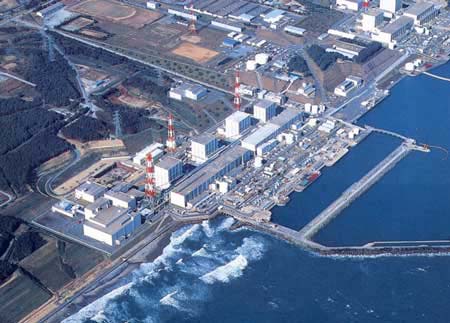
Kashiwazaki-Kariwa will be the latest plant to restart 15 years after the Fukushima disaster shut down the country’s nuclear energy programme.
Aljazeera, By Lyndal Rowlands and News Agencies, 22 Dec 25
Japan is set to resume operations at the world’s largest nuclear power plant: Kashiwazaki-Kariwa.
The partial restart of the plant got the green light in a vote on Monday by the Niigata local government. Japan has reopened several nuclear facilities as it seeks to reduce emissions, reversing policy 15 years after 54 reactors were shut in the wake of the Fukushima disaster despite public opposition.
Niigata prefecture’s assembly passed a vote of confidence on Governor Hideyo Hanazumi, who backed the restart last month, effectively allowing the plant to begin operations again.
The 2011 triple meltdown at Fukushima, following an earthquake and tsunami, destroyed Japan’s trust in its nuclear energy infrastructure…………..
Fourteen of the 33 nuclear plants that remain operable in the country have been resurrected. However, Kashiwazaki-Kariwa is the first to be operated by Tokyo Electric Power Co (TEPCO), which ran the Fukushima plant.
TEPCO is considering reactivating the first of seven reactors at the plant on January 20, Japanese public broadcaster NHK reported……………………
While lawmakers voted in support of Hanazumi, the assembly session showed that the community remains divided over the restart, despite the promise of new jobs and potentially lower electricity bills.
About 300 protesters rallied to oppose the vote, holding banners reading “No Nukes”, “We oppose the restart of Kashiwazaki-Kariwa” and “Support Fukushima”.
Farmer and antinuclear activist Ayako Oga, 52, joined the protests on Monday in her new home of Niigata, where she settled after fleeing the area around the Fukushima plant in 2011 with 160,000 other evacuees. Her old home was within the 20km (12-mile) radius irradiated exclusion zone.
“We know firsthand the risk of a nuclear accident and cannot dismiss it,” said Oga, adding that she still struggles with post-traumatic stress disorder-like symptoms……………………………… https://www.aljazeera.com/news/2025/12/22/japan-set-to-restart-worlds-biggest-nuclear-power-plant
Fukushima Now (29) – Part 1: What Constitutes Responsibility?
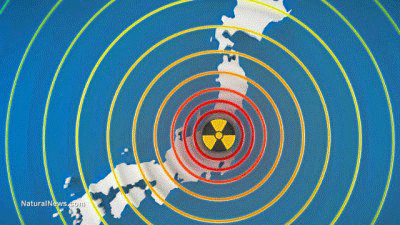
by Citizens’ Nuclear Information Center · December 21, 2025, By Yamaguchi Yukio, https://cnic.jp/english/?p=8747
n the 14 and a half years that have passed since March 2011, the cesium-137 that was released has finally made it to the halfway point of its half-life. After 90 years, its radioactive concentration will have diminished to one-eighth its initial level, and after 300 years, one-thousandth. According to the current medium-to-long-term roadmap, decommissioning measures should be completed around 2041 to 2051. Even by then, however, the radioactivity will have decreased only by a little more than half. Not even what these “decommissioning measures” are supposed to include has been decided on yet.
In places with serious radioactive contamination, nobody will be able to live there for another century. The area thus affected is said to exceed 300 square kilometers. The first sample of fuel debris taken from the Unit 2 reactor weighed 0.7 grams, and the second, 0.2 grams. The information gained from their analysis is just as miniscule. Meanwhile, the total amount of fuel debris in the Unit 1-3 reactors is estimated at 880 tons. Whether it will be necessary to retrieve all of it to begin with is a matter of great contention.
Idogawa Katsutaka, who was mayor of Futaba Town at the time of the accident, evacuated the entire town to protect everyone there from radioactive exposure, leading many of them as far as 250 kilometers away to Kazo City, Saitama Prefecture, near Tokyo, where they took refuge in a gymnasium that had belonged to the town’s former Kisai High School. This was just one of the municipalities that evacuated from Fukushima Prefecture to escape radioactivity. The town’s population totaled 6,971 people overall, of whom 187 took refuge at the former Kisai High School (as of September 18, 2012). Details of their evacuation were relayed widely around the world by the 2012 film “Nuclear Nation” (Japanese: “Futaba kara Toku Hanarete,” directed by Funahashi Atsushi, music by Sakamoto Ryuichi).
As of 1 August 2025, the registered population of Futaba Town had dwindled to 5,157 in all, of whom 59 percent were living within Fukushima Prefecture and 41 percent were still evacuees elsewhere among 43 of Japan’s 47 prefectures. Idogawa’s hope is, “We want somehow to go home, all of us, together, to a safe hometown.” The number of returnees so far, however, is a mere 87 people (as of August 2025).
■ Idogawa filed suit in May 2015 against the government of Japan and Tokyo Electric Power Co. (TEPCO), seeking 755 million yen in damages. A decision on the case was rendered on 30 July 2025 in Tokyo District Court, finding no responsibility on the part of the government, but ordering TEPCO to pay compensation of about 100 million yen for damages to real estate and compensation for the evacuations.
The reasoning behind this decision was that even if the government had required TEPCO to take measures against a possible tsunami, there was a good likelihood that a similar accident could have occurred anyway, so the government bore no responsibility for it. This followed the precedent of a Supreme Court’s ruling on 17 June 2022 denying the government’s responsibility.
Nor did they recognize Idogawa’s claim that his health had been damaged by his exposure in the course of evacuating. This angered Idogawa, who called it a terrible decision against a person who had faithfully fallen in line with Japan’s atomic energy administration.
I think what caused this tragic nuclear accident, unprecedented in scale, was Japan’s fundamentally flawed nuclear power system, adopted by the government in the name of “peaceful use of the atom.” It can only be called a huge transgression by the politicians, bureaucrats, scientists, and business leaders of that time on account of their lackadaisical inattention to safety.
The theory of plate tectonics teaches us not to expect to see broad regions of stability, free from concerns about earthquakes, tsunamis or volcanic activity in the Japanese archipelago. We are only part way toward clarifying the causes and circumstances of the Fukushima nuclear accident. Despite this, the government is ignoring the lessons of history and clearly announcing a “nuclear renaissance” in its 7th Strategic Energy Plan. Even if it intends to “put safety first” as a condition, it cannot create safety measures if it has yet to elucidate the causes of the accident. This is no way to ensure “safety first.” It’s a contradiction.
Establishing nuclear power plants in the Japanese archipelago in itself is a mistake. The first chairman of Japan’s Nuclear Regulation Authority publicly stated that even if the new safety standards created in 2012 were fulfilled, it would not guarantee safety. Even now, the phrase “safety first” commonly uttered by nuclear proponents is a fiction and can only be called irresponsible.
A Serious Proposal: Russia and China Call for Global Strategic Stability

By Alice Slater, World BEYOND War, October 8, 2025
It’s ironic that the arms control community is protesting the idea of resuming nuclear test detonations. The nuclear test detonations have never stopped.
Although Bill Clinton signed the Comprehensive Test Ban Treaty (CTBT) in 1996, he swiftly funded the “Stockpile Stewardship” program at the US nuclear weapons complex, allowing the Dr. Strangeloves in their labs to continue to perform laboratory tests as well as blowup plutonium with chemical explosives,1,000 feet below the desert floor at the Nevada Test Site on Western Shoshone holy land.
Since there was no chain reaction causing criticality, Clinton claimed these “sub-critical” tests were not nuclear tests and didn’t violate the new treaty. Of course, Russia and China swiftly followed the US lead; the Russians continued to test at Novaya Zemlya, and China at Lop Nor.
Indeed, it was the US’s refusal to promise that the Comprehensive Test Ban Treaty would be truly “comprehensive” that caused India and Pakistan to test their nuclear arsenals after the US rejected their pleas to include prohibitions against “sub-critical” and laboratory tests in the CTBT. Although Clinton signed the CTBT, the US, unlike Russia and China, never ratified it. Sadly, Russia announced during the Ukraine war that it was leaving the CTBT.
People of goodwill who are alarmed at new reports of proliferating nuclear weapons and would like to put the nuclear genie back in the bottle, stop the endless wars and huge budgets for useless atomic weapons, would do well to take some advice from Russia and China. On May 8, they issued a “Joint Statement by the Russian Federation and the People’s Republic of China on Global Strategic Stability” in the context of the 80th anniversary of the end of World War II.
They note “the serious challenges facing the international community” and lay out several recommendations that would strengthen “global strategic security”, acknowledging that “the destinies of all countries are interrelated” and urging that states not “seek to ensure their own security at the expense and to the detriment of the security of other states.”
U.S. “Golden Dome”

They proceed to explain a whole series of provocative actions that threaten the peace, including states deploying nuclear weapons and missiles outside their territories. They are particularly critical of the US “Golden Dome” program, which is expected to create a new battleground in space. Reiterating their pleas over many years to keep space for peace, they state the following:
The two sides oppose the attempts of individual countries to use outer space for armed confrontation. They will counter security policies and activities aimed at achieving military superiority, as well as at officially defining and using outer space as a ” warfighting domain”. The two Sides confirm the need to start negotiations on a legally binding instrument based on the Russian-Chinese draft of the treaty on the Prevention of the Placement of Weapons in Outer Space and of the Threat or Use of Force Against Outer Space Objects as soon as possible, that would provide fundamental and reliable guarantees for preventing an arms race in outer space, weaponization of outer space and the threat or use of force against outer space objects or with their help. To safeguard world peace, ensure equal and indivisible security for all, and improve the predictability and sustainability of the exploration and peaceful use of outer space by all States, the two Sides agree to promote on a global scale the international initiative/political commitment not to be the first to deploy weapons in outer space.
The US and its allies, sheltering under the US nuclear umbrella, would do well to take Russia and China up on their offers for making a more peaceful world! With Mother Earth sending cascading warnings about the need for nations to cooperate, we can ill afford business as usual. Time to change course!
*Alice Slater serves on the Boards of World BEYOND War and the Global Network Against Weapons and Nuclear Power in Space. She is an NGO representative at the UN for the Nuclear Age Peace Foundation.
Nuclear power’s role in Japan is fading. The myths of reactor safety and energy needs can’t change that reality.

By Tadahiro Katsuta , Bulletin of Atomic Scientists 11th Dec 2025
On November 24, the Niigata Prefecture approved the partial restart of the seven-unit Kashiwazaki-Kariwa Nuclear Power Plant—the world’s largest, with a 7,965-megawatt-electric capacity—the first time it would be operated since the 2011 Fukushima Daiichi accident. The decision follows a series of efforts by the Japanese government to revive its nuclear industry since the Fukushima disaster led to the temporary shutdown of all its reactors.
In February, the Japanese government unveiled the country’s latest revised strategic energy plan with one significant shift: It no longer includes the commitment to “reduce dependence on nuclear power as much as possible.” Since the 2011 Fukushima accident, this objective has been reaffirmed in all three revisions preceding the 2022 plan. Its removal marks a clear departure from the government’s previously cautious stance on Japan’s nuclear policy.
Decommissioning work of the Fukushima Daiichi plant is still falling behind schedule, and there are no prospects for fully lifting the evacuation orders in the Fukushima Prefecture. This uncertainty surrounding post-accident Fukushima casts doubt on the government’s ability to manage another nuclear crisis. Meanwhile, the government’s plan actively promotes the “effective use” of plutonium through the reprocessing of spent nuclear fuel and the “usefulness” of nuclear power as a decarbonized power source in its newest plan.
The Japanese government had consistently maintained a strong policy of promoting nuclear power since the initial planning stage in the 1950s until the Fukushima accident. Its current position, therefore, comes as little surprise. But in the nearly 15 years since the accident, Japan’s energy structure and society have changed—and all evidence shows that nuclear power cannot simply be switched on again, despite what the government claims.
Displaced by renewable energy. As a result of new safety regulations that the Nuclear Regulation Authority (NRA) established in 2012, nuclear power plants with inadequate accident prevention measures are still unable to operate.
Japan used to operate 54 commercial nuclear power plants before the Fukushima accident, but so far only 14 have obtained operating permits and resumed operations. This translated into nuclear power’s share of electricity supply dropping to just over 5 percent from the 29 percent before the accident. The government is seeking a 20-percent share by fiscal 2040 but has not presented any specific measures to achieve this goal.
Meanwhile, renewable energy has increased rapidly since the Fukushima accident, partially filling the vacuum of the shutdown reactors. Renewable energy now supplies 226 terawatt-hours of electricity—more than twice the 84 terawatt-hours supplied by nuclear power. And renewables will continue to dominate the electricity market with a target share of 40 to 50 percent by 2040, also more than double that of nuclear power……………..
While nuclear power lacks competitiveness in the electricity market, Japan’s electricity demand has already plateaued. Demand has decreased by more than 10 percent since 2010,[2] according to the latest figures. The government insists that electricity consumption will increase sharply over the next 10 years due to the growing demand in data centers and semiconductor factories. However, even if this happens, it will still result in a lower electricity demand compared to 2010.
Unlike France, Japan does not allow output adjustments for nuclear power generation, and being an island nation, it cannot export electricity overseas. Moreover, with a slowing economy and a shrinking population, electricity demand has already peaked. In a market that seeks to maximize profits by anticipating short-term electricity demand and avoiding excess power generation, nuclear power is not an attractive option.
Does Japan need MOX fuel?
……………………………………………..Power companies and the government have not disclosed what the cost will be for Japan of manufacturing this MOX fuel abroad and then importing it. But trade statistics indicate that the MOX fuel commissioned at a French reprocessing plant cost approximately $11,000 per kilogram of heavy metal (primarily plutonium and uranium), while uranium fuel imported from the United States cost approximately $1,000 per kilogram of heavy metal. In other words, MOX fuel is more than 10 times as expensive as imported non-reprocessed reactor fuel.[3]………………….
Does nuclear power mean fewer CO2 emissions?
……………………………………………………………………………………………………………………………………………..As spent nuclear fuel continues to accumulate in Japan, the government claims that it can be reduced by reprocessing. If so, the reduction cost can be estimated as ¥488 million ($3.3 million) per ton.[5] That’s an emission reduction cost per ton 300,000 times higher than for other mitigation measures indicated by the IPCC. Moreover, spent nuclear fuel does not disappear through reprocessing. Even at the end of a closed fuel cycle, the reprocessed and recycled used fuel will require permanent geological disposal, which comes with its own set of challenges. That’s particularly the case with MOX fuel, which generates high decay heat associated with plutonium and accumulated minor actinides.
Advocates of nuclear power argue that combining fast reactors and transmutation technology after reprocessing can reduce the volume of high-level radioactive waste. But, beyond their many scientific and economic challenges, those measures will not be available in time to solve the climate change crisis, which requires immediate solutions. The only way to stop the generation of spent nuclear fuel is to stop operating nuclear reactors in the first place.
The myth of nuclear power disappears. The Fukushima accident demonstrated—once again—that the claimed inherent safety of nuclear power is a myth. Japan’s reduced reliance on nuclear power since the accident has now also debunked a second myth—that the Japanese society needs nuclear energy. The government’s reversal of its passive stance in favor of a proactive nuclear power policy goes against the current facts. It should revise its energy plan accordingly.
Unfortunately, the new Japanese cabinet formed this October, like its predecessors, is sidestepping the many current and future challenges of nuclear power………………………… As long as the government continues to avoid confronting the difficult reality of nuclear power in Japan, the myth will go on. Until it doesn’t.
India’s Parliament approves bill to open civil nuclear power sector to private firms
DailyMail, By ASSOCIATED PRESS, 19 December 2025
NEW DELHI (AP) – India´s Parliament approved new legislation Thursday that enables opening the tightly controlled civil nuclear power sector to private companies.
The government termed it a major policy shift to speed up [?] clean energy expansion while the opposition political parties argued that it dilutes safety and liability safeguards.
The lower house of parliament passed the legislation Wednesday and the upper house on Thursday. It now needs the assent from the Indian president, which is a formality, to come into force.
………….. critics say it opens the door to risks, mainly health hazards, that could have long term consequences…………..
some are skeptical about India´s ambitions as the country´s nuclear sector is still very small, and negative public perceptions about the industry remain.
Opposition parties flagged concerns related to several provisions of the bill and urged the government to refer it to a parliamentary panel for examination. The government didn´t adhere to the request.
“The bill doesn´t have sufficient safeguards when it comes to mitigating the bad health of those impacted by living in areas closer to nuclear plants,” Ashok Mittal, a lawmaker from the opposition Aam Admi Party, told The Associated Press.
G. Sundarrajan, an anti-nuclear energy activist, called the bill a “disastrous law,” saying it takes away essential safeguards that are needed to make sure companies invest in safety and reduce the chances of a major disaster that can impact millions from occurring.
“It also provides little recourse for any Indian citizen to claim damages from nuclear companies even if they are affected by radiation leaks or suffer from any other health impact as a result of a nuclear plant in their region,” he said. https://www.dailymail.co.uk/wires/ap/article-15396015/Indias-Parliament-approves-bill-open-civil-nuclear-power-sector-private-firms.html
How nuclear submarines could pave the way for nuclear weapons in South Korea
Bulletin, By Sharon Squassoni | December 12, 2025
Share
The mystique of nuclear-powered submarines has been captured by at least half a dozen popular Hollywood films. Some have centered on the drama of undersea warfare and the risk of global nuclear apocalypse should the nuclear-tipped missiles aboard most of them be launched. Others confront the issues of rogue submarine commanders or the dilemmas of decision-making when out of communication with national leadership. One or two, including Kathryn Bigelow’s K-19 Widowmaker, portray real-world disasters of a reactor meltdown aboard submarines. (Bigelow is also the director of the new film, A House of Dynamite, which depicts the last 20 minutes before a nuclear-armed missile of unknown origin falls on an American city.)
The underlying message of these fictional works is that nuclear submarines—powered by reactors and armed with atomic missiles—are a tightrope act. One misstep could endanger many, many lives.
The United States’ recent nuclear submarine deal with South Korea is a tightrope act for a different reason. Lost in the noise about nuclear submarines, the Trump administration has agreed to let South Korea enrich uranium and reprocess commercial nuclear spent fuel. This step—which could give South Korea a virtual or latent nuclear weapons capability—is needlessly destabilizing.
US nuclear technology exports. In the last five years, the United States has made deals with Australia and South Korea to hasten the day when some countries will deploy nuclear-powered submarines that don’t carry nuclear missiles. Under the 2021 AUKUS deal (a partnership between Australia, the United Kingdom, and the United States), Australia will build nuclear-powered submarines using UK reactors and US highly enriched uranium fuel at the latest estimated cost of $368 billion. And in October, South Korea scored a political coup in convincing US President Donald Trump to allow its pursuit of nuclear-powered submarines.
South Korea has sought nuclear-powered submarines for more than 30 years. Sparked by the first international crisis over North Korea’s nuclear weapons program, Seoul has dabbled in the relevant technologies in an on-again, off-again fashion. Past forays included a 1994 directive to the Korean Atomic Energy Research Institute to design a nuclear-powered submarine (cancelled in 1998) and the so-called “362” covert task force formed in 2003 that reportedly utilized Russian help to design a submarine reactor. This task force was disbanded in 2004 after South Korean officials revealed that scientists had enriched uranium without declaring it to the International Atomic Energy Agency.
More recently, Moon Jae-in campaigned on South Korea acquiring nuclear-powered submarines in 2017, and Korean officials since 2020 have suggested that their next generation of submarines would be nuclear-powered. Speculation persists over whether South Korean efforts to develop small modular reactors fueled with 19.5 percent high-assay low-enriched uranium could be adapted or modified for naval applications.
Many details about South Korea’s nuclear submarines are still unknown— when, where, and how they will be built. Those details will matter a great deal in terms of the proliferation implications. Allowing South Korea to indigenously produce its own nuclear submarines could be riskier than if South Korea were to purchase US subs or the reactors that go into these subs.
Nuclear-powered vs. nuclear-armed. Nuclear-powered submarines make total sense to nuclear weapon states, which weigh the risks and costs of these vehicles against the benefits of stealth, range, and having a platform for assured, nuclear retaliation. (In theory, such submarines can enhance stability because they provide assured destruction in case an opponent seeks advantage by striking first—the so-called delicate balance of terror.) Already engaged in high-cost and high-risk nuclear projects, nuclear-powered submarines are not a huge step up for countries with nuclear weapons.
For countries without nuclear weapons, however, the costs far outweigh the benefits.
Per unit, a single modern diesel-electric attack submarine with air-independent propulsion costs between $500 million and $900 million. A modern nuclear-powered attack submarine will cost between $3 billion and $4 billion each, based on the current cost of Virginia-class nuclear attack submarines in the United States, a country with experience in building such ships. This is on top of the considerable investment in shipbuilding that countries like South Korea and Australia would have to make. For instance, South Korea has vowed to invest $350 billion in the United States, of which half will be spent on US shipbuilding…………………………………………………………………………………………………………………………………………… https://thebulletin.org/2025/12/how-nuclear-submarines-could-pave-the-way-for-nuclear-weapons-in-south-korea/
Japan rejects EU plan to steal Russian assets – Politico.

09 Dec 2025, https://www.sott.net/article/503419-Japan-rejects-EU-plan-to-steal-Russian-assets-Politico
The bloc wants to use Moscow’s funds immobilized in the West to cover Ukraine’s budget deficit.
Japan has reportedly dismissed a European Union initiative to tap frozen Russian sovereign assets to help finance Ukraine’s massive budget shortfall.
Brussels hopes to issue a so-called “reparation loan” backed by Russian funds immobilized in the West – a plan that Moscow has denounced as outright theft. Belgium, where most of the money is held by the Euroclear clearinghouse, has refused to greenlight the proposal unless other nations agree to share associated legal and financial risks.
Belgian Prime Minister Bart De Wever has said broader international backing, particularly from non-EU countries holding Russian assets, would bolster the European Commission’s case for what he called the effective confiscation of a foreign state’s funds. But at a meeting of G7 finance ministers on Monday, Japan’s Satsuki Katayama made clear her government would not support the plan due to legal constraints, Politico reported, citing EU diplomatic sources.
Officials told the outlet they believe Japan’s stance aligns with that of the United States, which also opposes the EU approach and views the frozen assets as leverage in negotiations with Moscow.
France has reportedly likewise declined to touch any assets held on its soil, while Canada and the UK have signaled possible participation if the EU ultimately pursues the scheme.
Ukraine’s parliament last week adopted a 2026 budget with a staggering $47.5 billion deficit, expecting foreign donors and creditors to fill the gap. Roughly half that anticipated support – an estimated $23.6 billion – remains uncertain pending the fate of the EU loan plan.
Ukrainian media noted that lawmakers pushed the budget through despite unresolved questions over foreign financing, in part to project stability following the removal of Andrey Yermak, formerly the most powerful aide to the country’s leader, Vladimir Zelensky. Yermak was dismissed as a corruption scandal engulfed Kiev’s political establishment.
Japan inspects nuclear sites as seismologists warn of another large quake.

Authorities assessed the damage from Monday’s 7.5-magnitude earthquake, amid warnings of aftershocks and a potentially larger tremblor in the coming days.
Nuclear facilities were inspected in Japan on Tuesday as
authorities assessed the damage from a 7.5-magnitude earthquake, amid
warnings of aftershocks and a potentially larger tremblor in the coming
days. As cleanup operations began, Prime Minister Sanae Takaichi told
reporters that an emergency task force was formed to urgently assess
damage, according to The Associated Press. “We are putting people’s
lives first and doing everything we can,” she said……………………………………………………………..
Japanese officials found “no abnormalities” at Fukushima, the International Atomic Energy Agency said early Tuesday.
But as inspections were carried out on other nuclear sites, the country’s Nuclear Regulation Authority said in a statement that nearly 120 gallons of water spilled from a fuel cooling system at a nuclear fuel processing plant in the city of Aomori near the epicenter of Monday’s earthquake……………………….
NBC News 9th Dec 2025, https://www.nbcnews.com/world/asia/japan-earthquake-nuclear-sites-damage-injuries-emergency-rcna248160
Japan pulls out of Vietnam nuclear project, complicating Hanoi’s power plans
Japan has dropped out of plans to build a major nuclear power plant in
Vietnam because the time frame is too tight, Japanese ambassador Naoki Ito told Reuters, potentially complicating Vietnam’s long-term strategy to
avoid new power shortages.
Vietnam, home to large manufacturing operations for multinationals including Samsung and Apple, has faced major power blackouts as demand from its huge industrial sector and expanding middle class often outpaces supplies, strained by increasingly frequent extreme weather, such as droughts and typhoons.
“The Japanese side is not in a position to implement the Ninh Thuan 2 project,” the ambassador to Vietnam said, referring to a plant with a planned capacity of 2 to 3.2 gigawatts. The project is part of Vietnam’s strategy to boost power generation capacity.
Asahi Shimbun 8th Dec 2025, https://www.asahi.com/ajw/articles/16208469
China’s New Underwater Drones Could Blindside the U.S. Navy

1945, By Reuben Johnson, 10 Dec 25
Key Points and Summary – China is quietly opening a new front in undersea warfare. Beijing’s latest AI-enabled underwater drones can execute zero-radius turns, recharge at submerged stations, datalink with each other, and reportedly operate below 90 decibels—making them extremely hard to detect.
-Designed to block shipping lanes, threaten warships, and autonomously target and attack, these systems fit neatly into China’s broader effort to keep U.S. and allied navies away from Taiwan.
China continues to make progress in drone technology—especially in aerial combat designs.
Their vehicles are similar to those being developed in the West, such as Collaborative Combat Aircraft or “loyal wingman” programs.
On Sept. 3, observers in Beijing were able to get a glance at one of China’s latest military innovations—a platform that could cause headaches for the U.S. and its allies.
The new design is for an unmanned underwater drone system controlled by what is described as advanced AI capabilities.
This new technology developed for the People’s Liberation Army Navy (PLAN) could be a disruptive development and a ground-breaking capability in anti-submarine warfare.
The new underwater drones are purportedly capable of zero-radius turns and can operate in almost any maritime environment.
They are also promoted as being difficult to detect by modern sonar and other underwater sensor networks, since any noise they generate during operations is below 90 decibels.
According to a recent report by the South China Morning Post, the PLAN’s newest unmanned systems do not have to operate as solo platforms—they will datalink and coordinate with each other to carry out a host of different missions.
These would include blocking shipping lanes, threatening naval vessels at sea, and launching attacks on seaborne targets.
Detection Impossible
China’s new underwater drone systems are reportedly also capable of long-endurance missions, as they can recharge batteries at underwater stations.
Since they will operate in an almost self-aware mode using AI, they will be able to autonomously identify a target, develop a firing solution, and attack any platform they deem a threat.
The endurance capability, ability to operate without a datalink to an operator, and the extreme ranges at which they will be able to strike would all be new advancements in underwater unmanned vehicles.
However, the real worry for adversaries is these undersea drones’ unprecedented ability to evade detection.
As one recent article points out, “this could disrupt the current global maritime security governance.”….. https://www.19fortyfive.com/2025/12/chinas-new-underwater-drones-could-blindside-the-u-s-navy/
South Korea’s nuclear submarine gamble raises prospect of underwater arms race in Asia.

Reuters, 5 Dec 25
- Summary
- South Korea’s nuclear subs could pressure Japan to develop similar capabilities
- Seoul’s ambitions align with US objectives to counter China’s influence
- North Korea warns Seoul’s plan could trigger “nuclear domino” effect
SEOUL/WASHINGTON/TOKYO, Dec 5 (Reuters) – South Korea’s pursuit of nuclear-powered submarines is gaining traction following President Donald Trump’s endorsement, ending decades of U.S. resistance in a move that could reshape Asia’s security landscape and escalate an underwater arms race.
Seoul has long sought to join the elite group of nations operating nuclear submarines to counter North Korea. Trump’s approval removed a key barrier by granting access to fuel under a nuclear agreement between the countries.
Still, South Korea’s rapidly developing programme could irk China and pressure Japan to develop similar capabilities, analysts and former military officials say.
“Submarines are highly effective attack systems. An arms race in the region is inevitable,” said Choi Il, a retired South Korean Navy submarine captain.
Seoul argues nuclear propulsion is crucial to counter North Korea’s undersea threats, including submarine-launched ballistic missiles. It has repeatedly said it will not acquire nuclear weapons and respects the non-proliferation regime.
South Korean President Lee Jae Myung on Wednesday described the deal as a major achievement from his meeting with Trump and said it would enhance security flexibility and defence autonomy.
North Korea claims to be developing similar capabilities, with state media showing leader Kim Jong Un inspecting what it said was a nuclear-powered submarine in March.
How advanced its programme is remains uncertain, but some analysts suspect Pyongyang is receiving Russian assistance, a possibility that South Korea’s military has said it is closely monitoring. Russia and North Korea have said they are beefing up defence cooperation, but have not provided details on technical cooperation on defence……………………………………………………… https://www.reuters.com/world/china/south-koreas-nuclear-submarine-gamble-raises-prospect-underwater-arms-race-asia-2025-12-05/
China releases arms control white paper in new era; ‘document injects positive energy, safeguards developing nations’ rights

Global Times By Liu Xuanzun and Guo Yuandan, : Nov 27, 2025
China’s State Council Information Office on Thursday released a white paper titled “China’s Arms Control, Disarmament, and Nonproliferation in the New Era.” An expert told the Global Times that at a time when the existing international arms control mechanisms are facing challenges, the white paper issued by China injects positive energy into the global arms control and nonproliferation process and fully safeguards the rights of developing countries.
Apart from the preface, conclusion, and annexes, the white paper has five sections: “Grim Realities: International Security and Arms Control,” “Position and Policies: China’s Arms Control in the New Era,” “Playing a Constructive Role in International Arms Control,” “Leading International Security Governance in Emerging Fields,” and “Strengthening International Cooperation on Nonproliferation and Peaceful Uses of Science and Technology.”
The white paper reiterated that China upholds a firm commitment to a policy of no-first-use of nuclear weapons and a nuclear strategy of self-defense. It said that China was compelled to make the strategic choice to develop nuclear weapons at a particular point in history to deal with nuclear threats and blackmail, break the existing nuclear monopoly, and prevent nuclear wars. China’s nuclear weapons are not intended to threaten other countries, but for defense and self-protection. China has never used nuclear weapons to threaten other countries nor deployed nuclear weapons outside its own territories, and has never provided a nuclear umbrella for other countries.

China releases arms control white paper in new era; ‘document injects positive energy, safeguards developing nations’ rights’
By
Liu Xuanzun and Guo YuandanPublished: Nov 27, 2025 10:25 PM
latest news
China’s State Council Information Office on Thursday released a white paper titled “China’s Arms Control, Disarmament, and Nonproliferation in the New Era.” An expert told the Global Times that at a time when the existing international arms control mechanisms are facing challenges, the white paper issued by China injects positive energy into the global arms control and nonproliferation process and fully safeguards the rights of developing countries.
Apart from the preface, conclusion, and annexes, the white paper has five sections: “Grim Realities: International Security and Arms Control,” “Position and Policies: China’s Arms Control in the New Era,” “Playing a Constructive Role in International Arms Control,” “Leading International Security Governance in Emerging Fields,” and “Strengthening International Cooperation on Nonproliferation and Peaceful Uses of Science and Technology.”
The white paper reiterated that China upholds a firm commitment to a policy of no-first-use of nuclear weapons and a nuclear strategy of self-defense. It said that China was compelled to make the strategic choice to develop nuclear weapons at a particular point in history to deal with nuclear threats and blackmail, break the existing nuclear monopoly, and prevent nuclear wars. China’s nuclear weapons are not intended to threaten other countries, but for defense and self-protection. China has never used nuclear weapons to threaten other countries nor deployed nuclear weapons outside its own territories, and has never provided a nuclear umbrella for other countries.
Whether confronted with nuclear threats or blackmail during the Cold War, or in a complex international security environment with growing strategic security threats at present, China has always committed to its policy of no-first-use of nuclear weapons, firmly upheld a nuclear strategy of self-defense, and promoted the modernization of its nuclear forces to safeguard China’s own strategic security and overall global strategic stability, according to the white paper………………………………………
…………….China previously issued white papers on arms control in 1995 and 2005. Pointing out new highlights in the new version, Guo told the Global Times that this white paper, for the first time, puts forward China’s vision for arms control – justice, cooperation, balance and effectiveness – emphasizing the balance of rights and obligations. It explicitly opposes abusing the concept of national security and export control measures, and exerting restrictions on developing countries’ rights to peaceful use of technology, Guo said.
Second, it is the first time to specifically address international security governance in emerging fields, detailing governance in the areas of outer space, cyberspace, and artificial intelligence, Guo said, noting that China advocates for strengthening the construction of a global governance system that takes into account the positions and interests of developing countries.
Third, the white paper summarizes China’s arms control policies and practices since the 18th National Congress of the Communist Party of China, highlighting many new practices and approaches. For example, in the field of nuclear arms control, in 2024, China submitted a working paper to the second session of the Preparatory Committee for the Eleventh Review Conference of the Parties to the Treaty on the Non-Proliferation of Nuclear Weapons (NPT), calling on the five nuclear-weapon states to conclude a treaty on mutual no-first-use of nuclear weapons, and also maintaining that nuclear-weapon states should undertake not to use or threaten to use nuclear weapons against non-nuclear-weapon states, Guo said. ………………..
…………………..The white paper said that China upholds a firm commitment to a policy of no-first-use of nuclear weapons and a nuclear strategy of self-defense, stressing that China’s greatest contribution to international nuclear arms control lies in the fact that it has the most stable, consistent and predictable nuclear policy among all nuclear-weapon states. “China’s nuclear weapons policy has remained remarkably consistent since 1964, consistently keeping its nuclear capabilities at the minimum level required for national security,” the expert noted………………………………………
…………………… n the chapter “Playing a Constructive Role in International Arms Control,” the white paper urged Japan to thoroughly destroy the chemical weapons it abandoned in China. During World War II, in flagrant violation of international law, invading Japanese troops used chemical weapons on a large scale in China. A total of 1,791 instances of chemical weapon use have been documented with confirmed dates, locations, and casualty records. The resulting casualties exceeded 200,000. After its defeat, Japan abandoned a large quantity of chemical weapons in China to cover up its crimes. Since the end of World War II, these abandoned chemical weapons have resulted in more than 2,000 poisoning casualties, gravely endangered the lives and property of the Chinese people as well as the environment.
“The Chemical Weapons Convention (CWC) clearly stipulates that a state party which has abandoned chemical weapons on the territory of another state party shall provide all necessary financial, technical, expert, facility as well as other resources for the purpose of destroying these weapons. After the CWC entered into force, the governments of China and Japan signed two memorandums, in 1999 and 2012, on destroying the chemical weapons abandoned by Japan, to advance the destruction process. However, due to insufficient attention and input from the Japanese side, the destruction plan has missed four deadlines. To date, the Japanese side has not yet provided comprehensive, detailed and accurate information on the whereabouts of its abandoned chemical weapons.
…………………………..Introducing the white paper, Chinese Foreign Ministry spokesperson Guo Jiakun said at a regular press conference on Thursday that this year marks the 80th anniversary of the victory in the Chinese People’s War of Resistance against Japanese Aggression and the World Anti-Fascist War, as well as the 80th anniversary of the founding of the UN. ……………………………………………………………………… https://www.globaltimes.cn/page/202511/1349241.shtml
Prawns, sneakers and spices: What we know about Indonesia’s radioactive exports
Thu 27 Nov, https://www.abc.net.au/news/2025-11-27/indonesia-radiation-contamination-explained/106057730
Indonesian authorities are conducting a criminal investigation into the cause of radioactive contamination in a number of its exports.
It comes amid growing concern from the country’s trading partners, after traces of radiation were found in items such as prawns, spices and even sneakers.
So how does a radioactive element end up in such a variety of items?
Here’s what we know.
What has been affected?
Concerns about contamination first surfaced after Dutch authorities detected radiation in shipping containers from Indonesia earlier this year.
A report stated that several boxes of sneakers were found to be contaminated.
That was followed by a safety alert from the US Food and Drug Administration (FDA) in August, urging consumers not to eat certain imported frozen prawns from a company known as PT Bahari Makmur Sejati.
The FDA later found the same radioactive compound in a sample of cloves from PT Natural Java Spice.
In all three cases, the products were recalled.
The FDA also banned products from the two Indonesian companies until they were able to demonstrate they had resolved issues that allowed the contamination to occur.
What has been detected?
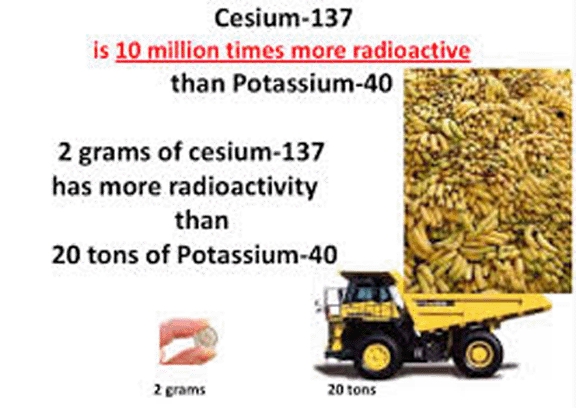
Both Dutch and American authorities say they found a radioactive element known as caesium-137.
The US Federal Drug Administration says long-term, repeated low-dose exposure to caesium-137 increases health risks.
But the agency adds that the levels detected in the Indonesian products posed no acute risk to health.
The radioactive isotope, which is created via nuclear reactions, is used in a variety of industrial, medical and research applications.
What is the source of radioactive contamination?
Investigations have so far centred on a metal-processing factory at the Cikande Industrial Estate, in Banten province on the island of Java.
The smelting company, called PT Peter Metal Technology, is believed to be China-owned, according to investigators.
Around 20 factories linked to the Cikande industrial estate are affected, including facilities that process shrimp and make footwear, authorities say.
Nine employees working on the industrial estate were detected to have been exposed to caesium-137. They have been treated at a government hospital in Jakarta and all contaminated facilities in the industrial area have been decontaminated.
In August, Indonesian authorities said the government would impose a restriction on scrap metal imports, which were reportedly a source of the contamination.
What is being done about it?
Indonesia’s nuclear agency last month said the sprawling industrial estate would be decontaminated.
On Wednesday, Indonesian authorities scaled up their probe into the suspected source of the contamination.
“The police have launched the criminal investigation,” said Bara Hasibuan, a spokesperson for the investigating task force.
Indonesian authorities have had difficulty conducting investigations as the management of PT Peter Metal Technology — which produces steel rods from scrap metal — has returned to China, Setia Diarta, director general of the Metal, Machinery, Transportation Equipment, and Electronics at Indonesia’s Ministry of Industry, told a hearing with politicians earlier this month.
In addition, Indonesian authorities say they are preventing goods contaminated with caesium-137 from entering Indonesia.
At one port, authorities said they detected and stopped eight containers of zinc powder from Angola that were contaminated with caesium-137.
After being re-exported, containers of the mineral were last month reported as being stranded off the Philippine coast amid a stoush between Jakarta and Manila over what to do with them.
Hiroshima Declaration and Declaration on the Rights of Nuclear Victims 2025

October 2025, https://mp-nuclear-free.com/Nuclear/2025_WNVF_01.html
In 2025, Hiroshima and Nagasaki mark the 80th anniversary of the atomic bombings by the United States. The nuclear age began when the United States dropped atomic bombs on Hiroshima and Nagasaki and human beings gained the power to wipe humanity from the earth. The atomic bombings instantly slaughtered countless innocent people, bringing unprecedented inhuman misery to Hiroshima and Nagasaki. Those who survived the horrors of this hell are still suffering from the effects of radiation. Reparation for victims of indiscriminate genocide as a result of state-provoked wars is yet to be fulfilled.
For more than 80 years, the nuclear industry and countries that have promoted the use of the nuclear cycle have trivialized or concealed the health effects of radiation and have created nuclear victims all over the world, regardless of whether it is used for military purposes or “peaceful” uses. Much of the nuclear impacts have been inflicted on Indigenous and colonized peoples. Even after the devastating nuclear disasters in Chernobyl and Fukushima, these countries and the nuclear industry are trying to further expand their negative impact by parading nuclear energy as a climate solution.
We would like to create a place of international solidarity in Hiroshima for nuclear victims and their allies, aiming for the elimination of the nuclear cycle and a world in which no more hibakusha (nuclear victims) are created.
Full text of the declaration at https://mp-nuclear-free.com/Nuclear/WNVF2025_image/HiroshimaDeclaration-Declaration-Rights-WNV2025_EN.pdf
China warns of severe consequences if Japan fails to retract its threats of military intervention over Taiwan
Japan, like most of the countries in the world, officially recognizes Taiwan as part of China. Both the countries signed an agreement in 1972 according to which Japan recognizes the one-China policy.
Though Japan recognizes the “one-China policy”, earlier this month its prime minister, Sanae Takaichi, threatened military intervention if China tried to unify Taiwan with the mainland.
November 20, 2025 by Abdul Rahman, https://peoplesdispatch.org/2025/11/20/china-warns-of-severe-consequences-if-japan-fails-to-retract-its-threats-of-military-intervention-over-taiwan/
China reiterated its demand that Japanese Prime Minister Sanae Takaichi retract her statement threatening military intervention in the event that China tries to forcefully integrate Taiwan into the mainland. It warned of strong counter measures otherwise.
The “Japanese prime minister’s erroneous remarks on Taiwan have fundamentally eroded the political foundation of China-Japan relations and triggered strong outrage and condemnation from the Chinese people,” said official spokesperson of the Chinese Ministry of Foreign Affairs, Mao Ning, in response to a question on Wednesday, November 19.
“Retract the erroneous remarks, stop making provocations on issues concerning China, take practical steps to admit and correct the wrongdoing, and uphold the political foundation of China-Japan relations,” Mao reiterated.
Speaking in the country’s parliament, newly elected Takaichi had said on November 7 that her country may respond militarily to any “situation threatening Japan’s survival” including an attempt to force the unification of Taiwan with China.
She also added that if a US warship sent to break a possible blockade on Taiwan is attacked it would invite a similar Japanese military response.
Japan hosts the largest contingent of American forces anywhere outside the US territory.
Despite strong Chinese protests and a diplomatic spat last week, Takaichi is still refusing to retract her comments, claiming that they were “hypothetical” in nature. She also said she would not repeat them in future.
However, China has demanded a complete retraction, saying Takaichi’s statement violates the fundamental principle of China-Japan relations and amounts to interference in its domestic affairs, a red line.
Indications of Japanese militarism
Mao also objected to Takaichi’s invocation of phrases such as “survival threatening situation” and “collective self defense” in the case of Taiwan, saying that it is a pretext for “Japanese militarism to launch aggression” in the region.
Takaichi, of Japan’s Liberal Democratic Party (LDP), is widely seen as an ultra nationalist and a hawk who wants to reverse the demilitarization of Japan imposed post the Second World War.
After assuming power in October she pushed the country’s defense budget up and even talked about revisiting Japan’s long held no-nuclear policy and manufacture of heavy weapons.
Takaichi’s Taiwan statement is based on the country’s military strategy, which provoked widespread popular protests in the country when it was adopted in 2015.
Mao reminded that similar aggressions and excuses had been used by the Japanese to justify its occupation of Chinese territories in the last century and to bring the Second World War into the region.
“In 1931, Japan called its seizure of Manchuria as ‘survival-threatening’, and used that as a pretext to carry out the September 18th incident and invaded and occupied Northeast China,” Mao reminded.
“Japan later claimed that to defend ‘the greater East Asia co-prosperity sphere’ was an existential battle” for it and expanded its war of aggression to the entire Asian region, Mao pointed out, asking “whether to attack Pearl Harbor was also deemed as survival-threatening to Japan, which ignited the Pacific War.”
“As we mark the 80th anniversary of the victory of the Chinese People’s War of Resistance against Japanese Aggression and the World Anti-Fascist War the international community must guard against and firmly thwart any attempt of reviving militarism, jointly uphold the post-WWII international order and safeguard world peace,” she emphasized.
Chinese counter measures
Japan, like most of the countries in the world, officially recognizes Taiwan as part of China. Both the countries signed an agreement in 1972 according to which Japan recognizes the one-China policy.
On November 12, China had underlined that Taiwan is the core of its national interest and a red line which no external force should cross. It asked the Japanese to respect the agreement signed between the two countries, including adherence to the “one-China policy”.
Since Takaichi’s remarks, China has taken several counter measures, including issuing a travel advisory asking its citizens to avoid traveling to Japan and restricting the sale of Japan’s seafood products in the country, among others.
China and Japan had a mutual trade of around USD 300 billion in 2024. Chinese visitors to Japan bring substantial revenue to the Japanese economy, according to one estimate, around USD 14 billion dollars each year.
“If Japan refuses to retract them or even continue to pursue the wrong course, China will have to take strong and resolute countermeasures and all consequences arising therefrom will be borne by Japan,” Mao warned.
1 This Month
23-25 October – on Zoom – World BEYOND War’s annual global conferenc


Shut down the radiation-damaged Heysham nuclear reactors now
To see nuclear-related stories in greater depth and intensity – go to https://nuclearinformation.wordpress.com

Say No to NASA’s Reckless Nuclear Reactor on the Moon
Say No to NASA’s Reckless Nuclear Reactor on the Moon

-
Archives
- October 2026 (247)
- September 2026 (339)
- August 2026 (330)
- July 2026 (355)
- June 2026 (287)
- May 2026 (306)
- April 2026 (356)
- March 2026 (251)
- February 2026 (267)
- January 2026 (308)
- December 2025 (358)
- November 2025 (359)
-
Categories
- 1
- 1 NUCLEAR ISSUES
- business and costs
- climate change
- culture and arts
- ENERGY
- environment
- health
- history
- indigenous issues
- Legal
- marketing of nuclear
- media
- opposition to nuclear
- PERSONAL STORIES
- politics
- politics international
- Religion and ethics
- safety
- secrets,lies and civil liberties
- spinbuster
- technology
- Uranium
- wastes
- weapons and war
- Women
- 2 WORLD
- ACTION
- AFRICA
- Atrocities
- AUSTRALIA
- Christina's notes
- Christina's themes
- culture and arts
- Events
- Fuk 2022
- Fuk 2023
- Fukushima 2017
- Fukushima 2018
- fukushima 2019
- Fukushima 2020
- Fukushima 2021
- general
- global warming
- Humour (God we need it)
- Nuclear
- RARE EARTHS
- Reference
- resources – print
- Resources -audiovicual
- Weekly Newsletter
- World
- World Nuclear
- YouTube
-
RSS
Entries RSS
Comments RSS

