International Atomic Energy Agency (IAEA) says Japan must urgently tackle Fukushima’s radioactive water buildup
 Reuters 13th Oct 2018 , Japan must urgently tackle a buildup of contaminated water at its Fukushima
nuclear plant, destroyed by an earthquake and tsunami more than seven years
ago, the International Atomic Energy Agency (IAEA) said on Tuesday. The
call after a site visit by IAEA experts follows last month’s admission by
plant owner Tokyo Electric Power (Tepco), that water treated there still
contained radioactive material, despite having said for years it had been
removed.
https://uk.reuters.com/article/us-japan-disaster-nuclear-water/iaea-pushes-japan-for-urgent-disposal-of-contaminated-fukushima-water-idUKKCN1NI14X?rpc=401&
Tepco to temporarily stop injecting water at Fukushima reactor
TEPCO to stop injecting water at Fukushima reactor https://www3.nhk.or.jp/nhkworld/en/news/20181109_10/ The operator of the Fukushima Daiichi nuclear power plant plans to temporarily stop injecting water into one of its damaged reactors to test the cooling of fuel debris.
Tokyo Electric Power Company announced it will conduct the 7-hour test at the No.2 reactor as early as March next year.
The unit is one of 3 in the 6-reactor facility that suffered a meltdown after the March 2011 earthquake and tsunami. The damaged reactors contain a mixture of molten nuclear fuel and structural parts.
TEPCO officials say water injections keep temperatures stable in the 3 reactors at around 30 degrees Celsius.
The planned experiment is aimed at checking how the debris is being cooled. It will be the first time to halt water injections into the reactor since they were stabilized after the accident.
TEPCO’s assessment says the reactor temperature would rise by around 5 degrees per hour if injections were halted by accident. But it says the rise will be limited to about 0.2 degrees per hour when natural heat radiation is taken into account.
TEPCO officials say they will begin cutting back on water injections by around half to 1.5 tons per hour for about a week as early as in January, before halting them completely in March after checking the results.
TEPCO estimates the 7-hour stoppage may raise the reactor temperature by about 1.4 degrees but says water injections will resume if the temperature rises more than 15 degrees.
Company officials say they want to assess changes in the temperature so they can use the data in future emergency cases, including earthquakes and tsunamis.
Fukushima nuclear disaster – whiteboard reveals the chaos in March 2011
“Stop monitoring, evacuate now,” an order said.
The next line follows, “1F3 (No. 3 reactor of Fukushima No. 1 plant) hydrogen explosion.”
“Don’t return here, head west,” another directive said.
Media representatives were invited on Nov. 8 for the first time to the emergency headquarters that was set up at the prefecture-run Environmental Radioactivity Monitoring Center of Fukushima here to monitor the radiation levels around the Fukushima No. 1 nuclear plant when a massive tsunami crippled the power supply on March 11, 2011.
The center was originally constructed as a facility to monitor radiation levels in the area as well as serve as an education center for nuclear power generation.
The headquarters were abandoned on the night of March 14, 2011, after the evacuation order was issued following the explosion at the No. 3 reactor building. No one since then has returned to use or tidy up the site………http://www.asahi.com/ajw/articles/AJ201811090033.html
Local opposition to restart of Tokai nuclear station, but it is cleared to start by Japan’s nuclear watchdog
|
Aging Tokai nuclear plant outside Tokyo cleared to restart, THE ASAHI SHIMBUN, November 7, 2018 The nation’s nuclear watchdog on Nov. 7 formally approved a 20-year extension of the only nuclear reactor in the Tokyo metropolitan area, although local communities will have the final say on the restart.Operator Japan Atomic Power Co. will need the consent of the Ibaraki prefectural government, as well as six local municipalities, including the village of Tokai, where its aging Tokai No. 2 nuclear plant is located.
The company faced having to prepare to decommission the plant’s 40-year-old reactor if it failed to meet a Nov. 27 deadline on revised and more stringent safety standards implemented by the Nuclear Regulation Authority in the aftermath of the 2011 nuclear disaster in Fukushima Prefecture. After the triple meltdown at the Fukushima No. 1 nuclear plant, the operational life of nuclear reactors was set at up to 40 years in principle. But power companies can continue to operate their facilities for an additional 20 years if their reactors pass the NRA screening. So far, all requests to the NRA to extend the operating life of old reactors have been approved. The reactor at the Tokai No. 2 plant is the fourth to clear the NRA for extended operations since the Fukushima disaster. It is located about 120 kilometers from the heart of Tokyo. The 1.1-gigawatt boiling water reactor is the only unit at the Tokai No. 2 plant and is of the same design as the crippled reactors at the Fukushima No. 1 nuclear plant. The Tokai No. 2 plant was also affected by the tsunami generated by the magnitude-9.0 Great East Japan Earthquake on March 11, 2011. It is the first time for a reactor affected by the tsunami to be approved for an operational extension. It is also the first boiling water reactor to gain such approval. The NRA examined the reactor’s pressure vessel and other equipment, and concluded that the unit could operate safely until November 2038. But it remains unclear if Japan Atomic Power can restart the plant under its earliest time frame of 2021, due to local opposition. In October, Mayor Toru Umino of Naka, one of the six municipalities around the plant, announced his opposition to the extension. The city assembly of Mito, another municipality, adopted a resolution against the extension in June. About 960,000 people live within a 30-km radius of the plant, making it the most densely populated site among the nation’s nuclear facilities. After the Fukushima disaster, municipalities in close proximity to a nuclear plant were required to craft an evacuation plan to respond to a nuclear emergency. But only three of the 14 municipalities around the Tokai No. 2 nuclear plant within that range have done so due to the difficulty of arranging transportation for such a large number of people. Bringing the reactor back online is expected to cost Japan Atomic Power at least 174 billion yen ($1.54 billion), a sum that includes construction of a seawall and other safeguard measures. The company hopes to have those measures in place by the end of March 2021. It may well also have to spend tens of billions of yen in the future to meet a new requirement that nuclear facilities are able to contain damage from a terrorist attack. TIMELINE OF KEY EVENTS …….http://www.asahi.com/ajw/articles/AJ201811070061.html |
|
2020 Olympics as PR for the global nuclear industry? Fukushima to start the events

Disaster-stricken prefecture will host first event of the 2020 games https://asia.nikkei.com/Politics/Abe-and-IOC-chief-to-visit-Fukushima-Olympics-venue
Bach will visit Japan to attend a two-day general assembly meeting of the Association of National Olympic Committees starting Nov. 28, followed by an IOC Executive Board session, both to be held in Tokyo.
The Olympic torch relay will start in Fukushima Prefecture on March 26, 2020, with the flame scheduled to be lit in the ancient Greek city of Olympia on March 12 the same year, a day after the ninth anniversary of the 2011 disaster.
The city of Fukushima will host six softball games including a match played by the Japan team on July 22 as the first event of the Olympic Games.
Fukushima’s fishing industry threatened by plans to dump radioactive water
  Radioactive water threatens Fukushima fishery’s fragile gains, Plant operator plans to dump contaminated water into the ocean, Nikkei Asian Review, TAKUMI SASAKI, Nikkei staff writer November 04, 2018, TOKYO — Since a catastrophic nuclear accident seven years ago, Fukushima fishermen have made painstaking efforts to rebuild their livelihood, assiduously testing the radioactivity levels of their catches to ensure safety. Now, rapidly accumulating wastewater from the crippled power plant is again threatening this hard-won business recovery. Radioactive water threatens Fukushima fishery’s fragile gains, Plant operator plans to dump contaminated water into the ocean, Nikkei Asian Review, TAKUMI SASAKI, Nikkei staff writer November 04, 2018, TOKYO — Since a catastrophic nuclear accident seven years ago, Fukushima fishermen have made painstaking efforts to rebuild their livelihood, assiduously testing the radioactivity levels of their catches to ensure safety. Now, rapidly accumulating wastewater from the crippled power plant is again threatening this hard-won business recovery.
Faced with the prospect that there will be no more space to store tanks containing radioactive water leaking from the Fukushima Daiichi nuclear power plant, operator Tokyo Electric Power Co. Holdings and the Japanese government are considering diluting the water and dumping it into the ocean. Even though Fukushima’s fishery has been recovering, the haul throughout the entire prefecture amounted to about 3,300 tons last year, just 10% of the average prior to the 2011 disaster. And even reaching there has not been easy. Fish markets in the prefecture now house testing rooms filled with equipment. Staff members mince seafood caught every morning to screen for radioactivity. Such painstaking efforts gradually enabled fishermen to return to the sea, with all fishing and farming operations resuming in February this year. But the trend could reverse if the government goes through with plans to release nuclear wastewater into the sea. Tepco has been cooling down the molten fuel cores by pumping water into the ruined reactors. The tainted water is later taken out and treated, but the system in place does not filter out tritium, a radioactive hydrogen isotope. The tritium-laced water is currently stored in tanks within the premises of Fukushima Daiichi, but space is due to run out within five years……..https://asia.nikkei.com/Economy/Radioactive-water-threatens-Fukushima-fishery-s-fragile-gains
|
Eastern Japan cities sign nuclear accident evacuation accord

Shikoku Electric restarts Ikata nuclear reactor following failed court challenges

The vexed problem of who will pay if Japan has another nuclear disaster
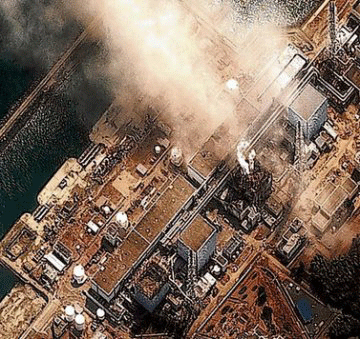 So who will foot the bill if another nuclear disaster strikes Japan? http://www.asahi.com/ajw/articles/AJ201811010019.html So who will foot the bill if another nuclear disaster strikes Japan? http://www.asahi.com/ajw/articles/AJ201811010019.html
November 1, 2018, The government is trying to wriggle out of overhauling the way compensation should be paid out for damages caused by a nuclear accident. A working group of the government’s Atomic Energy Commission had been considering ways to bolster the system, including raising the amount of losses covered by insurance, but failed to produce a formal proposal. The commission apparently failed to obtain support for these ideas from the electric power and insurance industries. The panel started reviewing the system in the aftermath of the 2011 Fukushima nuclear disaster. Nearly eight years have passed since the catastrophic triple meltdown at the Fukushima No. 1 nuclear power plant, yet serious problems and flaws remain unaddressed with the current system. The government clearly has no intention of tackling them anytime soon. The Abe administration and the power industry are pushing to restart offline reactors, which is a very irresponsible move. The current system for compensation requires operators of nuclear plants to sign contracts with both private-sector insurers and the government to finance payouts related to nuclear accidents. But these contracts are good for only up to 120 billion yen ($1.06 billion) per nuclear plant. This is way too small, given that compensation payments related to the Fukushima disaster have already surpassed 8 trillion yen. In the case of Tokyo Electric Power Co., the operator of the Fukushima facility, it quickly became clear that the company could not raise the necessary funds on its own. This prospect prompted the government to create a makeshift program to support such payouts. Under this system, the government first pays compensation and then recovers the money over a period of decades from TEPCO and other major electric utilities. The government’s rationale is that utilities must work together to fork up funding for the system in light of the massive sums required. This system is supposed to swing into action if another major nuclear accident occurs. But it is hard to claim that a system based on mutual aid among competitors is sustainable, given the growing competition due to the liberalization of the power retail market. It is time to find an answer to the weighty, complicated question of how the financial burden of preparing for nuclear accidents and paying compensation for losses should be shared among electric power companies, their stakeholders and the government. Operators of nuclear power plants have an obligation to provide against nuclear emergencies. As a first step, insurance coverage for accident-caused losses should be sharply raised. The government needs to continue working with related industries to work out a specific plan. It should also consider how to deal with the prospect of a power company going under in the event of a serious accident. If such a thing were to happen, the government would probably have to play the leading role in paying compensation. But it would still need to get the shareholders and financial institutions involved to cough up their fair share of the burden. Increased insurance premiums paid by major electric utilities could cause electricity bills to rise. But it would help make more accurate assessments of the real costs of nuclear power generation, which both the government and the power industry have claimed to be lower than those of alternative energy sources. At the root of the troubled history of policy efforts to address the issue of compensation is the ambiguous nature of the government’s nuclear power policy. This is borne out by the way it took the initiative in promoting nuclear power plants operated by private-sector companies. Should nuclear power generation continue despite the potential risks and social costs? If another severe nuclear accident occurs, who should take the responsibility for dealing with the aftermath and in what ways? These are just some of the fundamental questions about nuclear power policy raised by the need to revamp the compensation system.
|
|

Japan’s Onagawa nuclear reactor No 1 to be scrapped
|
Tohoku Electric to scrap aging No. 1 unit at Onagawa nuclear plant, Japan Times, 25 Oct 18
KYODO, SENDAI – Tohoku Electric Power Co. said Thursday it will scrap the idled No. 1 unit at its Onagawa nuclear power plant in Miyagi Prefecture, more than 30 years after it started operations. The company cited difficulties in taking additional safety measures as well as the relatively small output of the reactor that made it unprofitable. Tohoku Electric President Hiroya Harada conveyed its decision to Miyagi Gov. Yoshihiro Murai. “We decided to decommission (the reactor) at a board meeting today. We took into consideration technical restrictions associated with additional safety measures, output and the years in use,” Harada said when the two met at the prefectural government office….. The basement floors of the Onagawa plant’s No. 2 unit were flooded in the March 2011 earthquake and tsunami disaster. The company is building a 29-meter-high sea wall to guard the complex. Tohoku Electric aims to resume operations of the No. 2 unit at the Onagawa plant in fiscal 2020 at the earliest. The Nuclear Regulation Authority, the country’s nuclear watchdog, has been screening its safety measures. https://www.japantimes.co.jp/news/2018/10/25/national/tohoku-electric-scrap-aging-no-1-unit-onagawa-nuclear-plant/?fbclid=IwAR3HINMvYO5K5lpiyVwPaXXDlWvNy3cu4walE_uEkDivJ-5sn7uPRSnDEzE#.W9aIxWgzbIW |
|
Ikata nuclear reactor goes back online
The No.3 reactor restarted on Saturday. Workers in the central control room removed the control rods that suppress nuclear fission at 30 minutes past midnight.
Shikoku Electric Power Company shut down the reactor last October for regular inspections. It was kept offline by an injunction issued 2 months later by the Hiroshima High Court.
The ruling was revoked last month by another judge at the High Court, paving the way for a restart.
Shikoku Electric says if the process goes smoothly, the Ikata reactor will likely reach criticality — a self-sustaining nuclear reaction — on Saturday night.
It is expected to begin power generation and transmission on Tuesday, and start commercial operations on November 28th.
Ikata Mayor Kiyohiko Takakado in a statement called on Shikoku Electric to continue pursuing safety and reliability at the plant, and provide highly transparent information disclosure.
Members of a civic group opposing the nuclear plant on Saturday staged a demonstration at the site. One participant said she has heard nuclear reactors are needed to ensure stable energy supplies, but she finds it problematic life-threatening radioactive materials are being used to generate power.
TEPCO to scrap Onagawa NPP’s reactor#1

Utility plans to scrap reactor at Onagawa plant
Tohoku Electric to scrap aging No. 1 unit at Onagawa nuclear plant
Stop the return of women and child evacuees to radioactive parts of Fukushima – UN’s call to Japan
 U.N. rights expert urges Japan to halt women and child evacuee returns to radioactive parts of Fukushima https://www.japantimes.co.jp/news/2018/10/26/national/science-health/u-n-rights-expert-urges-japan-halt-women-child-evacuee-returns-radioactive-parts-fukushima/#.W9PVHmgzbIU
KYODO GENEVA – The Japanese government must halt the return of women and children displaced by the March 2011 nuclear disaster back to areas of Fukushima where radiation levels remain high, a U.N. human rights expert said Thursday.
The special rapporteur on hazardous substances, Baskut Tuncak, also criticized in his statement the government’s gradual removal of evacuation orders for most of the radioactive areas as well as its plan to lift all orders within the next five years, even for the most contaminated areas.
“The gradual lifting of evacuation orders has created enormous strains on people whose lives have already been affected by the worst nuclear disaster of this century. Many feel they are being forced to return to areas that are unsafe,” he said.
An official of Japan’s permanent mission to the international organizations in Geneva rebuffed the statement, saying it is based on extremely one-sided information and could fan unnecessary fears about Fukushima.
Tuncak expressed concerns about people returning to areas with radiation above 1 millisievert per year, a level previously observed by Japan as an annual limit so as to prevent risks to the health of vulnerable people, especially children and women of reproductive age.
“It is disappointing to see Japan appear to all but ignore the 2017 recommendation of the U.N. human rights monitoring mechanism to return back to what it considered an acceptable dose of radiation before the nuclear disaster,” he said.
In the wake of the Fukushima reactor meltdowns, the Japanese government heightened the annually acceptable level of radiation to 20 millisieverts, raising concerns for the health of residents.
In August, Tuncak and two other U.N. human rights experts jointly criticized the Japanese government for allegedly exploiting and putting at risk the lives of “tens of thousands” of people engaged in cleanup operations at and around the crippled Fukushima No. 1 nuclear plant, a claim Tokyo dismissed.
Japan’s government refuses UN call to stop returning evacuees to irradiated areas of Fukushima
Japan rejects UN call to stop returns to Fukushima, Channel News Asia, 27 Oct 18 TOKYO: Japan’s government on Friday (Oct 26) rejected calls from a UN rights expert to halt the return of women and children to areas affected by the Fukushima nuclear disasterover radiation fears.
UN special rapporteur Baskut Tuncak on Thursday warned that people felt they were “being forced to return to areas that are unsafe, including those with radiation levels above what the government previously considered safe.”
In the wake of the Fukushima disaster, Japan’s government lifted its standard for the acceptable level of radiation to 20 millisieverts per year from 1 millisievert.
It has been urged to revise that level back down again, but has rejected calls to do so, a decision Tuncak called “deeply troubling.”
“Japan has a duty to prevent and minimise childhood exposure to radiation,” he said.
But Japan’s government rejected the criticism, saying Tuncak’s comments were based on “one-sided information and could fan unnecessary fears about Fukushima,” a foreign ministry official told AFP.
Japan’s government has gradually lifted evacuation orders on large parts of the areas affected by the disaster, which occurred when a massive tsunami sent reactors at the Fukushima Daiichi plant into meltdown in March 2011.
But other areas remain under evacuation orders because of continued high levels of radiation.
Japan’s government has pushed hard to return affected areas to normal, but has faced criticism that what it refers to as “safe” radiation levels are not in line with international standards. …….. https://www.channelnewsasia.com/news/asia/japan-fukushima-meltdown-radiation-fears-10867932
Toshiba to dissolve its British nuclear unit NuGeneration?
Toshiba considers liquidation of British nuclear unit NuGeneration https://mainichi.jp/english/articles/20181026/p2g/00m/0bu/070000c
October 26, 2018 (Mainichi Japan) TOKYO (Kyodo) — Toshiba Corp. is considering dissolving its British nuclear subsidiary NuGeneration Ltd. as negotiations for its sell-off have stalled, sources close to the matter said Friday.
The Japanese conglomerate is in the process of withdrawing from its overseas nuclear businesses after the bankruptcy of its U.S. subsidiary Westinghouse Electric Co. in 2017.
Korea Electric Power Corp. has been selected as the preferred bidder for the British nuclear subsidiary, but no agreement was reached before its preferred bidder status expired, the sources said.
Toshiba is also at odds over the terms of the unit’s sale with a Canadian asset management company which has shown interest in buying NuGeneration, they said.
NuGeneration plans to build a nuclear power plant with three reactors in Moorside, northwestern England. It was initially scheduled to use reactors manufactured by Westinghouse before the U.S. company went bankrupt.
1 This Month
Chernobyl: The Lost Tapes – A good documentary on Chernobyl on SBS available On Demand for the next 3 weeks– https://www.sbs.com.au/ondemand/tv-program/chernobyl-the-lost-tapes/2352741955560

of the week–London Campaign for Nuclear Disarmament

Tell the Ukrainian Government to Drop Prosecution of Peace Activist Yurii Sheliazhenko
To see nuclear-related stories in greater depth and intensity – go to https://nuclearinformation.wordpress.com
-
Archives
- April 2026 (152)
- March 2026 (251)
- February 2026 (268)
- January 2026 (308)
- December 2025 (358)
- November 2025 (359)
- October 2025 (376)
- September 2025 (257)
- August 2025 (319)
- July 2025 (230)
- June 2025 (348)
- May 2025 (261)
-
Categories
- 1
- 1 NUCLEAR ISSUES
- business and costs
- climate change
- culture and arts
- ENERGY
- environment
- health
- history
- indigenous issues
- Legal
- marketing of nuclear
- media
- opposition to nuclear
- PERSONAL STORIES
- politics
- politics international
- Religion and ethics
- safety
- secrets,lies and civil liberties
- spinbuster
- technology
- Uranium
- wastes
- weapons and war
- Women
- 2 WORLD
- ACTION
- AFRICA
- Atrocities
- AUSTRALIA
- Christina's notes
- Christina's themes
- culture and arts
- Events
- Fuk 2022
- Fuk 2023
- Fukushima 2017
- Fukushima 2018
- fukushima 2019
- Fukushima 2020
- Fukushima 2021
- general
- global warming
- Humour (God we need it)
- Nuclear
- RARE EARTHS
- Reference
- resources – print
- Resources -audiovicual
- Weekly Newsletter
- World
- World Nuclear
- YouTube
-
RSS
Entries RSS
Comments RSS
 nuclear-news