TEPCO wants to restart reactors at the Kashiwazaki-Kariwa nuclear plant in Niigata Prefecture.
July 15, 2019
Any discussion on nuclear power policy should be based on reality.
In their Upper House election campaign platforms, the ruling Liberal Democratic Party and its junior coalition partner, Komeito, say they will allow more restarts of nuclear reactors in line with the government’s Basic Energy Plan.
The plan defines nuclear energy as a mainstay source of power, which it assumes will account for 20 to 22 percent of Japan’s total power supply in fiscal 2030.
Following the 2011 Fukushima nuclear disaster, decisions have been made to decommission some of the nation’s nuclear reactors; plans are being floated to decommission others. The total number of the reactors concerned is 21.
Achieving the goal of the Basic Energy Plan would require about 30 operating reactors, meaning the activation of almost all remaining nuclear reactors in Japan.
One is tempted to ask if such a plan can be described as realistic.
The power industry has placed topmost priority on restarting nuclear reactors, but only nine reactors have so far been brought back online.
Many reactors are not likely to be reactivated any time soon because of local opposition, the presence of an active fault nearby or for other reasons.
Officials of Tokyo Electric Power Co., which is seeking to restart reactors at its Kashiwazaki-Kariwa nuclear plant in Niigata Prefecture, made an argument for itself during a general shareholders’ meeting in June.
“We need to have nuclear reactors up and running, after all,” they said, adding that doing so would allow TEPCO to increase its profits and thereby “fulfill its responsibility for Fukushima.”
TEPCO, however, has apologized for keeping local governments in the dark for three years about insufficient seismic resistance of the Main Anti-Earthquake Building at the Niigata plant, which would serve as a center for response measures in the event of a disaster.
Following a big earthquake in June this year, TEPCO mistakenly sent wrong information to local governments saying that “abnormalities” had occurred at the Kashiwazaki-Kariwa plant.
Given these circumstances, TEPCO could hardly expect to gain deeper understanding of the host communities.
The construction of anti-terror facilities is falling behind schedule at nuclear plants elsewhere in Japan where reactors have been brought back online.
Beginning next spring, reactors operated by Kyushu Electric Power Co. and Kansai Electric Power Co. are expected to be taken offline again in succession.
The argument that nuclear power is cheap is also losing ground. Expenses for safety measures have swollen following the Fukushima disaster, and more than 4 trillion yen ($37 billion) in total has been spent so far to prepare nuclear reactors for their restarts.
The joint public-private efforts to export nuclear power technology to developing markets overseas, given the thin opportunities in Japan, have reached a deadlock in many nations.
The ruling parties should explain specifically how they plan to deal with all of these realities if they insist that Japan should remain reliant on nuclear power.
A final disposal site for high-level radioactive waste is unlikely to be built soon, either. The nuclear fuel recycling program, intended to extract plutonium from spent fuel for reuse, has also practically failed.
Despite all that, there are still plans to activate a reprocessing plant in Rokkasho, Aomori Prefecture, to extract plutonium. This shows Japan’s nuclear power policy is laden with many layers of contradictions.
Opposition parties that oppose reactor restarts and are calling for zero nuclear power, such as the Constitutional Democratic Party of Japan and the Japanese Communist Party, should also face up to the question of feasibility.
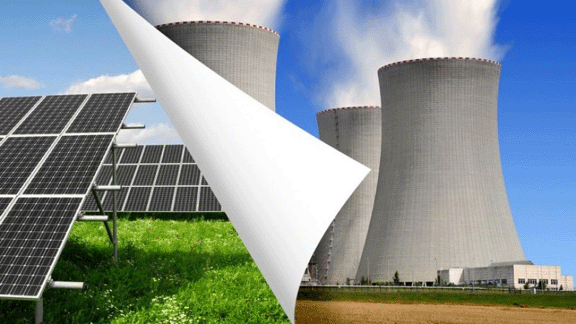
Even if a transition to renewable energy sources, such as solar power, is to be pursued, there is still a need to curb the burden on the public to guarantee a certain level of income for renewable energy operators.
Measures should be established to ensure a stable supply of power even when renewables account for the majority of it. Allowances should also be made for the economies of local communities that have long depended on nuclear power.
People living in power consumption areas, to say nothing of residents of communities hosting nuclear plants, should give serious thought to the future of nuclear power in this country.
Expert says 2020 Tokyo Olympics unsafe due to Fukushima | 60 Minutes
Fukushima: an ongoing disaster, Red Flag , Jack Crawford, 15 July 2019 In March – on the eighth anniversary of the Fukushima disaster – Time magazine published an article with the headline: “Want to Stop Climate Change? Then It’s Time to Fall Back in Love with Nuclear Energy”. In it, the former head of the International Atomic Energy Agency, Hans Blix, evokes the imminent threat of climate catastrophe to argue, “There are paths out of this mess. But on March 11, 2011 [the day of the Fukushima disaster], the world’s course was diverted away from one of the most important. I am talking about nuclear energy”. He continues by criticising public fears of nuclear as irrational: “Plane crashes have not stopped us from flying, because most people know it is an effective means of travelling”. Blix speaks for the global nuclear industry, which is increasingly attempting to present itself as the solution to climate change.
But plane crashes do not kill untold numbers and spread deadly poisons over huge areas of the planet. Fukushima was and still is a horrific and ongoing human and environmental catastrophe, exposing the horrendous risks to which the powerful are willing to subject people and the planet. It should be remembered every time a pro-nuclear bureaucrat or politician exploits genuine concern about climate change to promote this deadly industry. It should never be forgotten.
………..Today, towns such as Futaba, Tomioka and Okuma are nuclear ghost towns. In them you will find a forest of metal gates, decaying buildings, shattered glass and cars wrapped in vines. The only human faces are mannequins in store windows, still dressed in the fashion of 2011. Sprawled across the highway between towns are hundreds of black bags filled with toxic dirt. They are one of the many problems of the clean-up effort. There are about 30 million one-tonne bags of radioactive topsoil, tree branches, grass and other waste. There is no safe, long-term storage place for this material.
The clean-up is undermined by cost cutting. Workers are forced to meet strict deadlines, even if it compromises safety. “There were times when we were told to leave the contaminated topsoil and just remove the leaves so we could get everything done on schedule”, explained Minoru Ikeda, a former worker. “Sometimes we would look at each other as if to say: ‘What on earth are we doing here?’”
The task is mammoth. The government and TEPCO now say that decommissioning the failed nuclear plant will take 40 years, at a cost of ¥22 trillion (or US$200 billion). But there is significant uncertainty about how to remove the hundreds of tonnes of molten fuel from the reactors. “For the removal of the debris, we don’t have accurate information or any viable methodology for that”, admitted the plant’s manager, Akira Ono, in 2015. “We need to develop many, many technologies.”
Beyond the plant itself, the total clean-up is likely to cost between ¥50 trillion and ¥70 trillion (US$460-640 billion), according to the estimates of a right wing think tank, the Japan Center for Economic Research. Thousands of workers continue to make daily trips between the contaminated zones and company accommodation. Dodgy subcontractors recruit largely from Japan’s destitute, including the homeless, migrant workers and asylum seekers. A recent Greenpeace investigation, “On the Frontline of the Fukushima Nuclear Accident: Workers and Children”, found evidence of hyper-exploitation and dangerous radiation exposure. In one case, a 55-year-old homeless man was paid the equivalent of US$10 for a month’s work. “TEPCO is God”, lamented Tanaka, another homeless Fukushima worker. “The main contractors are kings, and we are slaves.”
Scandalously, organised crime has penetrated the clean-up operations. Those with debts to the Yakuza (Japanese organised crime) have found themselves shoved into hazmat suits and set to work. The subcontracting system has allowed TEPCO to turn a blind eye to such human rights abuses.
Despite triumphant optimism from some champions of nuclear, researchers continue to uncover unexpected and unpredictable consequences of the Fukushima disaster. These include the discovery of tiny, glassy beads containing extremely high concentrations of caesium-137 (a radioactive isotope) among polluted dust and dirt particles. These bacterium-sized particles are easily inhaled and persistently insoluble. How they react with our bodies and the environment is not yet clear, but scientists increasingly believe them to be a health risk. The beads have been found as far from the disaster site as Tokyo.
The dangers faced by those returning to Fukushima prefecture have been a central controversy of recent years. Compelled by economic necessity, most have returned. But as of February 2019, 52,000 remain displaced, either unwilling to return or with homes in still-prohibited zones. In a recent press tour, the government repeatedly blamed “harmful rumours” for creating fear of returning as well as the Japanese public’s unwillingness to consume Fukushima’s fish and agricultural products.
“To me”, explained activist Riken Komatsu, “talking about ‘harmful rumours’ sounds like they are making someone else the bad guy or villain, as if they are blaming people for saying negative things because they don’t understand science and radiation. But those who have lost our trust do not have the right”.
Mistrust is justified. Prime minister Shinzo Abe, keen to move on from the crisis, intends to end evacuations by the time Japan hosts the 2020 Olympics. The international and (prior to the meltdowns) Japanese standard of acceptable exposure to radiation, one millisievert per year, has been scrapped. Across Fukushima prefecture, measurements five times that level are now deemed safe.
Some places measure as high as 20 millisieverts per year. These radiation levels are especially dangerous for children, who are far more sensitive than adults to even low levels of exposure. It will take decades before the cost of the authorities’ carelessness can be measured in increased cancer rates. The loss of happy, healthy human life of course can never be quantified………
those who “benefit” from the powerful nuclear industry are the same people who crave military dominance. The politicians and officials currently fighting to rebuild Japanese nuclear capability are thinking far more about the military tensions surrounding them than tackling climate change. We don’t need to a build a world full of deadly nuclear power plants to combat climate change. We need clean, renewable energy and a system that prioritises people and the planet over money and military might. https://redflag.org.au/node/6838
Fukushima Upper House candidates face cynical voters despite anti-nuclear platforms, Japan Times, 14 July 19, JIJI FUKUSHIMA – Rival candidates, both women, from the ruling Liberal Democratic Party and the opposition camp for next Sunday’s House of Councilors election in Fukushima Prefecture are campaigning on platforms to eliminate nuclear power from the prefecture.
But their calls are in conflict with the national energy policy of the LDP and the positions of some opposition supporters.
With campaigning in the single-seat prefectural constituency shaping up effectively as a one-on-one race, local voters who were affected by the March 2011 nuclear accident are casting a cynical eye at the race for the July 21 election.
“I’m determined to push ahead with reconstruction following your requests,” Masako Mori, the LDP’s candidate for Fukushima, said on July 4, the opening day of the official campaign period, in the prefectural capital of Fukushima.
“I’ll do my best to achieve the goal of decommissioning all nuclear reactors in the prefecture,” said Mori, 54, vice chair of the LDP’s Headquarters for Accelerating Reconstruction after the Great East Japan Earthquake.
Prime Minister Shinzo Abe, also president of the LDP, gave a speech in support of Mori.
Reflecting local voter concerns over nuclear power, the LDP’s Fukushima chapter has set goals of scrapping all reactors in the prefecture and building up knowledge and expertise related to decommissioning.
In contrast to the prefectural chapter’s position, however, the Abe government’s basic energy program regards nuclear power as an important base load electric power source, while the LDP’s policy pledges for the Upper House election include efforts to reactivate nuclear reactors.
The LDP suffered losses in recent national elections in Fukushima Prefecture, home to Tokyo Electric Power Company Holdings Inc.’s Fukushima No. 1 nuclear power plant, the site of the nation’s worst-ever nuclear accident, which resulted from the March 2011 earthquake and tsunami………
Hard to differentiate
Mori’s key opponent in the three-way race is Sachiko Mizuno, 57, who is running as the opposition camp’s unified candidate.
On June 30, standing in drizzling rain in front of a department store in the city of Fukushima, Mizuno told a small crowd, “Reconstruction of Fukushima is still only half done.”
Referring to the LDP’s policy pledge, she said the government “has not presented a road map for decommissioning all reactors (in the prefecture).”……..
With Mizuno calling for a society free of nuclear power, the policy differences with the LDP are blurred. “It’s difficult to differentiate ourselves (from the LDP) in the prefecture,” a senior official in Mizuno’s campaign office said.
Within her camp, there are differing levels of enthusiasm regarding the elimination of nuclear power…….
Unenthusiastic voters
After the triple meltdown accident, the government issued an evacuation advisory to 11 municipalities around the stricken nuclear plant. Since the advisory was lifted in the eastern part of the city of Tamura in April 2014, the size of the exclusion zone has been reduced in stages.
But the advisory remains in place in the town of Futaba, as well as in parts of six municipalities, including the towns of Okuma and Namie. More than 30,000 people still live as evacuees outside the prefecture…….
A Fukushima Ghost Town Seeks Rebirth Through Renewable Energy
Devastated by Japanese nuclear plant’s meltdown in 2011, Namie hopes a new hydrogen-fuel facility can generate a turnaround. WSJ, By River Davis, July 12, 2019
NAMIE, Japan—Fukushima prefecture, a place synonymous in many minds with nuclear meltdown, is trying to reinvent itself as a hub for renewable energy.
One symbol is just outside Namie, less than five miles from the nuclear-power plant devastated by an earthquake and tsunami in 2011. At the end of a winding road through miles of barren land, construction is nearing completion on one of the world’s largest hydrogen plants.
The government hopes to show that hydrogen, a hard-to-handle fuel that hasn’t been used for large-scale power generation, can supplement intermittent solar and wind power.
……….. By 2040, Fukushima aims to cover 100% of its energy demand with non-nuclear renewable energy. Since 2011, the prefecture’s generating capacity from renewable energy, excluding large-scale hydropower, has more than quadrupled. More than a gigawatt of solar-energy capacity has been added—the equivalent of more than three million solar panels—while other projects are under way in offshore wind power and geothermal energy……… https://www.wsj.com/articles/a-fukushima-ghost-town-seeks-rebirth-through-renewable-energy-11562923802
July 8, 2019 (Mainichi Japan) TOKYO— Radioactive cesium released into the Pacific Ocean due to the March 2011 meltdowns at Fukushima Daiichi Nuclear Power Station is returning to Japanese shores via a shorter route than expected, according to a joint research initiative.
The findings were revealed by a team from the University of Tsukuba, the Japan Agency for Marine-Earth Science and Technology (JAMSTEC) and Kanazawa University.
Until now, it was thought that cesium from the Tokyo Electric Power Co. (TEPCO)-operated plant would be circulated around the Pacific by subtropical gyre currents for several decades before returning to Japanese waters. But in 2012, a year after the reactor core meltdowns, tests on seawater samples collected by the team showed increased cesium concentrations in East China Sea waters off Japan. Researchers say that the concentrations observed are too low to impact sea life.
The rate increased, peaking in 2014, and a year later high concentrations were also reported in the Sea of Japan. The team believes the cesium is now flowing around the Pacific Ocean again.
It is thought that seawater sank deeply into the sea after its density increased due to cooling by winter winds, causing the cesium to travel on a western-flowing underwater route.
Michio Aoyama, a visiting professor at the University of Tsukuba, said, “That the cesium would come back in such a short time was unexpected. We’ve found a previously unknown route.”
Senior JAMSTEC research scientist Yuichiro Kumamoto said of the project’s potential benefits, “Because it has visualized ocean circulation, the results could be used in the future for predictions on issues such as climate change.”
(Japanese original by Mayumi Nobuta, Science & Environment News Department)
FUKUSHIMA investigators were left “worried” after recording radiation levels 100 times normal, leading them to suggest the exclusion zone should be increased.Express UK , By CALLUM HOARE Jul 4, 2019 | “………… when Chernobyl researcher Yevgen visited as part of Amazon Prime’s “Radioactive Detectives” series, he was left shocked.
The narrator revealed in 2017: “Have the Japanese authorities determined the correct exclusion zone?
“The first big surprise is a completely unguarded borderline.
“Yevgen wants to carry out his first measurements here.
“He has to tell Kenzo that the radiation level exceeds the natural radiation 100 times over.
“The men are worried.”
Kenzo Hashimoto, a Japanese journalist claimed the exclusion zone needed to be increased as a result.
He said: “If the radiation is that high, the authorities should extend the border line even further.
Japan hopes latest Trump-Kim meeting will help get nuclear, abduction talks moving again, Japan Times , 29 June KYODO,Japan hopes the third meeting between U.S. President Donald Trump and North Korean leader Kim Jong Un on Sunday will reinvigorate stalled denuclearization talks and help resolve the issue of past abductions of Japanese citizens.
“The meeting could serve as an opportunity for North Korea to come out of its shell,” a senior Japanese Foreign Ministry official said.
Trump and Kim held talks in the Demilitarized Zone dividing the two Koreas and agreed to restart denuclearization talks within weeks following the rupture of their last summit in Hanoi in February.
The Guardian view of the Osaka G20 summit: bad as he is, Trump is not the only problem, Editorial, Guardian 268 June 19The climate crisis underlines the need for effective global economic leadership. The US president makes this harder, but so do China and several others.Ever since the G20 of leading global economies was founded, its summits have mostly been convergent occasions, marked by attempts to find common ground and remembered for nothing more unseemly than a bit of jostling among the heads of government to be on the front row of the group photograph. Japan’s prime minister Shinzō Abe clearly takes this traditional view about the G20 summi twhich he will host in Osaka on Friday and Saturday. “We want to make it a meeting that focuses on where we can agree and cooperate rather than highlighting differences,” he said recently.
But there is a balloon-puncturing problem with Mr Abe’s approach, and it answers to the name of Donald Trump. If there is one issue on which this year’s summit clearly ought to be showing global leadership, it is the climate crisis. The subject is indeed on the Osaka agenda but, in spite of efforts by countries including France, there is no prospect of serious or effective action. That is no surprise from a group of nations which almost tripled the subsidies they gave to coal-fired power plants between 2013 and 2017, with China, India and Japan itself leading the way. But it is Mr Trump’s decision to walk away from climate accords and to back fossil fuels that creates the wider permission for these other terrible derelictions.
Mr Trump’s disruptions do not end there. The US president uses these gatherings not to build alliances to solve common problems but to knock his adversaries – and sometimes his supposed allies – off their stride. He is not looking for general agreement, which he thinks is for wimps. He is looking for American advantage over friend and foe. That’s the reason why the summit is already overshadowed by the increasingly serious trade war between the United States and China (Mr Trump will have an all-smiles bilateral with Xi Jinping on Saturday). And it is certainly the reason why Mr Trump has used the run-up to Osaka to have a pop at his hosts, whom he claimed would respond to an attack on the US by watching it “on a Sony television”, attacking India for raising tariffs and then, inventing false figures, berating Germany as a “security freeloader”.
Since Mr Trump’s Friday schedule involves one-on-ones with Mr Abe, India’s Narendra Modi and Germany’s Angela Merkel, it seems these mind games are part of a deliberate strategy of disruption. This is not a novel conclusion. Mr Trump used the same approach before his recent visit to Britain, when he praised Boris Johnson and attacked Sadiq Khan and the Duchess of Sussex. If Mr Johnson becomes prime minister and Britain were to back off from supporting European opposition to the White House’s Iran strategy, Mr Trump would count this a job well done.
The No. 6 reactor at Tokyo Electric Power Company Holdings Inc.’s Kashiwazaki-Kariwa nuclear plant, seen here, has remained shut for years amid a protracted safety vetting by the regulators.
June 20, 2019
Tokyo Electric Power Company Holdings Inc. (Tepco) employees sparked a nuclear scare after a violent, late-night earthquake by ticking the wrong box on a fax form — inadvertently advising authorities that an accident had occurred when it had not.
The workers at Tepco, operator of the Kashiwazaki-Kariwa nuclear plant in Niigata Prefecture where the strong quake struck, faxed a message to local authorities Tuesday night, seeking to allay any fears of damage.
But the Tepco employees accidentally ticked the wrong box on the form, mistakenly indicating there was an abnormality at the plant rather than that there was no problem.
One official filled out the form, and it was checked by a colleague before being sent.
Many government departments and companies in Japan still rely on fax machines for communication.
Tepco’s Tokyo headquarters noticed the mistake and a correction was published 17 minutes after the original release, the firm’s Tokyo-based spokesman said.
The mayor of Kashiwazaki city, Masahiro Sakurai, saw the incorrectly filled-out form and immediately directed staff to check what was happening.
The mayor hit out at Tepco, which also operates the Fukushima No 1 nuclear plant that suffered a catastrophic disaster when an earthquake and tsunami struck in 2011, the worst nuclear accident since Chernobyl.
“When a real earthquake is happening, not a drill, this is a massive error,” Sakurai told local reporters, according to the Mainichi Shimbun daily.
“It is extremely poor on their part to make errors in the most important and basic information at a time of crisis,” he said, according to the Asahi Shimbun newspaper.
Tepco apologized and vowed not to repeat the mistake.
The late-night quake prompted a tsunami advisory, but only small ripples of 10 centimeters (three inches) were recorded.
The government said up to 26 people were injured — two seriously, although their injuries were not life-threatening.
Kyushu Electric Power’s Sendai nuclear power plant
June 18, 2019
FUKUOKA – A district court said Monday it had found no illegality in safety clearance granted for two nuclear reactors in southwestern Japan that restarted after the 2011 Fukushima crisis, dismissing a demand by local residents and others seeking retraction of the permission.
A total of 33 plaintiffs filed the lawsuit over a license issued by regulators for design changes to the Nos. 1 and 2 units at Kyushu Electric Power Co’s Sendai nuclear power plant in Kagoshima Prefecture, under tougher post-Fukushima safety regulations.
The two units were the first to restart among the commercial reactors that went offline in the wake of the nuclear disaster. The plaintiffs argued regulators gave the green light without sufficiently assessing the potential risk of eruptions at nearby Mt Aso in Kumamoto Prefecture and four other volcanoes.
But, in the first ruling of its kind, the Fukuoka District Court concluded the license issued by the Nuclear Regulation Authority was not illegal.
“Japanese laws on nuclear power do not go so far as requiring (regulators) to consider the impact of a catastrophic volcanic eruption that is impossible to predict and highly unlikely to occur,” Presiding Judge Moriharu Kurasawa said.
But Kurasawa acknowledged there were some “doubts” over the NRA’s volcanic risk assessment standard, given that methodology to accurately assess volcanic activity is yet to be established.
The plaintiffs, from a total of 10 prefectures, are considering appealing the ruling. Kyushu Electric said it viewed the ruling as “appropriate” and will continue to work to ensure the safety of the reactors.
During the trial, authorities said the rules were rational based on the latest analysis and there was nothing wrong with the approval process.
The plaintiffs, meanwhile, argued it is difficult to predict exactly when an eruption could occur and how big it could be, and the current safety standards on volcanoes underestimate their impact.
“It is regrettable,” Ryoko Torihara, a 70-year-old plaintiff from Kagoshima Prefecture, said after the ruling, adding, “The lessons of the nuclear accident (in Fukushima) have not been learned.”
Another plaintiff said, “The frequency of a catastrophic eruption may be low, but it could happen tomorrow. I’m very disappointed that the ruling appears to be just following (what) the state (wants to do).”
While the government is aiming to bring reactors back online after the triple reactor core meltdown at the Fukushima Daiichi complex led to a nationwide halt of nuclear plants, a number of lawsuits have been filed in the hope of stopping the drive.
The Nos. 1 and 2 reactors at the Sendai plant were rebooted in August and October 2015, respectively, after securing the license in September 2014.
A suit demanding an injunction to halt the Sendai reactors was rejected by the Kagoshima District Court in April 2015, a decision upheld by the Miyazaki branch of the Fukuoka High Court in April 2016.
Volcanic hazards have been a major concern in regard to nuclear plant operations, with similar injunction requests filed elsewhere.
The Hiroshima High Court in December 2017 halted the planned restart of the No. 3 unit at Shikoku Electric Power Co’s Ikata plant in Ehime Prefecture with a provisional injunction, citing the potential hazard from Mt Aso, around 130 kilometers away.
But the court later accepted an appeal by the utility to reactivate the reactor, saying worries over a volcanic eruption damaging the unit were “groundless.”
The Saga District Court in March 2018 rejected local residents’ demand to suspend the planned restart of two reactors at Kyushu Electric’s Genkai plant in Saga Prefecture due to the risk of a volcanic eruption in the region.
‘Fukushima suffering continues’ https://www.churchtimes.co.uk/articles/2019/21-june/news/world/fukushima-suffering-continues by HATTIE WILLIAMS, 21 JUNE 2019 Eight years since the disaster, NSKK calls for nuclear-free world EIGHT years after the Fukushima nuclear disaster, hundreds of evacuees and their children continue to suffer from debilitating conditions, Anglican priests told an International Forum for a Nuclear-Free World held in Sendai, Japan, last week.
The Tohoku earthquake, in 2011, triggered a tsunami which caused explosions at the Fukushima Daiichi Nuclear Power Plant, in Okuma, leading to widespread radioactive contamination and serious health and environmental effects (News, 25 March 2011).
The disaster is estimated to have caused the deaths of about 1600 people out of the 300,000 who were evacuated from the area
The forum was organised by the Nippon Sei Ko Kai (NSKK) — the Anglican Communion in Japan — whose General Synod passed a resolution in 2012 calling for an end to nuclear-power plants. A joint statement from the forum, due next month, is expected to encourage churches to join the call for a worldwide ban on nuclear energy, the Anglican News Service reports.
The chair of the forum’s organising committee, Kiyosumi Hasegawa, said: “We have yet to see an end to the damage done to the people and natural environment by the meltdown of TEPCO’s Fukushima Daiichi Nuclear Power Plant.
“This man-made disaster will haunt countless people for years to come. We still see numerous people who wish to go back to their home towns, but are unable to. We also have people who have given up on ever going home.”
The week-long conference at Christ Church Cathedral, Sendai, was attended by bishops, clergy, and lay representatives from each NSKK diocese, as well as representatives from the US Episcopal Church, USPG, the Episcopal Church of the Philippines, the diocese of Taiwan, and the Anglican Church of Korea.
The general secretary of the Sendai Christian relief network Touhoku HELP, Dr Naoya Kawakami, whose church was affected by the tsunami, said: “I have been more than 700 times to meet with more than 180 mothers and about 20 fathers, all of whom have seen abnormalities in their children since 2011. . . Thyroid cancer has been found in more than 273 children, and many mothers are in deep anxiety.”
An NSKK priest, the Revd John Makito Aizawa, said: “Both religiously and ethically, we cannot allow nuclear-power plants to continue running. They produce deadly waste, which we have no way of processing into something safe. More than 100,000 years are necessary for the radiation of such deadly waste to diminish to the level that it was in the original uranium. This alone is a strong enough reason to prohibit nuclear-power plants.”
The partners-in-mission secretary for NSKK, Paul Tolhurst, said: “Driving past the power station and seeing the ghost town around us as the Geiger-counter reading kept going up is something I won’t forget. It was like the town time forgot: they still seem to be living the incident, while the rest of Japan has moved on.”
The forum’s statement is expected to call for a goal of conversion to renewable sources of energy, and set out ways in which a network can be built to take forward denuclearisation.
No Damages To Nuclear Power Plants Reported After Earthquake In Japan – Trade Ministry
June 18, 2019
No damages have been reported so far on Japan’s nuclear power plants after the north of the country got hit by a 6.8 magnitude earthquake on Tuesday, the Japanese Ministry of Economy, Trade and Industry said
MOSCOW (UrduPoint News / Sputnik – 18th June, 2019) No damages have been reported so far on Japan’s nuclear power plants after the north of the country got hit by a 6.8 magnitude earthquake on Tuesday, the Japanese Ministry of Economy, Trade and Industry said.
“There is no information of damage inflicted on the following Nuclear Power Stations (all in shutdown or in decommissioning). Tokyo Electric Power: Kashiwazaki-Kariwa Nuclear Power Plant / Fukushima Daiichi Nuclear Power Plant / Fukushima Daini Nuclear Power Plant, Tohoku Electric Power: Higashidori Nuclear Power Plant / Onagawa Nuclear Power Plant,” the ministry said on Twitter.
No impact from the earthquake on primary TEPCO power facilities
June 19, 2019
At around 10:22 PM on June 18th, a 6.7 magnitude earthquake struck off the coast of Yamagata Prefecture, Japan.
Field patrols at the Kashiwazaki-Kariwa, Fukushima Daiichi and Fukushima Daini nuclear power stations did not find any abnormalities with equipment at any of the stations. And, no abnormalities were found in monitoring post or plant parameter data.
There was also no impact from this earthquake on other primary TEPCO power facilities, such as hydroelectric power facilities and transmission facilities in Niigata Prefecture.
QUAKE SHOCK Japan earthquake – Tsunami warning lifted after 6.8-magnitude tremor strikes near nuclear power plant and sparks power cuts, The Sun By Jon Lockett18 Jun 2019JAPAN has lifted an emergency tsunami warning after a 6.8-magnitude undersea earthquake struck near a huge nuclear power plant.Thousands of families lost electrical power and bullet train services were suspended on Tuesday, but there were no reports of serious injuries or damage.
Initial reports of waves crashing against the shore held chilling echoes of the Fukushima nuclear plant disaster – sparked just 80 miles away after it was hit by monster waves.
Tsunami warnings were issued for the Yamagata, Niigata and Ishikawa regions.
But only a minor swelling of the sea was observed in several cities about half an hour after the earthquake struck, 53 miles northeast of the island of Honshu…….
Bullet train service was suspended in parts of the region because of power outages and for safety checks. About 9,000 households in Yamagata and Niigata lost power, according to Tohoku Electric Power Co.
All seven reactors at the Kashiwazaki-Kariwa nuclear plant in Niigata were off line and no abnormalities were reported. Two other nuclear power plants in the affected region were also intact, according to the Nuclear Regulation Authority…….https://www.thesun.co.uk/news/9318581/japan-earthquake-tsunami-warning/
Get your fax right: Bungling officials spark Japan nuclear scare, https://phys.org/news/2019-06-bungling-japan-nuclear.html Bungling Japanese officials sparked a nuclear scare after a violent, late-night earthquake by ticking the wrong box on a fax form—inadvertently alerting authorities to a potential accident.
Employees of the Tokyo Electric Power Company (TEPCO), operator of the Kashiwazaki-Kariwa nuclear plant in Niigata—where the 6.4-magnitude quake struck—faxed a message to local authoritiesseeking to allay any fears of damage.
But TEPCO workers accidentally ticked the wrong box on the form, mistakenly indicating there was an abnormality at the plant rather than there was no problem.
One official filled out the form, and it was checked by a colleague before being sent.
Many Japanese government departments and companies still rely on fax machines for communication.
TEPCO’s Tokyo headquarters noticed the mistake, and a correction was published 17 minutes after the original release, the firm’s Tokyo-based spokesman told AFP.
Kashiwazaki city mayor Masahiro Sakurai saw the incorrectly filled-out form and immediately directed staff to check what was happening.
The mayor hit out at TEPCO, which also operated the crippled Fukushima nuclear plant—site of the worst nuclear accident since Chernobyl—when an earthquake and tsunami struck in 2011.
“When a real earthquake is happening, not a drill, this is a massive error,” Sakurai told local reporters, according to the Mainichi Shimbun daily.
“It is extremely poor on their part to make errors in the most important and basic information at a time of crisis,” he said, according to the Asahi Shimbun newspaper.
TEPCO apologised and vowed not to make the same mistake.
The late-night quake prompted a tsunami advisory, but only small ripples of 10 centimetres (three inches) were recorded.
The government said up to 26 people were injured—two seriously, although not life-threatening.
The signing of the collaboration agreement. From left to right: Dan Brouillette, Deputy Secretary, U.S. Department of Energy; Mark Whitney, Executive Vice President and General Manager for AECOM’s Nuclear & Environment strategic business unit; Goro Yanase, Chief Nuclear Officer, Toshiba ESS; and Taizo Takahashi, Commissioner, Agency for Natural Resources and Energy (ANRE).
June 17, 2019
LOS ANGELES–(BUSINESS WIRE)–
The partnership will expand access to the key Asian market that is valued at $50 billion and further underscores AECOM’s leading nuclear decontamination and decommissioning capabilities
AECOM (ACM), a premier, fully integrated global infrastructure firm, and Toshiba have signed an Alliance Agreement to work together on decommissioning nuclear reactors in Japan. This is a major step forward that combines AECOM’s 30 years of experience in nuclear decommissioning with Toshiba’s long history of supporting the nuclear industry. The alliance will offer comprehensive services to Japanese government organizations and commercial power utilities that plan to decommission their reactors and nuclear facilities.
“We are proud to be in an Alliance with such a respected company and excited about marketing our collective capabilities to the Japanese government and utilities,” said Michael S. Burke, AECOM’s chairman and chief executive officer. “We believe this Alliance has the right experience, capabilities, skill mix and resources to meet the needs of this nuclear cleanup market. We have had tremendous success in nuclear decommissioning for the U.S. Department of Energy and the UK’s Nuclear Decommissioning Authority, as well as commercial clients around the world, and we look forward to supporting the Japanese utilities through this Alliance.”
AECOM is the market leader in the U.S. and U.K. for managing high-hazard, complex nuclear decommissioning programs. This includes work for the U.S. Department of Energy at key sites, such as Hanford, Savannah River, Oak Ridge and the Waste Isolation Pilot Plant. AECOM also is a leader in the U.K. decommissioning market with major contracts at the Nuclear Decommissioning Authority facilities at Dounreay and the Low Level Waste Repository. Including the Company’s work for commercial nuclear utilities, such as at the San Onofre Nuclear Generating Station in Southern California, AECOM is viewed as a world leader in this expanding clean-up market. Combining AECOM‘s expertise with the local knowledge and capabilities of Toshiba, the Company can expand the full range of required decommissioning services to Japan.
“We are excited to partner with Toshiba and further expand our expertise in the nuclear D&D market,” said John Vollmer, AECOM’s president of its Management Services group. “In addition to our ongoing work at key U.S. Department of Energy sites and our recent selection for the $400 million Dounreay decommissioning framework, our teams have demonstrated a high level of success as we continue to expand our share within this high-growth market.”
Within the nuclear decommissioning sector, AECOM provides program management; planning, design and engineering; systems engineering and technical assistance; construction and construction management; operations and maintenance; environmental remediation; waste management and decommissioning, dismantling and closure services to a broad range of clients.
About AECOM
AECOM (ACM) is built to deliver a better world. We design, build, finance and operate critical infrastructure assets for governments, businesses and organizations. As a fully integrated firm, we connect knowledge and experience across our global network of experts to help clients solve their most complex challenges. From high-performance buildings and infrastructure, to resilient communities and environments, to stable and secure nations, our work is transformative, differentiated and vital. A Fortune 500 firm, AECOM had revenue of approximately $20.2 billion during fiscal year 2018. See how we deliver what others can only imagine at aecom.com and @AECOM.
“The plaintiffs argued the Nuclear Regulation Authority gave the green light without sufficiently assessing the potential risk of eruptions at nearby Mount Aso in Kumamoto Prefecture and four other volcanoes.”
June 17, 2019
FUKUOKA – A district court said on Monday it found nothing illegal with a safety clearance granted to two reactors in Kyushu that were restarted after the 2011 Fukushima nuclear crisis, dismissing a demand for a retraction filed by plaintiffs who said it ignored the risk of volcanic eruptions.
The lawsuit was filed by 33 plaintiffs against a license authorizing design changes at reactors 1 and 2 at the Sendai nuclear power plant in Kagoshima Prefecture under tougher post-Fukushima safety regulations.
They were the first commercial reactors in the nation to be restarted after the crisis.
The plaintiffs argued the Nuclear Regulation Authority gave the green light without sufficiently assessing the potential risk of eruptions at nearby Mount Aso in Kumamoto Prefecture and four other volcanoes.
In the first ruling of its kind, the Fukuoka District Court concluded the license issued was not illegal.
“Japanese laws on nuclear power do not go so far as to require that regulators consider the impact of a catastrophic volcanic eruption that is impossible to predict and highly unlikely to occur,” Judge Moriharu Kurasawa said.
But Kurasawa acknowledged there were “doubts” over the NRA’s standard for volcanic risk assessment, given no methodology exists for accurately assessing volcanic activity.
Kyushu Electric Power Co. described the ruling as “appropriate,” but the plaintiffs, who came from 10 prefectures, said they might appeal.
During the trial, authorities said that the rules were rational based on the latest analysis and that there was nothing wrong with the approval process.
The plaintiffs argued it is difficult to predict exactly when an eruption could occur and how big it could be, and said current safety standards underestimate their impact.
“It is regrettable,” plaintiff Ryoko Torihara, 70, of Kagoshima Prefecture said after the ruling. “The lessons of the nuclear accident have not been learned.”
Another plaintiff said, “The frequency of a catastrophic eruption may be low, but it could happen tomorrow. I’m very disappointed that the ruling appears to be just following (what) the state (wants to do).”
While the government is aiming to bring dozens of reactors back online after the triple reactor core meltdown at the Fukushima No. 1 complex led to a nationwide suspension of nuclear power, a number of lawsuits have been filed to stop the drive.
The two reactors at the Sendai plant were rebooted in August and October 2015, respectively, after the license was issued in September 2014.
A suit demanding an injunction to halt them was rejected by the Kagoshima District Court in April 2015, a decision that was upheld by the Miyazaki branch of the Fukuoka High Court in April 2016.
Volcanic hazards have been a major concern in regard to nuclear plant operations, with similar injunction requests filed elsewhere.
The Hiroshima High Court in December 2017 halted the restart of the No. 3 unit at Shikoku Electric Power Co.’s Ikata plant in Ehime Prefecture with a provisional injunction, citing the potential hazard from Mount Aso, around 130 km away.
But the court later accepted an appeal by the utility to reactivate it, saying worries over a volcanic eruption damaging the unit were “groundless.”
In March 2018, the Saga District Court rejected a demand by residents to suspend the restart of two reactors at Kyushu Electric’s Genkai plant in Saga Prefecture due to the risk of a volcanic eruption in the region.

 Fukushima Upper House candidates face cynical voters despite anti-nuclear platforms, Japan Times, 14 July 19, JIJI FUKUSHIMA – Rival candidates, both women, from the ruling Liberal Democratic Party and the opposition camp for next Sunday’s House of Councilors election in Fukushima Prefecture are campaigning on platforms to eliminate nuclear power from the prefecture.
 A Fukushima Ghost Town Seeks Rebirth Through Renewable Energy




 nuclear-news