Fukushima’s continued struggle with radioactive waste
 How Japan still struggles with the Fukushima nuclear waste http://www.ejinsight.com/20191028-how-japan-still-struggles-with-the-fukushima-nuclear-waste/ Kenji Cheung, Oct 28, 2019 It’s been more than eight years since the nuclear disaster occurred at the Fukushima Daiichi power plant in Japan.
Yet even to this day, the Japanese government is struggling with the issue of nuclear cleanup, waste disposal and storage. To say the least, the threat is still very much there.
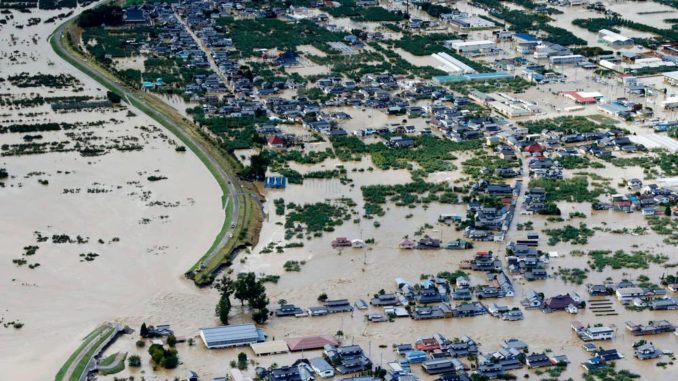
Earlier this month, Typhoon Hagibis swept across the Kanto region of Honshu, leading to deadly floods and landslides across the area.
The Asahi Shimbun reported that a temporary repository where some 2,667 bags of highly radioactive nuclear cleanup waste collected from the Fukushima Daiichi nuclear power plant were stored was completely flooded.
It’s been more than eight years since the nuclear disaster occurred at the Fukushima Daiichi power plant in Japan.
Yet even to this day, the Japanese government is struggling with the issue of nuclear cleanup, waste disposal and storage. To say the least, the threat is still very much there.
Earlier this month, Typhoon Hagibis swept across the Kanto region of Honshu, leading to deadly floods and landslides across the area.
The Asahi Shimbun reported that a temporary repository where some 2,667 bags of highly radioactive nuclear cleanup waste collected from the Fukushima Daiichi nuclear power plant were stored was completely flooded. To make matters worse, many local workers who handled the bags were cutting corners, and didn’t tie them tightly, not to mention that most of the bags, which totaled over 10 million in 2015, were only piled outdoors, unlike other nuclear waste handling plants which generally have facilities to store or cover the nuclear waste inside.
According to Japanese media reports, most of the bags containing the nuclear cleanup waste from the Fukushima Daiichi nuclear plant have not been handled properly. This suggests that the Japanese government and the subcontractors were negligent on the nuclear issue.
It may be a matter of time before the waste poses a huge threat to the environment again.
Given the fact that environmental damage caused by nuclear waste contamination can be both catastrophic and limitless, it is of utmost importance for mankind to learn the lesson of history and not to repeat the mistakes of the 1986 Chernobyl disaster.
This article appeared in the Hong Kong Economic Journal on Oct 18 Translation by Alan Lee
New plan for dealing with Fukushima’s radioactive water
FoE Japan 5th Oct 2019, Fukushima, On October 3, the Citizens’ Committee on Nuclear Energy, whose members include academics, technical experts, and NGOs, made a new proposal to deal with contaminated water from the damaged Fukushima Daiichi Nuclear Plant after the water has been treated.
The proposal, submitted to Ministry of Economy, Trade and Industry (METI), the Ministry of the Environment (MOE), and the Nuclear Regulation Authority, is to convert the treated water to solid form by mixing with mortar, and storing it on land. Citizens’Comittee on Nuclear Energy (CCNE).
340,000 to evacuate Fukushima, landslide fears(- and what about the nuclear waste bags?)
 Why doesn’t the news media explore the question of what is happening to Fukushima’s bags of radioactive nuclear debris?
|
Fukushima evacuation: 340,000 people told to leave over landslide fears after flooding, Mirror UK , By Bradley Jolly, Online journalist, 25 OCT 2019The 143,699 households in Fukushima, Japan, have been evacuated over flooding fears after Typhoon Hagibis lashed across the area. More than 340,000 people were today told to leave their homes over landslide fears due to flooding .
Many low-lying towns and cities east of Tokyo, Japan, were left inundated after Typhoon Hagibis swept across the region . Some 143,699 households in Fukushima, one of the worst affected cities, were evacuated today.
Fukushima Prefecture, the evacuation advisory, fears the danger of landslides remains very high. Alarming photos show muddy water spill from rivers and pedestrians wade through waist-deep floods. Almost 30,000 soldiers and rescue workers have been sent in to save stranded residents across the region. The recent typhoons have so far killed 24 people. More than 9,000 homes, including 6,000 in the Chiba prefecture and 2,500 in the nearby Ibaraki prefecture, were without electricity, according to Tokyo Electric Power Company. Local media reported two dams were expected to release built-up water and urged downstream residents to evacuate as a precaution. A motorway toll gate near Narita International Airport was temporarily closed for safety reasons. Heavy rain also washed out the second round of the PGA Tour’s first tournament held in Japan, the Zozo Championship in Inzai City, where Tiger Woods was tied with Gary Woodland at 64 after Thursday’s opening round. Fukushima is on Honshu, Japan’s largest island. It is about 40 miles away from Japan’s idyllic east coast. Soma, in particular, is a coastal city nearby popular with tourists.https://www.mirror.co.uk/news/world-news/fukushima-evacuation-340000-people-told-20721981 And the Meteorological Agency has predicted up to seven inches of rain over the next 24 hours. |
|
Activists urge Japan to avoid Fukushima in Tokyo Olympics

Hiroshima residents exposed to A-bomb ‘black rain’ developed health problems: lawyers
October 16, 2019 (Mainichi Japan) HIROSHIMA — Nearly all of the 85 plaintiffs in a class action lawsuit who claim to have been exposed to radioactive “black rain” that fell on Hiroshima and surrounding areas in the immediate aftermath of the U.S. atomic bombing of the city in 1945 have been diagnosed with health problems that could be related to radiation, their lawyers said.
The plaintiffs, of whom eight have already died, and their representatives have brought the case to the Hiroshima District Court, demanding the Hiroshima prefectural and municipal governments provide them health care benefits on the basis that they were exposed to the radioactive rain outside the designated area set by the central government. Research by the legal team representing the plaintiffs have revealed that almost all of the plaintiffs have been diagnosed with health issues that “radiation cannot be ruled out” as their causes.
The state has issued certificates for A-bomb survivors who were in the designated area near the epicenter. These certificates enable them to receive free medical care. As the actual health damage caused by the radioactive black rain remains unclear, however, the central government in 1976 named a 19-kilometer by 11-kilometer area northwest from the state-designated radiation exposure area “a special health checkup zone.” Those who were in this zone are subject to free health checkups, and if they develop illnesses involving at least one of 11 kinds of disorders that the government lists as potentially radiation-related, such as cardiovascular diseases, they are given the certificates…….https://mainichi.jp/english/articles/20191016/p2a/00m/0na/006000c
Hurricane Hagibis Spreads Fukushima Radiation (But No, 2,667 Bags of Decontaminated Waste were NOT Washed Away!)
 Nuclear HotSeat BY NHADMIN OCTOBER 16, 2019 Fukushima Hurricane Hagibis Flooding – deluge of water washes full bags of “decontaminated” soil, plants, and other radioactive matter into Furumichi river near the Japanese city of Tamura in Fukushima Prefecture (above). No report yet on how much radioactive material from the decomposing, torn waste bags was washed back into the environment. http://nuclearhotseat.com/2019/10/16/fukushima-hurricane-hagibis-flooding-spreads-radiation-risks/
|
Below are brief extracts – transcript from this important podcast.
Hurricane Hagibis – Alarms went off – City said an unknown number of radioactive waste bags were lost…
Each bag weighs more than one tonne…. some bags not swept away but still damaged
Nancy Faust of SimplyInfo.org. “- not enough information yet… Tepco did have time to prepare for the typhoon.
Tepco phrased it vaguely about the readings of radioactivity – equipment is monitored – readings showed that rain-water was leaking in to various facilities. They measured only the water itself, not radiation. Tepco has not talked about how much water is coming in to the reactor. We worry about how much water is coming in , and then washing things out.”
Question: Do we know how many bags of radioactive material were washed away?
“One report from one city Tamara City – has 2667 bags onsite – did not say how many were washed away -said that 6 were found….. We don’t know yet how many were washed away
We also don’t know the condition of these bags at the storage site. Older bags at higher risk of breaking. They have a lifespan of about 6 years. Also we don’t know what the level of radioactivity is in these bags.
We may get some bits of information about how much radiation was dispersed over the next weeks. Simply Info will be looking for differences in radiation level reports. Tepco not legally obliged to give this information.
From Arnie Gunderson.
Sean McGee reminds that there will be dispersal of radiatioactive material after the area dries out, and from the mountains.
The story that all 2667 bags were swept away is incorrect . That imprecision in the report was in the headline.
The Japanese government and Tepco will try to obscure the facts. It’s incumbent upon us to be accurate. |
|
Distribution of highly radioactive microparticles in Fukushima revealed
Distribution and origin of highly radioactive microparticles in Fukushima revealed, Science Daily
- Date:
- October 16, 2019
- Source:
- University of Helsinki
- Summary:
- New method allows scientists to create a quantitative map of radioactive cesium-rich microparticle distribution in soils collected around the damaged Fukushima Daiichi Nuclear Power Plant Nuclear Power Plant (FDNPP). This could help inform clean-up efforts in Fuksuhima region.
A large quantity of radioactivity was released into the environment during the 2011 Fukushima Daiichi Nuclear Power Plant accident. The released radioactivity included small, poorly soluble, cesium-rich microparticles. The microparticles have a very high radioactivity per unit mass (~1011 Bq/g), but their distribution, number, source, and movement in the environment has remained poorly understood. This lack of information has made it hard to predict the potential impact of the radioactive microparticles.
However, a study just published in the scientific journal Chemosphere, involving scientists from Japan, Finland, France, and the USA, addresses these issues. The team, led by Dr. Satoshi Utsunomiya, Ryohei Ikehara, and Kazuya Morooka (Kyushu University), developed a method in 2018 that allows scientists to quantify the amount of cesium-rich microparticles in soil and sediment samples.
Typhoon Hagibis floods carry away Fukushima nuclear waste bags in their thousands
Ed. note. Since we published the article below, Nuclear Hotseat has corrected the misleading information about 2667 bags of radioactive debris being washed away.
2,667 Radioactive Bags From Fukushima Swept Away By Typhoon Hagibis https://newspunch.com/1667-radioactive-bags-fukushima-swept-away-typhoon-hagibis/, October 14, 2019 Baxter Dmitry As Typhoon Hagibis hammered Japan on Saturday, thousands of bags containing radioactive waste at Fukushima were reportedly carried into a local stream by floodwaters.Experts warn the radioactive bags could have a devastating environmental impact across the entire Pacific region, reports Taiwan News.
According to Asahi Shimbun, a temporary storage facility containing 2,667 bags storing radioactive contaminants from the 2011 Fukushima nuclear disaster were “unexpectedly inundated by floodwaters brought by Typhoon Hagibis.“
Torrential rain flooded the storage facility and released the bags into a waterway 100 meters from the site.
Officials from Tamara City in Fukushima Prefecture said that each bag is approximately one cubic meter in size.
Authorities were only able to recover six of the bags by 9 p.m. on Oct. 12 and it is uncertain how many remain unrecovered while the potential environmental fallout is being assessed.
The radioactive waste swept away by Typhoon Hagibis represents the latest setback for Fukushima officials who have struggled to adequately quarantine the radiation.
StatesmanJournal reports: Seaborne radiation from Japan’s Fukushima nuclear disaster has been detected on the West Coast of the United States.
Cesium-134, the so-called fingerprint of Fukushima, was measured in seawater samples taken from Tillamook Bay and Gold Beach in Oregon, researchers from the Woods Hole Oceanographic Institution are reporting.
Because of its short half-life, cesium-134 can only have come from Fukushima.
Also for the first time, cesium-134 has been detected in a Canadian salmon, the Fukushima InFORM project, led by University of Victoria chemical oceanographer Jay Cullen, is reporting.
In both cases, levels are extremely low, the researchers said, and don’t pose a danger to humans or the environment.
Massive amounts of contaminated water were released from the crippled nuclear plant following a 9.0 magnitude earthquake and tsunami in March 2011. More radiation was released to the air, then fell to the sea.
Climate and nuclear threats join in Japan’s multibillion-dollar typhoon disaster.
|
………….As the core of the storm pulled away from Tokyo Sunday, it dumped heavy rains across Toshigi as well as Fukushima Prefecture. Floodwaters there have raised concerns about radioactive contamination following the 2011 Fukushima nuclear disaster.
Typhoon Hagibis will go down in Japanese history as a multibillion-dollar disaster. The storm’s widespread impacts and high death toll are unusual for Japan, since the country is one of the best-prepared in the world for natural disasters
Climate studies suggest that the Japanese Archipelago could see more frequent and stronger typhoons in the future, due in large part to warming seas as a result of human-caused global warming. There is evidence showing that tropical cyclones in the Northwest Pacific Ocean Basin are reaching their maximum intensities further north than they used to, a trend some scientists attribute in part to climate change. This could send more intense storms into areas that typically see weaker storms, such as Honshu and other parts of northern and northeastern Japan.
One trend that is especially clear is that damage costs from typhoons in Japan are escalating, with three of the top 10 most expensive Japanese typhoons since 1950 occurring in the past 2 years alone. Typhoon Faxai, which affected Tokyo in early September. Typhoon Hagibis is extremely likely to increase this number to four. https://www.theage.com.au/world/asia/why-typhoon-hagibis-packed-such-a-deadly-devastating-punch-in-japan-20191015-p530o7.html
|
|
|
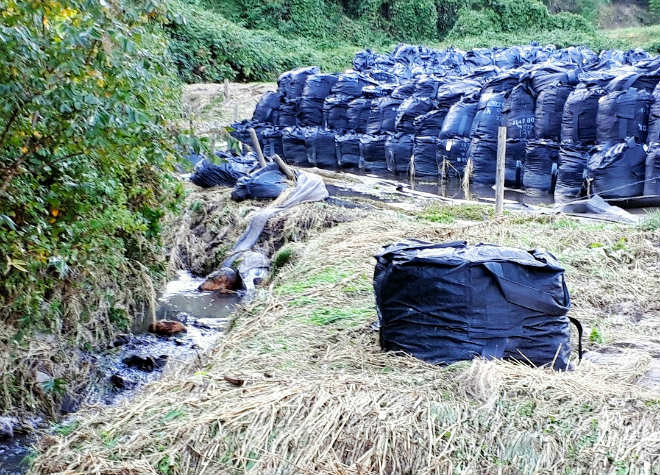
Bags of debris from Fukushima disaster swept away in typhoon
|
Bags of debris from Fukushima disaster swept away in typhoon http://www.asahi.com/ajw/articles/AJ201910140036.htmlBy TARO KOTEGAWA/ Staff Writer, October 14, 2019 Flexible bulk bags containing waste produced from decontamination work around the Fukushima No. 1 nuclear power plant were swept away in flooding during Typhoon No. 19 in Tamura, Fukushima Prefecture. (Hideyuki Miura) TAMURA, Fukushima Prefecture–Bulk bags filled with greenery collected during decontamination efforts after the nuclear disaster at the Fukushima No. 1 nuclear power plant were swept into a river during Typhoon No. 19 on Oct. 12. According to the Tamura city government, the bags were among 2,667 that have been stored temporarily at a site in the Miyakoji-machi district here. The facility was flooded after heavy rains brought by the typhoon, and the water carried an unknown number of the bags to a river about 100 meters away. A city government official received a phone call at around 9:20 p.m. on Oct. 12 from a nearby civil engineering firm, saying six of the bulk bags had been recovered from the river. Each of the bulk bags was 1 cubic meter in size. No sheets had been placed over the bags as a precaution against the rain and wind from the typhoon. A city official said consultations will be held with the Environment Ministry to determine possible effects on the environment. The decontamination effort involved removing debris, such as soil, leaves and plants, containing radioactive substances released after the 2011 triple meltdown at the Fukushima No. 1 plant. |
|
Ex-trade minister Hiroshige Seko involved in nuclear gifts scandal
 Gifts and donations link official in Kepco scandal to second nuclear plant and ex-trade minister Hiroshige Seko, Japan Times, 10 Oct 19, KYODO, JIJI OSAKA – A former senior Kansai Electric Power Co. official said Thursday he received gift coupons in the 1990s from a former deputy mayor of a town hosting one of the company’s nuclear power plants, though he was in charge of a plant outside the town.Eiji Moriyama, the late deputy mayor of Takahama in Fukui Prefecture, later hinted that a particular firm undertake regular inspection work at the utility’s Oi plant in the same prefecture, the former official said. Gifts and donations link official in Kepco scandal to second nuclear plant and ex-trade minister Hiroshige Seko, Japan Times, 10 Oct 19, KYODO, JIJI OSAKA – A former senior Kansai Electric Power Co. official said Thursday he received gift coupons in the 1990s from a former deputy mayor of a town hosting one of the company’s nuclear power plants, though he was in charge of a plant outside the town.Eiji Moriyama, the late deputy mayor of Takahama in Fukui Prefecture, later hinted that a particular firm undertake regular inspection work at the utility’s Oi plant in the same prefecture, the former official said.
The latest revelation suggests Moriyama was trying to involve himself in the operations of a nuclear plant in addition to the one at Takahama. Kepco has already admitted that 20 of its executives and officials received a total of ¥318.45 million worth of gifts from Moriyama……. Kepco Chairman Makoto Yagi and four other executives stepped down Wednesday amid growing criticism over the shady ties between the nuclear industry and local government officials. Also on Wednesday, former trade minister Hiroshige Seko’s office said his fund management body had received political donations from a company head linked to Moriyama. Seko’s political fund management body received ¥6 million from the head of Yanagida Sangyo, a maintenance service company based in Takasago, Hyogo Prefecture, according to the office. Moriyama served as an adviser to Yanagida Sangyo. The body accepted ¥1.5 million, the maximum amount for a personal donation, every year between 2012 and 2015 from the company head, the office said. Seko’s office said that the donations from the company head were handled appropriately as the money was reported in his political funding reports. Seko now serves as secretary-general for the ruling Liberal Democratic Party in the House of Councilors. Speaking to reporters, Seko said the contributions were “strictly” personal donations. “I’ve never received business requests (from the company head),” he said, adding that he will not return the money. He said he did not know Moriyama.https://www.japantimes.co.jp/news/2019/10/10/national/ex-takahama-deputy-mayor-also-gave-gift-coupons-kepco-official-nearby-oi-nuclear-plant/#.XaORu0YzbIU |
|
|
A million tonnes of radioactive water and nowhere to go – Fukushima
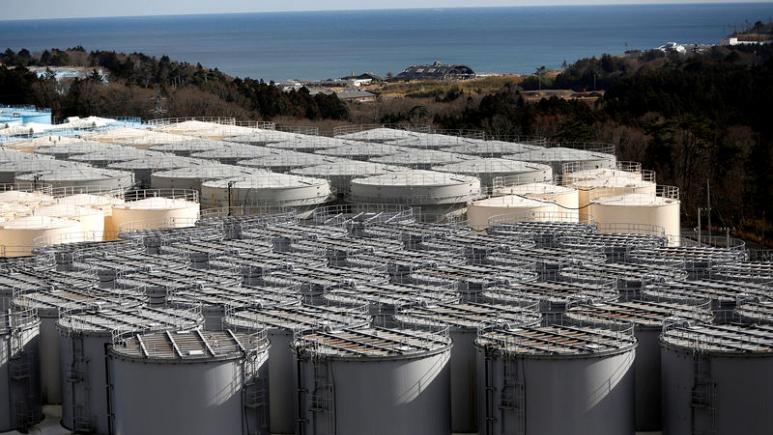
What to do with the enormous amount of water, which grows by around 150 tonnes a day, is a thorny question, with controversy surrounding a long-standing proposal to discharge it into the sea, after extensive decontamination.
The water comes from several different sources: Some is used for cooling at the plant, which suffered a meltdown after it was hit by a tsunami triggered by a massive earthquake in March 2011.
Groundwater that seeps into the plant daily, along with rainwater, add to the problem.
A thousand, towering tanks have now replaced many of the cherry trees that once dotted the plant’s ground.
Each can hold 1,200 tonnes, and most of them are already full.
“We will build more on the site until the end of 2020, and we think all the tanks will be full by around the summer of 2022,” said Junichi Matsumoto, an official with the unit of plant operator TEPCO in charge of dismantling the site.
TEPCO has been struggling with the problem for years, taking various measures to limit the amount of groundwater entering the site.
There is also an extensive pumping and filtration system, that each day brings up tonnes of newly contaminated water and filters out as many of the radioactive elements as possible.
HIGHLY RADIOACTIVE
The hangar where the decontamination system runs is designated “Zone Y” – a danger zone requiring special protections.
All those entering must wear elaborate protection: a full body suit, three layers of socks, three layers of gloves, a double cap topped by a helmet, a vest with a pocket carrying a dosimeter, a full-face respirator mask and special shoes.
Most of the outfit has to burned after use.
“The machinery filters contain radionuclides, so you have to be very protected here, just like with the buildings where the reactors are,” explained TEPCO risk communicator Katsutoshi Oyama.
TEPCO has been filtering newly contaminated water for years, but much of it needs to go through the process again because early versions of the filtration process did not fully remove some dangerous radioactive elements, including strontium 90.
The current process is more effective, removing or reducing around 60 radionuclides to levels accepted by the International Atomic Energy Agency (IAEA) for water being discharged.
But there is one that remains, which cannot be removed with the current technology: Tritium.
Tritium is naturally present in the environment, and has also been discharged in its artificial form into the environment by the nuclear industry around the world.
There is little evidence that it causes harm to humans except in very high concentrations and the IAEA argues that properly filtered Fukushima water could be diluted with seawater and then safely released into the ocean without causing environmental problems.
“ABSOLUTELY AGAINST IT”
But those assurances are of little comfort to many in the region, particularly Fukushima’s fishing industry which, like local farmers, has suffered from the outside perception that food from the region is unsafe.
Kyoichi Kamiyama, director of the radioactivity research department at the regional government’s Fisheries and Marine Science Research Centre, points out that local fishermen are still struggling eight years after the disaster.
“Discharging into the ocean? I’m absolutely against it,” he told AFP.
At the national government level, the view is more sanguine.
“We want to study how to minimise the damage (from a potential discharge) to the region’s reputation and Fukushima products,” an Industry Ministry official said.
The government is sensitive to fears that people inside Japan and further afield will view any discharge as sending radioactive waste into the sea.
No decisions are likely in the near-term, with the country sensitive to the international spotlight that will fall on Japan as it hosts the Olympic Games next year.
Environmentalists are also resolutely opposed to any discharge into the sea, and Greenpeace argues that TEPCO cannot trusted to properly decontaminate the water.
The solution, said Greenpeace senior nuclear specialist Shaun Burnie, “ultimately can only be long-term storage and processing.”
Appeal against acquittal of Tepco executives over Fukushima nuclear disaster
Plaintiffs have appealed a ruling handed down by the Tokyo District Court in mid-September that found three former Tokyo Electric Power Co. executives not guilty of professional negligence. A class action lawsuit against the executives claimed they had failed to apply the proper safety measures to prevent the 2011 disaster at the Fukushima No. 1 nuclear power plant, despite being aware of the devastating effect tsunami would have.
Ruiko Muto, the 66-year-old leader of the class action lawsuit against former Tepco executives, has tirelessly conducted talks around the country since the nuclear disaster in 2011, which saw three of the six core reactors of the Fukushima No. 1 power plant go into meltdown after massive tsunami struck the facility.
“Grassroots efforts are what pushes forward the social change we need to see,” she said, adding, “awareness spreads only when each individual starts to think about the issue at hand.”
Muto has campaigned for the end of nuclear power for over 30 years. Seeing the devastating effects of the 1986 Chernobyl nuclear accident in the former Soviet Union catapulted her into the anti-nuclear movement…..
The disaster upended daily life as local residents knew it and tore apart the social fabric of societies and communities around the area. Eight and a half years on, the victims are still grappling with the loss of their homes, and are turning to the courts for answers and closure….https://www.japantimes.co.jp/news/2019/10/11/national/tepco-acquittal-fukushima-nuclear-disaster-closure/#.XaDi30YzbIU
A-bomb survivor Toshiki Fujimori urges nuclear haves and have-nots to join hands on abolition
Fujimori, 75, assistant secretary-general at the Japan Confederation of A- and H-Bomb Sufferers Organizations (Nihon Hidankyo), urged both sides to join forces to bring about a peaceful world.
Fujimori was exposed to radiation from the atomic bomb dropped on Hiroshima on Aug. 6, 1945, while his mother was carrying him on her back to a hospital. After the bombing, six of his 12 family members died, Fujimori said.
Three days after, the second U.S. atomic bomb devastated Nagasaki.
NEW YORK – Hibakusha Toshiki Fujimori called for nuclear states and non-nuclear states to cooperate on abolishing atomic weapons as a meeting on the subject was held at U.N. headquarters in New York on Thursday.
Fujimori, 75, assistant secretary-general at the Japan Confederation of A- and H-Bomb Sufferers Organizations (Nihon Hidankyo), urged both sides to join forces to bring about a peaceful world.
Fujimori was exposed to radiation from the atomic bomb dropped on Hiroshima on Aug. 6, 1945, while his mother was carrying him on her back to a hospital. After the bombing, six of his 12 family members died, Fujimori said.
Three days after, the second U.S. atomic bomb devastated Nagasaki.
Nuclear industry in Japan – as corrupt as ever?
Hidden gold, ‘murky’ payoffs threaten Japan nuclear revival, Straits Times, TOKYO (BLOOMBERG) 9 Oct 19, – A payoff scandal has struck Japan’s nuclear world, threatening to delay the restart of idled reactors in what’s becoming the industry’s biggest crisis since the Fukushima meltdown of 2011.The issue, which emerged at the end of last month, centres around how an influential municipal official in a town that hosts a nuclear plant spent years doling out large gifts to executives of its operator, one of the country’s biggest power producers.
It’s an example of how big business and small towns work together, sometimes at the expense of corporate governance.
The payments to senior management at Kansai Electric Power Co included hundreds of millions of yen, US currency, vouchers for tailored suits and even gold coins hidden in a box of candy.
To make matters worse, the official in question was close to – and received money from – a company that won construction work from the utility.
The news is a blow to an already deeply unpopular industry as it seeks to resume operations at plants that were shuttered after Fukushima. It’s likely to have an impact beyond Kansai Electric, with the government’s top spokesman, who called the payoffs “murky,” vowing to investigate whether there are similar cases at other companies.
It’s also a headache for Prime Minister Shinzo Abe, who has set his stall as a proponent of nuclear power, a cheaper source of energy than imported fuels such as oil, coal and natural gas. And questions in Parliament about the scandal may delay Mr Abe’s efforts to pass a US trade deal and proceed towards changing the country’s pacifist Constitution.
…….The scandal is the latest exposure of governance issues at Japanese companies, which include the arrest last year of Nissan Motor Co’s chairman for concealing more than US$140 million (S$193 million) in compensation and Kobe Steel’s indictment in 2018 for falsifying quality data.
Kansai Electric chairman Makoto Yagi and president Shigeki Iwane bowed in apology at a three-hour public briefing last week as they detailed how they and 18 other executives received almost 320 million yen (S$4.12 million) in cash and presents from 2006 to 2018 from Mr Eiji Moriyama, the former deputy mayor of Takahama town, where a nuclear power plant is located. Mr Moriyama died at the age of 90 in March……..
The immediate risk for Kansai Electric is that the issue may delay the restart of three of its reactors, including two in the town in question, Takahama. Every month a reactor stays offline saddles the utility with extra fuel costs of 3.6 billion yen ……….
Kansai Electric’s investigation will leave no stone unturned to determine the cause and events surrounding the payments, the company said in an e-mailed response. The utility will also make efforts to ensure that this type of incident doesn’t happen again, it said.
In a sense, the goings-on at Kansai Electric suggest things haven’t changed in the nuclear industry. They mirror what independent investigators said in a 2012 report led to the scale of the Fukushima meltdown: collusion between government officials and a power company.
“This is the nuclear village at its worst,” Temple University’s Mr Kingston said, referring to the nexus of companies, politicians, bureaucrats and others that promote atomic power. “The cosy and collusive ties are a hotbed of corruption and raise questions about other plants.” https://www.straitstimes.com/asia/east-asia/hidden-gold-murky-payoffs-threaten-japan-nuclear-revival
1 This Month
Chernobyl: The Lost Tapes – A good documentary on Chernobyl on SBS available On Demand for the next 3 weeks– https://www.sbs.com.au/ondemand/tv-program/chernobyl-the-lost-tapes/2352741955560

of the week–London Campaign for Nuclear Disarmament

Tell the Ukrainian Government to Drop Prosecution of Peace Activist Yurii Sheliazhenko
To see nuclear-related stories in greater depth and intensity – go to https://nuclearinformation.wordpress.com
-
Archives
- April 2026 (139)
- March 2026 (251)
- February 2026 (268)
- January 2026 (308)
- December 2025 (358)
- November 2025 (359)
- October 2025 (376)
- September 2025 (257)
- August 2025 (319)
- July 2025 (230)
- June 2025 (348)
- May 2025 (261)
-
Categories
- 1
- 1 NUCLEAR ISSUES
- business and costs
- climate change
- culture and arts
- ENERGY
- environment
- health
- history
- indigenous issues
- Legal
- marketing of nuclear
- media
- opposition to nuclear
- PERSONAL STORIES
- politics
- politics international
- Religion and ethics
- safety
- secrets,lies and civil liberties
- spinbuster
- technology
- Uranium
- wastes
- weapons and war
- Women
- 2 WORLD
- ACTION
- AFRICA
- Atrocities
- AUSTRALIA
- Christina's notes
- Christina's themes
- culture and arts
- Events
- Fuk 2022
- Fuk 2023
- Fukushima 2017
- Fukushima 2018
- fukushima 2019
- Fukushima 2020
- Fukushima 2021
- general
- global warming
- Humour (God we need it)
- Nuclear
- RARE EARTHS
- Reference
- resources – print
- Resources -audiovicual
- Weekly Newsletter
- World
- World Nuclear
- YouTube
-
RSS
Entries RSS
Comments RSS
 nuclear-news