Fukushima nuclear debris removal to be delayed due to pandemic
|
Fukushima nuclear debris removal to be delayed due to pandemic, https://www.japantimes.co.jp/news/2020/12/23/national/fukushima-nuclear-debris-delay/ The operator of the Fukushima No. 1 nuclear power plant, which suffered core meltdowns in 2011, has decided to delay the removal of nuclear debris by about one year from 2021 due to the coronavirus pandemic, sources said Wednesday.The process of removing the melted fuel, the most difficult part of cleaning up the facility, was to begin at the No. 2 reactor in 2021, but the virus spread has stalled tests in the U.K. of a robot arm that is to be used for the removal, the sources said.
Of the Nos. 1 to 3 reactors that experienced meltdowns following a massive earthquake and tsunami, the removal procedure was to start at the No. 2 unit because the operator, Tokyo Electric Power Company Holdings Inc., had the best grasp of its internal condition, they said. Tepco had planned to insert a robot arm into the unit’s containment vessel, from which it would initially extract around 1 gram of the debris at a time, then gradually expand the amount as it works toward removing several kilograms a day. The company was originally scheduled to verify in August the viability of the robot arm in the U.K. and transfer the equipment to Japan in February 2021 so that workers could start training with it. However, the spread of COVID-19 in the U.K. has caused delays, as precautionary measures were taken to limit the number of workers at factories, according to the sources. Tepco is considering doing part of the testing in Japan. The removal process is expected to take several years for the No. 2 unit, which according to one estimate contains 237 tons of debris. Together, the three units are estimated to house around 880 tons of debris. The government and Tepco have said they expect the plant’s decommissioning to be completed between 2041 and 2051. |
|
75% of the Japanese public want Japan to join the Treaty on the Prohibition of Nuclear Weapons
 Japanese Public Opinion, Political Persuasion, and the Treaty on the Prohibition of Nuclear Weapons, Taylor Francis Online, Jonathon Baronb,Rebecca Davis Gibbons &Stephen Herzog– 21 Dec 20, Japanese Public Opinion, Political Persuasion, and the Treaty on the Prohibition of Nuclear Weapons, Taylor Francis Online, Jonathon Baronb,Rebecca Davis Gibbons &Stephen Herzog– 21 Dec 20, ABSTRACT
The Treaty on the Prohibition of Nuclear Weapons (TPNW) poses a challenge to decades of Japanese nuclear policy. While Japan has relied on the US nuclear umbrella since the aftermath of World War II, numerous pro-disarmament groups – including the Hibakusha – are calling for Tokyo to join the Treaty. We contribute to these discussions with commentary on a new national survey we conducted in Japan (N = 1,333). Our results indicate that baseline support for the Prime Minister signing and the Diet ratifying the TPNW stands at approximately 75% of the Japanese public. Only 17.7% of the population is opposed, and 7.3% is undecided. Moreover, this support is cross-cutting, with a wide majority of every demographic group in the country favoring nuclear disarmament. Most strikingly, an embedded survey experiment demonstrates that the Japanese government cannot shift public opinion to oppose the Ban through the use of policy arguments or social pressure. Such broad support for the TPNW indicates that the Japanese government will not be able to hide from the Treaty and must take action to restore its credibility as a leader on nuclear disarmament………… https://www.tandfonline.com/doi/full/10.1080/25751654.2020.1834961?src=& |
|
Major Japan life insurers shun investing in nuclear weapons-linked firms
 Major Japan life insurers shun investing in nuclear weapons-linked firms, https://www.japantimes.co.jp/news/2020/12/14/national/major-japan-life-insurers-investing-nuclear-weapons-linked-firms/ 14 Dec 20, Four major Japanese life insurers do not invest in or extend loans to producers of nuclear weapons or companies related to them, Kyodo News learned Saturday, as part of their efforts toward socially responsible investing.The revelation comes as various lenders in Japan, Europe and the United States have refrained from investing in companies involved in the nuclear weapons industry.It also precedes the entry into force in January of a United Nations treaty that will ban such weapons. Major Japan life insurers shun investing in nuclear weapons-linked firms, https://www.japantimes.co.jp/news/2020/12/14/national/major-japan-life-insurers-investing-nuclear-weapons-linked-firms/ 14 Dec 20, Four major Japanese life insurers do not invest in or extend loans to producers of nuclear weapons or companies related to them, Kyodo News learned Saturday, as part of their efforts toward socially responsible investing.The revelation comes as various lenders in Japan, Europe and the United States have refrained from investing in companies involved in the nuclear weapons industry.It also precedes the entry into force in January of a United Nations treaty that will ban such weapons.
The four life insurers which managed a combined ¥151 trillion in assets in fiscal 2019 — Nippon Life Insurance Co., Dai-ichi Life Insurance Co., Meiji Yasuda Life Insurance Co. and Fukoku Mutual Life Insurance Co. — did not disclose lists of targeted companies. The restraint shown by the life insurers reflects a growing trend toward valuing environmental, social and governance (ESG) factors in making investment decisions. It is believed that such investing strategies will give a boost to the advancement of green technologies while cutting funding for developing nuclear weapons. Three of the insurers, with Nippon Life being an exception, say they do not invest in companies involved in the maintenance of nuclear warheads or manufacturing of ballistic missiles, in addition to those making nuclear weapons. According to PAX, an international nongovernmental organization for peace, U.S. Lockheed Martin Corp., which develops the long-range Minuteman intercontinental ballistic missile, is among such companies. More than 300 lenders including major Japanese banks invested a total of $748 billion in companies involved in the nuclear weapons industry between January 2017 and January 2019, according to the NGO. In April, Dai-ichi Life published a basic policy that excludes weapons producers from its portfolio. The company told Kyodo News that companies linked to nuclear weapons raise concerns from the viewpoint of ESG. Meiji Yasuda said it does not invest in or extend loans to companies that are found to have links to nuclear and other inhumane weapons based on undisclosed internal rules. Categorizing companies related to nuclear weapons as “socially problematic,” Fukoku has excluded them from its investible universe in line with its own guidelines adopted in February 2019. Nippon Life, meanwhile, said it does not invest in shares or bonds of nuclear weapons producers. The Treaty on the Prohibition of Nuclear Weapons will become the first international pact outlawing the development, testing, possession and use of nuclear weapons, though the world’s major nuclear powers have not joined it. Japan, the only country to have suffered a nuclear attack, has not taken part, to the disappointment of many atomic bomb survivors in Hiroshima and Nagasaki, as it is protected under the U.S. nuclear umbrella. Sumitomo Life Insurance Co., which does not have guidelines on investing in nuclear weapons companies, said it will consider exercising restraint as investing in such companies would hurt its reputation once the nuclear ban treaty takes effect. |
|
2 million yen ($19,300) incentive for families to move to near crippled Fukushima No. 1 nuclear power plant
|
Under the program that will start in fiscal 2021, the Reconstruction Agency will provide an additional amount of up to 4 million yen to those who start new businesses in 12 cities, towns and villages where residents had been ordered to evacuate from after the triple meltdown at the plant. Eleven of those municipalities had come under the central government’s evacuation order, while in the remaining municipality, Hironomachi, residents were ordered to leave by the town government. Katsuei Hirasawa, the reconstruction minister, said on Dec. 17 that his agency is focused on repopulating those areas because only around 20 percent of residents have returned there even after the evacuation orders were lifted. One requirement is that the families must live in the locations for at least five years. The agency will provide 1.2 million yen to families that relocate to the 12 areas from other parts of Fukushima Prefecture and 2 million yen to those from other prefectures. The amount is 800,000 yen for single-person households that relocate from other areas of the prefecture and 1.2 million yen for those from outside the prefecture. …….. http://www.asahi.com/ajw/articles/14031389 |
|

Nuclear waste plan spells doom for a Hokkaido fishing community
Hokkaido fishing villages face tough decision over nuclear disposal sites, Japan Times, HOKKAIDO SHIMBUN, Dec 18, 2020
A frosty wind was blowing in from the Sea of Japan at the Suttsu fishing port in Hokkaido in late November. There, catching anglerfish with a grim look on his face was 77-year-old fisherman Kyozo Kimura.
“The haul of fish has been decreasing to the point where we can’t even make ends meet. It has been tough,” said Kimura.
In 1977, Kimura, a native of the town of Matsumae, married into a family whose fishing business had been around for five generations since the Meiji Era (1868-1912). Longline fishing of trout prospered at the time, and he reminisced about the time when he got a new 29-ton ship, funded by his father-in-law, and was filled with hope that he could go out fishing anywhere with it.
But that dream did not last long.
An international regulation took effect later that year restricting fishermen to operating within 200 nautical miles of a nation’s shores.
Despite various efforts including changing to smaller ships aiming to catch Alaskan pink shrimp in coastal waters, hauls continued to drop. To make ends meet, Kimura ventured into scallop farming, learning the ropes from acquaintances.
Though the stable revenue from scallop farming has supported the family for years, the increase in sea temperatures in the past few years and other factors have led to the recurrent deaths of scallops, cutting hauls to a third of their heyday. The impact of coronavirus this year has also kept the price low amid declining demand.
Then, in August, local residents saw shocking headlines that Suttsu was considering applying for preliminary research into being a final disposal site for high-level radioactive waste produced from nuclear power plants.
Hearing the news, Kimura was upset, worrying that harmful rumors about radiation could potentially bring down the price of scallops. Local fishermen were split, and Kimura has heard about families arguing over the topic. Soon, people started avoiding it altogether.
In the 60 years or so since he graduated from high school, Kimura has worked as a fisherman, taking pride in his profession. But he is also aware of the importance of the town’s subsidies. For him to run a steady scallop farming business, any help, including municipal subsidies for fishing materials, makes a difference.
“I can’t go on by myself. If the lives of people won’t improve, we won’t have any more younger generations in the town,” said Kimura.
While showing some understanding of the need for a preliminary survey — for which Suttsu will receive government subsidies — he does not see the need for building a nuclear waste disposal site in the town.
On Nov. 17, the government launched preliminary surveys for the towns and villages of Suttsu and Kamoenai in Hokkaido, where herring fishing used to flourish.
According to the histories of the municipalities, wajin, or Japanese migrants to Hokkaido, made a hamlet and started fishing there in the Meiji Era. The industry became so lucrative at the time that there even remains a “herring palace” in Suttsu, which symbolizes the successful fishing business back then.
Although once a thriving industry, herring fishing began its steep decline around the late Meiji Era, and it was a shadow of its former self by the onset of the Showa Era (1926-1989).
After the end of World War II, fishermen began to seek ways to increase their catch, such as switching to pelagic fishing, but they were soon hit by the 200-nautical-mile fishing regulation. Though they have shifted to catching atka mackerel inshore and scallop farming as alternatives for survival, the hauls have been on the decline.
According to a fishery cooperative in Suttsu, there was about ¥2 billion worth of transactions in fiscal 1978, the oldest figures available on record. But transactions are now about ¥1 billion to ¥1.5 billion annually.
The Furuu fishery co-op also reports that there were 270 members in total in fiscal 2009 when three co-ops, Furuu, Kamoenai and Tomari, were merged together, but the number had shrunk to 126 in fiscal 2019.
Nobushige Miura, a 57 year-old fisherman in Kamoenai village, saw the industry dwindling first hand.
“In the offshore area, there aren’t many fish in the sea and prospects for fish farming are bleak. In the past decade, fishermen have been quitting one after the other saying they cannot hand down the business to their kids,” said Miura.
Miura is neither for nor against the village accepting the government’s preliminary survey. But he knows that the village’s future is bleak.
“If we don’t do anything, the village will disappear in the future,” he said.
Miura has been farming scallops for the past 30 years but recently he has seen the number of dead scallops on the rise, a trend also seen in Suttsu.
Miura’s family business started in the Edo Period (1603 to 1868), and is now in its fifth generation. Despite its long history, though, he realizes that the business will come to a halt in his generation due to the absence of successors. That is why Miura hopes all the more for the village to thrive, even for a short time.
Nihonkai Shokudo, a restaurant that sits along the national highway in Suttsu, serves local seafood throughout spring and summer. Owner Sumio Kawachi, 58, is a fourth-generation fisherman.
After graduating from Suttsu high school, he ran a construction business in Sapporo before becoming a fisherman when he was 37 years old due to an injury at his former workplace.
Amid the difficulties in the fishing business, he has been offering fishing classes to tourists in a bid to survive.
“Combining fishing with tourism is creating new business opportunities,” said Kawachi.
Kawachi’s mother was born into a family of fishermen in Rokkasho, Aomori Prefecture, where a nuclear reprocessing plant is located. His mother used to tell him about the divide among fishermen over the construction of the facility.
Having visited Rokkasho multiple times since his childhood, he has seen the fishing industry decline despite the help of government subsidies.
Reflecting on his experience, his hope is for everyone to think twice about the potential consequences of constructing a nuclear disposal site.
“I am fishing in a sea that I have succeeded from my ancestors. Will we be able to hand down the sea to future generations given the preliminary research for the nuclear disposal site?”
44 year old Mihama nuclear station, with waste disposal problem may be allowed to restart

|
Town assembly gives nod to start 44-year-old nuclear reactor, http://www.asahi.com/ajw/articles/14031578 THE ASAHI SHIMBUN, December 18, 2020 MIHAMA, Fukui Prefecture–The town assembly here gave the green light Dec. 18 to resume operations at a nuclear power plant that has already passed its initial 40-year life span. The No. 3 reactor at the Mihama nuclear plant operated by Kansai Electric Power Co. first went online 44 years ago. The town assembly’s decision came a day after the Federation of Electric Power Companies (FEPC) of Japan submitted a proposal to the economy minister about a new initiative for joint use of an intermediate storage facility for spent nuclear fuel in Mutsu, Aomori Prefecture. Kansai Electric is keen to resume operations at the No. 3 reactor of the Mihama plant in January. The reactor has been offline for about a decade following the 2011 triple meltdown at the Fukushima No. 1 nuclear power plant. Key local officials will also have to sign off on the plan, and no further decisions are anticipated before the year-end. The Takahama town assembly in November also OK’d a resumption of operations at the Takahama plant’s No. 1 and No. 2 reactors. In response to questions from The Asahi Shimbun, Takahama Mayor Yutaka Nose said he would not make a decision before year-end. Mihama Mayor Hideki Toshima also said it would be difficult to reach a decision this month. Moreover, once the mayors give their approval, the Fukui prefectural assembly and Fukui Governor Tatsuji Sugimoto must also give their consent. Only then can operations resume. Sugimoto indicated earlier that he would only give his consent if Kansai Electric submitted a plan for an intermediate storage facility for spent nuclear fuel outside of the prefecture. The FEPC proposal submitted on Dec. 17 would allow Kansai Electric to use the Mutsu facility, but it is still not certain whether the local authorities in Aomori Prefecture will agree to that idea. Joint use of the Mutsu facility would help lower hurdles facing Sugimoto in reaching a decision on the Mihama reactor, according to a source in the Fukui prefectural government. Sugimoto is not expected to announce his decision until next year. In 2016, the Nuclear Regulation Authority gave the nod to operating the Mihama reactor beyond the legally set limit of 40 years after the facility passed rigorous safety screening procedures. The only other reactor older than 40 years to be given such approval besides the No. 1 and No. 2 reactors at the Takahama plant is the No. 2 Tokai plant operated by Japan Atomic Power Co. in Ibaraki Prefecture. The No. 3 reactor at the Mihama plant began operations in December 1976. Five plant workers were killed and six injured during a steam explosion at the reactor in 2004. (This article was written by Hideki Muroya and Tsunetaka Sato.) |
|
Mutsu Mayor Soichiro Miyashita made it clear that spent nuclear fuel facility will not go ahead.
|
Mayor again stands in way of plan for spent nuclear fuel, THE ASAHI SHIMBUN, December 18, 2020, Utilities have revived plans to expand the use of an intermediate storage facility for spent nuclear fuel, but immediately objections were voiced by the same mayor who quashed a similar proposal two years ago.The Federation of Electric Power Companies of Japan (FEPC) on Dec. 17 formally announced that it would push forward with the plan to allow all utilities that operate nuclear power plants to use the intermediate storage facility in Mutsu, Aomori Prefecture.
Kazuhiro Ikebe, head of FEPC, met the same day with economy minister Hiroshi Kajiyama, who oversees the nuclear power industry, and presented the proposal. Kajiyama pledged his cooperation to realize the plan. However, also on Dec. 17, Mutsu Mayor Soichiro Miyashita made clear that he would never allow all utilities to use the facility, which will be operated by Recyclable-Fuel Storage Co. (RFS) starting in fiscal 2021. RFS was jointly established by Tokyo Electric Power Co. and Japan Atomic Power Co. Under the original plan, spent nuclear fuel from only those two companies will be stored at the Mutsu facility in the northern prefecture. But in 2018, Kansai Electric Power Co. indicated that it also wanted to store its spent nuclear fuel at the Mutsu facility. Kansai Electric operates nuclear power plants in Fukui, a central Japan prefecture that faces the Sea of Japan. Fukui prefectural government officials asked the utility to find a storage facility for spent nuclear fuel outside of the prefecture. When word reached Miyashita about the Kansai Electric plan, he immediately opposed, and the utility was forced to retract the proposal. Under the latest FEPC proposal, other utilities besides TEPCO and Japan Atomic Power would be able to use the Mutsu facility as long as they paid storage fees. But the real, near-term beneficiary would still be Kansai Electric……. http://www.asahi.com/ajw/articles/14031110 |
|
Investigation of mass alterations of data on nuclear safety by Japanese company
 Japanese nuclear power firm inspected following mass data alterations https://mainichi.jp/english/articles/20201214/p2a/00m/0na/012000c December 14, 2020 (Mainichi Japan) TOKYO — Japan’s Nuclear Regulation Authority (NRA) launched an on-site inspection at the Japan Atomic Power Co.’s head office in Tokyo on Dec. 14 after it was learned earlier this year that the firm rewrote data related to safety reviews necessary to restart its Tsuruga Power Station Unit 2 in central Japan. Japanese nuclear power firm inspected following mass data alterations https://mainichi.jp/english/articles/20201214/p2a/00m/0na/012000c December 14, 2020 (Mainichi Japan) TOKYO — Japan’s Nuclear Regulation Authority (NRA) launched an on-site inspection at the Japan Atomic Power Co.’s head office in Tokyo on Dec. 14 after it was learned earlier this year that the firm rewrote data related to safety reviews necessary to restart its Tsuruga Power Station Unit 2 in central Japan.
The nuclear watchdog will check related documents and interview Japan Atomic Power employees, based on the nuclear regulation law, through Dec. 15. It is rare for the NRA to make an on-site inspection of a company over issues related to safety reviews. At around 9:30 a.m. on Dec. 14, workers of the Secretariat of the Nuclear Regulation Authority entered the building in the capital’s Taito Ward housing the Japan Atomic Power head office. The NRA apparently plans to also conduct an inspection on the trouble-ridden power station’s No. 2 unit located in Tsuruga, Fukui Prefecture, depending on how the probe at the head office develops. NRA Chairman Toyoshi Fuketa has said, “We hope to clarify the Japan Atomic Power’s vision through the inspection.” Regarding Tsuruga Power Station Unit 2, it has been pointed out that there lies an active fault directly beneath the reactor building, which Japan Atomic Power has argued against, claiming that it’s not an active fault line. If it is determined that an active fault runs beneath the building, the firm will not be able to restart the power station. The NRA had temporarily halted its safety review of the Tsuruga plant’s No. 2 unit after finding 80 data alterations and deletions in documents related to the power plant’s geological condition. (Japanese original by Hisashi Tsukamoto, Science and Environment News Department) |
|
Japanese govt trying to entice people by money grants, to come and live in Fukushima
 Japan government planning grants for those willing to reside in Fukushima Prefecture, https://the-japan-news.com/news/article/0006996690, December 13, 2020 Japan government planning grants for those willing to reside in Fukushima Prefecture, https://the-japan-news.com/news/article/0006996690, December 13, 2020
The Yomiuri ShimbunGovernment grants of up to ¥2 million will be provided next fiscal year to people who move to one of 12 municipalities surrounding the Fukushima No. 1 nuclear plant, where meltdowns occurred following the 2011 Great East Japan Earthquake, according to sources. The 12 municipalities — all in Fukushima Prefecture — are Futaba, Okuma, Tomioka, Namie, Iitate, Kawamata, Minami-Soma, Katsurao, Naraha, Kawauchi, Tamura and Hirono. Next March will mark 10 years since the nuclear accident at the plant operated by Tokyo Electric Power Company Holdings, Inc., but the population of these municipalities still hovers around 20% of the number in the basic resident register. Evacuation orders were issued at the time of the accident but have since been gradually lifted. The government aims to promote the reconstruction and revitalization of the area by not only encouraging evacuees to return, but also by getting people from outside the area to move in. The grants will be offered, likely next summer or later, to people who did not live in the 12 municipalities at the time of the 2011 accident. A family moving in from outside Fukushima Prefecture will receive ¥2 million, and a family from within the prefecture will be offered ¥1.2 million. For a single-person household, the grant will be ¥1.2 million for a newcomer to the prefecture and ¥800,000 for someone from Fukushima Prefecture. Recipients would be required to live in the region for at least five years and to have a job. People who live in the 12 municipalities and telework for firms outside the region will also be eligible for a grant. Those who start businesses within five years of moving to one of the municipalities will also receive three-quarters of the necessary expenses, with a maximum limit set at ¥4 million. The grants will be paid from resources including subsidies to accelerate the revitalization of Fukushima Prefecture, provided to the Fukushima prefectural government and the 12 local governments by the Reconstruction Agency. |
|
For safety the 40 year limit on nuclear reactor’s life should be kept

 Limiting life of nuclear plants to 40 years should be continued, http://www.asahi.com/ajw/articles/13964250?fbclid=IwAR1_ti6_xxCiBWrXIU94MSDTh6c6mKSygmlV4FVvNORcpuAJU4Cn_QCn708 November 26, 2020 Following the 2011 Fukushima nuclear disaster, new nuclear safety regulations were created to impose a 40-year limit on the operational lifespan of nuclear reactors in Japan.The rule was designed to ensure decommissioning of aging reactors that are more vulnerable to accidents and make Japanese society less dependent on nuclear power.
But a provision that allows one extension of the legal lifespan by up to 20 years in exceptional cases, introduced in response to concerns about a power shortage, has been widely exploited to gain permission to extend operations years or even decades beyond the 40-year cap.
This troubling trend should not be ignored. The original principle should be maintained.
The municipal assembly of Takahama, Fukui Prefecture, on Nov. 25 approved the restarts of the No. 1 and No. 2 reactors at Kansai Electric Power Co.’s (KEPCO) Takahama nuclear plant, which first went into service in the 1970s.
The move came four years after the Nuclear Regulation Authority (NRA), a government agency to ensure the safety of nuclear power plants, gave the green light to plans to extend operations of these aging reactors, which went offline in 2011 following the triple meltdown at the Fukushima No. 1 nuclear power plant.
While the consent of the Takahama mayor, the Fukui prefectural assembly and the Fukui governor is still needed to bring the reactors back on stream, the municipal assembly’s approval is a first step toward operating a reactor that is more than 40 years old for the first time in Japan.
Behind the town assembly’s decision is the fact that the nuclear power plant has been supporting the local economy. But the move has raised the question of whether the assembly has given sufficient consideration to issues concerning the safety of local residents.
In a meeting to explain the plans to residents in Takahama held at the end of October, some attendees voiced concerns about the risk of multiple natural disasters disrupting traffic on the prefectural road designated to be used as part of the evacuation route in the event of serious accidents at the plant. There remain serious safety concerns as to the planned operations of the reactors.
Even more questionable is the government’s stance toward the issue.
Prime Minister Yoshihide Suga’s administration has vowed to reduce Japan’s reliance on nuclear power generation as much as possible by making all-out efforts to promote energy conservation and use of renewable energy sources.
But the Suga administration’s stance toward nuclear power generation is showing no notable difference from the policy of the previous government led by his predecessor, former Prime Minister Shinzo Abe.
The Abe administration left decisions concerning reactor restarts to the NRA and the local governments involved and didn’t hesitate to bring reactors back online once the procedures for the step were completed.
In a sign that casts doubt on the administration’s commitment to reducing nuclear power generation, a senior official at the Agency for Natural Resources and Energy, an industry ministry body, has repeatedly visited the local governments of the host communities in Takahama to seek their consent for the plans.
In Fukui Prefecture, another aging reactor, the No. 3 unit of KEPCO’s Mihama nuclear power plant in Mihama, located along the coast of the Wakasa Bay, has been cleared by the NRA for operation beyond the 40-year legal lifespan. The Mihama town assembly is expected to decide on the restart in December.
KEPCO, which has been operating 11 reactors in Fukui Prefecture, including those at its Oi nuclear plant in the town of Oi, has decided to decommission four reactors at the Mihama and Oi plants. But it will still have seven reactors in service in the prefecture if the lives of three reactors are extended beyond the 40-year limit.
This means the local communities will continue being threatened by the safety risks posed by a concentration of reactors, which were underscored in a graphic way by the Fukushima calamity.
The government should demonstrate a clear commitment to scrapping aging reactors while supporting private-sector investment in renewable energy sources. It also should work with the local administrations in areas that have been dependent on nuclear plants for their economic well-being to carve out futures not dependent on atomic energy and provide policy support to their efforts to achieve the visions.
It is time for KEPCO to change its business strategy.
The utility is still halfway to its goal of regaining the public confidence that has been deeply undermined by a series of scandals including one in which company executives received gifts from a former top official at the Takahama municipal government.
The utility has promised the prefectural government to find a location outside the prefecture for an interim storage facility for spent nuclear fuel at its nuclear plants in Fukui Prefecture. But the outlook of this mission remains murky.
A responsible utility would pull the plug on the operations of aging reactors whose viability is in doubt economically as well as technologically and reinvent its business strategy accordingly.
Nuclear power industry stunned by Osaka District Court canceling central government approval for reactor restarts.
Japan Times 9th Dec 2020, A ruling Friday by the Osaka District Court canceling central government
approval for the operation of two reactors at the Oi nuclear plant run by
Kansai Electric Power Co. (Kepco), saying its calculations for standards
involving earthquake safety were flawed, has stunned the nuclear power
industry. The decision, which is the first of its kind, is likely to be
appealed and could still be overturned. But the result has resurrected
fundamental questions about nuclear power safety and the future role of the
energy source.
https://www.japantimes.co.jp/news/2020/12/09/national/oi-restart-ruling/
For the first time ever, a Japanese court rules against a government approval on nuclear safety
 Japan court nixes approval of post-Fukushima nuclear safety steps, KYODO NEWS – Dec 4, 2020 ,
A Japanese court on Friday, for the first time, revoked the government’s approval of operating a nuclear plant under new safety regulations developed in the wake of the 2011 Fukushima nuclear disaster.
The Osaka District Court ruled in favor of about 130 plaintiffs who claimed that the Nos. 3 and 4 reactors of Kansai Electric Power Co.’s Oi nuclear plant in Fukui Prefecture are vulnerable to a major earthquake.
A Japanese court on Friday, for the first time, revoked the government’s approval of operating a nuclear plant under new safety regulations developed in the wake of the 2011 Fukushima nuclear disaster.
The Osaka District Court ruled in favor of about 130 plaintiffs who claimed that the Nos. 3 and 4 reactors of Kansai Electric Power Co.’s Oi nuclear plant in Fukui Prefecture are vulnerable to a major earthquake.
In the ruling, Presiding Judge Hajime Morikagi said the Nuclear Regulation Authority’s safety screening “has errors and flaws that should not be overlooked” as its estimates needed to factor in a potentially much larger earthquake around the plant…..
It is the first time a Japanese court has withdrawn government approval granted to a power company to operate a nuclear plant under the safety standards set in 2013 following the meltdowns at the Fukushima Daiichi power plant triggered by a major earthquake and ensuing tsunami.
While the two reactors in Oi in the central Japan prefecture have been idle due to regular inspections since earlier this year, the ruling will not take effect if the NRA appeals the decision.
But the ruling may have an impact on the operations of not only the nuclear plant on the Sea of Japan coast but also other reactors in the country that went back online under the new rules…….
The utility, meanwhile, has decided to decommission the aging Nos. 1 and 2 reactors at the Oi plant. https://english.kyodonews.net/news/2020/12/8c717cf8568d-urgent-japan-court-nullifies-approval-of-oi-nuclear-reactor-safety-steps.html
Court ruling doubts the credibility of nuclear safetysassessments by Japan’s Nuclear Regulation Authority
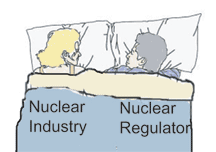 Ruling calls for review of NRA’s nuclear reactor safety screening, http://www.asahi.com/ajw/articles/13991979, A court ruling cast serious doubt over the credibility of safety assessments by the Nuclear Regulation Authority with regard to the operations of nuclear reactors.
The ruling called into question the safety of reactors restarted with NRA approval after being shut down in the aftermath of the 2011 Fukushima nuclear disaster.
It also underscored an urgent need for a sweeping review of the nuclear regulation system as a whole.
The Osaka District Court on Dec. 3 struck down the NRA’s endorsement of safety measures for the No. 3 and No. 4 reactors at the Oi nuclear power plant in Fukui Prefecture.
It invalidated the green light the nuclear safety watchdog gave in 2017 to Kansai Electric Power Co.’s plan to restart the two reactors.
The court said the NRA’s safety assessment was not fully in accordance with new tougher nuclear safety standards introduced after the catastrophic accident at the Fukushima No. 1 nuclear plant and screening guidelines based on those standards.
The ruling labeled the NRA’s decision as “unreasonable,” asserting there were “errors and deficiencies that cannot be overlooked” in the process of examining and approving anti-earthquake measures the electric utility adopted for the reactors.
In designing measures to protect a reactor against major earthquakes, the operator estimates the maximum possible ground motion generated by an earthquake around the reactor, called “reference ground motion.” It develops steps to ensure the safety of the reactor based on this estimate and requests for NRA approval for restarting the reactor.
The NRA examines the plan and determines whether the estimate is appropriate and the proposed safety measures are sufficient. It grants approval and authorization if it decides the plan meets the new safety standards.
Kansai Electric Power determined the reference ground motion by calculating the magnitude of the maximum credible earthquake based on its own assumptions concerning the length and width of faults around the reactors.
But residents of Fukui and six other prefectures filed a lawsuit to question the utility’s estimate of the reference ground motion. They argued that the utility’s estimate only represents an “average” for the spectrum of possible quakes, meaning that the safety measures are not based on the maximum strength of a possible earthquake in the area.
They cited a newly included provision in the NRA’s screening guidelines that says consideration should be given for the “variability” that arises due to the calculation methods used.
The plaintiffs claimed the NRA’s approval of the anti-quake measures was illegal because it was based on the utility’s questionable reference ground motion figure.
The government countered this argument by saying the utility’s calculation has a sufficient margin of error that makes it unnecessary to consider variability. But the court sided with the plaintiffs.
The ruling puts weight on the reasons for the NRA’s own decision to introduce the “variability” provision into the guidelines and demands that the screening process strictly follow strictly the established procedures.
The NRA should respond to the ruling by first reviewing the process of the safety screening of the two reactors at the Oi plant. It is possible that the screening of other reactors was similarly flawed. The ruling is likely to arouse anxiety among residents living in the vicinity of reactors that have been brought back online. The NRA should make a sincere and convincing response to the court decision.
The No. 3 and No. 4 reactors at the Oi plant are currently offline for regular maintenance. Debate is unnecessary in stating that the utility must not rush to restart the reactors.
Even without the triple meltdown at the Fukushima plant, it is amply obvious that this nation could be hit by unexpectedly severe natural disasters, such as earthquakes, tsunami and volcanic eruptions, at any time.
That makes it all the more important to establish nuclear power standards based on the principle of erring on the side of safety and ensure that safety screening and regulation are strictly based on the standards.
The government, which seems to be bent on restarting reactors, should take this imperative to heart.
Hokkaido’s ski areas could lose popularity, due to plans to house nuclear wastes
|
The towns of Suttsu and Kamoenai have both applied for preliminary feasibility surveys to be considered for a site that will store waste from the nation’s nuclear power plants. The cash-starved towns struggling with declining populations are poised to each pocket 2 billion yen ($19 million) promised by the government for taking part in the studies alone. Although whole selection process takes 20 years, the applications have touched off an outpouring of opposition from locals as well as from across the country, including from Hokkaido Gov. Naomichi Suzuki, who assailed the central government for “slapping the face with money.” The concern is especially palpable in the resort towns of Niseko and Kutchan, which are part of the Niseko resort area. “To outsiders, it might as well be Niseko that is undergoing a survey,” said Shinichi Maeda, an owner of a restaurant in Kutchan. “It’s possible that foreign investors who had previously valued Niseko will pull out one by one.” Suttsu is located about 40 km west of the town of Niseko, which will see no economic benefit from the study but will surely be hit by the anxiety the plan will generate………… the possibility of hosting a nuclear waste site, however remote, is enough to rail up opposition. The owner of a tourism business in Kutchan believes in local production and consumption, and uses seafood from Shiribeshi. But that may have to change. “Foreign customers are sensitive,” said the owner. “If the nuclear waste issue gains prominence, it’ll become hard to use” locally made seafood. In Japan, there is still no final repository for nuclear waste — it is stored in interim locations. After the 2011 Fukushima nuclear disaster raised public awareness, countries across the globe have struggled to find permanent places to store the waste. When Kamoenai announced it would apply for an initial survey in October, The Associated Press reported the story with the headline “2 remote Japan towns seek to host nuclear waste storage site.” The article was carried by news outlets all over the world. Last month, five citizens groups presented the Hokkaido governor with a petition signed by 450,000 people opposing the feasibility survey for the two towns. The signatures were collected nationwide. The preliminary studies underway in the two towns are becoming an issue that could undermine tourism throughout Hokkaido……….. |
|

Court retracts NRA approval of safety measures at nuclear plan
Court retracts NRA approval of safety measures at nuclear plant, Asahi Shimbun, By TAKASHI ENDO/ Staff Writer, December 4, 2020 OSAKA--A district court struck down central government approval of safety measures at the Oi nuclear power plant in Fukui Prefecture, effectively rejecting tougher safety screening guidelines used by the Nuclear Regulation Authority.
The Osaka District Court on Dec. 4 sided with plaintiffs who argued that the safety guidelines underestimated the maximum possible movement generated by an earthquake around the No. 3 and No. 4 reactors at the plant, operated by Kansai Electric Power Co.
However, the lawsuit filed by about 130 residents who live in Fukui and six neighboring prefectures did not seek a temporary injunction, so the two reactors can continue operating until the ruling is finalized.
The tougher safety standards were adopted after the Great East Japan Earthquake and tsunami caused the triple meltdown at the Fukushima No. 1 nuclear power plant in 2011.
The lawsuit revolved around whether the basic earthquake ground motion figure used by Kansai Electric in its safety measures was appropriate.
Electric power companies that operate nuclear plants set their own basic earthquake ground motion figures. The NRA uses its screening guidelines to determine if the calculated figures are appropriate……..
The plaintiffs argued that this calculation method only produces an “average” for the quake scale, meaning that the safety measures are not based on the maximum strength of a possible earthquake in the area. …….
The court, however, accepted the plaintiffs’ case and ordered a retraction of the approval of the Oi plant’s safety measures.
The ruling was the fourth victory for resident plaintiffs seeking a temporary injunction or retraction of government approval. http://www.asahi.com/ajw/articles/13989665
1 This Month



26 September – International Day for the Total Elimination of Nuclear Weapons


PLEASE OPPOSE HR 8255 AND S.3639 – bills would accelerate satellite deployment, with no environmental review or safeguards – https://ncstd5li.quorum.us/campaign/169331/
To see nuclear-related stories in greater depth and intensity – go to https://nuclearinformation.wordpress.com
-
Archives
- September 2026 (245)
- August 2026 (330)
- July 2026 (355)
- June 2026 (287)
- May 2026 (306)
- April 2026 (356)
- March 2026 (251)
- February 2026 (267)
- January 2026 (308)
- December 2025 (358)
- November 2025 (359)
- October 2025 (375)
-
Categories
- 1
- 1 NUCLEAR ISSUES
- business and costs
- climate change
- culture and arts
- ENERGY
- environment
- health
- history
- indigenous issues
- Legal
- marketing of nuclear
- media
- opposition to nuclear
- PERSONAL STORIES
- politics
- politics international
- Religion and ethics
- safety
- secrets,lies and civil liberties
- spinbuster
- technology
- Uranium
- wastes
- weapons and war
- Women
- 2 WORLD
- ACTION
- AFRICA
- Atrocities
- AUSTRALIA
- Christina's notes
- Christina's themes
- culture and arts
- Events
- Fuk 2022
- Fuk 2023
- Fukushima 2017
- Fukushima 2018
- fukushima 2019
- Fukushima 2020
- Fukushima 2021
- general
- global warming
- Humour (God we need it)
- Nuclear
- RARE EARTHS
- Reference
- resources – print
- Resources -audiovicual
- Weekly Newsletter
- World
- World Nuclear
- YouTube
-
RSS
Entries RSS
Comments RSS
 nuclear-news